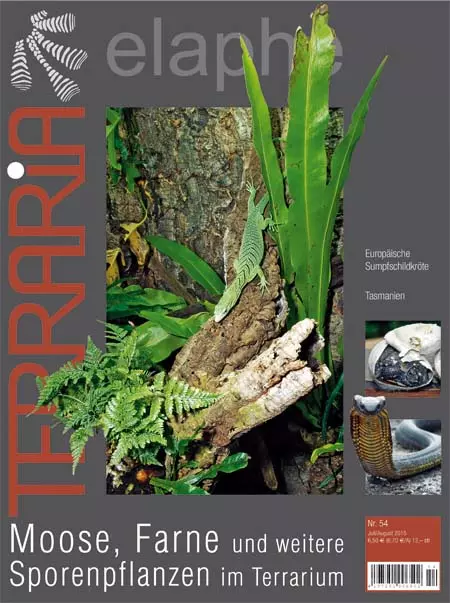
Terraria 54 - Mosses, ferns and further spore plants in the terrarium

Article no: terraria54

CHF 12.00

Stock: 0

Ready for dispatch in 1-3 days, delivery time 7 working days

Delivery between Tuesday, 28 April and Wednesday, 29 April
Zahlungsarten
Product information "Terraria 54 - Mosses, ferns and further spore plants in the terrarium"

Terraria 54 - Mosses, ferns and other spore plants in the terrarium

European pond turtle
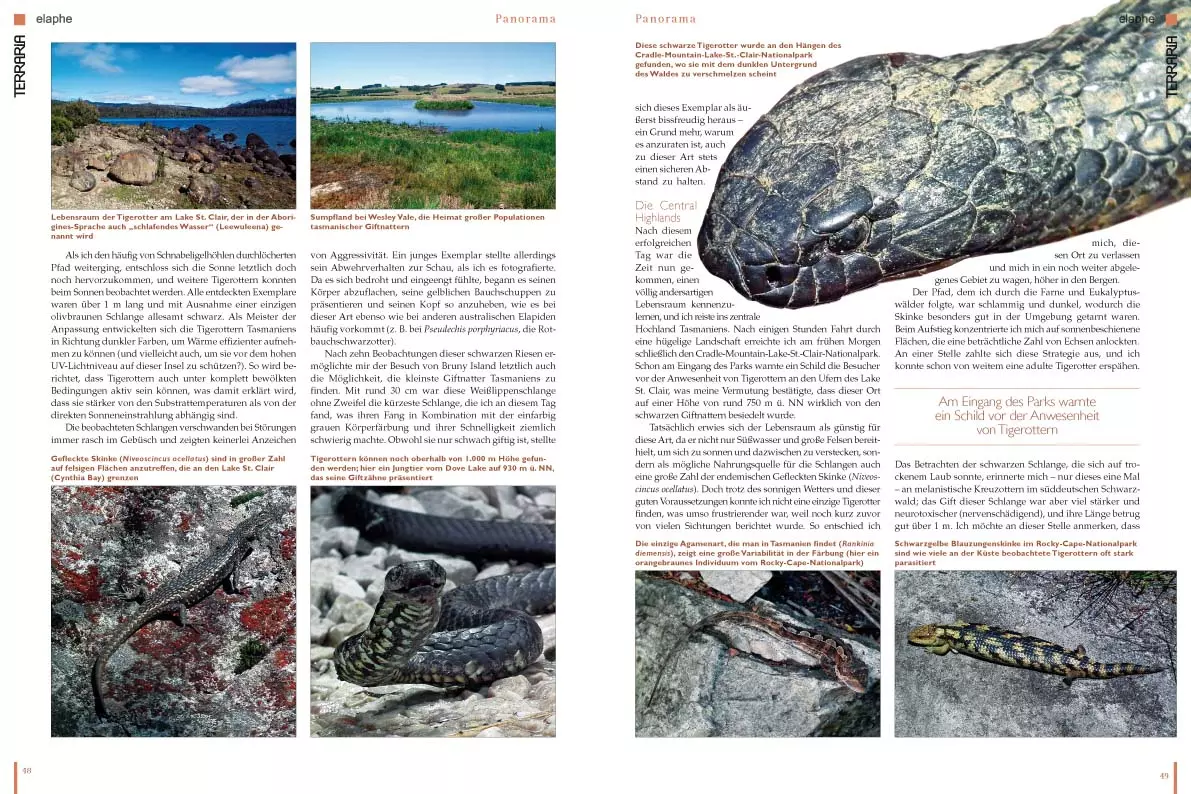
Tasmania


Contents:

Cover story: Mosses, ferns and other spore plants in the terrarium

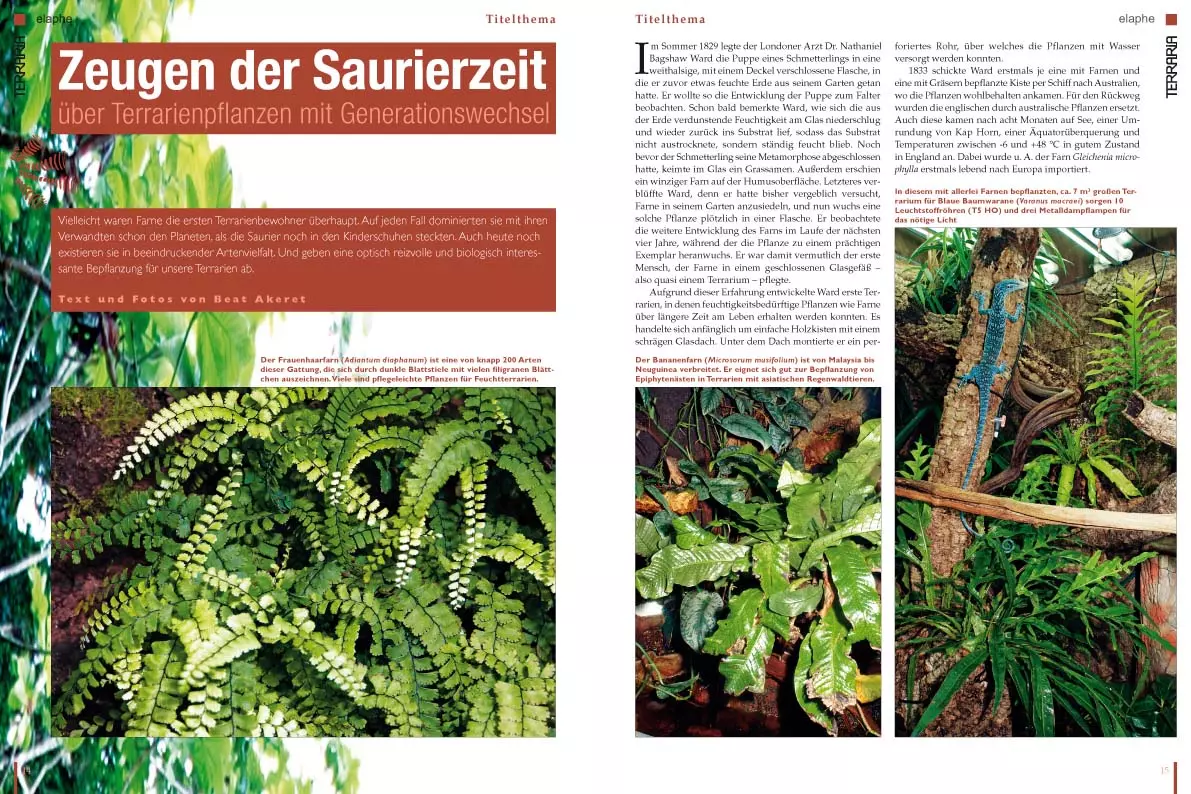
In 1892, the English physician Dr N.B. Ward realised that ferns could be cultivated in closed glass containers. This gave rise to Victorian plant display cases planted with ferns and mosses - the forerunners of today's terrariums. However, mosses, ferns and other spore plants are more than just decorative accessories in humid terrariums. Their reproduction by means of alternation of generations, which can also be observed in the terrarium, is particularly interesting. In addition to many interesting aspects of spore plants, the next issue will also contain numerous tips and tricks on how these plants can thrive in the terrarium and how they can best be kept together with reptiles and amphibians.

Contents

Territorial

Herpetorama
New study by the Federal Agency for Nature Conservation: What really jeopardises biodiversity in Germany 

Lookup
Thorn Devil: The Variable Rain Frog

Cultural successors: tortoises in Vienna

What did the first snakes look like?

Leafhoppers: In the News

Cover story
Witnesses of the dinosaur era - about terrarium plants with generational change
Beat Akeret

Mosses - unrecognised dwarfs among terrarium plants
Beat Akeret

Epiphytic ferns in the terrarium
Beat Akeret

Neither moss nor fern. Lycopodiopsida as terrarium plants
Beat Akeret

Panorama
Tiger otters: an invitation to get to know the reptiles of Tasmania Guillaume Gomard

Research
New species

In wild Kurdistan - a spectacular large monitor lizard from the Zagros Mountains
Axel Kwet

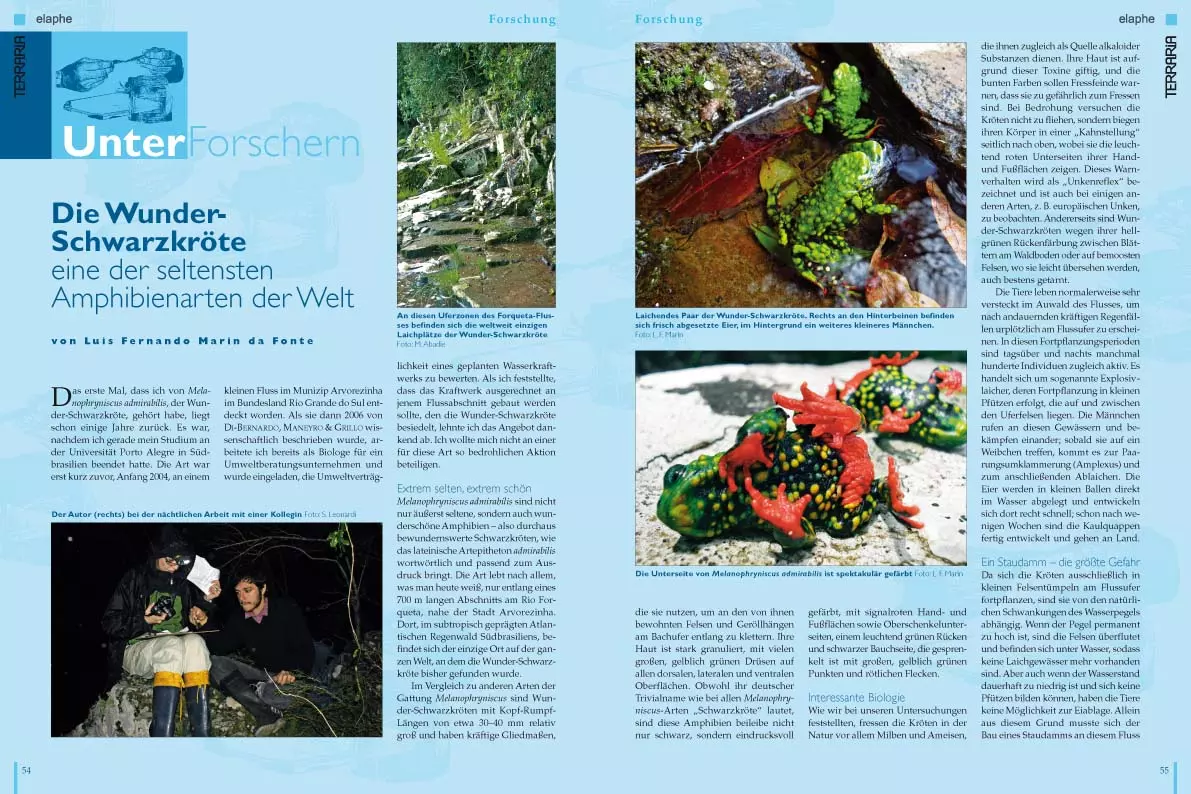
Among researchers
The miracle black toad, one of the rarest amphibian species in the world
Luis Fernando Marin da Fonte

Salamandra

Terraristics
Many years of experience in keeping and breeding the European pond turtle. Part 2: Egg laying, incubation, rearing the young, hibernation, husbandry problems
Bernd Wolff

First herpetological assistance from Cologne at Saigon Zoo
Thomas Ziegler & Anna Rauhaus

Nature and species conservation

Field notes
Late finds of yellow-bellied toad and natterjack toad larvae
Jürgen Gebhart

Mysterious deaths of frogs and newts
Axel Kwet

Also in your neighbourhood

Subscription & Service

Preview

Incubator
The danger seekers
Heiko Werning 

Composition
Feeding recommendation
Technical details
Size information

0 of 0 reviews

Give us a rating!

Share your experience with the product with other customers.


Customers also bought

Reptilia 40 - Terrarium Planting
Reptilia 40 - Terrarium Planting MarajóCopperheadFrogs of Costa Rica Contents: 2 EDITORIAL 3 READER LETTERS 7 MAGAZINE 17 DATES 20 WESTERN HERP PERSPECTIVESA juvenile snake hunting fiascoby B. Love 22 PHOTO REPORTAGE Terrarium plantingby B. Akeret 31 REPORTAGEPlanting of desert terrariums by B. Akeret 36 REPORTAGEPlanting an epiphyte branch for the terrarium by B. & W. Schwarz 40 REPORTAGECarnivorous plants in the terrarium by A. Glück 47 HERPETOFAUNABiology and distribution of Podocnemis vogli in Venezuelaby M. Merchán, A. M. Fidalgo & C. Pérez 51 PORTRAIT AND POSTERWrestling match in the rainforestby M. Ruckgaber 56 HUSBANDRY AND BREEDINGThe copperhead (Agkistrodon contortrix) – a “beginner's” snake?by D. Schmidt 65 HUSBANDRY AND BREEDINGHusbandry and breeding of Sind rock geckos, Cyrtopodion kachhensis (STOLICKA, 1872)by U. Schlüter 69 REPTORTAGEIn search of frogs in Costa Ricaby T. Eisenberg 75 TRAVELMarajó – Hot and humid Amazon paradiseby L. Dirksen 84 CLASSIFIEDS 90 TIPS & TRICKS 93 LIBRARY 104 GLOSSELiving in scalesby L. Hogeback

CHF 11.20

Reptilia 117 - Amphibian Rarities
Reptilia 117 - Amphibian raritiesFlooridaNight lizardIberian adderContents: Cover story: Amphibian raritiesIn all amphibian groups there are species which, for various reasons, are not kept as frequently in terrariums as fire salamanders, dyer frogs etc.: some species are only imported rarely and in small numbers, some have no lobby, others are highly sought after but not easy to breed.In the cover story of this issue of REPTILIA, we present such rarities in detail - with captivating photos and detailed reports on extremely pleasing breeding successes. We also visit a project in South America in which species sought after by terrarists are selectively propagated - and which simultaneously promotes science, nature conservation and environmental education.EditorialMAGAZINEDATES WESTERN HERP PERSPECTIVESThe fate of books, part 1B. LovePhoto storyAmphibian raritiesK. KunzKeeping and breedingCharming little fellows: Keeping and breeding Riobamba pouched frogs (Gastrotheca riobambae)D. SchmidtKeeping and breedingBreeding a Ryabov’s Phantom Moss Frog (Theloderma ryabovi) in a terrariumE. RyboltovskyReportageSustainable marketing of frogs for terraristics in EcuadorS. CondeKeeping and breedingKeeping and breeding the Iberian viper (Vipera seoanei)A. SchmidServicesKeeping and breedingCare and breeding of the night lizard Lepidophyma smithiG. KöhlerReportageTuataras. The living fossils of New ZealandO. DrewesAlso in your neighbourhoodJourneyThe great trek. Part 1: Melting Pot South FloridaH. WerningPreviewIncubatorNobody warns you about this before you have childrenH. Werning

CHF 12.00

Nekton Rep Calcium + D3
Rep Calcium +D3 Nekton Rep Calcium + D3 is a high-quality calcium supplement for reptiles and amphibians that supports optimal bone and muscle development. Enriched with vitamin D3, it promotes the absorption of calcium in the body and thus contributes to a healthy skeletal structure and an intact metabolism. Especially for reptiles kept in terrariums, a regular supply of calcium and vitamin D3 is crucial to avoid deficiency symptoms such as bone softening or deformities. The powder is easy to dose and can be sprinkled directly over the food or added to the drinking water. Nekton Rep Calcium + D3 is an ideal supplement for all reptile species that have an increased need for calcium, such as tortoises, geckos and agamas. Advantages: Optimum calcium supply: Promotes healthy bone and skeletal development and supports the muscular system. Enriched with vitamin D3: Improves calcium absorption in the body and ensures optimum utilization. Prevents deficiency symptoms: Reduces the risk of calcium deficiencies that can lead to health problems. Easy to use: The powder is easy to dose and can be added directly to the feed or drinking water. High-quality composition: Specially developed for the needs of reptiles and amphibians. Zoo Roco tips: Correct dosage: Pay attention to the recommended dosage depending on the species and age of the animal to avoid overdosing. Combine with UVB lighting: Vitamin D3 needs UVB radiation to be optimally processed. So provide good UVB lighting in the terrarium to maximize the effect of Nekton Rep Calcium + D3. Feeding frequency: Sprinkle the calcium supplement 2-3 times a week on the food or in the drinking water, depending on the animal's needs. Combination with other supplements: In some cases, it may be useful to combine Nekton Rep Calcium + D3 with other nutrients your pet needs, especially if a special diet is required.

From CHF 5.90

Reptilia 123 - Planting of poison dart frog terrariums
Reptilia 123 - Planting of poison dart frog terrariums Contents: Cover story: Planting poison dart frog terrariumsPoison dart frog terrariums can be real gems. Not only because of the "jewels from the rainforest" themselves – but also because of the rainforest around them. Poison dart frogs come to us from biotopes that are also home to countless attractive tropical plants, many of which are available to us and can be cultivated excellently. The experienced terrarium plant specialist Beat Akeret explains in the cover story of this REPTILIA exactly which plants are suitable for poison dart frog terrariums, so that these not only look great and meet the needs of the frogs, but even conjure up an authentic Latin American rainforest section in the living room.Also in REPTILIA No. 123Keeping and breeding one of the most mystical reptiles of all: the Bornean earless monitor in the terrariumDanger in the magic of blossoms: crab spidersThe great trek 3: with REPTILIA editor-in-chief Heiko Werning from coast to coast through the south of the USAand much more 4          editorial             6          MAGAZINE             14        DATES             16        WESTERN HERP PERSPECTIVES                                    Only in America                                    By B. Love             18        PHOTOSTORY                                    Plants in the poison dart frog terrarium                                    By B. Akeret             26        Terrarium technology                                    Plant care in the poison dart frog terrarium                                    Basic considerations                                    By B. Akeret             32        plants                                    Suitable plants for poison dart frog terrariums                                    By B. Akeret             44        KEEPING AND BREEDING                                    Notes on keeping and breeding of the earless monitor, Lanthanotus borneensis                                    By M. Zollweg & R. Seipp             54        Terrarium technology                                    Even more light                                    Comments by S. Wunderlich and O. Fischer             61        SERVICE             64        travel                                    The great trek                                    Part 3: Georgia on my Mind                                    By H. Werning             76        ALSO NEAR YOU             80        PREVIEW             82        INCUBATOR                                     If this sets a precedent                                    Part 2                                    By H. Werning

CHF 13.50

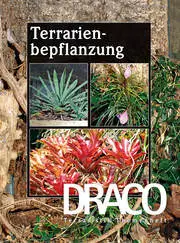
Draco 41 - Terrarium planting
Draco 41 - Terrarium plantingContents:EditorialTerrarium plantsBeat AkeretPlants in aquaterrariumsBeat SchmitterA touch of the Mediterranean - planting outdoor enclosures for Mediterranean tortoisesMichael WirthSucculents and other plants for the dry terrariumBeat AkeretClimbing plants and epiphytes - character plants in the forest terrariumBeat AkeretArtificial plants in the terrariumRoger AeberhardHerbs, grasses, houseplants, whatever is beautiful should grow in the tank - selected examples of planted terrariumsBeat Akeret

CHF 18.40

Oak leaves decorative foliage 1 liter
The Pet Factory - Decorative foliage The Pet Factory decorative foliage - holm oak leaves for natural decoration of terrariums. Oak leaves for terrariums pH lowering in aquariumsFood for shrimps for rearing poison dart frog tadpoles has an antifungal and disinfecting effect also as decoration for small mammal terrariums 1 liter corresponds to approx. 15 grams When used in aquariums, the pH-reducing properties must be taken into account and the foliage can also be used for breeding poison dart frog tadpoles. Decorative foliage has an antifungal and disinfecting effect. Tip:It is also ideal as decoration for small mammal terrariums, as it is only gnawed on a little. It simply does not taste good!

CHF 4.60

Suggested products

Handbook of food plants for tortoises and other reptiles
Handbook of forage plants 2nd revised editionMarion Minch is not only a successful breeder of diverse tortoises for many years, but also an excellent connoisseur of native wild herbs. She founded and runs samenkiste.de, which is well known to many tortoise keepers and nature lovers. Her name is inextricably linked with reptile care and species-appropriate nutrition for tortoises. Her handbook of food plants summarises the most important native food plants for herbivorous and omnivorous reptiles. She not only considers tortoises, but also iguanas, spiny-tailed dragons and even chameleons. From the basics of plant biology to native wild herbs to suitable food plants for hardy tropical reptile species, this comprehensive work provides the basis for species-appropriate keeping. In the expanded and supplemented 2nd edition, the plant section is divided according to flower colour. This makes it even easier to identify wild herbs. The work has also been supplemented with a wealth of additional information and many pictures.

CHF 46.50

Geckos
Geckos in the terrarium by Astrid FalkThe book offers a comprehensive introduction to geckos and their species-appropriate keeping in terrariums. It explains what you need to think about before buying a gecko and what preparations should be made. The book describes in detail how the terrarium is technically equipped and set up. The care of the animals, their special features and behaviour, their diet, reproduction and rearing of young animals are described, as well as diseases and husbandry problems with tried and tested suggestions for prevention and treatment. Individual gecko species that are particularly suitable for keeping and breeding in terrariums are portrayed in detail in the second part of the book.

CHF 28.50

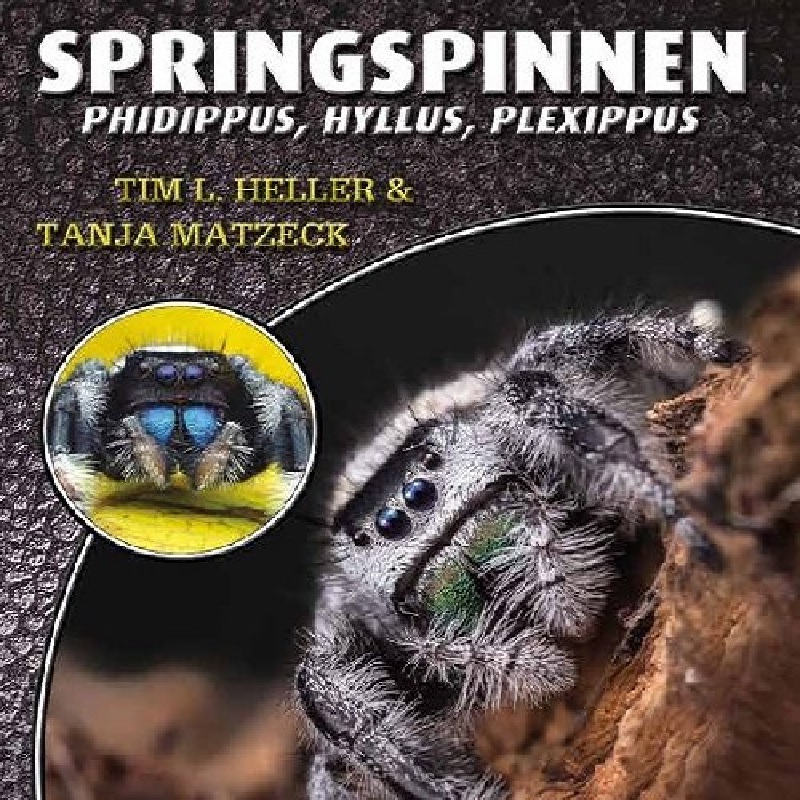
Jumping spiders Phidippus, Hyllus, Plexippus
Book Jumping Spiders - Phidippus, Hyllus & Plexippus A guide to keeping jumping spiders of the genera Phidippus, Hyllus & Plexippus. Who can resist the charm of jumping spiders? The childlike appearance of their expressive face simply leaves no one cold! In addition, their behavior is extremely exciting to observe, their colors are bright and their requirements for species-appropriate keeping are very easy to meet. No wonder these likeable jumpers are all the rage! This volume in the "Species by Species" series describes in detail what to look out for when buying and keeping them, introduces the most commonly kept species and color forms and provides plenty of tips on how to keep them successfully - so you can be sure they will breed well! Species by Species introduces you to the books in this series, which present the most popular terrarium animals. Each volume offers you detailed, practical care instructions and all the information you need to successfully breed your animals. All important questions from the required tank size to terrarium set-up, technical equipment, species-appropriate nutrition and disease prevention are answered with numerous tricks and tips. Experienced, long-standing breeders reveal how you can encourage the animals to reproduce and raise healthy young. All this in full color, generously illustrated and attractively designed - just about your terrarium animal - species by species

CHF 23.90

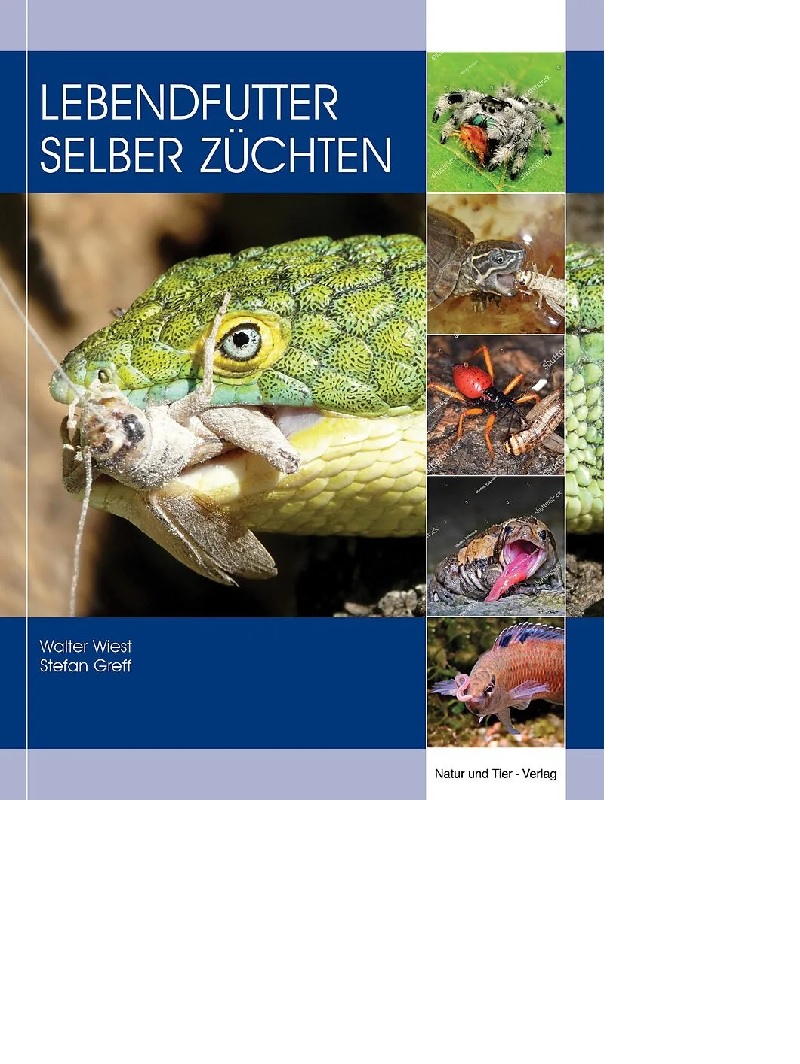
Book Breeding live food yourself
Book "Grow your own live food" - The perfect guide for pet owners Discover practical and detailed instructions on how you can easily breed food for your reptiles, birds, fish or other animals yourself in the book "Breeding live food yourself". With valuable tips on various food insects, their care and breeding, you can save money and ensure a species-appropriate diet for your pets. Contents of the book: Step-by-step instructions for breeding feeder insects Information on the best types of food for reptiles, birds and fish Care instructions and breeding conditions for various live food species Tips for sustainable and cost-effective food production Why breed your own live food? Get healthy, fresh food for your animals Save money and reduce dependence on pet shops Promote the health and well-being of your animals with species-appropriate food Whether you are a beginner or an experienced pet owner, this book provides you with everything you need to successfully breed live food yourself.

CHF 46.50

Marginata 69 - New Guinea tortoises
Marginata 69 - New Guinea tortoises – the genus ElseyaCover storyThe unrecognised beauties: New Guinea tortoises (Andreas S. Hennig)My experiences with Branderhorst's New Guinea tortoise, Elseya (Elseya) branderhorsti (Ouwens, 1914) (Andreas S. Hennig)Keeping and breeding of Rhodin's New Guinea tortoise, Elseya (Hanwarachelys) rhodini Thomson, Amepou, Anamiato & Georges, 2015 (Andreas S. Hennig)PortraitGeoemyda spengleri, Chinese serrated tortoise (Andreas S. Hennig)ReportageMacrochelys temminckii – Experiences and impressions with vulture tortoises part 2 (Reiner Praschag)KeepingAn alternative to year-round keeping of the Egyptian tortoise in the terrarium – my experiences with seasonal outdoor keeping of Testudo kleinmanni (Ricarda Schramm)EtymologySawbacks and living maps part 4: Graptemys gibbonsi, Pascagoula humpback tortoise (Holger Vetter)Classifieds & animal placement

CHF 16.50

The Bahamaanolis
All about the Bahamaanolis by the author duo Uwe Bartelt & Iris Zeilfelder 64 pages Format: 14.8 x 21 cm numerous colour photos Paperback Author Uwe Bartelt & Iris Zeilfelder Contents: Nothing is more fascinating than a healthy group of Bahama anoles in a species-appropriate terrarium.The very lively, diurnal animals are not very shy after familiarisation and can be well observed.They prove to be long-lived in the terrarium, forgive even minor husbandry mistakes and, in good conditions, readily reproduce. In short, they give the owner a great deal of pleasure. Systematics and body structure The fascinating biology: From the life of the Bahama anolis All information on species-appropriate keeping: From suitable terrariums and equipment and technology to feeding Successful breeding: Mating stimulation, incubation of the eggs and rearing the young Solutions to problems: How to avoid the most common mistakes in care and how to help sick animals Brilliant photos

CHF 17.90

Marginata 16 - African spurred tortoises
Marginata 16 - Spur-thighed tortoises Frozen food part 1Mauritius impressionsSea turtles Contents: 2 EDITORIAL 3 READER LETTERS 4 MAGAZINE 8 DATES 10 REPORTAGEThe spur-thighed tortoise - the largest tortoise of the African mainlandHans - Dieter Philippen 18 BREEDING IN HUMAN CAREBreeding of the spur-thighed tortoise(Centrochelys sulcata) at Pilsen Zoo, Czech RepublicVeronika Kodymová and Jan Konás 24 REPORTAGE A house for spur-thighed tortoises part 1Hilko Funsch 31 PORTRAITArgentine snake-necked turtles (Hydromedusa tectifera Pope, 1820)Hans - Dieter Philippen 35 REPORTAGEFrozen food part 1Hans - Dieter Philippen 40 BREEDING IN HUMAN CAREKeeping and breeding the Australian snake-necked turtle (Chelodina longicollis) part 2Stefan Thierfeldt & Sabine Höfler-Thierfeldt 48 REPORTAGEA visit to the giant tortoises in the "La Vanille Crocodile Park" of MauritiusPetra and Jens Jungnickel 54 REPORTAGEThe conservation status of the loggerhead sea turtle (Caretta caretta): an introduction to the current issuesJosé C. Báez, Raimundo Real & Juan A. Caminas 60 BOOK TIP 61 CLASSIFIEDS 62 REGIONAL GUIDE

CHF 14.70

Reptilia 118 - Morelia
Reptilia 118 - MoreliaMadagascarHumpback turtlesProfessional reptile breeding Contents:Cover story: Morelia - tree python, diamond python & Co.Everyone knows the green tree python. The animals are admired for their colouring and their favourite position, curling up over a branch, almost symbolises our idea of a tree-dwelling snake. This species has been successfully kept and bred in terrariums for a long time. However, the other pythons of the Morelia genus are also very popular. We offer an overview of these exceptionally beautiful giant snakes, describe new ways of setting up a terrarium for Morelia viridis in a naturalistic way and look at the keeping and breeding of a species that is still little known, the python with a scaly scales, Morelia carinata.EditorialMAGAZINEDATESWESTERN HERP PERSPECTIVESThe fate of books part 2B. LovePhoto storyPython beauties from the other side of the world: Morelia, the tree and diamond pythonsM. MenseKeeping and breedingKeeping a green tree python in a naturally designed large terrariumR. StallingerKeeping and breedingMorelia carinata – The Python with a Difference!O. JugReportageRare exhibition animal: Morelia bredli at Frankfurt ZooD. RösselKeeping and breedingHumpback turtles – The genus GraptemysM. RognerKeeping and breedingProfessional breeding of terrarium animals for the pet tradeSimone P. ReportageUnder the spell of the big telescopic eyes: jumping spiders on the lookoutU. & J. SchimmelpfennigAnimals of our homelandThe sand lizardR. LeptienSERVICELIBRARYALSO NEAR YOUJourneySearching for reptiles in MadagascarC. SchneiderPREVIEWBRUTKASTEN Why do pigeons of all things have to be the symbol of peace?H. Werning

CHF 12.00

Reptilia 24 - Stick insects
Reptilia 24 - Stick insects Incubation of turtle eggsTerrarium photographyArch-snakes Contents: Page 2 - EditorialPage 3 - Letters to the editorPage 6 - MagazinePage 13 - DatesPage 16 - Western Herp Perspectives: Tribute to the Frog, by B. LovePage 18 - Photo report: Stick and ghost grasshoppers, by O. ZomproPage 24 - Keeping and breeding: Ghost insects of the family Heteropterygidae in the terrariumPage 30 - Report: Food animal and terrarium ornament at the same time: The Indian stick insect (Carausius morosus), by F. GastPage 34 - Journey: On a big game hunt for the sticks - Insights into the joys and dangers of a collecting trip, by I. FritzschePage 40 - Herpetology and culture: On the utilisation of some amphibian and reptile species in Peru, by T. EisenbergPage 47 - Portrait and poster: Anolis roquet, by M. SchmidtPage 51 - Herpetofauna: Observations on the ecology and terrarium keeping of the arch-snake Chalcides chalcides mertensi, Klausewitz 1954, by H. EsterbauerPage 55 - Keeping and breeding: Incubation of turtle eggs, by M. MähnPage 63 - Terrarium studies: Herpetological photography – ABC of reptile and amphibian photography for beginners and advanced, by U. StrathemannPage 70 - Herpetofauna: Asaccus – The leaf-fingered geckos of the Oman mountains, by R. LeptienPage 79 - Reptilia on the road: Zoological Garden of the City of Wuppertal, by A. HauschildPage 82 - Advice and actionPage 89 - LibraryPage 96 - Gloss: Forget fighting dogs! A friend for life, by K. Kunz

CHF 9.80

Reptilia 113 - Rhacodactylus, the giants from New Caledonia
Reptilia 113 - RhacodactylusThe giants of New Caledonia Arum familyRed spitting cobraMilos Cover story: Rhacodactylus, the giants of New Caledonia. EditorialMAGAZINEDATES Photo storyRhacodactylus – Diverse giants from New CaledoniaP. Schoenecker Keeping and breedingDark giants in the terrarium: keeping and breeding Rhacodactylus leachianus , the local form from Mont KoghisP. Schoenecker ReportageIn search of New Caledonian giant geckosC. Langner Keeping and breedingThe local variants of Rhacodactylus leachianus in terrarium keeping Part 1: Grande TerreS. Cemelli PlantsArum plants in the terrarium Part 1: Species diversity, biology and special featuresB. Akeret Keeping and breedingThe jewel of venomous snake keeping. The red spitting cobra, Naja pallida, as a pet in the terrariumO. S. Rudolphi ReportageQueensland's spiders and their venoms Part 2: The araneomorph spiders T. J. Hauke ALSO NEAR YOUService Animals of our homelandThe fire-bellied toadR. Leptien WESTERN HERP PERSPECTIVESWalk the boardsB. Love JourneyFeta cheese, sun and snakes. Welcome to Milos!A. Schmid PREVIEW BRUTKASTENChuckwalla anecdotes. Part 2H. Werning

CHF 12.00

Draco 11 - Day geckos
Draco 11 - Day geckos Contents: 2 Editorial 4 day geckos of the genus PhelsumaJens Krüger 20 A terrarium for PhelumenHartmut Lipp 27 On the diet of day geckos of the genus Phelsuma Gerhard Hallmann 30 Group keeping and socialisation of PhelsumaHartmut Lipp 38 Phelsuma berghofi Krüger, 1996Biology, care and reproductionHand Peter Berghof 43 Experiences in the care and breeding of Phelsuma hielscheri Rösler, Obst & Seipp, 2001 from Isalo National Park Hans Peter Berhof & Roland Gebhard 47 On the keeping and breeding of Phelsuma inexpectata Mertens, 1966Oliver Pürkel 51 Taxonomy, care and breeding of the subspecies of Phelsuma lineata Hartmut Lipp 58 Selective colour breeding in Phelsuma madagascariensis grandis Rudolf Gerhardt 61 It doesn’t always have to be green – the less colourful representatives of the genus Phelsuma Hand Peter Berghof 68 Phelsums on Mauritius – A situation study Holger Schneider 77 To Madagascar – For the sake of day geckos Klaus Liebel & Wolfgang Schmidt 85 Book box 91 Magazine

CHF 16.80

Marginata 24 - Pointed Red-bellied Pond Turtle
Marginata 24 - Red-bellied Pointed Pond Turtle South African Beaked Tortoise Part 2Sea turtles of AustraliaHibernation and dry hibernation Part 1 Contents: EditorialLetters to the editorMagazineDates REPORTAGEThe red-bellied pointed pond turtle, Emydura subglobosa (Krefft, 1876) – long known and yet virtually unknownHans - Dieter Philippen & John Cann BREEDINGLong-term breeding experiences with the red-bellied pointed pond turtle (Emydura subglobosa) – compilation of personal and published data spanning over 40 yearsHans - Dieter Philippen & Martin Leonard Voss POSTERThe Black-bellied Box Turtle, Pelusios niger (Dumeril & Bibron, 1835)Hans - Dieter Philippen REPORTAGEThe African Beaked Tortoise (Chersina angulata). Part 2: Behavioural observationsMichael Wirth REPORTAGEThreats, protection and use of sea turtles. Part 4: Green Turtle (Chelonia mydas) and Loggerhead Turtle (Caretta caretta) in Northwest Australia Gerald & Christa Benyr REPORTAGEPhysiology of rest phases in reptiles, especially tortoises – Part 1: Hibernation – a literature overviewMarkus Baur & Tobias Friz Book tipClassifiedsSubscription & ServiceRegional guide

CHF 16.50

Customers also saw

Forest Moss - Terrarium Substrate
Trixie Forest Moss - Terrarium Substrate This 100% natural moss can be used for a variety of animal species:Terrariums:     increases and maintains humidity in terrariums     Decorative material     Shelter for frogs Small animals:     Decorative material     for plugging cracks in willow tunnels (important so that the animals do not pinch their feet) Birds:     as nesting material     Decorative in any bird enclosure Contents: 200g

CHF 11.90

Zoo Med Terrarium Moss
Zoo Med Terrarium moss for terrariums Zoo Med Terrarium Moss is a 100% natural product and is ideal for setting up and designing humid terrariums. 100% natural moss for setting up terrariums for reptiles and amphibians Ideal for egg-laying areas and caves Can also be used as an incubation substrate 2.46 litres Natural terrarium moss for furnishing and decorating terrariums. Very suitable for frogs, salamanders, toads, etc.

CHF 9.80

Taxiphyllum sp. 'Flame' (flame moss)
Taxiphyllum sp. 'Flame'Taxiphyllum Flame is a moss genus from Southeast Asia with upward stems that resemble flames. As a mid-ground plant, it is often placed on roots.Difficulty of growing: easyLight requirements: lowCO₂ requirements: lowHeight of mature plant: 5-15 cmGrowth: mediumTemperature: 18 - 28°CPlacement in aquarium: Middle ground, on the decorationOrigin: Southeast AsiaShell diameter 6 cmThe compact, upright and gently swaying stems give the impression of a green campfire up to 15 cm high. Therefore, the Taxiphyllum is often called flame moss or burning moss. With its interesting growth habit, flame moss is great for decorating horizontal areas and can also be used as a lawn. It looks great when grafted onto branching roots. Ideal for nano aquariums, shrimp tanks, but also for larger tanks. Unlike most mosses, it grows quickly in height and spreads much more slowly laterally. It grows well on roots, rocks, coconut shells or other decorative elements. It has no extensive root system, so it is not suitable for planting in the ground. The Taxiphyllum does not need strong lighting or carbon dioxide fertilization to grow well. However, it will grow faster with stronger lighting. It tolerates a wide temperature range from 18 to 28 °C. Frequent water changes encourage its growth, but it does not tolerate rapid changes in water parameters. It grows well in both soft and hard water. It thrives without additional macro- or micronutrient fertilization. Pruning helps the plant to compact and grow, creating a strikingly dense bed. Pruning is done with sharp moss shears. The cut branches can be reinserted into the aquarium to propagate. Thein vitro culture of plants is carried out in tissue culture laboratories. The cuttings are free from snails, algae or pathogens thanks to the sterile production conditions.Planting:The plant must be removed from the cup and thoroughly rinsed from the gel under running water. This is best done by placing the plant in a container of lukewarm water. Most of the gel will then fall off by itself. Divide the contents of the cup into 1-2 cm lumps and then place them on the selected items at a small distance..

CHF 6.50