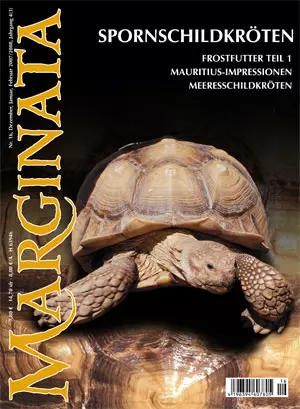
35 REPORTAGE Frozen food part 1 Hans - Dieter Philippen
40 BREEDING IN HUMAN CARE Keeping and breeding the Australian snake-necked turtle (Chelodina longicollis) part 2 Stefan Thierfeldt & Sabine Höfler-Thierfeldt
48 REPORTAGE A visit to the giant tortoises in the "La Vanille Crocodile Park" of Mauritius Petra and Jens Jungnickel
54 REPORTAGE The conservation status of the loggerhead sea turtle (Caretta caretta): an introduction to the current issues José C. Báez, Raimundo Real & Juan A. Caminas
60 BOOK TIP
61 CLASSIFIEDS
62 REGIONAL GUIDE
Composition
Feeding recommendation
Technical details
Size information
0 of 0 reviews
Give us a rating!
Share your experience with the product with other customers.
Login
No reviews found. Go ahead and share your findings with others.
Handbook of forage plants 2nd revised editionMarion Minch is not only a successful breeder of diverse tortoises for many years, but also an excellent connoisseur of native wild herbs. She founded and runs samenkiste.de, which is well known to many tortoise keepers and nature lovers. Her name is inextricably linked with reptile care and species-appropriate nutrition for tortoises. Her handbook of food plants summarises the most important native food plants for herbivorous and omnivorous reptiles. She not only considers tortoises, but also iguanas, spiny-tailed dragons and even chameleons. From the basics of plant biology to native wild herbs to suitable food plants for hardy tropical reptile species, this comprehensive work provides the basis for species-appropriate keeping. In the expanded and supplemented 2nd edition, the plant section is divided according to flower colour. This makes it even easier to identify wild herbs. The work has also been supplemented with a wealth of additional information and many pictures.
Geckos in the terrarium by Astrid FalkThe book offers a comprehensive introduction to geckos and their species-appropriate keeping in terrariums. It explains what you need to think about before buying a gecko and what preparations should be made. The book describes in detail how the terrarium is technically equipped and set up. The care of the animals, their special features and behaviour, their diet, reproduction and rearing of young animals are described, as well as diseases and husbandry problems with tried and tested suggestions for prevention and treatment. Individual gecko species that are particularly suitable for keeping and breeding in terrariums are portrayed in detail in the second part of the book.
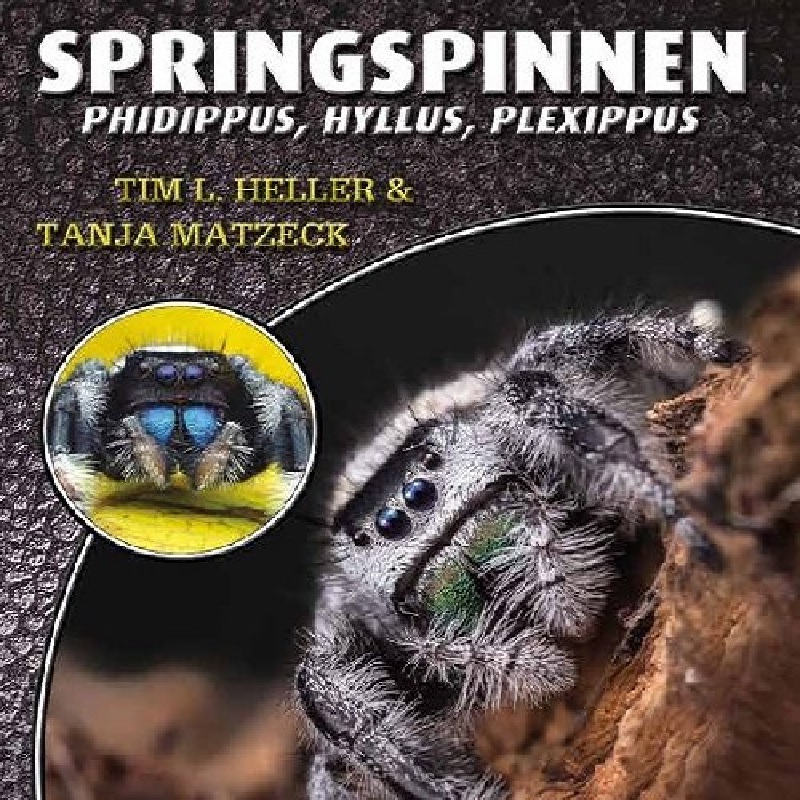
Book Jumping Spiders -
Phidippus, Hyllus & Plexippus
A guide to keeping jumping spiders of the genera Phidippus, Hyllus & Plexippus. Who can resist the charm of jumping spiders? The childlike appearance of their expressive face simply leaves no one cold! In addition, their behavior is extremely exciting to observe, their colors are bright and their requirements for species-appropriate keeping are very easy to meet. No wonder these likeable jumpers are all the rage!
This volume in the "Species by Species" series describes in detail what to look out for when buying and keeping them, introduces the most commonly kept species and color forms and provides plenty of tips on how to keep them successfully - so you can be sure they will breed well!
Species by Species introduces you to the books in this series, which present the most popular terrarium animals. Each volume offers you detailed, practical care instructions and all the information you need to successfully breed your animals.
All important questions from the required tank size to terrarium set-up, technical equipment, species-appropriate nutrition and disease prevention are answered with numerous tricks and tips.
Experienced, long-standing breeders reveal how you can encourage the animals to reproduce and raise healthy young.
All this in full color, generously illustrated and attractively designed - just about your terrarium animal - species by species
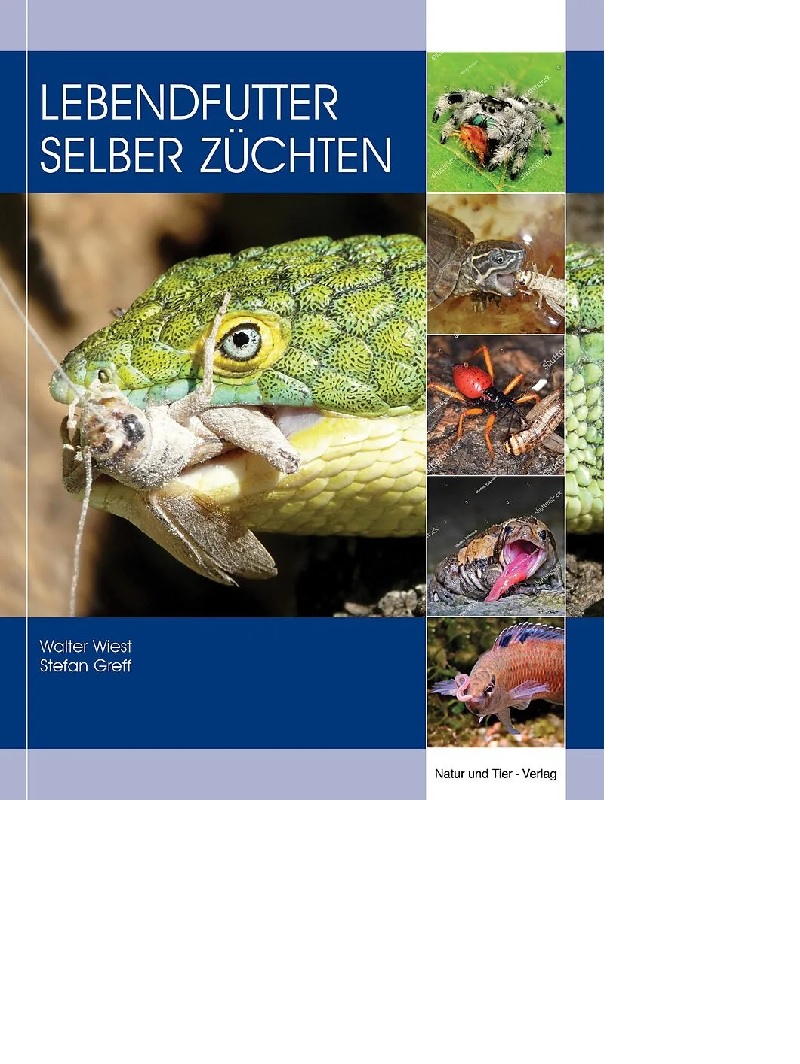
Book "Grow your own live food" - The perfect guide for pet owners
Discover practical and detailed instructions on how you can easily breed food for your reptiles, birds, fish or other animals yourself in the book "Breeding live food yourself". With valuable tips on various food insects, their care and breeding, you can save money and ensure a species-appropriate diet for your pets.
Contents of the book:
Step-by-step instructions for breeding feeder insects
Information on the best types of food for reptiles, birds and fish
Care instructions and breeding conditions for various live food species
Tips for sustainable and cost-effective food production
Why breed your own live food?
Get healthy, fresh food for your animals
Save money and reduce dependence on pet shops
Promote the health and well-being of your animals with species-appropriate food
Whether you are a beginner or an experienced pet owner, this book provides you with everything you need to successfully breed live food yourself.
Marginata 69 - New Guinea tortoises – the genus ElseyaCover storyThe unrecognised beauties: New Guinea tortoises (Andreas S. Hennig)My experiences with Branderhorst's New Guinea tortoise, Elseya (Elseya) branderhorsti (Ouwens, 1914) (Andreas S. Hennig)Keeping and breeding of Rhodin's New Guinea tortoise, Elseya (Hanwarachelys) rhodini Thomson, Amepou, Anamiato & Georges, 2015 (Andreas S. Hennig)PortraitGeoemyda spengleri, Chinese serrated tortoise (Andreas S. Hennig)ReportageMacrochelys temminckii – Experiences and impressions with vulture tortoises part 2 (Reiner Praschag)KeepingAn alternative to year-round keeping of the Egyptian tortoise in the terrarium – my experiences with seasonal outdoor keeping of Testudo kleinmanni (Ricarda Schramm)EtymologySawbacks and living maps part 4: Graptemys gibbonsi, Pascagoula humpback tortoise (Holger Vetter)Classifieds & animal placement
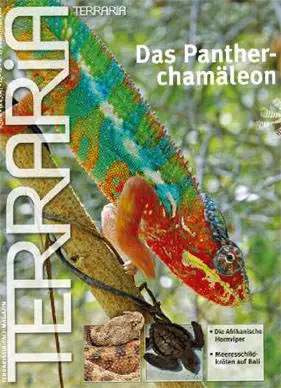
Terraria 27 - The Panther Chameleon
The African Horned ViperSea turtles in Bali
Contents:
With its spectacular colours, the panther chameleon, Furcifer pardalis. enchants every reptile enthusiast. Fortunately, however, it is not only one of the most beautiful lizards of all, but is also easy to keep and breed for a chameleon. Carsten Schneider presents the basics of caring for and breeding these beautiful animals step by step. And it goes without saying that this cover story will be particularly colourful.
EDITORIALMAGAZINEGondwanaland – a pioneering project at Leipzig Zoo, Part 3Andreas S. Henning
Change of staff at Museum Koenig in Bonn: Wolfgang Böhme leaves, Dennis Rödder arrivesAxel Kwet & Heiko Werning
A brief encounter with Alpine newts (Salamandra atra)Chritiane Kohlruss
SupersilkKriton Kunz
Lookup
News on the pointed-head agamas of the genus PseudocalotesJakob Hallermann
TERRAglobalHard days in TabaconasMaik Dobiey
TOPICThe colourful panther. About the chameleon Furcifer pardalis Carsten Schneider
The keeping of panther chameleonsCarsten Schneider
The breeding of the panther chameleon Carsten Schneider
Diseases and treatment options for the panther chameleonCarsten Schneider
The Tierra Caliente red-kneed tarantula, Brachypelma auratum – a highland tarantula from the Mexican highlands?Boris F. Striffler
The African horned viper, Cerastes cerastes cerastes Georg Jachan
Small but nice: Proyek Penyu – the sea turtle breeding station in Pemuteran on Bali Martin Hallmen
Ranas de Cristal. In search of glass frogs in north-east HondurasAlexander Gutsche
New speciesFat prey from MadagascarJörn Köhler
… and new “fat frogs” from BrazilAxel Kwet
AMONG RESEARCHERSWho belongs to whom? In search of tadpoles and frogs in the eastern lowlands of BoliviaArne Schulze
CATCH THE EYELarge and small large ones – the terrarium system of Stefanie and Jochen GeigerMichael Wirth
NEAR YOUSUBSCRIPTION & SERVICEPREVIEW
INCUBATORIn reality, I was always completely indifferent to clothing (for Wolfgang Böhme) Heiko Werning
NTV - Plants in the Terrarium
408 pages
over 1205 illustrations
Format: 17.5 x 23.2 cm
Hardcover
Author Beat Akeret
Contents:
If you want to fulfil your desire to bring a piece of nature into your home with a terrarium, you cannot do without plants to create a natural habitat for your pets. Plants not only increase the visual value of a terrarium, they also improve the climate and provide the animals with cover and hiding places. Some amphibians and reptiles are also very closely tied to certain plants. Planting in the terrarium therefore fulfils a whole range of functions and is an important part of the furnishings.This book offers everything you need to know about caring for terrarium plants, designing near-natural terrariums and selecting suitable plant species! With 400 pages and over 1000 illustrations, this is probably the most comprehensive German standard work on the subject of terrarium planting!
Draco 39 - European Snakes
Contents:
Editorial
The snake fauna of EuropeAndreas Schlüter
Vipera ammodytes: on abnormal vipers and hybridsMario Schweiger
The four-lined snake – Elaphe quatuorlineata (Lacépède, 1789)Sascha Esser
The snakes of northern Spain - travel impressions from the Cantabrian Mountains and neighbouring areasGuido Kreiner
European water snakes: Field observations, husbandry and breeding of Natrix natrix (Linnaeus, 1758), Natrix maura (Linnaeus, 1758) and Natrix tessellata (Laurenti, 1768)Michael Wirth & Rainer Hähnlein
Queens of European snakes: Four-lined snake (Elaphe quatuorlineata), Aesculapian snake (Zamenis longissimus) and Leopard snake (Zamenis situla)Michael Wirth
Terraria 41 - Tuscany
Diadem snakeFolding-breasted pelomedusa
Contents:
Cover story: Tuscany
Just in time for the season – Tuscany is a dream destination right on our doorstep. But it's not only lovers of good food, exquisite wines and gentle landscapes who will get their money's worth here, but also reptile and amphibian enthusiasts. In the cover story of TERRARIA/elaphe, we present the herpetofauna of this treasure trove of Europe, offer a herpetological travel guide and discuss the ecological role of the frequent forest aisles there for reptiles.
TerritorialHerpetorama
Cover storyTuscany. A herpetological overviewMichael Wirth
Tuscany for herpetotouristsMichael Wirth
The secret of the firebreaksMichael Wirth
Panorama
TerraglobalReptile search with obstacles - Part 2Joachim Bulian
Of considerable size: The fire salamanders of the Near East – Salamandra infraimmaculataJürgen Fleck
Research
New speciesList of reptiles newly described in 2012Axel Kwet
Among researchersIn search of distribution limits in the Caribbean lowlands of Costa RicaJohannes Köhler
Salamandra
Terraristics
ClassicsThe red-throated anole
The diadem snake, Spalerosophis diadema cliffordi
A somewhat different snakeHelmut Kantz
Care, mating and breeding of the West African folding-breasted pelomedusa turtle (Pelusios castaneus)Marvin Pawlinsky
Nature and species conservation
Field notesHawksbill turtles off GreeceEric Egerer
Plastic frog?Martin Dieckmann
Lizards in Israel. Observations on twoPhoenicolacerta speciesJürgen Gebhart
Also in your vicinitySubscription & ServiceGallery“The crowning glory of creation is at the end of the food chain”Turtle art by Michael RichterKlaus-Peter Pfeifer & Martina Raffel
Preview
Incubator Expired. Part 1Heiko Werning
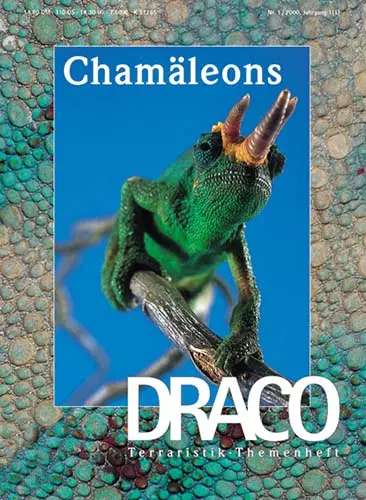
Draco 01 - Chameleons
Contents:
2 Editorial
4 Chameleons, the ancestry and systematics of the terrestrial lions, by P. Necas/D. Modry
20 On the trail of chameleons in southern Africa, by D. Jörgens
25 The play of colours of chameleons, by T. Stegemann
29 The tongue of the chameleons, by T. Stegemann
32 Chameleons in human care - review and current status, by G. Masurat
52 The Yemen Chameleon Chamaeleo calyptrates, by U. Dost
57 Coccidial infections in Chamaeleo calyptratus – a ‘trivial’ problem in the terrarium? by D. Modry, P. Necas, B. Koudela
61 On the keeping and breeding of Chamaeleo pfefferi, by A. Böhle and F. Steffen
63 About the terrestrial, leaf or stump-tailed chameleons of the genera Brookesia and Rhampholeon, by W. Schmidt
68 The chameleon in African mythology, by D. and M. Schuster
77 Magazine
86 Book box
89 Family Chamaeleoniade - List of recent species and subspecies
Terraria 62 - Unusual Food Animals
Campbell’s Tree Lizard
Succulents
Contents:
Cover Story: Unusual Food Animals
A healthy diet plays a decisive role in the successful care and breeding of our terrarium animals. The famous mealworm as a standard food is far from sufficient. Fortunately, specialist retailers now offer a wide range of suitable food insects such as house crickets, crickets, flies or cockroaches, which are available all year in any quantity. However, many pets also like to eat food animals outside the mainstream and some specialists are even dependent on a special diet for their well-being. In this issue of TERRARIA/elaphe, we take a closer look at some of these little-known, rather unusual food animals such as field slugs, woodlice, moth flies or a small-growing fruit fly variant.
3 Territorial
8 Herpetorama
Results of the 17th CITES Conference in Johannesburg – new regulations for some reptiles and amphibians
Synanthrope: Creeping Schnapps
Leaf Climber: Wasted “Time”
Thorny Devil: A Rural Keel-Tailed Iguana
Cover Story
14 Food Animals
A perennial topic in terraristics
Krition Kunz
20 Slippery Snacks
Breeding and use of the Mediterranean field slug as live food
Frank Täufer
25 Woodlice as Food Animals
Dominik Hoffses
30 A Small-Growing Variant of the Fruit Fly: Drosophila melanogaster “Ant”
Boris Stockmann
34 A Frog Farm for Feeding Reptiles and Amphibians: the Painted Disk-Tongued Frog (Discoglossus pictus)
Frank Pasmans, Sergé Bongaerts & An Martel
39 Moth Flies
A new food animal for small nocturnal hunters
Ingo Fritzsche
Panorama
42 Snake searching in the Ecuadorian Chocó rainforest
Daniel Jestrzemski
Research
50 New Species
A new slender boa from the Bahamas: the Conception Silver Boa (Chilabothrus argentum)
Axel Kwet
A new Borneo bush frog from Mt. Kinabalu
Axel Kwet
52 Among Researchers
The Comoros, a forgotten hotspot of diversity
Oliver Hawlitschek
56 Salamandra
Terraristics
60 Ant plants, leaf cacti and other succulent epiphytes for the terrarium
Beat Akeret
Nature and Species Conservation
70 Field Notes
Grass snake eating
Günther Vater
The feeding behaviour of the wall lizard Part 2
Malte Hornig
72 Project to protect the critically endangered tree lizard Abronia campbelli in eastern Guatemala
Brad Lock & Mónica Torres
84 Terrarino – the children’s page
The fire salamander – not a lucky animal
Alexa Sabarth
81 Subscription & Service
86 Also in your area
88 Preview
90 Incubator
No mercy for Mouse Z
Part 2
Heiko Werning
Tortoise library 2 - Greek tortoise
Holger Vetter
325 pages
150 colour photos
Distribution maps
Format: 15 x 21.5 cm
Contents:
This book is by far the most comprehensive collection of information on the range of the Greek tortoise: Testudo hermanni
CHF 42.90
❅
❆
❅
❆
❅
❆
❅
❆
❅
❆
❅
❆
This website uses cookies to ensure the best experience possible. More information...