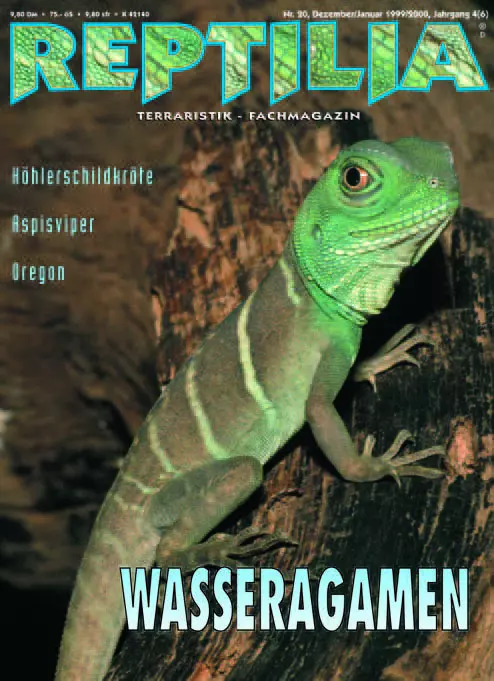
Reptilia 24 - Stick insects

Article no: reptilia24

CHF 9.80

Stock: 0

This article is currently not available

Product information "Reptilia 24 - Stick insects"

Reptilia 24 - Stick insects

Incubation of turtle eggs
Terrarium photography
Arch-snakes

Contents:

Page 2 - Editorial
Page 3 - Letters to the editor
Page 6 - Magazine
Page 13 - Dates
Page 16 - Western Herp Perspectives: Tribute to the Frog, by B. Love
Page 18 - Photo report: Stick and ghost grasshoppers, by O. Zompro
Page 24 - Keeping and breeding: Ghost insects of the family Heteropterygidae in the terrarium
Page 30 - Report: Food animal and terrarium ornament at the same time: The Indian stick insect (Carausius morosus), by F. Gast
Page 34 - Journey: On a big game hunt for the sticks - Insights into the joys and dangers of a collecting trip, by I. Fritzsche
Page 40 - Herpetology and culture: On the utilisation of some amphibian and reptile species in Peru, by T. Eisenberg
Page 47 - Portrait and poster: Anolis roquet, by M. Schmidt
Page 51 - Herpetofauna: Observations on the ecology and terrarium keeping of the arch-snake Chalcides chalcides mertensi, Klausewitz 1954, by H. Esterbauer
Page 55 - Keeping and breeding: Incubation of turtle eggs, by M. Mähn
Page 63 - Terrarium studies: Herpetological photography – ABC of reptile and amphibian photography for beginners and advanced, by U. Strathemann
Page 70 - Herpetofauna: Asaccus – The leaf-fingered geckos of the Oman mountains, by R. Leptien
Page 79 - Reptilia on the road: Zoological Garden of the City of Wuppertal, by A. Hauschild
Page 82 - Advice and action
Page 89 - Library
Page 96 - Gloss: Forget fighting dogs! A friend for life, by K. Kunz

Composition
Feeding recommendation
Technical details
Size information

0 of 0 reviews

Give us a rating!

Share your experience with the product with other customers.


Suggested products

Handbook of food plants for tortoises and other reptiles
Handbook of forage plants 2nd revised editionMarion Minch is not only a successful breeder of diverse tortoises for many years, but also an excellent connoisseur of native wild herbs. She founded and runs samenkiste.de, which is well known to many tortoise keepers and nature lovers. Her name is inextricably linked with reptile care and species-appropriate nutrition for tortoises. Her handbook of food plants summarises the most important native food plants for herbivorous and omnivorous reptiles. She not only considers tortoises, but also iguanas, spiny-tailed dragons and even chameleons. From the basics of plant biology to native wild herbs to suitable food plants for hardy tropical reptile species, this comprehensive work provides the basis for species-appropriate keeping. In the expanded and supplemented 2nd edition, the plant section is divided according to flower colour. This makes it even easier to identify wild herbs. The work has also been supplemented with a wealth of additional information and many pictures.

CHF 46.50

Geckos
Geckos in the terrarium by Astrid FalkThe book offers a comprehensive introduction to geckos and their species-appropriate keeping in terrariums. It explains what you need to think about before buying a gecko and what preparations should be made. The book describes in detail how the terrarium is technically equipped and set up. The care of the animals, their special features and behaviour, their diet, reproduction and rearing of young animals are described, as well as diseases and husbandry problems with tried and tested suggestions for prevention and treatment. Individual gecko species that are particularly suitable for keeping and breeding in terrariums are portrayed in detail in the second part of the book.

CHF 28.50

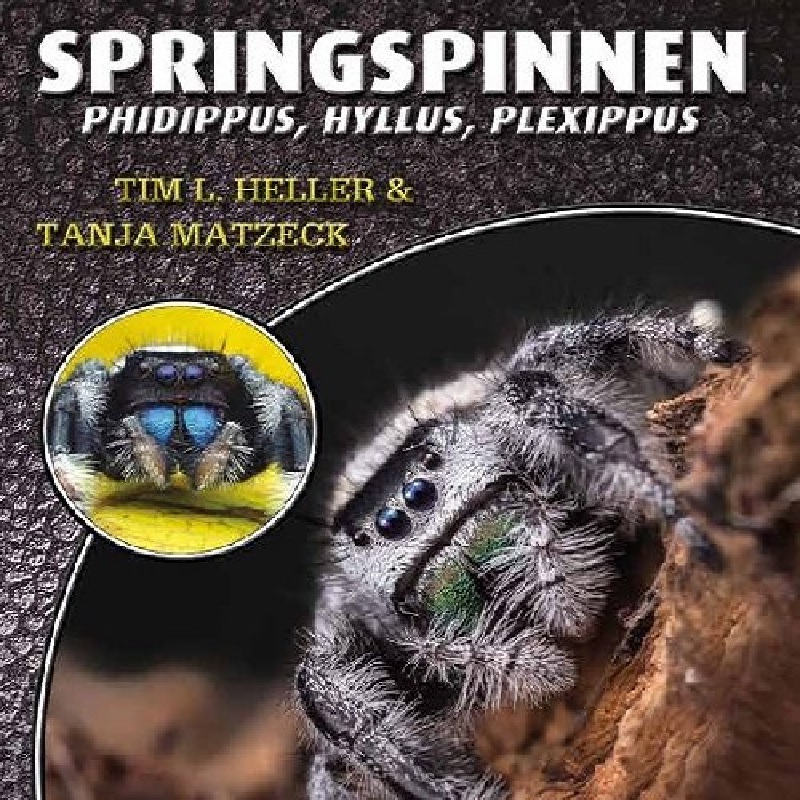
Jumping spiders Phidippus, Hyllus, Plexippus
Book Jumping Spiders - Phidippus, Hyllus & Plexippus A guide to keeping jumping spiders of the genera Phidippus, Hyllus & Plexippus. Who can resist the charm of jumping spiders? The childlike appearance of their expressive face simply leaves no one cold! In addition, their behavior is extremely exciting to observe, their colors are bright and their requirements for species-appropriate keeping are very easy to meet. No wonder these likeable jumpers are all the rage! This volume in the "Species by Species" series describes in detail what to look out for when buying and keeping them, introduces the most commonly kept species and color forms and provides plenty of tips on how to keep them successfully - so you can be sure they will breed well! Species by Species introduces you to the books in this series, which present the most popular terrarium animals. Each volume offers you detailed, practical care instructions and all the information you need to successfully breed your animals. All important questions from the required tank size to terrarium set-up, technical equipment, species-appropriate nutrition and disease prevention are answered with numerous tricks and tips. Experienced, long-standing breeders reveal how you can encourage the animals to reproduce and raise healthy young. All this in full color, generously illustrated and attractively designed - just about your terrarium animal - species by species

CHF 23.90

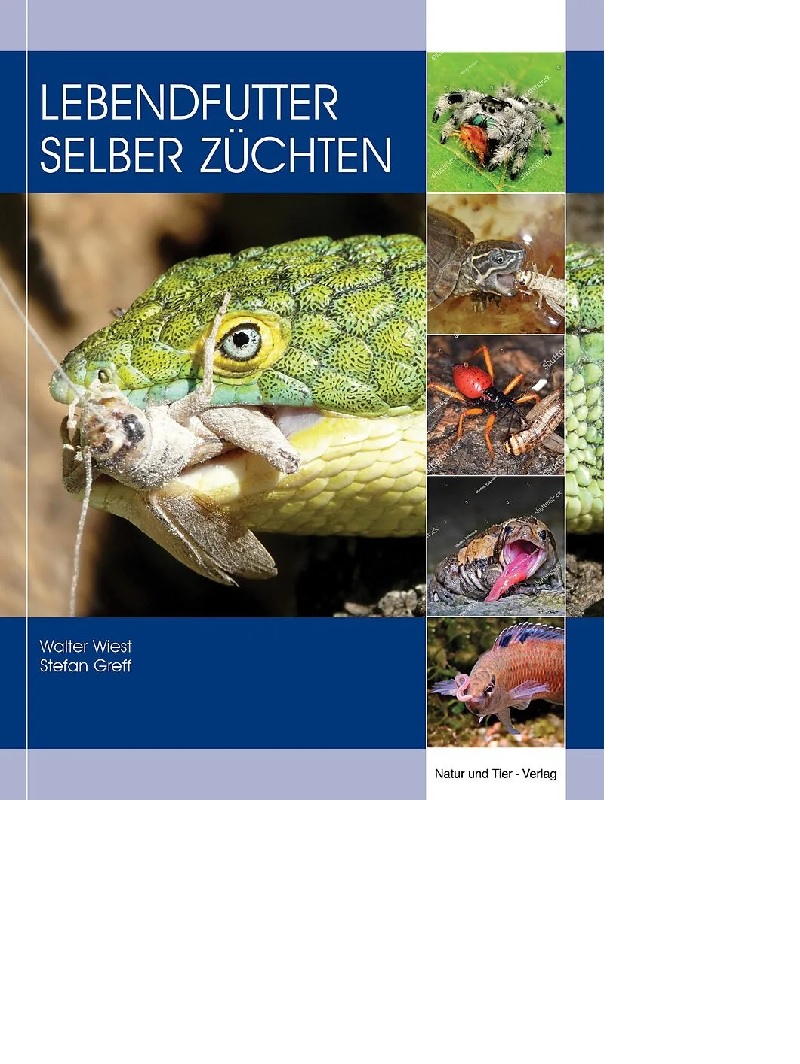
Book Breeding live food yourself
Book "Grow your own live food" - The perfect guide for pet owners Discover practical and detailed instructions on how you can easily breed food for your reptiles, birds, fish or other animals yourself in the book "Breeding live food yourself". With valuable tips on various food insects, their care and breeding, you can save money and ensure a species-appropriate diet for your pets. Contents of the book: Step-by-step instructions for breeding feeder insects Information on the best types of food for reptiles, birds and fish Care instructions and breeding conditions for various live food species Tips for sustainable and cost-effective food production Why breed your own live food? Get healthy, fresh food for your animals Save money and reduce dependence on pet shops Promote the health and well-being of your animals with species-appropriate food Whether you are a beginner or an experienced pet owner, this book provides you with everything you need to successfully breed live food yourself.

CHF 46.50

Marginata 69 - New Guinea tortoises
Marginata 69 - New Guinea tortoises – the genus ElseyaCover storyThe unrecognised beauties: New Guinea tortoises (Andreas S. Hennig)My experiences with Branderhorst's New Guinea tortoise, Elseya (Elseya) branderhorsti (Ouwens, 1914) (Andreas S. Hennig)Keeping and breeding of Rhodin's New Guinea tortoise, Elseya (Hanwarachelys) rhodini Thomson, Amepou, Anamiato & Georges, 2015 (Andreas S. Hennig)PortraitGeoemyda spengleri, Chinese serrated tortoise (Andreas S. Hennig)ReportageMacrochelys temminckii – Experiences and impressions with vulture tortoises part 2 (Reiner Praschag)KeepingAn alternative to year-round keeping of the Egyptian tortoise in the terrarium – my experiences with seasonal outdoor keeping of Testudo kleinmanni (Ricarda Schramm)EtymologySawbacks and living maps part 4: Graptemys gibbonsi, Pascagoula humpback tortoise (Holger Vetter)Classifieds & animal placement

CHF 16.50

Reptilia 01 - Crocodiles
Reptilia 01 - CrocodilesBearded dragonsFire SalamandersBaja californiaGAUDÍ and herpetologyContents:2 - Editorial6 - Magazine14 - Keeping and breeding: Bearded crocodiles, by J. Bergadá and J. Pether23 - Travelogue: Crocodiles in Ghana, by S. Zwernemann26 - Report: Hamburger made from crocodile meat, by M. Schmidt29 - Terraristics: Keeping guidelines for crocodiles30 - Pros and cons: keeping crocodiles33 - Travelogue: Baja California, by H. Werning39 - Portrait and poster: Hyla meridionalis, by M. Aresté and J. L. Farriols43 - Terraristics: Sexing of snakes, by Dr M. Bachs46 - Keeping and reproduction: Acrantophis dummeriliby W. Wengler49 - Herpetofauna, Fire Salamanders, by X. Rivera and A. de Saint Paul58 - Herpetology and culture: Gaudí and herpetology, by E. Filella64 - Veterinary medicine - Shell necrosis in turtles, by C. Lopez del Castillo71 - Report: Species conservation in the jungle of French Guiana, by S. Alviani73 - Library77 - Advice and action80 - Incubator: Glossary by H. Werning

CHF 9.80

Marginata 16 - African spurred tortoises
Marginata 16 - Spur-thighed tortoises Frozen food part 1Mauritius impressionsSea turtles Contents: 2 EDITORIAL 3 READER LETTERS 4 MAGAZINE 8 DATES 10 REPORTAGEThe spur-thighed tortoise - the largest tortoise of the African mainlandHans - Dieter Philippen 18 BREEDING IN HUMAN CAREBreeding of the spur-thighed tortoise(Centrochelys sulcata) at Pilsen Zoo, Czech RepublicVeronika Kodymová and Jan Konás 24 REPORTAGE A house for spur-thighed tortoises part 1Hilko Funsch 31 PORTRAITArgentine snake-necked turtles (Hydromedusa tectifera Pope, 1820)Hans - Dieter Philippen 35 REPORTAGEFrozen food part 1Hans - Dieter Philippen 40 BREEDING IN HUMAN CAREKeeping and breeding the Australian snake-necked turtle (Chelodina longicollis) part 2Stefan Thierfeldt & Sabine Höfler-Thierfeldt 48 REPORTAGEA visit to the giant tortoises in the "La Vanille Crocodile Park" of MauritiusPetra and Jens Jungnickel 54 REPORTAGEThe conservation status of the loggerhead sea turtle (Caretta caretta): an introduction to the current issuesJosé C. Báez, Raimundo Real & Juan A. Caminas 60 BOOK TIP 61 CLASSIFIEDS 62 REGIONAL GUIDE

CHF 14.70

The prairie garter snake
All about the Prairie Garter Snake by Martin Hallmen 64 pages Format: 14.8 x 21 cm numerous colour photos Contents: The prairie garter snake has a very alert nature. It is usually particularly active and interested in the terrarium. It remains very calm when handled and does not tend to bite.This volume from the "Species by Species" series is intended to provide the basic knowledge for keeping them in a species-appropriate way and shows how easy the prairie garter snake makes it for you if you decide to keep it. Systematics and body structure The fascinating biology: From the life of the prairie garter snake All information on species-appropriate keeping: from suitable terrariums to equipment and technology to feeding Successful breeding: Mating stimulation and rearing young animals Solutions to problems: How to avoid the most common mistakes in care and how to help sick animals Brilliant photos

CHF 16.90

Reptilia 33 - European snakes
Reptilia 33 European snakes Dwarf honeycomb toadFishing chameleonCuban Anolis Contents: 2 Editorial 4 Magazine 16 Western Herp PerspectivesSnake searchfrom B. Love 18 Photo reportageThe snakes of Europefrom B. Trapp 26 Keeping and breedingSome vipers from Europe in the terrariumby K. Orth 32 Keeping and breedingRearing and eighteen years of caring for a common viper (Vipera berus berus)by K. Orth 34 Reportage'Snake diving' - Encounter with the dice snake (Natrix tessellata)by W. Pölzer 39 Keeping and breedingGood times, bad times: Experiences with the chameleon Bradypodion fischeri (REICHENOW, 1895)by P. Müller 46 JourneyCuba: In search of Anolis smallwoodiby M. Rogner 51 Portrait and posterAmeiva undulataby U. Schlüter 56 Keeping and breedingThe Indian star tortoise Geochelone elegans (SCHOEPFF, 1795) - a problematic tropical tortoise? - Part 2: Careby H.-J. Bidmon 64 Keeping and breedingKeeping and breeding the dwarf honeycomb toad Pipa parvaby M. Beier 72 ReportageA popular feed insect, the green cockroach Panchlora nivea (LINNAEUS, 1758)by I. Fritzsche 76 REPTILIA on the roadReptile house Sipplingenby H. Werning 85 Classifieds 89 Advice and help 93 Library 104 ColumnNew recipes!by K. Kunz

CHF 9.80

Reptilia 113 - Rhacodactylus, the giants from New Caledonia
Reptilia 113 - RhacodactylusThe giants of New Caledonia Arum familyRed spitting cobraMilos Cover story: Rhacodactylus, the giants of New Caledonia. EditorialMAGAZINEDATES Photo storyRhacodactylus – Diverse giants from New CaledoniaP. Schoenecker Keeping and breedingDark giants in the terrarium: keeping and breeding Rhacodactylus leachianus , the local form from Mont KoghisP. Schoenecker ReportageIn search of New Caledonian giant geckosC. Langner Keeping and breedingThe local variants of Rhacodactylus leachianus in terrarium keeping Part 1: Grande TerreS. Cemelli PlantsArum plants in the terrarium Part 1: Species diversity, biology and special featuresB. Akeret Keeping and breedingThe jewel of venomous snake keeping. The red spitting cobra, Naja pallida, as a pet in the terrariumO. S. Rudolphi ReportageQueensland's spiders and their venoms Part 2: The araneomorph spiders T. J. Hauke ALSO NEAR YOUService Animals of our homelandThe fire-bellied toadR. Leptien WESTERN HERP PERSPECTIVESWalk the boardsB. Love JourneyFeta cheese, sun and snakes. Welcome to Milos!A. Schmid PREVIEW BRUTKASTENChuckwalla anecdotes. Part 2H. Werning

CHF 12.00

Draco 63 - Amphibians of Europe
Draco 63 - Amphibians of Europe Contents: Editorial Frogs and tailed amphibians in Europe – species diversity and biology              Axel Kwet & Benny TrappAmphibian of the Year 2016 – Morphological diversity in Salamandra salamandraAxel Kwet & Benny Trapp New amphibians in EuropeAxel Kwet & Benny Trapp The amphibian fauna of the Iberian PeninsulaAxel Kwet & Benny Trapp Corsica, Sardinia and Sicily: Amphibian diversity in the MediterraneanAxel Kwet & Benny Trapp List of the amphibians of Europe     Axel Kwet & Benny Trapp

CHF 32.00

Reptilia 58 - Crustacean lizards
Reptilia 58 - Crustacean lizards Bush crocodileAgate snailsPlains snake Contents: 2 EDITORIAL 4 MAGAZINE 8 DATES 12 REPORTAGEExperience with keeping and breedingof dinos in the terrariumBy D. Schmidtwith a review by H. Werning 16 WESTERN HERP PERSPECTIVESThe Madagascan turtle crisisBy B. Love 18 PHOTO REPORTAGECrustacean lizards – the genus HelodermaBy T. Wilms 26 KEEPING AND BREEDINGThe successful and continuouskeeping and breeding of the scorpion-crustacean lizard Heloderma horridumexasperatumBy M. Reisinger 36 HERPETOFAUNAThe Guatemalan scorpion crustacean lizard, Heloderma horridum charlesbogertiCampbell & Vannini, 1998By L. S. Meléndez Garcia 39 SPECIES CONSERVATIONPoisonous giants facing extinction?REPTILIA project for the protection of theGuatemalan scorpion crustacean lizardBy K. Kunz 44 REPORTAGEHunting anacondas with sonar and guillotineBy L. Dirksen 51 PORTRAIT AND POSTERBufo brongersmaiBy U. Schlüter 55 KEEPING AND BREEDINGThe bush crocodile – secret beauty in theterrariumBy M. Evers 63 KEEPING AND BREEDINGKeeping and breeding of the ChineseDione snake (Elaphe dione)By M. Diekmann & A. Weyers 72 KEEPING AND BREEDING Agate snails in the terrariumBy K. Wandtke 81 REPTILIA ON THE ROAD30 years Reptile Zoo HappBy D. Schmidt 88 CLASSIFIED ADS 93 RAT & TAT 94 LIBRARY 104 INCUBATORProtocol of a failed attempt at acautious approach, at first sight based on mutualsympathy and intersexualattraction, during a jubilantcelebrationBy H. Werning

CHF 11.20