Product information "Marginata 24 - Pointed Red-bellied Pond Turtle"
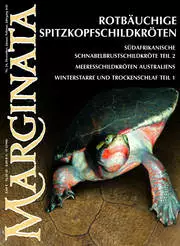
Marginata 24 - Red-bellied Pointed Pond Turtle
South African Beaked Tortoise Part 2 Sea turtles of Australia Hibernation and dry hibernation Part 1
Contents:
Editorial Letters to the editor Magazine Dates
REPORTAGE The red-bellied pointed pond turtle, Emydura subglobosa (Krefft, 1876) – long known and yet virtually unknown Hans - Dieter Philippen & John Cann
BREEDING Long-term breeding experiences with the red-bellied pointed pond turtle (Emydura subglobosa) – compilation of personal and published data spanning over 40 years Hans - Dieter Philippen & Martin Leonard Voss
POSTER The Black-bellied Box Turtle, Pelusios niger (Dumeril & Bibron, 1835) Hans - Dieter Philippen
REPORTAGE The African Beaked Tortoise (Chersina angulata). Part 2: Behavioural observations Michael Wirth
REPORTAGE Threats, protection and use of sea turtles. Part 4: Green Turtle (Chelonia mydas) and Loggerhead Turtle (Caretta caretta) in Northwest Australia Gerald & Christa Benyr
REPORTAGE Physiology of rest phases in reptiles, especially tortoises – Part 1: Hibernation – a literature overview Markus Baur & Tobias Friz
Book tip Classifieds Subscription & Service Regional guide
Composition
Feeding recommendation
Technical details
Size information
0 out of 0 reviews
Give us a rating!
Share your experience with the product with other customers.
Log in
No reviews found. Go ahead and share your findings with others.
Handbook of forage plants 2nd revised editionMarion Minch is not only a successful breeder of diverse tortoises for many years, but also an excellent connoisseur of native wild herbs. She founded and runs samenkiste.de, which is well known to many tortoise keepers and nature lovers. Her name is inextricably linked with reptile care and species-appropriate nutrition for tortoises. Her handbook of food plants summarises the most important native food plants for herbivorous and omnivorous reptiles. She not only considers tortoises, but also iguanas, spiny-tailed dragons and even chameleons. From the basics of plant biology to native wild herbs to suitable food plants for hardy tropical reptile species, this comprehensive work provides the basis for species-appropriate keeping. In the expanded and supplemented 2nd edition, the plant section is divided according to flower colour. This makes it even easier to identify wild herbs. The work has also been supplemented with a wealth of additional information and many pictures.
Geckos in the terrarium by Astrid FalkThe book offers a comprehensive introduction to geckos and their species-appropriate keeping in terrariums. It explains what you need to think about before buying a gecko and what preparations should be made. The book describes in detail how the terrarium is technically equipped and set up. The care of the animals, their special features and behaviour, their diet, reproduction and rearing of young animals are described, as well as diseases and husbandry problems with tried and tested suggestions for prevention and treatment. Individual gecko species that are particularly suitable for keeping and breeding in terrariums are portrayed in detail in the second part of the book.
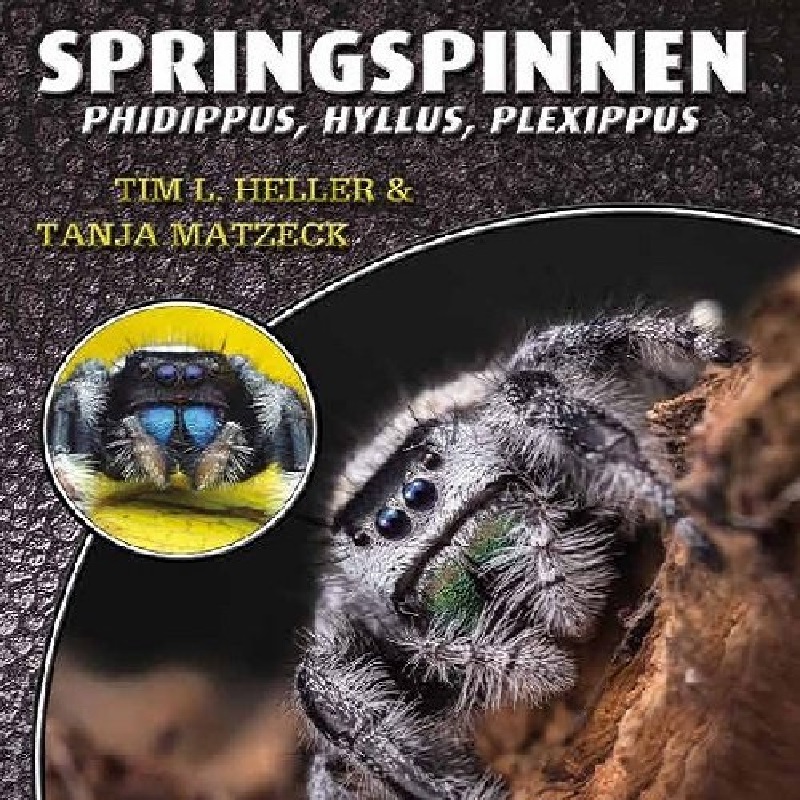
Book Jumping Spiders -
Phidippus, Hyllus & Plexippus
A guide to keeping jumping spiders of the genera Phidippus, Hyllus & Plexippus. Who can resist the charm of jumping spiders? The childlike appearance of their expressive face simply leaves no one cold! In addition, their behavior is extremely exciting to observe, their colors are bright and their requirements for species-appropriate keeping are very easy to meet. No wonder these likeable jumpers are all the rage!
This volume in the "Species by Species" series describes in detail what to look out for when buying and keeping them, introduces the most commonly kept species and color forms and provides plenty of tips on how to keep them successfully - so you can be sure they will breed well!
Species by Species introduces you to the books in this series, which present the most popular terrarium animals. Each volume offers you detailed, practical care instructions and all the information you need to successfully breed your animals.
All important questions from the required tank size to terrarium set-up, technical equipment, species-appropriate nutrition and disease prevention are answered with numerous tricks and tips.
Experienced, long-standing breeders reveal how you can encourage the animals to reproduce and raise healthy young.
All this in full color, generously illustrated and attractively designed - just about your terrarium animal - species by species
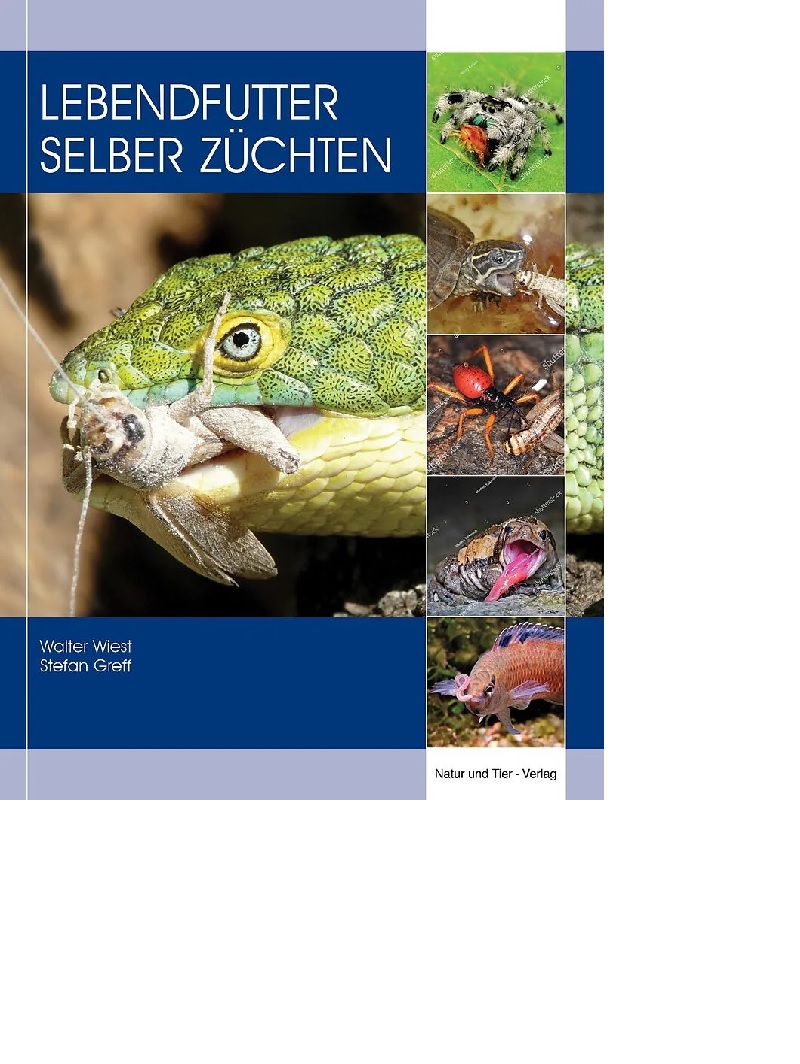
Book "Grow your own live food" - The perfect guide for pet owners
Discover practical and detailed instructions on how you can easily breed food for your reptiles, birds, fish or other animals yourself in the book "Breeding live food yourself". With valuable tips on various food insects, their care and breeding, you can save money and ensure a species-appropriate diet for your pets.
Contents of the book:
Step-by-step instructions for breeding feeder insects
Information on the best types of food for reptiles, birds and fish
Care instructions and breeding conditions for various live food species
Tips for sustainable and cost-effective food production
Why breed your own live food?
Get healthy, fresh food for your animals
Save money and reduce dependence on pet shops
Promote the health and well-being of your animals with species-appropriate food
Whether you are a beginner or an experienced pet owner, this book provides you with everything you need to successfully breed live food yourself.
Marginata 69 - New Guinea tortoises – the genus ElseyaCover storyThe unrecognised beauties: New Guinea tortoises (Andreas S. Hennig)My experiences with Branderhorst's New Guinea tortoise, Elseya (Elseya) branderhorsti (Ouwens, 1914) (Andreas S. Hennig)Keeping and breeding of Rhodin's New Guinea tortoise, Elseya (Hanwarachelys) rhodini Thomson, Amepou, Anamiato & Georges, 2015 (Andreas S. Hennig)PortraitGeoemyda spengleri, Chinese serrated tortoise (Andreas S. Hennig)ReportageMacrochelys temminckii – Experiences and impressions with vulture tortoises part 2 (Reiner Praschag)KeepingAn alternative to year-round keeping of the Egyptian tortoise in the terrarium – my experiences with seasonal outdoor keeping of Testudo kleinmanni (Ricarda Schramm)EtymologySawbacks and living maps part 4: Graptemys gibbonsi, Pascagoula humpback tortoise (Holger Vetter)Classifieds & animal placement
Draco 19 - Madagascar
Contents:
2 Editorial
4 The herpetofauna of Madagascar:Diversity, way of life and endangermentFrank Glaw
22 Journey to the east of MadagascarSebastian Wolf
30 Masoala – The eye of the forestNicolá Lutzmann
37 Mysterious Madagascar boas: Sanzinia & Acrantophis Frank Glaw & Kathrin Glaw
44 On the road in the “Reserve Speziale” of AnkaranaHans-Peter Berghof
50 In search of chameleons along the Route National 2 from Antananarivo to the east coast near Ambila-LemaitsoNicolá Lutzmann, Guy Kremer, Nico van Steendam & Achim Flamme
56The gecko genera of MadagascarPatrick Schönecker & Andreas Böhle
68 Biology, care and breeding of the short-headed day gecko (Phelsuma breviceps) BOETTGER, 1894 Patrick Schönecker
7 The “Madagascan poison dart frogs”– Keeping and breeding of Mantella Hartmut Lipp
82 A journey through the Madagascan highlandsAndreas Böhle
90 Magazine
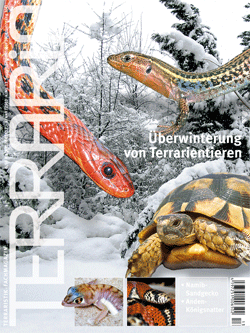
Terraria 13 - Hibernation of terrarium animals
Breeding the palmatogecko from the NamibKeeping and reproducing the Andean kingsnake
Contents:
2 Editorial by Heiko Werning4 Magazine Dangerous animals in Saarland / Zoo Days in Frankfurt / Liability for escaped pets / Climbing ability of snakes at different temperatures / First imports of vipers12 TERRAglobal The finest hour of Bolivian television: Herpetologist on Canal 21 by Martin Jansen The discovery of a new species by Karl-Heinz Switak 16 Cover story: Hibernation of terrarium animals Hibernation – Adaptations to cold climatic conditions by Beat Akeret23 Hibernation of reptiles and amphibians in the outdoor terrarium by Martin Hallmen32 The refrigerator method by Hans-Dieter Philippen37 Hibernation of turtles in the cellar light well by Xaver Wapelhorst 40 Hibernation in tarantulas Hans-Werner Auer44 Grey giants among themselves – of leopard tortoises and elephants in the Addo Elephant National Park, South Africa Part 2: Size and population ecology by Michael Wirth54 Lampropeltis triangulum andesianus – rare terrarium jewel with a dubious reputation Part 1: Biology and keeping by Thorsten Schmidt60 On keeping and breeding the palmatogecko Pachydactylus rangei Andersson, 1908 by Sebastian Schenk & Sebastian Wolf66 Frog die-off in the hotspot – a case study in eastern Brazil by Dennis Rödder70 Travel Costa Rica’s Hitoy Cerere, the gateway to the land of Sibú by Ivonne Meuche82 New species Leaf-fingered geckos of the genus Phyllodactylus/ Three tree frogs from southern Brazil84 Among researchers Bolivia: still a “terra incognita” of herpetology by Martin Jansen88 Test run Irrigation systems by Kriton Kunz94 Eye-catcher A turtle paradise – from the garden to the bathroom by Kriton Kunz99 Near you103 Preview104 Incubator The child does not speak by Heiko Werning
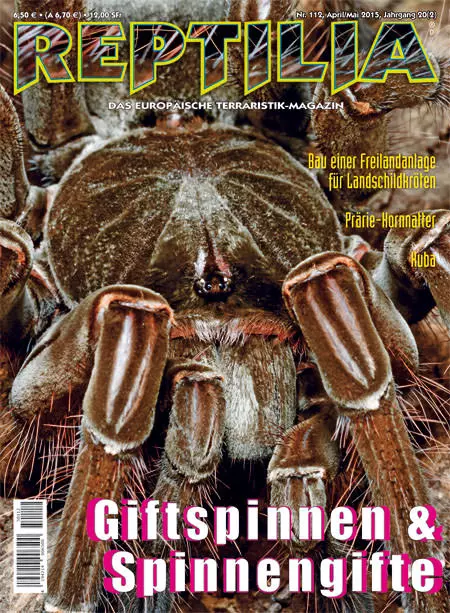
Reptilia 112 - Venomous Spiders & Spider Venoms
Building an outdoor enclosure for tortoisesPrairie horned snakeCubaContents: Cover story: Venomous spiders & spider venomsAll spiders are venomous, including tarantulas, which are particularly popular in terrariums. Nevertheless, they are largely harmless to humans, but are often considered dangerous. This becomes a problem when legislators believe they need to protect the public from these “dangerous animals”. But how dangerous are venomous spiders really? We provide an overview, take a tour of the spider fauna in Australia, the kingdom of all venomous animals, and cover the keeping of venomous spiders in terrariums, from tarantulas to black widows.
EditorialMAGAZINEDATES
WESTERN HERP PERSPECTIVESFrog paradise EuropeB. Love
Photo story“Venomous spiders” in terraristicsK. Kunz
ReportageQueensland’s spiders and their venoms Part 1: The mygalomorph spidersT. J. Hauke
Bibliography
Keeping and breedingVenomous yet harmless – the genera Loxosceles and Sicarius in the terrariumG. Ackermann & A. Leetz
ReportageStung by a tarantula? The South Russian tarantula (Lycosa singoriensis) in BurgenlandH.-J. Luef
TERRARIUM PRACTICEOutdoor enclosure for tortoises 2.0M. Hallmen
KEEPING AND BREEDINGRediscovering an old acquaintance: the Prairie Corn Snake (Pantherophis emoryi emoryi)K. Kessler
Animals of our homelandThe smooth newtR. Leptien
ServiceLibraryALSO NEAR YOU
JourneyCuba all inclusive. Beaches, cocktails, anoles and roll-tailed iguanasI. Kober
PREVIEW
BRUTKASTEN Chuckwalla anecdotes Part 1H. Werning
NTV, amphibians at the garden pond
André de Saint-Paul, Ingo Brand & Wolfgang Schmidt
104 pages
96 photos
Format: 16,8 x 21,8
With references to"Chemistry in the garden pond""Safety at the garden pond""Design"
Content:
You will not only get a beautifuland interesting small biotope to theown property, but can also be usedmake an important contribution to nature conservation!
Everything you need to know in order for amphibians to settle in your pond
The amphibian-friendly garden pond
Large species part with splendid pictures
With "amphibian calendar" for the garden pond
Press commentaries:
Following a taste of the time more and more garden pond friends lay themselves ponds, many of them become so-called natural ponds. Surely, only the fewest investors consider thereby, what they can cause. For these a book appeared, which can answer each question, which they could ask, exhaustively, if it refers to the topic: Amphibien at the garden pond . Who knows them all, toads, toads, frogs and newts? All animal species that before man had settled in the places of today's ponds had long been resident and indigenous and had been suppressed for the time being. What to do when they return suddenly and inconspicuously? Many gardeners are aware of the fact that this can happen in well-designed gardens and have been described in some articles (...). So what should we do to get to know these new citizens of the garden better and, if possible, to help them even more? Very simple: Buy and read the book discussed here!Rarely has a book summarized so much worth knowing about this topic so succinctly and comprehensibly.Some garden friends, who are not quite firm with the determination, will use the many clear photos beside the text, in order to determine its pond inhabitants correctly. The text leaves also no wish open, there are chapters about the animal species themselves and such, which have apparently secondary meaning, but for a longer existence of pond and animal are extremely important: "Nature as a model", "Legal regulations", "Settlement of amphibians", "Water supply", "Pond technology" and "Safety at the garden pond" are just a few examples. Everything is presented very clearly and comprehensibly for zoological laymen and is also exciting to read.Conclusion: A 5-star book!Walther Rohdich in The Aquarium 08/2002Recommended(...)Altogether (...) a recommendable book for garden owners who are interested in amphibians, as well as for all amphibian friends and those who want to become one.Petra Kölle in DATZ 9/2002(...)(This book) is intended to serve those who want to create a garden pond in their garden that is as close to nature as possible.The book first of all examines the question of whether the garden pond can be a Noah's ark for amphibians and what position amphibians occupy in the biotope garden pond. The next chapter gives a brief overview of amphibians: evolution, systematics, way of life, catching prey, breathing, voice, reproduction, from egg to lurch, migrations and enemies and diseases. This gives everyone the basic knowledge they need to better understand amphibians. (...)In the following kind descriptions all amphibian-types native with us are introduced except for two (...) in text and picture. Thereby, distribution, way of life and reproduction are discussed in detail. The garden ponds for amphibians are taken into account afterwards, whereby also the remaining garden is included in the discussion. The question "Fish and amphibians in a body of water - is that possible?", which is important for many people, is answered as well as questions about legal regulations, settlement in one's own garden and the construction and maintenance of a garden pond. (...)The last part of the book is about safety at the garden pond, care tips and an "amphibian calendar", which gives an overview of important events in the course of the year of the native species. At the end there is a glossary, a bibliography and an index.The book can be considered as quite successful and gives also the interested layman the possibility of making itself fast familiar with the topic. (...) Altogether a recommendable reading for "newcomers" or advanced readers who are interested in this topic.Peter Janzen, DGHT-AG Anuren, in elaphe 3/2002A feel-good garden for frogsA beautiful garden pond is not just a piece of quality of life. It can also make a contribution to nature and species conservation, according to André de Saint-Paul, Ingo Brand and Wolfgang Schmidt in the book "Amphibien am Gartenteich", published by Natur und Tier - Verlag. Location, pond type, water supply, planting and technology - nothing is left out. In addition the Artenteil equipped like the entire book with excellent color photos presents all domestic tail and frog through species with detailed information and refers also to their special needs.Review in Dresdner newest News of 30.05.2002(...)The book shows the right way. More and more garden owners want to create a piece of nature with frogs, toads and newts.One is also reasonably informed about the work involved in setting up and maintaining such a watercourse. The care of the small water is also important, and here the author gives many care tips.Also the amphibian calendar is valuable, which clearly tells each owner of a garden pond what is happening at which time of the year in his water and when he can find which kind of amphibian there.Get a beautiful and interesting small biotope on your own property. Well informed you can make an important contribution to nature conservation!
Marginata 25 - Cyrenaica tortoises
South African beaked tortoise part 3Argentine tortoisesSea turtles
Contents:
EditorialMagazineDatesREPORTAGEThe Cyrenaica tortoise (Testudo graeca cyrenaica)Alex PiehBREEDINGKeeping and breeding of the Cyrenaica tortoise (Testudo graeca cyrenaica) in an indoor terrariumBastian EsserBREEDINGOutdoor keeping and breeding of the Cyrenaica tortoise (Testudo graeca cyrenaica)Angelica H.POSTERThe Chaco flatback tortoise Acanthochelys pallidipectoris (Freiberg, 1945)Hans - Dieter PhilippenREPORTAGEThe African beaked tortoise (Chersina angulata). Part 3: Predators and other threats Michael WirthREPORTAGEThreats, protection and utilisation of sea turtles. Part 5: Conservation concepts and ways to sustainably utilise sea turtles Gerald & Christa BenyrBREEDINGKeeping and breeding the rarely kept Argentine tortoise (Trachemys d. dorbigni) Volker NathsBook tipClassifiedsSubscription & ServiceRegional guide
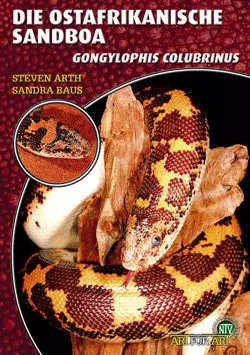
All about the East African Sand Boa
64 pages
Format 14.5 x 21 cm
Colour photos
Author Steven Arth & Sandra Baus
Contents:
Foreword
Description of the species
Relationship
Behaviour and lifestyle
Colour variations
Legal regulations
Considerations before acquisition
Acquisition of the animals
Transport and quarantine
Socialisation
Keeping in the terrarium
Terrarium and terrarium design
Terrarium technology and climate
Keeping in the "rack"
Care work
Feeding
Breeding
Sexual differences and sexual maturity
Mating trigger
Pregnancy and birth of the young animals
Housing, feeding and further rearing of the young animals
Diseases
Thanks
Further information
Literature used and further reading
NTV - Grass snakes
Thorsten Schmidt
88 pages
17 x 0.9 x 22.3cm
many colour photos
The splendidly green-coloured, diurnal and completely harmless grass snakes are much sought-after terrarium animals. The fact that they can be easily fed with insects and other invertebrates is another plus point in favour of keeping these lively snakes.This guide tells you everything you need to know to keep and breed grass snakes successfully.Thorsten Schmidt explains here from his rich experience with the animals that properly cared for grass snakes are not at all problematic, but can be easily cared for and also bred. The author explains what to look out for and gives specific tips on setting up and equipping species-appropriate terrariums.
CHF 33.50
❅
❆
❅
❆
❅
❆
❅
❆
❅
❆
❅
❆
This website uses cookies to provide the best possible experience. More information ...