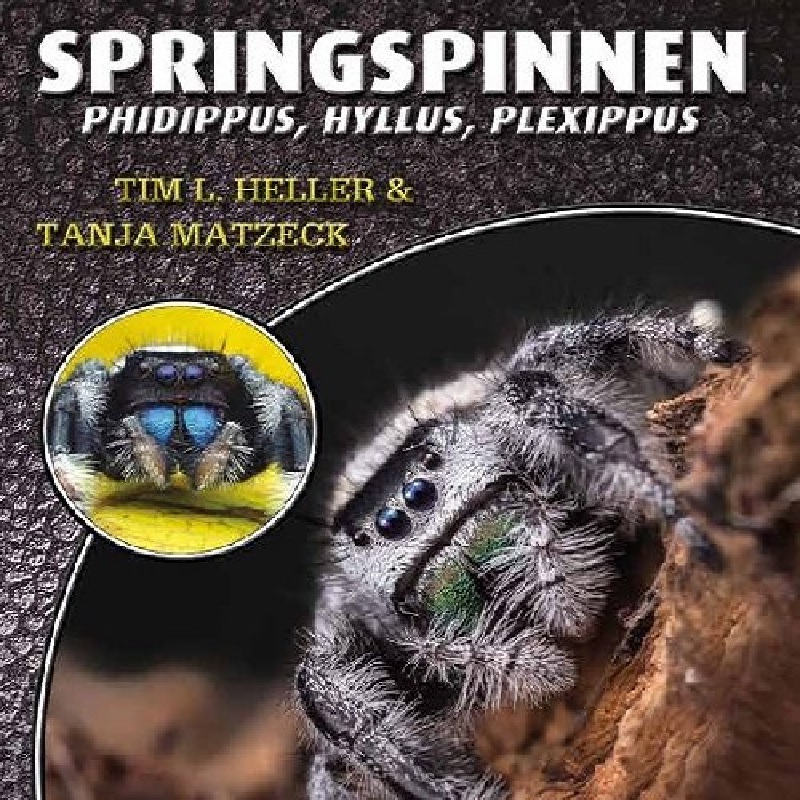
Jumping spiders Phidippus, Hyllus, Plexippus

  • Comprehensive guide for keeping, care & breeding
  • Lots of tips for successful breeding and species diversity
  • Attractively designed with colorful pictures and practical tips
Article no: BZ-48972415

CHF 23.90

Stock: 0

Ready for dispatch in 1-3 days, delivery time 14 working days

Delivery between Friday, 4 September and Monday, 7 September
Zahlungsarten
Product information "Jumping spiders Phidippus, Hyllus, Plexippus"

Book Jumping Spiders - Phidippus, Hyllus & Plexippus


A guide to keeping jumping spiders of the genera Phidippus, Hyllus & Plexippus. Who can resist the charm of jumping spiders? The childlike appearance of their expressive face simply leaves no one cold! In addition, their behavior is extremely exciting to observe, their colors are bright and their requirements for species-appropriate keeping are very easy to meet. No wonder these likeable jumpers are all the rage!

This volume in the "Species by Species" series describes in detail what to look out for when buying and keeping them, introduces the most commonly kept species and color forms and provides plenty of tips on how to keep them successfully - so you can be sure they will breed well!

Species by Species introduces you to the books in this series, which present the most popular terrarium animals. Each volume offers you detailed, practical care instructions and all the information you need to successfully breed your animals.

All important questions from the required tank size to terrarium set-up, technical equipment, species-appropriate nutrition and disease prevention are answered with numerous tricks and tips.

Experienced, long-standing breeders reveal how you can encourage the animals to reproduce and raise healthy young.

All this in full color, generously illustrated and attractively designed - just about your terrarium animal - species by species

Composition
Feeding recommendation
Technical details
Size information

0 of 0 reviews

Give us a rating!

Share your experience with the product with other customers.


Suggested products

Handbook of food plants for tortoises and other reptiles
Handbook of forage plants 2nd revised editionMarion Minch is not only a successful breeder of diverse tortoises for many years, but also an excellent connoisseur of native wild herbs. She founded and runs samenkiste.de, which is well known to many tortoise keepers and nature lovers. Her name is inextricably linked with reptile care and species-appropriate nutrition for tortoises. Her handbook of food plants summarises the most important native food plants for herbivorous and omnivorous reptiles. She not only considers tortoises, but also iguanas, spiny-tailed dragons and even chameleons. From the basics of plant biology to native wild herbs to suitable food plants for hardy tropical reptile species, this comprehensive work provides the basis for species-appropriate keeping. In the expanded and supplemented 2nd edition, the plant section is divided according to flower colour. This makes it even easier to identify wild herbs. The work has also been supplemented with a wealth of additional information and many pictures.

CHF 46.50

Geckos
Geckos in the terrarium by Astrid FalkThe book offers a comprehensive introduction to geckos and their species-appropriate keeping in terrariums. It explains what you need to think about before buying a gecko and what preparations should be made. The book describes in detail how the terrarium is technically equipped and set up. The care of the animals, their special features and behaviour, their diet, reproduction and rearing of young animals are described, as well as diseases and husbandry problems with tried and tested suggestions for prevention and treatment. Individual gecko species that are particularly suitable for keeping and breeding in terrariums are portrayed in detail in the second part of the book.

CHF 28.50

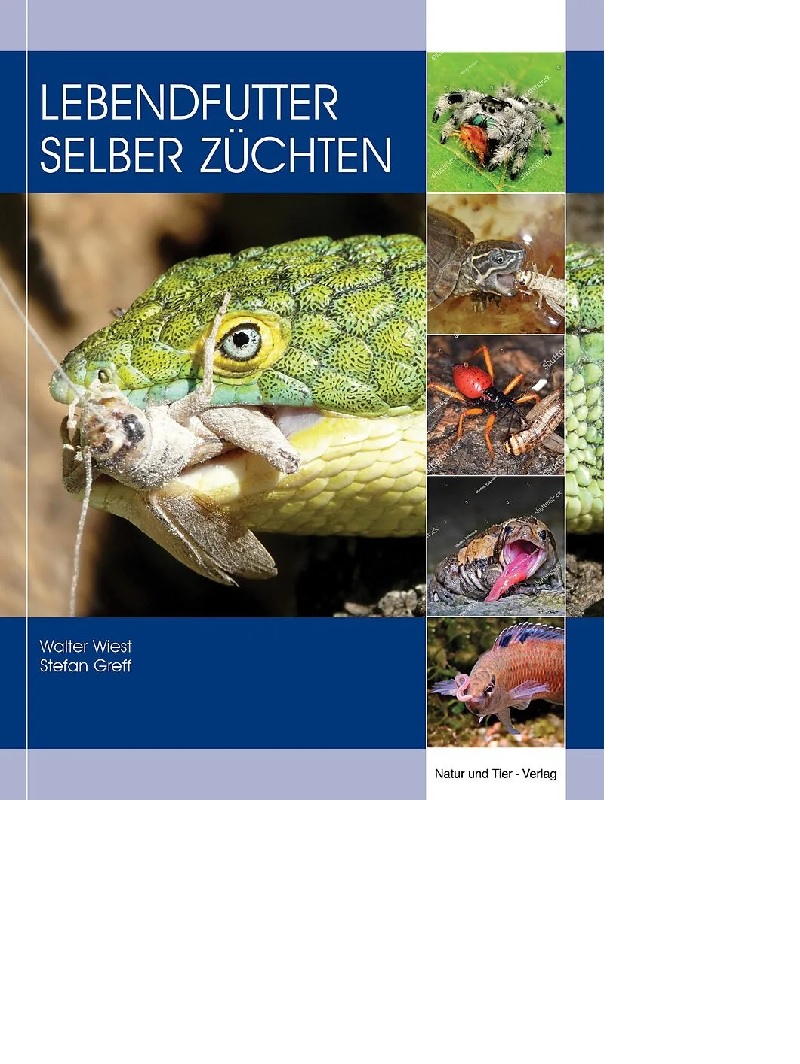
Book Breeding live food yourself
Book "Grow your own live food" - The perfect guide for pet owners Discover practical and detailed instructions on how you can easily breed food for your reptiles, birds, fish or other animals yourself in the book "Breeding live food yourself". With valuable tips on various food insects, their care and breeding, you can save money and ensure a species-appropriate diet for your pets. Contents of the book: Step-by-step instructions for breeding feeder insects Information on the best types of food for reptiles, birds and fish Care instructions and breeding conditions for various live food species Tips for sustainable and cost-effective food production Why breed your own live food? Get healthy, fresh food for your animals Save money and reduce dependence on pet shops Promote the health and well-being of your animals with species-appropriate food Whether you are a beginner or an experienced pet owner, this book provides you with everything you need to successfully breed live food yourself.

CHF 46.50

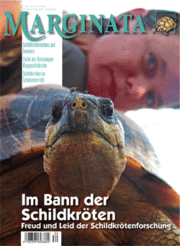
Marginata 69 - New Guinea tortoises
Marginata 69 - New Guinea tortoises – the genus ElseyaCover storyThe unrecognised beauties: New Guinea tortoises (Andreas S. Hennig)My experiences with Branderhorst's New Guinea tortoise, Elseya (Elseya) branderhorsti (Ouwens, 1914) (Andreas S. Hennig)Keeping and breeding of Rhodin's New Guinea tortoise, Elseya (Hanwarachelys) rhodini Thomson, Amepou, Anamiato & Georges, 2015 (Andreas S. Hennig)PortraitGeoemyda spengleri, Chinese serrated tortoise (Andreas S. Hennig)ReportageMacrochelys temminckii – Experiences and impressions with vulture tortoises part 2 (Reiner Praschag)KeepingAn alternative to year-round keeping of the Egyptian tortoise in the terrarium – my experiences with seasonal outdoor keeping of Testudo kleinmanni (Ricarda Schramm)EtymologySawbacks and living maps part 4: Graptemys gibbonsi, Pascagoula humpback tortoise (Holger Vetter)Classifieds & animal placement

CHF 16.50

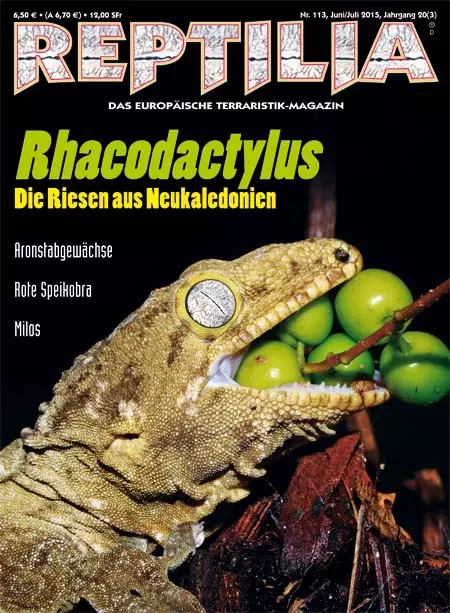
Reptilia 50 - Giant turtles
Reptilia 50 - Giant tortoisesStilt-walker iguanaBushmasterCollar lizardContents: 2 REPTILIA for the 50th anniversary 12 BIG PRIZE PUZZLE 15 DATES 18 WESTERN HERP PERSPECTIVESThe king python pyramidby B. Love 20 PHOTO REPORTAGE Giant tortoisesby J. Vaverde 28 HERPETOFAUNAThe spur-thighed tortoises (Centrochelys sulcata)The tortoise that cries by B. Deveaux, SOPTOM 34 REPORTAGEThe El Niño phenomena of 1995/96 and 1997/98 and the giant tortoises (Chelonoidis nigra vandenburghi, Chelonia: Testudinidae) on the Alcedo volcano, Isabela, Galápagos by C. Márquez, H. Snell & H. Snell 38 REPORTAGEProtection of the Seychelles giant tortoises by J. Gerlach 42 TRAVELPulau Tioman - Pearl in the South China SeaPart 1 by W. Grossmann & F. Tillack 51 PORTRAIT AND POSTERPhrynohyas venulosaby H. Werning 56 KEEPING AND BREEDINGThe Central American Bushmaster (Lachesis stenophrys COPE, 1876) in the terrarium by A. Hohmeister 64 KEEPING AND BREEDINGThe high world of the stilt-walking iguanasor: My experiences with keeping Plica plicaby S. Flicke 68 KEEPING AND BREEDINGA real dinosaur in the terrarium: the Australian ruffed lizard (Chlamydosaurus kingii)by T. Hörenberg 74 REPORTAGEThe survival of the tasty green iguana - New approaches to species and habitat conservation for Iguana iguana, with notes on Caiman crocodilus fuscusby K. Kunz 85 CLASSIFIED ADS 92 RAT & TAT 93 LIBRARY 104 GLOSSESIn search of Uracentron azureumPart 2by H. Werning

CHF 11.20

Marginata 8 - Panther tortoises
Marginata 8 - Panther tortoises Food plants 3Pakistani tortoisesEuropean pond turtles Contents: 2 EDITORIAL 3 READER LETTERS 5 MAGAZINE 9 DATES 10 PHOTO REPORTAGE Panther tortoises (Stigmochelys pardalis (Bell, 1828)) Hans - Dieter Philippen 16 BREEDING IN HUMAN CARE Breeding of the South African panther tortoise (Stigmochelys p. pardalis (Bell, 1828)) at Prague Zoo (Czech Republic) – Initial findings Petr Velensky & Natasha Velenska 21 BREEDING IN HUMAN CARE Biotopes of the panther tortoises (Stigmochelys pardalis (Bell, 1828)) as well as information on the care and breeding of the subspecies S. pardalis babcocki (Loveridge, 1935) Bernd Wolff 31 PORTRAIT Three-keeled black-bellied tortoise, (Melanochelys tricarinata) (Blyth, 1856) Hans - Dieter Philippen 36 FIELD RESEARCH Comments on the morphology, biology and distribution of the Baluch tortoise (Agrionemys horsfieldii baluchiorum (Annandale, 1906)) Muhammad Sharif Khan 43 REPORT Albino Marginated Tortoise (Testudo marginata) Hans - Dieter Philippen 44 REPORT Harriet – at 175 years old, probably the oldest vertebrate on earth Alf Jacob Nilsen 46 REPORT Food plants for tortoises part 3 Susanne Vogel 52 REPORTAGE The last pond turtles in the east of Slovakia? Stanislav Danko 58 BOOK TIP 61 CLASSIFIEDS 62 REGIONAL GUIDE 64 AGATHA MARGINATA

CHF 14.70

Draco 57 - Snakes: Colour and drawing breeding
Draco 57 - Snakes: Colour and markings breedingsContents:Editorial Variety is the trump cardHans - Dieter Philippen Colour forms in garter snakes. A look into the past, the present and the trends of tomorrowDaniel GrübnerHurricane Season Hans-Jörg WinnerSturdy beauties. Colour and pattern variations in PituophisBernd SkubowiusThe latest trends in breeding the green tree python Marcel HoffmannChoose the diamond! Colour and pattern types of diamond pythonsMarc Mense A look at colour breeding in Pantherophis guttatusStephan Drees Colour and pattern forms in the western hook-nosed snakeFilip LonghitanoReal rarities: Colour varieties of the grey-banded king snake Malte Hornig

CHF 32.00

Reptilia 77 - Moss frogs - the genus Theloderma
Reptilia 77 - Moss frogs - the genus Theloderma Travelling antsStar tortoiseAnolis roquet summus Contents: The fantastic masters of camouflage of the Asian frog genus Theloderma (moss or lichen frogs) are highly sought-after, extremely attractive terrarium inhabitants. Several species are endangered and urgently require conservation breeding projects – another reason to strive for their propagation. And the fact that their representatives also display many interesting behaviours, such as waving with the hind legs or “toe-twitching” in the context of catching prey, makes working with them even more exciting.REPTILIA editor Kriton KUNZ, who maintains one of the world’s most species-rich Theloderma collections, along with the Russian Theloderma experts Sergei RYABOV and Ivan ARININ, present these remarkable frogs in detail in the feature topic of this REPTILIA. Table of contents: EDITORIAL MAGAZINEBreakthrough in REPTILIA’s nose frog project: opening of a research and breeding station in Conceptión/Chile in collaboration with Leipzig Zoovby H. Werning DATES WESTERN HERP PERSPECTIVESThe hidden value of reptile excursions vby B. Love PHOTOSTORYMarvellous masters of camouflage. The moss frogs of the genus Thelodermaby K. Kunz KEEPING AND BREEDINGKeeping and breeding of Theloderma gordoni in the terrarium vby I. Arinin KEEPING AND BREEDING Experience with the first breeding of paddle frogs of the species Theloderma horridum in the Exotic Terrarium of the City of Tula vby A. A. Evsyunin TRAVEL EPiece of paradise. The Pouso Alegre in the Brazilian Pantanal from the perspective of a reptile friend. Part 2by M. Hallmen PORTRAIT and posterKinabalu bamboo viper. Parias malcolmiby J. M. Dehling KEEPING AND BREEDING The banded hook-nosed snake of the genus Lystrophis. Keeping and breeding a little beauty by A. Hutwalker REPORT First confiscated, then bred: Star tortoises (Geochelone elegans) at Allwetterzoo Münster vby J. Scholdei REPORTTravelling ants. Predatory nomads of the tropics vby D. J. C. Kronauer KEEPING AND BREEDINGBeauty has a name: Anolis roquet summus (Lazell, 1972) vby H. Herfurth LIBRARY ALSO IN YOUR AREA SUBSCRIPTION & SERVICE PREVIEW INCUBATOR In wild Wedding. An Eastern in two parts for three young men of “southern appearance”, a reptile researcher and a cockroach – Part 2 vby H. Werning

CHF 12.00

The dwarf bearded dragon
All about dwarf bearded dragons by Martin Dieckmann 64 pages Format: 14.8 x 21 cm 55 colour photos Paperback Author Martin Dieckmann Contents: Systematics and body structure  The fascinating biology: From the life of the dwarf bearded dragon All information on species-appropriate keeping: from suitable terrariums to equipment and technology to feeding Successful breeding: Mating stimulation, incubation of eggs and rearing of hatchlings Solutions to problems: How to avoid the most common mistakes in care and how to help sick animals Brilliant photos

CHF 18.50

Reptilia 121 - More light - Terrarium lighting for sun-loving reptiles
Reptilia 121 - More lightTerrarium lighting for sun-loving reptiles CubaTerrarium for emerald monitor lizardsPeacock-eyed terrapinsContents:Cover story: More light! – Terrarium lighting for sun-loving reptilesThere are few topics that occupy terrarium keepers as much as the question of the right lighting, especially for sun-loving species. Which lamps give off the most light, how do I ensure that my animals get enough UV rays, what do I need to do to provide the ideal lighting? In our cover story, we take a closer look at this sometimes complex subject and analyse the suitability of HQI spotlights & co. as terrarium lamps. EditorialMAGAZINEDATES WESTERN HERP PERSPECTIVESA political view of today's terrarium challengesB. Love REPORTAGEThe right terrarium lighting for chameleons and other reptilesM. Grimm Terrarium technologyMetal halide lamps in terrariumsU. Geissel Keeping and breedingPeacock-eyed terrapins. The genus SacaliaM. Rogner ReportageA lifelong dream comes true. 40 years Reptile House UnteruhldingenA. Kwet TerraristicsA terrarium for the emerald monitor (Varanus prasinus)S. & S. Leber SERVICE Animals of our homelandThe little water frogR. Leptien ALSO NEAR YOU JourneyCuba all inclusive. Part 2: the centre and the westI. Kober PREVIEW BRUTKASTEN A day with ReinerJ. Bulian

CHF 12.00

NTV, Discover the amphibians
NTV, Discover the amphibians and learn all about these animals. 56 pages colour photos throughout Large format: 20.7 x 28 cm Hardcover Author Kriton Kunz Contents: Every child knows a frog that swims around in its pond and croaks cheerfully, or the black and yellow fire salamander. But how do these friendly animals live? What do they eat, how do they survive the winter? How does a tadpole become a small frog? And what other amazing amphibians are there? "Entdecke die Amphibien" explains what amphibians are, their special features and their incredible abilities in an entertaining and child-friendly way. Fantastic records from the world of frogs, salamanders and the like are included, as well as an exciting quiz about these colourful survival artists. Including 20 great stickers 

CHF 17.90

Reptilia 95 - Chameleon & Co. The genus Furcifer
  Krokodil-AnlageAsiatische FalltürspinnenHaltung von Schmuckschildkröten Inhalt: Das Pantherchamäleon, Furcifer pardalis, gehört zu den beliebtesten Echsen überhaupt. Diese extrem farbenprächtigen, imposanten Chamäleons aus Madagaskar werden inzwischen in verschiedenen Lokalformen erfolgreich und dauerhaft in unseren Terrarien nachgezüchtet. Die Gattung Furcifer hält aber noch viele weitere hochinteressante Arten bereit – freuen Sie sich auf ein in jeder Hinsicht buntes Titelthema mit viel Praxisbezug! EDITORIALMAGAZINTERMINEIN 5 JAHREN UM DIE WELTBrüllaffen, Klappschildkröten und VulkaneA. PachmannWESTERN HERP PERSPECTIVESAuf Reptiliensuche in AustralienB. LoveFOTOSTORYChamäleons der Gattung FurciferP. NecasHERPETOFAUNAAbenteuer Komorenchamäleon – auf der Suche nach Furcifer cephalolepisR. LeptienPORTÄTIm Porträt: das Teppichchamäleon, Furcifer lateralis P. NecasIm Porträt: das Pantherchamäleon, Furcifer pardalisP. NecasZUCHTDie Entstehung einer neuen Designermorphe der Kornnatter (Pantherophis guttatus)A. SchmidHALTUNG UND VERMEHRUNGPhilippinenkrokodile (Crocodylus mindorensis) im Aquarium des Kölner Zoos. Teil 2: Bau einer Schauanlage für eine der am stärksten bedrohten Krokodilarten der Welt T. Ziegler, R. Sommerlad, W. Brass, K. van der Straeten, D. Karbe & A. RauhausHERPETOFAUNAAuf dem Weg ins All. Die Welt der Buchstaben-Schmuck-schildkröte, Trachemys scripta. Teil 5: Haltung und Vermehrung von Buchstaben-SchmuckschildkrötenA. S. HennigWIRBELLOSEAußergewöhnliche Falltürspinnen aus Asien: die Gattung Cyclocosmia F. Schneider, B. F. Striffler & I. WendtABO & SERVICETerrarienschauanlagen international Der „Rimba Reptile Park“ auf Bali M. HallmenTiere unserer Heimat Die ErdkröteR. LeptienBibliothekTipps & TricksTestlaufAUCH IN IHRER NÄHEREISEZwischen Anolis und Cycluren: Unterwegs auf Puerto RicoH. WerningVORSCHAUBRUTKASTENIguana chilena, Teil 2 H. Werning  

CHF 12.00

Customers also saw

Tropical plant - rainforest terrarium
Tropical plant for the rainforest terrarium assorted and mixted for rainforest terrariums For a great accent in your terrarium! The plants are delivered by us sorted according to the stock. You will not receive the whole assortment shown, but as many pots as you order.

CHF 6.50

LifeTarrium for small interbrates
Acrylic LifeTarrium by Lucky ReptileThe LifeTarrium is a high-quality acrylic terrarium for scorpions, tarantulas and small invertebrate species like millipedes or mantids. The LifeTarriums can also be used to temporarily hold food animals.Made of high-quality acrylicthe Tarrium can be easily assembled and disassembled again.The trap door closes magneticallywith two different lids (depending on lighting)available in four different sizesThe assembly is very simple. First, the protective films must be removed from all acrylic parts. Then the individual parts are plugged together and fixed with the transparent rubber ring outside.When inserting the trap door must be observed, depending on the size, that the magnets meet so that the door also closes.The delivery is without decoration.

From CHF 44.90

Cork back panel 58,5x41x2cm
Cork back wallDesign and furnish your terrarium with this natural cork background.Natural cork background with an attractive appearance.Can be adapted with cutting toolsSuitable for tropical and desert animalsDimension: 58.5 × 41 × 2 cm

CHF 49.90

Exo Terra Natural Terrarium Nano
Variant: 20x20x20cm | Variant (1): 20x20x20cm
Exo Terra Nano Terrarium (20x20x20xcm) Designed by European herpetologists for small insects, invertebrates and amphibians Ventilation through the front window  Waterproof bottom (1) Raised bottom frame (2) Top made of fine-meshed stainless steel (3) Lock to prevent “escapes” (4) Mesh screen cover can be easily attached (5) Closable holes for hoses and/or cables (6) Recesses at the back for hoses and/or cables (7) Suitable for the Compact Top Nano PT2224 20x20x20cm or 20x20x30cm The Exo Terra terrarium is the ideal home for reptiles and amphibians, designed by European herpetologists. The front-opening doors allow easy access for feeding and care. A special locking mechanism prevents “escapes” and the doors can be opened independently of each other. The fine-meshed metal mesh top and the associated good ventilation allow UVB and infrared light to penetrate into the terrarium. It can be easily removed completely for decoration or cleaning purposes. At the back of the top there are 5 sealable cable ducts on both sides for attaching heat stones, waterfalls, sensors etc. inside the terrarium. The base of the terrarium is raised so that a substrate heater can be fitted to heat part of the enlarged base area. The extra high front windows are ideal for thick layers of substrate (so that reptiles can burrow), for water points (paludarium) or to install an Exo Terra reptile cave. The lifelike background is in the same colour as all other Exo Terra decorative items and offers extra space for climbing.  ATTENTION: The animals shown are NOT suitable for this size of terrarium! Background included!  The Exo Terra stone motif background is an exceptionally lifelike background that can be easily cut to size. It creates a multi-dimensional home that is ideal for climbing reptiles or can simply be used to embellish the natural terrarium. Its colour and texture is the same as all Exo Terra decorative items to create a perfectly harmonised terrarium environment, wet or dry.

CHF 49.00

House flies (Musca domestica)
Contents Food animals: 1/2 liter
House flies - Musca domestica House flies (Musca domestica) are comparable to European house flies, but house flies cannot fly properly, instead they can only hop a few centimetres. unable to fly for reptiles and amphibians House flies are comparable to European house flies, but specimens with crippled wings have also been selectively bred, so that house flies also cannot fly properly but can generally only hop a few centimetres.However, this genetic defect is not dominant. This means that if the flies are mixed with flight-capable animals, the offspring are predominantly able to fly again. In this case, the flight-capable animals must be sorted out before further breeding can take place. House flies are offered either in breeding batches or in the form of washed-out pupae. Order by Sunday evening - delivery on Thursday Orders received by Sunday evening will be dispatched by A Mail on Wednesday or Thursday.Please provide a recipient address where the parcel can also be delivered.We accept no responsibility for parcels delivered late or collected late. Even with the greatest care, it can happen that feeder animals die due to temperature fluctuations or unpredictable events. We accept no liability for this.  

CHF 5.90

Live food vinegar eel
Essigaelchen - live food for small ornamental fish Vinegar lakes are suitable for any type of fry.But especially fish with small mouths such as small guppies, characins or danios, this is an optimal starter food. Suitable for the smallest fryFast growth and vital fish – due to high nutrient contentFast reproduction of the vinegar liceswim freely and live long in the aquariumvery easy maintenance, as breeding stock can stand for several months The batch contains: 200 ml sealable PET culture bottleVery many acetic lattices in about 150 ml of culture liquid (enough to quickly make 1 liter of mixtures yourself)Cultivation instructionsHow do I grow and feed the vinegar lice? Mix the fruit vinegar/apple cider vinegar with water in a 1:1 ratioa piece of sugar cube and a little dry yeast serve as food (already included in the breeding mixture). Lid may only rest on the opening, because the acetic lice need oxygen.For feeding, carefully add the culture liquid with the Essigälchen up to about 3 cm below the edge in a Schnapps bottle/Erlenmeyer flask with a thin neck. Insert cable ties and filter floss so that the floss is just covered by the liquid. is covered. Fill with normal water and wait 1 day.Aspirate the vinegar dish with the pipette over the absorbent cotton and feed directly.Put liquid from the liquor bottle back into the breeding bottle.

CHF 11.90

Thermo Mat / heating mat
Variant: 3 Watt - 10x12.5cm | Variant (1): 3 Watt - 10x12.5cm
Lucky Reptile Thermo Mat heating mat for terrariums  Emits infrared radiation Animals and objects are warmed Attachment outside the terrarium, e.g. under the terrarium, on the sides or the ceiling Extra flat for flexible installation Easy installation thanks to self-adhesive backing Special design for optimum heat dissipation Reduces the risk of overheating Lucky Reptile Thermo Mat heating mat, 3 watts, 10 cm x 12.5 cm Lucky Reptile Thermo Mat heating mat, 7 watts, 15 cm x 28 cm Lucky Reptile Thermo Mat heating mat, 14 watts, 28 cm x 28 cm These heating mats emit infrared radiant heat similar to ceramic heaters. The radiation directly warms objects and animals and only slightly increases the air temperature. This makes it easier to achieve and control the temperature gradient necessary for many reptiles in the terrarium. The heating mats are equipped with a self-adhesive film and can therefore be easily installed. Thanks to the radiant heat, these heating mats can be installed not only on the floor but also on the sides or the lid of the terrarium. The special design of the heating mat is characterised by optimum heat distribution and thus reduces the risk of overheating. ATTENTION!Most floor substrates (beech shavings, bark substrates, sawdust etc.) are not suitable for use with underfloor heating. Please inform yourself and in this case install the heating mat on the side of the terrarium. For safety reasons, we recommend only using heating mats with a thermostat.Please observe the instructions for use with the safety notes!

CHF 27.50