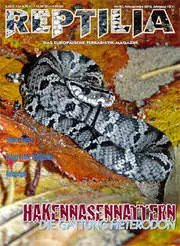
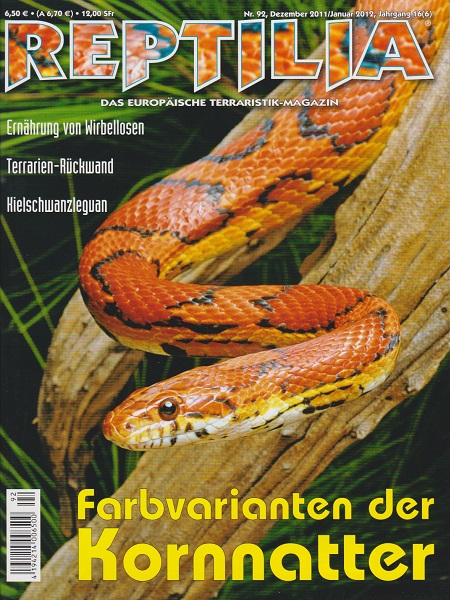
Reptilia 92 - Color variations of the corn snake

Article no: reptilia92

CHF 12.00

Stock: 0

Ready for dispatch in 1-3 days, delivery time 7 working days

Delivery between Monday, 31 August and Tuesday, 1 September
Zahlungsarten
Product information "Reptilia 92 - Color variations of the corn snake"

Reptilia 92 - Color variations of the corn snake

Ernährung von Wirbellosen
Terrarien - Rückwand
Kielschwanzleguan

Inhalt:

Inhalt
Immer neue, immer spektakulärere Farb- und
Zeichnungsformen der Kornnatter drängen ins Hobby. Wie bei kaum einer anderen Art haben die Züchter bei dieser Schlange ihre Kunst auf die Spitze getrieben aus dem Klassiker der Terraristik wurde so auch ein topmodernes Terrarientier. REPTILIA-Kolumnist Bill Love und seine Frau Kathy, selbst langjährig erfahrene Züchter, bieten Ihnen in mehreren prächtig bebilderten Artikeln einen Überblick über die Entwicklung der Farbzuchten und die aktuell erhältlichen Varianten, über das für die gezielte Zucht notwendige Know-how, und last but not least berichten sie aus ihrer persönlichen Erfahrung über eine ganz spezielle Morphe, die sie als Erste überhaupt erzielten.


EDITORIAL

MAGAZIN
TERMINE
WESTERN HERP PERSPECTIVES
Regelungs-Rage Von B. Love

FOTOSTORY
Den Guppys auf der Spur 50 Jahre Zucht der Kornnatter, Pantherophis guttatus
Von K. & B. Love

Haltung und Nachzucht Kornnattern vermehren Ein Rezept für Jedermann

Von K. & B. Love

HALTUNG UND NACHZUCHT
Okeetee Rising Mein Vierteljahrhundert in der Welt der Kornnattern
Von K. Love

Reise
Überleben im Sand
Eine Exkursion in die peruanische Wüste
Von G. Chavez & A. P. Mendoza

PORTRÄT und Poster
Triturus carnifex

Von B. Trapp

Herpetofauna
Auf dem Weg ins All Die Welt der Buchstaben-Schmuckschildkröte, Trachemys scriptaTeil 2
Von A. S. Hennig

Haltung und Vermehrung
Haltung und Vermehrung des Halsband-Kielschwanzleguans, Tropidurus torquatus

Von J. Luttermann

TERRARIENPRAXIS
Selbstbau der perkeften Terrarienrückwand – ein missglückter Versuch

Von L. Pfetzing & J. Egerer

ERNÄHRUNG
Hochwertige Ernährung wirbelloser Futtertiere und Terrarienbewohner – Teil 2

Von R. Lautensack & R. Hübers

Tiere unserer Heimat
Ein schützenswertes Reptil – die Kreuzotter

Von R. Leptien

Bibliothek
BRUTKASTEN
Mit den Fleisch der Feinde

Gastgeschichte von U. Hannemann


Composition
Feeding recommendation
Technical details
Size information

0 of 0 reviews

Give us a rating!

Share your experience with the product with other customers.


Suggested products

Handbook of food plants for tortoises and other reptiles
Handbook of forage plants 2nd revised editionMarion Minch is not only a successful breeder of diverse tortoises for many years, but also an excellent connoisseur of native wild herbs. She founded and runs samenkiste.de, which is well known to many tortoise keepers and nature lovers. Her name is inextricably linked with reptile care and species-appropriate nutrition for tortoises. Her handbook of food plants summarises the most important native food plants for herbivorous and omnivorous reptiles. She not only considers tortoises, but also iguanas, spiny-tailed dragons and even chameleons. From the basics of plant biology to native wild herbs to suitable food plants for hardy tropical reptile species, this comprehensive work provides the basis for species-appropriate keeping. In the expanded and supplemented 2nd edition, the plant section is divided according to flower colour. This makes it even easier to identify wild herbs. The work has also been supplemented with a wealth of additional information and many pictures.

CHF 46.50

Geckos
Geckos in the terrarium by Astrid FalkThe book offers a comprehensive introduction to geckos and their species-appropriate keeping in terrariums. It explains what you need to think about before buying a gecko and what preparations should be made. The book describes in detail how the terrarium is technically equipped and set up. The care of the animals, their special features and behaviour, their diet, reproduction and rearing of young animals are described, as well as diseases and husbandry problems with tried and tested suggestions for prevention and treatment. Individual gecko species that are particularly suitable for keeping and breeding in terrariums are portrayed in detail in the second part of the book.

CHF 28.50

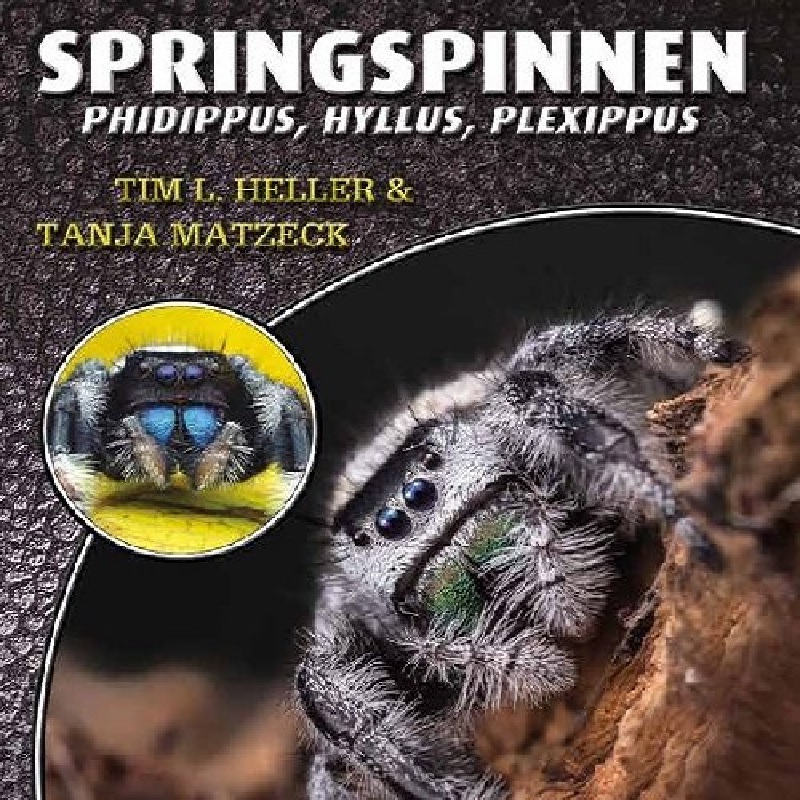
Jumping spiders Phidippus, Hyllus, Plexippus
Book Jumping Spiders - Phidippus, Hyllus & Plexippus A guide to keeping jumping spiders of the genera Phidippus, Hyllus & Plexippus. Who can resist the charm of jumping spiders? The childlike appearance of their expressive face simply leaves no one cold! In addition, their behavior is extremely exciting to observe, their colors are bright and their requirements for species-appropriate keeping are very easy to meet. No wonder these likeable jumpers are all the rage! This volume in the "Species by Species" series describes in detail what to look out for when buying and keeping them, introduces the most commonly kept species and color forms and provides plenty of tips on how to keep them successfully - so you can be sure they will breed well! Species by Species introduces you to the books in this series, which present the most popular terrarium animals. Each volume offers you detailed, practical care instructions and all the information you need to successfully breed your animals. All important questions from the required tank size to terrarium set-up, technical equipment, species-appropriate nutrition and disease prevention are answered with numerous tricks and tips. Experienced, long-standing breeders reveal how you can encourage the animals to reproduce and raise healthy young. All this in full color, generously illustrated and attractively designed - just about your terrarium animal - species by species

CHF 23.90

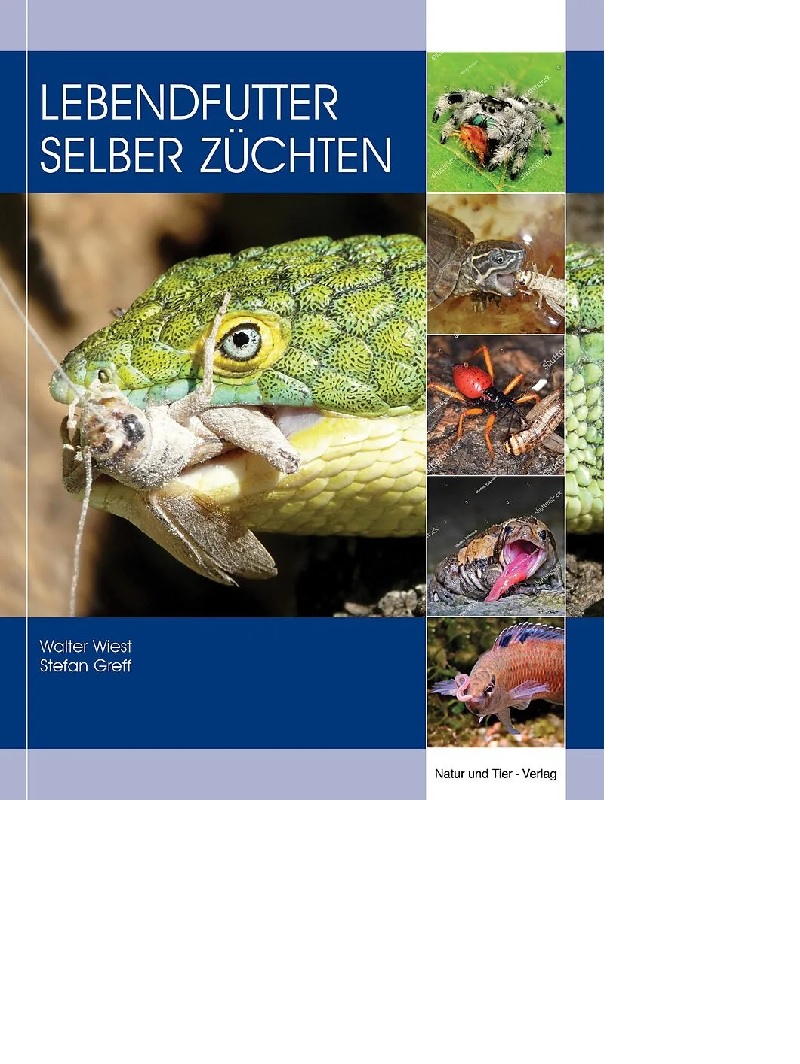
Book Breeding live food yourself
Book "Grow your own live food" - The perfect guide for pet owners Discover practical and detailed instructions on how you can easily breed food for your reptiles, birds, fish or other animals yourself in the book "Breeding live food yourself". With valuable tips on various food insects, their care and breeding, you can save money and ensure a species-appropriate diet for your pets. Contents of the book: Step-by-step instructions for breeding feeder insects Information on the best types of food for reptiles, birds and fish Care instructions and breeding conditions for various live food species Tips for sustainable and cost-effective food production Why breed your own live food? Get healthy, fresh food for your animals Save money and reduce dependence on pet shops Promote the health and well-being of your animals with species-appropriate food Whether you are a beginner or an experienced pet owner, this book provides you with everything you need to successfully breed live food yourself.

CHF 46.50

Marginata 69 - New Guinea tortoises
Marginata 69 - New Guinea tortoises – the genus ElseyaCover storyThe unrecognised beauties: New Guinea tortoises (Andreas S. Hennig)My experiences with Branderhorst's New Guinea tortoise, Elseya (Elseya) branderhorsti (Ouwens, 1914) (Andreas S. Hennig)Keeping and breeding of Rhodin's New Guinea tortoise, Elseya (Hanwarachelys) rhodini Thomson, Amepou, Anamiato & Georges, 2015 (Andreas S. Hennig)PortraitGeoemyda spengleri, Chinese serrated tortoise (Andreas S. Hennig)ReportageMacrochelys temminckii – Experiences and impressions with vulture tortoises part 2 (Reiner Praschag)KeepingAn alternative to year-round keeping of the Egyptian tortoise in the terrarium – my experiences with seasonal outdoor keeping of Testudo kleinmanni (Ricarda Schramm)EtymologySawbacks and living maps part 4: Graptemys gibbonsi, Pascagoula humpback tortoise (Holger Vetter)Classifieds & animal placement

CHF 16.50

The african rose chafer
Not just food animals! Everything about keeping and caring for African rose chafer beetles at home. 64 pages Format: 14.8 x 21 cm numerous colour photos Author Uwe Schlüter Many terrarium keepers only know them as food animals: the larvae of rose chafer beetles. However, these beautiful insects are in turn fascinating, easy-to-keep terrarium animals. Uwe Schlüter presents tropical species of rose chafer beetles from Africa that are currently in vogue, including the impressive goliath beetles. Beetle care made easy! Contents: Foreword Classification Morphology of rose chafer beetles Imagines of the Cetoniinae Larvae of the Cetoniinae Rose chafer beetles in nature Lifestyle and behaviour Life cycle Care in the terrarium Acquisition and transport Terrarium equipment and climate Socialisation Feeding of imagines and larvae Reproduction in the terrarium Egg laying Rearing the larvae Pupation and hatching of imagines Descriptions of selected species Further information Further and used literature

CHF 19.90

Reptilia 29 - King snakes
Reptilia 29 King snakes SpainDecorated spiny-tailed lizardGreenhouse terrarium Contents: 2 Editorial 3 Letters to the editor 6 Magazine 15 Dates 18 Western Herp Perspectives, The role of terrarium clubs, by B. Love 20 Photo report, The genus Lampropeltis, by P. Gérard 28 Care and breeding, Snakes of the genus Lampropeltis in the terrarium, by Dr, D. Schmidt 36 Reportage, Commentary fight in the Mexican king snake, by T. Kölpin 43 Journey, More than just a beach holiday – A herpetological excursion across the Iberian Peninsula, by B. Trapp 51 Portrait and poster, Iguana iguana 56 Care and breeding, Care and breeding of the decorated spiny-tailed lizard Uromastyx ocellata ocellata, by M. Evers 62 Care and breeding, Praying mantids (Mantodea) – An overview. Part 2: Distribution, way of life, care and breeding, identification, by R. Ehrmann 68 Care and breeding, On the care and breeding of clawed frogs (Silurana spec.)– Part 2: Rearing tadpoles and juvenile frogs, discussion and literature, by K. Kunz 73 Herpetoculture, Kambô – The frog vaccination, by R. & B. Pieper 84 Advice and action 89 Classifieds 93 Library 104 Gloss, Uni, by K. Kunz

CHF 9.80

Reptilia 111 - Rarities of snakes
Reptilia 111 - Snake raritiesAmazonian tortoisesMagnificent keel lizardMoroccoContents:Cover story: Snake raritiesSome species or subspecies of snakes have simply not managed to establish themselves in the terrarium hobby. Or they were once sought-after and regularly available, but have now completely or almost disappeared from the population. There are many reasons for this: they do not appear attractive enough at first glance, they were bred so frequently for a while that they were no longer profitable to breed, their requirements in terms of food are difficult to fulfil, they have a "bad reputation", no real lobby or are simply hardly ever imported. However, many of these mostly overlooked snakes are highly interesting and often extremely attractive, and are well worth keeping. We would like to introduce you to some of these wonderful rarities.EditorialMAGAZINEDATESWESTERN HERP PERSPECTIVESThe lamentation about terrarium fairsB. LovePhoto storySnake raritiesK. KunzKeeping and breedingWelcome back! Keeping and breeding Oocatochus rufodorsatusK. KunzKeeping and breedingThe queen of climbing snakes. Archelaphe bella chapaensis in the wild & in the terrariumS. Ryabov, I. Korshunov, T. T. Nguyen & X. WangHerpetofaunaThe magnificent keelback lizard Algyroides nigropunctatus - a little-known beauty from the BalkansM. DieckmannHerpetofaunaEncounters with turtles in the Venezuelan state of Amazonas. Part 2: TortoisesM. HeartReportageScorpions of IsraelM. Seiter & A. UllrichALSO NEAR YOUReportageThe white spring of the addersA. SchmidServicesJourneyThe herpetofauna of south-east MoroccoU. SchlüterPREVIEWBRUTKASTEN German animal welfare speaks hereH. Werning

CHF 12.00

Terraria 42 - Pond turtles
Terraria 42 - TerrapinsStrawberry FrogsCyclura nubila caymanensisContents:The Emydidae family includes some of the best-known and most popular turtles. In addition to our native European pond turtle, these include the North American ornamental and decorative turtles of the genera Pseudemys and Trachemys as well as the Terrapene box turtles. In the cover story, we provide an up-to-date overview of this interesting group and present a detailed article about the magnificent tortoise, Graptemys oculifera. We also shed light on the role that European pond turtles can play in biology lessons.TerritorialHerpetoramaCover storyThe New World terrapins of the family EmydidaeAndreas S. HennigGraptemys oculifera: Biology, Care and Breeding of the Splendid Box Turtle Part 1: Biology, Endangerment and Initial Care Experiences Ewald RoddewigThe European pond turtle (Emys orbicularis) in biology lessonsMichael FreundPanoramaTerraglobalOn safari in Zambia, or: Why do the pelomeduses flee?Alfred SchleicherPearl lizards (Timon lepidus) in the Sierra de Grazalema, AndalusiaWerner & Yvonne LantermannResearchNew speciesA Comorian gecko and the problem of the new online taxonomy Oliver HawlitschekTrachylepis cristinae, a new skink from Sokrota Axel KwetIn search of strawberry frogs in NicaraguaDiana Galindo Uribe, Javier Sunyer, Adolfo Amézquita, Gunther Köhler, Heiko Pröhl & Miguel VencesSalamandraTerraristicsClassicsThe North African spiny-tailed dragonBothriopsis taeniata, a beauty from the South American rainforestJuan TimmsHomerangeIn the realm of the little lizards. A visit to the terrarium facility of Katrin and Dietmar MistlerPatrick SchöneckerNature and species conservationField notesSubmerging under water as an escape strategy for the common lizardRudolf MalkmusGrass snakes and slow worms - hunters and huntedAndreas OchsenbeinThe smooth snake (Coronella austriaca). Reptile of the Year 2013Dirk Alfermann, Axel Kwet & Richard PodlouckyThreatened in paradiseKathrin Sawannia, Matthias Goetz & Katharina FoersterMissingVogl’s Stump-footed Frog (Atelopus vogli)Also in your neighbourhoodSubscription & ServiceGalleryHave a nice holiday! The journey is the rewardBenny TrappPreviewIncubatorExpired part 2Heiko Werning

CHF 12.00

Marginata 17 - Indochine hinge turtles
Marginata 17 - Indochinese Hinged Turtles Turtle genetics ISea turtlesFrozen food II Contents: 2EDITORIAL 3READERS' LETTERS 4MAGAZINE 8TERMINE 10REPORTAGEIntraspecific Variability of Cuora galbinifronsHerbert Becker & Hans - Dieter Philippen 16BREEDING IN HUMAN CAREObservations on the Indochinese Hinged Turtle Cuora galbinifrons galbinifronsArwin & Irmhild Hiller 22BREEDING IN HUMAN CARE Observations and experiences regarding the keeping and breeding of Cuora galbinifrons bourretiMonika & Johannes Janßen 28 BREEDING IN HUMAN CAREBreeding of Cuora galbinifrons picturataLies Niessen 31 PORTRAITSaw-backed Flat Turtle, Homopus s. signatus Hans - Dieter Philippen 35REPORTAGEFrozen food - Part IIHans - Dieter Philippen 40REPORTAGEReducing the bycatch rate of sea turtles José. Báez, Raimundo Real & Juan A. Caminas 44 REPORTAGEGenetics yesterday and today - Part IJens R. Poschadel & Martin Plath 50REPORTAGEVisit to the African island of ChanguuHorst Köhler 56REPORTAGEA house for spur-thighed tortoises - Part IIHilko Funsch 60BOOK TIP 61CLASSIFIEDS 62REGIONAL GUIDE

CHF 14.70

Marginata 7 - Magnificent tortoises
Marginata 7 - Magnificent Tortoises Food plants 2Herpesvirus in tortoisesTurkish tortoises Contents: 2 EDITORIAL 3 READER LETTERS 4 MAGAZINE 8 DATES 10 PHOTO REPORTAGE Magnificent Tortoises (Rhinoclemmys pulcherrima GRAY, 1856) Hans - Dieter Philippen 16 BREEDING IN HUMAN CARE Keeping, care and breeding of the Magnificent Tortoise Rhinoclemmys pulcherrima incisa (Bocourt, 1868) Andreas Mende & Thomas Berndt 21 BREEDING IN HUMAN CARE The Costa Rican Magnificent Tortoise (Rhinoclemmys pulcherrima manni) Fons Bänziger 26 FIELD RESEARCH The tropical dry forest in north-western Costa Rica Jan Michels 31 PORTRAIT Egyptian tortoise Testudo [Pseudotestudo] kleinmanni (Lortet, 1883) Hans - Dieter Philippen 35 VETERINARY MEDICINE An update on herpesvirus in tortoises Thomas Filip & Anna Kübber-Heiss 45 REPORTAGE Food plants for tortoises Part 2 Susanne Vogel 51 SHORT REPORT A foray through the area of Dalyan and Kaunos, Turkey Franz Hummel 54 SHORT REPORT Oh you big egg ... Heinz Frühauf 55 REPORTAGE ShellShock conservation campaign Hans - Dieter Philippen 59 RAT & TAT 60 BOOK TIP 61 CLASSIFIEDS 62 REGIONAL GUIDE 64 AGATHA MARGINATA

CHF 14.70

Reptilia 115 - Adders for the terrarium
Reptilia 115 - Adders for the Terrarium Flamingo flowersBlue rock iguanaNew Zealand mantis Contents:Cover story: Adders for the TerrariumAdders are among the classic and most popular terrarium animals. This extremely species-rich group of snakes has produced some of the most popular reptile pets. We provide an overview of the terrarium-relevant species and focus in particular on those adders suitable for beginners, among which there are many truly perfect pets. But we also have a real beauty for advanced keepers and report on the keeping and breeding of red bamboo adders. EditorialMAGAZINEDATES WESTERN HERP PERSPECTIVESThe dark sideB. Love FotostoryEvergreens in the terrarium: AddersK. Kunz PracticeAdders. Species and tips for beginnersD. Schmidt Husbandry and breedingThai bamboo adders (Oreocryptophis porphyraceus coxi) in the terrariumM. Hornig Husbandry and breedingThe New Zealand mantis, Orthodera novaezealandiae. A praying mantis from the other side of the worldB. Fuhrmann & C. Sehorz Husbandry and breedingThe keeping and breeding of the Blue rock iguana (Petrosaurus thalassinus) in the terrariumJ. Schulz PlantsArum family in the terrarium. Part 3: The genus AnthuriumB. Akeret Husbandry and breedingFirst ever natural rearing of the critically endangered Philippine crocodiles (Crocodylus mindorensis) in Europe successfulT. Ziegler, A. Rauhaus & C. Niggemann, AG Zoological Garden Cologne Animals of our homelandThe fire salamanderR. Leptien ALSO IN YOUR AREA Service TravelOn an excursion through the Colombian Amazon rainforestJ. Cañas-Orozco PREVIEW INCUBATOR Attention – more cat contentH. Werning

CHF 12.00