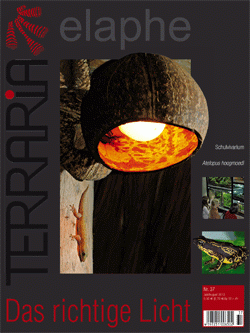
Terraria 37 - The correct light

Article no: terraria37

CHF 12.00

Stock: 6

Available, delivery time: 1-3 days

Delivery between Friday, 21 August and Monday, 24 August
Zahlungsarten
Product information "Terraria 37 - The correct light"

Terraria 37 - The right light

School vivarium
Atelopus hoogmoedi

Contents:

Cover story: The right light
Hardly any other topic in terraristics is as important and at the same time as intensively discussed as the right terrarium lighting. What do you need to look out for to ensure that your pets get the best possible replacement for sunlight in their terrarium? What do you think of new lighting technologies such as LEDs? And: How do reptiles actually perceive light? The cover story of the next issue attempts to provide some answers.

Territorial
Herpetorama

TOPIC
The fluorescent tube - a classic newly illuminated
Steven Arth

The use of UV measuring devices in terraristics
Sarina Wunderlich

Colour temperature and colour rendering index: Useful parameters in terraristics
Sarina Wunderlich

PANORAMA
Terraglobal: Close to death, part 2
Joachim Bulian

Since when do agamas eat peanuts - and crocodile bread?
Alfred Schleicher

The school vivarium at the Edith-Stein-Schule in Erfurt - much more than just animals at school
Rica Kepter & Achim Kempter

RESEARCH
New species: The frog and the prince - splendid tree frogs from Ecuador
Axel Kwet

Among researchers: Inhabitants of the elfin forest: Herpetofauna at Picu La Picucha in the Sierra de Angalta National Park, Honduras
Alexander Gutsche

News from Indochina: The amphibians and reptiles of the Cat Thien National Park in South Vietnam
Peter Geissler

Salamandra

TERRARISTICS
Classic: The Dreicksnatter

Experiences in rearing spiny-edged soft-shelled turtles (Apalone spinifera)
Sebastian Nickl

First successful breeding of the short-toed toad Atelopus hoohmoedi at the Aquazoo/Löbbecke Museum in Düsseldorf
Sandra Honigs, Marc Messing & Beate Pelzer

Some additional information on the article about the mysterious death of hatchlings of the green tree python
Joachim Bulian

NATURE AND SPECIES CONSERVATION
Field notes: Toad under ice
Stefan Meyer

Late reproduction of the fire-bellied toad in Saxony
Wolf-Rüdiger Grosse & Andreas Nöllert

Two examples of accidental anthropogenic displacement of lizards due to their flight behaviour
Andreas Arnold

Missing: Pinta giant tortoise (Chelonoides abingdonii)

Also in your neighbourhood
Subscription & Service

GALERIA
Komodo’s Centenarian Dragons

Preview

BRUTKASTEN
Crocodile alarm at the swimming lake: human tragedy narrowly averted
Jakob Hein

Composition
Feeding recommendation
Technical details
Size information

0 of 0 reviews

Give us a rating!

Share your experience with the product with other customers.


Suggested products

Handbook of food plants for tortoises and other reptiles
Handbook of forage plants 2nd revised editionMarion Minch is not only a successful breeder of diverse tortoises for many years, but also an excellent connoisseur of native wild herbs. She founded and runs samenkiste.de, which is well known to many tortoise keepers and nature lovers. Her name is inextricably linked with reptile care and species-appropriate nutrition for tortoises. Her handbook of food plants summarises the most important native food plants for herbivorous and omnivorous reptiles. She not only considers tortoises, but also iguanas, spiny-tailed dragons and even chameleons. From the basics of plant biology to native wild herbs to suitable food plants for hardy tropical reptile species, this comprehensive work provides the basis for species-appropriate keeping. In the expanded and supplemented 2nd edition, the plant section is divided according to flower colour. This makes it even easier to identify wild herbs. The work has also been supplemented with a wealth of additional information and many pictures.

CHF 46.50

Geckos
Geckos in the terrarium by Astrid FalkThe book offers a comprehensive introduction to geckos and their species-appropriate keeping in terrariums. It explains what you need to think about before buying a gecko and what preparations should be made. The book describes in detail how the terrarium is technically equipped and set up. The care of the animals, their special features and behaviour, their diet, reproduction and rearing of young animals are described, as well as diseases and husbandry problems with tried and tested suggestions for prevention and treatment. Individual gecko species that are particularly suitable for keeping and breeding in terrariums are portrayed in detail in the second part of the book.

CHF 28.50

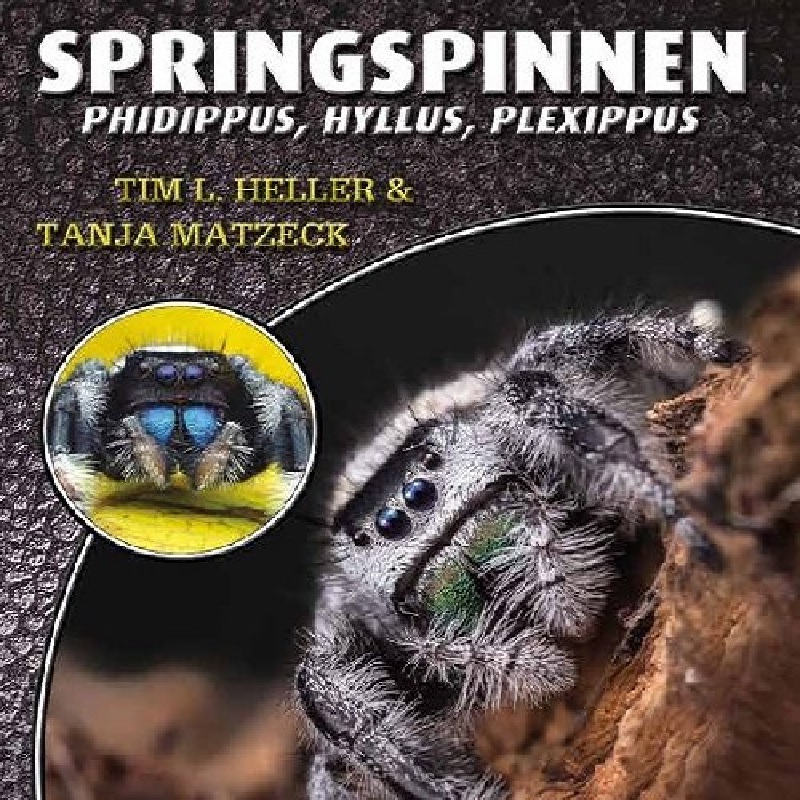
Jumping spiders Phidippus, Hyllus, Plexippus
Book Jumping Spiders - Phidippus, Hyllus & Plexippus A guide to keeping jumping spiders of the genera Phidippus, Hyllus & Plexippus. Who can resist the charm of jumping spiders? The childlike appearance of their expressive face simply leaves no one cold! In addition, their behavior is extremely exciting to observe, their colors are bright and their requirements for species-appropriate keeping are very easy to meet. No wonder these likeable jumpers are all the rage! This volume in the "Species by Species" series describes in detail what to look out for when buying and keeping them, introduces the most commonly kept species and color forms and provides plenty of tips on how to keep them successfully - so you can be sure they will breed well! Species by Species introduces you to the books in this series, which present the most popular terrarium animals. Each volume offers you detailed, practical care instructions and all the information you need to successfully breed your animals. All important questions from the required tank size to terrarium set-up, technical equipment, species-appropriate nutrition and disease prevention are answered with numerous tricks and tips. Experienced, long-standing breeders reveal how you can encourage the animals to reproduce and raise healthy young. All this in full color, generously illustrated and attractively designed - just about your terrarium animal - species by species

CHF 23.90

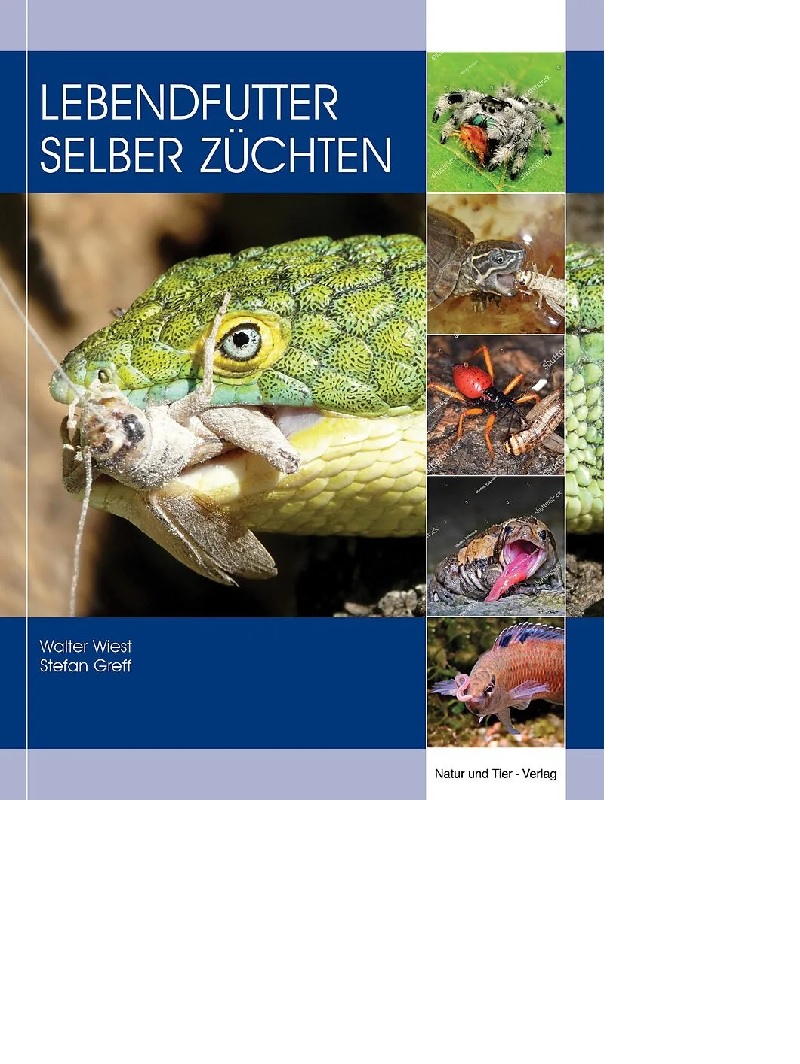
Book Breeding live food yourself
Book "Grow your own live food" - The perfect guide for pet owners Discover practical and detailed instructions on how you can easily breed food for your reptiles, birds, fish or other animals yourself in the book "Breeding live food yourself". With valuable tips on various food insects, their care and breeding, you can save money and ensure a species-appropriate diet for your pets. Contents of the book: Step-by-step instructions for breeding feeder insects Information on the best types of food for reptiles, birds and fish Care instructions and breeding conditions for various live food species Tips for sustainable and cost-effective food production Why breed your own live food? Get healthy, fresh food for your animals Save money and reduce dependence on pet shops Promote the health and well-being of your animals with species-appropriate food Whether you are a beginner or an experienced pet owner, this book provides you with everything you need to successfully breed live food yourself.

CHF 46.50

Marginata 69 - New Guinea tortoises
Marginata 69 - New Guinea tortoises – the genus ElseyaCover storyThe unrecognised beauties: New Guinea tortoises (Andreas S. Hennig)My experiences with Branderhorst's New Guinea tortoise, Elseya (Elseya) branderhorsti (Ouwens, 1914) (Andreas S. Hennig)Keeping and breeding of Rhodin's New Guinea tortoise, Elseya (Hanwarachelys) rhodini Thomson, Amepou, Anamiato & Georges, 2015 (Andreas S. Hennig)PortraitGeoemyda spengleri, Chinese serrated tortoise (Andreas S. Hennig)ReportageMacrochelys temminckii – Experiences and impressions with vulture tortoises part 2 (Reiner Praschag)KeepingAn alternative to year-round keeping of the Egyptian tortoise in the terrarium – my experiences with seasonal outdoor keeping of Testudo kleinmanni (Ricarda Schramm)EtymologySawbacks and living maps part 4: Graptemys gibbonsi, Pascagoula humpback tortoise (Holger Vetter)Classifieds & animal placement

CHF 16.50

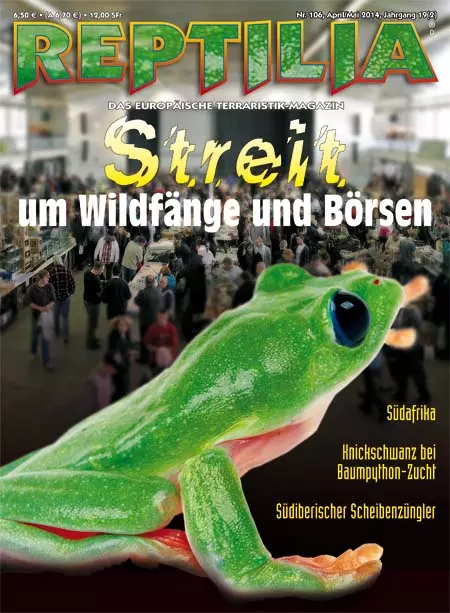
Reptilia 104 - King Pythons
Reptilia 104 - King PythonsFlagellate spidersDiamondback terrapinWraptail skinkContents:What a rise! From an eccentric that was almost impossible to feed to an almost domesticated animal bred hundreds of thousands of times in just two decades - the royal python has had an unparalleled terrarium career. We offer a colourful overview of the breeding varieties of this giant snake, present the latest new breeds, take a close look at possibly the most expensive morph and discuss the controversial issue of rack keeping in this species.EditorialMAGAZINEDATESPHOTOREPORTAGEFrom problem animal to superstarK. KunzTERRARIUM PRACTICENot animal-friendly? Comments on the rack keeping of royal pythonsS. BroghammerKEEPING AND REPRODUCTIONNew colours for the kingS. BroghammerKEEPING AND REPRODUCTION"Not without a Yellowbelly"S. BroghammerREPORTAGEChampagneS. BroghammerKEEPING AND REPRODUCTIONBreeding the diamondback terrapin, Malaclemys terrapinX. WapelhorstReportageWraptail skinks - or: Some are the same, others are more equalM. ZollwegKEEPING AND BREEDINGKeeping and breeding the African whip spider Damon variegatusE. BruinsKEEPING AND BREEDINGLong-tailed lizards from Okinawa. Terrarium keeping and breeding of Takydromus smaragdinusA. DanierLibraryWESTERN HERP PERSPECTIVESThe white magicB. LoveServicesJourneyHerpetological impressions on safaris in East AfricaM. HeartALSO NEAR YOUPREVIEWBRUTKASTEN Sexual dimorphismM. Zawadzki

CHF 12.00

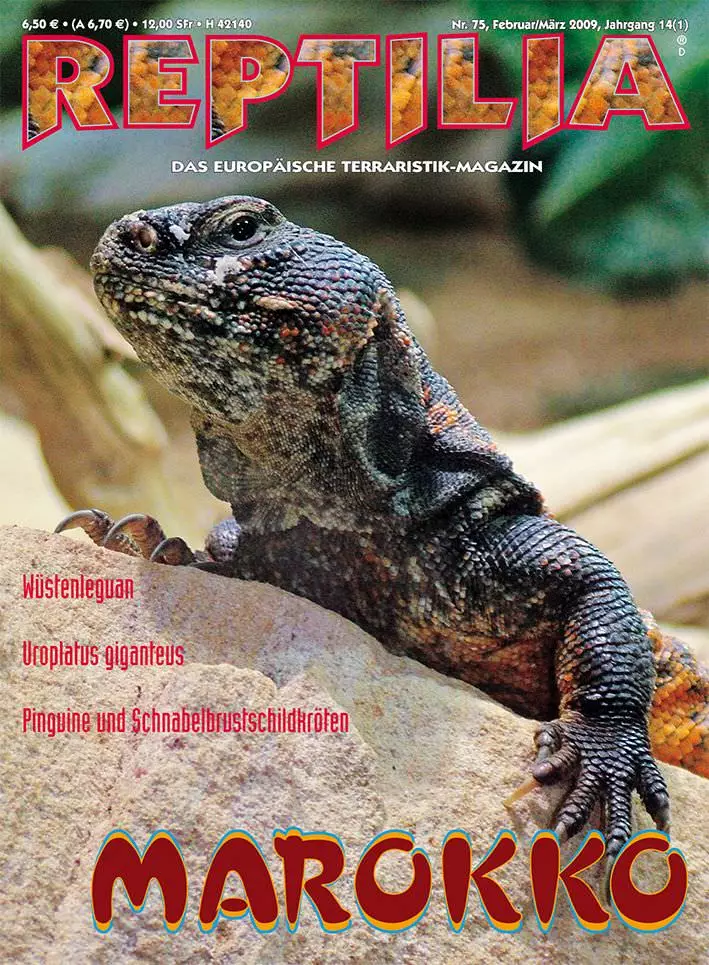
Terraria 02 - Monitor lizards and crustacean lizards
Terraria 02 - Monitor lizards and crustacean lizards Puebla King SnakeDevil's Flower Contents: 2 Editorial Axel Kwet TITLE TOPIC 4–23 • Crustacean lizards and monitor lizards: New and familiar facts about the four-footed poisonous clan Hans-Georg Horn SCIENCE 24 Herpetorama New amphibian family tree highly controversial / New names for well-known poison dart frogs 30 New species Melanophryniscus admirabilis – a brightly coloured “black toad” 32 Among researchers In the shadow of the saw – Amphibian communities in selectively logged tropical forests Raffael Ernst 36 My Home Is My Castle Experiences with the self-construction of a terrarium for a Yemen chameleon Frank Angermann 40 A new way to disinfect terrariums Hans-Peter Berghof and Ulf Schwabe 44 Melanophryniscus – not just black toads Part 1: General information on the genus Melanophryniscus Axel Kwet 54 Ornate turtles – the genus Pseudemys Part 1: Introduction, systematics, production and trade Andreas S. Hennig 59 Keeping and breeding the Puebla King Snake, Lampropeltis triangulum campbelli Thorsten Schmidt 63 The devil's flower Idolomantis diabolica (Saussure, 1869) Part 1 Christian J. Schwarz, Jürgen E. Mehl and Jürg Sommerhalder TRAVEL 71 In the land of the Jacarés – the Pantanal Part 2 Heiko Werning TERRARIUM PRACTICE 82 Test run Artificial rock furnishings from Exo Terra84 Prelude A good start: the leopard gecko (Eublepharis macularius) Sven Zeeb 88 Eye-catcher The rainforest in your living room Mike Zawadzk 93 Also in your neighbourhood 96 TERRAnet Of snakes and poisonous snakes 98 TERRAglobal Santa Catalina – Island of the rattleless rattlesnakes Karl H. Switak A new workplace, a plethora of new animals Mirco Solé 103 Preview 104 TERRAwinn

CHF 11.20

Terraria No. 34 - Basilisks
Terraria No. 34 - Basilisks ArabienNeu beschriebenen Amphibien 2011 Inhalt: Basilisk, Jesus-Christus-Echse – kaum ein Reptil ist mystisch so aufgeladen, wie die kleine mittel- und südamerikanische Leguangattung Basiliscus. Ihr bizarres Äußeres schlägt Menschen seit jeher in den Bann, ebenso ihre spektakuläre Fähigkeit, über das Wasser zu laufen. Und als Terrarientiere gehören sie zu den Klassikern, die in geräumigen Terrarien über Generationen erfolgreich zu halten und zu vermehren sind und eine wirkliche Augenweide für jedes Regenwald-Schauterrarium darstellen. Wir stellen Ihnen diese faszinierende Gattung vor, berichten über die faszinierende Freilandbiologie im „Basilisken-Land“ Costa Rica und beschreiben ausführlich die Terrarienhaltung dieser wunderschönen Echsen. TerritorialHerpetoramaChytrid – eine durch den Amphibienhandel menschengemachte Katastrophe?Axel KwetTitelthemaBasilisken. Spektakuläre Vertreter der LeguaneMichael WirthÖkologie der Basilisken und Freilandbeobachtungen in Costa RicaMichael WirthBasiliscus plumifrons, der Stirnlappenbasilisk: Erfahrungen aus 20 Jahren Haltung und Vermehrung im Terrarium. Teil 1: Einrichtung und TechnikIngo KoberTerraglobalRespekt vor GiftschlangenMirco SoléBangkok, die Flut und Grüne MambasJoachim BulianÜberraschendes Arabien 2.0. Teil 2Wolfgang Grossmann, Thomas Kowalski & Hans-Jürgen ZilgerUnter ForschernEin neues Schildkrötenschutzprojekt im Südosten Nepals – das „Budoholi Turtle Conservation Centre“Markus Baur, KaluRam Rai & Henk ZwartepoorteNeue ArtenListe der im Jahr 2011 neu beschriebenen AmphibienAxel KwetSalamandraKlassikerDie Fransenschildkröte oder Mata-MataAlexander GutscheGiftbisse von giftigen und „harmlosen“ Schlangen. Teil 1Dieter SchmidtHomerangeUnd das alles für die Schildkröten …Michael WirthNatur- und Artenschutz FeldnotizenRiesenquappe im TeichDie Rote Liste der Amphibien und Reptilien Deutschlands. Teil 1: Werdegang und ErgebnisseKlaus-Detlef Kühnel, Arno Geuger & Richard PodlouckyVermisstStuarts Wurmsalamander (Oedipina stuarti)Alexander GutscheAbo & ServiceAuch in Ihrer NäheGalerieGeschmeidige SchlangenKriton Kunz VorschauBrutkastenZimmer freiHeiko Werning  

CHF 12.00

Terraria 59 - The Fire Salamander
Terraria 59 - The Fire Salamander Newly described reptiles 2015Tyrol Contents: Cover story: The Fire Salamander - Amphibian of the Year 2016The colourful fire salamander, which was named Amphibian of the Year 2016, has achieved great popularity worldwide. Not only in terraristics, where the animals have been successfully kept and bred for decades, but also as a symbolic and flagship species in national and international species conservation. We present the different aspects of this species in detail and address the current threat posed by a microscopic fungus that is currently threatening wild populations, but also discuss measures that terrarium keepers can take to prevent or control its rapid spread. TerritorialHerpetoramaA headbutt with consequences – tree frogs with deadly venomDornteufel: Grass snakes without ringletsCultural follower: Frog with castleBlattsteiger: Lizards against Stuttgart 21A frog as acrobatSecond helping Cover storyLong live the salamander: Amphibian of the Year 2016Axel Kwet, Philine Werner & Ulrich Schulte Fire salamander – keeping and breeding a famous amphibian. Part 1: Terrarium, set-up and careYvonne & Thomas Klesius Batrachochytrium salamandrivorans. The new threat to tailed amphibiansPaul Bachhausen The fire salamander as a favourite and flagship species in the Thuringian Slate Mountains. Experiences from a volunteer projectManfred Klöppel PanoramaExcursion between the Grossglockner and Lienz DolomitesRolf Leptien In search of the Lebanese mountain viper (Montivipera bornmuelleri)Alexander Eppler Research New speciesList of reptiles newly described in 2015Axel Kwet Salamandra TerraristicsElaphe dione – an attractive snake in the terrariumHelmut Kantz Nature and species conservation Field notesMorphology follows genetics: A characteristic to distinguish two crested newt species from TurkeyUwe Gerlach & Michael Fahrbach Juvenile adder consumes adult common lizardChristoph Klaus, Andreas Nöllert & Siegfried Klaus The American Crocodile Education Sanctuary (ACES) in BelizePeter Janzen Terrarino – the children's page Comb on, newt!Ute Nüsken Subscription & Service Also in your areaPreview Incubator Herpetologists' Hostel WeddingHeiko Werning

CHF 12.00

Terraria 38 - Corn snakes naturally beautiful!
Terraria 38 - Corn snakes naturally beautiful!End of the world? Mayan mysticism and reptilesBush crocodileContents:Cover story: Corn snakes - naturally beautiful!There are now countless colour morphs of the corn snake that have been selected by breeding, products of a veritable reptile industry, often reared in the controversial rack-keeping method. This almost threatens to make us forget that these North American snakes also occur in the wild and have adapted to their habitat. How exciting it is to observe these best-known terrarium snakes in their natural habitat and how diverse the colour and pattern variations are, even in "natural corn snakes", is shown bywill be the cover story of the upcoming TERRARIA/elaphe. TerritorialHerpetoramaCover storyThe local varieties of the corn snake (Pantherophis guttatus)Bernd SKUBOWIUSA visit to the prairie corn snakes in TexasBernd SKUBOWIUSThe Slowinski's corn snake, Pantherophis slowinskii: a rare guest in German terrariumsBernd SKUBOWIUSPanoramaTerraglobalBeware of toolboxes and ventilation holesLester MELÉNDEZThree years of photo safaris through Asia and OceaniaAntonia PACHMANNResearchNew speciesA new belted tail from the Katanga region in the CongoChristian SCHNEIDER & Mirko BARTSTwo new "little hammers" from Panama's tropical forestAndreas HERTZAmong researchersDry forest habitat - the Menabe region in western MadagascarJulian GLOSNew names and old acquaintances - genus revision of the New Caledonian giant geckos (Rhacodactylus) and other gecko genera of New CaledoniaPatrick SCHÖNECKER & Christian LANGNERSalamandraTerraristicsClassicsThe charcoal tortoiseAlexander GutscheF2 offspring of the Laos warty newt (Laotriton laoensis) - an example of a successful conservation breeding project in the newt register of the DGHT-AG UrodelaPaul BACHHAUSENFirst experiences with the New Guinea helmet skink, Tribolonotus novaeguineaeJochen MEYERHomerangeIn the bath with Anolis - a visit to Uwe BarteltHeiko WERNINGNature and species conservationField notesLate discovery of sand lizards in the Hainich National Park (Thuringia)Andreas NÖLLERTPond newts as transport hosts for puffer musselsStephan BÖHMUnusual spawning site of the grass frog, Rana t. temporaria, in a phytotelm in the Hainich National Park, ThuringiaAndreas NÖLLERTMissingWolterstorff's newt (Hypselotriton woltersdorffi)Also in your neighbourhoodSubscription & ServiceGalleryEnd of the world moodPreviewIncubatorBreaking Bad WeddingHeiko WERNING

CHF 12.00

Draco 59 - Spectacular invertebrates
Draco 59 - Spectacular Invertebrates Contents: Editorial Spectacular diversity in the terrariumTimm AdamGreat jumpers – jumping insects in the terrariumTimm AdamGiant water bugs (Belostomatidae) and water scorpions (Nepidae) in the aquaterrariumTimm Adam & Hermann ElsasserSpectacular arachnids: whip spiders and whip scorpionsMichael SeiterThe largest invertebrates in the terrarium Timm AdamEnigmatic creatures: hooded spidersFrederic Schramm, Michael Seiter & Johannes NiglSymphony in blue – The large diplurid Linothele megatheloides in ColombiaJorge Cañas-Orozco Giant beetles: armoured insect giantsTom Schouteet & Mark van Bergen   The extraordinary arthropods of the family LiphistiidaeIngo Wendt & Frank Schneider

CHF 32.00

Reptilia 68 - Soft-shelled Turtles
Reptilia 68 - Soft-shelled turtlesTiger pythons in the terrariumBert Langerwerf's lizard farmBlue poison dart frogContents: 2 EDITORIAL 3 MAGAZINE 14 DATES 16 PHOTO REPORTAGESoft-shelled turtlesBy J. Valverde 24 KEEPING AND REPRODUCTIONApalone ferox,the Florida soft-shelled turtleBy J. Valverde 29 HERPETOFAUNATrionyx triungius, the Nile soft-shelled turtleBy Oster Türkosan 34 KEEPING AND REPRODUCTIONPerspectives on the keeping and breeding of the Burmese soft-shelled turtleturtle (Lissemys scutata)By H. Prokop & L. Hojay 44 TRAVEL In search of the blue poison dart frogin the Sipalawini-Svanne in SurinamBy H. Divossen 51 PORTRAIT AND POSTERAtheris squamigeraBy M. Dobiey 56 KEEPING AND REPRODUCTIONKeeping and breeding the tiger pythonBy S. Barone 62 KEEPING AND REPRODUCTIONThe breeding of the Argentine black turtleMelanophryniscus stelzneriBy R. Siegenthaler 67 KEEPING AND REPRODUCTIONKeeping and breeding of the IberianEmerald lizard (Lacerta schreibersi) in an indoor terrariumBy C. Jeschull 75 PEOPLEHolidays on the farmThe agama farm "Agama International inc."by Bert LangerwerfBy H. Werning 88 WESTERN HERP PERSPECTIVESAccidents or carnageFrom B. Love 90 FAQ - FREQUENTLY ASKED QUESTIONSPogona henrylawsoniBy M. Dieckmann 93 LIBRARY 104 BRUTKASTENFlorida Diaries (Part 1)By H. Werning

CHF 11.20