Product information "Bede by Ulmer, Scorpions Your hobby"
Scorpions: Your Hobby – Everything you need to know about keeping scorpions in your own home.
96 pages
79 colour photos
Hardcover
2nd edition
Authors Ann Webb and Herbert Schiejok
Ulmer
The book describes everything important for keeping scorpions. It describes the origins, natural habitats and lifestyles of the animals and how to care for them at home. Descriptions of scorpions and keeping instructions in detail.
Composition
Feeding recommendation
Technical details
Size information
0 of 0 reviews
Give us a rating!
Share your experience with the product with other customers.
Login
No reviews found. Go ahead and share your findings with others.
Handbook of forage plants 2nd revised editionMarion Minch is not only a successful breeder of diverse tortoises for many years, but also an excellent connoisseur of native wild herbs. She founded and runs samenkiste.de, which is well known to many tortoise keepers and nature lovers. Her name is inextricably linked with reptile care and species-appropriate nutrition for tortoises. Her handbook of food plants summarises the most important native food plants for herbivorous and omnivorous reptiles. She not only considers tortoises, but also iguanas, spiny-tailed dragons and even chameleons. From the basics of plant biology to native wild herbs to suitable food plants for hardy tropical reptile species, this comprehensive work provides the basis for species-appropriate keeping. In the expanded and supplemented 2nd edition, the plant section is divided according to flower colour. This makes it even easier to identify wild herbs. The work has also been supplemented with a wealth of additional information and many pictures.
Geckos in the terrarium by Astrid FalkThe book offers a comprehensive introduction to geckos and their species-appropriate keeping in terrariums. It explains what you need to think about before buying a gecko and what preparations should be made. The book describes in detail how the terrarium is technically equipped and set up. The care of the animals, their special features and behaviour, their diet, reproduction and rearing of young animals are described, as well as diseases and husbandry problems with tried and tested suggestions for prevention and treatment. Individual gecko species that are particularly suitable for keeping and breeding in terrariums are portrayed in detail in the second part of the book.
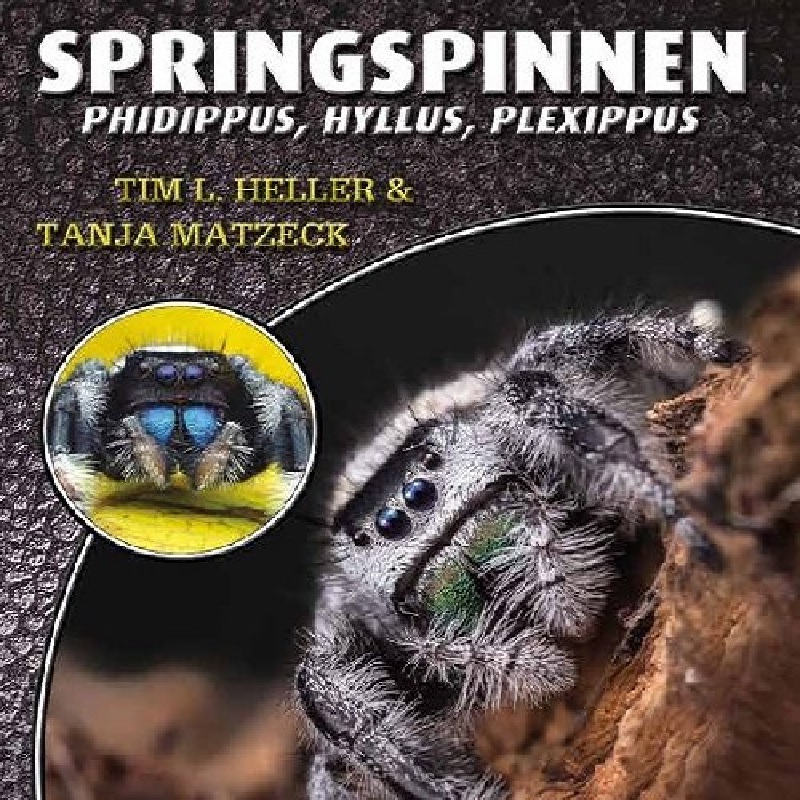
Book Jumping Spiders -
Phidippus, Hyllus & Plexippus
A guide to keeping jumping spiders of the genera Phidippus, Hyllus & Plexippus. Who can resist the charm of jumping spiders? The childlike appearance of their expressive face simply leaves no one cold! In addition, their behavior is extremely exciting to observe, their colors are bright and their requirements for species-appropriate keeping are very easy to meet. No wonder these likeable jumpers are all the rage!
This volume in the "Species by Species" series describes in detail what to look out for when buying and keeping them, introduces the most commonly kept species and color forms and provides plenty of tips on how to keep them successfully - so you can be sure they will breed well!
Species by Species introduces you to the books in this series, which present the most popular terrarium animals. Each volume offers you detailed, practical care instructions and all the information you need to successfully breed your animals.
All important questions from the required tank size to terrarium set-up, technical equipment, species-appropriate nutrition and disease prevention are answered with numerous tricks and tips.
Experienced, long-standing breeders reveal how you can encourage the animals to reproduce and raise healthy young.
All this in full color, generously illustrated and attractively designed - just about your terrarium animal - species by species
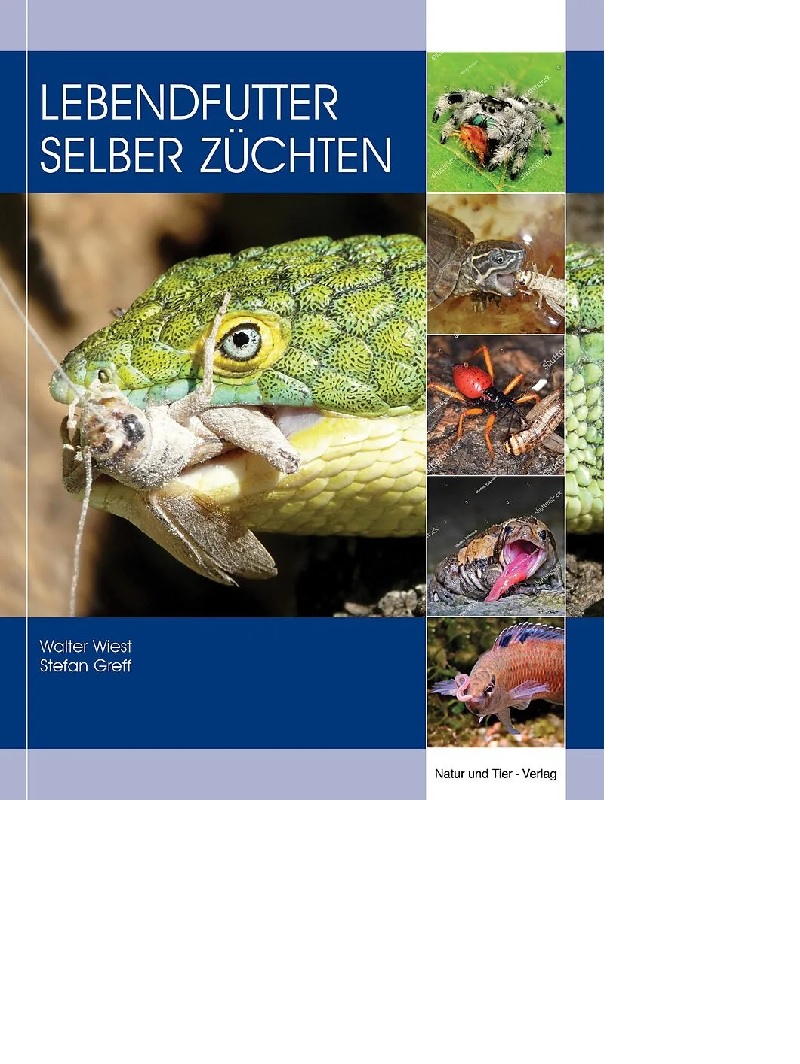
Book "Grow your own live food" - The perfect guide for pet owners
Discover practical and detailed instructions on how you can easily breed food for your reptiles, birds, fish or other animals yourself in the book "Breeding live food yourself". With valuable tips on various food insects, their care and breeding, you can save money and ensure a species-appropriate diet for your pets.
Contents of the book:
Step-by-step instructions for breeding feeder insects
Information on the best types of food for reptiles, birds and fish
Care instructions and breeding conditions for various live food species
Tips for sustainable and cost-effective food production
Why breed your own live food?
Get healthy, fresh food for your animals
Save money and reduce dependence on pet shops
Promote the health and well-being of your animals with species-appropriate food
Whether you are a beginner or an experienced pet owner, this book provides you with everything you need to successfully breed live food yourself.
Marginata 69 - New Guinea tortoises – the genus ElseyaCover storyThe unrecognised beauties: New Guinea tortoises (Andreas S. Hennig)My experiences with Branderhorst's New Guinea tortoise, Elseya (Elseya) branderhorsti (Ouwens, 1914) (Andreas S. Hennig)Keeping and breeding of Rhodin's New Guinea tortoise, Elseya (Hanwarachelys) rhodini Thomson, Amepou, Anamiato & Georges, 2015 (Andreas S. Hennig)PortraitGeoemyda spengleri, Chinese serrated tortoise (Andreas S. Hennig)ReportageMacrochelys temminckii – Experiences and impressions with vulture tortoises part 2 (Reiner Praschag)KeepingAn alternative to year-round keeping of the Egyptian tortoise in the terrarium – my experiences with seasonal outdoor keeping of Testudo kleinmanni (Ricarda Schramm)EtymologySawbacks and living maps part 4: Graptemys gibbonsi, Pascagoula humpback tortoise (Holger Vetter)Classifieds & animal placement
Ulmer Pocket Atlas of TurtlesAll turtles at a glanceDetailed portraits of all turtle speciesTerrarium types organised according to group characteristicsPictograms for a quick overviewDetailed portraits of 111 commercially available turtle species inform you about their origin, appearance and all the important data on care in the terrarium. You will also learn everything you need to know about terrarium types, natural habitats and keeping conditions. Practical pictograms provide you with the most important information at a glance.
Reptilia 92 - Color variations of the corn snake
Ernährung von WirbellosenTerrarien - RückwandKielschwanzleguan
Inhalt:
InhaltImmer neue, immer spektakulärere Farb- und Zeichnungsformen der Kornnatter drängen ins Hobby. Wie bei kaum einer anderen Art haben die Züchter bei dieser Schlange ihre Kunst auf die Spitze getrieben aus dem Klassiker der Terraristik wurde so auch ein topmodernes Terrarientier. REPTILIA-Kolumnist Bill Love und seine Frau Kathy, selbst langjährig erfahrene Züchter, bieten Ihnen in mehreren prächtig bebilderten Artikeln einen Überblick über die Entwicklung der Farbzuchten und die aktuell erhältlichen Varianten, über das für die gezielte Zucht notwendige Know-how, und last but not least berichten sie aus ihrer persönlichen Erfahrung über eine ganz spezielle Morphe, die sie als Erste überhaupt erzielten.
EDITORIAL
MAGAZIN TERMINEWESTERN HERP PERSPECTIVES Regelungs-Rage Von B. LoveFOTOSTORY Den Guppys auf der Spur 50 Jahre Zucht der Kornnatter, Pantherophis guttatusVon K. & B. Love Haltung und Nachzucht Kornnattern vermehren Ein Rezept für JedermannVon K. & B. Love HALTUNG UND NACHZUCHT Okeetee Rising Mein Vierteljahrhundert in der Welt der KornnatternVon K. LoveReiseÜberleben im Sand Eine Exkursion in die peruanische WüsteVon G. Chavez & A. P. Mendoza PORTRÄT und PosterTriturus carnifexVon B. TrappHerpetofauna Auf dem Weg ins All Die Welt der Buchstaben-Schmuckschildkröte, Trachemys scriptaTeil 2Von A. S. HennigHaltung und VermehrungHaltung und Vermehrung des Halsband-Kielschwanzleguans, Tropidurus torquatusVon J. LuttermannTERRARIENPRAXISSelbstbau der perkeften Terrarienrückwand – ein missglückter VersuchVon L. Pfetzing & J. EgererERNÄHRUNGHochwertige Ernährung wirbelloser Futtertiere und Terrarienbewohner – Teil 2Von R. Lautensack & R. HübersTiere unserer HeimatEin schützenswertes Reptil – die KreuzotterVon R. LeptienBibliothekBRUTKASTENMit den Fleisch der FeindeGastgeschichte von U. Hannemann
Terraria 09 - Asian tarantulas
ArabiaHardunContents:
2 EditorialKriton KUNZTOPIC4 The unrecognised tarantulas of AsiaVolker VON WIRTH & Martin HUBER10 Experiences with keeping and breeding Chilobrachys fimbriatus Martin HUBER & Volker VON WIRTH 21 Haplopelma longipes - Terrarium keeping and breeding,with new findings on the distribution area Martin HUBER & Volker VON WIRTHSCIENCE29 Herpetorama"Deep-sea toad" in Loch Ness?/Fast eaters31 New speciesCalumma-brevicorne group & Vibrissaphora promustache34 Among researchersAmphibian diversity in the Andes of PeruEdgar LEHR38 Fascinating climbing artists - The sling-tailed agamaLaudakia stellio brachydactylaMichael FRANK47 A dream in black-red-grey - Keeping and breeding Lampropeltis alterna "blairi"Thomas BAMANN54 North American soft-shelled turtles of the genus ApalonePart 3: Keeping and breedingAndreas S. HENNIG64 Frogs in and around bromeliads in the Atlantic rainforestin Espirito Santo, BrazilWeslei PERTEL, Rodrigo B. FERREIRA, Dennis RÖDDER & Rogerio L. TEIXEIRATRAVEL70 Surprising ArabiaThomas KOWALSKI, Jürgen ZILGER & Wolfgang GROSSMANNTERRARIUM PRACTICE83 Test runTerrarium introductionKriton KUNZ85 Prelude Good start: Cross-banded day gecko, Phelsuma standingiMETHUEN & HEWITT, 1913Sven ZEEB88 Eye-catcherA terrarium room dedicated exclusively to bog and teardrop turtlesHans - Dieter PHILIPPEN92 Also in your area 95 TERRAnetLizards96 TERRAglobalSea snakes from the Banda Sea (Indonesia)Mark AULIYAA day of hunting in South Africa's LowveldKarl-Heinz SWITAK104 TERRAwinn
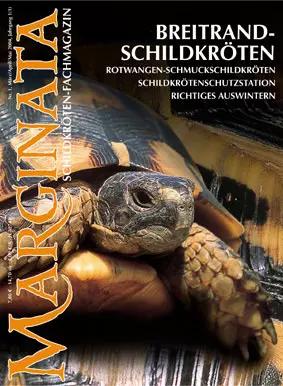
Marginata 01 - Broad-shelled tortoises
Articulated tortoises Turtle conservation stationCorrect wintering
Contents:
2 EDITORIAL
3 ADVISORY BOARD
5 MAGAZINE
10 PHOTO REPORTAGEBroad-shelled tortoises – the most impressive and largest land tortoises in EuropeHans - Dieter Philippen
18 REPORTKeeping and breeding of the broad-shelled tortoiseMatthias Mähn
24 REPORTAGEThe Sardinian population of the broad-shelled tortoiseWolfgang Wegehaupt
31 PORTRAITIndian flapshell softshell turtleMatthias Mähn
36 REPORTAGERemarks on the biology and alternative keeping and breeding of Kinixys belliana nogueyi (LATASTE, 1886)Irmtraud Jasser-Häger and Hans - Dieter Philippen
46 REPORTAGERed-eared slider turtles – Threatening newcomers?Hans - Dieter Philippen
48 REPORTAGEHibernation in European land tortoisesNatural, physiological preparation and “wake-up phase” Markus Baur and R. W. Hoffmann
55 ADVICE & ACTION
56 CLASSIFIEDS
57 REPORTAGEOfficial opening of the International Centre for Turtle Conservation – a look in front of and behind the scenesHans - Dieter Philippen
63 REGIONAL GUIDE
64 AGATHA MARGINATA
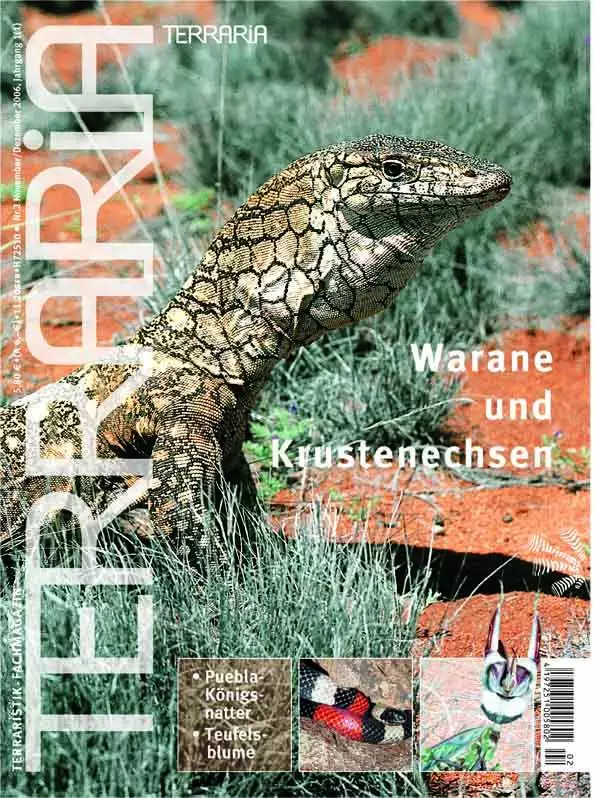
Terraria 02 - Monitor lizards and crustacean lizards
Puebla King SnakeDevil's Flower
Contents:
2 Editorial Axel Kwet TITLE TOPIC
4–23 • Crustacean lizards and monitor lizards: New and familiar facts about the four-footed poisonous clan Hans-Georg Horn SCIENCE
24 Herpetorama New amphibian family tree highly controversial / New names for well-known poison dart frogs
30 New species Melanophryniscus admirabilis – a brightly coloured “black toad”
32 Among researchers In the shadow of the saw – Amphibian communities in selectively logged tropical forests Raffael Ernst
36 My Home Is My Castle Experiences with the self-construction of a terrarium for a Yemen chameleon Frank Angermann
40 A new way to disinfect terrariums Hans-Peter Berghof and Ulf Schwabe
44 Melanophryniscus – not just black toads Part 1: General information on the genus Melanophryniscus Axel Kwet
54 Ornate turtles – the genus Pseudemys Part 1: Introduction, systematics, production and trade Andreas S. Hennig
59 Keeping and breeding the Puebla King Snake, Lampropeltis triangulum campbelli Thorsten Schmidt
63 The devil's flower Idolomantis diabolica (Saussure, 1869) Part 1 Christian J. Schwarz, Jürgen E. Mehl and Jürg Sommerhalder TRAVEL
71 In the land of the Jacarés – the Pantanal Part 2 Heiko Werning TERRARIUM PRACTICE
82 Test run Artificial rock furnishings from Exo Terra84 Prelude A good start: the leopard gecko (Eublepharis macularius) Sven Zeeb
88 Eye-catcher The rainforest in your living room Mike Zawadzk
93 Also in your neighbourhood
96 TERRAnet Of snakes and poisonous snakes
98 TERRAglobal Santa Catalina – Island of the rattleless rattlesnakes Karl H. Switak A new workplace, a plethora of new animals Mirco Solé
103 Preview
104 TERRAwinn
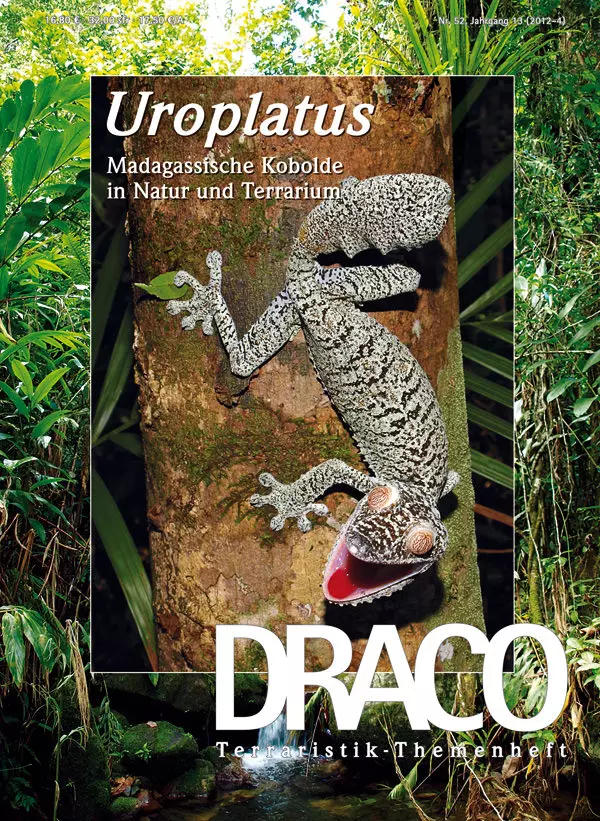
Draco 52 Magazine
Uroplatus Madagascan Goblins in Nature & Terrarium
Contents:
EditorialSoul-stealers with adhesive lamellae – Madagascan flat-tailed geckos of the genus UroplatusPhilip-Sebastian GehringIn search of flat-tailed geckos in MadagascarPhilip-Sebastian Gehring & Patrick SchöneckerBiology, husbandry and long-term breeding of Uroplatus guentheri Mocquard, 1980 up to the fourth filial generationPatrick Schönecker A ghost in the terrarium – the successful keeping and breeding of Uroplatus phantasticus (Boulenger, 1888)Kai-Uwe Volta & Philipp Höhne Experiences in the keeping and breeding of the lichen flat-tailed gecko (Uroplatus sikorae Boettger, 1913)Philip-Sebastian Gehring Natural treasures of Madagascar: Flat-tailed geckos and their protectionFanomezana Ratsoavina and Philip-Sebastian Gehring Experiences with keeping flat-tailed geckos (Uroplatus fimbriatus) in the Masoala rainforest at Zurich Zoo, SwitzerlandSamuel Furrer
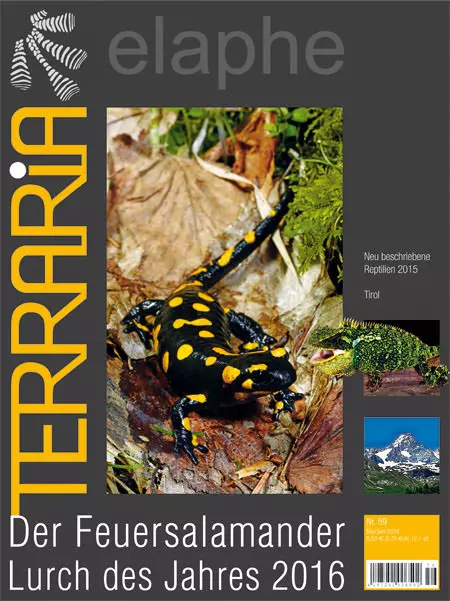
Terraria 59 - The Fire Salamander
Newly described reptiles 2015Tyrol
Contents:
Cover story: The Fire Salamander - Amphibian of the Year 2016The colourful fire salamander, which was named Amphibian of the Year 2016, has achieved great popularity worldwide. Not only in terraristics, where the animals have been successfully kept and bred for decades, but also as a symbolic and flagship species in national and international species conservation. We present the different aspects of this species in detail and address the current threat posed by a microscopic fungus that is currently threatening wild populations, but also discuss measures that terrarium keepers can take to prevent or control its rapid spread.
TerritorialHerpetoramaA headbutt with consequences – tree frogs with deadly venomDornteufel: Grass snakes without ringletsCultural follower: Frog with castleBlattsteiger: Lizards against Stuttgart 21A frog as acrobatSecond helping
Cover storyLong live the salamander: Amphibian of the Year 2016Axel Kwet, Philine Werner & Ulrich Schulte
Fire salamander – keeping and breeding a famous amphibian. Part 1: Terrarium, set-up and careYvonne & Thomas Klesius
Batrachochytrium salamandrivorans. The new threat to tailed amphibiansPaul Bachhausen
The fire salamander as a favourite and flagship species in the Thuringian Slate Mountains. Experiences from a volunteer projectManfred Klöppel
PanoramaExcursion between the Grossglockner and Lienz DolomitesRolf Leptien
In search of the Lebanese mountain viper (Montivipera bornmuelleri)Alexander Eppler
Research
New speciesList of reptiles newly described in 2015Axel Kwet
Salamandra
TerraristicsElaphe dione – an attractive snake in the terrariumHelmut Kantz
Nature and species conservation
Field notesMorphology follows genetics: A characteristic to distinguish two crested newt species from TurkeyUwe Gerlach & Michael Fahrbach
Juvenile adder consumes adult common lizardChristoph Klaus, Andreas Nöllert & Siegfried Klaus
The American Crocodile Education Sanctuary (ACES) in BelizePeter Janzen
Terrarino – the children's page Comb on, newt!Ute Nüsken
Subscription & Service Also in your areaPreview
Incubator Herpetologists' Hostel WeddingHeiko Werning
CHF 12.00
❅
❆
❅
❆
❅
❆
❅
❆
❅
❆
❅
❆
This website uses cookies to ensure the best experience possible. More information...