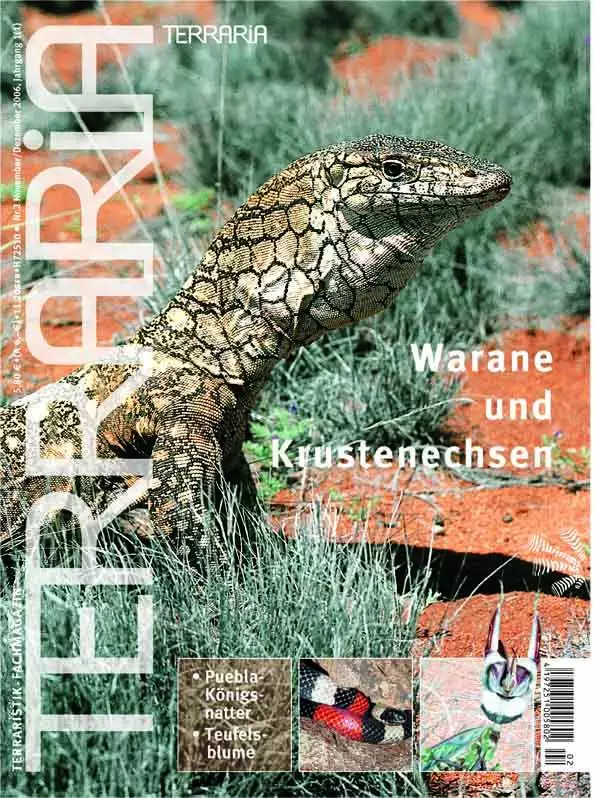
Terraria 02 - Monitor lizards and crustacean lizards

Article no: terraria2

CHF 11.20

Stock: 0

Ready for dispatch in 1-3 days, delivery time 7 working days

Delivery between Friday, 28 August and Monday, 31 August
Zahlungsarten
Product information "Terraria 02 - Monitor lizards and crustacean lizards"

Terraria 02 - Monitor lizards and crustacean lizards

Puebla King Snake
Devil's Flower

Contents:

  • 2 Editorial
    Axel Kwet
    TITLE TOPIC
  • 4–23 • Crustacean lizards and monitor lizards:
    New and familiar facts about the four-footed poisonous clan
    Hans-Georg Horn
    SCIENCE
  • 24 Herpetorama
    New amphibian family tree highly controversial / New names for well-known poison dart frogs
  • 30 New species
    Melanophryniscus admirabilis – a brightly coloured “black toad”
  • 32 Among researchers
    In the shadow of the saw – Amphibian communities in selectively logged tropical forests
    Raffael Ernst
  • 36 My Home Is My Castle
    Experiences with the self-construction of a terrarium for a Yemen chameleon
    Frank Angermann
  • 40 A new way to disinfect terrariums
    Hans-Peter Berghof and Ulf Schwabe
  • 44 Melanophryniscus – not just black toads
    Part 1: General information on the genus Melanophryniscus
    Axel Kwet
  • 54 Ornate turtles – the genus Pseudemys
    Part 1: Introduction, systematics, production and trade
    Andreas S. Hennig
  • 59 Keeping and breeding the Puebla King Snake, Lampropeltis triangulum campbelli
    Thorsten Schmidt
  • 63 The devil's flower Idolomantis diabolica (Saussure, 1869)
    Part 1
    Christian J. Schwarz, Jürgen E. Mehl and Jürg Sommerhalder
    TRAVEL
  • 71 In the land of the Jacarés – the Pantanal
    Part 2
    Heiko Werning
    TERRARIUM PRACTICE
  • 82 Test run
    Artificial rock furnishings from Exo Terra
    84 Prelude
    A good start: the leopard gecko (Eublepharis macularius)
    Sven Zeeb
  • 88 Eye-catcher
    The rainforest in your living room
    Mike Zawadzk
  • 93 Also in your neighbourhood
  • 96 TERRAnet
    Of snakes and poisonous snakes
  • 98 TERRAglobal
    Santa Catalina – Island of the rattleless rattlesnakes
    Karl H. Switak
    A new workplace, a plethora of new animals
    Mirco Solé
  • 103 Preview
  • 104 TERRAwinn
Composition
Feeding recommendation
Technical details
Size information

0 of 0 reviews

Give us a rating!

Share your experience with the product with other customers.


Suggested products

Handbook of food plants for tortoises and other reptiles
Handbook of forage plants 2nd revised editionMarion Minch is not only a successful breeder of diverse tortoises for many years, but also an excellent connoisseur of native wild herbs. She founded and runs samenkiste.de, which is well known to many tortoise keepers and nature lovers. Her name is inextricably linked with reptile care and species-appropriate nutrition for tortoises. Her handbook of food plants summarises the most important native food plants for herbivorous and omnivorous reptiles. She not only considers tortoises, but also iguanas, spiny-tailed dragons and even chameleons. From the basics of plant biology to native wild herbs to suitable food plants for hardy tropical reptile species, this comprehensive work provides the basis for species-appropriate keeping. In the expanded and supplemented 2nd edition, the plant section is divided according to flower colour. This makes it even easier to identify wild herbs. The work has also been supplemented with a wealth of additional information and many pictures.

CHF 46.50

Geckos
Geckos in the terrarium by Astrid FalkThe book offers a comprehensive introduction to geckos and their species-appropriate keeping in terrariums. It explains what you need to think about before buying a gecko and what preparations should be made. The book describes in detail how the terrarium is technically equipped and set up. The care of the animals, their special features and behaviour, their diet, reproduction and rearing of young animals are described, as well as diseases and husbandry problems with tried and tested suggestions for prevention and treatment. Individual gecko species that are particularly suitable for keeping and breeding in terrariums are portrayed in detail in the second part of the book.

CHF 28.50

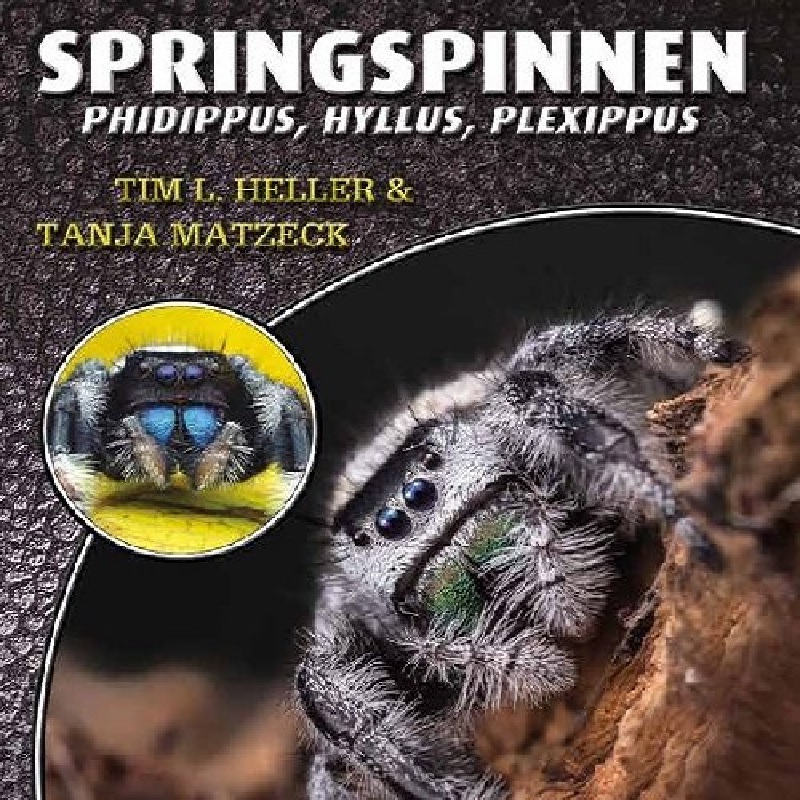
Jumping spiders Phidippus, Hyllus, Plexippus
Book Jumping Spiders - Phidippus, Hyllus & Plexippus A guide to keeping jumping spiders of the genera Phidippus, Hyllus & Plexippus. Who can resist the charm of jumping spiders? The childlike appearance of their expressive face simply leaves no one cold! In addition, their behavior is extremely exciting to observe, their colors are bright and their requirements for species-appropriate keeping are very easy to meet. No wonder these likeable jumpers are all the rage! This volume in the "Species by Species" series describes in detail what to look out for when buying and keeping them, introduces the most commonly kept species and color forms and provides plenty of tips on how to keep them successfully - so you can be sure they will breed well! Species by Species introduces you to the books in this series, which present the most popular terrarium animals. Each volume offers you detailed, practical care instructions and all the information you need to successfully breed your animals. All important questions from the required tank size to terrarium set-up, technical equipment, species-appropriate nutrition and disease prevention are answered with numerous tricks and tips. Experienced, long-standing breeders reveal how you can encourage the animals to reproduce and raise healthy young. All this in full color, generously illustrated and attractively designed - just about your terrarium animal - species by species

CHF 23.90

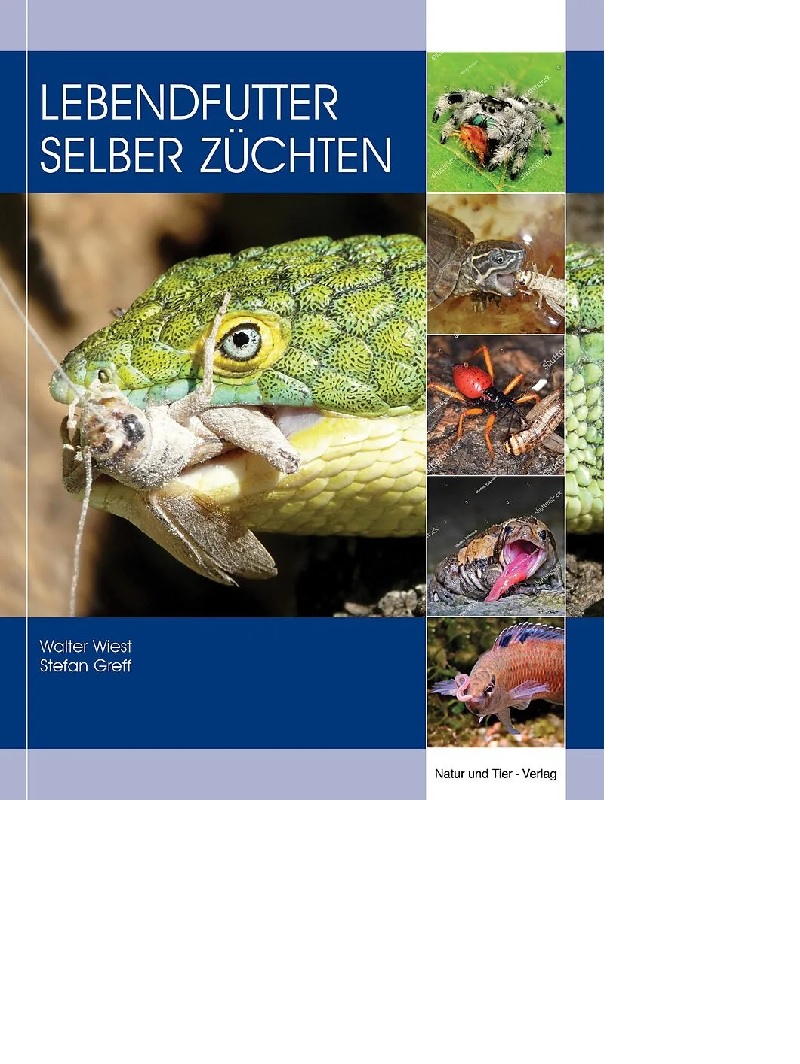
Book Breeding live food yourself
Book "Grow your own live food" - The perfect guide for pet owners Discover practical and detailed instructions on how you can easily breed food for your reptiles, birds, fish or other animals yourself in the book "Breeding live food yourself". With valuable tips on various food insects, their care and breeding, you can save money and ensure a species-appropriate diet for your pets. Contents of the book: Step-by-step instructions for breeding feeder insects Information on the best types of food for reptiles, birds and fish Care instructions and breeding conditions for various live food species Tips for sustainable and cost-effective food production Why breed your own live food? Get healthy, fresh food for your animals Save money and reduce dependence on pet shops Promote the health and well-being of your animals with species-appropriate food Whether you are a beginner or an experienced pet owner, this book provides you with everything you need to successfully breed live food yourself.

CHF 46.50

Marginata 69 - New Guinea tortoises
Marginata 69 - New Guinea tortoises – the genus ElseyaCover storyThe unrecognised beauties: New Guinea tortoises (Andreas S. Hennig)My experiences with Branderhorst's New Guinea tortoise, Elseya (Elseya) branderhorsti (Ouwens, 1914) (Andreas S. Hennig)Keeping and breeding of Rhodin's New Guinea tortoise, Elseya (Hanwarachelys) rhodini Thomson, Amepou, Anamiato & Georges, 2015 (Andreas S. Hennig)PortraitGeoemyda spengleri, Chinese serrated tortoise (Andreas S. Hennig)ReportageMacrochelys temminckii – Experiences and impressions with vulture tortoises part 2 (Reiner Praschag)KeepingAn alternative to year-round keeping of the Egyptian tortoise in the terrarium – my experiences with seasonal outdoor keeping of Testudo kleinmanni (Ricarda Schramm)EtymologySawbacks and living maps part 4: Graptemys gibbonsi, Pascagoula humpback tortoise (Holger Vetter)Classifieds & animal placement

CHF 16.50

Terraria 14 - Praying Mantises in the Terraria
Terraria 14 - Praying Mantises in the Terrarium Uroplatus henkeliPanther tortoise Contents: 2 Editorial Kriton Kunz4 Magazine Gondwanaland – a future-orientated project at Leipzig Zoo / New findings on the taxonomy of pythons / snakes and culture at the Potsdam Natural History Museum / The Frankfurt Zoological Society and their activities on Galápagos12 TERRAglobal Snake dealer Joachim Bulian On the road in the Andes Maik Dobiey Cover story: Praying Mantises16 Praying Mantises: Fascinating terrarium inhabitants Timm Adam 28 A terrarium for praying mantises Timm Adam33 How to: Tips for species-appropriate care for praying mantises Timm Adam42 Breeding of Mantodea Timm Adam46 Lampropeltis triangulum andesianus – rare terrarium jewel with a dubious reputation Part 2: Reproduction Thorsten Schmidt54 Grey giants among themselves – about panther tortoises and elephants in Addo Elephant National Park, South Africa Part 3: Reproduction and lifestyle of the panther tortoise Michael Wirth63 Biology, keeping and breeding of Henkel's flat-tailed gecko, Uroplatus henkeli Christian Müttherthies71 Travel Herpetological impressions during iguana search on the French Antilles: Martinique Stefanie Bach & Patrick Schönecker82 New Species Greek wall lizards with a new name / Two new tree frogs from New Guinea85 Among Researchers In the valleys of the Andes: still unknown and already threatened Claudia Koch89 Test run Aquarium internal filter for terrarium keepers Kriton Kunz95 Eye-catcher Visiting Betty Heiko Werning99 Near You 103 Preview 104 Incubator The invasion of the stray mantises Heiko Werning

CHF 12.00

Terraria No. 30 - Social bird spiders and other social spiders
Terraria No. 30 - Social bird spiders and other social spiders Freilandterrarien für EidechsenDie Pflege von Landschildkröten im Sommer Inhalt: Etliche Vertreter der Vogelspinnen lassen sich im Terrarium in Gruppen halten, beispielsweise Poecilotheria-Arten oder Holothele incei. Die Pflege einer solchen Spinnengemeinschaft zählt zum Faszinierendsten, was man in der Wirbellosenterraristik erleben kann. Boris F. STRIFFLER stellt nicht nur sämtliche Vogelspinnen vor, die für eine solche Haltung infrage kommen, sondern geht außerdem auch auf weitere soziale Spinnen ein – selbst auf solche, die direkt vor unserer Haustür leben! EditorialKriton KunzMagazinGondwanaland – ein zukunftsweisendes Projekt im Zoo Leipzig. Teil 4: Die Eröffnung der Tropenerlebniswelt / Revision der Familie Cordylidae / Marktplatz / Rechtliches / Wie kommt das Gift in die Beute?TERRAglobalIn der Bergwelt der Inka Maik DobieyTitelthemaSoziale Vogelspinnen und andere soziale SpinnenBoris F. StrifflerSoziale Spinnen – ein Widerspruch in sich?Boris F. StrifflerSoziale Vogelspinnen? Beispiele aus Amerika Boris F. Striffler, Frank Schneider und Ingo WendtDas Schildkrötenjahr. Freilandbiologie und Haltung europäischer Landschildkröten über den Jahreslauf Teil 3: Juli bis August – SommerhitzeMichael WirthDie Gattung Nerodia. Wassernattern aus Nordamerika: Lebensweise sowie Haltung und Vermehrung im Terrarium Teil 1 Dieter SchmidtEidechsen im Freilandterrarium Martin DieckmannReise Auf Amphibien- und Reptiliensuche in der Umgebung von Iquitos: Ranitomeya reticulata im Wald von Llanchama Mario KassatNeue Arten Ein psychedelischer Gecko Axel Kwet Neuer Pfeilgiftfrosch aus Brasilien Axel KwetAbo & ServiceUnter Forschern Der Weg ist das Ziel – oder: Wie man sich eine Diplomarbeit selbst organisiertStephan BöhmBlickfang Terrarianernostalgie und tropischer Regenwald in Reutlingen – ein Besuch bei Florian Riedel Michael WirthIn Ihrer Nähe Vorschau Brutkasten Schlimme Nächte: Guayaquil Teil 2: Wir Kleinlaut-Touristen Heiko Werning  

CHF 12.00

Terraria No. 34 - Basilisks
Terraria No. 34 - Basilisks ArabienNeu beschriebenen Amphibien 2011 Inhalt: Basilisk, Jesus-Christus-Echse – kaum ein Reptil ist mystisch so aufgeladen, wie die kleine mittel- und südamerikanische Leguangattung Basiliscus. Ihr bizarres Äußeres schlägt Menschen seit jeher in den Bann, ebenso ihre spektakuläre Fähigkeit, über das Wasser zu laufen. Und als Terrarientiere gehören sie zu den Klassikern, die in geräumigen Terrarien über Generationen erfolgreich zu halten und zu vermehren sind und eine wirkliche Augenweide für jedes Regenwald-Schauterrarium darstellen. Wir stellen Ihnen diese faszinierende Gattung vor, berichten über die faszinierende Freilandbiologie im „Basilisken-Land“ Costa Rica und beschreiben ausführlich die Terrarienhaltung dieser wunderschönen Echsen. TerritorialHerpetoramaChytrid – eine durch den Amphibienhandel menschengemachte Katastrophe?Axel KwetTitelthemaBasilisken. Spektakuläre Vertreter der LeguaneMichael WirthÖkologie der Basilisken und Freilandbeobachtungen in Costa RicaMichael WirthBasiliscus plumifrons, der Stirnlappenbasilisk: Erfahrungen aus 20 Jahren Haltung und Vermehrung im Terrarium. Teil 1: Einrichtung und TechnikIngo KoberTerraglobalRespekt vor GiftschlangenMirco SoléBangkok, die Flut und Grüne MambasJoachim BulianÜberraschendes Arabien 2.0. Teil 2Wolfgang Grossmann, Thomas Kowalski & Hans-Jürgen ZilgerUnter ForschernEin neues Schildkrötenschutzprojekt im Südosten Nepals – das „Budoholi Turtle Conservation Centre“Markus Baur, KaluRam Rai & Henk ZwartepoorteNeue ArtenListe der im Jahr 2011 neu beschriebenen AmphibienAxel KwetSalamandraKlassikerDie Fransenschildkröte oder Mata-MataAlexander GutscheGiftbisse von giftigen und „harmlosen“ Schlangen. Teil 1Dieter SchmidtHomerangeUnd das alles für die Schildkröten …Michael WirthNatur- und Artenschutz FeldnotizenRiesenquappe im TeichDie Rote Liste der Amphibien und Reptilien Deutschlands. Teil 1: Werdegang und ErgebnisseKlaus-Detlef Kühnel, Arno Geuger & Richard PodlouckyVermisstStuarts Wurmsalamander (Oedipina stuarti)Alexander GutscheAbo & ServiceAuch in Ihrer NäheGalerieGeschmeidige SchlangenKriton Kunz VorschauBrutkastenZimmer freiHeiko Werning  

CHF 12.00

Reptilia 52 - Maci frogs
Reptilia 52 - Maci frogs Wrath snakesSnake processionFishing spiders Contents: 2 EDITORIAL 6 MAGAZINE 16 DATES 20 PHOTO REPORTAGE The fairies of the forestThe Maci frogs of the genus Phyllomedusaby E. Biggi 31 HERPETOFAUNAThe Brazilian Maci frog Phyllomedusa burmeisteri by J. Bertoluci, P. S. Santos, M. A. S. Canelas & J. Cassimiro 35 KEEPING AND BREEDINGThe breeding of the giant Maci frog, Phyllomedusa bicolor by S. Soden 41 TRAVELThe emerald lizard forest of CaorleHerpetological observations between Venice and Trieste by S. Meyer 51 PORTRAIT AND POSTERLeiocephalus carinatusby K. Kunz 56 HERPETOFAUNAThe wrath snakes of North Africa by U. Schlüter 66 KEEPING AND BREEDINGA pirate's lifeKeeping and breeding the fishing spiders Ancylometes - Part 1 by K. Kunz 72 HERPTOCULTUREThe snake procession of Coculloby M. Meyer 79 REPTILIA ON THE ROADThe South America rainforest house in Krefeld Zooby A. Hauschild 86 LIBRARY 90 CLASSIFIEDS 95 WESTERN HERP PERSPECTIVESA lovely herping placeby B. Love 104 GLOSSSpider webs – spider lifeby H. Werning

CHF 11.20

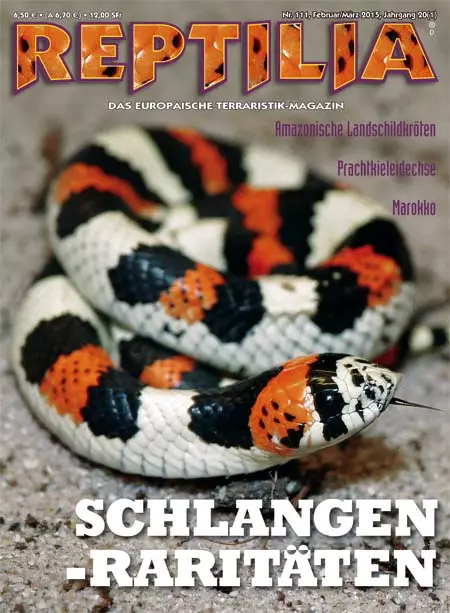
Reptilia 111 - Rarities of snakes
Reptilia 111 - Snake raritiesAmazonian tortoisesMagnificent keel lizardMoroccoContents:Cover story: Snake raritiesSome species or subspecies of snakes have simply not managed to establish themselves in the terrarium hobby. Or they were once sought-after and regularly available, but have now completely or almost disappeared from the population. There are many reasons for this: they do not appear attractive enough at first glance, they were bred so frequently for a while that they were no longer profitable to breed, their requirements in terms of food are difficult to fulfil, they have a "bad reputation", no real lobby or are simply hardly ever imported. However, many of these mostly overlooked snakes are highly interesting and often extremely attractive, and are well worth keeping. We would like to introduce you to some of these wonderful rarities.EditorialMAGAZINEDATESWESTERN HERP PERSPECTIVESThe lamentation about terrarium fairsB. LovePhoto storySnake raritiesK. KunzKeeping and breedingWelcome back! Keeping and breeding Oocatochus rufodorsatusK. KunzKeeping and breedingThe queen of climbing snakes. Archelaphe bella chapaensis in the wild & in the terrariumS. Ryabov, I. Korshunov, T. T. Nguyen & X. WangHerpetofaunaThe magnificent keelback lizard Algyroides nigropunctatus - a little-known beauty from the BalkansM. DieckmannHerpetofaunaEncounters with turtles in the Venezuelan state of Amazonas. Part 2: TortoisesM. HeartReportageScorpions of IsraelM. Seiter & A. UllrichALSO NEAR YOUReportageThe white spring of the addersA. SchmidServicesJourneyThe herpetofauna of south-east MoroccoU. SchlüterPREVIEWBRUTKASTEN German animal welfare speaks hereH. Werning

CHF 12.00

Draco 59 - Spectacular invertebrates
Draco 59 - Spectacular Invertebrates Contents: Editorial Spectacular diversity in the terrariumTimm AdamGreat jumpers – jumping insects in the terrariumTimm AdamGiant water bugs (Belostomatidae) and water scorpions (Nepidae) in the aquaterrariumTimm Adam & Hermann ElsasserSpectacular arachnids: whip spiders and whip scorpionsMichael SeiterThe largest invertebrates in the terrarium Timm AdamEnigmatic creatures: hooded spidersFrederic Schramm, Michael Seiter & Johannes NiglSymphony in blue – The large diplurid Linothele megatheloides in ColombiaJorge Cañas-Orozco Giant beetles: armoured insect giantsTom Schouteet & Mark van Bergen   The extraordinary arthropods of the family LiphistiidaeIngo Wendt & Frank Schneider

CHF 32.00

Reptilia 68 - Soft-shelled Turtles
Reptilia 68 - Soft-shelled turtlesTiger pythons in the terrariumBert Langerwerf's lizard farmBlue poison dart frogContents: 2 EDITORIAL 3 MAGAZINE 14 DATES 16 PHOTO REPORTAGESoft-shelled turtlesBy J. Valverde 24 KEEPING AND REPRODUCTIONApalone ferox,the Florida soft-shelled turtleBy J. Valverde 29 HERPETOFAUNATrionyx triungius, the Nile soft-shelled turtleBy Oster Türkosan 34 KEEPING AND REPRODUCTIONPerspectives on the keeping and breeding of the Burmese soft-shelled turtleturtle (Lissemys scutata)By H. Prokop & L. Hojay 44 TRAVEL In search of the blue poison dart frogin the Sipalawini-Svanne in SurinamBy H. Divossen 51 PORTRAIT AND POSTERAtheris squamigeraBy M. Dobiey 56 KEEPING AND REPRODUCTIONKeeping and breeding the tiger pythonBy S. Barone 62 KEEPING AND REPRODUCTIONThe breeding of the Argentine black turtleMelanophryniscus stelzneriBy R. Siegenthaler 67 KEEPING AND REPRODUCTIONKeeping and breeding of the IberianEmerald lizard (Lacerta schreibersi) in an indoor terrariumBy C. Jeschull 75 PEOPLEHolidays on the farmThe agama farm "Agama International inc."by Bert LangerwerfBy H. Werning 88 WESTERN HERP PERSPECTIVESAccidents or carnageFrom B. Love 90 FAQ - FREQUENTLY ASKED QUESTIONSPogona henrylawsoniBy M. Dieckmann 93 LIBRARY 104 BRUTKASTENFlorida Diaries (Part 1)By H. Werning

CHF 11.20