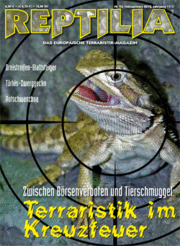
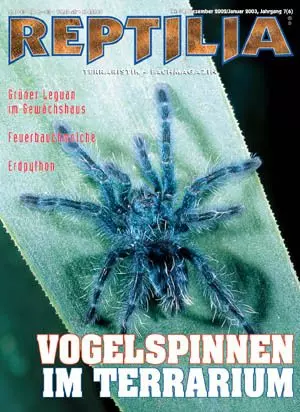
Reptilia 38 - Tarantulas in terrariums

Reptilia 38 - Tarantulas in the terrarium
Green iguana in a greenhouse
Fire-bellied newts
Earth python
Contents:
- 2 EDITORIAL
- 3 READER LETTERS
- 7 MAGAZINE
- 15 DATES
- 16 WESTERN HERP PERSPECTIVES
The hymn of natural terrariums
from B. Love - 18 PHOTO REPORTAGE
Large, hairy spiders - An introduction to the Theraphosidae family
by F. Tomasinelli - 26 KEEPING AND BREEDING
Breeding of tarantulas with special consideration of their way of life in the wild
by B. F. Striffler - 32 KEEPING AND BREEDING
The ‘Malaysian Earth Tiger’ – Keeping and Breeding the Asian Tarantula Cyriopagopus thorelli
by F. de Vita & F. Tomasinelli - 36 KEEPING AND BREEDING
Poecilotheria subfusca POCOCK, 1895: Group housing and breeding
by B. F. Striffler - 42 TRAVEL
Adventure Oman Mountains
by R. Leptien - 51 PORTRAIT AND POSTER
Azemiops feae
by A. Gumprecht - 56 REPORTAGE
A life like in paradise - experiences with keeping a green iguana in a tropical hall
by C. Ströhlein, idea-Schmetterlings-Paradies Neuenmarkt - 61 HERPTOFAUNA
The fire-bellied newts of the genus Cynops
Part 1: Keeping and species
by P. Bachhausen - 68 KEEPING AND BREEDING
Observations on the ecology and terrarium husbandry of the Eastern lizard snake, Malpolon monspessulanus insignitus Geoffroy, 1827
by H. Esterbauer - 74 HERPTOFAUNA
The Burrowing Python (Calabaria reinhardtii)
by S. Seidel - 78 REPORTAGE
The school vivarium
Part 3: Behavioural practical course for a biology class
by M. Hallmen - 85 RAT & TAT
- 87 CLASSIFIED ADS
- 92 LIBRARY
- 104 GLOSSES
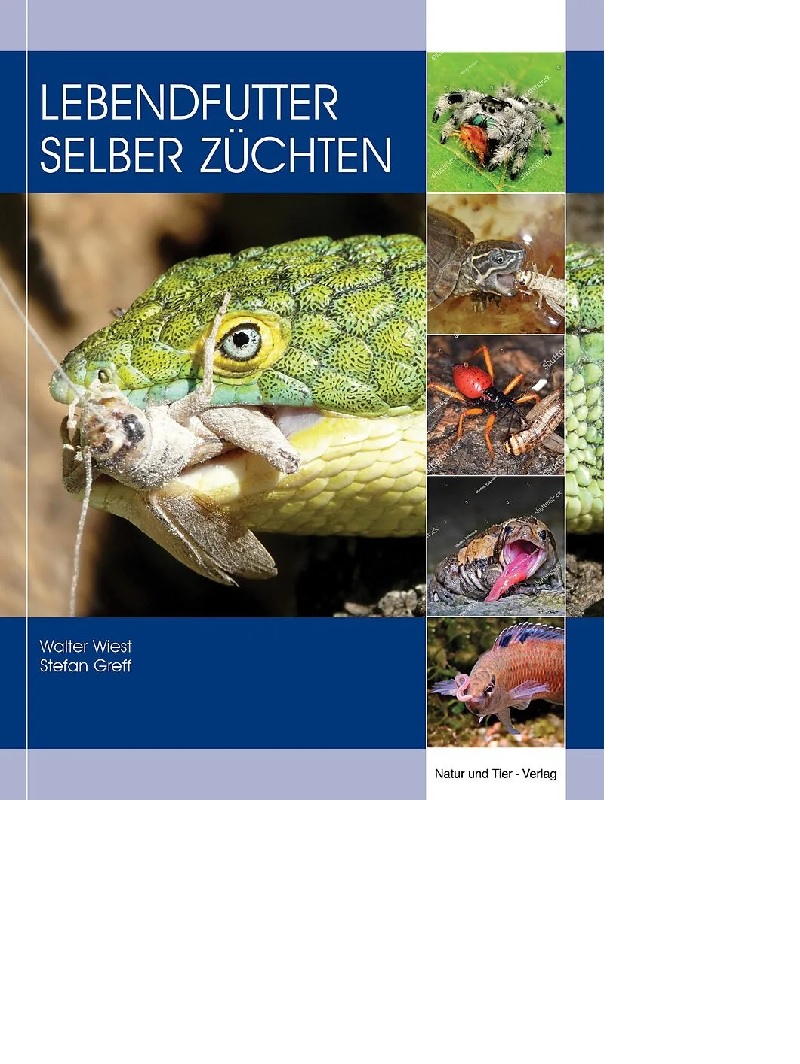
Feed animal breeding magazine
by N. Nadolny
This issue of your specialist terrarium magazine REPTILIA is dedicated to tarantulas. Alongside a photo feature richly illustrated with impressive photographs, which provides an overview of the family of these popular animals, there are expert and detailed reports on keeping and breeding them. The focus is on the magnificent Poecilotheria species, which – unusually for tarantulas – can almost without exception be kept in groups, as well as the “Malaysian Earth Tiger” Cyriopagopus thorelli. The article by B. Striffler on the breeding of tarantulas, with particular attention to their natural behaviour, also deserves special mention. Here you will discover interesting facts that you will search for in vain in standard books on tarantulas, and which will enable you to draw valuable conclusions regarding husbandry and breeding conditions.
Spectacular finds and a life-threatening attack - the result of the exciting travelogue Adventure Oman, which you should not miss.
After the brilliant photos of the extremely rarely shown venomous snake Azemiops feae comes a report on an unusual way of keeping the green iguana that could not be more exemplary.
Extremely colourful animals that can reach a great age when kept properly are the fire-bellied newts of the genus Cynops, which newt expert P. Bachhausen presents to you in detail through text and images.
Observing animals in the wild not only provides fascinating insights into their way of life, but also makes it easy to draw conclusions about the successful care and breeding of these species. The proof of this simple yet effective strategy: the article by H. Esterbauer on the ecology and terrarium husbandry of the Eastern lizard snake, Malpolon monspessulanus insignitus.
In this issue of REPTILIA, we are also able to present one of the first reports on the breeding of the unusual ground python Calabaria reinhardtii. S. Seidel, who achieved this success, describes in detail here, amongst other things, the husbandry conditions that stimulated his animals to mate.
In the last part of his article on the school vivarium, M Hallmen finally reports on the concrete possibilities that arise from keeping animals in the classroom.
As always, REPTILIA once again offers you the full range of comprehensive services: events, classifieds, the magazine featuring interesting facts about Hobby, advice and practical tips, and the library are all included, as is the column, this time offering a satirical take on RODENTIA, the specialist magazine on small mammals published by Natur und Tier Verlag.
Login
Suggested products