Bugs No. 01 - Goliath beetle colorful giants

Article no: bugs01

CHF 12.00

Stock: 0

This article is currently not available

Product information "Bugs No. 01 - Goliath beetle colorful giants"

Bugs No. 01 - Goliath beetles colourful giants

Preparation of invertebrates
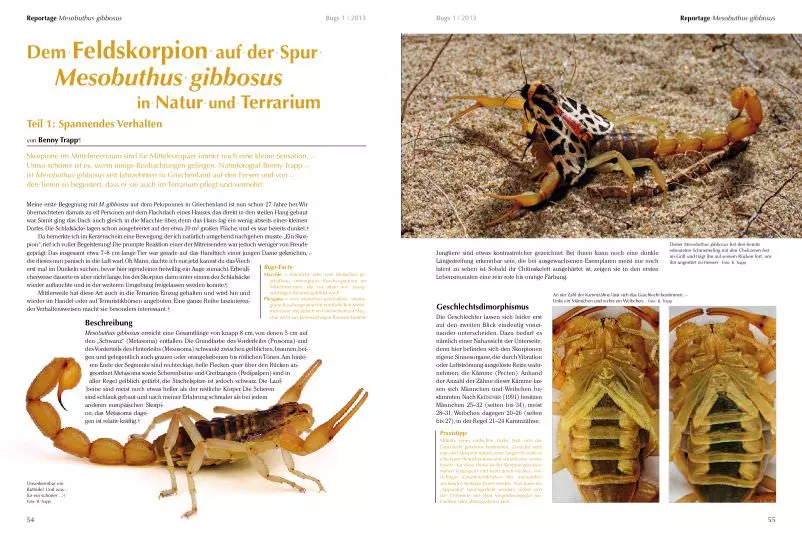
Mesobuthus gibbosus
Poecilotheria metallica

Table of contents

Editorial
Team introduction
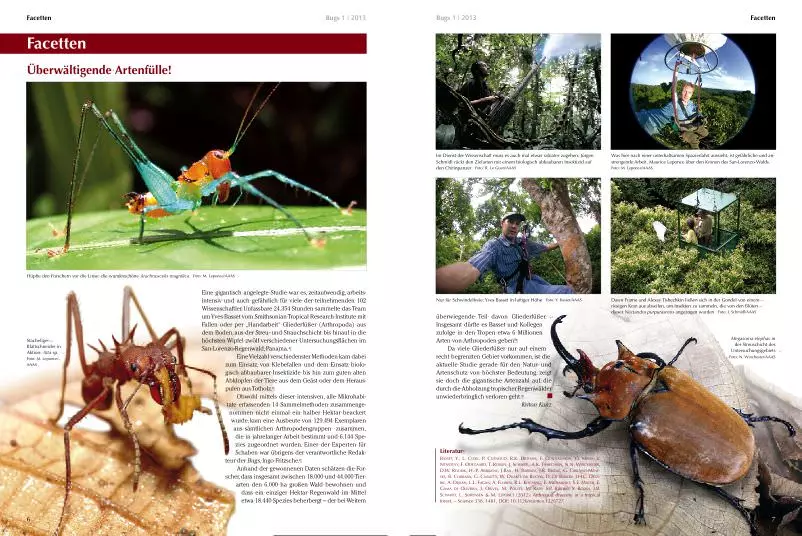
Facets
Flown in
Dates

Cover story
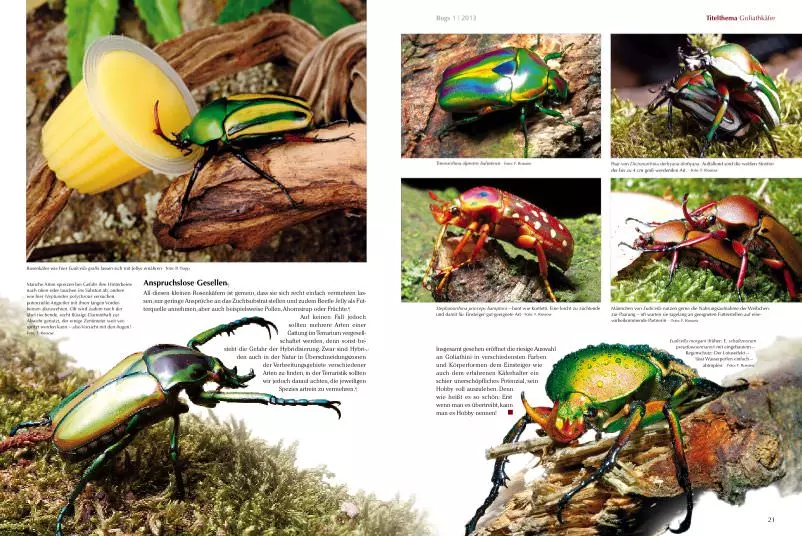
Goliath beetles – not just giants!
Frank Rossow

Top class! Keeping and breeding Goliathus goliatus
Frank Rossow & Jens Rudnik

Colour galore! Mecynorhina, brightly coloured rose beetles with big noses
Frank Rossow & Jens Rudnik

Fledged
On the hunt for invertebrates in the Levant
Ingo Fritzsche

In the crosshairs
Atlas moth Attacus atlas
Daniel Dittmar

Practice
A gem in the terrarium Poecilotheria metallica
Patrick Meyer

Practice
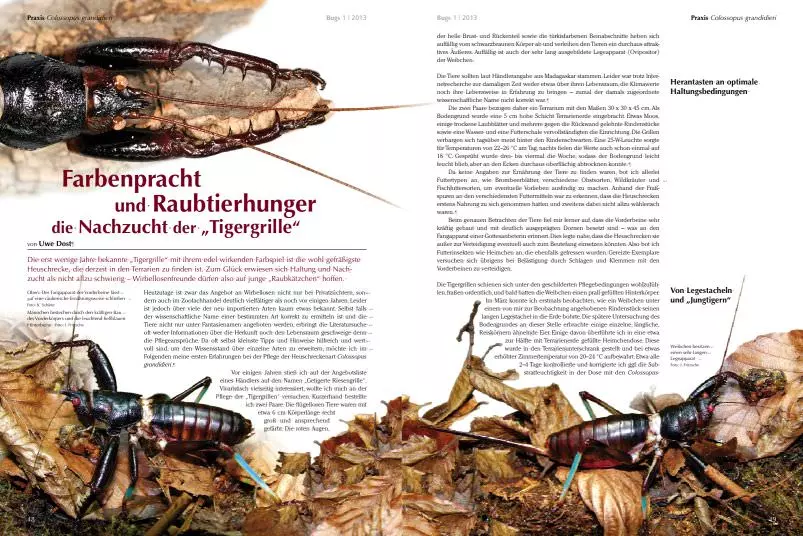
Colourful splendour and predator hunger, breeding the "tiger cricket"
Uwe Dost

Reportage
Fungi as deadly enemies of arthropods – but worth their weight in gold
Ingo Fritzsche

Reportage
On the trail of the field scorpion. Mesobuthus gibbosus in nature and in the terrarium. Part 1: Exciting behaviour
Benny Trapp

Reportage
“Cracking difficult species!” A visit to Jutta Renda
Kriton Kunz

Potter bee
Weathering of food plants
Bruno Kneubühler

Kids Corner
Feeder animals under the microscope
Ingo Fritzsche

Showcase
Specimens homemade – an introduction
Patrick Urban

Book scorpion
Service & Imprint
Preview

Metamorphoses
Start into life
Kriton Kunz

Composition
Feeding recommendation
Technical details
Size information

0 of 0 reviews

Give us a rating!

Share your experience with the product with other customers.


Suggested products

Handbook of food plants for tortoises and other reptiles
Handbook of forage plants 2nd revised editionMarion Minch is not only a successful breeder of diverse tortoises for many years, but also an excellent connoisseur of native wild herbs. She founded and runs samenkiste.de, which is well known to many tortoise keepers and nature lovers. Her name is inextricably linked with reptile care and species-appropriate nutrition for tortoises. Her handbook of food plants summarises the most important native food plants for herbivorous and omnivorous reptiles. She not only considers tortoises, but also iguanas, spiny-tailed dragons and even chameleons. From the basics of plant biology to native wild herbs to suitable food plants for hardy tropical reptile species, this comprehensive work provides the basis for species-appropriate keeping. In the expanded and supplemented 2nd edition, the plant section is divided according to flower colour. This makes it even easier to identify wild herbs. The work has also been supplemented with a wealth of additional information and many pictures.

CHF 46.50

Geckos
Geckos in the terrarium by Astrid FalkThe book offers a comprehensive introduction to geckos and their species-appropriate keeping in terrariums. It explains what you need to think about before buying a gecko and what preparations should be made. The book describes in detail how the terrarium is technically equipped and set up. The care of the animals, their special features and behaviour, their diet, reproduction and rearing of young animals are described, as well as diseases and husbandry problems with tried and tested suggestions for prevention and treatment. Individual gecko species that are particularly suitable for keeping and breeding in terrariums are portrayed in detail in the second part of the book.

CHF 28.50

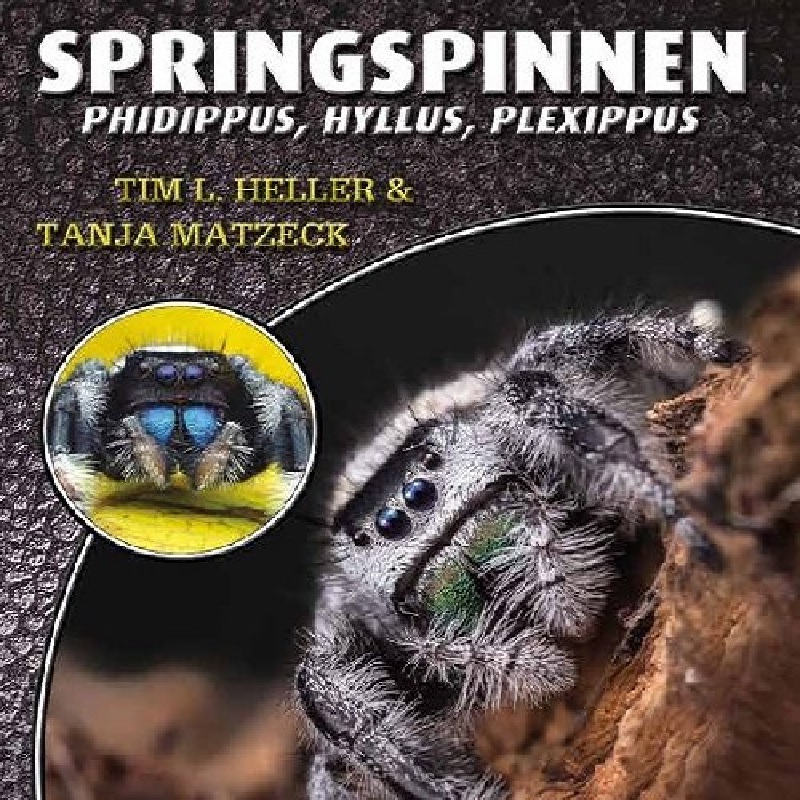
Jumping spiders Phidippus, Hyllus, Plexippus
Book Jumping Spiders - Phidippus, Hyllus & Plexippus A guide to keeping jumping spiders of the genera Phidippus, Hyllus & Plexippus. Who can resist the charm of jumping spiders? The childlike appearance of their expressive face simply leaves no one cold! In addition, their behavior is extremely exciting to observe, their colors are bright and their requirements for species-appropriate keeping are very easy to meet. No wonder these likeable jumpers are all the rage! This volume in the "Species by Species" series describes in detail what to look out for when buying and keeping them, introduces the most commonly kept species and color forms and provides plenty of tips on how to keep them successfully - so you can be sure they will breed well! Species by Species introduces you to the books in this series, which present the most popular terrarium animals. Each volume offers you detailed, practical care instructions and all the information you need to successfully breed your animals. All important questions from the required tank size to terrarium set-up, technical equipment, species-appropriate nutrition and disease prevention are answered with numerous tricks and tips. Experienced, long-standing breeders reveal how you can encourage the animals to reproduce and raise healthy young. All this in full color, generously illustrated and attractively designed - just about your terrarium animal - species by species

CHF 23.90

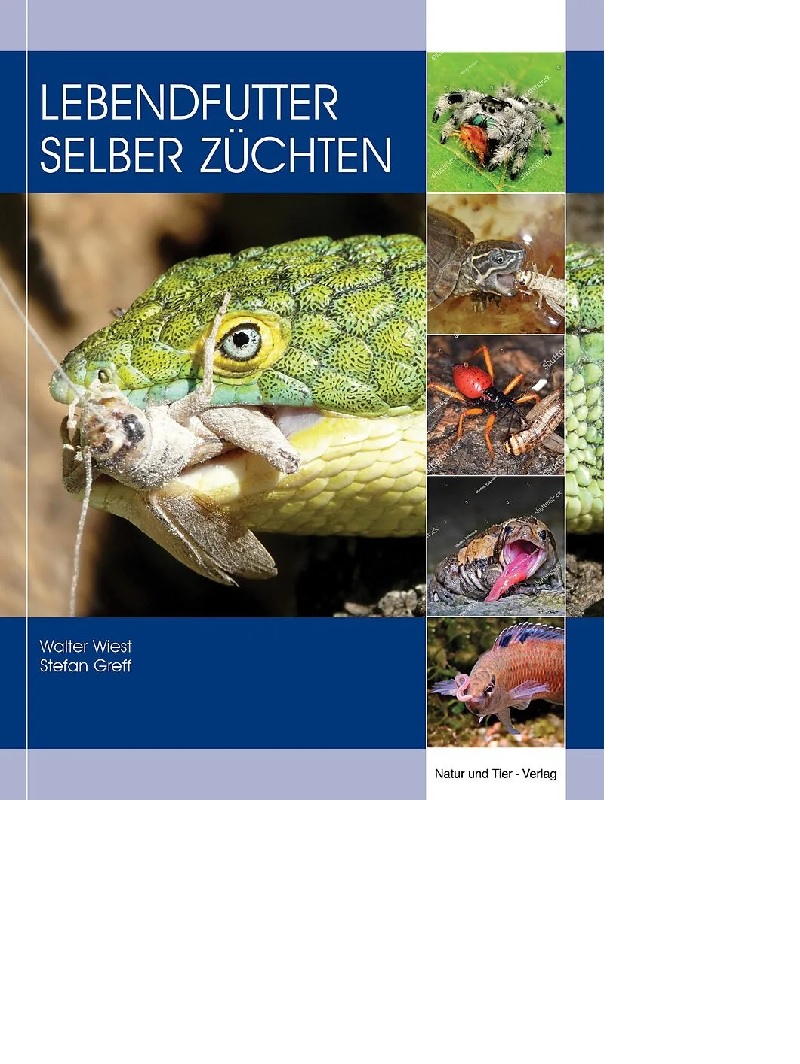
Book Breeding live food yourself
Book "Grow your own live food" - The perfect guide for pet owners Discover practical and detailed instructions on how you can easily breed food for your reptiles, birds, fish or other animals yourself in the book "Breeding live food yourself". With valuable tips on various food insects, their care and breeding, you can save money and ensure a species-appropriate diet for your pets. Contents of the book: Step-by-step instructions for breeding feeder insects Information on the best types of food for reptiles, birds and fish Care instructions and breeding conditions for various live food species Tips for sustainable and cost-effective food production Why breed your own live food? Get healthy, fresh food for your animals Save money and reduce dependence on pet shops Promote the health and well-being of your animals with species-appropriate food Whether you are a beginner or an experienced pet owner, this book provides you with everything you need to successfully breed live food yourself.

CHF 46.50

Marginata 69 - New Guinea tortoises
Marginata 69 - New Guinea tortoises – the genus ElseyaCover storyThe unrecognised beauties: New Guinea tortoises (Andreas S. Hennig)My experiences with Branderhorst's New Guinea tortoise, Elseya (Elseya) branderhorsti (Ouwens, 1914) (Andreas S. Hennig)Keeping and breeding of Rhodin's New Guinea tortoise, Elseya (Hanwarachelys) rhodini Thomson, Amepou, Anamiato & Georges, 2015 (Andreas S. Hennig)PortraitGeoemyda spengleri, Chinese serrated tortoise (Andreas S. Hennig)ReportageMacrochelys temminckii – Experiences and impressions with vulture tortoises part 2 (Reiner Praschag)KeepingAn alternative to year-round keeping of the Egyptian tortoise in the terrarium – my experiences with seasonal outdoor keeping of Testudo kleinmanni (Ricarda Schramm)EtymologySawbacks and living maps part 4: Graptemys gibbonsi, Pascagoula humpback tortoise (Holger Vetter)Classifieds & animal placement

CHF 16.50

Terraria No. 26 - Snakes of South America
Terraria No. 26 - Snakes of South America Peru-BuntleguanTheloderma leporosum > Inhalt: Südamerika ist Heimat einer überwältigenden Vielfalt an Schlangen. Einige davon zählen zu den begehrtesten, aber auch geheimnisvollsten Terrarienpfleglingen überhaupt, allen voran die Grünen Hundskopfschlinger der Gattung Corallus. Über sie berichtet einer der profiliertesten Züchter dieser faszinierenden Tiere, Harald Quirmbach. Weitere Einblicke in die reiche Schlangenfauna des Kontinents bietet Experte Christian Neumann, und TERRARIA-Redakteur Kriton Kunz porträtiert die Gattung Xenodon, zu der mit der bis vor kurzem als Lystrophis pulcher geführten Südamerikanischen Hakennasennatter einer der aktuellen Shootingstars der Terraristik gehört. EditorialMagazinGondwanaland – ein zukunftsweisendes Projekt im Zoo Leipzig. Teil 2: Bepflanzung und BaufortschritAndreas S. Hennig Neue Taxonomie für Gefleckte WalzenskinkeUwe Schlüter 15 Jahre HammKritón Kunz Erstimport des Pazifischen Schmuckhornfroschs, Ceratophrys stolzmanniKriton Kunz Rechtliches, Fehlende Sachkunde: Gewerbsmäßige Zucht und Handel mit Tieren können untersagt werden!Dietrich Rössel Mäuse-Bombardement gegen Braune NachtbaumnatterKriton Kunz „Most Wanted“ – die Suche nach 100 verschwundenen AmphibienartenAxel Kwet TERRAglobalIm Zauberwald der Anden Maik Dobiey TitelthemaVon Froschfressern und Schlangenjägern – Biogeografie und Anpassung südamerikanischer Schlangen Christian Neumann Die Königinnen Südamerikas: Corallus batesii und Corallus caninus Harald Quirmbach Südamerikanische Hakennasennattern und ihre Verwandten Kriton Kunz Erstnachzucht des Moosfroschs Theloderma leporosum Alexei A. Evsyunin, Sergei A. Ryabov & Kriton Kunz Der Peruanische Buntleguan, Polychrus peruvianus (Noble, 1924) Uwe Schlüter Zoropsis spinimana im Terrarium Reinhard Hübers Reise Die Herpetofauna auf Samos – außergewöhnliche Artenvielfalt auf einer InselHans-Jürgen Luef Neue ArtenWinzling in KannenpflanzenAxel Kwet Neue Blindschleichen in EuropaAxel Kwet Unter Forschern Herpetologie im Untergrund: globale Feldforschungen an Blindwühlen Alexander Kupfer Blickfang Von Halbaffen, Pfeilgiftfröschen und Geckos. Zu Gast bei Ute Thut und Dennis Peukert Teil 2Michael Wirth In Ihrer NäheAbo & ServiceVorschau Brutkasten Nächte mit Charlene Ludger Hogeback

CHF 12.00

Marginata No. 30 - Under the spell of the turtle - joy and suffering of turtle research
  Schildkrötenschutz auf SumatraZucht der Rotwangen-KlappschildkröteSchildkröten im Schulunterricht Inhalt: EditorialLESERBRIEFEMagazinTermineREPORTAGEJenseits von Afrika – ein Forschungsaufenthalt in MadagaskarJutta HammerREPORTAGESchildkrötenforschung in Vietnam Inga Fischer, Sarah Wahl und Sandra WeimerHALTUNG UND ZUCHT„Kambodscha – ein Königreich der Wunder“. Feldherpetologische Arbeit an Indotestudo elongataFlora IhlowPOSTERDie Turkana-See-Klappbrustschildkröte (Pelusios broadleyi)Hans - Dieter PhilippenZUCHTHaltung und Nachzucht der Madagassischen Strahlenschildkröte Teil 2Michael Wirth und Peter FritzReportageDie Ernährung europäischer Landschildkröten in der freien Wildbahn Wolfgang WegehauptBuchtippKleinanzeigenAbo & ServiceRegionalführer  

CHF 16.50

Terraria No. 33 - Aqua terrariums for turtles
Terraria No. 33 - Aqua terrariums for turtles Lurch des Jahres 2012: die ErdkröteAsiatische Grubenottern Inhalt: Wasserschildkröten gehören zu den beliebtesten Reptilien, die häufig auch von Tierhaltern gepflegt werden, die mit Terraristik nichts weiter zu tun haben. Doch aus den häufig in Zoogeschäften und Baumärkten angebotenen eurostückgroßen Babys wachsen schnell kräftige Schildkröten heran, die nach einer angemessenen Unterbringung verlangen. In unserem Titelthema stellen wir die grundlegenden Anforderungen an Aquaterrarien für Wasserschildkröten und ihre Einrichtung vor und zeigen, wie Sie sicher und sinnvoll ganze Anlagen für diese sympathischen Panzerträger errichten.TerritorialHerpetoramaTitelthemaAquaterrarien für WasserschildkrötenAndreas S. HennigSchildkröten im Regal. Vom Bau einer Kompaktanlage zur Haltung von WasserschildkrötenAndreas S. HennigEinrichtungsvorschläge für WasserschildkrötenbeckenSebastian NicklAquaterrarien – Beispiele aus der PraxisAndreas S. HennigTerraglobalSeltenen Schildkröten Namibias auf der SpurAlfred SchleicherWeil ich meinen Eltern nicht gehorcht habeFabio CupulÜberraschendes Arabien 2.0Wolfgang Grossmann, Thomas Kowalski & Hans-Jürgen ZilgerUnter ForschernZerstören für den Aufschwung: Ist es das wirklich wert? Fallstudie aus BrasilienBreno HamdanNeue ArtenDoppelt publiziert hält besser: ein „neues Nilkrokodil“Axel KwetAktuelles zur Taxonomie und Systematik asiatischer GrubenotternAndreas GumprechtStadtkröten vs. LandkrötenSabrina KarlSalamandraTerraristikKlassiker. Der AxolotlAlexander GutscheDie „unscheinbaren Taggeckos“ Oder doch Juwelen aus dem Süden Madagaskars? Phelsuma modesta in Biotop und TerrariumThomas HofmannEuropäische Landschildkröten im WinterMichael WirthHomerange. Vom Vereinsabend zur Reptilienwohnung. Zu Besuch bei Sandra Baus und Steven Arth im SaarlandHeiko WerningNatur- und ArtenschutzFeldnotizen. Fünfbeiniger AlpensalamanderAxel KwetRingelnatter frisst WasserschneckeUrs und Heidi HostDie Erdkröte (Bufo bufo) – Der Lurch des Jahres 2012Axel Kwet & Arno GeigerVermisst. Südliche Florida-Regenbogennatter (Farancia erytrogramma seminola)Alexander GutscheAbo & ServiceAuch in Ihrer NäheGalerie 2012 – Das Jahr des DrachenKriton KunzVorschauBrutkastenBetriebsprüfungHeiko Werning  

CHF 12.00

Reptilia 62 - Gopher tortoises
Reptilia 62 - Gopher tortoises Giant crab spiderAgalychnis moreletiiAmeives Contents: 2 EDITORIAL 3 MAGAZINE 16 DATES 18 WESTERN HERP PERSPECTIVESHerp Art - a sign of maturityBy B. Love 20 PHOTO REPORTAGEThe tortoises of North AmericaAn overview of the genus GopherusBy S. Winchell 28 HERPETOFAUNAGopherus flavomarginatus, the Mexican gopher tortoiseBy R. Gonzáles Trápaga & G. Aguirre León 35 HERPETOFAUNAThe gopher tortoise (Gopherus polyphemus) – a civil engineerBy H. R. Mushinsky & E. D. McCoy 41 REPORTAGEScrew trees (Pandanaceae) as microhabitats for reptiles and amphibians in MadagascarBy P.-S. Gehring 43 TRAVELHerpetological excursion to YbbstalBy S. Fallend 51 PORTRAIT AND POSTERRhacophorus pardalisBy M. Gaulke 56 PRACTICEThe diet of ameives and monitor tegus inthe wild and in captivityBy U. Schlüter 63 KEEPING AND BREEDINGKeeping and breeding of Morelet’s leaffrog, Agalychnis moreletii (Duméril, 1853)By T. Eisenberg 72 PRACTICE North American aquatic turtles in the outdoor terrarium Part 3: Description of an outdoor enclosure for the seasonal keeping of North American aquatic turtlesBy A. S. Hennig & D. Symanski 76 KEEPING AND BREEDINGEight-eyed hunters of the nightBrief remarks on the keeping and breeding of Heteropoda venatoria and Holconia sp.By K. Kunz 86 FAQ - FREQUENTLY ASKED QUESTIONSQuestions about purchasing and keeping snakesBy D. Schmidt 92 TERRARIUM EXHIBITSParque "Reptilandia" near Dominical, Costa RicaBy T. Eisenberg 95 LIBRARY 104 INCUBATORHigh mountain hallucinationsBy H. Werning

CHF 11.20

Marginata 37 - Pancake tortoise
Marginata 37 - Slaty turtles Common musk turtleTwo-headed turtles Contents: EditorialMagazineDates Cover storyAn extraordinary species: the split-shell tortoise (Malacochersus tornieri)Hans-Dieter Philippen FIELD RESEARCHA collection stop for split-shelled turtles – what does it do?Reginald Theodor Mwaya PortraitDumeril’s box turtle, Peltocephalus dumerilianus (Schweigger, 1812)Hans-Dieter Philippen ReportageSearch dogs for turtle researchSarah Wahl & Tim McCormack REPRODUCTIONExperiences with the care and breeding of the Common Musk Turtle (Sternotherus odoratus)Thomas Hofmann ReportageTwo-headed turtles – a not so rare phenomenon?Hans–Dieter Philippen ReportageTurtle Watch on Watamu beach. Volunteer work on the east coast of KenyaNadja Schaubhut Book tipClassifiedsSubscription & ServiceRegional guide

CHF 16.50

The mandarin snake
All about the Mandarin Snake by Andreas Gumprecht 64 pages Format: 14.8 x 21 cm numerous colour photos Author Andreas Gumprecht Contents: Despite the high acquisition costs, the fascination that the mandarin snake exerts on a large number of snake lovers remains unbroken.This marvellous Asian climbing snake is universally admired for its extraordinary beauty and aesthetics.In this guide, Andreas Gumprecht, long-time terrarium keeper and snake expert, shares his positive experiences with the care and reproduction of the mandarin snake with the reader. Systematics and body structure The fascinating biology: From the life of the mandarin snake All information on species-appropriate keeping: from suitable terrariums to equipment and technology to feeding Successful breeding: Mating stimulation, incubation of the eggs and rearing the young Solutions to problems: How to avoid the most common mistakes in care and how to help sick animals Brilliant photos

CHF 19.90

Green spiny lizards
All about green spiny lizards from Mike Zawadzki 62 Seiten 14,8 x 21 cm zahlreiche Farbfotos 1. Auflage Autor Mike Zawadzki Verlag NTV Inhalt: Was kann es Schöneres geben, als ein munteres Pärchen Malachit-Stachelleguane zu pflegen und sich an der reizenden Schar der selbst nachgezogenen Jungtiere zu erfreuen? Die prächtig gefärbten Tiere lassen mit Sicherheit das Herz eines jeden Echsenfreundes höher schlagen, und ihre Haltung und Pflege gelingen auch dem Einsteiger. Seit vielen Jahren vermehrt Mike Zawadzki erfolgreich Malachit-Stachelleguane. In diesem Ratgeber geht er detailliert auf alle Arten dieser Leguangruppe ein und schildert anschaulich ihre artgerechte Haltung. Und natürlich fehlen auch keineswegs die wichtigen Informationen, wie Sie Ihre Stachelleguane zur Fortpflanzung anregen und wie Sie die Jungtiere aufziehen können. Systematik und Körperbau Die faszinierende Biologie: Aus dem Leben der Malachit-Stachelleguane Alle Informationen zur artgerechten Haltung: Vom geeigneten Terrarium über Einrichtung und Technik bis hin zur Fütterung Erfolgreich nachzüchten: Paarungsstimulation und Aufzucht der Jungtiere Problemlösungen: Wie man die häufigsten Fehler bei der Pflege vermeidet, und wie man kranken Tieren helfen kann Brillante Fotos

CHF 21.90