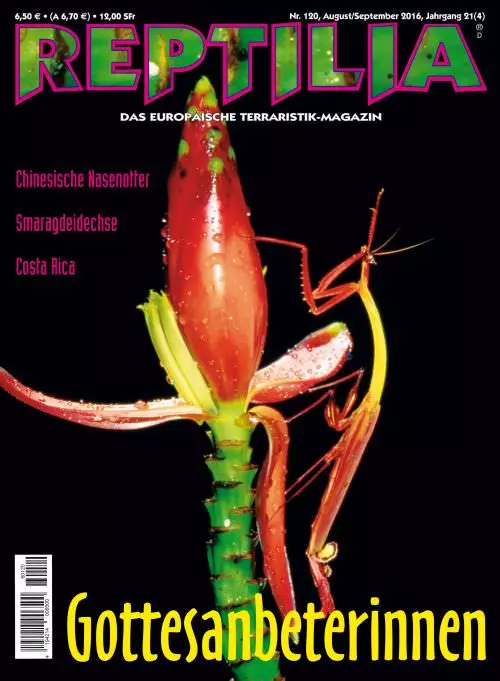

Reptilia 120 - Praying Mantises

Article no: reptilia120

CHF 12.00

Stock: 0

Ready for dispatch in 1-3 days, delivery time 7 working days

Delivery between Tuesday, 28 April and Wednesday, 29 April
Zahlungsarten
Product information "Reptilia 120 - Praying Mantises"

Reptilia 120 - Praying Mantises

Chinese viper
Emerald lizard
Costa Rica
 
Contents:
 
Cover story: Praying Mantises

Nobody can escape the fascination of praying mantises. These predatory insects with their alien appearance and martial mating habits have long secured a permanent place in terrariums. We offer an overview of mantids in breeding, the classics, and the latest trends. We also feature an unusual species from the Philippines and look to eastern Germany, where Mantis religiosa has spread.

Editorial
MAGAZINE
DATES

Photo story
The fascination of praying mantises
K. Kunz

Keeping and breeding
Praying mantises. The basics of keeping in terrariums
C. J. Schwarz

REPORTAGE
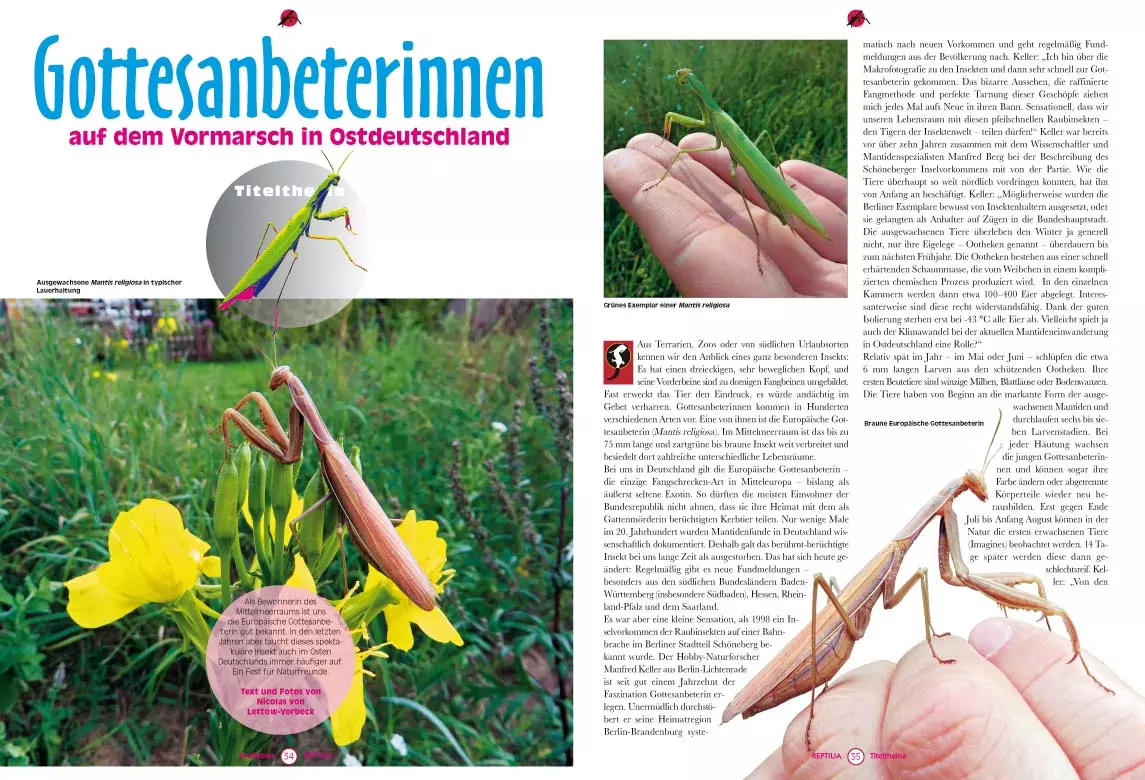
Praying mantises on the advance in eastern Germany
N. von Lettow-Vorbeck

Biology
Praying mantis, change your tune. On the challenge of identifying praying mantises using the Philippine species Creobroter meleagris as an example
C. J. Schwarz

Reportage
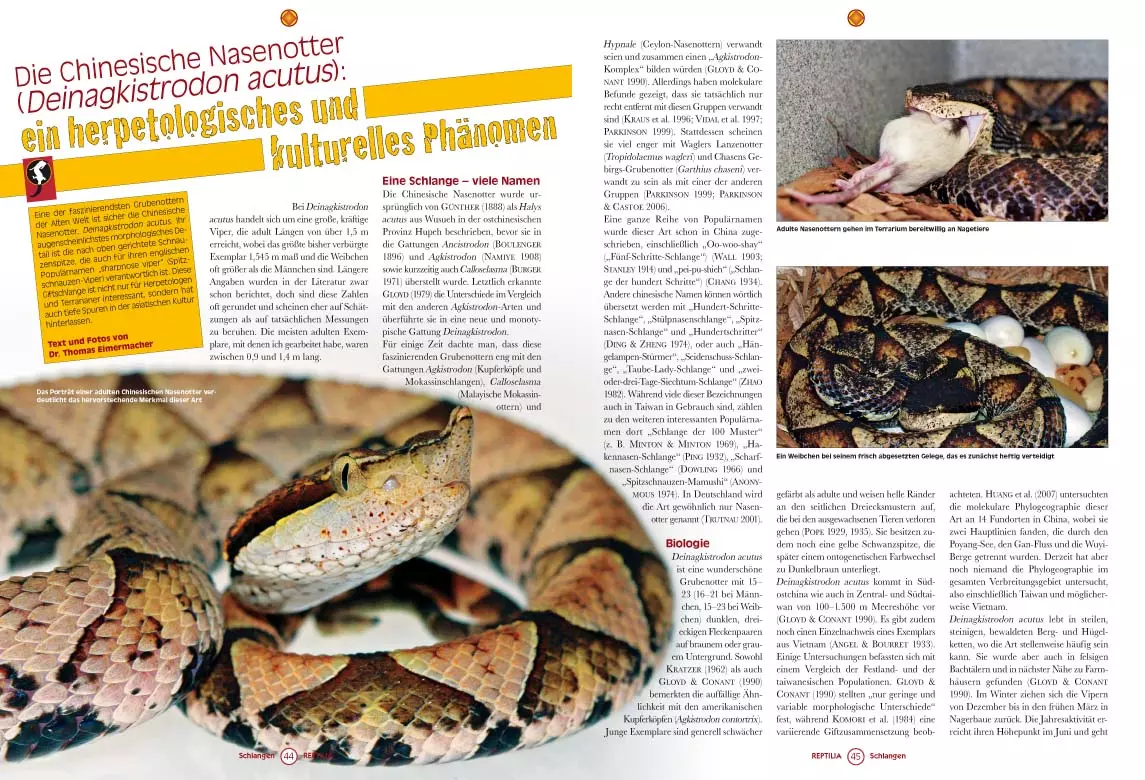
The Chinese viper (Deinagkistrodon acutus): a herpetological and cultural phenomenon
Dr. T. Eimermacher

Keeping and breeding
The banded fire salamander (Salamandra salamandra terrestris).  Distribution, habits and breeding
M. Rogner

Rreportage
A display terrarium for fire salamanders
R. Hoppe

Animals of our homeland
The emerald lizard
R. Leptien

SERVICE

WESTERN HERP PERSPECTIVES
But it’s a dry heat
B. Love

ALSO NEAR YOU

Travel
Costa Rica – Paradisiacal biodiversity between the Atlantic and the Pacific
N. Weinbeer

PREVIEW

INCUBATOR
The break
H. Werning

Composition
Feeding recommendation
Technical details
Size information

0 of 0 reviews

Give us a rating!

Share your experience with the product with other customers.


Customers also bought

Reptilia 49 - Food animal breeding
Reptilia 49 - Food animal breedingScorpion crust lizardSpotted pythonChinese mountain dragonContents: 2 EDITORIAL 4 READER LETTERS 5 MAGAZINE 14 DATES 18 WESTERN HERP PERSPECTIVESHurricane Sale in Floridaby B. Love 20 PHOTO REPORTAGE Breeding food animals yourself - a problem?by F. Bruse & H. Werning 27 REPORTAGEEfficient and productive cricket breeding by F. Bruse 33 REPORTAGEBreeding the chocolate cockroach (Shellfordella tartara) by F. Bruse 36 REPORTAGEA simple Drosophila breeding project by F. Bruse 40 HERPETOFAUNANotes on the Motagua lizard (Cnemidophorus motaguae) by U. Schlüter 43 TRAVELHerpetological observations and more from Gambia by U. Thieme 51 PORTRAIT AND POSTERGeoclemys hamiltoniby H. - D. Philippen 56 KEEPING AND BREEDINGKeeping and Breeding the Chinese Mountain Agame (Japalura splendida) by H. Schradin 68 HERPETOFAUNADendrobates pumilioThe strawberry frog on the Bocas Islands by B. Schwarz 72 KEEPING AND BREEDING The black Mexican chain snake (Lampropeltis getula nigrita in the terrariumby M. Thums 79 REPORTAGEAntaresia maculosa (PETERS, 1873)Spotted pythonby D. Hasselberg 85 CLASSIFIED ADS 90 RAT & TAT 93 LIBRARY 104 GLOSSESIn search of Uracentron azureumPart 1by H. Werning

CHF 11.20

Bugs No. 06 - Asian Mantids
Bugs No. 06 - Asian Mantids African Harlequin CockroachRed Hainan crabThailandContents:The cover story of Bugs No. 6 is full of beauties, but they all have only three things on their minds: Eat, hide and reproduce. They are beautiful in their own right, but their perfect camouflage makes them hard to spot in their habitat - mantids from Asia! Find out new and interesting facts about species that live in mosses and lichens and read detailed breeding reports.Table of contents EditorialFacetsDatesFlown in      Cover storyAsian mantids Cover storySmall, colourful flower mantises Cover storyDemanding Dwarfs ReportageNative ‘tigers’ on a slimy trail  In the crosshairsBlood-red freshwater crab from China  FledgedIn search of scorpions in Morocco Keeping & BreedingSuccessful breeding of a roller spider CultureCuisine from Laos ShowcaseThe State Zoological Collection, Munich Kids CornerWhat’s crawling about in May? Potter beeHandling tarantulas Book scorpionAlso in your neighbourhoodService & ImprintPreview MetamorphosesThe Very Hungry Caterpillar

CHF 12.00

Suggested products

Handbook of food plants for tortoises and other reptiles
Handbook of forage plants 2nd revised editionMarion Minch is not only a successful breeder of diverse tortoises for many years, but also an excellent connoisseur of native wild herbs. She founded and runs samenkiste.de, which is well known to many tortoise keepers and nature lovers. Her name is inextricably linked with reptile care and species-appropriate nutrition for tortoises. Her handbook of food plants summarises the most important native food plants for herbivorous and omnivorous reptiles. She not only considers tortoises, but also iguanas, spiny-tailed dragons and even chameleons. From the basics of plant biology to native wild herbs to suitable food plants for hardy tropical reptile species, this comprehensive work provides the basis for species-appropriate keeping. In the expanded and supplemented 2nd edition, the plant section is divided according to flower colour. This makes it even easier to identify wild herbs. The work has also been supplemented with a wealth of additional information and many pictures.

CHF 46.50

Geckos
Geckos in the terrarium by Astrid FalkThe book offers a comprehensive introduction to geckos and their species-appropriate keeping in terrariums. It explains what you need to think about before buying a gecko and what preparations should be made. The book describes in detail how the terrarium is technically equipped and set up. The care of the animals, their special features and behaviour, their diet, reproduction and rearing of young animals are described, as well as diseases and husbandry problems with tried and tested suggestions for prevention and treatment. Individual gecko species that are particularly suitable for keeping and breeding in terrariums are portrayed in detail in the second part of the book.

CHF 28.50

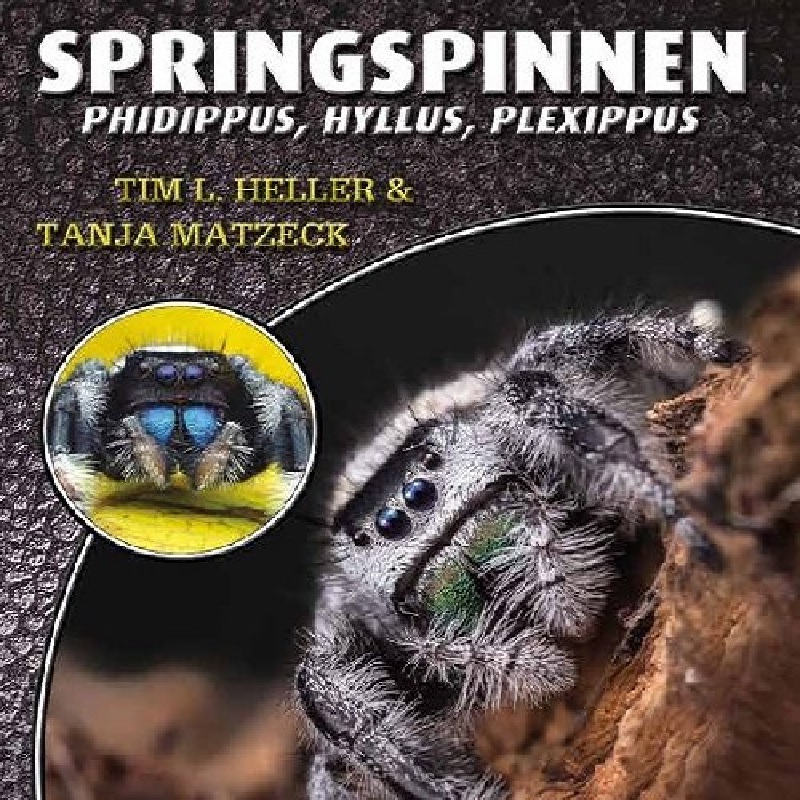
Jumping spiders Phidippus, Hyllus, Plexippus
Book Jumping Spiders - Phidippus, Hyllus & Plexippus A guide to keeping jumping spiders of the genera Phidippus, Hyllus & Plexippus. Who can resist the charm of jumping spiders? The childlike appearance of their expressive face simply leaves no one cold! In addition, their behavior is extremely exciting to observe, their colors are bright and their requirements for species-appropriate keeping are very easy to meet. No wonder these likeable jumpers are all the rage! This volume in the "Species by Species" series describes in detail what to look out for when buying and keeping them, introduces the most commonly kept species and color forms and provides plenty of tips on how to keep them successfully - so you can be sure they will breed well! Species by Species introduces you to the books in this series, which present the most popular terrarium animals. Each volume offers you detailed, practical care instructions and all the information you need to successfully breed your animals. All important questions from the required tank size to terrarium set-up, technical equipment, species-appropriate nutrition and disease prevention are answered with numerous tricks and tips. Experienced, long-standing breeders reveal how you can encourage the animals to reproduce and raise healthy young. All this in full color, generously illustrated and attractively designed - just about your terrarium animal - species by species

CHF 23.90

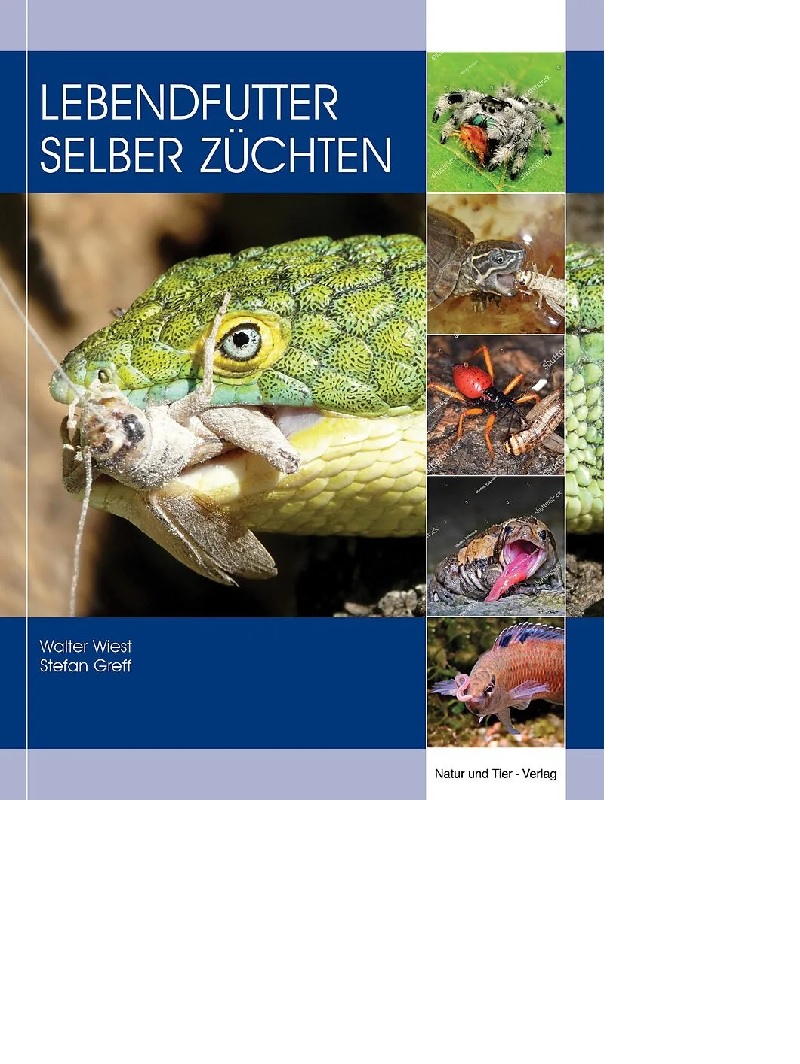
Book Breeding live food yourself
Book "Grow your own live food" - The perfect guide for pet owners Discover practical and detailed instructions on how you can easily breed food for your reptiles, birds, fish or other animals yourself in the book "Breeding live food yourself". With valuable tips on various food insects, their care and breeding, you can save money and ensure a species-appropriate diet for your pets. Contents of the book: Step-by-step instructions for breeding feeder insects Information on the best types of food for reptiles, birds and fish Care instructions and breeding conditions for various live food species Tips for sustainable and cost-effective food production Why breed your own live food? Get healthy, fresh food for your animals Save money and reduce dependence on pet shops Promote the health and well-being of your animals with species-appropriate food Whether you are a beginner or an experienced pet owner, this book provides you with everything you need to successfully breed live food yourself.

CHF 46.50

Marginata 69 - New Guinea tortoises
Marginata 69 - New Guinea tortoises – the genus ElseyaCover storyThe unrecognised beauties: New Guinea tortoises (Andreas S. Hennig)My experiences with Branderhorst's New Guinea tortoise, Elseya (Elseya) branderhorsti (Ouwens, 1914) (Andreas S. Hennig)Keeping and breeding of Rhodin's New Guinea tortoise, Elseya (Hanwarachelys) rhodini Thomson, Amepou, Anamiato & Georges, 2015 (Andreas S. Hennig)PortraitGeoemyda spengleri, Chinese serrated tortoise (Andreas S. Hennig)ReportageMacrochelys temminckii – Experiences and impressions with vulture tortoises part 2 (Reiner Praschag)KeepingAn alternative to year-round keeping of the Egyptian tortoise in the terrarium – my experiences with seasonal outdoor keeping of Testudo kleinmanni (Ricarda Schramm)EtymologySawbacks and living maps part 4: Graptemys gibbonsi, Pascagoula humpback tortoise (Holger Vetter)Classifieds & animal placement

CHF 16.50

Bede your hobby chameleons
Bede - Your Hobby Chameleons Rolf Müller and Ulrike Walbröl have been successfully breeding chameleons for years. As members of the DGHT’s Chameleon Working Group and contact persons for the Chameleon Hotline, they are thoroughly familiar with the problems faced by beginners in chameleon keeping. Here, they have brought together their knowledge and experience for the first time and, in collaboration with Dominik Kieselbach, have created a book for beginners unlike any other previously available on the German market.

CHF 23.50

The Bahamaanolis
All about the Bahamaanolis by the author duo Uwe Bartelt & Iris Zeilfelder 64 pages Format: 14.8 x 21 cm numerous colour photos Paperback Author Uwe Bartelt & Iris Zeilfelder Contents: Nothing is more fascinating than a healthy group of Bahama anoles in a species-appropriate terrarium.The very lively, diurnal animals are not very shy after familiarisation and can be well observed.They prove to be long-lived in the terrarium, forgive even minor husbandry mistakes and, in good conditions, readily reproduce. In short, they give the owner a great deal of pleasure. Systematics and body structure The fascinating biology: From the life of the Bahama anolis All information on species-appropriate keeping: From suitable terrariums and equipment and technology to feeding Successful breeding: Mating stimulation, incubation of the eggs and rearing the young Solutions to problems: How to avoid the most common mistakes in care and how to help sick animals Brilliant photos

CHF 17.90

NTV, Nutrition of land tortoises
NTV Nutrition of tortoises 144 pages 113 colour photos 27 tables 17 graphics Author Dr Carolin Dennert Format: 16.8 x 21.8 cm  Contents: Tortoises are popular pets. However, these seemingly robust reptiles place high demands on their diet. The popular European tortoises in particular often unintentionally fall victim to inadequate feeding and the wrong food. But the increasingly popular tropical tortoise species also have very specific requirements, which can differ significantly from those of their European relatives. Carolin Dennert is a vet and committed tortoise keeper. For many years, she has focussed on the nutrition and nutrition-related diseases of reptiles, both scientifically and in veterinary practice.This book is the first to present the basics of tortoise nutrition in an understandable way, as well as all common food plants and feedstuffs. The correct supply of vitamins and minerals is discussed in detail, as well as nutrition-related diseases and treatment options. Information on the correct feeding of the individual tortoise species rounds off this special work. The nutrient content of all common food plants and the correct dosage of commercially available vitamin and mineral supplements can be found in an extensive appendix of tables.

CHF 35.90

Reptilia 93 - Terraristics in the crossfire
Reptilia 93 - Terraristics in the crossfire Dreistreifen-BlattsteigerTürkis-ZwerggeckoRotschwanzboa Inhalt: EDITORIALLESERBRIEFENACHSCHLAGMAGAZINTERMINEIN 5 JAHREN UM DIE WELT Meine zweite herpetologische Exkursion: Lateinamerika A. PachmannWESTERN HERP PERSPECTIVES Total cool: Winterherping B. LoveFOTOSTORY Terraristik im Kreuzfeuer. Ein Hobby in der Kritik K. KunzInterview „Denen ist jedes Mittel recht!“ K. KunzREPORTAGE„Wir sind im Ausnahmezustand!“. Der Kölner Schmuggelfall K. KunzHerpetofauna Der Türkis-Zwerggecko. Ein Juwel vor dem Aus? H. SchneiderHALTUNG UND NACHZUCHTBoa constrictor constrictor. Haltung und Nachzucht der RotschwanzboaM. BorerHerpetofaunaAuf dem Weg ins All. Die Welt der Buchstaben-Schmuckschildkröte, Trachemys scripta Teil 3: Die Gelbwangen-Schmuckschildkröte, Trachemys scripta scripta A. S. HennigHaltung und Vermehrung Der Dreistreifen-Blattsteiger, Epipedobates anthonyi. Der trillernde Guppy unter den Pfeilgiftfröschen U. DostTiere unserer Heimat Der Moorfrosch R. LeptienBibliothekABO & SERVICETipps & TricksTestlaufAUCH IN IHRER NÄHEReiseSüdamerikas „Big One“ – Auf Anakondasuche in der unberührten Wildnis von GuyanaL. DirksenVORSCHAUBRUTKASTENDas Chamäleon-GebetB. Trapp  

CHF 12.00

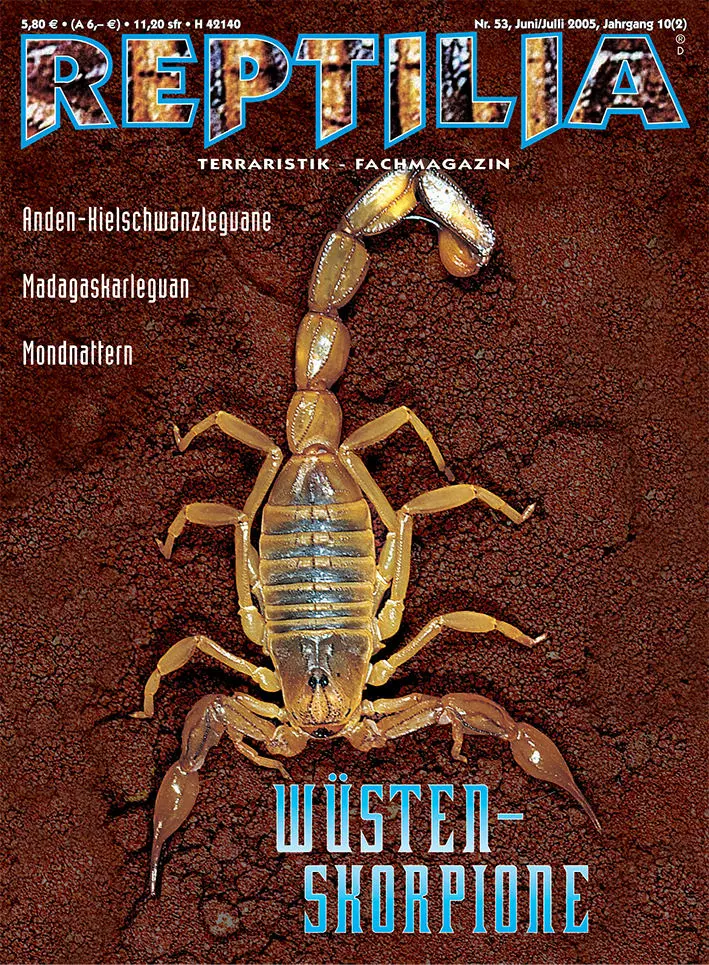
Reptilia 24 - Stick insects
Reptilia 24 - Stick insects Incubation of turtle eggsTerrarium photographyArch-snakes Contents: Page 2 - EditorialPage 3 - Letters to the editorPage 6 - MagazinePage 13 - DatesPage 16 - Western Herp Perspectives: Tribute to the Frog, by B. LovePage 18 - Photo report: Stick and ghost grasshoppers, by O. ZomproPage 24 - Keeping and breeding: Ghost insects of the family Heteropterygidae in the terrariumPage 30 - Report: Food animal and terrarium ornament at the same time: The Indian stick insect (Carausius morosus), by F. GastPage 34 - Journey: On a big game hunt for the sticks - Insights into the joys and dangers of a collecting trip, by I. FritzschePage 40 - Herpetology and culture: On the utilisation of some amphibian and reptile species in Peru, by T. EisenbergPage 47 - Portrait and poster: Anolis roquet, by M. SchmidtPage 51 - Herpetofauna: Observations on the ecology and terrarium keeping of the arch-snake Chalcides chalcides mertensi, Klausewitz 1954, by H. EsterbauerPage 55 - Keeping and breeding: Incubation of turtle eggs, by M. MähnPage 63 - Terrarium studies: Herpetological photography – ABC of reptile and amphibian photography for beginners and advanced, by U. StrathemannPage 70 - Herpetofauna: Asaccus – The leaf-fingered geckos of the Oman mountains, by R. LeptienPage 79 - Reptilia on the road: Zoological Garden of the City of Wuppertal, by A. HauschildPage 82 - Advice and actionPage 89 - LibraryPage 96 - Gloss: Forget fighting dogs! A friend for life, by K. Kunz

CHF 9.80

Terraria No. 29 - Incubators for reptile eggs
Schildkrötenjahr: Europäische Landschildkröten im Mai und JuniFreilandterrarien fit für den Sommer machen Inhalt: Ein Schlüsselmoment bei der Nachzucht eierlegender Reptilien ist die Bebrütung der Gelege. Umso wichtiger ist es, Inkubatoren zur Verfügung zu haben, die sowohl die Temperatur als auch die relative Luftfeuchtigkeit zuverlässig regeln. Gerade rechtzeitig zur Nachzuchtsaison 2011 stellen wir Ihnen die verschiedenen Funktionsprinzipien von Brutkästen ausführlich vor, geben Tipps zu den diversen Brutsubstraten und haben die gängigsten Inkubator-Modelle für Sie auf Herz und Nieren geprüft. EditorialMagazinSuche nach verschwundenen Amphibien: vier von 100 Arten wiederentdeckt / Nachschlag / Schlangentagung / Paarung der Gelbgrünen Zornnatter (Hierophis viridiflavus) auf Malta / Rechtliches / Riskante Beute TERRAglobalStrandvergnügen und PazifikleguaneMaik Dobiey Bromelienfrösche – jede NachtMirco Solé TitelthemaEntwicklungsgeschichte der Reptilienzucht und -inkubation – Ein nicht nur historischer ÜberblickHans-Dieter Philippen TestlaufInkubatoren Kriton Kunz SchrankbrüterKriton Kunz Vor- und Nachteile verschiedener InkubationssubstrateHans-Dieter Philippen Das Schildkrötenjahr. Freilandbiologie und Haltung europäischer Landschildkröten über den Jahreslauf. Teil 2: Mai bis Juni – Fortpflanzungszeit Michael Wirth Rhacophorus – Die fliegenden Frösche von Borneo J. Maximilian Dehling Renovierung der Abdeckung des Freilandterrariums für Strumpfbandnattern Helmut Kreyerhoff Reise Die Herpetofauna des westlichen Hohen Atlas in Marokko Uwe Schlüter Abo & Service Neue ArtenListe der im Jahr 2010 neu beschriebenen Reptilien Axel Kwet BlickfangEin Keller voller KGV – und Asseln Michael Wirth In Ihrer Nähe Vorschau Brutkasten Schlimme Nächte: Guayaquil Teil 1: Wir Topchecker-TouristenHeiko Werning

CHF 12.00

Turtle Library 4 - European Pond Turtle
European Pond Turtle - Emys orbicularis Turtle Library 4 This book covers everything from tried-and-tested advice on successful breeding to a scientific overview of current populations in the countries where they are found. The book includes a short article on the following countries and regions: North Africa (Morocco, Algeria, Tunisia); the Iberian Peninsula (including the Balearic Islands); France (including Corsica); the Benelux countries; Switzerland; Germany; Italy (including Sicily and Sardinia);  Denmark; Austria; Czech Republic; Slovenia, Poland; Hungary; Slovakia; Albania; Greece; Romania; Lithuania; Latvia; Bulgaria; Ukraine; Belarus; Turkey; Russia and the Caucasus region.

CHF 46.90

Customers also saw

Decoration set - Mantis
Decoration set for mantis terrariumsThis set was specially developed for mantis terrariums and is therefore suitable for nano terrariums.Finding the right decorative items for small nano terrariums can be a challenge. That's why we offer attractive decoration sets that are specially adapted to the sizes of Insect Terrariums, Life Boxes and similar models.The sets contain branches, pieces of wood, bark, hiding places and moss. As these are natural materials, the composition of the sets may vary.

CHF 17.90

Reptilia 28 - Praying mantises
Reptilia 28 - Praying Mantises Clawed frogsChinese pond turtlesArabian Desert Contents: 2 Editorial 3 letters to the editor 6 Magazine 14 dates 18 Western Herp Perspectives: The future of terraristics, by B. Love 20 Photo report: Praying mantises - A brief introduction to their lifestyle and biology, by F. Tomasinelli 26 Photo report: Praying Mantises (Mantodea), An Overview, Part 1: Phylogeny, Systematics, Physique, Reproduction, by R. Ehrmann 33 Keeping and breeding: Angels of Death - The orchid mantis, mimicry, behaviour and care of Hymenopis coronatus, by F. Tomasinelli 38 Keeping and breeding: Burrows for clutches - The praying mantis Humbertiella ceylonica Saussure 1869 (insecta: Matodea), by H. Müller 42 Journey: Rhub al Khali - The Empty Quarter, A journey to the United Arab Emirates, by R. Leptien 51 Portrait and poster: Chamaeleo chamaeleon, by M. Aresté 56 Keeping and breeding: Keeping and breeding the Chinese pond turtle Mauremys mutica (Cantor 1842), by A. S. Henning 60 Keeping and breeding: Giant geckos from Madagascar: Homopholis boivini (Duméril, 1856) in a terrarium, by U. Schlüter 64 Herpetofauna: Remarks on the biology and care of Rhinobotryum bovalli (Andersson, 1916), by A. Hohmeister 68 Keeping and breeding: Keeping and breeding clawed frogs (Silurana spec.) - Part : Systematics, description and keeping, by K. Kunz 74 Herpetoculture: Adam, Eve and the snake, by Dr C. Thiede 77 Terraristics: Building a snake enclosure Part 4: Snakes and concrete. A gloss, by M. Hallmen 80 Reptilia on the road: Outdoor terrarium and aquarium stone, by H. Wölfel 91 Advice and action 95 Library 104 Gloss: DGHT conference: Preliminary statement, by H. Werning

CHF 9.80