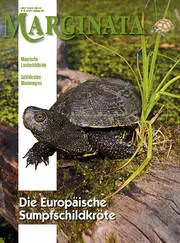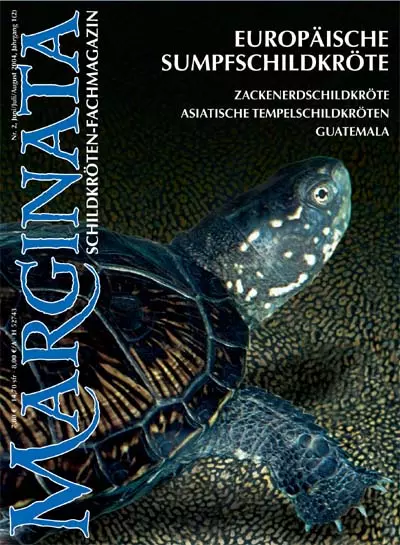
Marginata 02 - European Pond Turtle

Article no: marginata2

CHF 14.70

Stock: 0

Ready for dispatch in 1-3 days, delivery time 7 working days

Delivery between Friday, 28 August and Monday, 31 August
Zahlungsarten
Product information "Marginata 02 - European Pond Turtle"

Marginata 02 - European pond turtle

Serrated terrapins
Asian Temple Turtles
Guatemala

Contents:

    • 2 EDITORIAL
    • 3 THE TEAM INTRODUCES ITSELF
    • 4 READER LETTERS
    • 5 MAGAZINE
    • 9 DATES
    • 10 PHOTO REPORTAGE
      European pond turtles (Emys orbicularis LINNAEUS, 1758)
      Hans - Dieter Philippen
    • 14 REPORTAGE
      Observations and experiences regarding the keeping and breeding of the European pond turtle (Emys orbicularis LINNAEUS, 1758)
      Bernd Wolff
    • 24 REPORTAGE
      The relationship between origin, currently known phylogeny (evolutionary history) and habitat of the European pond turtle (Emys orbicularis) using three populations as examples
      Jens Poschadel
    • 31 PORTRAIT
      Madagascan flat-tailed turtle
      Pyxis [Acinixys] planicauda (GRANDIDIER, 1867)
      Matthias Mähn
    • 36 REPORTAGE
      Species protection on the dream beach –
      The projects of the organisation ARCAS in Guatemala
      Kriton Kunz
    • 46 REPORTAGE
      The fascination of serrated terrapins (genus Geoemyda
      Some aspects of their keeping and biology
      Ingo Schaefer
    • 52 REPORTAGE
      Intensively exploited without protection: Amyda cartilaginea (BODDART, 1770) and Dogania subplana (GEOFFROY ST.-HILAIRE, 1809)
      Mark Auliya
    • 56 BOOK TIP
    • 57 CLASSIFIEDS
    • 58 REPORTAGE
      Salmonellosis – Measures to prevent turtle-related transmission
      Tessa E. H. Römkens and Frank Stam
    • 62 REGIONAL GUIDE
    • 64 AGATHA MARGINATA
Composition
Feeding recommendation
Technical details
Size information

0 of 0 reviews

Give us a rating!

Share your experience with the product with other customers.


Suggested products

Handbook of food plants for tortoises and other reptiles
Handbook of forage plants 2nd revised editionMarion Minch is not only a successful breeder of diverse tortoises for many years, but also an excellent connoisseur of native wild herbs. She founded and runs samenkiste.de, which is well known to many tortoise keepers and nature lovers. Her name is inextricably linked with reptile care and species-appropriate nutrition for tortoises. Her handbook of food plants summarises the most important native food plants for herbivorous and omnivorous reptiles. She not only considers tortoises, but also iguanas, spiny-tailed dragons and even chameleons. From the basics of plant biology to native wild herbs to suitable food plants for hardy tropical reptile species, this comprehensive work provides the basis for species-appropriate keeping. In the expanded and supplemented 2nd edition, the plant section is divided according to flower colour. This makes it even easier to identify wild herbs. The work has also been supplemented with a wealth of additional information and many pictures.

CHF 46.50

Geckos
Geckos in the terrarium by Astrid FalkThe book offers a comprehensive introduction to geckos and their species-appropriate keeping in terrariums. It explains what you need to think about before buying a gecko and what preparations should be made. The book describes in detail how the terrarium is technically equipped and set up. The care of the animals, their special features and behaviour, their diet, reproduction and rearing of young animals are described, as well as diseases and husbandry problems with tried and tested suggestions for prevention and treatment. Individual gecko species that are particularly suitable for keeping and breeding in terrariums are portrayed in detail in the second part of the book.

CHF 28.50

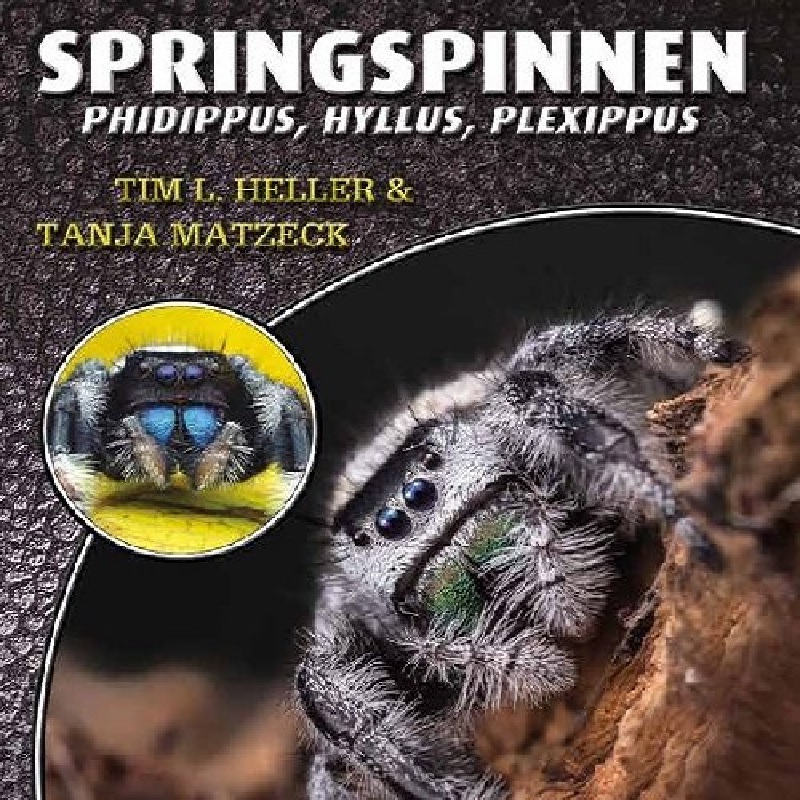
Jumping spiders Phidippus, Hyllus, Plexippus
Book Jumping Spiders - Phidippus, Hyllus & Plexippus A guide to keeping jumping spiders of the genera Phidippus, Hyllus & Plexippus. Who can resist the charm of jumping spiders? The childlike appearance of their expressive face simply leaves no one cold! In addition, their behavior is extremely exciting to observe, their colors are bright and their requirements for species-appropriate keeping are very easy to meet. No wonder these likeable jumpers are all the rage! This volume in the "Species by Species" series describes in detail what to look out for when buying and keeping them, introduces the most commonly kept species and color forms and provides plenty of tips on how to keep them successfully - so you can be sure they will breed well! Species by Species introduces you to the books in this series, which present the most popular terrarium animals. Each volume offers you detailed, practical care instructions and all the information you need to successfully breed your animals. All important questions from the required tank size to terrarium set-up, technical equipment, species-appropriate nutrition and disease prevention are answered with numerous tricks and tips. Experienced, long-standing breeders reveal how you can encourage the animals to reproduce and raise healthy young. All this in full color, generously illustrated and attractively designed - just about your terrarium animal - species by species

CHF 23.90

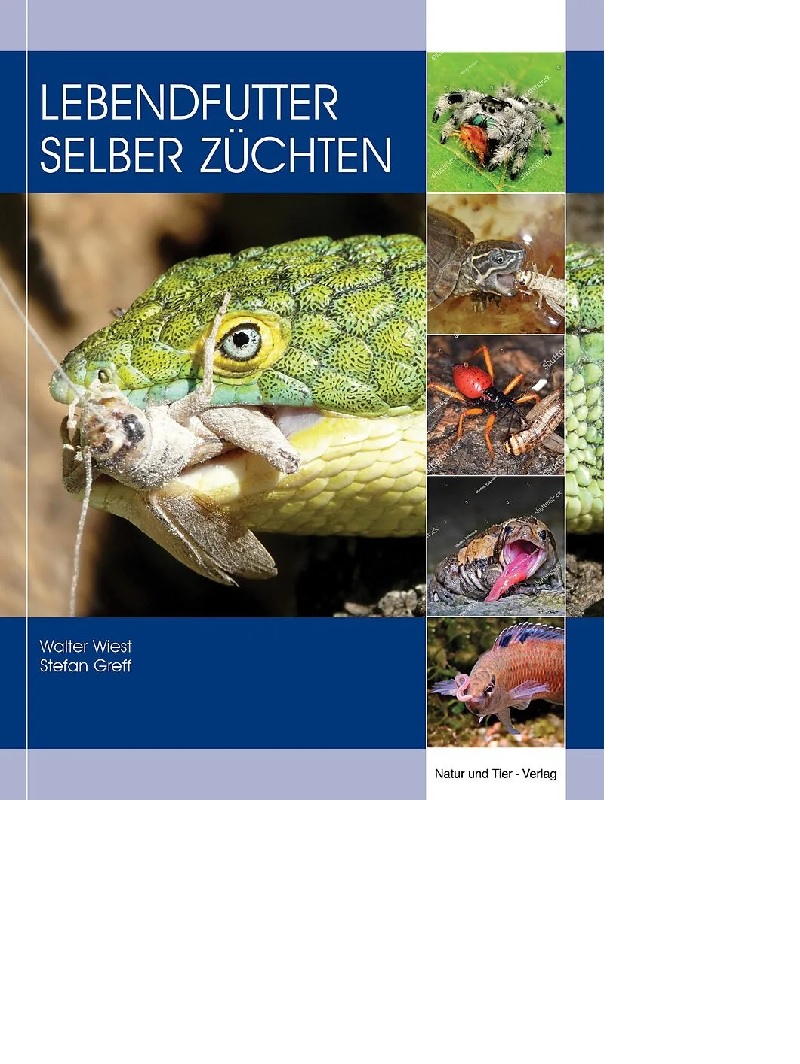
Book Breeding live food yourself
Book "Grow your own live food" - The perfect guide for pet owners Discover practical and detailed instructions on how you can easily breed food for your reptiles, birds, fish or other animals yourself in the book "Breeding live food yourself". With valuable tips on various food insects, their care and breeding, you can save money and ensure a species-appropriate diet for your pets. Contents of the book: Step-by-step instructions for breeding feeder insects Information on the best types of food for reptiles, birds and fish Care instructions and breeding conditions for various live food species Tips for sustainable and cost-effective food production Why breed your own live food? Get healthy, fresh food for your animals Save money and reduce dependence on pet shops Promote the health and well-being of your animals with species-appropriate food Whether you are a beginner or an experienced pet owner, this book provides you with everything you need to successfully breed live food yourself.

CHF 46.50

Marginata 69 - New Guinea tortoises
Marginata 69 - New Guinea tortoises – the genus ElseyaCover storyThe unrecognised beauties: New Guinea tortoises (Andreas S. Hennig)My experiences with Branderhorst's New Guinea tortoise, Elseya (Elseya) branderhorsti (Ouwens, 1914) (Andreas S. Hennig)Keeping and breeding of Rhodin's New Guinea tortoise, Elseya (Hanwarachelys) rhodini Thomson, Amepou, Anamiato & Georges, 2015 (Andreas S. Hennig)PortraitGeoemyda spengleri, Chinese serrated tortoise (Andreas S. Hennig)ReportageMacrochelys temminckii – Experiences and impressions with vulture tortoises part 2 (Reiner Praschag)KeepingAn alternative to year-round keeping of the Egyptian tortoise in the terrarium – my experiences with seasonal outdoor keeping of Testudo kleinmanni (Ricarda Schramm)EtymologySawbacks and living maps part 4: Graptemys gibbonsi, Pascagoula humpback tortoise (Holger Vetter)Classifieds & animal placement

CHF 16.50

Ulmer, tortoises
Ulmer - TortoisesProper care for prehistoric creaturesThe book offers a comprehensive introduction to the species-appropriate keeping of tortoises in the enclosure and in the tortoise house.The book gives instructions on:Tortoises in the wildTrade and protection regulationsBiological specialitiesConsiderations before buyingSpecies for beginners and advanced keepersNatural housingNutrition and healthBreeding and rearingup to dateinformativepractical

CHF 27.90

Marginata No. 32 - Fascination of yellowhead tortoises
Heft Marginata Nr. 32 leider vergriffen und vom Lieferanten nicht mehr lieferbar.

CHF 16.50

Bugs No. 07 - Colorful bird spiders
Bugs No. 07 - Colourful tarantulas Journey: Thailand and BorneoCockroaches: Deropeltis paulinoiRearing substrate: Flake SoilContents:Tarantulas are gloomy grey-brown? Not at all! Many species display fantastic, bright colours! We introduce you to the most beautiful representatives and show you how to keep and breed them using two species as examples.The colourful theme continues: Necroscia annulipes, one of the most colourful stick insects currently to be found in our terrariums, is presented. You can find out everything you need to know to keep them successfully in this issue of Bugs.Our travel report takes you to the forests of Thailand, where, for example, a lot of brightly coloured praying mantises live.For cockroach lovers we have an article about Deropeltis paulinoi – the authors report in detail about the breeding of this impressive species.In addition, of course, a number of other exciting topics are addressed, so that there will be something for fans of various invertebrate groups. Plus practical tips and news from the world of science and much more ...Table of contents EditorialFacetsDatesFlown in Cover storyColourful splendour on eight legs Blue is beautiful! FledgedA journey to the praying mantises and grasshoppers of Thailand and Borneo Keeping & BreedingAbout the breeding of the privet hawk moth PracticeFlake Soil – Quality offensive in beetle breeding Keeping & BreedingTurquoise blue stick insect CultureCockroaches in the mouth Keeping & BreedingVelvet cockroaches – Noble terrarium inhabitants Kids CornerA chirping and chirping Book scorpionAlso in your neighbourhoodService & ImprintPreview

CHF 12.00

Draco 20 - Crocodiles
Draco 20 - Crocodiles Contents: 2 Editorial 4 The agamas of the worldMirko Barts & Thomas Wilms 24 On keeping Philippine sailfin lizards (Hydrosaurus pustulatus)Jiři Gábriš 34 On aggressive encounters among free-living butterfly agamas (genus Leiolepisy CUVIER), with a form of locomotion previously unknown in vertebrates/Wolfgang Böhme 40 In profile: the Vietnamese butterfly lizard (Leiolepis guttata CUVIER, 1829)Uwe Schlüter 42 On keeping and breeding two taxa from the Uromastyx-acanthinura complex: Uromastyx geyri MÜLLER, 1922 and Uromastyx dispar flavifasciata MERTENS, 1962 (Reptilia: Agamidae: Leiolepidinae: UromastyxThomas Wilms, Dieter Ruf & Beate Löhr 56 Agama impalearis (BOETTGER, 1874) – the Atlas agama, well-known and rare in the terrariumHans D. Müller 64Notes on keeping and breeding the lyre-headed lizard, Lyocephalus scutatus (LINNAEUS, 1758) Uwe Bartelt 70The agamas of southern AfricaMirko Barts 80 Experiences with the blue-throated angulate-headed lizard (Gonocephalus bellii) in the terrariumIngo Kober 87 Book box 94 Magazine

CHF 16.80

Reptilia 107 - Toad lizards
Reptilia 107 Toad lizards Eared frogMagnificent tortoiseConstruction of an outdoor terrarium Contents:Cover story: Toad lizardsThe bizarre toad lizards of the genus Phrynosoma are among the almost legendary terrarium animals. Every reptile lover is probably enchanted by the appearance of these small North American iguanas, but they have a reputation for being impossible to keep. However, more and more dedicated terrarium keepers are succeeding not only in keeping these food specialists for many years, but also in breeding them successfully. We provide an overview of the genus, discuss the problem of feeding these animals and provide two examples of successful keeping and breeding. EditorialMAGAZINEDATES WESTERN HERP PERSPECTIVESThe invisible ark B. Love PHOTOSTORYToad lizards – a (very good) freak of natureH. Werning REPORTAGEConsiderations on the diet of toad lizardsB. Fabian KEEPING AND BREEDINGKeeping and breeding the giant toad lizard (Phrynosoma asio) in the terrariumK. Haase KEEPINGPhrynosoma orbiculare – a toad lizard  from the highlands in captive careK. Haase KEEPINGThe eared frog, a little-known guest in the terrariumP. Janzen KEEPING AND BREEDINGSilent observers – on the lifestyle and keeping of the Central American magnificent tortoiseL. Spinner PracticeConstruction of an outdoor enclosure for emerald lizardsM. Herz TEST RUNSuccessful combination of terrarium and rackK. Kunz ANIMALS OF OUR HOMEThe spadefoot toadR. Leptien LIBRARYSERVICEALSO NEAR YOU TRAVELTerra incognita in the middle of Madagascar's rice fields – the herpetofauna of BetaolanaS. Wolf PREVIEW BRUTKASTEN Tangimangi – or: Take what you need!M. Zawadzki 

CHF 12.00

Reptilia 64 - Web spiders
Reptilia 64 - Web spidersColour variations of the web pythonAmerican tree frogChamaeleo montiumContents: 2 EDITORIAL 3 MAGAZINE 12 DATES 16 WESTERN HERP PERSPECTIVESThe thing with the rubbishFrom B. Love 18 PHOTO REPORTAGEWeb spiders and their amazing survival strategiesBy F. Tomasinelli 26 REPORTAGEThe thousand uses of spider silk - from catching prey to brood careBy F. Tomasinelli 31 KEEPING AND REPRODUCTIONBiology and breeding of hunting spiders of the genus CupienniusBy F. Tomasinelli 35 ARACHNOFAUNAThe European Tarantulas - Introduction to the genus Lycosa in Western EuropeBy E. Biggi & F. Tomasinelli 40 TRAVELWestern emerald lizards(Lacerta bilineata) on the Atlantic coast in BrittanyBy W. & Y. Lantermann 44 TRAVELWith harpoon and machete - the hunt for moor caimans in the AmazonasBy P. Ulmer 51 PORTRAIT AND POSTERMacropisthodon flavicepsBy A. Gumprecht & D. Trautmann 56 KEEPING AND REPRODUCTIONThe breeding of the American tree frog, Hyla cinerea (SCHNEIDER 1799), in the aquarium of Cologne ZooBy K. van der Straeten, D. Karbe, S. Olbort & T. Ziegler 64 KEEPING AND REPRODUCTIONKeeping offspring of the mountain chameleon, Chamaeleo (Trioceros) montiumBy T. Paechl 70 REPORTAGEUnknown diversity: colour and pattern variations of the reticulated python(Python reticulatus)By K. Wöllner 75 HERPETOFAUNAHydromedusa maximiliani - The Brazilian snake-necked tortoiseBy F. L. Souza 80 HUSBANDRY AND REPRODUCTIONCare and breeding of the Peruvian leaf-fingered gecko Phyllodactylus reissi (PETERS 1862)By U. Schlüter 87 FAQ - FREQUENTLY ASKED QUESTIONSAnacondasBy L. Dirksen 94 LIBRARY 104 BRUTKASTENHigh mountain hallucinations, part 2By H. Werning

CHF 11.20

Reptilia 67 - Tiger Salamander, Axolotl & Co.
Reptilia 67 - Tiger Salamander, Axolotl & Co.Steve Irwin's legacyHusbandry problems with the green tree pythonBroad-shelled turtles in SardiniaContents: 2EDITORIAL 3MAGAZINE 11TERMINE 14WESTERN HERP PERSPECTIVESRevive the old passionFrom B. Love 6 PHOTO REPORTAGEAmbystomatidae Gray, 1850 ?transverse-toothed newtsBy T. Blanck 22HERPETOFAUNAThe cross-toothed newts, family Ambystomatidae Gray, 1850An overview of the speciesBy T. Blanck 36 KEEPING AND REPRODUCTIONKeeping and breeding the banded tiger salamander Ambystoma mavortiumBy T. Blanck & M. Braun 41HERPETOCULTUREThe axolotl in religion, magic and mythBy F. Cupul 45LETTERS11 years ReptiliaVisiting Bill LoveBy H. Werning 51PORTRAIT AND POSTERZamenis longissimusFrom A. Kwet 56 KEEPING AND REPRODUCTIONFringed-fingered lizards (Acanthodactylus) in the wild and in the terrariumPart 2: Basics of terrarium keeping and reproductive biologyBy U. Schlüter 67HERPETOFAUNATestudo marginata - A view of SardiniaBy E. Cimatti 77KEEPING AND REPRODUCTIONThe most common husbandry problems with the green tree python (Morelia viridis)By G. Maxwell 82TERRARIUM SHOW PLANTSCrickey! - A visit to Australia ZooBy K. Grießhammer 90FAQ - FREQUENTLY ASKED QUESTIONSGarter snakesBy M. Hallmen 94LIBRARY 104BROOD BOX The Silence of the Nose Frogs, Part 2 By H. Werning

CHF 11.20