Marginata 36 - Dwarf tortoises

Article no: marginata36

CHF 16.50

Stock: 0

This article is currently not available

Product information "Marginata 36 - Dwarf tortoises"

Marginata 36 - Dwarf tortoises

Breeding Homopus areolatus Part 2
Breeding of musk turtles
Hibernation in Mediterranean tortoises

Contents:

Editorial
Magazine
Dates

PHOTOSTORY
"Dwarf tortoises" An overview of the smallest forms of tortoise
Hans - Dieter Philippen

Breeding
Experiences with the husbandry and breeding of the Areolate Flat-shelled Tortoise (Homopus areolatus) under different conditions in Namibia and Switzerland. Part 2: Husbandry and breeding of the species in Switzerland
Victor Mislin

BREEDING
The dwarf Pelomedus tortoise (Pelusios nanus) – the world’s smallest neck-turning tortoise. Experiences with acclimatisation, care and initial breeding attempts
Hans - Dieter Philippen

Portrait
Kalahari tent or ray-eyed tortoise Psammobates oculiferus
Alfred Schleicher & Hans - Dieter Philippen

Reportage
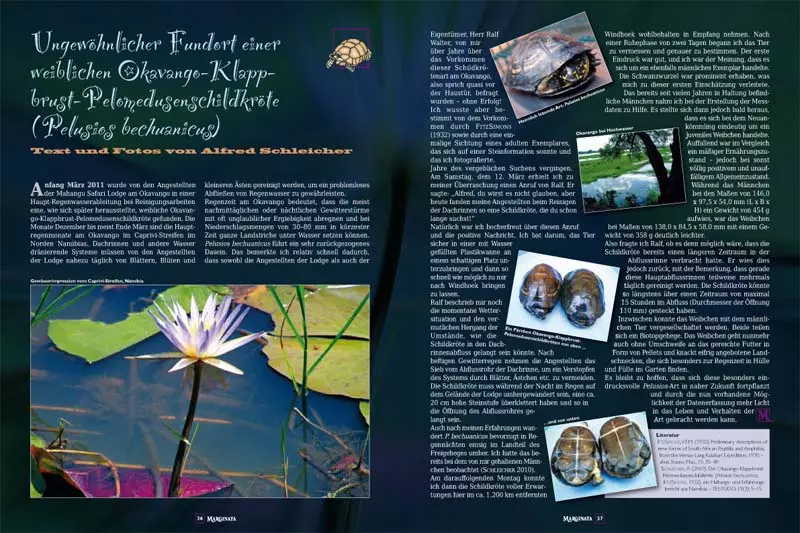
Unusual discovery of a female Okavango flap-breasted Pelomedus turtle (Pelusios bechuanicus)
Alfred Schleicher

Reportage
With the giant tortoises of Prison Island, Zanzibar
Jens Jungnickel

Reportage
Turtles in a case
Vienna Zoo

Attitude
Hibernation of European tortoises
Thorsten Geier

Reportage
Siamese twin of Testudo graeca ibera
Bayram Göçmen

Reportage
As a turtle volunteer in the Maldives
Sibylle Gaus

Book tip
Classifieds
Subscription & Service
Regional guide

Composition
Feeding recommendation
Technical details
Size information

0 of 0 reviews

Give us a rating!

Share your experience with the product with other customers.


Suggested products

Handbook of food plants for tortoises and other reptiles
Handbook of forage plants 2nd revised editionMarion Minch is not only a successful breeder of diverse tortoises for many years, but also an excellent connoisseur of native wild herbs. She founded and runs samenkiste.de, which is well known to many tortoise keepers and nature lovers. Her name is inextricably linked with reptile care and species-appropriate nutrition for tortoises. Her handbook of food plants summarises the most important native food plants for herbivorous and omnivorous reptiles. She not only considers tortoises, but also iguanas, spiny-tailed dragons and even chameleons. From the basics of plant biology to native wild herbs to suitable food plants for hardy tropical reptile species, this comprehensive work provides the basis for species-appropriate keeping. In the expanded and supplemented 2nd edition, the plant section is divided according to flower colour. This makes it even easier to identify wild herbs. The work has also been supplemented with a wealth of additional information and many pictures.

CHF 46.50

Geckos
Geckos in the terrarium by Astrid FalkThe book offers a comprehensive introduction to geckos and their species-appropriate keeping in terrariums. It explains what you need to think about before buying a gecko and what preparations should be made. The book describes in detail how the terrarium is technically equipped and set up. The care of the animals, their special features and behaviour, their diet, reproduction and rearing of young animals are described, as well as diseases and husbandry problems with tried and tested suggestions for prevention and treatment. Individual gecko species that are particularly suitable for keeping and breeding in terrariums are portrayed in detail in the second part of the book.

CHF 28.50

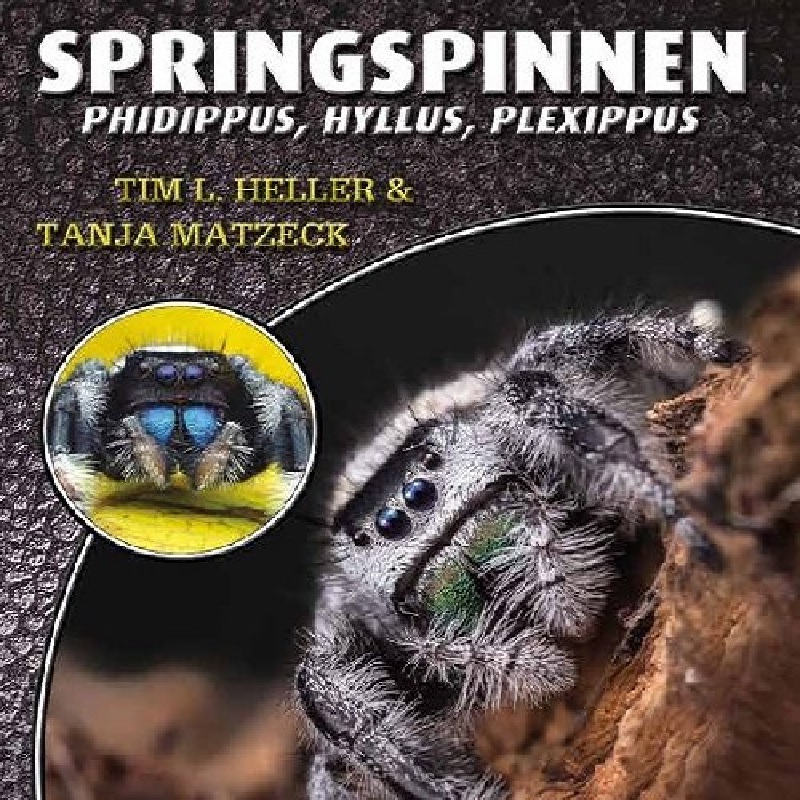
Jumping spiders Phidippus, Hyllus, Plexippus
Book Jumping Spiders - Phidippus, Hyllus & Plexippus A guide to keeping jumping spiders of the genera Phidippus, Hyllus & Plexippus. Who can resist the charm of jumping spiders? The childlike appearance of their expressive face simply leaves no one cold! In addition, their behavior is extremely exciting to observe, their colors are bright and their requirements for species-appropriate keeping are very easy to meet. No wonder these likeable jumpers are all the rage! This volume in the "Species by Species" series describes in detail what to look out for when buying and keeping them, introduces the most commonly kept species and color forms and provides plenty of tips on how to keep them successfully - so you can be sure they will breed well! Species by Species introduces you to the books in this series, which present the most popular terrarium animals. Each volume offers you detailed, practical care instructions and all the information you need to successfully breed your animals. All important questions from the required tank size to terrarium set-up, technical equipment, species-appropriate nutrition and disease prevention are answered with numerous tricks and tips. Experienced, long-standing breeders reveal how you can encourage the animals to reproduce and raise healthy young. All this in full color, generously illustrated and attractively designed - just about your terrarium animal - species by species

CHF 23.90

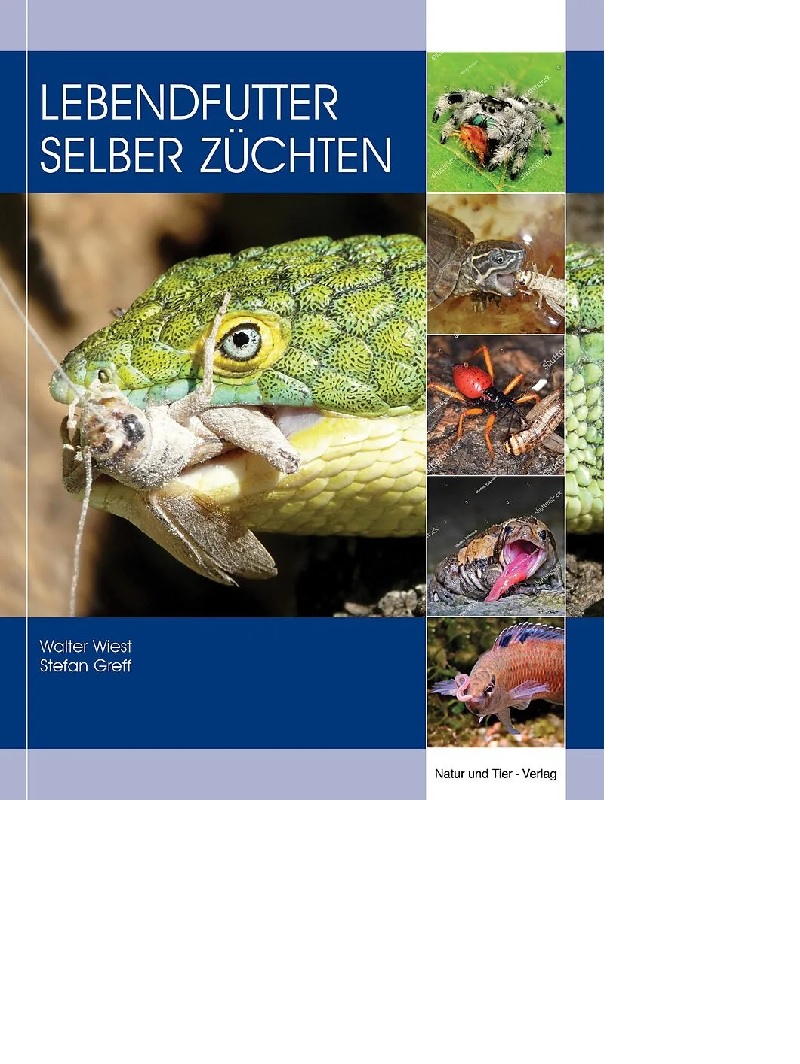
Book Breeding live food yourself
Book "Grow your own live food" - The perfect guide for pet owners Discover practical and detailed instructions on how you can easily breed food for your reptiles, birds, fish or other animals yourself in the book "Breeding live food yourself". With valuable tips on various food insects, their care and breeding, you can save money and ensure a species-appropriate diet for your pets. Contents of the book: Step-by-step instructions for breeding feeder insects Information on the best types of food for reptiles, birds and fish Care instructions and breeding conditions for various live food species Tips for sustainable and cost-effective food production Why breed your own live food? Get healthy, fresh food for your animals Save money and reduce dependence on pet shops Promote the health and well-being of your animals with species-appropriate food Whether you are a beginner or an experienced pet owner, this book provides you with everything you need to successfully breed live food yourself.

CHF 46.50

Marginata 69 - New Guinea tortoises
Marginata 69 - New Guinea tortoises – the genus ElseyaCover storyThe unrecognised beauties: New Guinea tortoises (Andreas S. Hennig)My experiences with Branderhorst's New Guinea tortoise, Elseya (Elseya) branderhorsti (Ouwens, 1914) (Andreas S. Hennig)Keeping and breeding of Rhodin's New Guinea tortoise, Elseya (Hanwarachelys) rhodini Thomson, Amepou, Anamiato & Georges, 2015 (Andreas S. Hennig)PortraitGeoemyda spengleri, Chinese serrated tortoise (Andreas S. Hennig)ReportageMacrochelys temminckii – Experiences and impressions with vulture tortoises part 2 (Reiner Praschag)KeepingAn alternative to year-round keeping of the Egyptian tortoise in the terrarium – my experiences with seasonal outdoor keeping of Testudo kleinmanni (Ricarda Schramm)EtymologySawbacks and living maps part 4: Graptemys gibbonsi, Pascagoula humpback tortoise (Holger Vetter)Classifieds & animal placement

CHF 16.50

Reptilia 118 - Morelia
Reptilia 118 - MoreliaMadagascarHumpback turtlesProfessional reptile breeding Contents:Cover story: Morelia - tree python, diamond python & Co.Everyone knows the green tree python. The animals are admired for their colouring and their favourite position, curling up over a branch, almost symbolises our idea of a tree-dwelling snake. This species has been successfully kept and bred in terrariums for a long time. However, the other pythons of the Morelia genus are also very popular. We offer an overview of these exceptionally beautiful giant snakes, describe new ways of setting up a terrarium for Morelia viridis in a naturalistic way and look at the keeping and breeding of a species that is still little known, the python with a scaly scales, Morelia carinata.EditorialMAGAZINEDATESWESTERN HERP PERSPECTIVESThe fate of books part 2B. LovePhoto storyPython beauties from the other side of the world: Morelia, the tree and diamond pythonsM. MenseKeeping and breedingKeeping a green tree python in a naturally designed large terrariumR. StallingerKeeping and breedingMorelia carinata – The Python with a Difference!O. JugReportageRare exhibition animal: Morelia bredli at Frankfurt ZooD. RösselKeeping and breedingHumpback turtles – The genus GraptemysM. RognerKeeping and breedingProfessional breeding of terrarium animals for the pet tradeSimone P. ReportageUnder the spell of the big telescopic eyes: jumping spiders on the lookoutU. & J. SchimmelpfennigAnimals of our homelandThe sand lizardR. LeptienSERVICELIBRARYALSO NEAR YOUJourneySearching for reptiles in MadagascarC. SchneiderPREVIEWBRUTKASTEN Why do pigeons of all things have to be the symbol of peace?H. Werning

CHF 12.00

Bugs No. 01 - Goliath beetle colorful giants
Bugs No. 01 - Goliath beetles colourful giants Preparation of invertebratesMesobuthus gibbosusPoecilotheria metallicaTable of contents EditorialTeam introductionFacetsFlown inDates Cover storyGoliath beetles – not just giants!Frank Rossow Top class! Keeping and breeding Goliathus goliatusFrank Rossow & Jens Rudnik Colour galore! Mecynorhina, brightly coloured rose beetles with big nosesFrank Rossow & Jens Rudnik FledgedOn the hunt for invertebrates in the LevantIngo Fritzsche In the crosshairsAtlas moth Attacus atlasDaniel Dittmar PracticeA gem in the terrarium Poecilotheria metallicaPatrick Meyer PracticeColourful splendour and predator hunger, breeding the "tiger cricket"Uwe Dost ReportageFungi as deadly enemies of arthropods – but worth their weight in goldIngo Fritzsche Reportage On the trail of the field scorpion. Mesobuthus gibbosus in nature and in the terrarium. Part 1: Exciting behaviourBenny Trapp Reportage“Cracking difficult species!” A visit to Jutta RendaKriton Kunz Potter bee Weathering of food plantsBruno Kneubühler Kids Corner Feeder animals under the microscopeIngo Fritzsche Showcase Specimens homemade – an introductionPatrick Urban Book scorpionService & ImprintPreview MetamorphosesStart into lifeKriton Kunz

CHF 12.00

Reptilia 40 - Terrarium Planting
Reptilia 40 - Terrarium Planting MarajóCopperheadFrogs of Costa Rica Contents: 2 EDITORIAL 3 READER LETTERS 7 MAGAZINE 17 DATES 20 WESTERN HERP PERSPECTIVESA juvenile snake hunting fiascoby B. Love 22 PHOTO REPORTAGE Terrarium plantingby B. Akeret 31 REPORTAGEPlanting of desert terrariums by B. Akeret 36 REPORTAGEPlanting an epiphyte branch for the terrarium by B. & W. Schwarz 40 REPORTAGECarnivorous plants in the terrarium by A. Glück 47 HERPETOFAUNABiology and distribution of Podocnemis vogli in Venezuelaby M. Merchán, A. M. Fidalgo & C. Pérez 51 PORTRAIT AND POSTERWrestling match in the rainforestby M. Ruckgaber 56 HUSBANDRY AND BREEDINGThe copperhead (Agkistrodon contortrix) – a “beginner's” snake?by D. Schmidt 65 HUSBANDRY AND BREEDINGHusbandry and breeding of Sind rock geckos, Cyrtopodion kachhensis (STOLICKA, 1872)by U. Schlüter 69 REPTORTAGEIn search of frogs in Costa Ricaby T. Eisenberg 75 TRAVELMarajó – Hot and humid Amazon paradiseby L. Dirksen 84 CLASSIFIEDS 90 TIPS & TRICKS 93 LIBRARY 104 GLOSSELiving in scalesby L. Hogeback

CHF 11.20

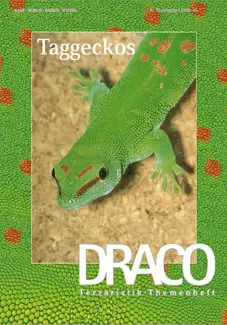
Draco 11 - Day geckos
Draco 11 - Day geckos Contents: 2 Editorial 4 day geckos of the genus PhelsumaJens Krüger 20 A terrarium for PhelumenHartmut Lipp 27 On the diet of day geckos of the genus Phelsuma Gerhard Hallmann 30 Group keeping and socialisation of PhelsumaHartmut Lipp 38 Phelsuma berghofi Krüger, 1996Biology, care and reproductionHand Peter Berghof 43 Experiences in the care and breeding of Phelsuma hielscheri Rösler, Obst & Seipp, 2001 from Isalo National Park Hans Peter Berhof & Roland Gebhard 47 On the keeping and breeding of Phelsuma inexpectata Mertens, 1966Oliver Pürkel 51 Taxonomy, care and breeding of the subspecies of Phelsuma lineata Hartmut Lipp 58 Selective colour breeding in Phelsuma madagascariensis grandis Rudolf Gerhardt 61 It doesn’t always have to be green – the less colourful representatives of the genus Phelsuma Hand Peter Berghof 68 Phelsums on Mauritius – A situation study Holger Schneider 77 To Madagascar – For the sake of day geckos Klaus Liebel & Wolfgang Schmidt 85 Book box 91 Magazine

CHF 16.80

Bede at Ulmer, Handbook of Turtle Diseases
Bede at Ulmer - Handbook of Turtle Diseases From the contents: Body structure and function of the organs Nervous system and sensory functions Selected behaviours Growth and age Direct husbandry and feeding damage Diseases of the head, eyes, ears, respiratory organs, digestive organs Poisoning Incubation defects and hatchling diseases

CHF 27.90

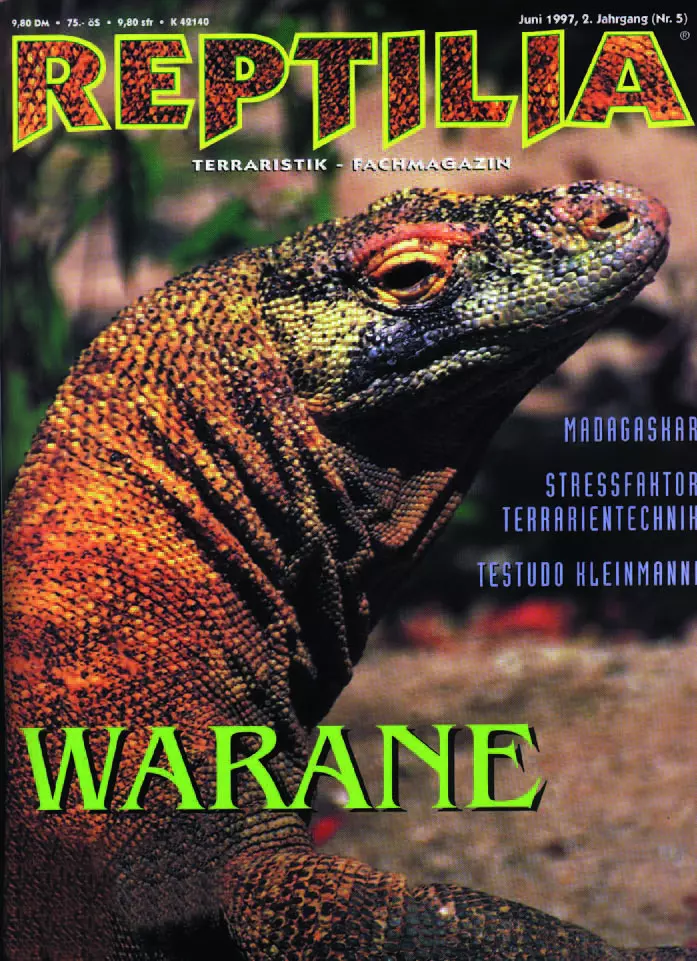
Reptilia 05 - Monitor Lizards
Reptilia 05 - Monitor lizards MadagascarStress factor terrarium technologyTestudo Kleinmanni Contents: Page 2 - EditorialPage 3 - Letters to the editorPage 4 - Discussion: What to do after snake bites?Page 6 - MagazinePage 16 - Photo reportage: Monitor lizards, by J. de Ávalos and P. Martínez CarriónPage 22 - Keeping and breeding: Keeping and breeding monitor lizards, by B. EidenmüllerPage 26 - Herpetofauna: The spoilt dragons of Komodo, by H. WerningPage 28 - Monitor lizards - Use by humans, by Dr M. GaulkePage 33 - Travelogue: Journey to the south-east of Madagascar, by W. Schmidt and K. LiebelPage 39 - Portrait and poster: Dendrobates tinctorius, by M. SchmidtPage 43 - Herpetofauna: Testudo kleinmanni, by B. DevauxPage 52 - Terraristics: Stress in the terrarium, by G. VossPage 56 - Herpetofauna: Frogs of the genus Eleutheradactylus in Costa Rica, by J. EhmckePage 60 - Herpetology and Culture: Magic and superstition, Part 2: Snakes and lizards, by L. B. Carissimi-PrioriPage 69 - Reptilia on the road: Terrazoo Moers, by W. SchmidtPage 74 - Advice and actionPage 75 - LibraryPage 80 - Incubator: Column by H. Werning

CHF 9.80

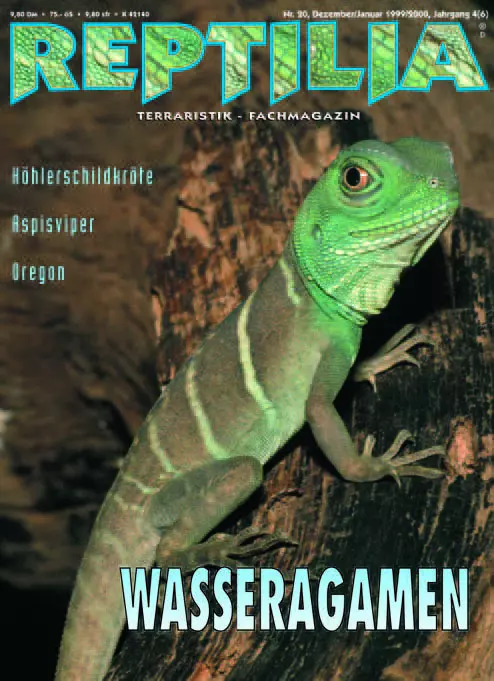
Reptilia 20 - Water dragons
Reptilia 20 - Water dragons Charcoal tortoiseAspis viperOregon Contents: Page 2 - EditorialPage 3 - Letters to the editorPage 6 - MagazinePage 13 - DatesPage 14 - Western Herp Perspectives: a childhood with box turtles, by B. LovePage 15 - Photo report: Water dragons, by. H. WerningPage 22 - Report: Observations of Physignathus concincinus in Thailand and Laos, by S. and U. MantheyPage 24 - Keeping and breeding: 15 years with water dragons, by H. WerningPage 32 - Report: The Australian water dragon Physignathus lesueurii lesueurii, by B. LangerwerfPage 40 - Journey: On tailed amphibian excursions in northern Oregon. Part 1: From the Columbia River Gorge to the north coast, by H. WallaysPage 47 - Portrait and poster: Tribolonotus gracilis, by U. DostPage 51 - Report: the alpine viper Vipera aspis atra, by W. StrassmannPage 56 - Report: Biology, distribution and conservation of the charcoal tortoise Geochelone carbonaria, by M. Merchàn, A. M. Fidalgo and C. PérezPage 64 - Keeping and breeding: Keeping and breeding of some Andean keel-tailed iguanas (Stenocercus) from the Peruvian highlands. Part 2, by U. SchlüterPage 68 - Report: Insects in the terrarium. Part 2, by H. FischerPage 80 - Reptilia on the road: Vivarium Darmstadt, by A. HauschildPage 83 - Advice and actionPage 89 - LibraryPage 96 - Gloss: The crisis in statutory health insurance for reptiles and amphibians, Part 1, by M. Vanselow

CHF 9.80