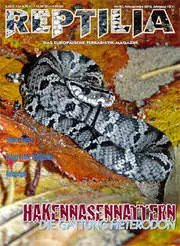
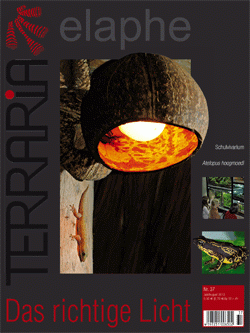
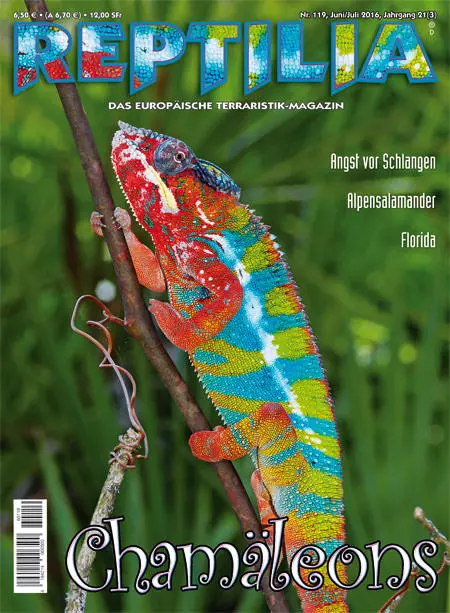
Reptilia 109 - Exclusive terrariums

Article no: reptilia109

CHF 12.00

Stock: 0

Ready for dispatch in 1-3 days, delivery time 7 working days

Delivery between Tuesday, 20 October and Wednesday, 21 October
Zahlungsarten
Product information "Reptilia 109 - Exclusive terrariums"

Reptilia 109 Exclusive Terrariums

Boa constrictor
Colour breeding of blue-tongued skinks
Sumatra
 
Contents:

Cover story: Exclusive terrariums

First and foremost, every terrarium must fulfil the needs of the animals kept in it. This can be done pragmatically, but also allows the keeper to create tanks that satisfy their own aesthetic requirements and give the impression of a real biotope section. In the cover story of the upcoming REPTILIA, we present a series of such "luxury villas for reptiles", describe the work of a terrarium builder who works individually according to the customer's wishes, but also how such exclusive terrariums are created step by step.

Editorial
MAGAZINE
DATES

WESTERN HERP PERSPECTIVES
A completely different terrarium meeting
B. Love

REPORTAGE
Luxury villas for reptiles, amphibians and invertebrates - exclusive terrariums
R. Hoppe

REPORTAGE
Natural terrariums for young and old. Facilities for rhinoceros iguanas and other lizards
S. Kalopp

REPORTAGE
The stable terrarium. Unconventional design of a snake terrarium
D. Renner

REPORTAGE
From the idea to the dream. Creation of a customised dry terrarium by professional terrarium builders
R. Hoppe

KEEPING AND BREEDING
First captive breeding of Stimson’s python (Antaresia stimsoni) at Cologne Zoo
A. Rauhaus, D. Karbe, C. Niggemann, K. van der Straeten & T. Ziegler

herpetofauna
Boa constrictor. Exciting news from an old acquaintance                                  
J. Cañas-Orozco

KEEPING AND BREEDING
Colour breeding in the Northern Blue-tongued Skink, Tiliqua scincoides intermedia
M. Reisinger

Services
Library

ANIMALS OF OUR HOME
The midwife toad
R. Leptien

ALSO NEAR YOU

Journey
Herpetological impressions from Sumatra
D. Prötzel & J. Forster

PREVIEW

BRUTKASTEN
Television is coming - Part 2
H. Werning

Composition
Feeding recommendation
Technical details
Size information

0 of 0 reviews

Give us a rating!

Share your experience with the product with other customers.


Suggested products

Handbook of food plants for tortoises and other reptiles
Handbook of forage plants 2nd revised editionMarion Minch is not only a successful breeder of diverse tortoises for many years, but also an excellent connoisseur of native wild herbs. She founded and runs samenkiste.de, which is well known to many tortoise keepers and nature lovers. Her name is inextricably linked with reptile care and species-appropriate nutrition for tortoises. Her handbook of food plants summarises the most important native food plants for herbivorous and omnivorous reptiles. She not only considers tortoises, but also iguanas, spiny-tailed dragons and even chameleons. From the basics of plant biology to native wild herbs to suitable food plants for hardy tropical reptile species, this comprehensive work provides the basis for species-appropriate keeping. In the expanded and supplemented 2nd edition, the plant section is divided according to flower colour. This makes it even easier to identify wild herbs. The work has also been supplemented with a wealth of additional information and many pictures.

CHF 46.50

Geckos
Geckos in the terrarium by Astrid FalkThe book offers a comprehensive introduction to geckos and their species-appropriate keeping in terrariums. It explains what you need to think about before buying a gecko and what preparations should be made. The book describes in detail how the terrarium is technically equipped and set up. The care of the animals, their special features and behaviour, their diet, reproduction and rearing of young animals are described, as well as diseases and husbandry problems with tried and tested suggestions for prevention and treatment. Individual gecko species that are particularly suitable for keeping and breeding in terrariums are portrayed in detail in the second part of the book.

CHF 28.50

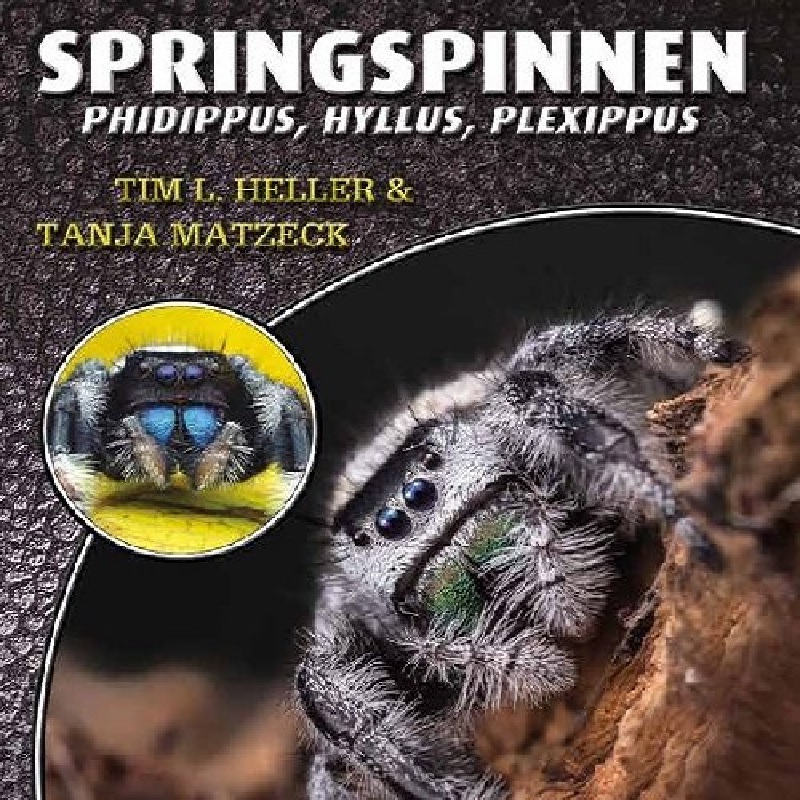
Jumping spiders Phidippus, Hyllus, Plexippus
Book Jumping Spiders - Phidippus, Hyllus & Plexippus A guide to keeping jumping spiders of the genera Phidippus, Hyllus & Plexippus. Who can resist the charm of jumping spiders? The childlike appearance of their expressive face simply leaves no one cold! In addition, their behavior is extremely exciting to observe, their colors are bright and their requirements for species-appropriate keeping are very easy to meet. No wonder these likeable jumpers are all the rage! This volume in the "Species by Species" series describes in detail what to look out for when buying and keeping them, introduces the most commonly kept species and color forms and provides plenty of tips on how to keep them successfully - so you can be sure they will breed well! Species by Species introduces you to the books in this series, which present the most popular terrarium animals. Each volume offers you detailed, practical care instructions and all the information you need to successfully breed your animals. All important questions from the required tank size to terrarium set-up, technical equipment, species-appropriate nutrition and disease prevention are answered with numerous tricks and tips. Experienced, long-standing breeders reveal how you can encourage the animals to reproduce and raise healthy young. All this in full color, generously illustrated and attractively designed - just about your terrarium animal - species by species

CHF 23.90

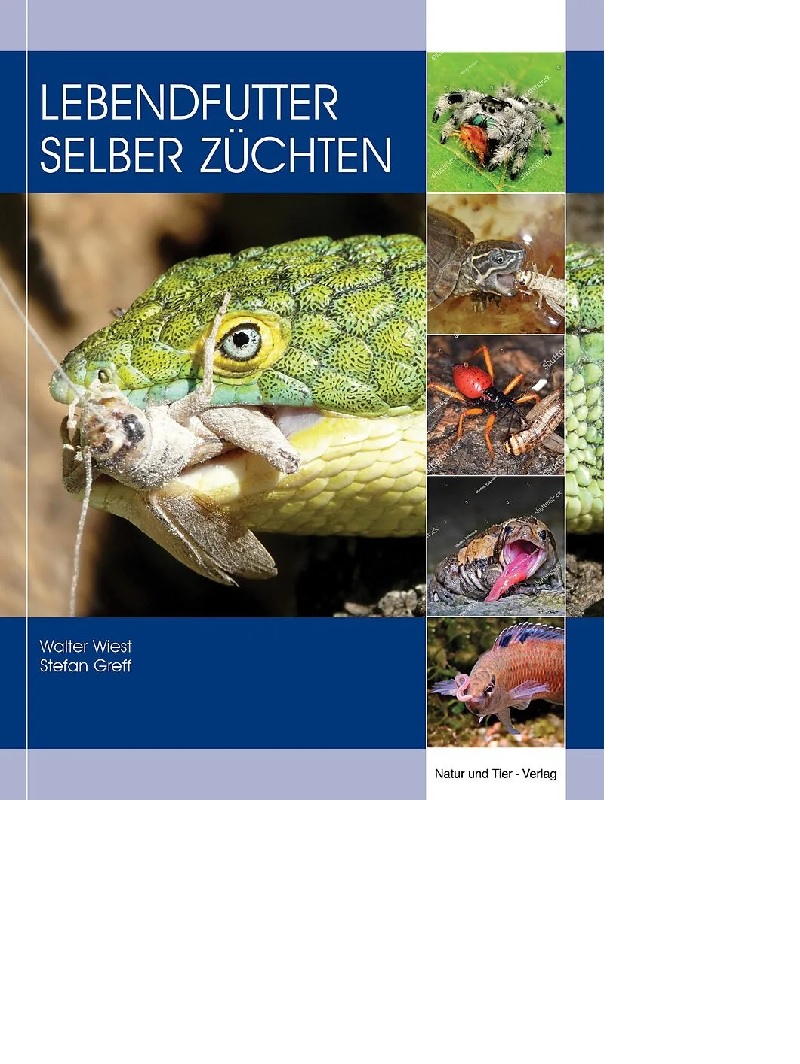
Book Breeding live food yourself
Book "Grow your own live food" - The perfect guide for pet owners Discover practical and detailed instructions on how you can easily breed food for your reptiles, birds, fish or other animals yourself in the book "Breeding live food yourself". With valuable tips on various food insects, their care and breeding, you can save money and ensure a species-appropriate diet for your pets. Contents of the book: Step-by-step instructions for breeding feeder insects Information on the best types of food for reptiles, birds and fish Care instructions and breeding conditions for various live food species Tips for sustainable and cost-effective food production Why breed your own live food? Get healthy, fresh food for your animals Save money and reduce dependence on pet shops Promote the health and well-being of your animals with species-appropriate food Whether you are a beginner or an experienced pet owner, this book provides you with everything you need to successfully breed live food yourself.

CHF 46.50

Marginata 69 - New Guinea tortoises
Marginata 69 - New Guinea tortoises – the genus ElseyaCover storyThe unrecognised beauties: New Guinea tortoises (Andreas S. Hennig)My experiences with Branderhorst's New Guinea tortoise, Elseya (Elseya) branderhorsti (Ouwens, 1914) (Andreas S. Hennig)Keeping and breeding of Rhodin's New Guinea tortoise, Elseya (Hanwarachelys) rhodini Thomson, Amepou, Anamiato & Georges, 2015 (Andreas S. Hennig)PortraitGeoemyda spengleri, Chinese serrated tortoise (Andreas S. Hennig)ReportageMacrochelys temminckii – Experiences and impressions with vulture tortoises part 2 (Reiner Praschag)KeepingAn alternative to year-round keeping of the Egyptian tortoise in the terrarium – my experiences with seasonal outdoor keeping of Testudo kleinmanni (Ricarda Schramm)EtymologySawbacks and living maps part 4: Graptemys gibbonsi, Pascagoula humpback tortoise (Holger Vetter)Classifieds & animal placement

CHF 16.50

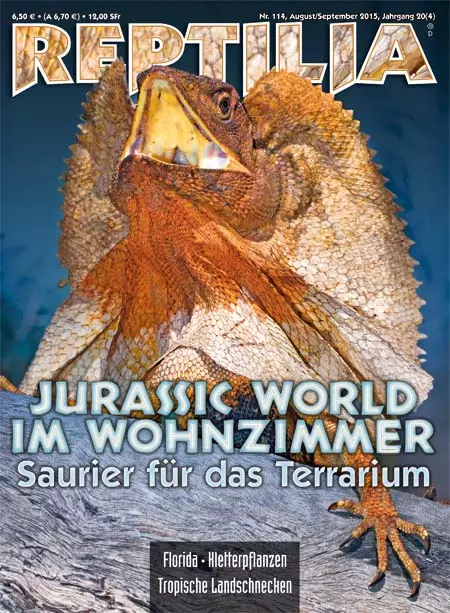
Reptilia 114 - Jurassic World in the living room, dinosaur for the terrarium
Reptilia 114 - Jurassic World in the living room, dinosaurs for the terrarium Florida climbing plantsTropical land snailsContents:Cover story: Jurassic World in the living room – dinosaurs for the terrarium“Jurassic World” is this summer’s blockbuster. Hardly anyone can escape the fascination of dinosaurs. And our modern-day prehistoric creatures quickly catch the eye. Many lizards actually look like real dinosaurs in miniature. They enchant with their prehistoric charm and make many people want to keep such a miniature dinosaur at home. And the best thing is: with many species, this is very possible! We present the best “dinosaurs” for the terrarium. And, of course, we take a closer look at “Jurassic World” and talk to a palaeontologist about the chances of us actually being able to see real dinosaurs one day – and whether they would even look like they do in the cinema. EditorialMagazineDates Western Herp PerspectivesThe end of the golden age for terrariumsB. LovePhoto story The return of the prehistoric lizardsH. Werning Keeping and breedingJurassic World in the living room. Mini dinosaurs for the terrariumH. Werning Film reviewJurassic World – The park is openH. Werning InterviewJurassic World – Questions about the filmA. Kwet in conversation with R. Schoch Keeping and breedingThe Green Water Dragon (Physignathus cocincinus) in the terrariumM. Rogner PlantsArum plants in the terrarium Part 2: Climbing araceaeB. Akeret Keeping and breedingThe local variants of Rhacodactylus leachianus in terrarium keeping Part 2: The island formsS. Cemelli & F. Fast ReportageSlowing down through the rainforestM. Gaulke Animals of our homelandThe pond frogR. Leptien LibraryAlso in your neighbourhoodService JourneyA round trip through Sri LankaV. Harport Preview Incubator The holiday jobA. “Spider” Krenzke

CHF 12.00

Reptilia 90 - Breeding of poison dart frogs
Reptilia 90 - Breeding of poison dart frogs Reptil des Jahres: MauereidechseSchmuckschildkrötenPazifikboa Inhalt: EditorialMAGAZINTERMINEWESTERN HERP PERSPECTIVESSweet (New) Home ArizonaB. LoveFOTOSTORYDie Zucht von PfeilgiftfröschenM. Wirth &  F. RiedelHaltung und Nachzucht Haltung und Nachzucht des Schrecklichen Pfeilgiftfroschs, Phyllobates terribilis M. Wirth & F. RiedelNACHZUCHTDas Einmaleins der QuappenaufzuchtM. SchmidtREISE Eine herbstliche Stippvisite in MontenegroB. TrappPORTRÄT UND POSTERPhrynosoma platyrhinos. WüstenkrötenechseH. WerningHerpetofaunaAuf dem Weg ins All. Die Welt der Buchstaben-Schmuckschildkröte, Trachemys scripta Teil 1A. S. HennigHerpetofaunaDie Mauereidechse – Reptil des Jahres 2011U. Schulte, A. Kwet & A. NöllertHALTUNG UND ZUCHTCandoia paulsoni paulsoni: Haltung und Nachzucht der Pazifikboa M. Borer & L. MeierREPORTAGEMit Schülerpraktikanten in der Iguana-Station auf der Insel Utila, Honduras Teil 1: Eine neue Herausforderung M. HallmenBibliothekABO & SERVICEAUCH IN IHRER NÄHEVORSCHAUBRUTKASTEN Klapperschlangen und Mexikaner Teil 1 H. Werning  

CHF 12.00

Reptilia 81 - Hognose snakes
Reptilia 81 - Hook-nosed snakes Samar cobraPantanal flatback turtleGalápagos Contents: The hook-nosed snakes of the genus Heterodon are currently experiencing an unimagined terraristic boom. Previously rather underappreciated, various very attractive colour forms have recently been bred, and this has led to a real boom. But even the normally coloured animals – and the natural spectrum of the eastern hook-nosed snake in particular covers an extremely wide range of colours – are extremely lovable terrarium pets.We present all species in detail, offer detailed breeding reports even on rarer forms, and a splendidly illustrated overview of current developments in colour variety breeding is of course also included. EDITORIAL MAGAZINE DATES PHOTOSTORY Hooked on Hogs! Hooked on hook-nosed snakes by K. Kunz KEEPING AND REPRODUCTION The Western hook-nosed snake of North America "trend snake" by B. Bumgardner HERPETOFAUNA Unleashed East! – The Eastern hook-nosed snake, Heterodon platirhinos by L. Spinner KEEPING AND REPRODUCTION Small but mighty! The Southern hook-nosed snake by K. Kunz & N. Nickel HERPETOFAUNA The Pantanal flatback turtle, Acanthochelys macrocephala – A turtle that still raises many questions by T. & S. Vinke PORTRAIT AND POSTER Gekko gecko (Linnaeus, 1758). Tokay gecko von M. Gaulke TRAVEL In the footsteps of Darwin through South America Part 4: Galápagos – The Darwin Archipelago by H. Werning KEEPING AND REPRODUCTION Keeping and breeding Samar cobra (Naja samarensis) by C. Frömberg KEEPING AND REPRODUCTION Sicarius terrosus in the terrarium by R. Hübers ANIMALS OF OUR HOME The forest lizard by R. Leptien WESTERN HERP PERSPECTIVES The big frost by B. Love LIBRARYBook review: Fläschendräger & Wijffel (2009): Anolisby U. Bartelt SUBSCRIPTION & SERVICE ALSO NEAR YOU PREVIEW BRUTKASTEN Alone among sheep. Part 1 by H. Werning

CHF 12.00

Terraria 37 - The correct light
Terraria 37 - The right lightSchool vivariumAtelopus hoogmoediContents:Cover story: The right lightHardly any other topic in terraristics is as important and at the same time as intensively discussed as the right terrarium lighting. What do you need to look out for to ensure that your pets get the best possible replacement for sunlight in their terrarium? What do you think of new lighting technologies such as LEDs? And: How do reptiles actually perceive light? The cover story of the next issue attempts to provide some answers. TerritorialHerpetoramaTOPICThe fluorescent tube - a classic newly illuminatedSteven ArthThe use of UV measuring devices in terraristicsSarina WunderlichColour temperature and colour rendering index: Useful parameters in terraristicsSarina WunderlichPANORAMATerraglobal: Close to death, part 2Joachim BulianSince when do agamas eat peanuts - and crocodile bread?Alfred SchleicherThe school vivarium at the Edith-Stein-Schule in Erfurt - much more than just animals at schoolRica Kepter & Achim KempterRESEARCHNew species: The frog and the prince - splendid tree frogs from EcuadorAxel KwetAmong researchers: Inhabitants of the elfin forest: Herpetofauna at Picu La Picucha in the Sierra de Angalta National Park, HondurasAlexander GutscheNews from Indochina: The amphibians and reptiles of the Cat Thien National Park in South VietnamPeter GeisslerSalamandraTERRARISTICSClassic: The DreicksnatterExperiences in rearing spiny-edged soft-shelled turtles (Apalone spinifera)Sebastian NicklFirst successful breeding of the short-toed toad Atelopus hoohmoedi at the Aquazoo/Löbbecke Museum in DüsseldorfSandra Honigs, Marc Messing & Beate PelzerSome additional information on the article about the mysterious death of hatchlings of the green tree pythonJoachim BulianNATURE AND SPECIES CONSERVATIONField notes: Toad under iceStefan MeyerLate reproduction of the fire-bellied toad in SaxonyWolf-Rüdiger Grosse & Andreas NöllertTwo examples of accidental anthropogenic displacement of lizards due to their flight behaviourAndreas ArnoldMissing: Pinta giant tortoise (Chelonoides abingdonii)Also in your neighbourhoodSubscription & ServiceGALERIAKomodo’s Centenarian DragonsPreviewBRUTKASTENCrocodile alarm at the swimming lake: human tragedy narrowly avertedJakob Hein

CHF 12.00

Boa Constrictor
All about Boa Constrictor by Stefan Binder 96 pages 89 photos 2 graphics 1 table 11 distribution maps Format: 16.8 x 21.8 cm  Contents: The boa constrictor (Boa constrictor) is the epitome of the giant snake. Contrary to its popular reputation, however, it is neither dangerous to humans, nor does it reach excessive body sizes. Rather, it is an animal that is excellently suited to terrarium keeping, extremely elegant and attractive, and is even recommended for beginners in giant snake keeping. In this book, snake enthusiasts will find everything they need to know for the successful keeping and breeding of these beautiful reptiles:- Physique and sensory abilities- Classification: all subspecies and local forms- All colour and pattern variants- Keeping boas correctly: furnishing and technical equipment of a species-appropriate terrarium- Problem solutions: prophylaxis and therapy of diseases- How to breed your boas; rearing of the young- Brilliant colour photos Press reviews: Reviewing this book was a real pleasure for me. When reading it (...) the impression is confirmed that the author can convey the subject clearly and understandably. (...)A book that should not be missing from any (giant snake) keeper's shelf!Bruno Treu in Sauria 25/2 (2003)

CHF 68.00

Reptilia 119 - Chameleons
Reptilia 119 - Chameleons Fear of snakesAlpine salamanderFloridaContents:Cover story: ChameleonsThey used to be considered untenable, but today they are among the most popular terrarium animals. Chameleons, the "dragons of our time". We indulge in pictures of these extremely photogenic animals, present in detail the keeping and breeding of one of the most prominent representatives of this group, the lobed chameleon, and devote ourselves to the legendary colour-changing ability of these lizards. EditorialMagazineDates Photo storyChameleons. Always something newN. Lutzmann Keeping and breedingKeeping and breeding the elephant-eared chameleon (Trioceros melleri)C. Malberg & A. Schäberle ResearchInfluence of various factors on colour change in the Yemen chameleon (Chamaeleo calyptratus) and the Madagascar giant chameleon (Furcifer oustaleti)A. Schmidt MAN AND ANIMALFear of snakes: innate, learnt or groundless?D. Schmidt ReportageViper snakes for breakfast. Observations of Natrix maura in southern PortugalW. & Y. Lantermann SERVICEALSO NEAR YOU Animals of our homelandThe Alpine SalamanderR. Leptien LIBRARY WESTERN HERP PERSPECTIVESEuropeans are known for …B. Love TRAVELThe great trek.  Part 2: Spring rivers and eternal swampsH. Werning PREVIEW BRUTKASTEN The spider's web (or: Stuttgart 21 will not be the last victim of these green lizard spiders)Ancestor

CHF 12.00

Draco 44 - Constrictor
Draco 44 - Giant SnakesContents:EditorialReproduction and breeding of giant snakesDieter SchmidtMating triggers in giant snakesMichaela & Marco SchulzeA few thoughts on feeding giant snakesErich Koerber & Christian BittnerPregnancy and confinement of boas - initial care of offspring and possible complicationsHermann & Erika StöcklAn aberrant form of Boa constrictor longicauda – the ‘Zeros’Hermann & Erika StöcklThe green tree python - success through natural breedingMichèl KroneisKeeping and breeding the Jungle carpet python, Morelia spilota cheyneiSteven Arth & Sandra BausKeeping and breeding the Woma, Aspidites ramsayiManuel Uhlhaas & Philipp Pohlscheid

CHF 18.40