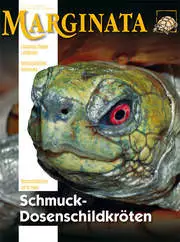
Marginata 42 - Jewellery box turtles

Article no: marginata42

CHF 16.50

Stock: 0

Ready for dispatch in 1-3 days, delivery time 7 working days

Delivery between Tuesday, 7 July and Wednesday, 8 July
Zahlungsarten
Product information "Marginata 42 - Jewellery box turtles"

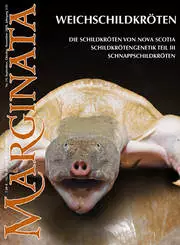
Marginata 42 - Jewellery Box Turtles

Unique steppe tortoises
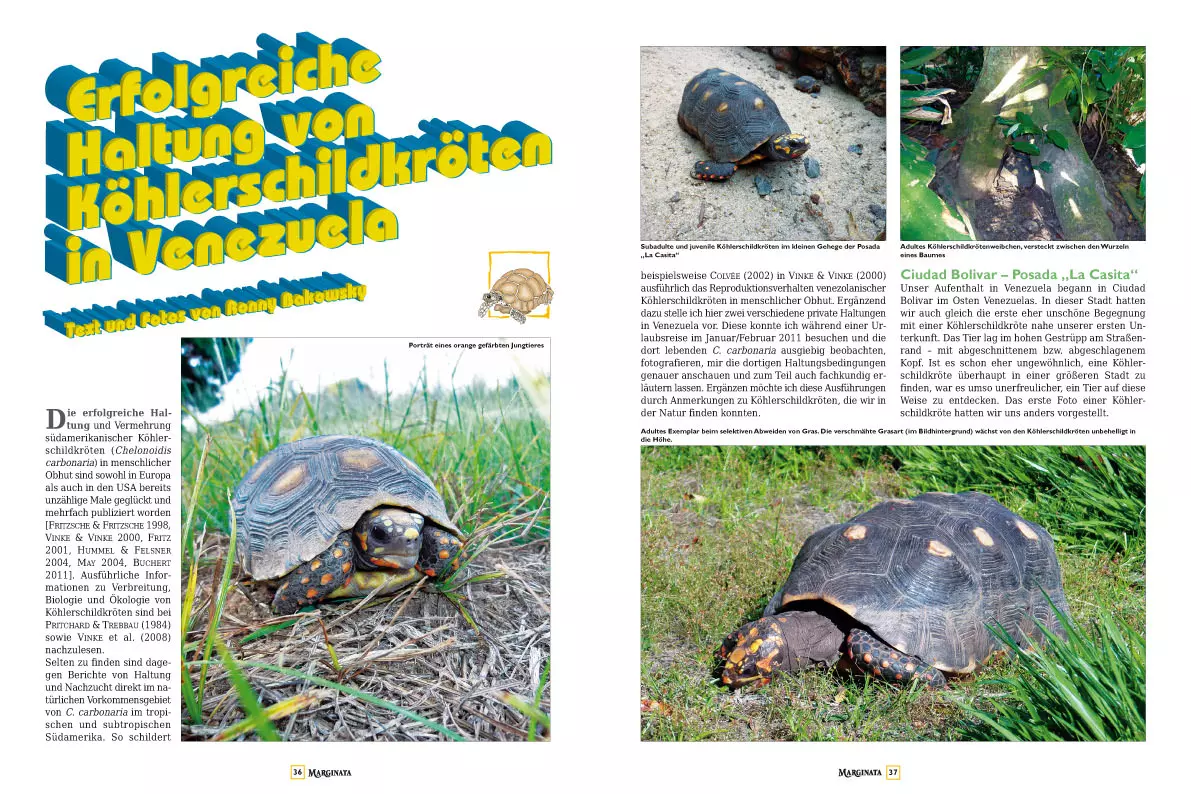
Coal tortoises in Venezuela
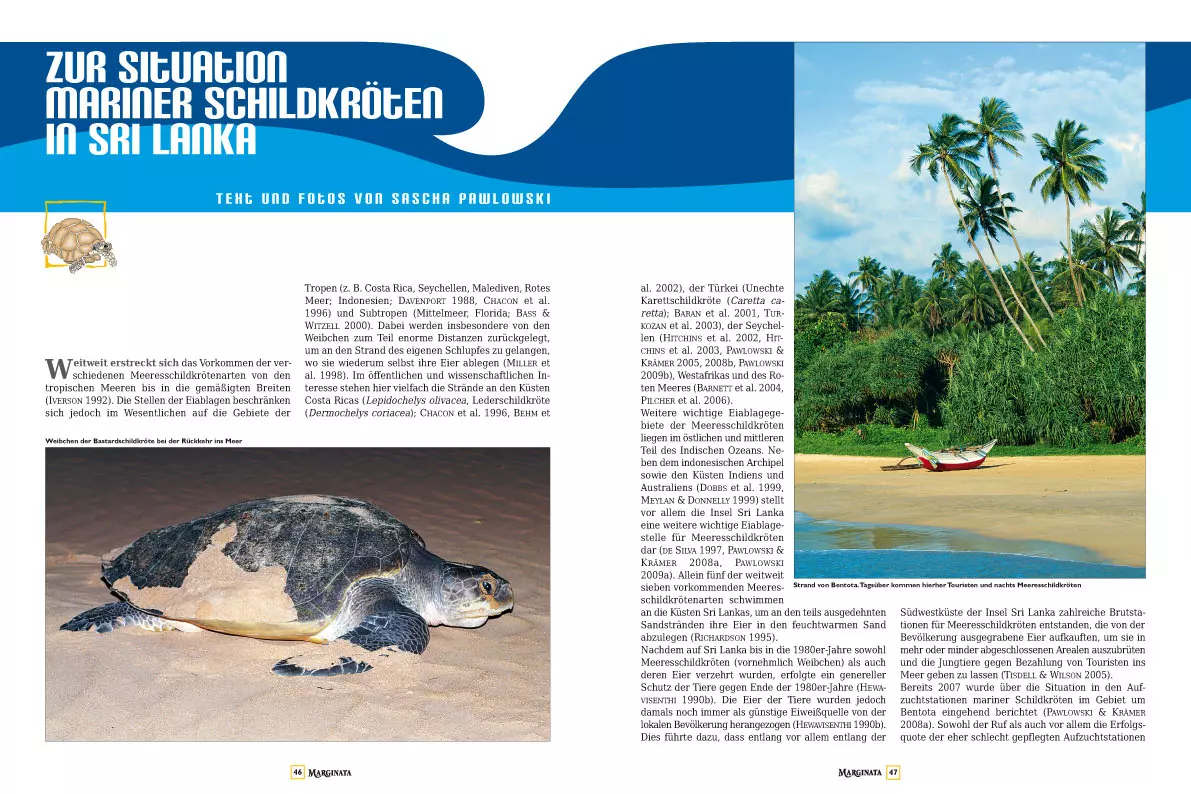
Sea turtles in Sri Lanka

Contents:

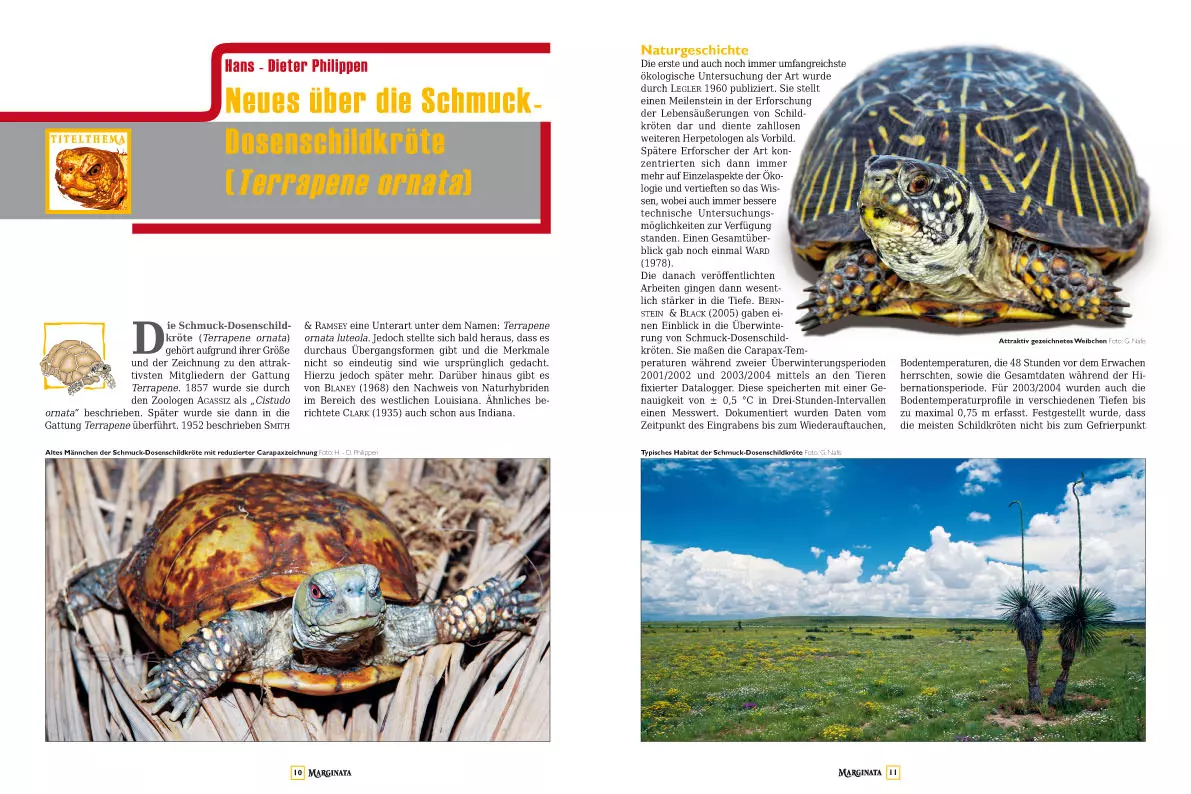
One of the most beautiful and commonly kept box turtles, the ornate box turtle (Terrapene ornata) is the main focus of Marginata. As an inhabitant of the North American prairie and forest regions, it inhabits the centre of the USA and here the region from western Indiana, to eastern Texas and as far as Louisiana. The subspecies T. ornata luteola inhabits the arid areas of West Texas, New Mexico, Arizona and is also found in adjacent areas of northern Mexico. The species is regularly kept and bred in captivity. In the forthcoming issue of Marginata, both field data from the USA, as well as husbandry and breeding under outdoor conditions and rearing in special mini-greenhouse terrariums are presented.

Contents
Editorial
Magazine
Dates

REPORTAGE
News about the Ornate Box Turtle (Terrapene ornata)
Hans - Dieter Philippen

KEEPING AND BREEDING
Optimising the husbandry of Terrapene ornata
Josef Joven

BREEDING
Courtship and mating behaviour of the ornate box turtle (Terrapene ornata)
Hans - Dieter Philippen

PORTRAIT
New Guinea snapping turtle Elseya novaeguineae (Meyer, 1874)
Hans - Dieter Philippen

KEEPING AND BREEDING
Successful keeping of coal tortoises in Venezuela
Ronny Bakowsky

REPORTAGE
On the situation of marine turtles in Sri Lanka
Sascha Pawlowski

REPORTAGE
Further evidence of the morphological variability of the steppe tortoise
Petr Velensky

REPORTAGE
On the longevity of tortoises (Testudinidae)
Hans-Volker Karl

Book tip
Subscription & Service
Regional guide

Composition
Feeding recommendation
Technical details
Size information

0 of 0 reviews

Give us a rating!

Share your experience with the product with other customers.


Suggested products

Handbook of food plants for tortoises and other reptiles
Handbook of forage plants 2nd revised editionMarion Minch is not only a successful breeder of diverse tortoises for many years, but also an excellent connoisseur of native wild herbs. She founded and runs samenkiste.de, which is well known to many tortoise keepers and nature lovers. Her name is inextricably linked with reptile care and species-appropriate nutrition for tortoises. Her handbook of food plants summarises the most important native food plants for herbivorous and omnivorous reptiles. She not only considers tortoises, but also iguanas, spiny-tailed dragons and even chameleons. From the basics of plant biology to native wild herbs to suitable food plants for hardy tropical reptile species, this comprehensive work provides the basis for species-appropriate keeping. In the expanded and supplemented 2nd edition, the plant section is divided according to flower colour. This makes it even easier to identify wild herbs. The work has also been supplemented with a wealth of additional information and many pictures.

CHF 46.50

Geckos
Geckos in the terrarium by Astrid FalkThe book offers a comprehensive introduction to geckos and their species-appropriate keeping in terrariums. It explains what you need to think about before buying a gecko and what preparations should be made. The book describes in detail how the terrarium is technically equipped and set up. The care of the animals, their special features and behaviour, their diet, reproduction and rearing of young animals are described, as well as diseases and husbandry problems with tried and tested suggestions for prevention and treatment. Individual gecko species that are particularly suitable for keeping and breeding in terrariums are portrayed in detail in the second part of the book.

CHF 28.50

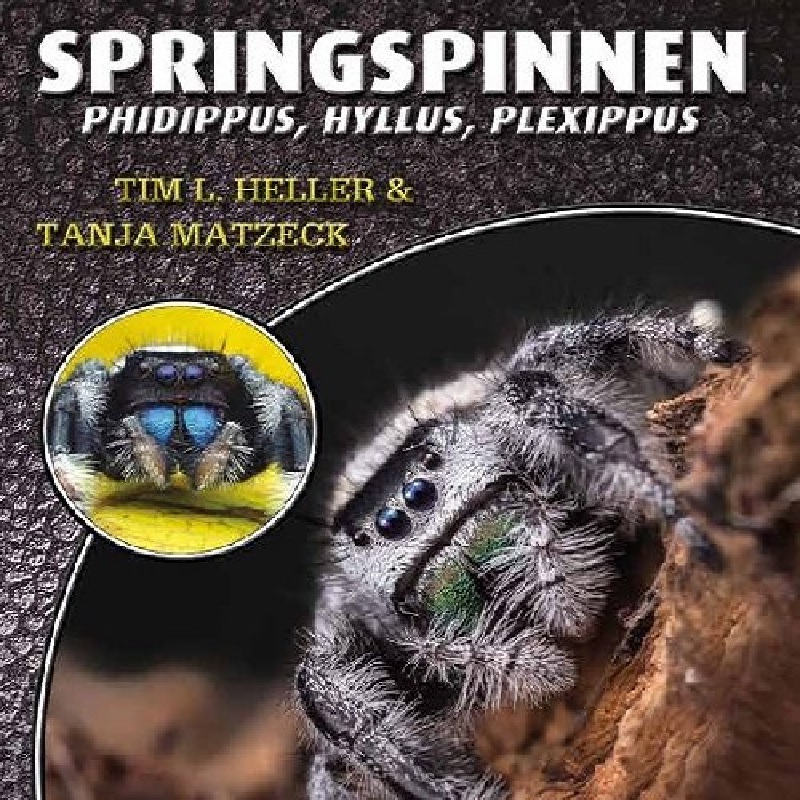
Jumping spiders Phidippus, Hyllus, Plexippus
Book Jumping Spiders - Phidippus, Hyllus & Plexippus A guide to keeping jumping spiders of the genera Phidippus, Hyllus & Plexippus. Who can resist the charm of jumping spiders? The childlike appearance of their expressive face simply leaves no one cold! In addition, their behavior is extremely exciting to observe, their colors are bright and their requirements for species-appropriate keeping are very easy to meet. No wonder these likeable jumpers are all the rage! This volume in the "Species by Species" series describes in detail what to look out for when buying and keeping them, introduces the most commonly kept species and color forms and provides plenty of tips on how to keep them successfully - so you can be sure they will breed well! Species by Species introduces you to the books in this series, which present the most popular terrarium animals. Each volume offers you detailed, practical care instructions and all the information you need to successfully breed your animals. All important questions from the required tank size to terrarium set-up, technical equipment, species-appropriate nutrition and disease prevention are answered with numerous tricks and tips. Experienced, long-standing breeders reveal how you can encourage the animals to reproduce and raise healthy young. All this in full color, generously illustrated and attractively designed - just about your terrarium animal - species by species

CHF 23.90

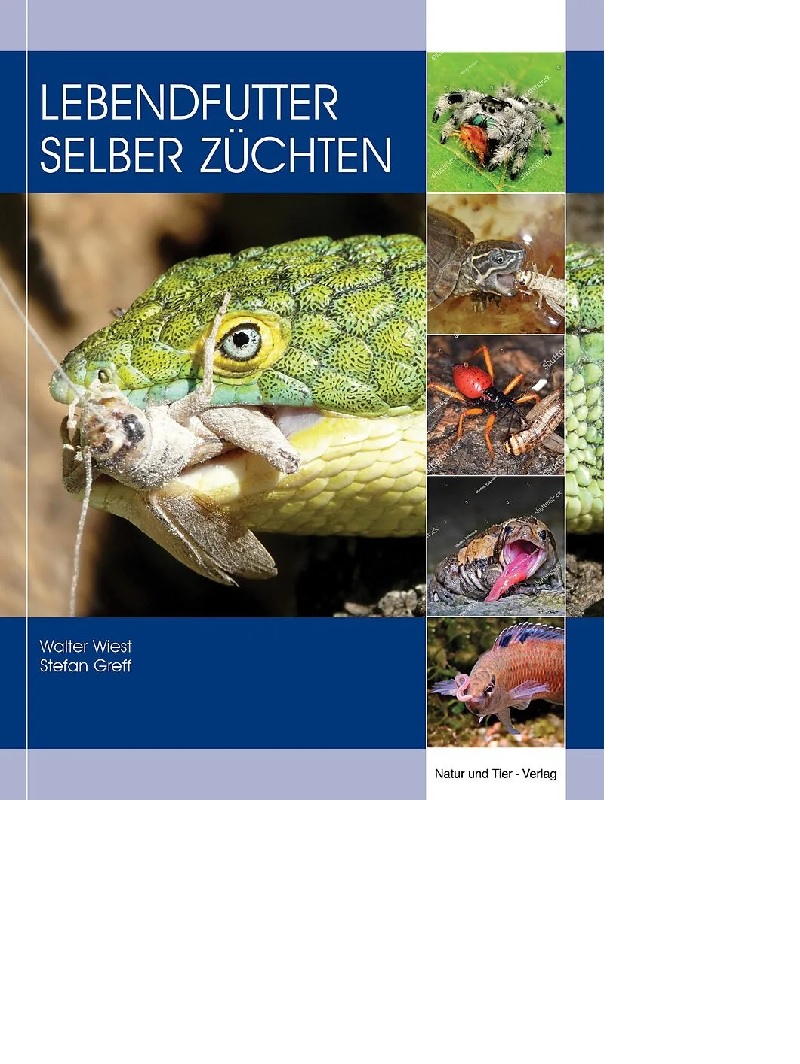
Book Breeding live food yourself
Book "Grow your own live food" - The perfect guide for pet owners Discover practical and detailed instructions on how you can easily breed food for your reptiles, birds, fish or other animals yourself in the book "Breeding live food yourself". With valuable tips on various food insects, their care and breeding, you can save money and ensure a species-appropriate diet for your pets. Contents of the book: Step-by-step instructions for breeding feeder insects Information on the best types of food for reptiles, birds and fish Care instructions and breeding conditions for various live food species Tips for sustainable and cost-effective food production Why breed your own live food? Get healthy, fresh food for your animals Save money and reduce dependence on pet shops Promote the health and well-being of your animals with species-appropriate food Whether you are a beginner or an experienced pet owner, this book provides you with everything you need to successfully breed live food yourself.

CHF 46.50

Marginata 69 - New Guinea tortoises
Marginata 69 - New Guinea tortoises – the genus ElseyaCover storyThe unrecognised beauties: New Guinea tortoises (Andreas S. Hennig)My experiences with Branderhorst's New Guinea tortoise, Elseya (Elseya) branderhorsti (Ouwens, 1914) (Andreas S. Hennig)Keeping and breeding of Rhodin's New Guinea tortoise, Elseya (Hanwarachelys) rhodini Thomson, Amepou, Anamiato & Georges, 2015 (Andreas S. Hennig)PortraitGeoemyda spengleri, Chinese serrated tortoise (Andreas S. Hennig)ReportageMacrochelys temminckii – Experiences and impressions with vulture tortoises part 2 (Reiner Praschag)KeepingAn alternative to year-round keeping of the Egyptian tortoise in the terrarium – my experiences with seasonal outdoor keeping of Testudo kleinmanni (Ricarda Schramm)EtymologySawbacks and living maps part 4: Graptemys gibbonsi, Pascagoula humpback tortoise (Holger Vetter)Classifieds & animal placement

CHF 16.50

Terraria 64 - Croatia
Terraria 64 - Croatia Contents: Cover story: Croatia – herpetological pearl on the Adriatic Sea Croatia from Istria to Dubrovnik: The northern Balkan peninsula is famous for its wild beauty and yet is only a few hours' drive from Germany. We travel to the Adriatic coast with its rugged islands and the mountains of the Dinaric Karst. There we encounter a diverse herpetofauna, which for Croatia comprises a total of 20 amphibian and 39 reptile species and is perfectly adapted to the often harsh habitat conditions. Also in TERRARIA/elaphe 2/2017: Human fish: Stories about the European olm Keeping large ornate tortoises List of newly described amphibian species 2016 and much more Territorial HerpetoramaFaster than the eye allows – Record-breaking snake bites/Leaf creepers: Prehistoric creatures in Florida/Cultural followers: Large lizards on Tenerife/Thorn devil: Colourful tree toads Cover storyWonderful natural heritage. The herpetofauna of CroatiaMartin Dieckmann The Kvarner Bay. An interface between the ecosystems of EuropeMartin Dieckmann The Lacertids of CroatiaMartin Dieckmann On the trail of Winnetou. Croatia's wild westMartin Dieckmann PanoramaHuman fish and stories about the cave olm in the HarzWolf-Rüdiger Grosse, Anne Ipsen & Friedhart Knolle ResearchNew species. List of amphibians newly described in 2016Axel Kwet Salamandra TerraristicsAn alternative way to keep large ornate tortoisesSebastian Nickl Nature and species conservationField notesPartial leucism in the North American bullfrogMichael Waitzmann Artful toad deathAxel Kwet TERRARINO – The children's pageCommon toads. Love at second sightUte Nüsken Subscription & ServiceAlso in your areaPreview IncubatorMedia education Part 2Heiko Werning

CHF 13.50

Reptilia 08 - Grasping frogs
Reptilia 08 - Grasping frogsDay geckos on the MascarenesRoyal pythonArizonaContents:Page 2 - EditorialPage 3 - Letters to the editorPage 5 - MagazinePage 14 - Western Herp Perspectives: Albino turtles, by B. LovePage 16 - Photo report: Griffin frogs, by C. ProyPage 23 - Report: Sleepyheads - Maci frogs, by Dr H. HermannPage 28 - Keeping and breeding: Keeping and breeding the red-eyed frog, by H. Birkhahn and K. WassmannPage 33 - Travelogue: Arizona, by H. WerningPage 39 - Portrait and poster: Laudakia stellio, by D. Modry and P. NecasPage 43 - Report: The genus Neurergus - Fascinating mountain stream salamanders, by S. Steinfartz and G. SchultschickPage 49 - Keeping and breeding: Keeping and breeding the royal python, by W. WenglerPage 54 - Report: Day geckos on the Mascarene Islands, by G. TrautmannPage 60 - Herpetology and culture: The reptile cult in the realm of the pharaohs, by L. Batista Carissimi-PrioriPage 69 - Reptilia on the road: Zoo-Aquarium in Berlin, by H. WerningPage 74 - Advice and actionPage 77 - LibraryPage 80 - Incubator: Glossary by H. Evers

CHF 9.80

Reptilia 21 - Terrarium equipment
Reptilia 21 - Terrarium equipment Sand ottersPhrynops Dahli - a rare tortoise from ColombiaSkolopender - Schnapps and scorpion snacks Contents: Page 2 - EditorialPage 3 - Letters to the editorPage 6 - MagazinePage 13 - DatesPage 16 - Western Herp Perspectives: Broadening horizons abroad, by B. LovePage 18 - Photo report: The biotope in the living room, by J. RauhPage 24 - Report: An uncomplicated indoor terrarium, by M. SchmidtPage 29 - Report: Artificial rocks in the terrarium, by H. Zwartepoorte and M. VriesPage 33 - Report: Substrates and back wall design, by J. RauhPage 40 - Journey: On a tail lizard excursion in northern Oregon. Part 2: From the coast to Eugene, by H. WallaysPage 47 - Portrait and poster: Chlamydosaurus kingii, by M. Aresé and J. L. FarriolsPage 51 - Report: The sand adder Vipera ammodytes, by P. Katke and B. TrappPage 58 - Keeping and breeding: Keeping and breeding of some Andean keel-tailed iguanas (Stenocercus) from the Peruvian highlands. Part 3, by U. SchlüterPage 63 - Herpetofauna Phrynops dahli - A little known turtle species from the Caribbean coast of Colombia, by J. L. de la Osa VelásquezPage 68 - Keeping and breeding: Rare in the terrarium: The desert dragon Trapelus mutabilis, by H. D. MüllerPage 73 - Report: A drink with a bite and the liver with a sting, by I. and B. FritzschePage 80 - REPTILIA on the road: Reptile Zoo Iguana in Visslingen/NL, by A. HauschildPage 83 - Advice and actionPage 89 - LibraryPage 96 - Glossary: The crisis of statutory health insurance for reptiles and amphibians, by M. Vanselow

CHF 9.80

Reptilia 28 - Praying mantises
Reptilia 28 - Praying Mantises Clawed frogsChinese pond turtlesArabian Desert Contents: 2 Editorial 3 letters to the editor 6 Magazine 14 dates 18 Western Herp Perspectives: The future of terraristics, by B. Love 20 Photo report: Praying mantises - A brief introduction to their lifestyle and biology, by F. Tomasinelli 26 Photo report: Praying Mantises (Mantodea), An Overview, Part 1: Phylogeny, Systematics, Physique, Reproduction, by R. Ehrmann 33 Keeping and breeding: Angels of Death - The orchid mantis, mimicry, behaviour and care of Hymenopis coronatus, by F. Tomasinelli 38 Keeping and breeding: Burrows for clutches - The praying mantis Humbertiella ceylonica Saussure 1869 (insecta: Matodea), by H. Müller 42 Journey: Rhub al Khali - The Empty Quarter, A journey to the United Arab Emirates, by R. Leptien 51 Portrait and poster: Chamaeleo chamaeleon, by M. Aresté 56 Keeping and breeding: Keeping and breeding the Chinese pond turtle Mauremys mutica (Cantor 1842), by A. S. Henning 60 Keeping and breeding: Giant geckos from Madagascar: Homopholis boivini (Duméril, 1856) in a terrarium, by U. Schlüter 64 Herpetofauna: Remarks on the biology and care of Rhinobotryum bovalli (Andersson, 1916), by A. Hohmeister 68 Keeping and breeding: Keeping and breeding clawed frogs (Silurana spec.) - Part : Systematics, description and keeping, by K. Kunz 74 Herpetoculture: Adam, Eve and the snake, by Dr C. Thiede 77 Terraristics: Building a snake enclosure Part 4: Snakes and concrete. A gloss, by M. Hallmen 80 Reptilia on the road: Outdoor terrarium and aquarium stone, by H. Wölfel 91 Advice and action 95 Library 104 Gloss: DGHT conference: Preliminary statement, by H. Werning

CHF 9.80

Terraria 24 - Successfully breeding lizards
Terraria 24 - Breeding lizards successfully Breeding of the spotted turtle Snake fauna of the Pantanal Contents: In an extensive, excellently researched article, our regular author Uwe Schlüter uses the example of lizards to illustrate the effects of incubation conditions on lizard eggs and the young animals developing in them. A highly interesting topic for all lizard breeders! TERRARIA editor Mike Zawadzki has been involved for many years in the keeping and breeding of pityusic and Balearic lizards; in this issue, he presents his exciting results. Werner and Yvonne Lantermann present their experiences with rearing young pearl lizards. EditorialMike Zawadzki Magazine Fire at Instituto Butantan – largest collection of venomous snakes in the world destroyedMarkus Monzel Legal: Infection of a healthy animal stock by purchased sick animalsDietrich Rössel Legal: Disturbing animals in the rented flatDietrich Rössel Calling tadpoles detected for the first timeAlexander Gutsche Marketplace:Exclusive condominium from 2000,- Euro Vietnamese geckos of the genus GekkoMirko Barts TERRAglobal In the forest Maik Dobiey Cover topic: Breeding lizards successfully Influence of environmental factors on lizard eggs and hatchlings Uwe Schlüter Keeping and breeding pityusic and Balearic lizards Mike Zawadzki Notes on the breeding and rearing of young pearl lizards (Timon lepidus)Werner & Yvonne Lantermann New Zealand stick insects in Cornwall, England – an example of established neozoaHans-Jürgen Luef Travel The snake fauna of Pouso Alegre – a herpetological highlight in the Pantanal Martin Hallmen, Luiz Vincente Campos & Christine Strüssmann Spotted jokers. The spotted turtles (Clemmys guttata) of the Cape Cod Peninsula Leo Spinner The Agusan Valley in Mindanao, Philippines Maren Gaulke New species Two spectacular monitors from the Philippines and Indonesia Axel Kwet Among researchers Field research between unicorns and dragons – the amphibians and reptiles of the Cat Tien National Park in South Vietnam Peter Geißler Eye-catcher Nano terraristics at its finest Kriton Kunz Near youSubscription & ServicePreview Incubator 80 mosquitoes for one frog. Part 2 Heiko Werning

CHF 12.00

Bede your hobby chameleons
Bede - Your Hobby Chameleons Rolf Müller and Ulrike Walbröl have been successfully breeding chameleons for years. As members of the DGHT’s Chameleon Working Group and contact persons for the Chameleon Hotline, they are thoroughly familiar with the problems faced by beginners in chameleon keeping. Here, they have brought together their knowledge and experience for the first time and, in collaboration with Dominik Kieselbach, have created a book for beginners unlike any other previously available on the German market.

CHF 23.50

Draco Nr. 45 - Costa Rica (German edition)
Draco 45 - Costa Rica Editorial Costa Rica - a herpetological paradise!Michael Wirth --> Literature Worthwhile destinations for amphibian and reptile lovers in Costa RicaMichael Wirth In search of frogs in Costa RicaTobias Eisenberg Of crocodiles and caimans - the armoured lizards of Costa RicaMichael Wirth --> Literature Redfrog Team - Conservation of reptiles and amphibians in the Talamanca region, Costa RicaJens Ackermann & Thorsten Tittel Looking for snakes around Puerto Viejo - a great day in Costa RicaMichael Wirth

CHF 18.40

Customers also saw

Exo Terra Pro Terrarium Large Low 90x45x30cm
Exo Terra Pro Terrarium Large Low (90 × 45 × 30 cm)Innovative natural terrarium for reptiles, amphibians & invertebrates.The Pro Terrarium Large Low from Exo Terra offers a generous, flat footprint and is ideal for ground-dwelling species and species that prefer wide, textured landscapes. Developed by European herpetologists, this terrarium combines a modern, high-quality design with a wealth of functional features that ensure a stable, healthy microclimate. The maximized front window and double-door front openings provide a clear view and particularly convenient access, while the patented ventilation system ensures clear windows and optimal air circulation. A terrarium that combines beauty and function to perfection.Highlights & advantages at a glanceIdeal for ground-dwelling reptiles & amphibiansLarge base area: 90 × 45 cm - perfect for creating landscapes & structuresMaximized front pane for the best view of animals & furnishings3-stage adjustable ventilation system - prevents condensationVertical air flow for healthy breathing conditionsDouble front doors with spring-loaded pressure lock (escape protection)Removable & lockable stainless steel mesh coverOptimum UVB penetration for species-appropriate light supplyDeep, waterproof base - ideal for wet biotopesRaised base frame - safe use of a heat matCompatible with Exo Terra Monsoon irrigation system (optional)Efficient cable & hose management for clean installationGenerous habitat for natural microhabitatsWith its large base area of 90 × 45 cm, the Large Low offers the best conditions for creating varied, near-natural habitats. This allowsdifferent temperature zoneshumidity gradientsnatural hiding placesplanted areasStructurally rich landscapesThe extra-deep front glass pane ensures an intensive observation experience and maximum transparency.Innovative ventilation system - for a clear view & healthy climate The patented, three-stage adjustable ventilation system creates a controlled vertical air flow that:Prevents condensationImproves the air qualityreduces mold and odoursguarantees clear windowsAn integrated dirt trap reliably retains escaping sand or dust and ensures a clean terrarium environment.Safe & convenient access via double front doorsThe two front-opening doors are equipped with a spring-loaded pressure lock that prevents accidental opening - ideal as reliable escape protection. The wide door opening enables particularly convenient care, feeding and set-up. The stainless steel mesh cover is:removablelockablerobustUVB permeablePerfect for installing lighting, accessories and plants.Perfectly prepared for technology & accessoriesSeveral lockable cable and hose inlets at the back facilitate the installation of:Irrigation systems (e.g. Exo Terra Monsoon)FoggersSensors & measuring devicesHeating cablesLED or UVB lampsInside, guide channels and mounting points ensure a clean, safe installation of all components. The raised base frame enables the safe use of a heat mat for natural temperature gradients.Technical data Model: Pro Terrarium Large LowDimensions (W × D × H): 90 × 45 × 30 cmAccess: double front door + removable stainless steel mesh coverMaterial: glass & stainless steel mesh

CHF 299.00