Geyr's spiny-tailed lizard

Article no: 978-3-937285-09-2

CHF 21.90

Stock: 0

Ready for dispatch in 1-3 days, delivery time 14 working days

Delivery between Friday, 11 December and Monday, 14 December
Zahlungsarten
Product information "Geyr's spiny-tailed lizard"

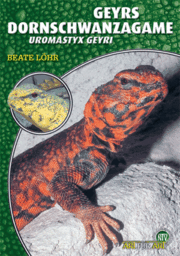
All about the Gery's spiny-tailed lizard from Beate Löhr

  • 62 pages
  • 14.8 x 21 cm
  • numerous color photos
  • 2nd Edition
  • Author Beate Löhr
  • Publisher NTV

Content:
Geyr's spiny-tailed lizard is a terrarium care that attracts animal lovers right off the bat. Attractive coloring and prehistoric appearance quickly give rise to the desire to cultivate this lovable lizard in the home terrarium.

And that is certainly not rocket science, if one observes the practical instructions for their care and breeding, presented the expert Beate Löhr in this volume of the series "Art for Art". Of course, the author also explains how to stimulate the beautiful lizards for mating, how to incubate the eggs and raise the cute boys.

Systematics and physique

  • The fascinating biology: From the life of Geyr's spiny-tailed lizard
  • All information on the species-appropriate attitude: From the suitable terrarium over equipment and technology up to the feeding
  • Successfully breeding: mating stimulation, incubation of the eggs and breeding of the young
  • Troubleshooting: How to avoid the most common mistakes in care, and how to help sick animals
  • Brilliant photos
Composition
Feeding recommendation
Technical details
Size information

0 out of 0 reviews

Give us a rating!

Share your experience with the product with other customers.


Suggested products

Handbook of food plants for tortoises and other reptiles
Handbook of forage plants 2nd revised editionMarion Minch is not only a successful breeder of diverse tortoises for many years, but also an excellent connoisseur of native wild herbs. She founded and runs samenkiste.de, which is well known to many tortoise keepers and nature lovers. Her name is inextricably linked with reptile care and species-appropriate nutrition for tortoises. Her handbook of food plants summarises the most important native food plants for herbivorous and omnivorous reptiles. She not only considers tortoises, but also iguanas, spiny-tailed dragons and even chameleons. From the basics of plant biology to native wild herbs to suitable food plants for hardy tropical reptile species, this comprehensive work provides the basis for species-appropriate keeping. In the expanded and supplemented 2nd edition, the plant section is divided according to flower colour. This makes it even easier to identify wild herbs. The work has also been supplemented with a wealth of additional information and many pictures.

CHF 46.50

Geckos
Geckos in the terrarium by Astrid FalkThe book offers a comprehensive introduction to geckos and their species-appropriate keeping in terrariums. It explains what you need to think about before buying a gecko and what preparations should be made. The book describes in detail how the terrarium is technically equipped and set up. The care of the animals, their special features and behaviour, their diet, reproduction and rearing of young animals are described, as well as diseases and husbandry problems with tried and tested suggestions for prevention and treatment. Individual gecko species that are particularly suitable for keeping and breeding in terrariums are portrayed in detail in the second part of the book.

CHF 28.50

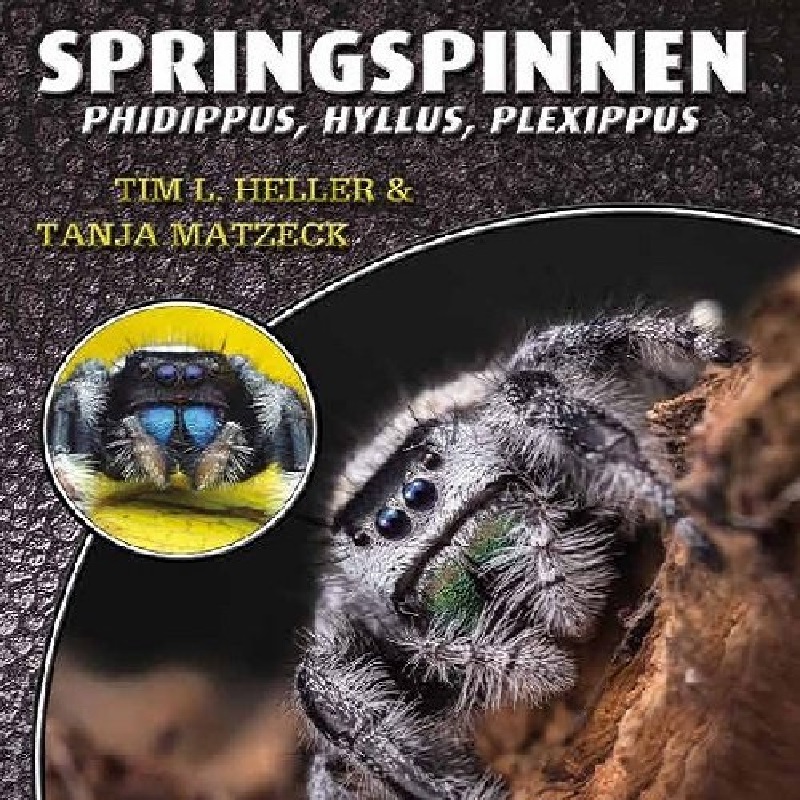
Jumping spiders Phidippus, Hyllus, Plexippus
Book Jumping Spiders - Phidippus, Hyllus & Plexippus A guide to keeping jumping spiders of the genera Phidippus, Hyllus & Plexippus. Who can resist the charm of jumping spiders? The childlike appearance of their expressive face simply leaves no one cold! In addition, their behavior is extremely exciting to observe, their colors are bright and their requirements for species-appropriate keeping are very easy to meet. No wonder these likeable jumpers are all the rage! This volume in the "Species by Species" series describes in detail what to look out for when buying and keeping them, introduces the most commonly kept species and color forms and provides plenty of tips on how to keep them successfully - so you can be sure they will breed well! Species by Species introduces you to the books in this series, which present the most popular terrarium animals. Each volume offers you detailed, practical care instructions and all the information you need to successfully breed your animals. All important questions from the required tank size to terrarium set-up, technical equipment, species-appropriate nutrition and disease prevention are answered with numerous tricks and tips. Experienced, long-standing breeders reveal how you can encourage the animals to reproduce and raise healthy young. All this in full color, generously illustrated and attractively designed - just about your terrarium animal - species by species

CHF 23.90

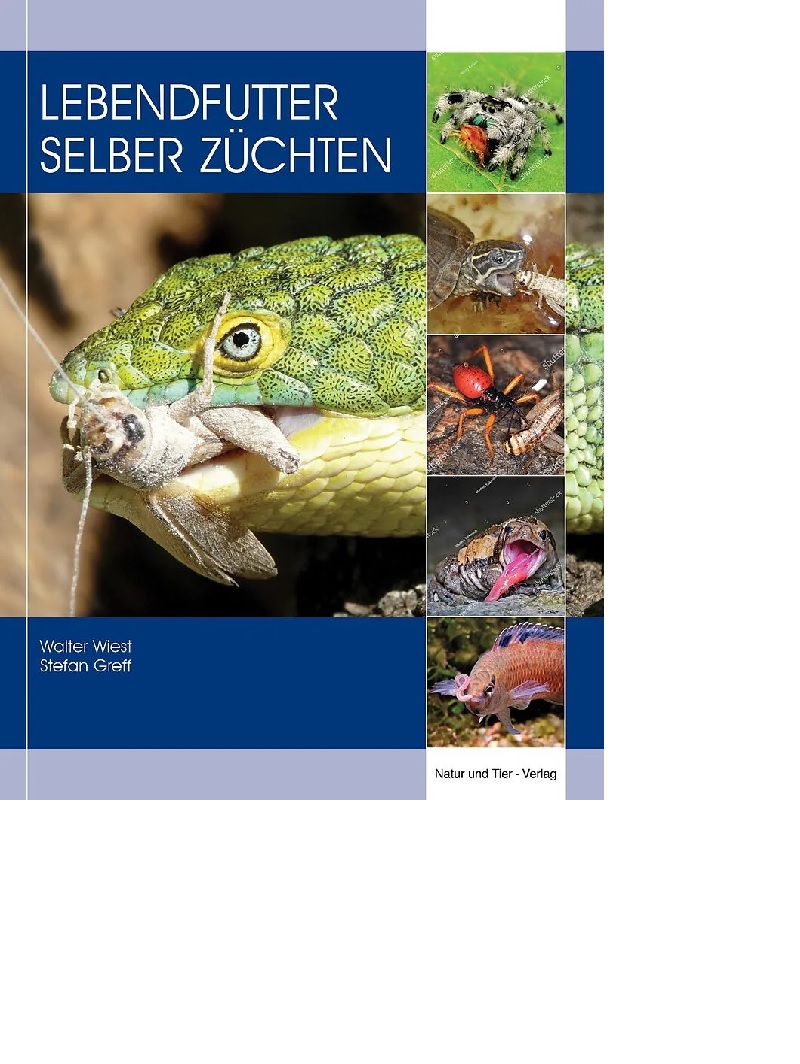
Book Breeding live food yourself
Book "Grow your own live food" - The perfect guide for pet owners Discover practical and detailed instructions on how you can easily breed food for your reptiles, birds, fish or other animals yourself in the book "Breeding live food yourself". With valuable tips on various food insects, their care and breeding, you can save money and ensure a species-appropriate diet for your pets. Contents of the book: Step-by-step instructions for breeding feeder insects Information on the best types of food for reptiles, birds and fish Care instructions and breeding conditions for various live food species Tips for sustainable and cost-effective food production Why breed your own live food? Get healthy, fresh food for your animals Save money and reduce dependence on pet shops Promote the health and well-being of your animals with species-appropriate food Whether you are a beginner or an experienced pet owner, this book provides you with everything you need to successfully breed live food yourself.

CHF 46.50

Marginata 69 - New Guinea tortoises
Marginata 69 - New Guinea tortoises – the genus ElseyaCover storyThe unrecognised beauties: New Guinea tortoises (Andreas S. Hennig)My experiences with Branderhorst's New Guinea tortoise, Elseya (Elseya) branderhorsti (Ouwens, 1914) (Andreas S. Hennig)Keeping and breeding of Rhodin's New Guinea tortoise, Elseya (Hanwarachelys) rhodini Thomson, Amepou, Anamiato & Georges, 2015 (Andreas S. Hennig)PortraitGeoemyda spengleri, Chinese serrated tortoise (Andreas S. Hennig)ReportageMacrochelys temminckii – Experiences and impressions with vulture tortoises part 2 (Reiner Praschag)KeepingAn alternative to year-round keeping of the Egyptian tortoise in the terrarium – my experiences with seasonal outdoor keeping of Testudo kleinmanni (Ricarda Schramm)EtymologySawbacks and living maps part 4: Graptemys gibbonsi, Pascagoula humpback tortoise (Holger Vetter)Classifieds & animal placement

CHF 16.50

Reptilia 54 - Terrarium construction
Reptilia 54 - Terrarium construction PrachtskinkAtelopus zetekiRainbow boas Contents: 2 EDITORIAL 6 MAGAZINE 14 DATES 18 PHOTO REPORTAGE Terrarium constructionby H. Werning 26 REPORTAGEBiotopArt - the terrariums of the Dresden artist Andreas Deißig by J. Jungnickel & U. Prokoph 28 REPORTAGEDetermining the weight of terrariums by P.M. Müller 34 REPORTAGEThe rock wall in the living room on I. Kober 39 REPORTAGEA conservatory for iguanas by S. Winkle 44 TRAVELHerpetological observations in the Dalyan delta by U. Thieme 51 PORTRAIT AND POSTERQuedenfeldtia trachyblepharusby U. Schlüter 56 KEEPING AND BREEDINGKeeping and breeding the Red Rainbow Boa (Epicrates cenchria cenchria) by H. Bellosa 62 KEEPING AND BREEDINGArgentine rainbow boa (Epicrates cenchria alvarezi) by V. Knietsch 66 KEEPING AND BREEDINGOn keeping and breeding the Prachtskink(Mochlus fernandi)by I. Veltum El Copé - In the forest of the Atelopus zetekiby P. Janzen 76 KEEPING AND BREEDINGA pirate's lifeKeeping and breeding Ancylometes fishing spiders - Part 2by K. Kunz 85 LIBRARY 89 CLASSIFIED ADS 94 RAT & TAT 96 WESTERN HERP PERSPECTIVESMorphsby B. Love 104 INCUBATORBegging flight periodBy H. Werning

CHF 11.20

Marginata 40 - Red-headed slider turtles
Marginata 40 - Red-headed slider turtlesFree-range keeping and breeding of European water turtlesKeeping and breeding big-headed tortoises part 2Looking turtles in the mouthContents:EditorialMagazineDates PHOTOSTORYThe red-headed slider turtleHans-Dieter Philippen REPORTAGEThe red-headed slider turtle in the wildHerbert Meier BREEDINGKeeping and breeding the red-headed slider (Podocnemis erythrocephala) Part 1David Drajeske PortraitSalvin’s Cross-breasted Turtle Staurotypus salvinii Grey, 1864Hans-Dieter Philippen BREEDINGBig-headed turtles in nature and human care part 2Reiner Praschag REPORTAGEOutdoor keeping of European pond turtles of the genera Mauremys and EmysSacha Pawlowski REPORTAGELooking turtles in the mouthEgon Heiss & Nikolay Natchev Book tipSubscription & ServiceRegional guide

CHF 16.50

Terraria No. 31 - Collared lizards
Nordamerikanische WassernatternAufzucht europäischer Landschildkröten Inhalt: Halsbandleguane gehören schon lange zu den beliebtesten Echsen im Terrarium. Sie sind farbenprächtig, werden sehr zutraulich und können gut vermehrt werden. Aber auch bei diesen scheinbar so bekannten Evergreens der Terraristik gibt es viel Neues zu berichten. So stellen wir nicht nur in Bild und Text einige „exotische“ Crotaphytus-Arten vor, sondern auch spektakuläre Farbformen des Östlichen Halsbandleguans, von denen einige glücklicherweise bei uns inzwischen gehalten werden. Natürlich darf ein ausgiebiger Haltungs- und Nachzuchtbericht zu C. collaris nicht fehlen. Und über neue Erkenntnisse zur Überwinterung berichtet der wohl bekannteste Experte für diese Tiere, Robert Schumacher. EditorialMagazinKennzeichnung von Reptilien durch neuen Mini-Transponder / Verschollene Regenbogenkröte auf Borneo wiederentdeckt / Beobachtungen an Europäischen Chamäleons (Chamaeleo chamaeleon) auf Malta / Gemeinschaftsbaue bei sozialen Skinken / RechtlichesTERRAglobalGiftige SchönheitenMaik Dobiey TitelthemaSympathieträger aus dem Wilden Westen – Halsbandleguane Heiko Werning & Michael WirthClowns im Terrarium – Langjährige Haltung und Nachzucht Östlicher Halsbandleguane, Crotaphytus collaris Michael Wirth & Florian RiedelDurch die Jahreszeiten der Halsbandleguane in Natur und TerrariumYvonne & Robert SchumacherZu Besuch beim Mountainboomer, dem Staatsreptil von Oklahoma Robert SchumacherDas Schildkrötenjahr Freilandbiologie und Haltung europäischer Landschildkröten über den Jahreslauf Teil 4: Spätsommer und HerbstbeginnMichael WirthDie Gattung Nerodia. Wassernattern aus Nordamerika: Lebensweise sowie Haltung und Vermehrung im Terrarium Teil 2Dieter SchmidtSoziale Vogelspinnen? – Teil 2 Beispiele aus Asien und Europa Frank Schneider, Ingo Wendt & Boris F. StrifflerErste Erfahrungen bei der Haltung und Nachzucht des Chinesischen Wasserskinks (Tropidophorus sinicus) Steven ArthNeue ArtenAus eins mach zwei: neue Gopherschildkröte aus der Sonora-Wüste beschrieben Axel KwetAbo & ServiceUnter Forschern Malpelo – lebender Fels im PazifikMatthias JurczykBlickfangSchildkrötenhimmel im Schnäppchenparadies. Zu Gast in der „Villa Testudo“ in Metzingen Michael WirthIn Ihrer Nähe Vorschau BrutkastenTouristisch im Dschungel Teil 1: Reisende soll man nicht ansprechen Heiko Werning  

CHF 12.00

Reptilia 124 - North American poisonous snakes
Reptilia 124 - North American venomous snakes Contents:Cover story: North American venomous snakesRattlesnakes fascinate every reptile lover! But North America is also home to other interesting venomous snakes, from the coral viper to the water moccasin snake. We offer an overview of the North American venomous snake fauna and then take an in-depth look at the rattlesnakes of the USA and the “cottonmouth” in the wild and in the terrarium. Spectacular new pictures by our photographer Bill Love included. Editorial   Farewell words Something of mine remains here L. Hogeback   MAGAZINE DATES   WESTERN HERP PERSPECTIVES The return to Australia B. Love   PHOTOSTORY The rattlesnakes of the USA in nature and terrarium L. Spinner   KEEPING AND BREEDING On the lookout: Water moccasin snakes in the wild and in the terrarium L. Spinner   TERRARIUM PLANTS The beach almond. Versatile use for small reptiles B. Röll   ALSO NEAR YOU   KEEPING AND BREEDING Jewels in the garden. The Western Green Lizard (Lacerta bilineata) in an outdoor terrarium C. Malberg & A. Schäberle   SERVICE   Journey Terribilis trip to Colombia. Excursion to a country in upheaval B. Encke, Frogs & Friends   PREVIEW   INCUBATOR  Three bright colours H. Werning

CHF 13.50

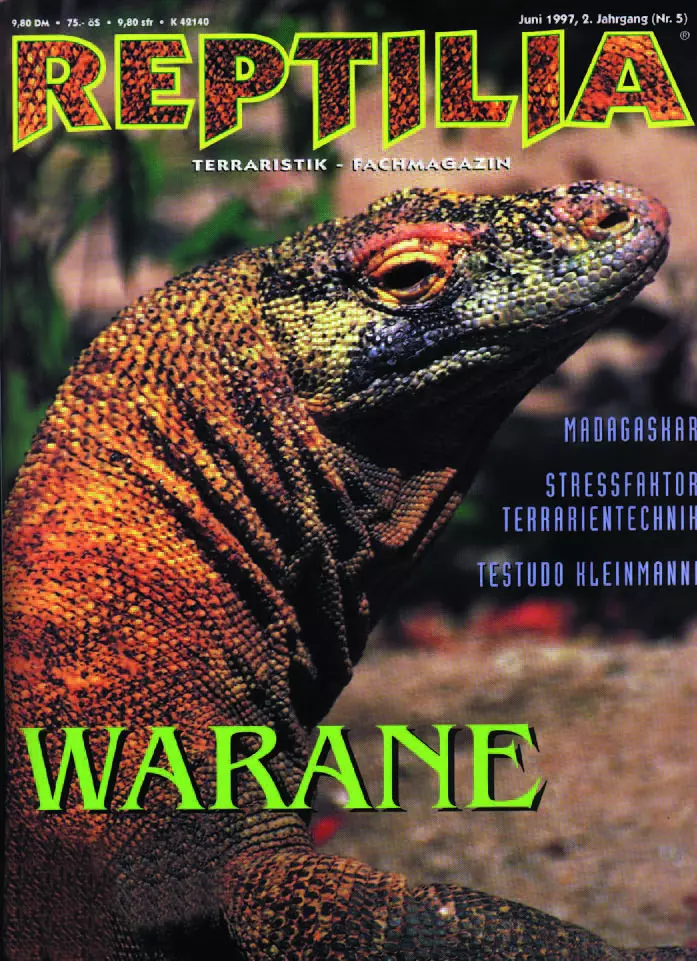
Reptilia 05 - Monitor Lizards
Reptilia 05 - Monitor lizards MadagascarStress factor terrarium technologyTestudo Kleinmanni Contents: Page 2 - EditorialPage 3 - Letters to the editorPage 4 - Discussion: What to do after snake bites?Page 6 - MagazinePage 16 - Photo reportage: Monitor lizards, by J. de Ávalos and P. Martínez CarriónPage 22 - Keeping and breeding: Keeping and breeding monitor lizards, by B. EidenmüllerPage 26 - Herpetofauna: The spoilt dragons of Komodo, by H. WerningPage 28 - Monitor lizards - Use by humans, by Dr M. GaulkePage 33 - Travelogue: Journey to the south-east of Madagascar, by W. Schmidt and K. LiebelPage 39 - Portrait and poster: Dendrobates tinctorius, by M. SchmidtPage 43 - Herpetofauna: Testudo kleinmanni, by B. DevauxPage 52 - Terraristics: Stress in the terrarium, by G. VossPage 56 - Herpetofauna: Frogs of the genus Eleutheradactylus in Costa Rica, by J. EhmckePage 60 - Herpetology and Culture: Magic and superstition, Part 2: Snakes and lizards, by L. B. Carissimi-PrioriPage 69 - Reptilia on the road: Terrazoo Moers, by W. SchmidtPage 74 - Advice and actionPage 75 - LibraryPage 80 - Incubator: Column by H. Werning

CHF 9.80

Marginata 03 - Endangered tortoises
Marginata 03 - Endangered tortoises Three-striped roofed turtleCoahuila box turtle Contents: 2 EDITORIAL 3 READER LETTERS 4 MAGAZINE 7 DATES 9 PHOTO REPORTAGEEndangered tortoisesHans - Dieter Philippen 13 REPORTAGEIn search of mates for "Lonesome George" – Results of the Pinta Expedition 2003Peter C. H. Pritchard 21 REPORTAGESouth Africa – attempt to conserve one third of the world's known tortoisesMargaretha D. Hofmeyr and Brian T. Henen 31 PORTRAITMadagascan beaked tortoiseAstrochelys yniphora (VAILLANT, 1885)Hans - Dieter Philippen 36 REPORTAGEThe Seychelles giant tortoisesA contribution to nature conservation and species preservationJustin Gerlach 44 REPORTAGEThe species conservation project for the three-striped roofed turtle (Kachuga trivittata) at Mandalay ZooGerald Kuchling and U Twint Lwin 52 REPORTAGEKeeping and breeding the Coahuila box turtle Terrapene coahuila SCHMIDT & OWENS, 1944)Part 1 Markus Baur & Irmtraud Jasser-Häger 60 BOOK TIP 61 CLASSIFIEDS 62 REGIONAL GUIDE 64 AGATHA MARGINATA

CHF 14.70

Reptilia 71 - Terrariums for poison dart frogs
Reptilia 71 - Terrariums for poison dart frogsAngola pythonPhilippine monitor lizard MabitangAquatic turtles for beginnersContents: 2 EDITORIAL 3 READER LETTERS 6 MAGAZINE 14 DATES 16 WESTERN HERP PERSPECTIVESNew equipment for "herping"From B. Love 18 PHOTO REPORTAGEPoison dart frog terrariums - Treasure chests for the Juwel of the rainforestBy H. Werning 26 PRACTICEA terrarium for poison dart frogs in 25 stepsBy H. Werning 36 REPORTAGEFrogs, frogs, frogsAt home with the poison dart frog breeders Renate and Bernd PieperBy M. Schmidt & H. Werning 42 TRAVELRanario Cahuita Costa RicaBy M. Haberkern 51 PORTRAIT AND POSTERTestudo hermanni hermanniBy M. Wirth 56 HERPETOFAUNANorth Carolina's Blue Ridge Mountains - The Salamander Capital of the WorldBy H.-J. Luef 63 KEEPING AND REPRODUCTIONPython anchietaeKeeping and breeding the Angolan pythonBy M. Borer 67 HERPETOFAUNAThe Mabitang (Varanus mabitang), a fruit-eating large monitor lizard from the PhilippinesBy M. Gaulke & A. D. Demegillo 75 HERPETOFAUNASkinks in the Usambara Mountains in north-east TanzaniaBy W. & Y. Lantermann 78 REPORTAGEMake two out of one - converting an outdoor terrarium for snakesPart 2: A unique experience among snakesBy M. Hallmen 87 FAQ - FREQUENTLY ASKED QUESTIONSAquatic turtlesBy A. S. Hennig 92 LIBRARY 104 BRUTKASTENZoo Director - Part 2By H. Werning

CHF 12.00