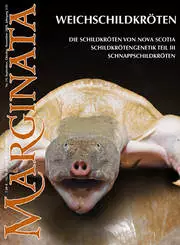
Marginata 03 - Endangered tortoises

Article no: marginata3

CHF 14.70

Stock: 0

Ready for dispatch in 1-3 days, delivery time 7 working days

Delivery between Friday, 28 August and Monday, 31 August
Zahlungsarten
Product information "Marginata 03 - Endangered tortoises"

Marginata 03 - Endangered tortoises

Three-striped roofed turtle
Coahuila box turtle

Contents:

    • 2 EDITORIAL
    • 3 READER LETTERS
    • 4 MAGAZINE
    • 7 DATES
    • 9 PHOTO REPORTAGE
      Endangered tortoises
      Hans - Dieter Philippen
    • 13 REPORTAGE
      In search of mates for "Lonesome George" – Results of the Pinta Expedition 2003
      Peter C. H. Pritchard
    • 21 REPORTAGE
      South Africa – attempt to conserve one third of the world's known tortoises
      Margaretha D. Hofmeyr and Brian T. Henen
    • 31 PORTRAIT
      Madagascan beaked tortoise
      Astrochelys yniphora (VAILLANT, 1885)
      Hans - Dieter Philippen
    • 36 REPORTAGE
      The Seychelles giant tortoises
      A contribution to nature conservation and species preservation
      Justin Gerlach
    • 44 REPORTAGE
      The species conservation project for the three-striped roofed turtle (Kachuga trivittata) at Mandalay Zoo
      Gerald Kuchling and U Twint Lwin
    • 52 REPORTAGE
      Keeping and breeding the Coahuila box turtle Terrapene coahuila SCHMIDT & OWENS, 1944)
      Part 1
      Markus Baur & Irmtraud Jasser-Häger
    • 60 BOOK TIP
    • 61 CLASSIFIEDS
    • 62 REGIONAL GUIDE
    • 64 AGATHA MARGINATA
Composition
Feeding recommendation
Technical details
Size information

0 of 0 reviews

Give us a rating!

Share your experience with the product with other customers.


Suggested products

Handbook of food plants for tortoises and other reptiles
Handbook of forage plants 2nd revised editionMarion Minch is not only a successful breeder of diverse tortoises for many years, but also an excellent connoisseur of native wild herbs. She founded and runs samenkiste.de, which is well known to many tortoise keepers and nature lovers. Her name is inextricably linked with reptile care and species-appropriate nutrition for tortoises. Her handbook of food plants summarises the most important native food plants for herbivorous and omnivorous reptiles. She not only considers tortoises, but also iguanas, spiny-tailed dragons and even chameleons. From the basics of plant biology to native wild herbs to suitable food plants for hardy tropical reptile species, this comprehensive work provides the basis for species-appropriate keeping. In the expanded and supplemented 2nd edition, the plant section is divided according to flower colour. This makes it even easier to identify wild herbs. The work has also been supplemented with a wealth of additional information and many pictures.

CHF 46.50

Geckos
Geckos in the terrarium by Astrid FalkThe book offers a comprehensive introduction to geckos and their species-appropriate keeping in terrariums. It explains what you need to think about before buying a gecko and what preparations should be made. The book describes in detail how the terrarium is technically equipped and set up. The care of the animals, their special features and behaviour, their diet, reproduction and rearing of young animals are described, as well as diseases and husbandry problems with tried and tested suggestions for prevention and treatment. Individual gecko species that are particularly suitable for keeping and breeding in terrariums are portrayed in detail in the second part of the book.

CHF 28.50

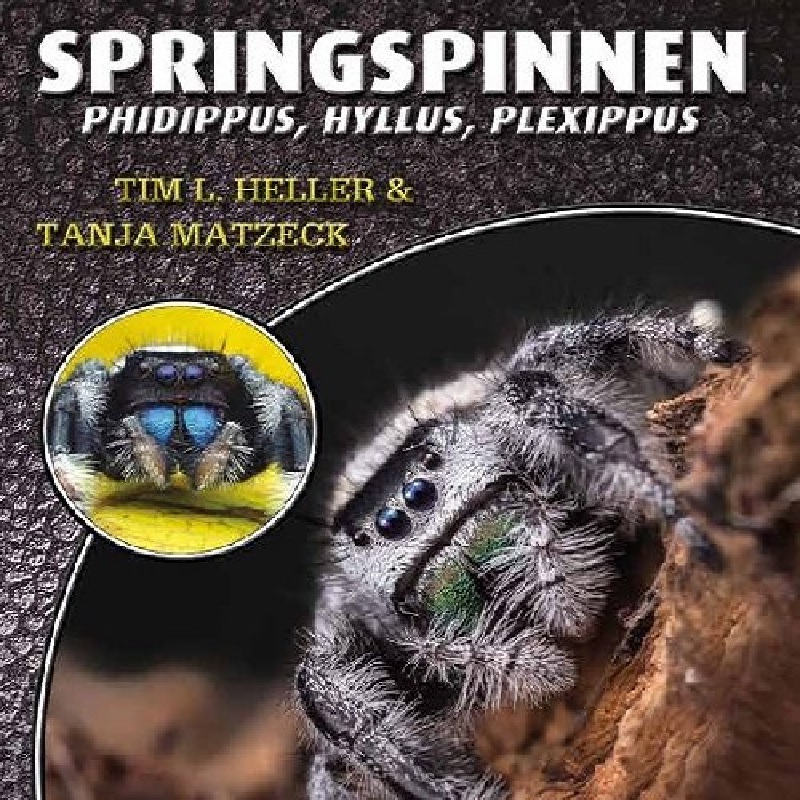
Jumping spiders Phidippus, Hyllus, Plexippus
Book Jumping Spiders - Phidippus, Hyllus & Plexippus A guide to keeping jumping spiders of the genera Phidippus, Hyllus & Plexippus. Who can resist the charm of jumping spiders? The childlike appearance of their expressive face simply leaves no one cold! In addition, their behavior is extremely exciting to observe, their colors are bright and their requirements for species-appropriate keeping are very easy to meet. No wonder these likeable jumpers are all the rage! This volume in the "Species by Species" series describes in detail what to look out for when buying and keeping them, introduces the most commonly kept species and color forms and provides plenty of tips on how to keep them successfully - so you can be sure they will breed well! Species by Species introduces you to the books in this series, which present the most popular terrarium animals. Each volume offers you detailed, practical care instructions and all the information you need to successfully breed your animals. All important questions from the required tank size to terrarium set-up, technical equipment, species-appropriate nutrition and disease prevention are answered with numerous tricks and tips. Experienced, long-standing breeders reveal how you can encourage the animals to reproduce and raise healthy young. All this in full color, generously illustrated and attractively designed - just about your terrarium animal - species by species

CHF 23.90

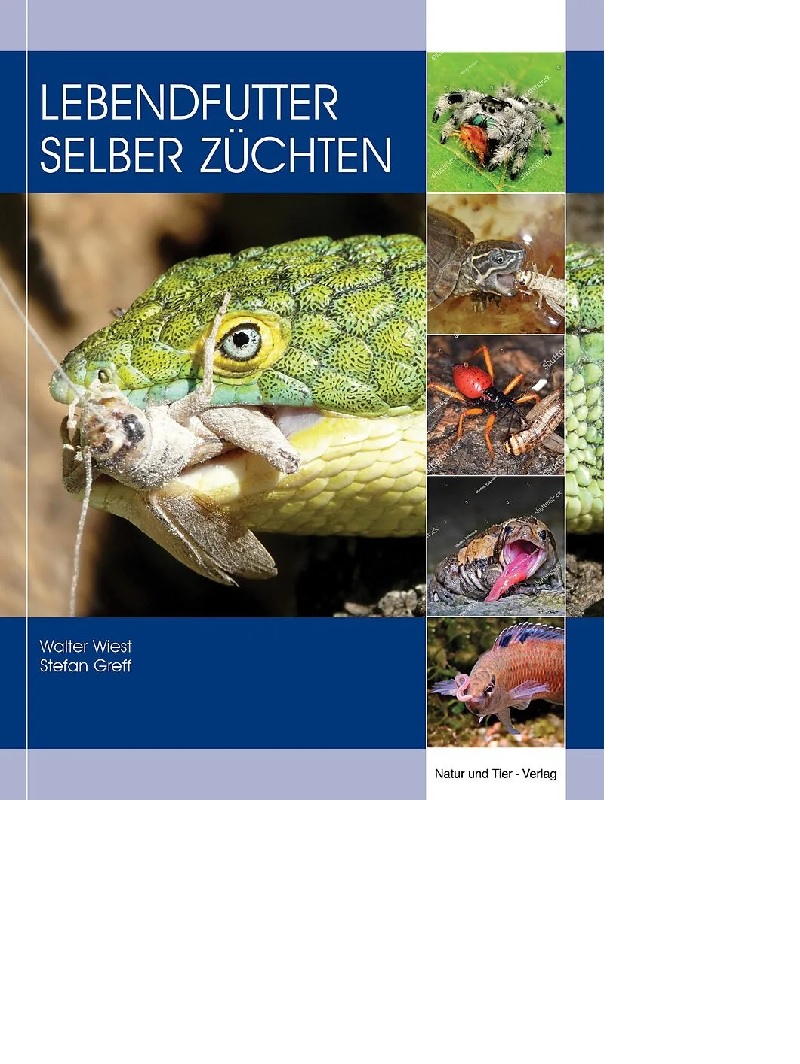
Book Breeding live food yourself
Book "Grow your own live food" - The perfect guide for pet owners Discover practical and detailed instructions on how you can easily breed food for your reptiles, birds, fish or other animals yourself in the book "Breeding live food yourself". With valuable tips on various food insects, their care and breeding, you can save money and ensure a species-appropriate diet for your pets. Contents of the book: Step-by-step instructions for breeding feeder insects Information on the best types of food for reptiles, birds and fish Care instructions and breeding conditions for various live food species Tips for sustainable and cost-effective food production Why breed your own live food? Get healthy, fresh food for your animals Save money and reduce dependence on pet shops Promote the health and well-being of your animals with species-appropriate food Whether you are a beginner or an experienced pet owner, this book provides you with everything you need to successfully breed live food yourself.

CHF 46.50

Marginata 69 - New Guinea tortoises
Marginata 69 - New Guinea tortoises – the genus ElseyaCover storyThe unrecognised beauties: New Guinea tortoises (Andreas S. Hennig)My experiences with Branderhorst's New Guinea tortoise, Elseya (Elseya) branderhorsti (Ouwens, 1914) (Andreas S. Hennig)Keeping and breeding of Rhodin's New Guinea tortoise, Elseya (Hanwarachelys) rhodini Thomson, Amepou, Anamiato & Georges, 2015 (Andreas S. Hennig)PortraitGeoemyda spengleri, Chinese serrated tortoise (Andreas S. Hennig)ReportageMacrochelys temminckii – Experiences and impressions with vulture tortoises part 2 (Reiner Praschag)KeepingAn alternative to year-round keeping of the Egyptian tortoise in the terrarium – my experiences with seasonal outdoor keeping of Testudo kleinmanni (Ricarda Schramm)EtymologySawbacks and living maps part 4: Graptemys gibbonsi, Pascagoula humpback tortoise (Holger Vetter)Classifieds & animal placement

CHF 16.50

Terraria No. 35 - Reptile search
Terraria No. 35 - Reptile search Rhacophorus feaeTrugnattern Inhalt: Titelthema: Reptiliensuche in der NaturReptilien in freier Natur zu suchen und zu beobachten, macht nicht nur Spaß, sondern dabei lassen sich auch viele wichtige Erkenntnisse für die Haltung der betreffenden Arten sammeln. Allerdings ist es nicht einfach damit getan, rauszugehen und darauf zu hoffen, dass einem die Tiere nur so über den Weg laufen. Worauf es ankommt, um bei der Suche nach Reptilien auch wirklich Erfolg und damit schöne Erlebnisse zu haben, das erfahren Sie in den ausführlichen Beiträgen des Titelthemas der nächsten TERRARIA/elaphe-Ausgabe. TerritorialHerpetoramaTitelthema„Fieldherping“. Die erfolgreiche Suche nach Reptilien im FreilandMichael WirthVon Kratzern, gutem Müll und gebräunten Nacken. Praxistipps für die ReptiliensucheMichael WirthBitte nicht stören! Verantwortungsbewusstes Verhalten bei der Suche nach ReptilienBenny TrappPanoramaTerraglobal. Reptilien rund um Haus und GartenAlfred Schleicher Reptilienerinnerungen à la GuatemalaLester MeléndezForschungUnter Forschern. Vielfalt zwischen Tempeln und Landminen – Herpetologische Feldarbeit in KambodschaTimo HartmannNeue ArtenListe der im Jahr 2011 neu beschriebenen Reptilien Axel KwetSalamandraTerraristikKlassikerDer Grüne LeguanBasiliscus plumifrons, der Stirnlappenbasilisk: Erfahrungen aus 20 Jahren Haltung und Vermehrung im Terrarium. Teil 2: Pflege und NachzuchtIngo KoberGiftbisse von giftigen und „harmlosen“ Schlangen. Teil 2Dieter SchmidtErstnachzucht von Feas Riesenruderfrosch, Rhacophorus feae, im Leningrad Zoo Anna A. Bagaturova & Mikhail F. BagaturovNatur- und ArtenschutzFeldnotizen. Die Rote Liste der Amphibien und Reptilien Deutschlands. Teil 2: Verantwortlichkeit, Gefährdungsursachen, Schutz- und HilfsmaßnahmenKlaus-Detlef Kühnel, Arno Geiger & Richard PodlouckyVermisstHalbschwimmer-Nasenfrosch (Rhinoderma rufum)Alexander GutscheAuch in Ihrer NäheAbo & ServiceGalerie100 Jahre Herpetologia EuropaeaAxel Kwet

CHF 12.00

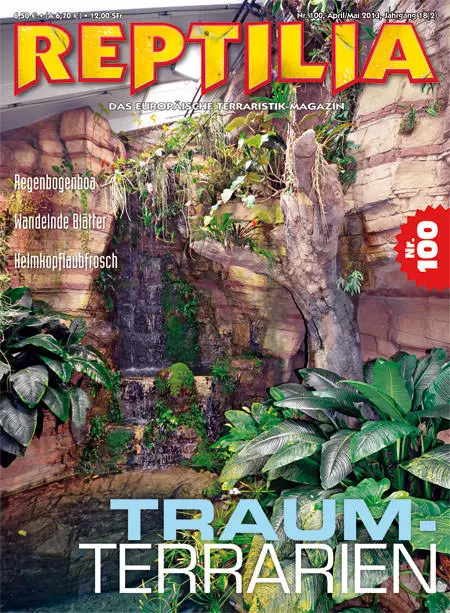
Reptilia 100 - Dream terrariums
Reptilia 100 - Dream terrariums Rainbow boaChanging leavesHelmeted tree frog Contents: What could be more fitting for the 100th issue of our magazine, than to showcase the very best the hobby has to offer: dream terrariums! We show you the most extraordinary tanks owned by private keepers, and they’ll leave you speechless. We’ve also included building guides with plenty of ideas so that you too can make your dream of the perfect terrarium a reality. EDITORIALMAGAZINEDATES AROUND THE WORLD IN 5 YEARSThe end is nearA. Pachmann PHOTOREPORTAGEDream terrariums REPORTAGEPack your swimming trunks – a visit to Georg Reitmaier’s superlative terrariumH. Werning TERRARIUM PRACTICE“A Dream comes true”. Building a terrarium for keeping Morelia boeleniM. Uhlhaas, P. Pohlscheid & L. Schilling TERRARIUM PRACTICEJewels in stainless steel. Building a terrarium for poison dart frogs. Part 1: Planning, construction and manufactureM. Schulte REPORTAGEThe first world championship in terrascapingL. Barkam Readers’ competition“Your dream terrarium” KEEPING AND BREEDINGOn the knowledge, care and breeding of the Yucatán shovel-headed tree frog Triprion petasatusT. Eisenberg KeepingKeeping and care of changing leaves, using Phyllium siccifolium from the Philippines as an exampleM. Friend REPORTAGEFringed-finger lizards (Acanthodactylus) in the wild and in the terrarium. Part 7: The Acanthodactylus-erythrurus group and conclusionU. Schlüter KEEPING AND BREEDINGOn the biology and care of the Guyana rainbow boa (Epicrates maurus guyanensis)M. Schwederski & L. Trutnau Animals of our homelandThe European pond turtleR. Leptien WESTERN HERP PERSPECTIVESThe safe world syndrome – protection from everything and everyoneB. Love TIPS AND TRICKSSUBSCRIPTION & SERVICETest runALSO NEAR YOU JourneyAdventure holiday in the PhilippinesM. Gaulke PREVIEW BRUTKASTENI would even let myself be locked up for the REPTILIA – part 2H. Werning

CHF 12.00

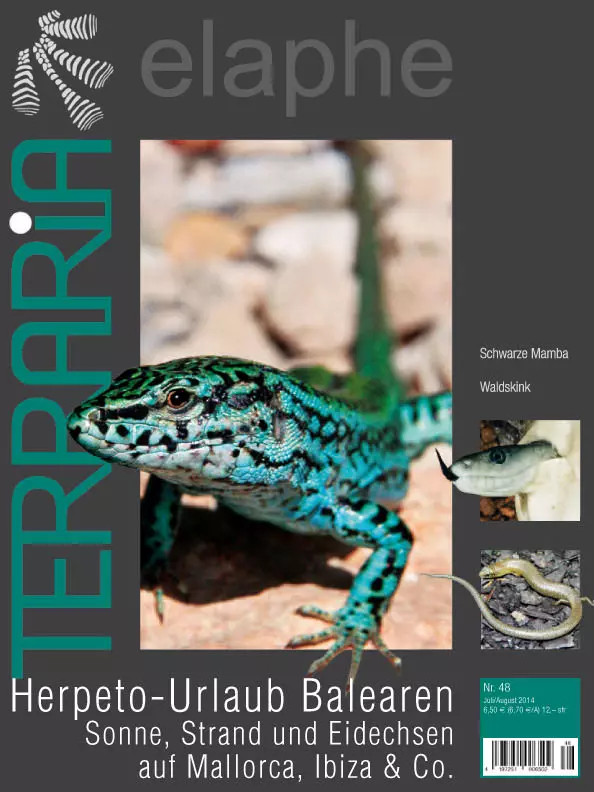
Terraria 48 - Herpeto Holiday Balearic Islands
Terraria 48 - Herpeto holiday Balearic IslandsBlack MambaForest skinkContents:TerritorialHerpetoramaCover storyHerpeto holiday Balearic Islands. Sun, beach and lizards on Mallorca, Ibiza & Co.Mike ZawadzkiIbiza - Sun, beach and lizardsMike ZawadzkiFormentera - Beyond timeMike ZawadzkiMenorca - Blown by the windMike ZawadzkiCabrera - Spain's little GalápagosMike ZawadzkiMallorca - The unrecognised islandMike ZawadzkiPanoramaIn search of mountain vipers (Monitvipera xanthina) in north-eastern Greece – Part 2Michael Wirth"Just Remember that Death is not the End". Taxidermy of reptilesJörg PetzoldWilly Wolterstorff. The "father of the newt" was born 150 years agoWolfgang BischoffResearchAmong researchers"Harmless" snake on the road or the discovery of a new pit viper in the HimalayasGernot VogelNew speciesThe relict-like leaf toad or the discovery of a new frog speciesMirko SoléSalamandraTerraristicsKeeping and breeding the Madagascar forest skink Amphiglossus macorcercusJochen MeyerSubscription & ServiceObservations of the black mamba, Dendroaspis polylepis, in the terrariumLudwig Trutnau & Alfred WallnerNature and species conservationField notesGreek vipersHans PichlerGrass frogs in VilsalpseeAxel KwetEasy help for the amphibian of the year, the yellow-bellied toadAndreas OchsenbeinAlso in your neighbourhoodPreviewIncubator The boys in the swampRolf Leptien

CHF 12.00

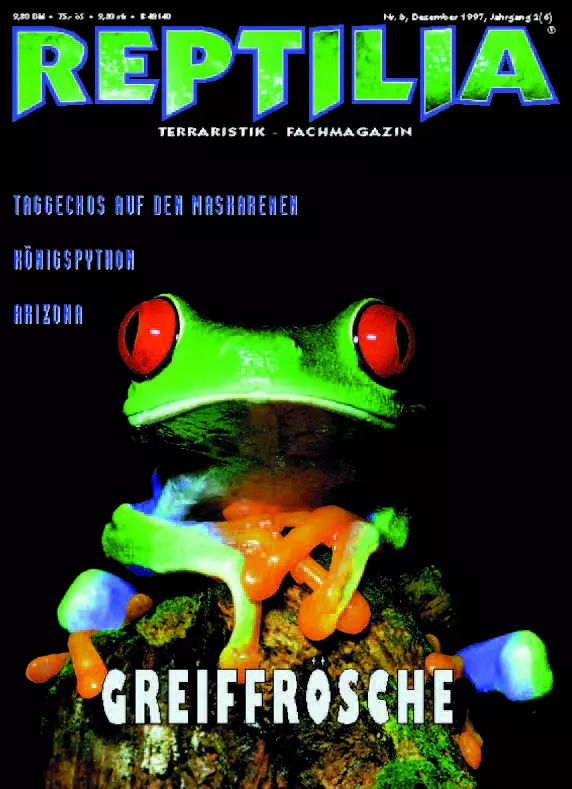
Reptilia 08 - Grasping frogs
Reptilia 08 - Grasping frogsDay geckos on the MascarenesRoyal pythonArizonaContents:Page 2 - EditorialPage 3 - Letters to the editorPage 5 - MagazinePage 14 - Western Herp Perspectives: Albino turtles, by B. LovePage 16 - Photo report: Griffin frogs, by C. ProyPage 23 - Report: Sleepyheads - Maci frogs, by Dr H. HermannPage 28 - Keeping and breeding: Keeping and breeding the red-eyed frog, by H. Birkhahn and K. WassmannPage 33 - Travelogue: Arizona, by H. WerningPage 39 - Portrait and poster: Laudakia stellio, by D. Modry and P. NecasPage 43 - Report: The genus Neurergus - Fascinating mountain stream salamanders, by S. Steinfartz and G. SchultschickPage 49 - Keeping and breeding: Keeping and breeding the royal python, by W. WenglerPage 54 - Report: Day geckos on the Mascarene Islands, by G. TrautmannPage 60 - Herpetology and culture: The reptile cult in the realm of the pharaohs, by L. Batista Carissimi-PrioriPage 69 - Reptilia on the road: Zoo-Aquarium in Berlin, by H. WerningPage 74 - Advice and actionPage 77 - LibraryPage 80 - Incubator: Glossary by H. Evers

CHF 9.80

Marginata 19 - Soft-shelled turtles
Marginata 19 - Soft-shelled Turtles The turtles of Nova ScotiaTurtle genetics Part IIISnapping turtles Contents: 2Editorial3 Letters to the Editor4Magazine8 Dates10Reportage The family of soft-shelled turtles – a more than fascinating group of turtles by Hans-Dieter Philippen16ReportageThe Red-backed Flap- Soft-shelled Turtle (Cycloderma aubryi) – a special beauty from the Congo by Gunther Köhler & Herbert Nigl22Breeding in Human CareKeeping and breeding of the Indian Flap-backed Soft-shelled Turtle (Lissemys punctata punctata)by Christina Schäfer31ProfileOrnate Box Turtle, Terrapene ornata ornataby Hans - Dieter Philippen35 ReportageFeeder Animals Part 2Hans - Dieter Philippen40ReportageFrom the pea experiment to decoding of the human genome – Genetics yesterday and today Part 3 by Jens R. Poschadel & Martin Platz46ReportageA journey to the turtles of Nova Scotia in Canada by Herbert Becker, Andreas Gräf & Urs Landweer55ReportageThe snapping turtle problem, a problem to be taken seriously by Markus Baur, Tobias Friz & Rudolf Hoffmann60Book Tip61Classifieds62Regional Guide

CHF 14.70

Reptilia 16 - Uromastyx
Reptilia 16 - Thorntails Food animal breeding: CockroachesChameleon keepingPeloponnese Contents: Page 2 - EditorialPage 3 - MagazinePage 9 - Herpetofauna: Crocodile newts, by Dr J. FleckPage 12 - DatesPage 16 - Western Herp Perspecives: Souvenirs from Florida, by B. LovePage 18 - Photo reportage: Spiny-tailed agamas, by T. WilmsPage 25 - Keeping and breeding: The care and breeding of spiny-tailed agamas in the terrarium, by T. WilmsPage 30 - Report: Arabia Felix - in search of Uromastyx thomasi, by F. Hulbert and T. WilmsPage 34 - Keeping and breeding: The reproductive behaviour of the Uromastyx species, by T. WilmsPage 38 - Travelogue: Herpetological observations on the Peloponnese, by L. Siegmund and B. TrappPage 44 - Report: The brown-edged tortoise Testudo marginata in the surroundings of Tolo (Peloponnese), by H. RautertPage 47 - Portrait and poster: Atelopus flavescens, M. SchmidtPage 51 - Keeping and breeding: Introduction to keeping chameleons, by R. LeptienPage 56 - Report: Breeding the Argentine cockroach (Blaptica dubia), by B. HauschildPage 63 - Keeping and breeding: Experiences with the Typhloneces compressicauda, by H. WallaysPage 68 - Keeping and breeding: Keeping and breeding the silver-grey slender boa Epicrates striatus striatus, by J.-M. HerrmannPage 73 - Herpetology and culture: ...but more and more often. Reptiles in advertising, by L. HogebackPage 82 - Reptilia on the road: Parque Seminario in Guayaquil, Ecuador, by H. WerningPage 85 - Advice and actionPage 91 - LibraryPage 96 - Glossary: Iguana à la carte, by H. Werning

CHF 9.80

Bede your hobby chameleons
Bede - Your Hobby Chameleons Rolf Müller and Ulrike Walbröl have been successfully breeding chameleons for years. As members of the DGHT’s Chameleon Working Group and contact persons for the Chameleon Hotline, they are thoroughly familiar with the problems faced by beginners in chameleon keeping. Here, they have brought together their knowledge and experience for the first time and, in collaboration with Dominik Kieselbach, have created a book for beginners unlike any other previously available on the German market.

CHF 23.50