Handbook of forage plants 2nd revised editionMarion Minch is not only a successful breeder of diverse tortoises for many years, but also an excellent connoisseur of native wild herbs. She founded and runs samenkiste.de, which is well known to many tortoise keepers and nature lovers. Her name is inextricably linked with reptile care and species-appropriate nutrition for tortoises. Her handbook of food plants summarises the most important native food plants for herbivorous and omnivorous reptiles. She not only considers tortoises, but also iguanas, spiny-tailed dragons and even chameleons. From the basics of plant biology to native wild herbs to suitable food plants for hardy tropical reptile species, this comprehensive work provides the basis for species-appropriate keeping. In the expanded and supplemented 2nd edition, the plant section is divided according to flower colour. This makes it even easier to identify wild herbs. The work has also been supplemented with a wealth of additional information and many pictures.
Geckos in the terrarium by Astrid FalkThe book offers a comprehensive introduction to geckos and their species-appropriate keeping in terrariums. It explains what you need to think about before buying a gecko and what preparations should be made. The book describes in detail how the terrarium is technically equipped and set up. The care of the animals, their special features and behaviour, their diet, reproduction and rearing of young animals are described, as well as diseases and husbandry problems with tried and tested suggestions for prevention and treatment. Individual gecko species that are particularly suitable for keeping and breeding in terrariums are portrayed in detail in the second part of the book.
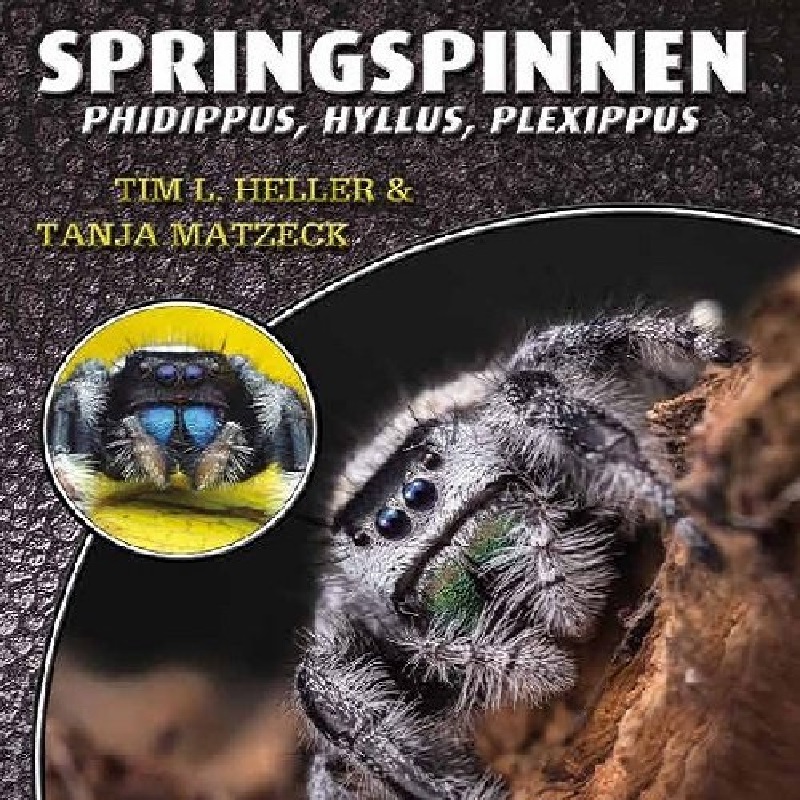
Book Jumping Spiders -
Phidippus, Hyllus & Plexippus
A guide to keeping jumping spiders of the genera Phidippus, Hyllus & Plexippus. Who can resist the charm of jumping spiders? The childlike appearance of their expressive face simply leaves no one cold! In addition, their behavior is extremely exciting to observe, their colors are bright and their requirements for species-appropriate keeping are very easy to meet. No wonder these likeable jumpers are all the rage!
This volume in the "Species by Species" series describes in detail what to look out for when buying and keeping them, introduces the most commonly kept species and color forms and provides plenty of tips on how to keep them successfully - so you can be sure they will breed well!
Species by Species introduces you to the books in this series, which present the most popular terrarium animals. Each volume offers you detailed, practical care instructions and all the information you need to successfully breed your animals.
All important questions from the required tank size to terrarium set-up, technical equipment, species-appropriate nutrition and disease prevention are answered with numerous tricks and tips.
Experienced, long-standing breeders reveal how you can encourage the animals to reproduce and raise healthy young.
All this in full color, generously illustrated and attractively designed - just about your terrarium animal - species by species
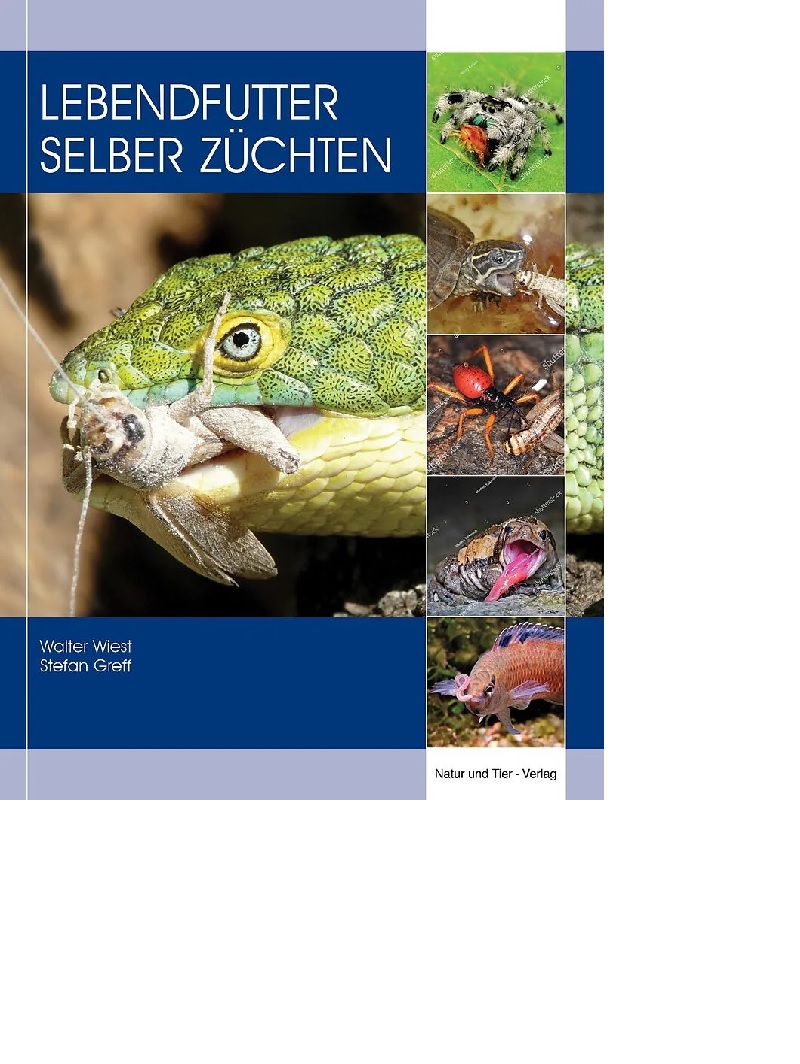
Book "Grow your own live food" - The perfect guide for pet owners
Discover practical and detailed instructions on how you can easily breed food for your reptiles, birds, fish or other animals yourself in the book "Breeding live food yourself". With valuable tips on various food insects, their care and breeding, you can save money and ensure a species-appropriate diet for your pets.
Contents of the book:
Step-by-step instructions for breeding feeder insects
Information on the best types of food for reptiles, birds and fish
Care instructions and breeding conditions for various live food species
Tips for sustainable and cost-effective food production
Why breed your own live food?
Get healthy, fresh food for your animals
Save money and reduce dependence on pet shops
Promote the health and well-being of your animals with species-appropriate food
Whether you are a beginner or an experienced pet owner, this book provides you with everything you need to successfully breed live food yourself.
Marginata 69 - New Guinea tortoises – the genus ElseyaCover storyThe unrecognised beauties: New Guinea tortoises (Andreas S. Hennig)My experiences with Branderhorst's New Guinea tortoise, Elseya (Elseya) branderhorsti (Ouwens, 1914) (Andreas S. Hennig)Keeping and breeding of Rhodin's New Guinea tortoise, Elseya (Hanwarachelys) rhodini Thomson, Amepou, Anamiato & Georges, 2015 (Andreas S. Hennig)PortraitGeoemyda spengleri, Chinese serrated tortoise (Andreas S. Hennig)ReportageMacrochelys temminckii – Experiences and impressions with vulture tortoises part 2 (Reiner Praschag)KeepingAn alternative to year-round keeping of the Egyptian tortoise in the terrarium – my experiences with seasonal outdoor keeping of Testudo kleinmanni (Ricarda Schramm)EtymologySawbacks and living maps part 4: Graptemys gibbonsi, Pascagoula humpback tortoise (Holger Vetter)Classifieds & animal placement
Marginata 15 - Snake-necked turtles
Genetic variability of western tortoisesTuscan tortoises part 2Food plants for aquatic turtles part 3
Contents:
2 EDITORIAL
3 READER LETTERS
4 MAGAZINE
8 DATES
10 REPORTAGEThe snake-necked turtles of Indo-AustraliaHans - Dieter Philippen
18 BREEDING IN HUMAN CAREKeeping and breeding the Australian long-necked turtle (Chelodina longicollis)Stefan Thierfeldt & Sabine Höfler-Thierfeldt
24 BREEDING IN HUMAN CAREKeeping and breeding the white-nosed snake-necked turtle (Chelodina spec.) Steffen Szymanski
31 PORTRAITSouth African tent-footed tortoise (Psammobates tentorius, BELL 1828)Irmtraud Jasser-Häger & Matts Blohm
35 REPORTAGEFood plants for aquatic turtles (Part III)Susanne Vogel
40 REPORTAGETuscany – In search of Eurotestudo hermanni (Part II)Michael Wirth & Walter Matzanke
48 REPORTAGEGenetic studies on western tortoisesGiorgio Berorelle, Vassili Goutner, Barbara Livoreill and Stefano Mazzotti
54 REPORTAGENotes on incubation and hatching of a wet clutch of red-bellied slider turtles Martin Leonard Voss
58 SHORT REPORTAGEComments on frequent carcass findings of leatherback turtlesAlfred Schleicher
60 BOOK TIP
61 CLASSIFIEDS
62 REGIONAL GUIDE
Reptilia 33 European snakes
Dwarf honeycomb toadFishing chameleonCuban Anolis
Contents:
2 Editorial
4 Magazine
16 Western Herp PerspectivesSnake searchfrom B. Love
18 Photo reportageThe snakes of Europefrom B. Trapp
26 Keeping and breedingSome vipers from Europe in the terrariumby K. Orth
32 Keeping and breedingRearing and eighteen years of caring for a common viper (Vipera berus berus)by K. Orth
34 Reportage'Snake diving' - Encounter with the dice snake (Natrix tessellata)by W. Pölzer
39 Keeping and breedingGood times, bad times: Experiences with the chameleon Bradypodion fischeri (REICHENOW, 1895)by P. Müller
46 JourneyCuba: In search of Anolis smallwoodiby M. Rogner
51 Portrait and posterAmeiva undulataby U. Schlüter
56 Keeping and breedingThe Indian star tortoise Geochelone elegans (SCHOEPFF, 1795) - a problematic tropical tortoise? - Part 2: Careby H.-J. Bidmon
64 Keeping and breedingKeeping and breeding the dwarf honeycomb toad Pipa parvaby M. Beier
72 ReportageA popular feed insect, the green cockroach Panchlora nivea (LINNAEUS, 1758)by I. Fritzsche
76 REPTILIA on the roadReptile house Sipplingenby H. Werning
85 Classifieds
89 Advice and help
93 Library
104 ColumnNew recipes!by K. Kunz
Draco 63 - Amphibians of Europe
Contents:
Editorial
Frogs and tailed amphibians in Europe – species diversity and biology Axel Kwet & Benny TrappAmphibian of the Year 2016 – Morphological diversity in Salamandra salamandraAxel Kwet & Benny Trapp
New amphibians in EuropeAxel Kwet & Benny Trapp
The amphibian fauna of the Iberian PeninsulaAxel Kwet & Benny Trapp
Corsica, Sardinia and Sicily: Amphibian diversity in the MediterraneanAxel Kwet & Benny Trapp
List of the amphibians of Europe Axel Kwet & Benny Trapp
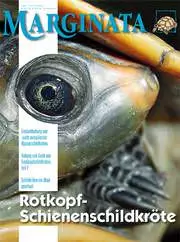
Im Biotop der Großkopf-Schienenschildkröte?Zucht von Kinosternon bauriiHaltung und Zucht von Astrochelys radiata Teil 6
Inhalt:
Editorial
Magazin
Termine
FOTOSTORY
Die Gattung Kinixys. Schildkröten mit „Knick“ im Panzer
Hans-Dieter Philippen
NACHZUCHT
Gemischte Erfahrungen bei Haltung und Nachzucht der Madagassischen oder Dormergues Glattrand Gelenkschildkröte
Viktor Mislin & Hans-Dieter Philippen
NACHZUCHT
Haltung und Nachzucht der Stutz-Gelenkschildkröte (Kinixys homeana) bis zur F2-Generation
John Zoran
PORTRÄT
Weissingers Breitrandschildkröte, Testudo marginata weissingeri
Hans-Dieter Philippen
HALTUNG UND NACHZUCHT
Haltung und Nachzucht der Madagassischen Strahlenschildkröte. Teil 6
Michael Wirth & Peter Fritz
REPTORTAGE
Im Biotop der Großkopf-Schienenschildkröte (Peltocephalus dumerilianus)
Mario Herz
ZUCHT
Haltung, Pflege und Nachzucht der Dreistreifen-Klappschildkröte, Kinosternon baurii
Nicolas Pellegrin
Buchtipp
Kleinanzeigen
Abo & Service
Regionalführer
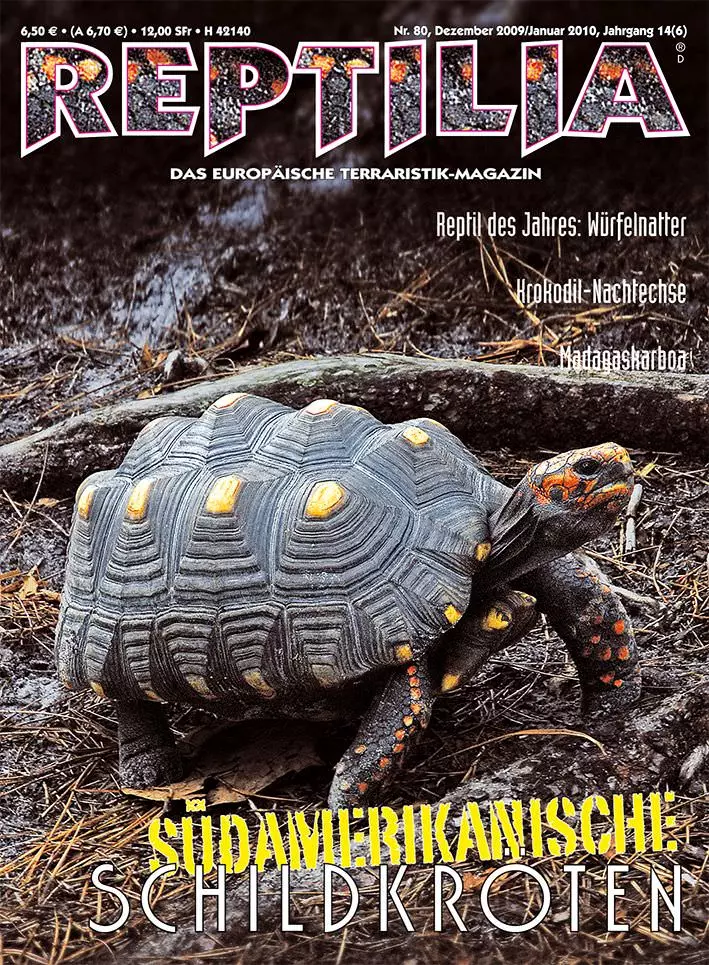
Reptilia 80 - South American turtles
Reptile of the Year: Dice snakeCrocodile night lizardMadagascar boa
Contents:
South America is home to a rich and diverse turtle fauna –especially as far as the aquatic species are concerned. Although some species from this continent are very popular in terraristics, such as the charcoal tortoise, little is known about others. Our lavishly illustrated photo story offers you an overview of the South American turtles, and experienced experts then present individual species in detail.
MAGAZINEDATES
WESTERN HERP PERSPECTIVESBad economic times – and theirconsequences for terraristicsBy B. Love
PHOTOSTORYSouth American turtlesby J. Valverde
HERPETOFAUNACharcoal tortoises in the Gran Chaco – adaptations to an extreme habitatby T. & S. Vinke
33 HERPETOFAUNAMesoclemmys zuliae – The mysterious toad-headed turtle from the south of Lake Maracaiboby F.J.M. Rojas-Runjaic
REPTILE OF THE YEARThe dice snake (Natrix tessellata), Reptile of the Year 2009by A. Kwet & K. Mebert
PORTRAIT AND POSTERNatrix tessellataby A. Kwet & K. Mebert
TRAVELIn the footsteps of Darwin through South AmericaPart 3: From the cold rainforest to the driest desertby H. Werning
KEEPING AND REPRODUCTIONAcrantophis dumerili – Keeping and breeding of the Southern Madagascar boaby M. Borer
KEEPING AND REPRODUCTIONThe yellow-spotted crocodile night lizard (Lepidophyma flavimaculatum) in the terrariumby U. Schlüter
FAQ – FREQUENTLY ASKED QUESTIONSHarduneby M. Dieckmann
LIBRARYSUBSCRIPTION & SERVICE ALSO NEAR YOU PREVIEW INCUBATORWhy we will be standing in front of unconscious civvies in old ageL. Hogeback
Reptilia 58 - Crustacean lizards
Bush crocodileAgate snailsPlains snake
Contents:
2 EDITORIAL
4 MAGAZINE
8 DATES
12 REPORTAGEExperience with keeping and breedingof dinos in the terrariumBy D. Schmidtwith a review by H. Werning
16 WESTERN HERP PERSPECTIVESThe Madagascan turtle crisisBy B. Love
18 PHOTO REPORTAGECrustacean lizards – the genus HelodermaBy T. Wilms
26 KEEPING AND BREEDINGThe successful and continuouskeeping and breeding of the scorpion-crustacean lizard Heloderma horridumexasperatumBy M. Reisinger
36 HERPETOFAUNAThe Guatemalan scorpion crustacean lizard, Heloderma horridum charlesbogertiCampbell & Vannini, 1998By L. S. Meléndez Garcia
39 SPECIES CONSERVATIONPoisonous giants facing extinction?REPTILIA project for the protection of theGuatemalan scorpion crustacean lizardBy K. Kunz
44 REPORTAGEHunting anacondas with sonar and guillotineBy L. Dirksen
51 PORTRAIT AND POSTERBufo brongersmaiBy U. Schlüter
55 KEEPING AND BREEDINGThe bush crocodile – secret beauty in theterrariumBy M. Evers
63 KEEPING AND BREEDINGKeeping and breeding of the ChineseDione snake (Elaphe dione)By M. Diekmann & A. Weyers
72 KEEPING AND BREEDING Agate snails in the terrariumBy K. Wandtke
81 REPTILIA ON THE ROAD30 years Reptile Zoo HappBy D. Schmidt
88 CLASSIFIED ADS
93 RAT & TAT
94 LIBRARY
104 INCUBATORProtocol of a failed attempt at acautious approach, at first sight based on mutualsympathy and intersexualattraction, during a jubilantcelebrationBy H. Werning
Reptilia 66 - Rattlesnakes
Peninsula tortoiseMadagascar terrariumFringed Fingers
Contents:
2 EDITORIAL
3 MAGAZINE
14 DATES
16 WESTERN HERP PERSPECTIVESTurtles in the seaFrom B. Love
18 PHOTO REPORTAGERattlesnakes! The genus CrotalusBy S. Winchell
26 KEEPING AND REPRODUCTIONKeeping and breeding of the Western diamondback rattlesnakeBy F. J. Caballero Gasca & J. M. Rodriguez Gòmez
32 REPORTAGEPhoto hunt for mountain rattlesnakesin MexicoBy R. W. Bryson Jr.
38 KEEPING AND REPRODUCTIONTerrarium keeping of Mountain RattlesnakesBy D. Lazcano, R. D. J. Galvàn C. Garcia de la Pena G. Castaneda
42 TRAVELA stay in a remote part of the Brazilian Amazon region: Herpetological diaryBy P. Ulmer
51 PORTRAIT AND POSTERAgama lionotus lionotusBy M. Dobiey & P. Wagner
56 HERPETOFAUNAFrogsnake of the year 2007 The spadefoot toad (Pelobates fuscus)By A. Kwet & A. Nöllert
64 PRACTICEMadagascar in the living roomBy A. Hartig
68 HERPETOFAUNAFringed-fingered lizards (Acanthodactylus) in nature and in the terrariumPart 1: General information on ecology and behaviourBy U. Schlüter
77 HERPETOFAUNAKeeping and breeding of the Peninsula Ornate Tortoise Pseudemys peninsularis Carr, 1938By A. S. Hennig
87 FAQ - FREQUENTLY ASKED QUESTIONSThe Indian Praying MantisBy K. Kunz
92 LIBRARY
104 BRUTKASTEN The Silence of the Nose Frogs, Part 1 From H. Werning
1one1 Origami - Dog crate for the carDiscover the first foldable and safe dog crate for your car: The 1ONE1 Origami dog crate is quick to set up, comfortable for everyday use and sturdy in an emergency – developed for maximum safety, function and a discreet design that fits into almost any vehicle interior.Your dog is your best friend – and deserves a solution that doesn’t slow you down in everyday life.Conventional aluminium dog crates are often heavy, bulky and unwieldy. The answer: Origami. The Origami dog crate is the world’s first foldable safety dog crate that can be folded up at the touch of a button. Every crate is tested under realistic crash conditions so that your dog remains as well protected as possible in the event of an accident. Made from robust aluminium and high-quality textiles, it combines safety, comfort and design in a balanced harmony.Safety starts with the design. Developed to withstand. Built to protect.The sophisticated design protects your dog, your passengers and yourself. At the same time, the high-quality, durable textile materials help to protect the vehicle interior from scratches, dirt and pet hair. Thanks to the easy-care materials, cleaning is quick and uncomplicated.Foldable & practical – transporting your dog in the car has never been so easy.With just the touch of a button, the Origami dog crate can be set up and taken down in seconds. It also fits through narrow doors, such as in caravans, holiday homes or boats, and can be stored away compactly when not in use. This leaves enough space in the boot for the things that matter to you.The name is inspired by the Japanese art of paper folding – a symbol of precision, aesthetics and function. 1ONE1 Origami – the dog crate of the future, already a reality today.Advantages at a glance:Heavy, sturdy aluminium frame for maximum stabilityCentral buckle for quick folding and unfoldingSecure, lockable fastening system – operable with one handShade-providing mesh for air circulation and ventilationIncludes 2 fastening straps and operating instructionsSizes (including breed recommendation)The Origami dog crates are available in four sizes – from S to XL. Please measure the space between the rear seat bench and the tailgate to find the right size for your vehicle.Size S
–
Ideal for terrier-sized dogs (e.g. Jack Russell Terrier, West Highland White Terrier, Miniature Schnauzer)Dimensions:(H × W × D): 55.7 × 58.0 × 71.4 cmWeight: 14.95 kgMaximum load: 35 kgSize M – ideal for Beagle to Border Collie (e.g. Beagle, Border Collie, American Staffordshire Terrier)Dimensions:(H × W × D): 65.8 × 74.0 × 71.4 cmWeight: 17.5 kgMaximum load: 45 kgSize L – ideal for German Shepherd to Doberman (e.g. German Shepherd, Doberman)Dimensions:(H × W × D): 65.8 × 81.0 × 81.4 cmWeight: 19.03 kgMaximum load: 50 kg Size XL – ideal for large breeds (e.g. Labrador Retriever, Rottweiler)Dimensions:(H × W × D): 65.8 × 94.0 × 71.4 cmWeight: 19.7 kgMaximum load: 55 kgZoo Roco tip: Watch the video - you’ll be surprised how easy this crate is to fold up and down again - simply practical if you want to use your boot for something else when your dog isn’t travelling with you.