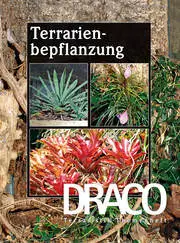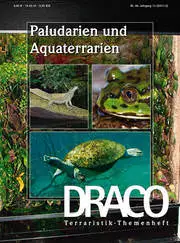
Draco 46 - Paludaria and aqua terrariums

Article no: draco46

CHF 18.40

Stock: 4

Available, delivery time: 1-3 days

Delivery between Tuesday, 21 April and Wednesday, 22 April
Zahlungsarten
Product information "Draco 46 - Paludaria and aqua terrariums"

Draco 46 - Paludariums and aqua-terrariums

Contents:

Editorial

Paludariums and aqua-terrariums – a brief introduction to the subject
Beat Akeret

No "land under" in aqua-terrariums – land parts for aquatic turtles
Andreas S. Hennig

Keeping and breeding moss frogs of the genus Theloderma – some comments from practice
Mikhail F. Bagaturov

Construction, set-up and technology of an aqua-terrarium
Beat Akeret

Fishing spiders in the aqua-terrarium – keeping, breeding and rearing spiders of the genus Ancylometes
Reinhard Hübers & Roland Lautensack

Optimum care conditions in an aqua-terrarium for day and dwarf geckos
Jens Westig

Plants in paludariums and aqua-terrariums
Beat Akeret

Dragons in the aqua-terrarium: keeping and breeding the Philippine sailfin lizard, Hydrosaurus pustulatus
Michael Wirth & Florian Riedel 

Composition
Feeding recommendation
Technical details
Size information

0 of 0 reviews

Give us a rating!

Share your experience with the product with other customers.


Suggested products

Handbook of food plants for tortoises and other reptiles
Handbook of forage plants 2nd revised editionMarion Minch is not only a successful breeder of diverse tortoises for many years, but also an excellent connoisseur of native wild herbs. She founded and runs samenkiste.de, which is well known to many tortoise keepers and nature lovers. Her name is inextricably linked with reptile care and species-appropriate nutrition for tortoises. Her handbook of food plants summarises the most important native food plants for herbivorous and omnivorous reptiles. She not only considers tortoises, but also iguanas, spiny-tailed dragons and even chameleons. From the basics of plant biology to native wild herbs to suitable food plants for hardy tropical reptile species, this comprehensive work provides the basis for species-appropriate keeping. In the expanded and supplemented 2nd edition, the plant section is divided according to flower colour. This makes it even easier to identify wild herbs. The work has also been supplemented with a wealth of additional information and many pictures.

CHF 46.50

Geckos
Geckos in the terrarium by Astrid FalkThe book offers a comprehensive introduction to geckos and their species-appropriate keeping in terrariums. It explains what you need to think about before buying a gecko and what preparations should be made. The book describes in detail how the terrarium is technically equipped and set up. The care of the animals, their special features and behaviour, their diet, reproduction and rearing of young animals are described, as well as diseases and husbandry problems with tried and tested suggestions for prevention and treatment. Individual gecko species that are particularly suitable for keeping and breeding in terrariums are portrayed in detail in the second part of the book.

CHF 28.50

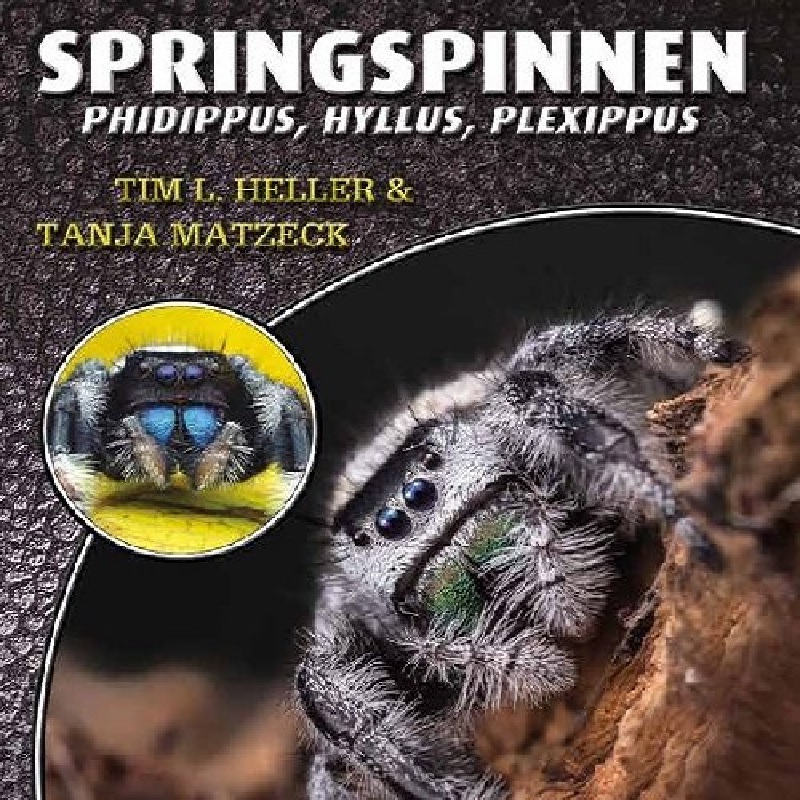
Jumping spiders Phidippus, Hyllus, Plexippus
Book Jumping Spiders - Phidippus, Hyllus & Plexippus A guide to keeping jumping spiders of the genera Phidippus, Hyllus & Plexippus. Who can resist the charm of jumping spiders? The childlike appearance of their expressive face simply leaves no one cold! In addition, their behavior is extremely exciting to observe, their colors are bright and their requirements for species-appropriate keeping are very easy to meet. No wonder these likeable jumpers are all the rage! This volume in the "Species by Species" series describes in detail what to look out for when buying and keeping them, introduces the most commonly kept species and color forms and provides plenty of tips on how to keep them successfully - so you can be sure they will breed well! Species by Species introduces you to the books in this series, which present the most popular terrarium animals. Each volume offers you detailed, practical care instructions and all the information you need to successfully breed your animals. All important questions from the required tank size to terrarium set-up, technical equipment, species-appropriate nutrition and disease prevention are answered with numerous tricks and tips. Experienced, long-standing breeders reveal how you can encourage the animals to reproduce and raise healthy young. All this in full color, generously illustrated and attractively designed - just about your terrarium animal - species by species

CHF 23.90

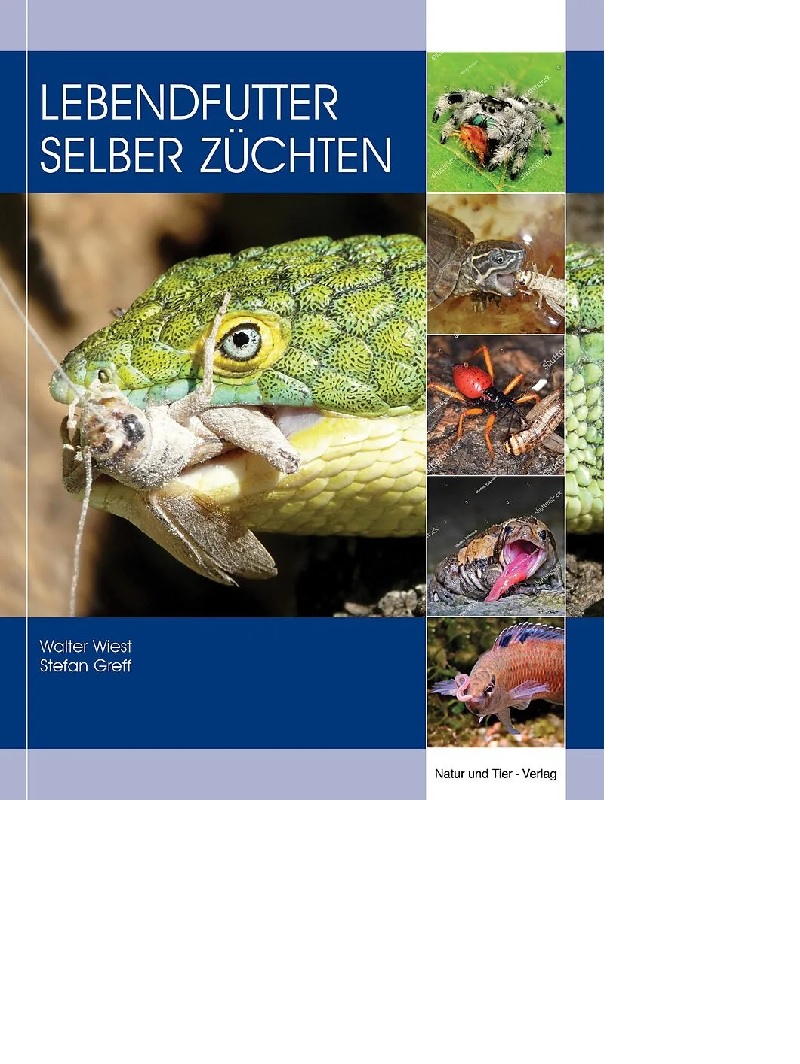
Book Breeding live food yourself
Book "Grow your own live food" - The perfect guide for pet owners Discover practical and detailed instructions on how you can easily breed food for your reptiles, birds, fish or other animals yourself in the book "Breeding live food yourself". With valuable tips on various food insects, their care and breeding, you can save money and ensure a species-appropriate diet for your pets. Contents of the book: Step-by-step instructions for breeding feeder insects Information on the best types of food for reptiles, birds and fish Care instructions and breeding conditions for various live food species Tips for sustainable and cost-effective food production Why breed your own live food? Get healthy, fresh food for your animals Save money and reduce dependence on pet shops Promote the health and well-being of your animals with species-appropriate food Whether you are a beginner or an experienced pet owner, this book provides you with everything you need to successfully breed live food yourself.

CHF 46.50

Marginata 69 - New Guinea tortoises
Marginata 69 - New Guinea tortoises – the genus ElseyaCover storyThe unrecognised beauties: New Guinea tortoises (Andreas S. Hennig)My experiences with Branderhorst's New Guinea tortoise, Elseya (Elseya) branderhorsti (Ouwens, 1914) (Andreas S. Hennig)Keeping and breeding of Rhodin's New Guinea tortoise, Elseya (Hanwarachelys) rhodini Thomson, Amepou, Anamiato & Georges, 2015 (Andreas S. Hennig)PortraitGeoemyda spengleri, Chinese serrated tortoise (Andreas S. Hennig)ReportageMacrochelys temminckii – Experiences and impressions with vulture tortoises part 2 (Reiner Praschag)KeepingAn alternative to year-round keeping of the Egyptian tortoise in the terrarium – my experiences with seasonal outdoor keeping of Testudo kleinmanni (Ricarda Schramm)EtymologySawbacks and living maps part 4: Graptemys gibbonsi, Pascagoula humpback tortoise (Holger Vetter)Classifieds & animal placement

CHF 16.50

NTV Green snakes
NTV - Grass snakes Thorsten Schmidt 88 pages 17 x 0.9 x 22.3cm many colour photos The splendidly green-coloured, diurnal and completely harmless grass snakes are much sought-after terrarium animals. The fact that they can be easily fed with insects and other invertebrates is another plus point in favour of keeping these lively snakes.This guide tells you everything you need to know to keep and breed grass snakes successfully.Thorsten Schmidt explains here from his rich experience with the animals that properly cared for grass snakes are not at all problematic, but can be easily cared for and also bred. The author explains what to look out for and gives specific tips on setting up and equipping species-appropriate terrariums.

CHF 33.50

Terraria 53 - The European pond turtle
Terraria 53 - The European pond turtle Newly described reptiles 2014Vietnamese moss frogContents: Cover story: Reptile of the year 2015 – the European pond turtle The only turtle in Central Europe is the reptile of the year! As a characteristic animal of the native herpetofauna, the species also enjoys a lot of sympathy among the general public. The next issue of TERRARIA/elaphe is dedicated to various aspects of this highly endangered species. We present the European pond turtle in a detailed portrait, provide insights into a current reintroduction project and report on keeping and breeding in private hands. Territorial HerpetoramaAspidoscelis neavesi – a running lizard is the first reptile species created in a laboratory / Spiny devil: The meowing night frog / Colour change in chameleons through photonic crystals / Synanthrope: The crocodiles of Nîmes / Leaf climber: Award-winning lizard Cover storyFrom fasting food to reptile of the year 2015 – the European pond turtleAxel Kwet, Uwe Fritz, Andreas Nöllert, Richard Podloucky & Norbert Schneeweiss Many years of experience in keeping and breeding the European pond turtle. Part 1: Keeping, designing an outdoor enclosure, feedingBernd Wolff A reintroduction project for the European pond turtle and the problem of abandoned pond turtles from private keepingFlorian Brandes & Martina Anne-Claire Meeske PanoramaThe island of lost salamanders: On the herpetofauna of the Honduran Isla del TigreAlexander Gutsche Reptile and amphibian fauna of the Quinta do Barranco da Estrada in Portugal's Alentejo – a travelogueWerner & Yvonne Lantermann Research New speciesList of reptiles newly described in 2014 Axel Kwet Salamandra Terrarium husbandryWhy vivaristics is indispensable now and in the future Jens Crueger, Peter Sound & Christina-Johanne Schröder Let's get started!The Vietnamese moss frog (Theloderma corticale) on the riseKriton Kunz Nature and species conservation Field notesRare amphibians in the canton of Lucerne I: Italian tree frog (Hyla intermedia) in blueUrs & Heidi Jost Rare amphibians in the canton of Lucerne II: Common frog (Rana temporaria) in whiteUrs & Heidi Jost Subscription & ServiceAlso in your neighbourhoodPreview Incubator Always eat chalkHeiko Werning 

CHF 12.00

Turtles Volume 2 - The Turtles Gardener
The Turtle Gardener – A Natural Diet for European TortoisesGuide to keeping European tortoises Over 65 suitable food plants, plus instructions, tips and tricks for successful plant cultivation – 14–99 years When keeping tortoises, nutrition plays an essential role. Through a careful selection of safe food plants, we can significantly influence their health and thus ensure a balanced diet for our animals. As a recognised expert and successful author of numerous books on tortoises, Thorsten Geier aims to explain all horticultural aspects to you in an accessible way. This guide is aimed at both beginners in tortoise keeping and those who have been keeping them for many years. In this comprehensive guide, you will find detailed, clear and clearly presented information on species-appropriate nutrition and independent foraging within the enclosure. Numerous instructions, tips and tricks for successful plant cultivation, as well as over 65 highly suitable and varied food plants, are listed in this book. Furthermore, it contains information on feeding behaviour in the wild, on keeping tortoises in a natural environment in the garden, and on poisonous or unsuitable plants. Numerous photos and picture galleries document all the necessary steps for successful plant cultivation, so that every tortoise owner can grow valuable and nutritious food in their garden, even without a ‘green thumb’. A truly fabulous guide to a varied diet.

CHF 34.90

Terraria 49 - Caudates in the terrarium
Terraria 49 - Tail amphibians in the terrarium EvergladesPhelsuma barbonica Contents: Cover story: Tail amphibians in the terrarium Newts and salamanders are among the less favoured terrarium animals. Yet these urodeles offer a wide variety of shapes and an often surprising blaze of colour, not to mention fascinating observation opportunities. We take a detailed look at the famous “father of newts”, Willy Wolterstorff, who was born 150 years ago, and in further articles we present the tiger salamander, the Vietnamese warty newt and, with the lungless salamanders of Central America, a little-known group of urodeles with an even more surprising biology. TerritorialHerpetorama Cover storyKeeping and breeding the tiger salamander Ambystoma tigrinum, A. mavortium and A. californienseJens Benthien With webbed feet and sling tongue. Neotropical lungless salamanders in the wild and in the terrariumThomas Bille F2 offspring of the Vietnamese warty newt (Paramesotriton deloustali) after six years of rearingPaul Bachhausen PanoramaField notes from the Everglades National ParkGuillaume Gomard Research Among researchersThe poison dart frogs at the Rio CristalinoJonas Benner New speciesNews on the Iberian wall lizards aroundPodarcis hispanicusAxel Kwet Vipers of north-eastern Turkey: Gene flow and environmental factors among the taxa of the Vipera-barani-kaznakovi-darevskii complexKonrad Mebert, Nasit Igci, Bayram Göçmen & Sylvain Ursenbacher Salamandra TerraristicsPhelsuma borbonica agalegae. An often overlooked beautyJosua Wohler Subscription & Service Nature and species conservation Field notesRare meal for aspisvipersAxel Kwet The consequences of a horned adder biteHans Pichler Observations of giant green lizards, (Lacerta trilineata polylepidota), in CreteWerner & Yvonne Lantermann Also in your neighbourhoodPreview Incubator Mr. Obama, please take over!Heiko Werning

CHF 12.00

Reptilia 29 - King snakes
Reptilia 29 King snakes SpainDecorated spiny-tailed lizardGreenhouse terrarium Contents: 2 Editorial 3 Letters to the editor 6 Magazine 15 Dates 18 Western Herp Perspectives, The role of terrarium clubs, by B. Love 20 Photo report, The genus Lampropeltis, by P. Gérard 28 Care and breeding, Snakes of the genus Lampropeltis in the terrarium, by Dr, D. Schmidt 36 Reportage, Commentary fight in the Mexican king snake, by T. Kölpin 43 Journey, More than just a beach holiday – A herpetological excursion across the Iberian Peninsula, by B. Trapp 51 Portrait and poster, Iguana iguana 56 Care and breeding, Care and breeding of the decorated spiny-tailed lizard Uromastyx ocellata ocellata, by M. Evers 62 Care and breeding, Praying mantids (Mantodea) – An overview. Part 2: Distribution, way of life, care and breeding, identification, by R. Ehrmann 68 Care and breeding, On the care and breeding of clawed frogs (Silurana spec.)– Part 2: Rearing tadpoles and juvenile frogs, discussion and literature, by K. Kunz 73 Herpetoculture, Kambô – The frog vaccination, by R. & B. Pieper 84 Advice and action 89 Classifieds 93 Library 104 Gloss, Uni, by K. Kunz

CHF 9.80

NTV, Discover the Snakes
NTV, Discover the Snakes! 48 pages colour photos throughout Large format: 20.7 x 28 cm, hardcover Author Kriton Kunz Contents: Discover the Snakes!Snakes are fascinating animals. Children are particularly aware of this because they still have an unprejudiced view of the beauties and secrets of nature as well as an innate urge to explore and simply want to know everything about these mysterious and beautiful animals. REPTILIA editor Kriton Kunz is completely in tune with the views and needs of his young readers and conveys everything worth knowing about these animals in an exciting way that answers children's questions in an easily understandable and simply fun way. What are snakes, what species are there? How does their body work, why do they flick their tongues? Why do snakes shed their skin, how do they hunt and eat? Are all snakes poisonous? What can you do to protect snakes? And, of course, what particularly interests children: What records exist in the world of snakes, which is the longest, which is the most venomous, which has the most babies...?The author not only deals with these and all other questions in detail and in a child-friendly way, but also offers two Extras on: Portraits of all native snake species to get to know and a big snake quiz in which the young experts can test their knowledge!Conclusion: A highly valuable educational book with a high fun factor!

CHF 23.90

Marginata 39 - Big-headed turtles
Marginata 39 - Big-headed turtlesBreeding of Chrysemys picta belliMale flat-sharing communitiesTortoise keeping on the brink of extinction?Contents:EditorialMagazineDates FIELD REPORTIn steep streams. In search of the "eagle-beaked turtles" – Platysternon megacephalum in the wildTorsten BlanckKEEPING AND BREEDINGBig-headed turtles in nature and human care. Part 1Reiner PraschagPORTRAITThree-toed box turtle (Terrapene mexicana triunguis Agassiz, 1852)Hans-Dieter Philippen COMMENTAre we facing the end of turtle keeping?Hans-Dieter Philippen KEEPING AND BREEDINGTrial makes perfect - positive and negative experiences in the care of the Indian tortoise Sebastian Nickl REPORTAGETurtle consumption in the Western Ghats, India Wildlife utilisation using the example of two endangered jungle species Arun Kanagavel, Rajkumar S. & Rajeev Raghavan HOLDINGMale flat share. Keeping males of different species of turtles together?Ewald Roddewig REPORTAGEA turtle hotel in VenezuelaLutz Geissler Book tipSubscription & ServiceRegional guide

CHF 16.50