Terraria 38 - Corn snakes naturally beautiful!

Article no: terraria38

CHF 12.00

Stock: 0

This article is currently not available

Product information "Terraria 38 - Corn snakes naturally beautiful!"

Terraria 38 - Corn snakes naturally beautiful!

End of the world? Mayan mysticism and reptiles
Bush crocodile

Contents:

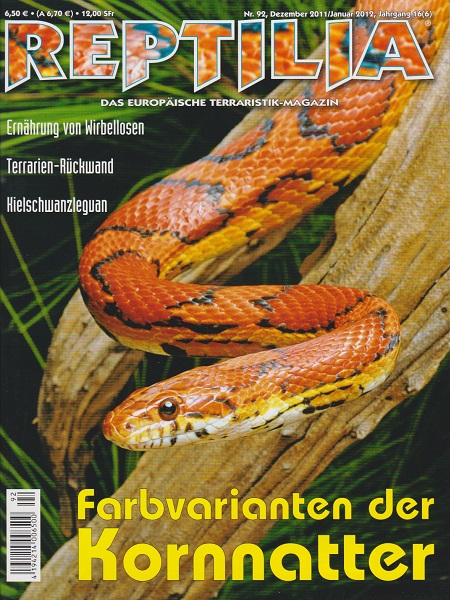
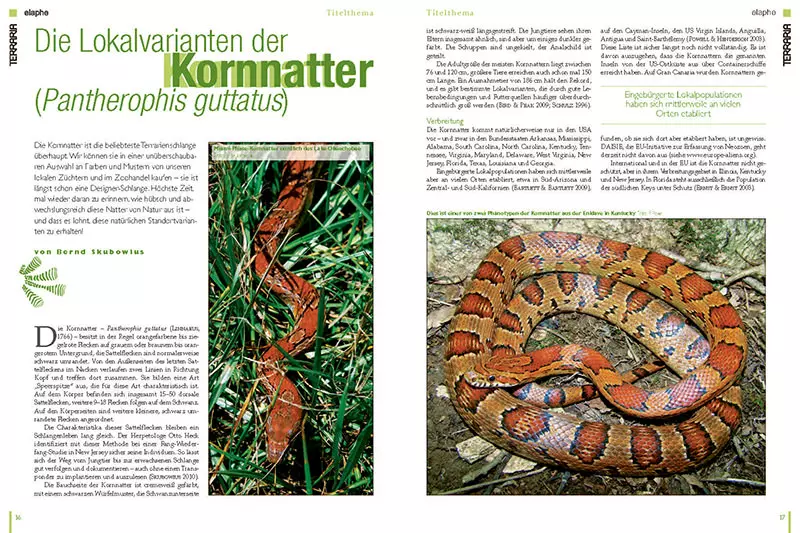
Cover story: Corn snakes - naturally beautiful!
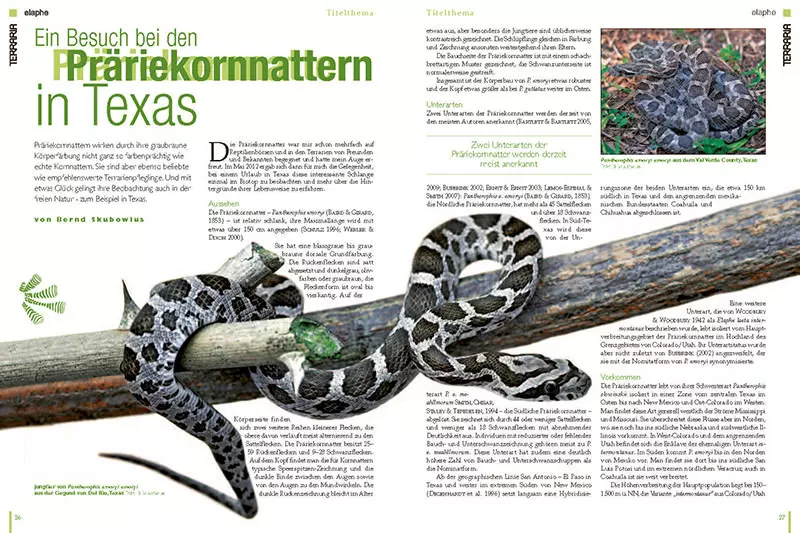
There are now countless colour morphs of the corn snake that have been selected by breeding, products of a veritable reptile industry, often reared in the controversial rack-keeping method. This almost threatens to make us forget that these North American snakes also occur in the wild and have adapted to their habitat. How exciting it is to observe these best-known terrarium snakes in their natural habitat and how diverse the colour and pattern variations are, even in "natural corn snakes", is shown by
will be the cover story of the upcoming TERRARIA/elaphe.

Territorial
Herpetorama

Cover story
The local varieties of the corn snake (Pantherophis guttatus)
Bernd SKUBOWIUS

A visit to the prairie corn snakes in Texas
Bernd SKUBOWIUS

The Slowinski's corn snake, Pantherophis slowinskii: a rare guest in German terrariums
Bernd SKUBOWIUS

Panorama

Terraglobal
Beware of toolboxes and ventilation holes
Lester MELÉNDEZ

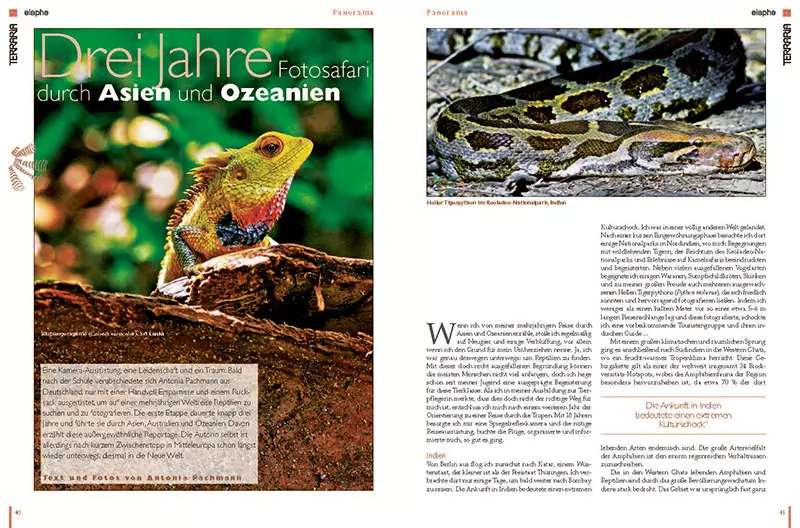
Three years of photo safaris through Asia and Oceania
Antonia PACHMANN

Research
New species
A new belted tail from the Katanga region in the Congo
Christian SCHNEIDER & Mirko BARTS

Two new "little hammers" from Panama's tropical forest
Andreas HERTZ

Among researchers
Dry forest habitat - the Menabe region in western Madagascar
Julian GLOS

New names and old acquaintances - genus revision of the New Caledonian giant geckos (Rhacodactylus) and other gecko genera of New Caledonia
Patrick SCHÖNECKER & Christian LANGNER

Salamandra

Terraristics
Classics
The charcoal tortoise
Alexander Gutsche

F2 offspring of the Laos warty newt (Laotriton laoensis) - an example of a successful conservation breeding project in the newt register of the DGHT-AG Urodela
Paul BACHHAUSEN

First experiences with the New Guinea helmet skink, Tribolonotus novaeguineae
Jochen MEYER

Homerange
In the bath with Anolis - a visit to Uwe Bartelt
Heiko WERNING

Nature and species conservation
Field notes
Late discovery of sand lizards in the Hainich National Park (Thuringia)
Andreas NÖLLERT

Pond newts as transport hosts for puffer mussels
Stephan BÖHM

Unusual spawning site of the grass frog, Rana t. temporaria, in a phytotelm in the Hainich National Park, Thuringia
Andreas NÖLLERT

Missing
Wolterstorff's newt (Hypselotriton woltersdorffi)

Also in your neighbourhood
Subscription & Service
Gallery
End of the world mood
Preview

Incubator
Breaking Bad Wedding
Heiko WERNING

Composition
Feeding recommendation
Technical details
Size information

0 of 0 reviews

Give us a rating!

Share your experience with the product with other customers.


Suggested products

Handbook of food plants for tortoises and other reptiles
Handbook of forage plants 2nd revised editionMarion Minch is not only a successful breeder of diverse tortoises for many years, but also an excellent connoisseur of native wild herbs. She founded and runs samenkiste.de, which is well known to many tortoise keepers and nature lovers. Her name is inextricably linked with reptile care and species-appropriate nutrition for tortoises. Her handbook of food plants summarises the most important native food plants for herbivorous and omnivorous reptiles. She not only considers tortoises, but also iguanas, spiny-tailed dragons and even chameleons. From the basics of plant biology to native wild herbs to suitable food plants for hardy tropical reptile species, this comprehensive work provides the basis for species-appropriate keeping. In the expanded and supplemented 2nd edition, the plant section is divided according to flower colour. This makes it even easier to identify wild herbs. The work has also been supplemented with a wealth of additional information and many pictures.

CHF 46.50

Geckos
Geckos in the terrarium by Astrid FalkThe book offers a comprehensive introduction to geckos and their species-appropriate keeping in terrariums. It explains what you need to think about before buying a gecko and what preparations should be made. The book describes in detail how the terrarium is technically equipped and set up. The care of the animals, their special features and behaviour, their diet, reproduction and rearing of young animals are described, as well as diseases and husbandry problems with tried and tested suggestions for prevention and treatment. Individual gecko species that are particularly suitable for keeping and breeding in terrariums are portrayed in detail in the second part of the book.

CHF 28.50

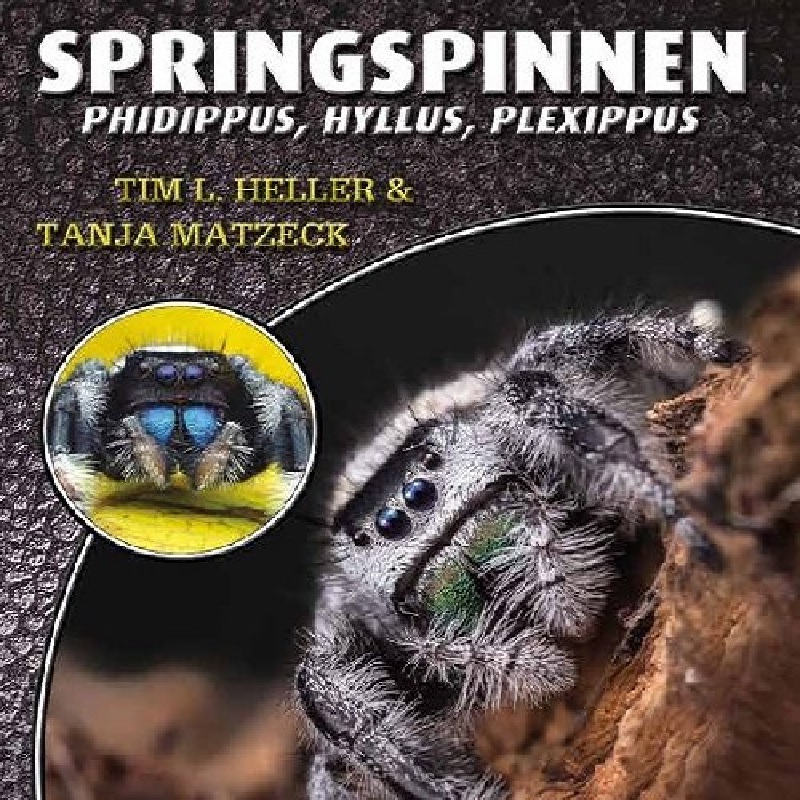
Jumping spiders Phidippus, Hyllus, Plexippus
Book Jumping Spiders - Phidippus, Hyllus & Plexippus A guide to keeping jumping spiders of the genera Phidippus, Hyllus & Plexippus. Who can resist the charm of jumping spiders? The childlike appearance of their expressive face simply leaves no one cold! In addition, their behavior is extremely exciting to observe, their colors are bright and their requirements for species-appropriate keeping are very easy to meet. No wonder these likeable jumpers are all the rage! This volume in the "Species by Species" series describes in detail what to look out for when buying and keeping them, introduces the most commonly kept species and color forms and provides plenty of tips on how to keep them successfully - so you can be sure they will breed well! Species by Species introduces you to the books in this series, which present the most popular terrarium animals. Each volume offers you detailed, practical care instructions and all the information you need to successfully breed your animals. All important questions from the required tank size to terrarium set-up, technical equipment, species-appropriate nutrition and disease prevention are answered with numerous tricks and tips. Experienced, long-standing breeders reveal how you can encourage the animals to reproduce and raise healthy young. All this in full color, generously illustrated and attractively designed - just about your terrarium animal - species by species

CHF 23.90

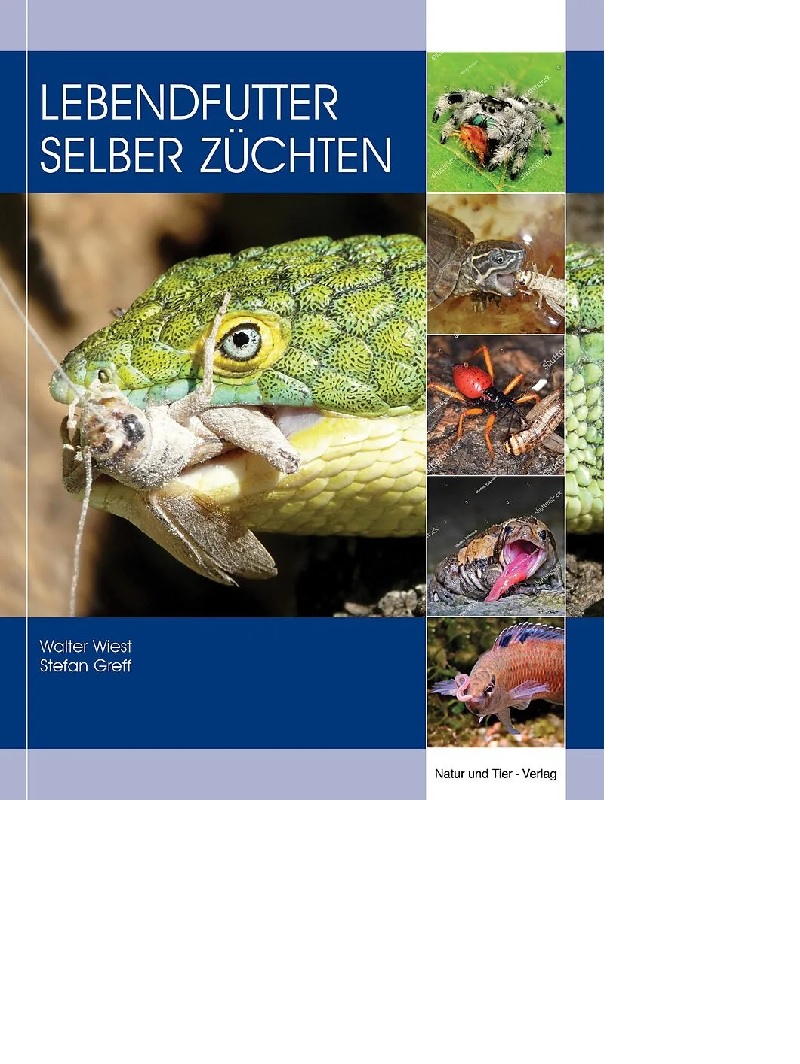
Book Breeding live food yourself
Book "Grow your own live food" - The perfect guide for pet owners Discover practical and detailed instructions on how you can easily breed food for your reptiles, birds, fish or other animals yourself in the book "Breeding live food yourself". With valuable tips on various food insects, their care and breeding, you can save money and ensure a species-appropriate diet for your pets. Contents of the book: Step-by-step instructions for breeding feeder insects Information on the best types of food for reptiles, birds and fish Care instructions and breeding conditions for various live food species Tips for sustainable and cost-effective food production Why breed your own live food? Get healthy, fresh food for your animals Save money and reduce dependence on pet shops Promote the health and well-being of your animals with species-appropriate food Whether you are a beginner or an experienced pet owner, this book provides you with everything you need to successfully breed live food yourself.

CHF 46.50

Marginata 69 - New Guinea tortoises
Marginata 69 - New Guinea tortoises – the genus ElseyaCover storyThe unrecognised beauties: New Guinea tortoises (Andreas S. Hennig)My experiences with Branderhorst's New Guinea tortoise, Elseya (Elseya) branderhorsti (Ouwens, 1914) (Andreas S. Hennig)Keeping and breeding of Rhodin's New Guinea tortoise, Elseya (Hanwarachelys) rhodini Thomson, Amepou, Anamiato & Georges, 2015 (Andreas S. Hennig)PortraitGeoemyda spengleri, Chinese serrated tortoise (Andreas S. Hennig)ReportageMacrochelys temminckii – Experiences and impressions with vulture tortoises part 2 (Reiner Praschag)KeepingAn alternative to year-round keeping of the Egyptian tortoise in the terrarium – my experiences with seasonal outdoor keeping of Testudo kleinmanni (Ricarda Schramm)EtymologySawbacks and living maps part 4: Graptemys gibbonsi, Pascagoula humpback tortoise (Holger Vetter)Classifieds & animal placement

CHF 16.50

Reptilia 87 - Crocodiles - prehistoric animals in danger
Reptilia 87 - Crocodiles - primeval animals in danger Jewelled box turtleDesign of rainforest terrariumsLong-nosed snake, Rhynchophis boulengeriContents:Cover story: Crocodiles – primeval animals in dangerWhen the great dinosaurs ruled the world, crocodiles were already lurking for prey in the swamps of that era. These reptiles have not changed their design significantly for millions of years – a success story of evolution. It is only today that many species are on the brink of extinction because humans are killing them en masse and, above all, destroying their habitats. With the cover story of the next REPTILIA, a high-calibre team of experts opens a series of articles that shed light on the crucial role that zoos can play in saving these living fossils. Dieter Gramentz also presents the precarious situation of the swamp and saltwater crocodile in Sri Lanka, and Ralf Sommerlad reports on a hopeful project to preserve the extremely rare Siamese crocodile.Endangered crocodiles in Europe's zoological gardens? R. Sommerlad, F. Schmidt & T. Ziegler Table of contents Editorial MAGAZINE DATES WESTERN HERP PERSPECTIVES    “Winter herping” in Florida B. Love PHOTOSTORY Crocodiles – reptile giants in danger R. Sommerlad REPORTAGE Endangered crocodiles in Europe's zoological gardens? R. Sommerlad, F. Schmidt & T. Ziegler REPORTAGE A special conservation project, not only for crocodiles: Danau Mesangat R. Sommerlad REPORTAGE Threats to and "conservation" of the swamp crocodile (Crocodylus  palustris) and the saltwater crocodile (Crocodylus porosus) in Sri Lanka D. Gramentz PORTRAIT AND POSTER Bufo bufo (Linnaeus, 1758). Common toadA. Kwet & J. Fieber PRACTICE Near-natural design of rainforest terrariums    D. Hluschi KEEPING AND REPRODUCTION Information on the care, husbandry and breeding of the  Vietnamese long-nosed snake, Rhynchophis boulengeri Mocquard, 1897 B. Schulz & K.-D. Schulz KEEPING AND REPRODUCTION Care and breeding of the Eastern jewelled box turtle, Terrapene ornata ornata M. Wirth & H. P. Mattern HERPETOFAUNA Black widows. Spiders of the genus Latrodectus C. Nagel & R. Hübers SUBSCRIPTION & SERVICE ALSO NEAR YOU PREVIEW  INCUBATOR Borderlands. Part 2 H. Werning 

CHF 12.00

Draco 39 - European Snakes
Draco 39 - European Snakes Contents: Editorial The snake fauna of EuropeAndreas Schlüter Vipera ammodytes: on abnormal vipers and hybridsMario Schweiger The four-lined snake – Elaphe quatuorlineata (Lacépède, 1789)Sascha Esser The snakes of northern Spain - travel impressions from the Cantabrian Mountains and neighbouring areasGuido Kreiner European water snakes: Field observations, husbandry and breeding of Natrix natrix (Linnaeus, 1758), Natrix maura (Linnaeus, 1758) and Natrix tessellata (Laurenti, 1768)Michael Wirth & Rainer Hähnlein Queens of European snakes: Four-lined snake (Elaphe quatuorlineata), Aesculapian snake (Zamenis longissimus) and Leopard snake (Zamenis situla)Michael Wirth

CHF 18.40

Terraria 58 – Amazonas setups
Terraria 58 – ‘Amazonas’ setupsNewly described amphibians 2015Responsible venomous snake careContents:Cover story: Amazonian setups – AmazonasTerritorialHerpetoramaSalamander in amber - a spectacular findCultural successor: Crocodile in the AllgäuThorn devils: confusion of names for African toadsInvasive red-cheeked tortoise spreads its wingsBlattsteiger: A dead man helps the survivors - with a turtleLookupCover storyNatural habitats at Wilhelma: a living, man-made ‘Amazonas’ biotopeIsabel Koch & Björn SchäferThe Amazon House at Dortmund Zoo: Territory of the green iguanasSimone KarlowskiThe Guiana dragon tree (Dracaena guianensis) at Schönbrunn ZooDoris Preininger, Manuela Sirny, Eveline Dungl & Anton WeissenbacherPanoramaRio Douro - The Grand Canyon of PortugalRudolf MalkmusResearchNew speciesList of new amphibians described in 2015Axel KwetUnknown invaders: the African clawed frog in EuropeJohn Measey, Thierry Backeljau, Anthony Herrel, Rui Rebeio & Dennis RödderSalamandraTerraristicsA checklist of safety precautions when keeping venomous snakesGerald BenyrImportant and invasive infectious diseases in amphibians: chytrid mycosis and ranavirus infectionsRachel E. Marschang, Kim Oster Heckers & Janosch Dietz Nature and species conservationField notesLight at the end of the tunnelUte Nüsken & Christoph LeebAutumn mating of grass snakesBenny TrappThe dice snake (Natrix tesselata) at the reintroduction site in Knorre near Meissen: current situation and a look back at the floods of June 2013Peter Strasser & Torsten PetersTerrarino - the children's page The spring frogsAlexa SabarthSubscription & ServiceAlso in your neighbourhoodPreviewIncubator In praise of bondageHeiko Werning

CHF 12.00

Reptilia 25 - Bearded dragons
Reptilia 25 - Bearded dragons Outdoor terrariumsYucatánDragons Contents: 2 Editorial 4 Letters to the Editor 8 Magazine 16 Dates 20 Western Herp Perspectives: Road Cruising - in search of reptiles and amphibians by car 22 Photo report: The bearded dragons, by A. Hauschild 28 Keeping and breeding: An evergreen: Bearded dragons in the terrarium, by A. Hauschild 33 Herpetofauna: Behaviour and interaction of my bearded dragons (Pogona vitticeps) in the terrarium, by R. Kohlmeyer 39 Report: Bearded dragon fever, by B. Love 43 Journey: Travelling in the realm of the Maya, by L. Barkam and H. Werning 51 Portrait and poster: Trapelus pallidus, by L. Rifai and D. Modry 56 Herpetofauna: Notes on Boiga nigriceps(GÜNTHER, 1863) 62 Report: To Madagascar - for the turtles?, by W. Schmidt and K. Liebel 68 Keeping and breeding: Dendrobates azureus, a blue jewel in the terrarium, U. Dost 73 Terraristics: Building a snake enclosure, Part 1: Basic considerations, by M. Hallmen 78 Herpetology and culture: 'In caves lives the dragon's old brood', a look at the ideas of dragons in East and West, Part 1, by K. Kunz 87 Advice and action 91 Library 104 Gloss: Dead texts don't talk, by L. Hogeback

CHF 9.80

Corn snakes
All about corn snakes from Wolfgang Schmidt 88 Seiten 62 Abbildungen Format: 16,8 x 21,8 cm Autor Wolfgang Schmidt Inhalt: Kornnattern gehören schon seit jeher zu den beliebtesten Terrarientieren. Nahezu jeder engagierte Terrarianer hat sie schon kennen gelernt. Doch woher kommt das starke Interesse gerade an dieser Kletternatter? Die Antwort liegt sicherlich in erster Linie im Wesen der Schlange begründet. Als besonders friedfertige Natur ist sie daher nicht nur dem fortgeschrittenen Terrarianer zu empfehlen, sondern sie eignet sich auch ausgezeichnet für den Einstieg in die Terraristik.Der Autor geht intensiv auf die Pflege und Zucht der Tiere ein, spart aber auch Themen wie Krankheiten und deren Behandlung nicht aus. Neben den drei Unterarten stellt er Farbformen vor, die sich mittlerweile auch hierzulande grosser Beliebtheit erfreuen. Über den Autor: Wolfgang Schmidt, Jahrgang 1962, ist verheiratet und hat zwei Kinder. Seit seinem 12. Lebensjahr hält und züchtet er erfolgreich die verschiedensten Amphibien und Reptilienarten. Durch seine zahlreichen Bücher und Zeitschriftenpublikationen auf dem Gebiet der Herpetologie und Terrarienkunde ist der Autor einem breiten Publikum als Fachmann bekannt, der seine Leser in fundierter und dennoch leicht verständlicher Form von seinem reichen Erfahrungsschatz profitieren lässt.

CHF 28.90

Natural building material clay for keeping birds and small animals
Natural building material clay for keeping birds and small animals The first clay DIY book for animal lovers - a practical guide with simple instructions, new ideas and health tips! Designing and crafting Pest prevention Feed supplement Clay is the oldest and most universal building material in the world. The animal world has been demonstrating for millions of years how it can be used to build safe dwellings. And humans also utilised this building material a long time ago and even created huge and artistic buildings from it. Clay can also be used perfectly for our pets. Building projects for animal housing of all kinds, landscaping in terrariums, soil construction for aquariums, pest control in aviaries, pigeon coops and stables - this book will show you how to do all this and what you need for it.Clay is not only a building material that can almost always be reused, but also contributes to the health of humans and animals. Clay binds toxins, displaces pests and is suitable as a fertiliser. For this reason, the health maintenance of our protégés through clay is also described in detail

CHF 27.90

Reptilia 47 - Sand boas
Reptilia 47 - Sandboas White alligatorsBeavertail dragonsThree-striped folding tortoise Contents: 2 EDITORIAL 3 MAGAZINE 16 DATES 18 WESTERN HERP PERSPECTIVESThe Mecca of a reptile photographerby B. Love 20 PHOTO REPORTAGE Sandboasby C. Jones 31 KEEPING AND BREEDINGOn keeping and caring for sandboas by C. Jones 35 KEEPING AND BREEDINGOn breeding Eurasian sandboas: Eryx jaculus, Eryx miliaris and Eryx tataricus by C. Jones 42 REPORTFascination record snakePart 3: Don't let them bite you… by Henry Bellosa 45 TRAVELThe white alligators of the MississippiOf ancient Indian trails, bald cypresses and crocodiles by W. Ise 51 PORTRAIT AND POSTERLialis burtonisby U. Schlüter 56 KEEPING AND BREEDINGThe Three-striped Box Turtle Kinosternon baurii) – A turtle for small aquariums?by A. M. Glaser 64 HERPETOFAUNAKeeping and breeding some Andean keel-tailed iguanas Stenocercus from the Peruvian highlandsPart 4: Observations on behaviour, sexual dimorphism and ecology of Stenocercus melanopygus BOULENGER, 1900by U. Schlüter 72 KEEPING AND BREEDINGExperiences in keeping and breeding Xenagama batillifera (VAILLANT, 1882), with observations on the behaviour of Xenagama taylori (PARKER, 1935)by M. Barts 78 REPORTAGEPlanning and building a reptile zoo: "Reptilium - Terrarien- und Wüstenzoo" in Landau is being built - Part 2: The construction phaseby T. Wilms 87 CLASSIFIED ADS 91 RAT & TAT 94 LIBRARY 104 GLOSSA family story. Part 1by H. Werning

CHF 11.20