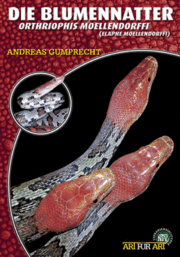
Ein Grossteil der Tier-Importe, die uns alljährlich aus China erreichen, besteht aus verschiedenen Kletternattern. Das Gros davon wiederum machen die in diesem Buch der Reihe "Art für Art" vorgestellten Blumennattern aus. Trotzdem sind Berichte über eine erfolgreiche Haltung und Nachzucht dieser attraktiven Schlange bislang weitestgehend ausgeblieben, obwohl rein statistisch gesehen der Blumennatter mittlerweile ein fester Platz in der Terraristik gesichert sein sollte. Der langjährige Terrarianer und Schlangen-Experte Andreas Gumprecht gibt dem Leser in diesem Ratgeber seine positiven Erfahrungen bei der Pflege und Vermehrung der Blumennatter weiter.
Systematik und Körperbau
Die faszinierende Biologie: Aus dem Leben der Blumennatter
Alle Informationen zur artgerechten Haltung: Vom geeigneten Terrarium über Einrichtung und Technik bis hin zur Fütterung
Erfolgreich nachzüchten: Paarungsstimulation, Inkubation der Eier und Aufzucht der Jungtiere
Problemlösungen: Wie man die häufigsten Fehler bei der Pflege vermeidet, und wie man kranken Tieren helfen kann
Brillante Fotos
Composition
Feeding recommendation
Technical details
Size information
0 of 0 reviews
Leave a review!
Share your experiences with other customers.
Login
No reviews found. Share your insights with others.
Handbuch der Futterpflanzen 2. überarbeitete AuflageMarion Minch ist nicht nur eine langjährig erfolgreiche Züchterin diverser Landschildkröten, sondern auch eine exzellente Kennerin der heimischen Wildkräuter. Die von Ihr gegründete und geführte samenkiste.de ist vielen Schildkrötenhaltern und Naturliebhabern ein Begriff. Ihr Name ist untrennbar mit der Reptilienpflege und der artgerechten Ernährung von Schildkröten verbunden. Ihr Handbuch der Futterpflanzen bildet eine Zusammenfassung über die wichtigsten heimischen Futterpflanzen für herbi- und omnivore Reptilien. Dabei berücksichtigt sie nicht nur Landschildkröten, sondern u.a. auch Leguane, Dornschwanzagamen und sogar Chamäleons. Angefangen von den Grundlagen der Pflanzenbiologie über heimische Wildkräuter bis hin zu geeigneten Futterpflanzen für winterwache tropische Reptilienarten stellt dieses umfassende Werk die Basis für eine artgerechte Haltung dar. In der erweiterten und ergänzten 2. Auflage ist der Pflanzenteil nach Blütenfarbe gegliedert. So wird das Bestimmen der Wildkräuter noch einfacher. Ebenso wurde das Werk um zahlreiche weitere Informationen und viele Bilder ergänzt.
Geckos im Terrarium von Astrid FalkDas Buch bietet eine umfassende Einführung in die Geckos und ihre artgerechte Haltung im Terrarium. Es geht darauf ein, welche Gedanken man sich vor der Anschaffung machen und welche Vorbereitungen getroffen werden sollten. Das Buch beschreibt ausführlich, wie das Terrarium technisch ausgestattet und eingerichtet wird. Die Pflege der Tiere, ihre Besonderheiten und ihr Verhalten, ihre Ernährung, Fortpflanzung und Aufzucht der Jungtiere werden dargestellt, ebenso Krankheiten und Haltungsschäden m it praxiserprobten Vorschlägen zur Vorbeugung und Behandlung. Einzelne Gecko-Arten, die sich besonders gut im Terrarium halten und züchten lassen, werden ausführlich im zweiten Teil des Buches porträtiert.
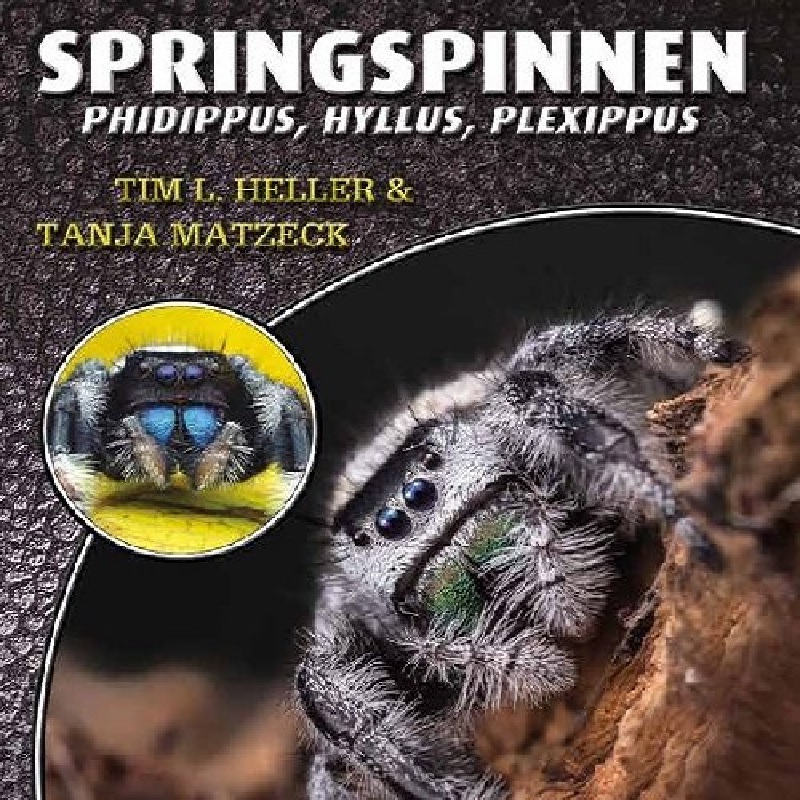
Book Jumping Spiders -
Phidippus, Hyllus & Plexippus
A guide to keeping jumping spiders of the genera Phidippus, Hyllus & Plexippus. Who can resist the charm of jumping spiders? The childlike appearance of their expressive face simply leaves no one cold! In addition, their behavior is extremely exciting to observe, their colors are bright and their requirements for species-appropriate keeping are very easy to meet. No wonder these likeable jumpers are all the rage!
This volume in the "Species by Species" series describes in detail what to look out for when buying and keeping them, introduces the most commonly kept species and color forms and provides plenty of tips on how to keep them successfully - so you can be sure they will breed well!
Species by Species introduces you to the books in this series, which present the most popular terrarium animals. Each volume offers you detailed, practical care instructions and all the information you need to successfully breed your animals.
All important questions from the required tank size to terrarium set-up, technical equipment, species-appropriate nutrition and disease prevention are answered with numerous tricks and tips.
Experienced, long-standing breeders reveal how you can encourage the animals to reproduce and raise healthy young.
All this in full color, generously illustrated and attractively designed - just about your terrarium animal - species by species
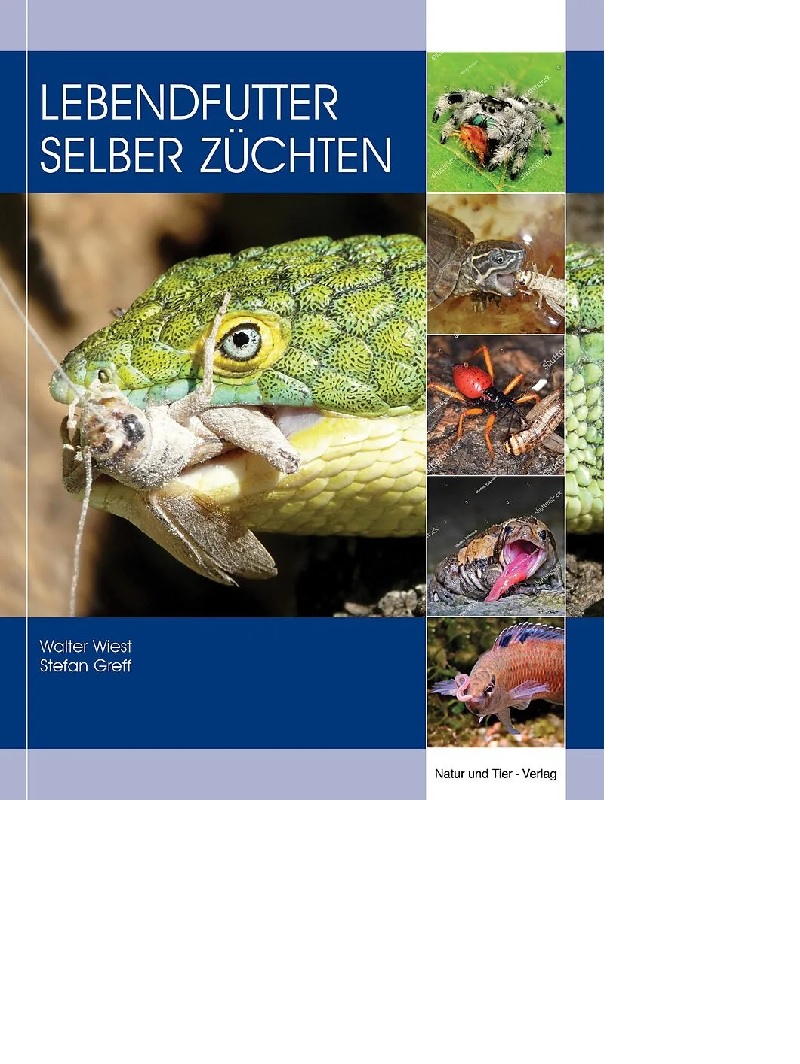
Book "Grow your own live food" - The perfect guide for pet owners
Discover practical and detailed instructions on how you can easily breed food for your reptiles, birds, fish or other animals yourself in the book "Breeding live food yourself". With valuable tips on various food insects, their care and breeding, you can save money and ensure a species-appropriate diet for your pets.
Contents of the book:
Step-by-step instructions for breeding feeder insects
Information on the best types of food for reptiles, birds and fish
Care instructions and breeding conditions for various live food species
Tips for sustainable and cost-effective food production
Why breed your own live food?
Get healthy, fresh food for your animals
Save money and reduce dependence on pet shops
Promote the health and well-being of your animals with species-appropriate food
Whether you are a beginner or an experienced pet owner, this book provides you with everything you need to successfully breed live food yourself.
Marginata 69 - Neuguinea-Schildkröten – die Gattung ElseyaTitelthemaDie verkannten Schönheiten: Neuguinea-Schildkröten (Andreas S. Hennig)Meine Erfahrungen mit Branderhorsts Neuguinea-Schildkröte, Elseya (Elseya) branderhorsti (Ouwens, 1914) (Andreas S. Hennig)Haltung und Nachzucht von Rhodins Neuguinea-Schildkröte, Elseya (Hanwarachelys) rhodini Thomson, Amepou, Anamiato & Georges, 2015 (Andreas S. Hennig)PorträtGeoemyda spengleri, Chinesische Zackenerdschildkröte (Andreas S. Hennig)ReportageMacrochelys temminckii – Erlebnisse und Erfahrungen mit Geierschildkröten Teil 2 (Reiner Praschag)HaltungEine Alternative zur ganzjährigen Haltung der Ägyptischen Landschildkröte im Terrarium – meine Erfahrungen mit der saisonellen Freilufthaltung von Testudo kleinmanni (Ricarda Schramm)EtymologieSägerücken und lebende Landkarten Teil 4: Graptemys gibbonsi, Pascagoula-Höckerschildkröte (Holger Vetter)Kleinanzeigen & Tiervermittlung
Alles über den Plattschwanzgecko von Patrick Schönecker
64 Seiten
Format: 14,8 x 21 cm
zahlreiche Farbfotos
1. Auflage
Autor Patrick Schönecker
Verlag NTV
Inhalt:
Plattschwanzgeckos sind interessante Pfleglinge für den fortgeschritteneren Echsenhalter, der schon einige Erfahrung mit der Pflege und Nachzucht anderer Arten gesammelt hat und sich nun mit seinem fundierten Wissen an diese skurrilen Reptilien wagen möchte.Dieses Buch versteht sich dabei nicht als allumfassendes Werk zur Uroplatenpflege. Es soll vielmehr dem interessierten Einsteiger in die Haltung von Arten der Gattung durch die Vorstellung von vier empfehlenswerten Spezies einen problemlosen Einstieg und eine erleichterte Auswahl der für ihn geeigneten Art ermöglichen.Der Inhalt des Buches versteht sich dabei auch als Hilfe in der Praxis mit diesen Tieren.
Systematik und Körperbau
Die faszinierende Biologie: Aus dem Leben der Plattschwanzgeckos
Alle Informationen zur artgerechten Haltung: Vom geeigneten Terrarium über Einrichtung und Technik bis hin zur Fütterung
Erfolgreich nachzüchten: Paarungsstimulation, Aufzucht der Jungtiere
Problemlösungen: Wie man die häufigsten Fehler bei der Pflege vermeidet, und wie man kranken Tieren helfen kann
Brillante Fotos
Käfer-Fibel - 96 Seiten über alles Wissenswerte zur erfolgreichen Haltung verschiedener Käferarten.
96 Seiten
150 Fotos
gebunden
Autor Timm Adam
Verlag Dähne Verlag
Nicht jeder kann sich vorstellen einen Käfer als Haustier zu halten, doch diese kleinen faszinierenden Tiere werden immer beliebter. Das Buch zeigt verschiedene Arten und beschreibt alles Wissenswerde über die Haltung und die Vermehrung der Tiere.
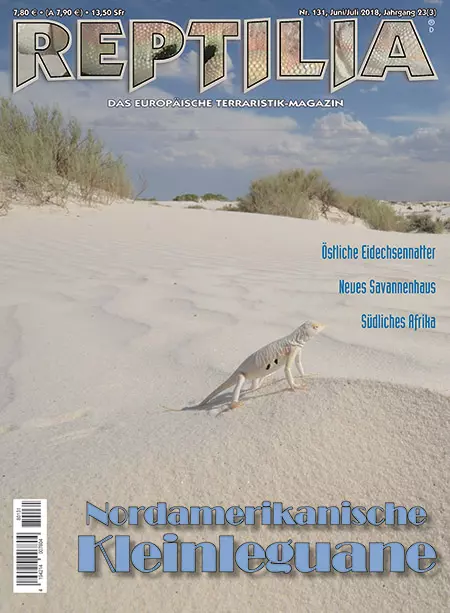
Reptilia 131- Nordamerikanische Kleinleguane
Inhalt:
FotostoryNordamerikanische Kleinleguane – Die Familie PhrynosomatidaeVon H. Werning
Haltung und NachzuchtVerkannter Evergreen im Terrarium: Der Nördliche Seitenfleckleguan, Uta stansburiana stansburianaVon J. Schulz
Haltung und NachzuchtBleichgesichter im Terrarium: Der Taubleguan aus White Sands, Holbrookia maculata ruthveniVon J. Schulz
ReportageDrei Jahre im urbanen Lebensraum von Sceloporus occidentalis longipesVon M. Barts
SchauterrarienSpannende Reptilien und moderne Technik in neuen Schweizer Zooanlagen – Jurrasic Park lebt! Teil 3: Das neue Savannenhaus im Walter Zoo Gossau/SGVon O. Fischer
Haltung und NachzuchtDie Östliche Eidechsennatter, Malpolon insignitusVon O. Gius
Western Herp PerspectivesParaguayVon B. Love
BibliothekSERVICEAUCH IN IHRER NÄHE
ReiseHeia Safari – Echsen am Wegesrand auf einer Reise durch Südafrika, Simbabwe und BotswanaVon I. Kober
VORSCHAU
BRUTKASTENCane Toad RacesVon H. Werning
Terraria 05 - Asiatische Bambusottern
GrünfröscheEuropäische Skorpione
Inhalt:
2 Editorial Kriton KUNZ
TITELTHEMA
4 Asiatische Bambusottern – Biologie und Verbreitung Andreas GUMPRECHT
9 Zur aktuellen Taxonomie und Systematik der Asiatischen Bambusottern Andreas GUMPRECHT
13 Haltung und kontinuierliche Nachzucht der Asiatischen Bambusotter Popeia popeiorum (SMITH, 1937) Andreas GUMPRECHT
20 Wildes Yunnan – auf der Suche nach Bambusottern im SüdwestenChinas Andreas GUMPRECHT
28 Zitierte oder empfohlene Literatur zu Bambusottern Andreas GUMPRECHT
WISSENSCHAFT
30 Herpetorama Farbwechsel beim Grünen Baumpyhton / „Azureus“ ade
32 Neue Arten Bungarus slowinskii / Cordylus meculae / Calotes htunwini & C. irawadi
35 Unter Forschern Krokodilforschung in den Torf-Sumpfwäldern Borneos René BONKE
39 Die Spaltenschildkröte, Malacochersus tornieri (SIEBENROCK, 1903) – Verbreitung, Lebensweise und Vermehrung Manfred ROGNER
44 Mit der Kamera beobachtet: Wasserfroschleben am Teich Dietmar SCHUPHAN
54 Europäische Skorpione der Gattung Euscorpius THORELL, 1876 Alexander TIETZ
61 Die Taggeckos des Oman Rolf LEPTIEN
64 Melanophryniscus – nicht nur schwarze KrötenTeil 4 (Schluss): Die Arten in Argentinien, Paraguay und Bolivien Axel KWET
REISE74 Das griechische Festland – europäisches Eldorado für Reptilienund Amphibien Benny TRAPP
TERRARIENPRAXIS
84 Testlauf Schlupfkisten Kriton KUNZ & Heiko WERNING Vitamin-Mineralstoff-Präparat Eurital Silvia MACINA
86 Auftakt Checkliste zum Erwerb eines Chamäleons Nicolá LUTZMANN
90 BlickfangEin Streifzug durch die Terraristik – zu Besuch bei Paul-Heinz Grünwaldt Mike ZAWADZKI
94 Auch in Ihrer Nähe
97 TERRAnetz Serum-Depot Berlin / Zwergbartagamen
99 TERRAglobal Wo bleibt die TERRARIA? Joachim BULIAN Die Schlange in meinem Leben – und in dem meiner Familie Fabio CUPUL
104 TERRAwinn
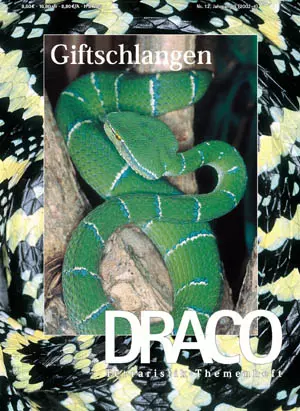
Draco 12 - Giftschlangen
EDITORIAL
Fasizination Giftschlangen Pro und Contra TerrarienhaltungDieter Schmidt
Giftschlangen - Systematische Betrachtungen zu einem schwierigen Wort Ulrich Kuch
Die Gattung Trimeresurus LACÉPÈDE, 1804Zum Kenntnisstand der ForschungAndreas Gumprecht & Sergei Ryabov
Beobachtungen an der Monokelkobra (Naja kouthia LESSON, 1831) im Freiland und im TerrariumLudwig Trutnau
Crotalus willardi MEEK, 1905 - eine kleine Berg-KlapperschlangeLudwig Trutnau
Die Giftschlangen Costa RicasAndreas Hohmeister
Pflege und Zucht der mittelamerikanischen Lanzenotter Atropoides nummifer (RÜPPELL, 1845)Andreas Hohmeister
Ein Besuch im Queen Saovabha Memorial Institute in ThailandJoachim Bulian & Lawan Chanhome
Der Vogel, der die Schlangen kenntDieter Mahsberg & K. Eduard Linsenmair
Giftschlangen in Südbrasilien - Zoogeographie, Ökologie und "Ofidismo"Markus Monzel
BÜCHERKISTE
MAGAZIN
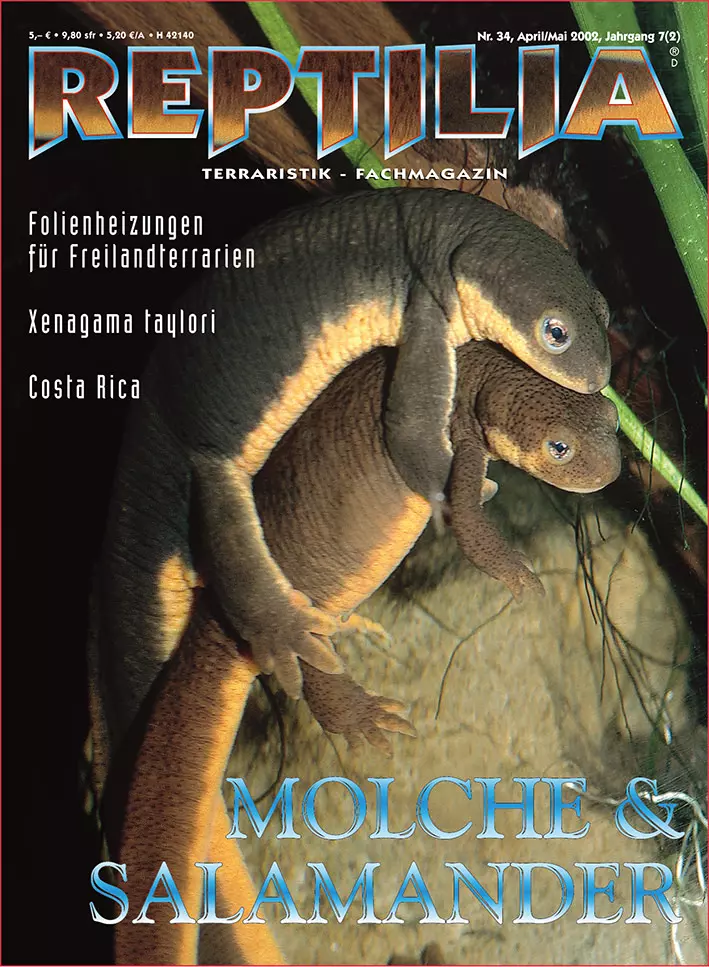
Reptilia 34 Efts & Salamanders
Foil heaters for outdoor terrariumsXenagama tayloriIn the roof of the rainforestContent:2 EDITORIAL4 READER'S LETTERS6 MAGAZINE16 DATES20 WESTERN HERP PERSPECTIVESSeptember - Ambush Attackfrom B. Love22 PHOTO REPORTAGEcaudatesby M. Staniszewski30 HUSBANDRY AND BREEDINGThe band newt Triturus vittatus ophryticusby Uwe Dost35 REPORTUnequal Brothers - The European Mountain Creek Newt (Genus Euproctus)by B. Thiesmeier & C. Hornberg43 TRAVELIn search of beavertail agams (Xenagama - A journey to Somalilandby A. Roos51 PORTRAIT AND POSTERAgalychnis callidryasby M. Schmidt56 HUSBANDRY AND BREEDINGThe Indian star turtle Geochelone elegans (Schoepff, 1795) - a problematic tropical land turtle? - Part 3: Offspringby H.-J. Bidmon63 REPORTLife above our heads: Amphibians and reptiles in the treetops of the Central American rainforestby T. Leenders70 HUSBANDRY AND BREEDINGBiology, Care and Breeding of Snakes of the Genus Pseustes (Fitzinger, 1834)by A. Hohmeister & F. Fiegenbaum75 REPORT"The foil heating - a simple and inexpensive possibility for the heat addition in free systemsby U. Strathemann78 REPORTThe oven fish (Thermobia domestica) - an ideal addition to the menu for numerous terrarium birdsby W. Schmidt81 REPTILIA ON THE ROADInnsbruck Alpine Zooby M. Hallmen88 CLASSIFIEDS92 ADVICE AND ACTION94 LIBRARY104 GLOSSERecently at the WG-Partyby Heiko WerningAnd here is an overview of the contents:This time your terraristics magazine is titled Molche & Salamander!It goes without saying that there should be a beautifully illustrated photo story in which an excerpt from the great variety of shapes of the tail amphibians is presented to you. And of course you will also get an overview of the essential facts about this amphibian order, its systematics, habitat, development and much more!The band newt Triturus vittatus ophryticusIn the wedding robe, the males of this subspecies of the band newt from Turkey and the Caucasus are certainly among the most spectacular amphibians of all: Apart from the magnificent coloration, the high and serrated ridge of the back makes the animals, which can reach a length of almost 20 cm in extreme cases, look like bizarre little dragons! Uwe Dost describes in detail and practically how to keep and breed these jewels among the newts, how to set up a suitable tank, how to care for the animals, and how to avoid possible problems from the beginning. In principle, however, the keeping and reproduction of the "water dragons" are not too difficult, so that after reading this article every amphibian friend will surely wish to take care of the beautiful newts himself!
Unequal Brothers - The European Mountain Creek Newt (Genus Euproctus)For a long time, little was known about the three species of the genus Euproctus in every respect, and they were regarded as not or only very difficult to keep and breed. Burkhard Thiesmeier and Claudia Hornberg describe here as examples, how a deepened knowledge of the habitat and the living conditions of a species has a positive effect on the care results. What do the biotopes of the respective species actually look like, and what consequences does this have for husbandry? Do the animals need an aquarium or a terrarium? These and all other relevant questions for a successful breeding of the rarely maintained mountain stream newts are answered by the authors in detail and competently. Try these highly interesting newts with their unique mating behaviour!Life above our heads: Amphibians and reptiles in the treetops of the Central American rainforestIt is well known that the deep sea is still a largely unexplored "continent". However, it is far less known that the canopy of the tropical rainforest contains an unbelievable wealth of species, only a fraction of which has so far been recorded. Twan Leenders himself has been researching the "treetop" habitat for a long time and now offers you an insight into this fascinating foreign world: the bizarre Bolitoglossa salamanders with their oversized feet, flying frogs, giant anole, bromeliad lizards, they all have amazing adaptations to their biotope high above the ground. How, for example, do the amphibians that are normally bound to water reproduce up there, how do they find partners in this extensive habitat? And what is a snake known as a digging species looking for at lofty altitudes? An extraordinary contribution with extraordinary insights!"The foil heating" - a simple and inexpensive possibility for the heat supplement for free plantsAnyone who cares for reptiles in the field knows the problem: In our latitudes it is difficult to ensure sufficient heat supply. If the weather is too cool and humid, the animals become ill quite quickly. One creates remedy with expensive and current eating radiators - or with the cleveren foil heating , whose production and effectiveness Udo Strathemann describes to you. This article will show you two different ways to help you offer your reptiles adequate conditions outside, which will of course also have a positive effect on their vitality and probably their reproductive success!The Indian star turtle Geochelone elegans (Schoepff, 1795), a problematic tropical tortoise? Several years of keeping and reproduction in GermanySo here is the third part of this incredibly detailed and highly descriptive report by Hans-J. Bidmon. This time the author dedicates himself to the successful breeding of his animals, describes mating behaviour, egg laying and incubation. Exact details and data - especially for the solution of problem cases - make this contribution interesting not only for all keepers of the beautifully drawn Indian star tortoise, but each tortoise friend can deduce from it conclusions, which surely benefit his own animals!The oven fish (Thermobia domestica): An ideal enrichment of the menu for numerous terrarium birds. If you feed your insect-eating terrarium birds day in, day out with crickets or crickets, you are certainly doing something wrong. Here Wolfgang Schmidt presents a possible alternative with the oven fish, a relative of the well-known silver fish. This urine insect offers many obvious advantages for breeding as a food animal: For example, it can be easily kept and reproduced, does not make any special demands on the food, and escaped specimens normally cannot reproduce in the home and therefore do not become a plague. Particularly important: not immediately eaten Ofenfischchen nibble neither the planting nor the terrarium animals themselves! Wolfgang Schmidt gives all important tips for the breeding, from the equipment of the containers over the attitude conditions up to the efficient feeding. The oven fish - a change in the menu that you should treat your amphibians or lizards to!
In search of beavertail agamas (Xenagama) - A journey to SomalilandDo you know anything about beaver tail agams? Have you ever been to Somaliland? If you answered both questions with "no", you certainly do not belong to the minority! There was hardly anything known about the genus Xenagama until now, and Somaliland is not exactly the main destination of sun-hungry African tourists. Alexander Roos, who carried out field biological studies on these very special animals there, describes the difficulties one has to struggle with when travelling to this region. The author's enthusiasm for the soon to be very trustful little agamas in the terrarium will certainly be passed on to the REPTILIA readers, especially as it is difficult to escape the impression of the beautiful photos of the cute guys anyway!Biology, care and breeding of snakes of the genus Pseustes (Fitzinger, 1843)And also with this article by Andreas Hohmeister and Franz Fiegenbaum we can offer you information about reptiles, of which so far practically no data from the terrarium keeping was available! The attractive, tree-dwelling species of the genus Pseustes are unfortunately still very rare guests in Central European terrariums, but the authors were able to cultivate two species successfully and even bring one of them several times to offspring. This probably fails with the other species only because of the lack of a female, because Hohmeister and Fliegenbaum describe the large, powerful vipers as very suitable fosterlings.A real treat for all snake fans!In addition to the above-mentioned articles, you will of course also find in this REPTILIA all the services you are accustomed to from your trade magazine, such as the sections Advice & Action, Dates, Posters, Classifieds, Library and of course the popular incubator not to forget!
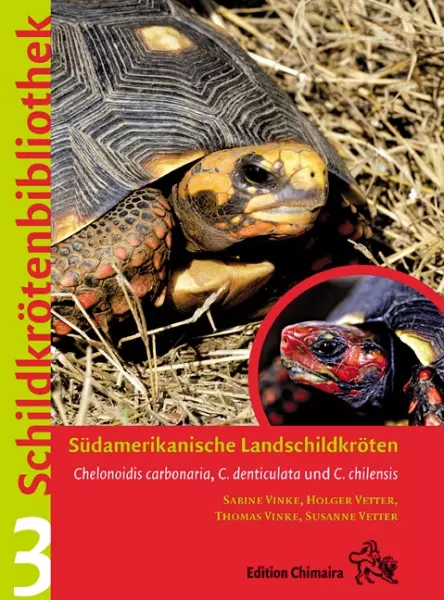
Turtle library 3 - The South American tortoises
Sabine & Thomas Finke, Susanne & Holger Vetter
355 pages
285 color photos
2 drawings 4 distribution maps
Format: 15 x 21.5 cm
Content:
This book is by far the most comprehensive collection of information from all parts of the Southern Turtle's tortoise range: Chelonoidis carbonaria, C. denticulata and C. chilensis.
CHF 42.90
❅
❆
❅
❆
❅
❆
❅
❆
❅
❆
❅
❆
This website uses cookies to ensure the best experience possible. More information...