Product information "Marginata 46 - The European Swamp Turtle"
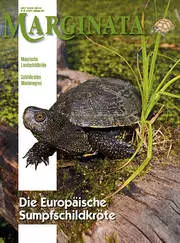
Marginata 46 - The European pond turtle
Moorish tortoise Turtles of Montenegro
Contents:
Editorial Magazine
TOPIC The keeping and breeding of European pond turtles Michael Richter
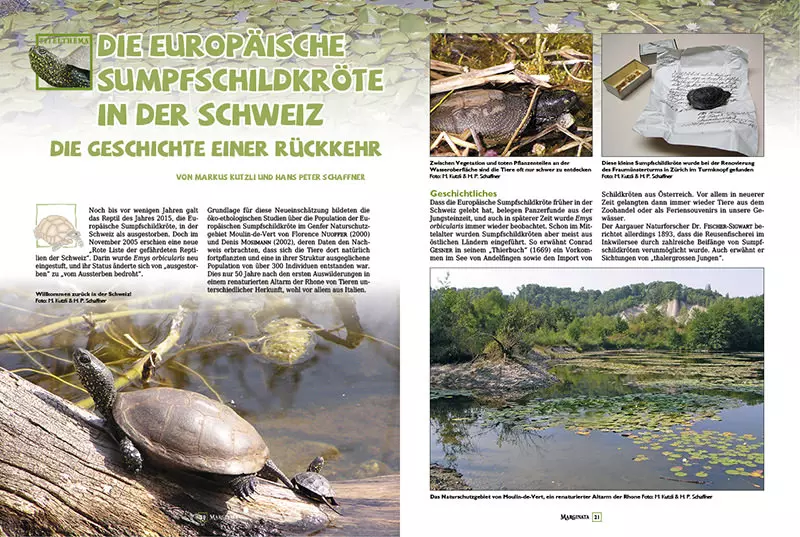
TOPIC The European pond turtle in Switzerland – the story of a return Markus Kutzli & Hans Peter Schaffner
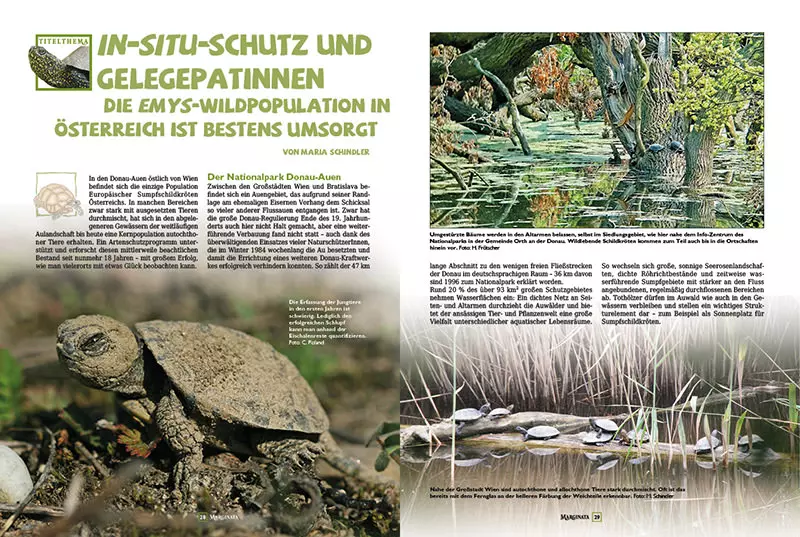
TOPIC In-situ conservation and nest guardians. The Emys wild population in Austria is well looked after Maria Schindler
TOPIC 17 years of the pond turtle conservation programme in Hesse Matthias Kuprian, Silke Schweitzer, Rudolf Wicker, Michael Homeier, Olaf Homeier, Matthias Mähn & Sibylle Winkel
PORTRAIT Testudo graeca Linnaeus, 1758 – Moorish tortoise Benny Trapp
TRAVEL Turtles at the foot of the black mountains Mario Schweiger
Subscription & Service Regional guide
Composition
Feeding recommendation
Technical details
Size information
0 out of 0 reviews
Give us a rating!
Share your experience with the product with other customers.
Log in
No reviews found. Go ahead and share your findings with others.
Handbook of forage plants 2nd revised editionMarion Minch is not only a successful breeder of diverse tortoises for many years, but also an excellent connoisseur of native wild herbs. She founded and runs samenkiste.de, which is well known to many tortoise keepers and nature lovers. Her name is inextricably linked with reptile care and species-appropriate nutrition for tortoises. Her handbook of food plants summarises the most important native food plants for herbivorous and omnivorous reptiles. She not only considers tortoises, but also iguanas, spiny-tailed dragons and even chameleons. From the basics of plant biology to native wild herbs to suitable food plants for hardy tropical reptile species, this comprehensive work provides the basis for species-appropriate keeping. In the expanded and supplemented 2nd edition, the plant section is divided according to flower colour. This makes it even easier to identify wild herbs. The work has also been supplemented with a wealth of additional information and many pictures.
Geckos in the terrarium by Astrid FalkThe book offers a comprehensive introduction to geckos and their species-appropriate keeping in terrariums. It explains what you need to think about before buying a gecko and what preparations should be made. The book describes in detail how the terrarium is technically equipped and set up. The care of the animals, their special features and behaviour, their diet, reproduction and rearing of young animals are described, as well as diseases and husbandry problems with tried and tested suggestions for prevention and treatment. Individual gecko species that are particularly suitable for keeping and breeding in terrariums are portrayed in detail in the second part of the book.
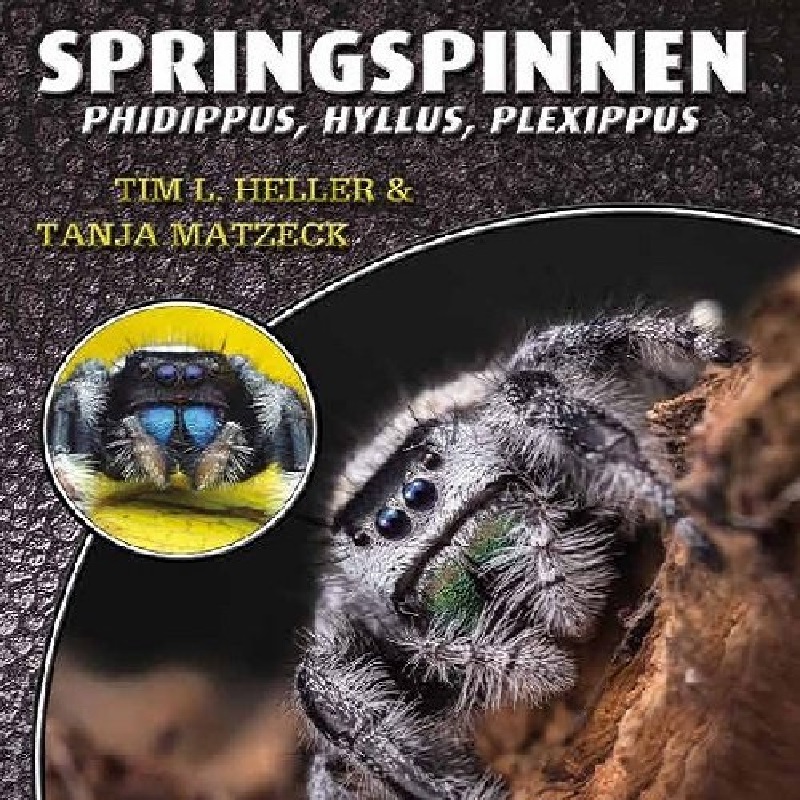
Book Jumping Spiders -
Phidippus, Hyllus & Plexippus
A guide to keeping jumping spiders of the genera Phidippus, Hyllus & Plexippus. Who can resist the charm of jumping spiders? The childlike appearance of their expressive face simply leaves no one cold! In addition, their behavior is extremely exciting to observe, their colors are bright and their requirements for species-appropriate keeping are very easy to meet. No wonder these likeable jumpers are all the rage!
This volume in the "Species by Species" series describes in detail what to look out for when buying and keeping them, introduces the most commonly kept species and color forms and provides plenty of tips on how to keep them successfully - so you can be sure they will breed well!
Species by Species introduces you to the books in this series, which present the most popular terrarium animals. Each volume offers you detailed, practical care instructions and all the information you need to successfully breed your animals.
All important questions from the required tank size to terrarium set-up, technical equipment, species-appropriate nutrition and disease prevention are answered with numerous tricks and tips.
Experienced, long-standing breeders reveal how you can encourage the animals to reproduce and raise healthy young.
All this in full color, generously illustrated and attractively designed - just about your terrarium animal - species by species
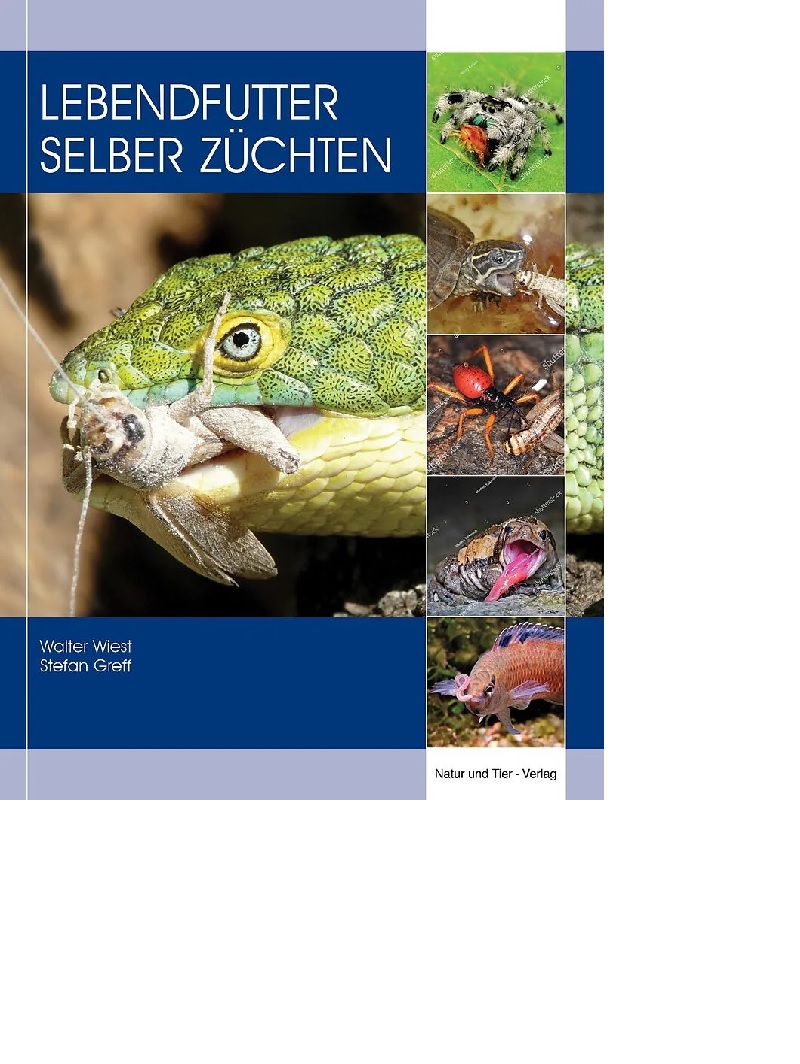
Book "Grow your own live food" - The perfect guide for pet owners
Discover practical and detailed instructions on how you can easily breed food for your reptiles, birds, fish or other animals yourself in the book "Breeding live food yourself". With valuable tips on various food insects, their care and breeding, you can save money and ensure a species-appropriate diet for your pets.
Contents of the book:
Step-by-step instructions for breeding feeder insects
Information on the best types of food for reptiles, birds and fish
Care instructions and breeding conditions for various live food species
Tips for sustainable and cost-effective food production
Why breed your own live food?
Get healthy, fresh food for your animals
Save money and reduce dependence on pet shops
Promote the health and well-being of your animals with species-appropriate food
Whether you are a beginner or an experienced pet owner, this book provides you with everything you need to successfully breed live food yourself.
Marginata 69 - New Guinea tortoises – the genus ElseyaCover storyThe unrecognised beauties: New Guinea tortoises (Andreas S. Hennig)My experiences with Branderhorst's New Guinea tortoise, Elseya (Elseya) branderhorsti (Ouwens, 1914) (Andreas S. Hennig)Keeping and breeding of Rhodin's New Guinea tortoise, Elseya (Hanwarachelys) rhodini Thomson, Amepou, Anamiato & Georges, 2015 (Andreas S. Hennig)PortraitGeoemyda spengleri, Chinese serrated tortoise (Andreas S. Hennig)ReportageMacrochelys temminckii – Experiences and impressions with vulture tortoises part 2 (Reiner Praschag)KeepingAn alternative to year-round keeping of the Egyptian tortoise in the terrarium – my experiences with seasonal outdoor keeping of Testudo kleinmanni (Ricarda Schramm)EtymologySawbacks and living maps part 4: Graptemys gibbonsi, Pascagoula humpback tortoise (Holger Vetter)Classifieds & animal placement
Marginata 39 - Big-headed turtlesBreeding of Chrysemys picta belliMale flat-sharing communitiesTortoise keeping on the brink of extinction?Contents:EditorialMagazineDates FIELD REPORTIn steep streams. In search of the "eagle-beaked turtles" – Platysternon megacephalum in the wildTorsten BlanckKEEPING AND BREEDINGBig-headed turtles in nature and human care. Part 1Reiner PraschagPORTRAITThree-toed box turtle (Terrapene mexicana triunguis Agassiz, 1852)Hans-Dieter Philippen COMMENTAre we facing the end of turtle keeping?Hans-Dieter Philippen KEEPING AND BREEDINGTrial makes perfect - positive and negative experiences in the care of the Indian tortoise Sebastian Nickl REPORTAGETurtle consumption in the Western Ghats, India Wildlife utilisation using the example of two endangered jungle species Arun Kanagavel, Rajkumar S. & Rajeev Raghavan HOLDINGMale flat share. Keeping males of different species of turtles together?Ewald Roddewig REPORTAGEA turtle hotel in VenezuelaLutz Geissler Book tipSubscription & ServiceRegional guide
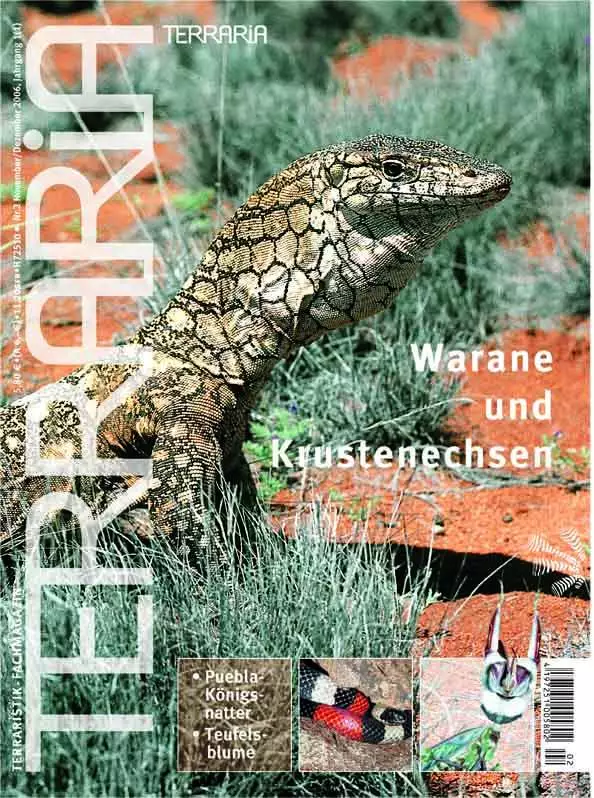
Terraria 02 - Monitor lizards and crustacean lizards
Puebla King SnakeDevil's Flower
Contents:
2 Editorial Axel Kwet TITLE TOPIC
4–23 • Crustacean lizards and monitor lizards: New and familiar facts about the four-footed poisonous clan Hans-Georg Horn SCIENCE
24 Herpetorama New amphibian family tree highly controversial / New names for well-known poison dart frogs
30 New species Melanophryniscus admirabilis – a brightly coloured “black toad”
32 Among researchers In the shadow of the saw – Amphibian communities in selectively logged tropical forests Raffael Ernst
36 My Home Is My Castle Experiences with the self-construction of a terrarium for a Yemen chameleon Frank Angermann
40 A new way to disinfect terrariums Hans-Peter Berghof and Ulf Schwabe
44 Melanophryniscus – not just black toads Part 1: General information on the genus Melanophryniscus Axel Kwet
54 Ornate turtles – the genus Pseudemys Part 1: Introduction, systematics, production and trade Andreas S. Hennig
59 Keeping and breeding the Puebla King Snake, Lampropeltis triangulum campbelli Thorsten Schmidt
63 The devil's flower Idolomantis diabolica (Saussure, 1869) Part 1 Christian J. Schwarz, Jürgen E. Mehl and Jürg Sommerhalder TRAVEL
71 In the land of the Jacarés – the Pantanal Part 2 Heiko Werning TERRARIUM PRACTICE
82 Test run Artificial rock furnishings from Exo Terra84 Prelude A good start: the leopard gecko (Eublepharis macularius) Sven Zeeb
88 Eye-catcher The rainforest in your living room Mike Zawadzk
93 Also in your neighbourhood
96 TERRAnet Of snakes and poisonous snakes
98 TERRAglobal Santa Catalina – Island of the rattleless rattlesnakes Karl H. Switak A new workplace, a plethora of new animals Mirco Solé
103 Preview
104 TERRAwinn
Draco 30 - Sri Lanka
Contents:
2 Editorial
4 Adam's sanctuary: Sri LankaPeter Janzen, Peter Klaas & Stefan Ziesmann
18 Of skinks and other lizardsPeter Janzen, Peter Klaas & Stefan Ziesmann
24 The agama fauna of the islandPeter Janzen, Peter Klaas & Stefan Ziesmann
34 The horned agama Ceratophora stoddartii in its natural habitat and in the terrariumUwe Bartelt & Peter Janzen
38 The diversity of geckosStefan Ziesmann, Peter Janzen & Peter Klaas
45 Crocodiles and turtles in Sri LankaPeter Janzen, Peter Klaas & Stefan Ziesmann
50 Keeping and breeding the star tortoiseGeochelone elegans (SCHOEPFF, 1794) from Sri Lanka Andrea Saus
56 Sri Lanka's snake faunaPeter Janzen, Peter Klaas & Stefan Ziesmann
65 Chaos without end – the taxonomy of the Sri Lankan frogsPeter Janzen, Peter Klaas & Stefan Ziesmann
75 In search of invertebratesPeter Klaas
80 Tarantulas of the genus Poecilotheria in Sri LankaPeter Klaas, Peter Janzen & Stefan Ziesmann
84 Book box
91 Magazine
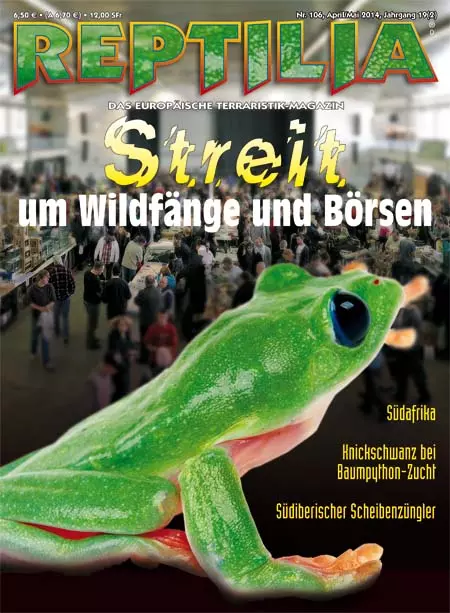
Reptilia 106 Dispute over wild catches and stock marketsSouth AfricaBent tail in tree python breedingSouthern Iberian disc tonguesContents:Cover story: Dispute over wild catches and stock marketsIn its coalition agreement, the currentThe German government has finalised its intention to ban exotic animal markets and the import of wild-caught animals into the EU. In the next issue of REPTILIA, we take a look behind the scenes of a large German importer of wild-caught animals and observe the current stock market situation. We also discuss whether restrictions or bans on wild-caught imports and terrarium fairs are necessary from an animal or species conservation perspective and what impact they could have on the terrarium hobby.EditorialMAGAZINEDATESINTERVIEWIllegal wildlife trade can no longer be bannedH. Werning in conversation with N. LutzmannREPORTAGEBehind the scenes and between the tables: Terraristika from early to lateH. WerningREPORTAGEBehind the scenes of the wholesale tradeA. KwetTRAVELGoodbye winter. Spring days on the Côte d'AzurA. SchmidAttitude“Kinked tails” in the green tree python (Morelia viridis) – a home-grown problem?M. KroneisKEEPING AND BREEDINGSurprising breeding of the Southern Iberian disc-tongued lizard (Discoglossus galganoi jeanneae)B. TrappTERRARIUM DISPLAYSSnake, spider & co. The Happ reptile zoo in KlagenfurtA. GutscheANIMALS OF OUR HOMEThe pond newtR. LeptienServicesWESTERN HERP PERSPECTIVESChange of pace for "small game" B. LoveALSO NEAR YOUJourneySouth Africa. Between reptiles and the Big FiveV. Kruschenski & C. KässerPREVIEWBRUTKASTEN Once a snake breeder, always a snake breederR. Leptien
All about the popular stick insects, ghost insects and walking leaves.
128 pages
coloured photos
1st edition
Author Alexander Esch
Invertebrates are on the rise in terraristics, and among them phasmids are at the top of the popularity scale. Shifting leaves, stick insects and ghost insects are suitable even for beginners in the terrarium hobby and fascinate with their bizarre body shapes and varied behaviour. In this book, author Alexander Esch provides you with a practical guide with general information on the biology and successful keeping and breeding of this exciting group of insects and introduces the most popular species in the terrarium hobby.
Draco 59 - Spectacular Invertebrates
Contents:
Editorial Spectacular diversity in the terrariumTimm AdamGreat jumpers – jumping insects in the terrariumTimm AdamGiant water bugs (Belostomatidae) and water scorpions (Nepidae) in the aquaterrariumTimm Adam & Hermann ElsasserSpectacular arachnids: whip spiders and whip scorpionsMichael SeiterThe largest invertebrates in the terrarium Timm AdamEnigmatic creatures: hooded spidersFrederic Schramm, Michael Seiter & Johannes NiglSymphony in blue – The large diplurid Linothele megatheloides in ColombiaJorge Cañas-Orozco Giant beetles: armoured insect giantsTom Schouteet & Mark van Bergen The extraordinary arthropods of the family LiphistiidaeIngo Wendt & Frank Schneider
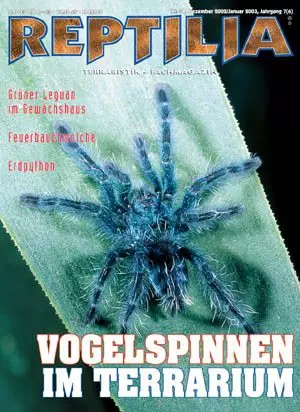
Reptilia 38 - Tarantulas in the terrariumGreen iguana in a greenhouseFire-bellied newtsEarth pythonContents:
2 EDITORIAL
3 READER LETTERS
7 MAGAZINE
15 DATES
16 WESTERN HERP PERSPECTIVES The hymn of natural terrariumsfrom B. Love
18 PHOTO REPORTAGE Large, hairy spiders - An introduction to the Theraphosidae familyby F. Tomasinelli
26 KEEPING AND BREEDINGBreeding of tarantulas with special consideration of their way of life in the wildby B. F. Striffler
32 KEEPING AND BREEDINGThe ‘Malaysian Earth Tiger’ – Keeping and Breeding the Asian Tarantula Cyriopagopus thorelliby F. de Vita & F. Tomasinelli
36 KEEPING AND BREEDINGPoecilotheria subfusca POCOCK, 1895: Group housing and breedingby B. F. Striffler
42 TRAVELAdventure Oman Mountainsby R. Leptien
51 PORTRAIT AND POSTERAzemiops feaeby A. Gumprecht
56 REPORTAGEA life like in paradise - experiences with keeping a green iguana in a tropical hallby C. Ströhlein, idea-Schmetterlings-Paradies Neuenmarkt
61 HERPTOFAUNAThe fire-bellied newts of the genus CynopsPart 1: Keeping and speciesby P. Bachhausen
68 KEEPING AND BREEDINGObservations on the ecology and terrarium husbandry of the Eastern lizard snake, Malpolon monspessulanus insignitus Geoffroy, 1827by H. Esterbauer
74 HERPTOFAUNAThe Burrowing Python (Calabaria reinhardtii)by S. Seidel
78 REPORTAGEThe school vivariumPart 3: Behavioural practical course for a biology classby M. Hallmen
85 RAT & TAT
87 CLASSIFIED ADS
92 LIBRARY
104 GLOSSESFeed animal breeding magazineby N. Nadolny
This issue of your specialist terrarium magazine REPTILIA is dedicated to tarantulas. Alongside a photo feature richly illustrated with impressive photographs, which provides an overview of the family of these popular animals, there are expert and detailed reports on keeping and breeding them. The focus is on the magnificent Poecilotheria species, which – unusually for tarantulas – can almost without exception be kept in groups, as well as the “Malaysian Earth Tiger” Cyriopagopus thorelli. The article by B. Striffler on the breeding of tarantulas, with particular attention to their natural behaviour, also deserves special mention. Here you will discover interesting facts that you will search for in vain in standard books on tarantulas, and which will enable you to draw valuable conclusions regarding husbandry and breeding conditions.Spectacular finds and a life-threatening attack - the result of the exciting travelogue Adventure Oman, which you should not miss. After the brilliant photos of the extremely rarely shown venomous snake Azemiops feae comes a report on an unusual way of keeping the green iguana that could not be more exemplary.Extremely colourful animals that can reach a great age when kept properly are the fire-bellied newts of the genus Cynops, which newt expert P. Bachhausen presents to you in detail through text and images.Observing animals in the wild not only provides fascinating insights into their way of life, but also makes it easy to draw conclusions about the successful care and breeding of these species. The proof of this simple yet effective strategy: the article by H. Esterbauer on the ecology and terrarium husbandry of the Eastern lizard snake, Malpolon monspessulanus insignitus.In this issue of REPTILIA, we are also able to present one of the first reports on the breeding of the unusual ground python Calabaria reinhardtii. S. Seidel, who achieved this success, describes in detail here, amongst other things, the husbandry conditions that stimulated his animals to mate.In the last part of his article on the school vivarium, M Hallmen finally reports on the concrete possibilities that arise from keeping animals in the classroom.As always, REPTILIA once again offers you the full range of comprehensive services: events, classifieds, the magazine featuring interesting facts about Hobby, advice and practical tips, and the library are all included, as is the column, this time offering a satirical take on RODENTIA, the specialist magazine on small mammals published by Natur und Tier Verlag.