The splendidly green-coloured, diurnal and completely harmless grass snakes are much sought-after terrarium animals. The fact that they can be easily fed with insects and other invertebrates is another plus point in favour of keeping these lively snakes. This guide tells you everything you need to know to keep and breed grass snakes successfully.
Thorsten Schmidt explains here from his rich experience with the animals that properly cared for grass snakes are not at all problematic, but can be easily cared for and also bred. The author explains what to look out for and gives specific tips on setting up and equipping species-appropriate terrariums.
Composition
Feeding recommendation
Technical details
Size information
0 of 0 reviews
Give us a rating!
Share your experience with the product with other customers.
Login
No reviews found. Go ahead and share your findings with others.
Handbook of forage plants 2nd revised editionMarion Minch is not only a successful breeder of diverse tortoises for many years, but also an excellent connoisseur of native wild herbs. She founded and runs samenkiste.de, which is well known to many tortoise keepers and nature lovers. Her name is inextricably linked with reptile care and species-appropriate nutrition for tortoises. Her handbook of food plants summarises the most important native food plants for herbivorous and omnivorous reptiles. She not only considers tortoises, but also iguanas, spiny-tailed dragons and even chameleons. From the basics of plant biology to native wild herbs to suitable food plants for hardy tropical reptile species, this comprehensive work provides the basis for species-appropriate keeping. In the expanded and supplemented 2nd edition, the plant section is divided according to flower colour. This makes it even easier to identify wild herbs. The work has also been supplemented with a wealth of additional information and many pictures.
Geckos in the terrarium by Astrid FalkThe book offers a comprehensive introduction to geckos and their species-appropriate keeping in terrariums. It explains what you need to think about before buying a gecko and what preparations should be made. The book describes in detail how the terrarium is technically equipped and set up. The care of the animals, their special features and behaviour, their diet, reproduction and rearing of young animals are described, as well as diseases and husbandry problems with tried and tested suggestions for prevention and treatment. Individual gecko species that are particularly suitable for keeping and breeding in terrariums are portrayed in detail in the second part of the book.
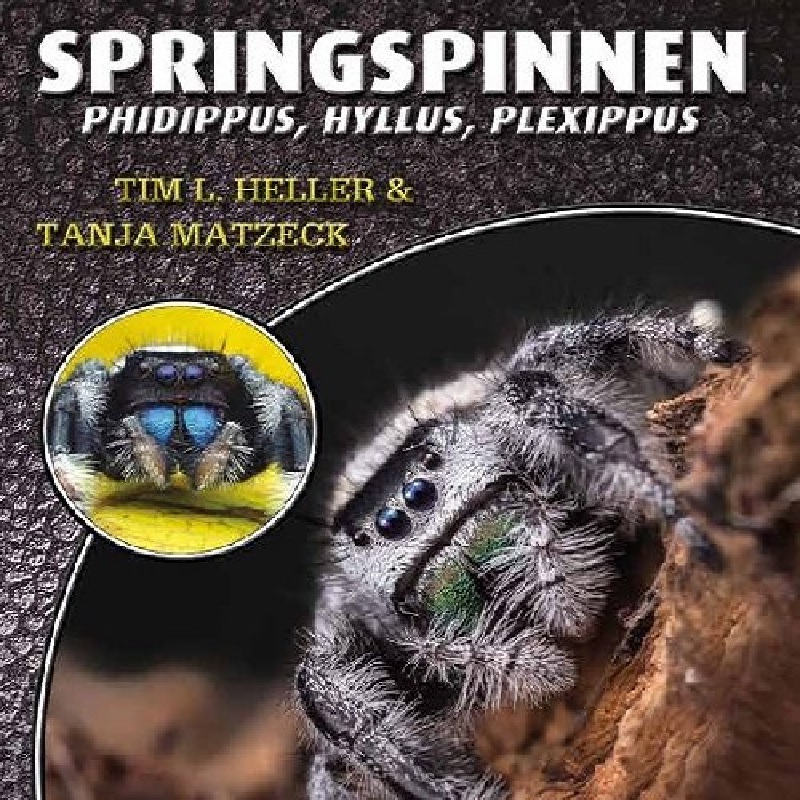
Book Jumping Spiders -
Phidippus, Hyllus & Plexippus
A guide to keeping jumping spiders of the genera Phidippus, Hyllus & Plexippus. Who can resist the charm of jumping spiders? The childlike appearance of their expressive face simply leaves no one cold! In addition, their behavior is extremely exciting to observe, their colors are bright and their requirements for species-appropriate keeping are very easy to meet. No wonder these likeable jumpers are all the rage!
This volume in the "Species by Species" series describes in detail what to look out for when buying and keeping them, introduces the most commonly kept species and color forms and provides plenty of tips on how to keep them successfully - so you can be sure they will breed well!
Species by Species introduces you to the books in this series, which present the most popular terrarium animals. Each volume offers you detailed, practical care instructions and all the information you need to successfully breed your animals.
All important questions from the required tank size to terrarium set-up, technical equipment, species-appropriate nutrition and disease prevention are answered with numerous tricks and tips.
Experienced, long-standing breeders reveal how you can encourage the animals to reproduce and raise healthy young.
All this in full color, generously illustrated and attractively designed - just about your terrarium animal - species by species
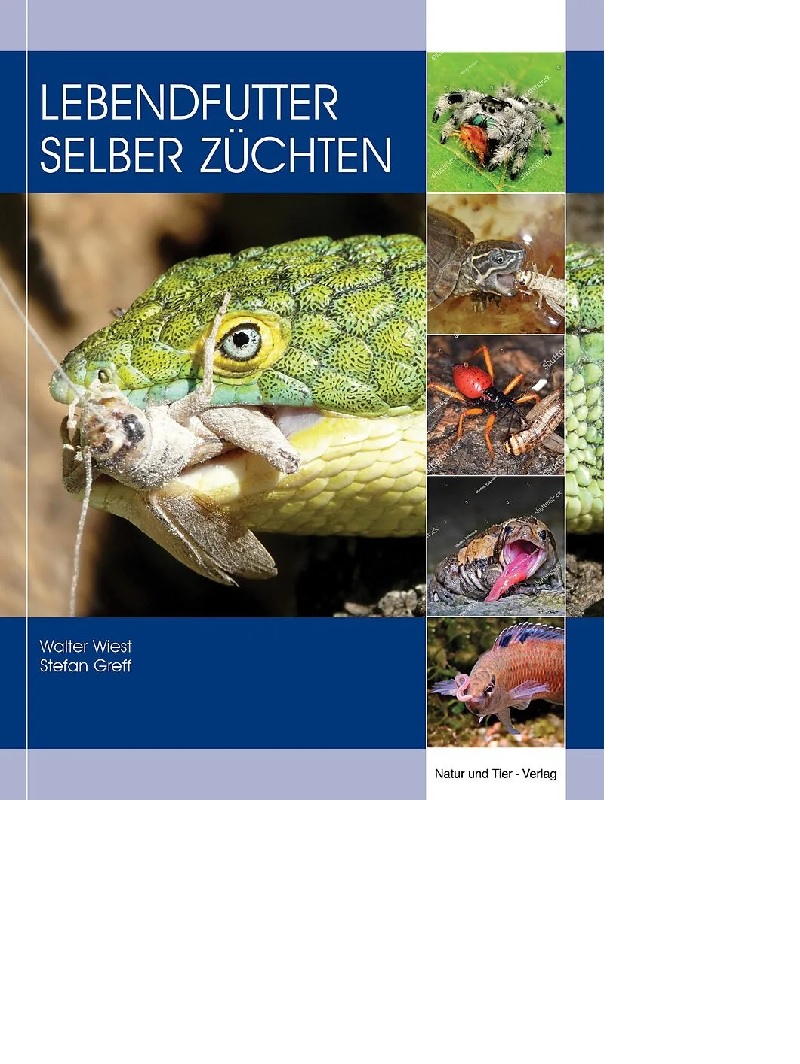
Book "Grow your own live food" - The perfect guide for pet owners
Discover practical and detailed instructions on how you can easily breed food for your reptiles, birds, fish or other animals yourself in the book "Breeding live food yourself". With valuable tips on various food insects, their care and breeding, you can save money and ensure a species-appropriate diet for your pets.
Contents of the book:
Step-by-step instructions for breeding feeder insects
Information on the best types of food for reptiles, birds and fish
Care instructions and breeding conditions for various live food species
Tips for sustainable and cost-effective food production
Why breed your own live food?
Get healthy, fresh food for your animals
Save money and reduce dependence on pet shops
Promote the health and well-being of your animals with species-appropriate food
Whether you are a beginner or an experienced pet owner, this book provides you with everything you need to successfully breed live food yourself.
Marginata 69 - New Guinea tortoises – the genus ElseyaCover storyThe unrecognised beauties: New Guinea tortoises (Andreas S. Hennig)My experiences with Branderhorst's New Guinea tortoise, Elseya (Elseya) branderhorsti (Ouwens, 1914) (Andreas S. Hennig)Keeping and breeding of Rhodin's New Guinea tortoise, Elseya (Hanwarachelys) rhodini Thomson, Amepou, Anamiato & Georges, 2015 (Andreas S. Hennig)PortraitGeoemyda spengleri, Chinese serrated tortoise (Andreas S. Hennig)ReportageMacrochelys temminckii – Experiences and impressions with vulture tortoises part 2 (Reiner Praschag)KeepingAn alternative to year-round keeping of the Egyptian tortoise in the terrarium – my experiences with seasonal outdoor keeping of Testudo kleinmanni (Ricarda Schramm)EtymologySawbacks and living maps part 4: Graptemys gibbonsi, Pascagoula humpback tortoise (Holger Vetter)Classifieds & animal placement
Marginata 18 - Moorish Tortoises
Philippine Pond TurtleGalapagos Tortoise BreedingTortoise Genetics II
Contents:
2EDITORIAL
3READERS' LETTERS
4MAGAZINE
8DATES
10REPORTAGEComments on the Iberian TortoiseHans - Dieter Philippen
16REPORTAGEObservations on Testudo graeca iberaPetr Velensky & Natasha Velenská
26REPORTAGE Sympatric occurrence of two forms of Testudo graeca in ArmeniaMarine Arakelyan, James F. Parham, Oguz Türkozan & Felix Danielyan
31 PORTRAITMeier's Three-striped Box Turtle (Cuora cyclornata meieri Blanck, McCord & Le, 2006)Hans - Dieter Philippen
35 REPORTAGELive food Part 1Hans - Dieter Philippen
39BREEDING IN HUMAN CAREObservations on the Indochinese Box Turtle Part 2Arwin & Irmhild Hiller
44REPORTAGEFrom the pea experiment to the decoding of the human genome – Genetics yesterday and today Part 2Jens R. Poschadel & Martin Platz
52 REPORTAGEInformation on the growth of Siebenrockiella leytensisSabine Schoppe
58 REPORTAGEAn early Easter blessing of eggs Samuel Furrer
60BOOK TIP
61CLASSIFIEDS
62 REGIONAL GUIDE
NTV, Discover the amphibians and learn all about these animals.
56 pages
colour photos throughout
Large format: 20.7 x 28 cm
Hardcover
Author Kriton Kunz
Contents:
Every child knows a frog that swims around in its pond and croaks cheerfully, or the black and yellow fire salamander. But how do these friendly animals live? What do they eat, how do they survive the winter? How does a tadpole become a small frog? And what other amazing amphibians are there?
"Entdecke die Amphibien" explains what amphibians are, their special features and their incredible abilities in an entertaining and child-friendly way. Fantastic records from the world of frogs, salamanders and the like are included, as well as an exciting quiz about these colourful survival artists.
Including 20 great stickers
NTV, Schildkröten im Gartenteich - Hier werden Wasserschildkröten vorgestellt welche im Gartenteich gehalten werden können.
112 Seiten
88 Abbildungen
Format: 16,8 x 21,8 cm
Autor Veronika Müller und Wolfgang Schmidt
Verlag NTV
Inhalt:
Schildkröten im Gartenteich? Sicher haben auch Sie sich schon gefragt, ob es nicht möglich ist, eine Schildkröte im Gartenteich zu pflegen. Es ist möglich!In diesem Buch werden u. a. alle Wasserschildkrötenarten vorgestellt, die auch ganzjährig im Garten leben können. Sie finden wertvolle Tips zur Gestaltung des Schildkröten-Biotops, zur Fütterung, zur Vergesellschaftung der Tiere sowie zum Thema Überwinterung. Was tun, wenn Ihre Schildkröte Eier legt? Was geschieht, wenn einmal ein Tier krank wird? Auch auf diese Fragen gehen die Autoren in eigenen Kapiteln ausführlich ein.Es gibt viele Bücher über Schildkröten. Das Buch 'Schildkröten im Gartenteich' befasst sich erstmals ausschliesslich mit den Arten, die auch im Freien gepflegt werden können. Geschrieben für den Natur- und Tierfreund, ist es ein wertvoller Leitfaden für die richtige Pflege von Wasserschildkröten.
Draco 39 - European Snakes
Contents:
Editorial
The snake fauna of EuropeAndreas Schlüter
Vipera ammodytes: on abnormal vipers and hybridsMario Schweiger
The four-lined snake – Elaphe quatuorlineata (Lacépède, 1789)Sascha Esser
The snakes of northern Spain - travel impressions from the Cantabrian Mountains and neighbouring areasGuido Kreiner
European water snakes: Field observations, husbandry and breeding of Natrix natrix (Linnaeus, 1758), Natrix maura (Linnaeus, 1758) and Natrix tessellata (Laurenti, 1768)Michael Wirth & Rainer Hähnlein
Queens of European snakes: Four-lined snake (Elaphe quatuorlineata), Aesculapian snake (Zamenis longissimus) and Leopard snake (Zamenis situla)Michael Wirth
Reptilia 59 - Rose chafer
South American tortoisesBuilding a desert terrariumReptile of the year: Forest lizard
Contents:
4 EDITORIAL
6 MAGAZINE
17 DATES
20 PHOTO REPORTAGERose chaferBy M. Tomás Rafáles
28 KEEPING AND REPRODUCTIONCare and breeding of the rose chaferAmaurodes passeriniiBy M. Tomás Rafáles
33 REPORTAGEEuropean rose beetles (family Cetoniidae)By M. Yliana
39 TRAVELThin air – An excursion into the highlands ofIran and TurkeyBy B. Trapp
51 PORTRAIT AND POSTERPsammodynastes pulverulentusBy M. Gaulke
55 HERPETOFAUNAOn the "Reptile of the Year 2006" – The Eurasianforest or mountain lizard (Zootoca vivipara),the world's most successful terrestrial reptileBy W. Böhme & D. Rödder
62 PRACTICEUse of a conservatory as a terrariumlocation for a desert terrariumPart 1: Planning and building the terrariumBy T. Ackermann
71 HERPETOFAUNA The North African-Arab cat snakeTelescopus dhara (Forsskål, 1775)By U. Schlüter
77 REPORTAGEObservations on the occurrence ofGeochelone (Chelonoides) in southern BoliviaBy J. Knaack
87 CLASSIFIED ADS
92 RAT & TAT
96 WESTERN HERP PERSPECTIVESThe new "Good Guys"By B. Love
104 INCUBATORMaggot dispenserBy H. Werning
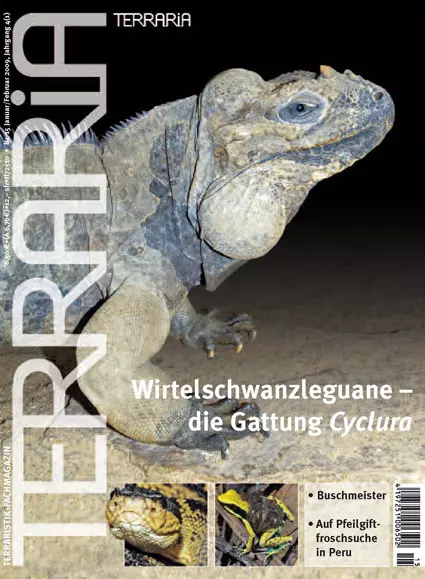
Terraria 15 - Whorlet-tailed Iguanas - Genus Cyclura
BushmasterSearching for poison dart frogs in Peru
Contents:
The imposing rhinoceros iguanas and their relatives of the genus Cycluraare among the most impressive reptiles of all – and among the rarest. TERRARIA editor-in-chief Heiko Werning introduces this group of iguanas and their struggle for survival in detail. Probablythe most successful European breeder of these animals, Jürgen Schmidt, reports exclusively in TERRARIA about the first successful private breeding of the extremely rare Isla-Mona Iguana (Cyclura cychlura figginsi), while Matthias Götz from the Jersey Wildlife Preservation Trust contributes a report on conservation projects for the famous Blue Iguana from the Cayman Islands and its relative C. nubila caimanensis.
2 Editorial Heiko Werning4 Magazine The dyskinetic syndrome in tarantulas using the example of three sick animals/animal husbandry and "Hartz IV"/Urgent measures according to § 16 a of the Animal Welfare Act and obligation to bear costs/ Exciting breeding import: Theloderma stellatum/For the first time Protobothrops cornutus in Germany/New on the market/11 TERRAnetz12 TERRAglobal Through the coastal desert Maik DOBIEYTITLE TOPIC: Rhinoceros Iguanas14 Whorlet-tailed iguanas of the genus Cyclura, the threatened giants of the Caribbean Heiko WERNING24 The Exuma Whorlet-tailed Iguana, Cyclura cychlura figginsi: Biology, husbandry and first breeding Jürgen SCHMIDT34 One of the rarest lizards in the world: the Anegada Whorlet-tailed Iguana Heiko WERNING42 The Whorlet-tailed Iguanas of the Cayman Islands – Conservation and research on Cyclura lewisi and Cyclura nubila caymanensis Michael GOETZ
50 The wonder gecko from China’s ancient Silk Road Rolf LEPTIEN54 Bushmaster – the genus Lachesis DAUDIN, 1803 Maximilian DEHLING & Matthias DEHLING59 Husbandry and breeding of the Giant Cleft-tailed Scorpion, Hadogenes troglodytes Alexander STÜRTZ66 TRAVEL In the rainforests of San Martin, Peru – a short trip to Tarapoto Maik DOBIEY74 New Species Brachylophus bulabula – “Hello Hello”, a new Fiji iguana/New wall gecko from Cuba/Two new naked-finger geckos from Vietnam87 AMONG RESEARCHERS “Ice Age” in Austria – Where did Austrian reptiles survive the last ice age? Silke SCHWEIGER81 TEST RUN External filters for terrarium enthusiasts Kriton KUNZ86 EYE-CATCHER The wild living room of Sascha Esser Axel KWET91 NEAR YOU94 PREVIEW96 HATCH BOX Exotic attack! The background … Kriton KUNZ
Terraria 62 - Unusual Food Animals
Campbell’s Tree Lizard
Succulents
Contents:
Cover Story: Unusual Food Animals
A healthy diet plays a decisive role in the successful care and breeding of our terrarium animals. The famous mealworm as a standard food is far from sufficient. Fortunately, specialist retailers now offer a wide range of suitable food insects such as house crickets, crickets, flies or cockroaches, which are available all year in any quantity. However, many pets also like to eat food animals outside the mainstream and some specialists are even dependent on a special diet for their well-being. In this issue of TERRARIA/elaphe, we take a closer look at some of these little-known, rather unusual food animals such as field slugs, woodlice, moth flies or a small-growing fruit fly variant.
3 Territorial
8 Herpetorama
Results of the 17th CITES Conference in Johannesburg – new regulations for some reptiles and amphibians
Synanthrope: Creeping Schnapps
Leaf Climber: Wasted “Time”
Thorny Devil: A Rural Keel-Tailed Iguana
Cover Story
14 Food Animals
A perennial topic in terraristics
Krition Kunz
20 Slippery Snacks
Breeding and use of the Mediterranean field slug as live food
Frank Täufer
25 Woodlice as Food Animals
Dominik Hoffses
30 A Small-Growing Variant of the Fruit Fly: Drosophila melanogaster “Ant”
Boris Stockmann
34 A Frog Farm for Feeding Reptiles and Amphibians: the Painted Disk-Tongued Frog (Discoglossus pictus)
Frank Pasmans, Sergé Bongaerts & An Martel
39 Moth Flies
A new food animal for small nocturnal hunters
Ingo Fritzsche
Panorama
42 Snake searching in the Ecuadorian Chocó rainforest
Daniel Jestrzemski
Research
50 New Species
A new slender boa from the Bahamas: the Conception Silver Boa (Chilabothrus argentum)
Axel Kwet
A new Borneo bush frog from Mt. Kinabalu
Axel Kwet
52 Among Researchers
The Comoros, a forgotten hotspot of diversity
Oliver Hawlitschek
56 Salamandra
Terraristics
60 Ant plants, leaf cacti and other succulent epiphytes for the terrarium
Beat Akeret
Nature and Species Conservation
70 Field Notes
Grass snake eating
Günther Vater
The feeding behaviour of the wall lizard Part 2
Malte Hornig
72 Project to protect the critically endangered tree lizard Abronia campbelli in eastern Guatemala
Brad Lock & Mónica Torres
84 Terrarino – the children’s page
The fire salamander – not a lucky animal
Alexa Sabarth
81 Subscription & Service
86 Also in your area
88 Preview
90 Incubator
No mercy for Mouse Z
Part 2
Heiko Werning
CHF 12.00
❅
❆
❅
❆
❅
❆
❅
❆
❅
❆
❅
❆
This website uses cookies to ensure the best experience possible. More information...