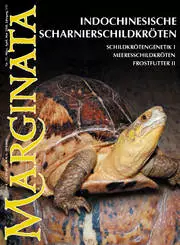
Marginata 13 - False map turtles

Article no: marginata13

CHF 14.70

Stock: 0

Ready for dispatch in 1-3 days, delivery time 7 working days

Delivery between Tuesday, 7 July and Wednesday, 8 July
Zahlungsarten
Product information "Marginata 13 - False map turtles"

Marginata 13 - False map turtles

Food plants for aquatic turtles 1
The power of scents
Kyrgyz four-toed tortoise

Contents:

  • 2 EDITORIAL
  • 3 READER LETTERS
  • 4 MAGAZINE
  • 8 DATES
  • 10 REPORTAGE
    False map turtles – colourful
    and easy-to-keep humpback turtles
    Hans - Dieter Philippen
  • 16 BREEDING IN HUMAN CARE
    Keeping and breeding the false map turtle
    Siegbert Schulz
  • 24 BREEDING IN HUMAN CARE
    The Mississippi humpback turtle in human care
    Elmar Meier
  • 31 PORTRAIT
    South African beaked tortoise
    Erica Staelenberg & Hans - Dieter Philippen
  • 35 REPORTAGE
    Food plants for aquatic turtles (Part I)
    Susanne Vogel
  • 40 REPORTAGE
    The language of scents: European pond turtles use water-soluble messengers
    Jens R. Poschadel & Martin Plath
  • 48 REPORTAGE
    Hope for the four-toed steppe tortoise
    Valentina Ismailovna Toropova, Thorsten Harder
    & Heike Finke
  • 51 SHORT REPORT
    Discovery of an unusually marked
    brown tortoise on the island of Sumatra
    Elva Gemita
  • 52 REPORTAGE
    Distribution of Cuora pani aurocapitata Part 1
    Torsten Blanck & Tanja Kremser
  • 57 SHORT REPORT
    The slider turtle issue
    Thomas Türbl, Markus Baur, Rudolf Hoffmann,
    Tobias Friz, Sabine Öfner & Friederike Weinzierl
  • 60 BOOK TIP
  • 61 CLASSIFIED ADS
  • 62 REGIONAL GUIDE
Composition
Feeding recommendation
Technical details
Size information

0 of 0 reviews

Give us a rating!

Share your experience with the product with other customers.


Suggested products

Handbook of food plants for tortoises and other reptiles
Handbook of forage plants 2nd revised editionMarion Minch is not only a successful breeder of diverse tortoises for many years, but also an excellent connoisseur of native wild herbs. She founded and runs samenkiste.de, which is well known to many tortoise keepers and nature lovers. Her name is inextricably linked with reptile care and species-appropriate nutrition for tortoises. Her handbook of food plants summarises the most important native food plants for herbivorous and omnivorous reptiles. She not only considers tortoises, but also iguanas, spiny-tailed dragons and even chameleons. From the basics of plant biology to native wild herbs to suitable food plants for hardy tropical reptile species, this comprehensive work provides the basis for species-appropriate keeping. In the expanded and supplemented 2nd edition, the plant section is divided according to flower colour. This makes it even easier to identify wild herbs. The work has also been supplemented with a wealth of additional information and many pictures.

CHF 46.50

Geckos
Geckos in the terrarium by Astrid FalkThe book offers a comprehensive introduction to geckos and their species-appropriate keeping in terrariums. It explains what you need to think about before buying a gecko and what preparations should be made. The book describes in detail how the terrarium is technically equipped and set up. The care of the animals, their special features and behaviour, their diet, reproduction and rearing of young animals are described, as well as diseases and husbandry problems with tried and tested suggestions for prevention and treatment. Individual gecko species that are particularly suitable for keeping and breeding in terrariums are portrayed in detail in the second part of the book.

CHF 28.50

Jumping spiders Phidippus, Hyllus, Plexippus
Book Jumping Spiders - Phidippus, Hyllus & Plexippus A guide to keeping jumping spiders of the genera Phidippus, Hyllus & Plexippus. Who can resist the charm of jumping spiders? The childlike appearance of their expressive face simply leaves no one cold! In addition, their behavior is extremely exciting to observe, their colors are bright and their requirements for species-appropriate keeping are very easy to meet. No wonder these likeable jumpers are all the rage! This volume in the "Species by Species" series describes in detail what to look out for when buying and keeping them, introduces the most commonly kept species and color forms and provides plenty of tips on how to keep them successfully - so you can be sure they will breed well! Species by Species introduces you to the books in this series, which present the most popular terrarium animals. Each volume offers you detailed, practical care instructions and all the information you need to successfully breed your animals. All important questions from the required tank size to terrarium set-up, technical equipment, species-appropriate nutrition and disease prevention are answered with numerous tricks and tips. Experienced, long-standing breeders reveal how you can encourage the animals to reproduce and raise healthy young. All this in full color, generously illustrated and attractively designed - just about your terrarium animal - species by species

CHF 23.90

Book Breeding live food yourself
Book "Grow your own live food" - The perfect guide for pet owners Discover practical and detailed instructions on how you can easily breed food for your reptiles, birds, fish or other animals yourself in the book "Breeding live food yourself". With valuable tips on various food insects, their care and breeding, you can save money and ensure a species-appropriate diet for your pets. Contents of the book: Step-by-step instructions for breeding feeder insects Information on the best types of food for reptiles, birds and fish Care instructions and breeding conditions for various live food species Tips for sustainable and cost-effective food production Why breed your own live food? Get healthy, fresh food for your animals Save money and reduce dependence on pet shops Promote the health and well-being of your animals with species-appropriate food Whether you are a beginner or an experienced pet owner, this book provides you with everything you need to successfully breed live food yourself.

CHF 46.50

Marginata 69 - New Guinea tortoises
Marginata 69 - New Guinea tortoises – the genus ElseyaCover storyThe unrecognised beauties: New Guinea tortoises (Andreas S. Hennig)My experiences with Branderhorst's New Guinea tortoise, Elseya (Elseya) branderhorsti (Ouwens, 1914) (Andreas S. Hennig)Keeping and breeding of Rhodin's New Guinea tortoise, Elseya (Hanwarachelys) rhodini Thomson, Amepou, Anamiato & Georges, 2015 (Andreas S. Hennig)PortraitGeoemyda spengleri, Chinese serrated tortoise (Andreas S. Hennig)ReportageMacrochelys temminckii – Experiences and impressions with vulture tortoises part 2 (Reiner Praschag)KeepingAn alternative to year-round keeping of the Egyptian tortoise in the terrarium – my experiences with seasonal outdoor keeping of Testudo kleinmanni (Ricarda Schramm)EtymologySawbacks and living maps part 4: Graptemys gibbonsi, Pascagoula humpback tortoise (Holger Vetter)Classifieds & animal placement

CHF 16.50

Reptilia 06 - Mimicry - The perfect deception
Reptilia 06 - Mimicry - The perfect illusion MaltaBuilding polystyrene terrariumsNutrition of tortoises Contents: Page 2 - EditorialPage 3 - Letters to the editorPage 5 - MagazinePage 11 - DatesPage 14 - Western Herp Perspectives: The Queen of Snakes, by B. LovePage 16 - Photo reportage: Mimicry, by L. AissefairePage 24 - Report: Mimicry - Saving energy through camouflage, by Dr M. GaulkePage 32 - Keeping and breeding: Like a leaf in the wind. The walking leaf Phyllum celebicum in the terrarium, by H. FischerPage 38 - Travelogue: Temples, disc-tongued frogs and reptiles – impressions of a trip to Malta, by U. SchlüterPage 43 - Photographic profile: Reptiles and amphibians in the Du Tsingy de Bamaraha nature reserve (West Madagascar), by G. Hallmann, E. Hoffmann, J. Krüger, P. Schlagböhmer and G. TrautmannPage 47 - Portrait and poster: Gastrotheca riobambae, by H. WerningPage 51 - Report: Nutrition of European tortoises, Part 2, by Dr C. DennertPage 59 - Keeping and breeding: A mini-crocodile for the paludarium – The keeled skink Tropidophorus grayi, by U. DostPage 64 - Terrarium practice: Styrofoam terrariums, by D. HasselbergPage 69 - Herpetofauna: The Bismarck Dwarf Python Liasis boa – keeping and breeding a colourful giant snake, by V. FranzPage 72 - Herpetology and culture: Snakes go to school – Part 2, by M. HallmenPage 81 - Reptilia on the road: Zoo Berlin-Friedrichsfelde, by H. WerningPage 84 - Advice and HelpPage 90 - LibraryPage 96 - Satire: Something different, by A. Scheffler

CHF 9.80

Reptilia 120 - Praying Mantises
Reptilia 120 - Praying Mantises Chinese viperEmerald lizardCosta Rica Contents: Cover story: Praying MantisesNobody can escape the fascination of praying mantises. These predatory insects with their alien appearance and martial mating habits have long secured a permanent place in terrariums. We offer an overview of mantids in breeding, the classics, and the latest trends. We also feature an unusual species from the Philippines and look to eastern Germany, where Mantis religiosa has spread. EditorialMAGAZINEDATES Photo storyThe fascination of praying mantisesK. Kunz Keeping and breedingPraying mantises. The basics of keeping in terrariumsC. J. Schwarz REPORTAGEPraying mantises on the advance in eastern GermanyN. von Lettow-Vorbeck BiologyPraying mantis, change your tune. On the challenge of identifying praying mantises using the Philippine species Creobroter meleagris as an exampleC. J. Schwarz ReportageThe Chinese viper (Deinagkistrodon acutus): a herpetological and cultural phenomenonDr. T. Eimermacher Keeping and breedingThe banded fire salamander (Salamandra salamandra terrestris).  Distribution, habits and breedingM. Rogner RreportageA display terrarium for fire salamandersR. Hoppe Animals of our homelandThe emerald lizardR. Leptien SERVICE WESTERN HERP PERSPECTIVESBut it’s a dry heatB. Love ALSO NEAR YOU TravelCosta Rica – Paradisiacal biodiversity between the Atlantic and the PacificN. Weinbeer PREVIEW INCUBATOR The breakH. Werning

CHF 12.00

The plumed basilisk
Alles über den Stirnlappenbasilisk von Ingo Kober 64 Seiten 14,8 x 21 cm zahlreiche Farbfotos 2. Auflage Autor Ingo Kober Verlag NTV Inhalt: Eindrucksvolle grosse Echsen sind sie, die Stirnlappenbasilisken. Den Betrachter erinnern sie unwillkürlich an drachenartige Fabelwesen. Dabei handelt es sich bei diesen attraktiven Echsen um völlig harmlose und äusserst interessante Tiere, die sich zur Pflege im Terrarium vorzüglich eignen. Ingo Kober beschäftigt sich seit vielen Jahren mit Stirnlappenbasilisken. In diesem Buch geht er auf alle Aspekte rund um die Haltung und artgerechte Pflege dieser spannenden Echsen ein und zeigt Ihnen, wie Sie Ihre Tiere zur Vermehrung bringen, die Eier ausbrüten und die Kleinen aufziehen können. Systematik und Körperbau Die faszinierende Biologie: Aus dem Leben der Stirnlappenbasilisken Alle Informationen zur artgerechten Haltung: Vom geeigneten Terrarium über Einrichtung und Technik bis hin zur Fütterung Erfolgreich nachzüchten: Paarungsstimulation, Inkubation der Eier und Aufzucht der Jungtiere Problemlösungen: Wie man die häufigsten Fehler bei der Pflege vermeidet, und wie man kranken Tieren helfen kann Brillante Fotos

CHF 21.90

Reptilia 11 - Galapagos
Reptilia 11 - Galapagos Cultural history of the Solomon IslandsSea turtles off MadeiraWrinkled gecko Contents: EditorialLetters to the editorMagazinesDatesWestern Herp Perspectives: The Terrarium TrapB. Love Photo reportageGalápagosH. Werning HerpetofaunaThe Galápagos giant tortoiseB. Schramm ReportageSpecies conservation hunt on GalápagosH. Stoldt ReportageEl niño and the Galápagos reptilesH. Stoldt Keeping and breedingThe Egg Snake Dasypeltis atraD. Modry and P. Neças Portrait and posterBrachypelma emiliaP. Klaas HerpetofaunaSea turtles off MadeiraProf. T. Dellinger and Prof. P. Wirtz Keeping and breedingThe poison dart frog Minyobates minutusM. Schulte TerraristicsProphylaxis and quarantineProf. P. Kölle and Prof. R. Hoffmann Herpetology and cultureAmphibian and reptile myths of the MelanesiansDr. H.-J. Hermann Reptilia on the roadLeipzig ZooS. Hennig LibraryAdvice and actionIncubator

CHF 9.80

The green water dragon
All about the green water dragon by Heiko Werning 64 pages Format: 14.8 x 21 cm 43 colour photos Paperback Author Heiko Werning Contents: The green water dragon is without question a "classic" of terraristics. For decades it has been a permanent fixture both in the pet trade and in the terrariums of enthusiasts.REPTILIA editor Heiko Werning explains in this volume of the "Species by Species" series what is involved in the species-appropriate keeping and care of the green water dragon and, of course, also reveals how you can successfully breed your favourites and raise the adorable young animals. Systematics and body structure The fascinating biology: From the life of the green water dragon All information on species-appropriate keeping: from suitable terrariums to equipment and technology to feeding Successful breeding: Mating stimulation, incubation of the eggs and rearing the young Solutions to problems: How to avoid the most common mistakes in care and how to help sick animals Brilliant photos

CHF 18.50

Draco 28 - Live food
Draco 28 - Live food Contents: 2 Editorial 4 Live food for amphibians and reptiles– History and basicsUrsula Friedrich 22 The professional handling of food animals – Basic requirement for a species- and animal-appropriate diet for reptiles and amphibiansThomas Wilms 32 Some aspects of breeding your own food animalsStefan Ziesmann 39 The pea aphid – an unusual food animalLars Österdahl 42 Breeding the common fruit fly (Drosophila melanogaster)– Many paths lead to successMarco Wagemann 50 Tropical cockroaches – lively insect lovers, valuable food animals or even both?Andreas Bauer 58 Oven fish breeding – a way to provide a little variety in the diet of our vivarium animals with little effort!Marco Wagemann 64 The breeding of aquatic snails Cornelia Gabler 67 Agate snails – not only an extraordinary food animalUwe Geissel 71 Tubifex breedingCornelia Gabler 74 Small mammals as food animals – using the house mouse (Mus musculus) as an exampleThomas Wilms & Beate Löhr 86 Book box

CHF 18.40

Reptilia 56 - African land tortoises
Reptilia 56 - African tortoises Red bamboo snakeFisher's ChameleonXenagama taylori Contents: 2 EDITORIAL 6 MAGAZINE & READERS' LETTERS 14 DATES 16 WESTERN HERP PERSPECTIVES  The blue Mexican  From B. Love 18  PHOTO REPORTAGE  African tortoises  By J. Valverde 26 REPORTAGE  The tortoises of Africa – diversity through  Adaptation to extreme habitats  By T. & S. Vinke 31 HERPETOFAUNA  Taxonomy, ecology and protection of the   Panther tortoise (Stigmochelys pardalis)  By J. S. Massana & A. M. Silvestre 36 KEEPING AND BREEDING  The areola tortoise Hompus areola-  tus (THUNBERG, 1787) – Observations   and experiences: Lifestyle, husbandry,   Breeding and rearing  By A. Schleicher 42 TRAVEL  Excursion in western Cuba   By L. Geißler 51 PORTRAIT AND POSTER  Bradypodion occidentale  By M. Dobiey 56 KEEPING AND BREEDING  Keeping, care and breeding of Taylors   Beavertail dragon, Xenagama taylori   (PARKER, 1935)  By P. M. Müller 62 KEEPING AND BREEDING  Terrarium keeping of the Thai Red bamboo snake (Oreophis porphyraceus coxi)  and a rare birth of twins   By V. Knietsch 67 HERPETOFAUNA On the breeding of the red broad-banded bamboo snake, Oreophis porphyraceus laticinctus SCHULZ & HELFENBERGER 1998   By J. Bulian, B Siebert & M. Ansermet 72 HERPETOFAUNA   Chameleons in the western Usambara-  Mountains in northern Tanzania   By W. & Y. Lantermann 78 REPORTAGE  A cyclone in Sri Lanka   By P. Janzen 86 CLASSIFIED ADS 91 RAT & TAT 94 LIBRARY 104 BRUTKASTEN  My flat-sharing community  Part 1: I wouldn't have any time at all,  Set cars on fire!  By H. Werning

CHF 11.20