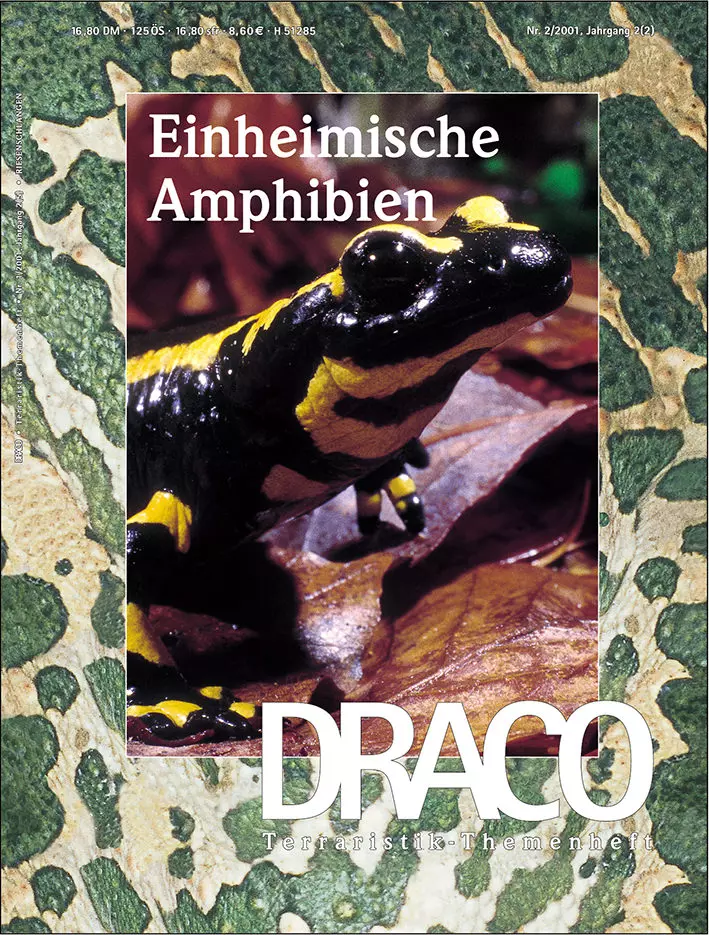
Draco 06 - Local amphibians

Article no: draco6

CHF 16.80

Stock: 0

Ready for dispatch in 1-3 days, delivery time 7 working days

Delivery between Monday, 31 August and Tuesday, 1 September
Zahlungsarten
Product information "Draco 06 - Local amphibians"

Draco 06 - Native amphibians

Contents:

  • Page content
  • 2 Editorial
  • 4 The native amphibians - an overview, by Dr B. Thiesmeyer
  • 22 A king without a kingdom, by E. Meier & T. Mutz
  • 30 The moor frog Rana arvalis NILSSON, 1842, by H. Laufer & A. Pieh
  • 38 The green toad Bufo viridis LAURENTI, 1768, by A. Pieh & N. Braitmayer
  • 45 Midwife toads (genus Alytes, discoglossidae): Biology, care and breeding, by H.-J. Schekeler
  • 53 Great crested newts: Little water dragons in our ponds and pools, by A. Kupfer
  • 58 Long time in the forest: Long live the salamander!, by Dr B. Thiesmeyer
  • 69 First photos of the birth of the Alpine salamander (Salamandra atra atra)
  • 78 Book box
  • 89 Magazine
Composition
Feeding recommendation
Technical details
Size information

0 of 0 reviews

Give us a rating!

Share your experience with the product with other customers.


Suggested products

Handbook of food plants for tortoises and other reptiles
Handbook of forage plants 2nd revised editionMarion Minch is not only a successful breeder of diverse tortoises for many years, but also an excellent connoisseur of native wild herbs. She founded and runs samenkiste.de, which is well known to many tortoise keepers and nature lovers. Her name is inextricably linked with reptile care and species-appropriate nutrition for tortoises. Her handbook of food plants summarises the most important native food plants for herbivorous and omnivorous reptiles. She not only considers tortoises, but also iguanas, spiny-tailed dragons and even chameleons. From the basics of plant biology to native wild herbs to suitable food plants for hardy tropical reptile species, this comprehensive work provides the basis for species-appropriate keeping. In the expanded and supplemented 2nd edition, the plant section is divided according to flower colour. This makes it even easier to identify wild herbs. The work has also been supplemented with a wealth of additional information and many pictures.

CHF 46.50

Geckos
Geckos in the terrarium by Astrid FalkThe book offers a comprehensive introduction to geckos and their species-appropriate keeping in terrariums. It explains what you need to think about before buying a gecko and what preparations should be made. The book describes in detail how the terrarium is technically equipped and set up. The care of the animals, their special features and behaviour, their diet, reproduction and rearing of young animals are described, as well as diseases and husbandry problems with tried and tested suggestions for prevention and treatment. Individual gecko species that are particularly suitable for keeping and breeding in terrariums are portrayed in detail in the second part of the book.

CHF 28.50

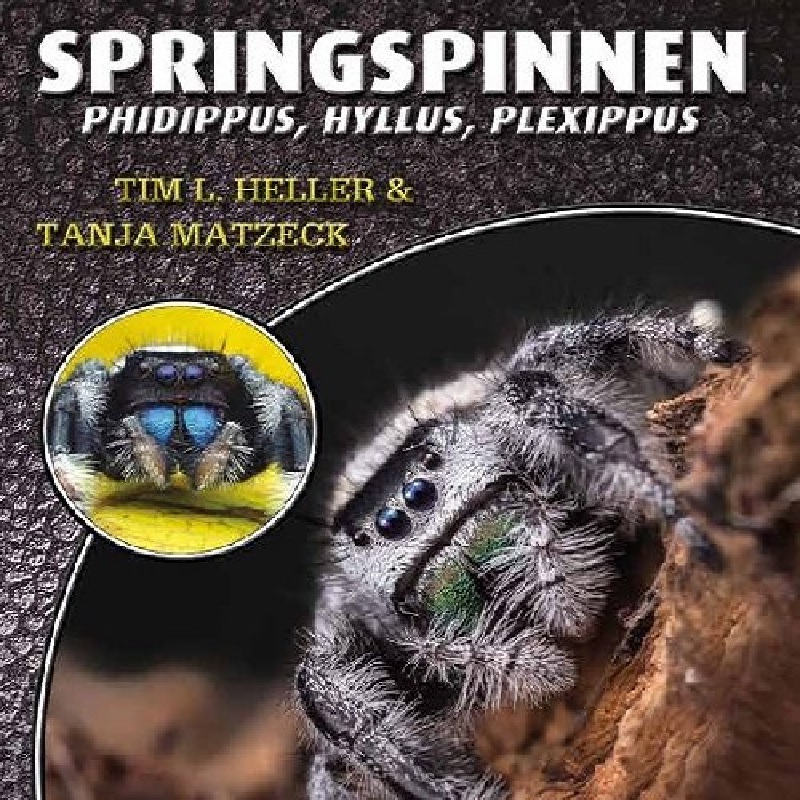
Jumping spiders Phidippus, Hyllus, Plexippus
Book Jumping Spiders - Phidippus, Hyllus & Plexippus A guide to keeping jumping spiders of the genera Phidippus, Hyllus & Plexippus. Who can resist the charm of jumping spiders? The childlike appearance of their expressive face simply leaves no one cold! In addition, their behavior is extremely exciting to observe, their colors are bright and their requirements for species-appropriate keeping are very easy to meet. No wonder these likeable jumpers are all the rage! This volume in the "Species by Species" series describes in detail what to look out for when buying and keeping them, introduces the most commonly kept species and color forms and provides plenty of tips on how to keep them successfully - so you can be sure they will breed well! Species by Species introduces you to the books in this series, which present the most popular terrarium animals. Each volume offers you detailed, practical care instructions and all the information you need to successfully breed your animals. All important questions from the required tank size to terrarium set-up, technical equipment, species-appropriate nutrition and disease prevention are answered with numerous tricks and tips. Experienced, long-standing breeders reveal how you can encourage the animals to reproduce and raise healthy young. All this in full color, generously illustrated and attractively designed - just about your terrarium animal - species by species

CHF 23.90

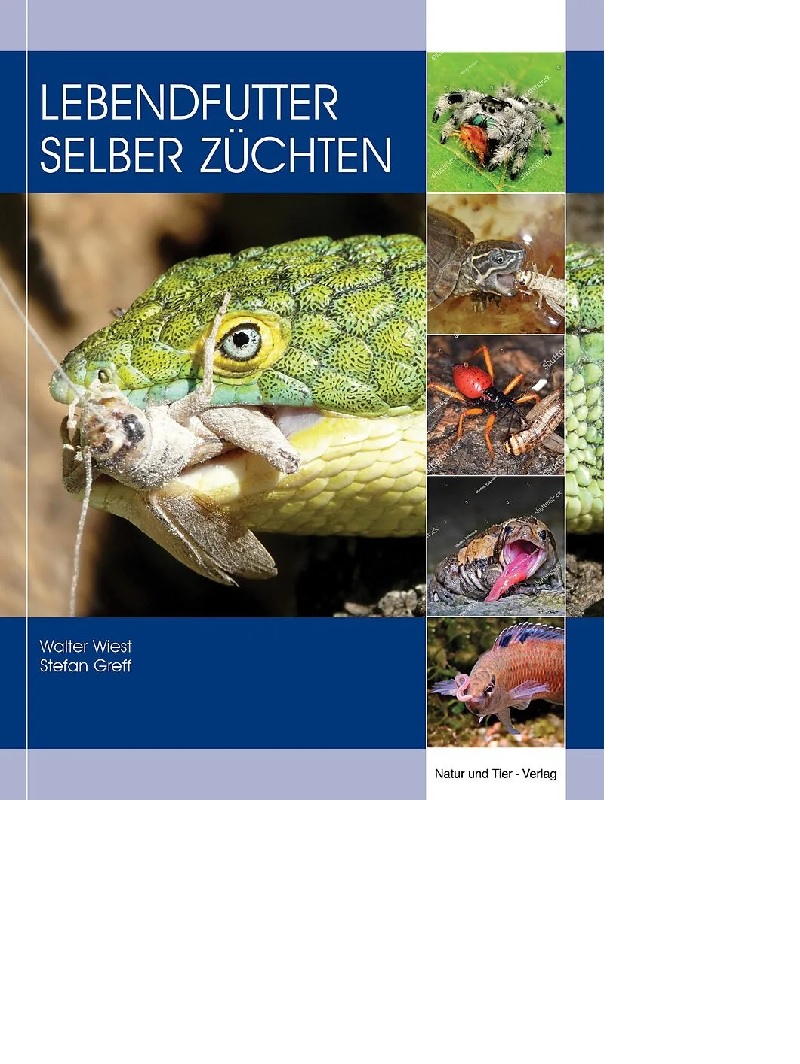
Book Breeding live food yourself
Book "Grow your own live food" - The perfect guide for pet owners Discover practical and detailed instructions on how you can easily breed food for your reptiles, birds, fish or other animals yourself in the book "Breeding live food yourself". With valuable tips on various food insects, their care and breeding, you can save money and ensure a species-appropriate diet for your pets. Contents of the book: Step-by-step instructions for breeding feeder insects Information on the best types of food for reptiles, birds and fish Care instructions and breeding conditions for various live food species Tips for sustainable and cost-effective food production Why breed your own live food? Get healthy, fresh food for your animals Save money and reduce dependence on pet shops Promote the health and well-being of your animals with species-appropriate food Whether you are a beginner or an experienced pet owner, this book provides you with everything you need to successfully breed live food yourself.

CHF 46.50

Marginata 69 - New Guinea tortoises
Marginata 69 - New Guinea tortoises – the genus ElseyaCover storyThe unrecognised beauties: New Guinea tortoises (Andreas S. Hennig)My experiences with Branderhorst's New Guinea tortoise, Elseya (Elseya) branderhorsti (Ouwens, 1914) (Andreas S. Hennig)Keeping and breeding of Rhodin's New Guinea tortoise, Elseya (Hanwarachelys) rhodini Thomson, Amepou, Anamiato & Georges, 2015 (Andreas S. Hennig)PortraitGeoemyda spengleri, Chinese serrated tortoise (Andreas S. Hennig)ReportageMacrochelys temminckii – Experiences and impressions with vulture tortoises part 2 (Reiner Praschag)KeepingAn alternative to year-round keeping of the Egyptian tortoise in the terrarium – my experiences with seasonal outdoor keeping of Testudo kleinmanni (Ricarda Schramm)EtymologySawbacks and living maps part 4: Graptemys gibbonsi, Pascagoula humpback tortoise (Holger Vetter)Classifieds & animal placement

CHF 16.50

Tortoise library 2 - Greek tortoise
Tortoise library 2 - Greek tortoise  Holger Vetter 325 pages 150 colour photos Distribution maps Format: 15 x 21.5 cm Contents: This book is by far the most comprehensive collection of information on the range of the Greek tortoise: Testudo hermanni

CHF 42.90

Reptilia 109 - Exclusive terrariums
Reptilia 109 Exclusive TerrariumsBoa constrictorColour breeding of blue-tongued skinksSumatra Contents:Cover story: Exclusive terrariumsFirst and foremost, every terrarium must fulfil the needs of the animals kept in it. This can be done pragmatically, but also allows the keeper to create tanks that satisfy their own aesthetic requirements and give the impression of a real biotope section. In the cover story of the upcoming REPTILIA, we present a series of such "luxury villas for reptiles", describe the work of a terrarium builder who works individually according to the customer's wishes, but also how such exclusive terrariums are created step by step.EditorialMAGAZINEDATESWESTERN HERP PERSPECTIVESA completely different terrarium meetingB. LoveREPORTAGELuxury villas for reptiles, amphibians and invertebrates - exclusive terrariumsR. HoppeREPORTAGENatural terrariums for young and old. Facilities for rhinoceros iguanas and other lizardsS. KaloppREPORTAGEThe stable terrarium. Unconventional design of a snake terrariumD. RennerREPORTAGEFrom the idea to the dream. Creation of a customised dry terrarium by professional terrarium buildersR. HoppeKEEPING AND BREEDINGFirst captive breeding of Stimson’s python (Antaresia stimsoni) at Cologne ZooA. Rauhaus, D. Karbe, C. Niggemann, K. van der Straeten & T. Zieglerherpetofauna Boa constrictor. Exciting news from an old acquaintance                                   J. Cañas-OrozcoKEEPING AND BREEDINGColour breeding in the Northern Blue-tongued Skink, Tiliqua scincoides intermediaM. ReisingerServicesLibraryANIMALS OF OUR HOMEThe midwife toadR. LeptienALSO NEAR YOUJourneyHerpetological impressions from SumatraD. Prötzel & J. ForsterPREVIEWBRUTKASTEN Television is coming - Part 2H. Werning

CHF 12.00

NTV, Moorish tortoise-Testudo graeca
NTV Moorish tortoises-Testudo graeca 128 pages Colour illustrations Paperback Mario Herz Moorish tortoises colonise a huge distribution area that stretches across three continents. This group probably consists of up to 20 clearly defined species!Author Mario Herz presents the various local forms in words and pictures and describes the significantly differing husbandry conditions depending on their origin – a basic requirement for species-appropriate care and, above all, successful reproduction! This book therefore offers everything you need to know about the biology, keeping and breeding of these popular tortoises!

CHF 35.90

Herpeton, Fire belly newts
Herpeton - Fire-bellied newts With this book, the authors draw on their over 20 years of experience with various fire-bellied newt species to provide beginners and advanced keepers with instructions on how to keep and breed their animals professionally Contents: Systematics, habitats, way of life, appearance, behaviour, acquisition of animals, stocking density, acclimatisation, socialisation, capture and temporary housing, aquaria (size, cover, aquarium technology, location, equipment, rearing tanks, aqua-terraria and paludaria, terraria, plants for fire-bellied newt tanks, care and water changes, overview of food animals, life expectancy, hibernation, egg laying and egg development, housing of eggs, larval development, housing of larvae, rearing of metamorphosed juveniles, problems with breeding, diseases, species descriptions, (Cynops ensicauda, Cynops pyrrhogaster, Cynops orientalis), and much more.

CHF 28.90

NTV, Life with tarantulas
NTV, Life with tarantulas ISBN: 978-3-86659-042-7 Karin Manns 176 pages numerous colour photos Format: 16.8 x 21.8 cm Contents: Karin Manns is an animal psychologist and loves tarantulas. She was not deterred by the fact that little is known about diseases of these animals and their treatment, but sought contact with an experienced vet to find out more about this topic. In this book, she not only describes some revealing case studies of successful treatments and the methods used, but also shares very personal experiences of keeping tarantulas together and considers whether distinguishing between "aggressive" and "less aggressive" species makes sense. Life with tarantulas – intense and very close to the animal! Foreword and acknowledgements The tarantula as a pet Keeping and care Breeding tarantulas Species portraits Morphology and anatomy Morphology Anatomy Diseases and treatment options in tarantulas Bacterial diseases: cause, diagnosis, treatment Case studies Neurotoxic diseases: cause, diagnosis, treatment Metabolic diseases: cause, diagnosis, treatment Fungal diseases: cause, diagnosis, treatment Further risks for our tarantulas Injuries Moulting problems Motor disorders “Tarantula cancer” Nematodes Moulting delay Apathy Cessation of venom production Deformation of the limbs and body structure Anus closure Administration of medication Social behaviour in tarantulas Coexistence of two males Avicularia avicularia Coexistence of a female and a male Avicularia avicularia Joint rearing and keeping of Avicularia metallica Inter-species communal housing of tarantulas of the genus Avicularia Joint rearing and care ofPoecilotheria regalis Joint rearing and keeping ofPoecilotheria ornata Summary Aggressive vs. tame tarantulas: a meaningful distinction? Case study: Pterinochilus murinus Closing words References Press reviews Karin Manns is an animal psychologist and loves tarantulas. She was not deterred by the fact that little is known about the diseases of these animals and their treatment, but sought contact with an experienced vet to find out more about this topic. Species portraits and a chapter on social behaviour round off this fascinating book. Zoologischer Zentral Anzeiger 2/2009

CHF 28.50

Bugs No. 07 - Colorful bird spiders
Bugs No. 07 - Colourful tarantulas Journey: Thailand and BorneoCockroaches: Deropeltis paulinoiRearing substrate: Flake SoilContents:Tarantulas are gloomy grey-brown? Not at all! Many species display fantastic, bright colours! We introduce you to the most beautiful representatives and show you how to keep and breed them using two species as examples.The colourful theme continues: Necroscia annulipes, one of the most colourful stick insects currently to be found in our terrariums, is presented. You can find out everything you need to know to keep them successfully in this issue of Bugs.Our travel report takes you to the forests of Thailand, where, for example, a lot of brightly coloured praying mantises live.For cockroach lovers we have an article about Deropeltis paulinoi – the authors report in detail about the breeding of this impressive species.In addition, of course, a number of other exciting topics are addressed, so that there will be something for fans of various invertebrate groups. Plus practical tips and news from the world of science and much more ...Table of contents EditorialFacetsDatesFlown in Cover storyColourful splendour on eight legs Blue is beautiful! FledgedA journey to the praying mantises and grasshoppers of Thailand and Borneo Keeping & BreedingAbout the breeding of the privet hawk moth PracticeFlake Soil – Quality offensive in beetle breeding Keeping & BreedingTurquoise blue stick insect CultureCockroaches in the mouth Keeping & BreedingVelvet cockroaches – Noble terrarium inhabitants Kids CornerA chirping and chirping Book scorpionAlso in your neighbourhoodService & ImprintPreview

CHF 12.00

The leopard gecko
All about the leopard gecko by Melanie Hartwig 64 pages Format: 14.8 x 21 cm 70 colour photos 1 map Paperback Author Melanie Hartwig Contents: Foreword Description Distribution and natural habitat Lifestyle Legal regulations and acquisition Transport and quarantine Terrarium and technology The terrarium setup Care and diet Hibernation Propagation Rearing the young Colour and pattern forms Basics of the theory of heredity Diseases Socialisation Further information Thanks Literature used and further reading

CHF 21.90