Handbook of forage plants 2nd revised editionMarion Minch is not only a successful breeder of diverse tortoises for many years, but also an excellent connoisseur of native wild herbs. She founded and runs samenkiste.de, which is well known to many tortoise keepers and nature lovers. Her name is inextricably linked with reptile care and species-appropriate nutrition for tortoises. Her handbook of food plants summarises the most important native food plants for herbivorous and omnivorous reptiles. She not only considers tortoises, but also iguanas, spiny-tailed dragons and even chameleons. From the basics of plant biology to native wild herbs to suitable food plants for hardy tropical reptile species, this comprehensive work provides the basis for species-appropriate keeping. In the expanded and supplemented 2nd edition, the plant section is divided according to flower colour. This makes it even easier to identify wild herbs. The work has also been supplemented with a wealth of additional information and many pictures.
Geckos in the terrarium by Astrid FalkThe book offers a comprehensive introduction to geckos and their species-appropriate keeping in terrariums. It explains what you need to think about before buying a gecko and what preparations should be made. The book describes in detail how the terrarium is technically equipped and set up. The care of the animals, their special features and behaviour, their diet, reproduction and rearing of young animals are described, as well as diseases and husbandry problems with tried and tested suggestions for prevention and treatment. Individual gecko species that are particularly suitable for keeping and breeding in terrariums are portrayed in detail in the second part of the book.
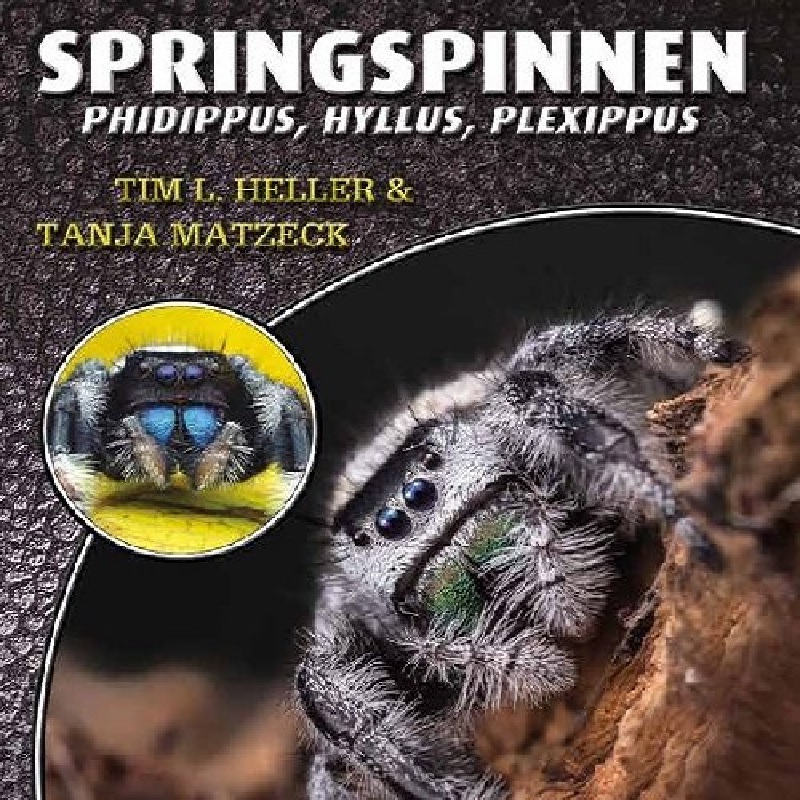
Book Jumping Spiders -
Phidippus, Hyllus & Plexippus
A guide to keeping jumping spiders of the genera Phidippus, Hyllus & Plexippus. Who can resist the charm of jumping spiders? The childlike appearance of their expressive face simply leaves no one cold! In addition, their behavior is extremely exciting to observe, their colors are bright and their requirements for species-appropriate keeping are very easy to meet. No wonder these likeable jumpers are all the rage!
This volume in the "Species by Species" series describes in detail what to look out for when buying and keeping them, introduces the most commonly kept species and color forms and provides plenty of tips on how to keep them successfully - so you can be sure they will breed well!
Species by Species introduces you to the books in this series, which present the most popular terrarium animals. Each volume offers you detailed, practical care instructions and all the information you need to successfully breed your animals.
All important questions from the required tank size to terrarium set-up, technical equipment, species-appropriate nutrition and disease prevention are answered with numerous tricks and tips.
Experienced, long-standing breeders reveal how you can encourage the animals to reproduce and raise healthy young.
All this in full color, generously illustrated and attractively designed - just about your terrarium animal - species by species
Book "Grow your own live food" - The perfect guide for pet owners
Discover practical and detailed instructions on how you can easily breed food for your reptiles, birds, fish or other animals yourself in the book "Breeding live food yourself". With valuable tips on various food insects, their care and breeding, you can save money and ensure a species-appropriate diet for your pets.
Contents of the book:
Step-by-step instructions for breeding feeder insects
Information on the best types of food for reptiles, birds and fish
Care instructions and breeding conditions for various live food species
Tips for sustainable and cost-effective food production
Why breed your own live food?
Get healthy, fresh food for your animals
Save money and reduce dependence on pet shops
Promote the health and well-being of your animals with species-appropriate food
Whether you are a beginner or an experienced pet owner, this book provides you with everything you need to successfully breed live food yourself.
Marginata 69 - New Guinea tortoises – the genus ElseyaCover storyThe unrecognised beauties: New Guinea tortoises (Andreas S. Hennig)My experiences with Branderhorst's New Guinea tortoise, Elseya (Elseya) branderhorsti (Ouwens, 1914) (Andreas S. Hennig)Keeping and breeding of Rhodin's New Guinea tortoise, Elseya (Hanwarachelys) rhodini Thomson, Amepou, Anamiato & Georges, 2015 (Andreas S. Hennig)PortraitGeoemyda spengleri, Chinese serrated tortoise (Andreas S. Hennig)ReportageMacrochelys temminckii – Experiences and impressions with vulture tortoises part 2 (Reiner Praschag)KeepingAn alternative to year-round keeping of the Egyptian tortoise in the terrarium – my experiences with seasonal outdoor keeping of Testudo kleinmanni (Ricarda Schramm)EtymologySawbacks and living maps part 4: Graptemys gibbonsi, Pascagoula humpback tortoise (Holger Vetter)Classifieds & animal placement
Reptilia 85 - Snake-necked tortoisesCrocodile-tailed crested lizardBreeding of the king pythonPristidactylus valeriaeContents:The snake-necked turtles include such popular species for the aquaterrarium as the Australian representatives of the genus Chelodina or the pointed-headed turtles of the genus Emydura, but also the bizarre Mata-Mata from the waters of Amazonia or the funny toad-headed turtles of the genus Phrynops. In our cover story, we introduce you to this exciting family of turtles with lots of brilliant photos and portray some particularly interesting species in detail.Table of contentsEDITORIALMAGAZINEEcotourism de luxe: End of the chameleon conservation project in the Peloponnese?H. WerningSancho, the illegal immigrant - what to do when exotic animals are found?S. SchletchSkin-eating blind worms bred for the first timeA. Kupfer & S. ReinhardWESTERN HERP PERSPECTIVESConfusing species protectionBill LovePHOTOSTORY Snake-necked tortoises J. ValverdeKEEPING AND REPRODUCTIONThe Argentine snake-necked tortoise(Hydromedusa tectifera) - observations in biotope and terrarium D. FabiusKEEPING AND REPRODUCTION Keeping and breeding of the broad-breasted snapping turtle, Myuchelys latisternum(Elseya latisternum) H. ProkopTRAVEL Cave dwellers in the PhilippinesM. GaulkePORTRAIT AND POSTER Telescopus fallax (Fleischmann 1831). European cat snakeK. Ehrlich & B. TrappHERPETOFAUNA A conservation project for the Valeria large-headed iguana, Pristidactylus valeriae - with the support of REPTILIA B. CamousseigtKEEPING AND REPRODUCTION Versatile favourites. Experiences with Royal PythonsM. BorerKEEPING AND REPRODUCTION News on sex determination of the crocodile-tailed humpback lizard, Shinisaurus crocodilurus M. ZollwegHERPETOFAUNA Basking sites on mangrove biotopes of Phelsuma robertmertensi Meier, 1980 on the Comorian island of Mayotte P. KrauseANIMALS OF OUR HOMEA snake that is not a snake: the slow wormR. LeptienLIBRARYSUBSCRIPTION & SERVICEALSO NEAR YOUPREVIEWBRUTKASTENBag magicM. ZawadzkiDATESHeiko WerningWESTERN HERP PERSPECTIVESConfusing species protectionB. Love
Schildkrötenschutz auf SumatraZucht der Rotwangen-KlappschildkröteSchildkröten im Schulunterricht
Inhalt:
EditorialLESERBRIEFEMagazinTermineREPORTAGEJenseits von Afrika – ein Forschungsaufenthalt in MadagaskarJutta HammerREPORTAGESchildkrötenforschung in Vietnam Inga Fischer, Sarah Wahl und Sandra WeimerHALTUNG UND ZUCHT„Kambodscha – ein Königreich der Wunder“. Feldherpetologische Arbeit an Indotestudo elongataFlora IhlowPOSTERDie Turkana-See-Klappbrustschildkröte (Pelusios broadleyi)Hans - Dieter PhilippenZUCHTHaltung und Nachzucht der Madagassischen Strahlenschildkröte Teil 2Michael Wirth und Peter FritzReportageDie Ernährung europäischer Landschildkröten in der freien Wildbahn Wolfgang WegehauptBuchtippKleinanzeigenAbo & ServiceRegionalführer
Reptilia 04 - Tarantulas
SkinkThailandMysticism & superstition
Contents:
Page 2 - EditorialPage 3 - Letters to the editorPage 6 - MagazinePage 17 - Photo reportage: Tarantulas, by P. KlaasPage 23 - Keeping and reproduction: Keeping and breeding tarantulas, by P. KlaasPage 26 - Terraristics and law: Legal issues in keeping spiders and scorpions, by D. RösselPage 27 - Report: A feast of tarantulas, by R. WestPage 30 - Psychology: Arachnophobia, by L. HogebackPage 33 - Travelogue: Thailand - Mecca of herpetological tourism, by J. BergadáPage 37 - Travelogue: The snake farm of Bangkok, by J. ViaderPage 39 - Portrait and poster: Chondropython viridis, by M. Aresté and J. L. FarriolsPage 43 - Herpetofauna: Skinks, by P. Gassner and A. HauschildPage 50 - Reptilia on the road: Terrarium displays, by H. WerningPage 54 - Terraristics and law: Snake keeping in residential property and tenancy law, by D. RösselPage 57 - Herpetology and Culture: Magic and Superstition, Part 1: Turtles and Amphibians, by L. B. Carissimi-PriorPage 62 - Terraristics: Egg-laying problems with tortoises, by E. MeierPage 69 - Supplement: Venomous snakesPage 74 - Advice and actionPage 76 - LibraryPage 80 - Incubator: Glossary by H. Werning
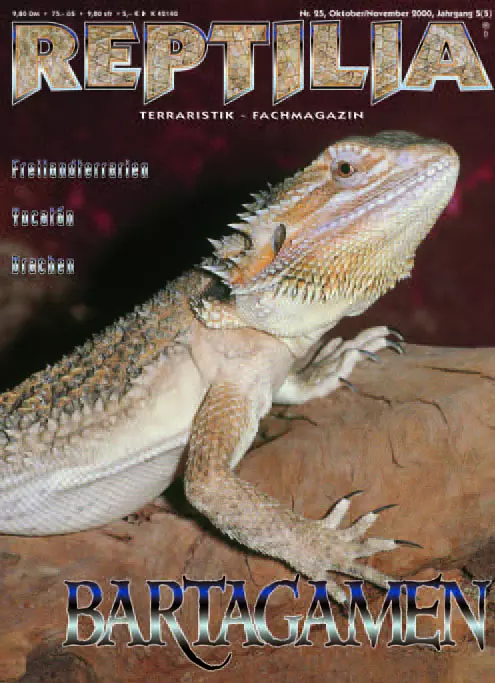
Reptilia 25 - Bearded dragons
Outdoor terrariumsYucatánDragons
Contents:
2 Editorial
4 Letters to the Editor
8 Magazine
16 Dates
20 Western Herp Perspectives: Road Cruising - in search of reptiles and amphibians by car
22 Photo report: The bearded dragons, by A. Hauschild
28 Keeping and breeding: An evergreen: Bearded dragons in the terrarium, by A. Hauschild
33 Herpetofauna: Behaviour and interaction of my bearded dragons (Pogona vitticeps) in the terrarium, by R. Kohlmeyer
39 Report: Bearded dragon fever, by B. Love
43 Journey: Travelling in the realm of the Maya, by L. Barkam and H. Werning
51 Portrait and poster: Trapelus pallidus, by L. Rifai and D. Modry
56 Herpetofauna: Notes on Boiga nigriceps(GÜNTHER, 1863)
62 Report: To Madagascar - for the turtles?, by W. Schmidt and K. Liebel
68 Keeping and breeding: Dendrobates azureus, a blue jewel in the terrarium, U. Dost
73 Terraristics: Building a snake enclosure, Part 1: Basic considerations, by M. Hallmen
78 Herpetology and culture: 'In caves lives the dragon's old brood', a look at the ideas of dragons in East and West, Part 1, by K. Kunz
87 Advice and action
91 Library
104 Gloss: Dead texts don't talk, by L. Hogeback
Marginata 37 - Slaty turtles
Common musk turtleTwo-headed turtles
Contents:
EditorialMagazineDates
Cover storyAn extraordinary species: the split-shell tortoise (Malacochersus tornieri)Hans-Dieter Philippen
FIELD RESEARCHA collection stop for split-shelled turtles – what does it do?Reginald Theodor Mwaya
PortraitDumeril’s box turtle, Peltocephalus dumerilianus (Schweigger, 1812)Hans-Dieter Philippen
ReportageSearch dogs for turtle researchSarah Wahl & Tim McCormack
REPRODUCTIONExperiences with the care and breeding of the Common Musk Turtle (Sternotherus odoratus)Thomas Hofmann
ReportageTwo-headed turtles – a not so rare phenomenon?Hans–Dieter Philippen
ReportageTurtle Watch on Watamu beach. Volunteer work on the east coast of KenyaNadja Schaubhut
Book tipClassifiedsSubscription & ServiceRegional guide
Reptilia 63 - Small monitor lizards
ThailandLizards in the greenhouseRespiratory diseases in tortoises
Contents:
2 EDITORIAL
3 MAGAZINE
11 DATES
14 WESTERN HERP PERSPECTIVESThe luxury point of viewBy B. Love
16 PHOTO REPORTAGESmall monitor lizards in the terrariumBy B. Eidenmüller
24 KEEPING AND BREEDINGKeeping and breeding of the spiny-tailedmonitor lizard (Varanus acanthurus)By S. Arth
34 KEEPING AND BREEDINGVaranus boehmei, keeping and first-timebreeding in the terrariumBy M. Reisinger & D. Reisinger-Raweyai
39 KEEPING AND BREEDINGKeeping, care and breeding ofVaranus macraeiBy A. Dedlmar
42 TRAVELThailand - fascination herpetofaunaBy F. Longhitano
51 PORTRAIT AND POSTERLiophis jaegeriBy A. Kwet
56 REPORTAGEFrog societies in South AmericaBy D. Rödder, G. Zeidan, W. Pertel & R. L. Teixeira
64 PRACTICEKeeping lizards in the greenhouseBy D. Prötzel
71 KEEPING AND BREEDING Truly a jewel in the terrarium: Ampulex compressaBy T. Ramann
75 HERPETIC MEDICINERespiratory diseases in tortoises:recognise, treat, preventBy U. Eggenschwiler
80 TERRARIUM EXHIBITIONSThe reptile and amphibian exhibition of the Dusit Zoo in BangkokBy J. Bulian
87 FAQ - FREQUENTLY ASKED QUESTIONSAcquisition of royal pythons (Python regius)By T. Kölpin
91 HERPETOCULTUREThe lion for Bavaria, the bear for Berlin, the chameleon for...?By J. Wolf
94 LIBRARY
104 INCUBATOR specialAt night in the museumBy H. Werning & L. Hogeback
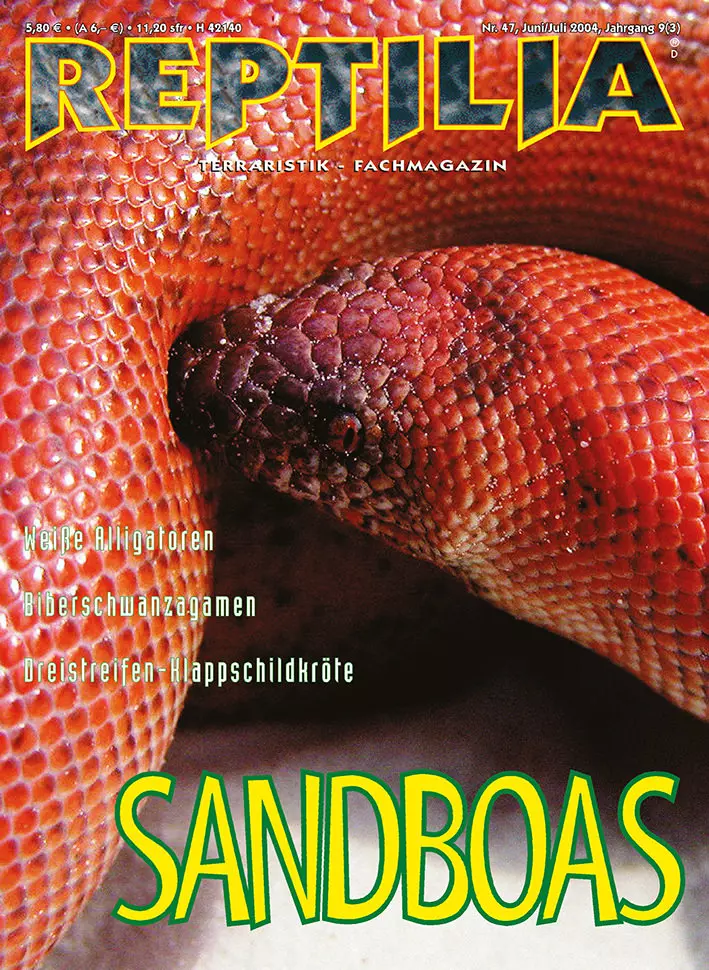
Reptilia 47 - Sandboas
White alligatorsBeavertail dragonsThree-striped folding tortoise
Contents:
2 EDITORIAL
3 MAGAZINE
16 DATES
18 WESTERN HERP PERSPECTIVESThe Mecca of a reptile photographerby B. Love
20 PHOTO REPORTAGE Sandboasby C. Jones
31 KEEPING AND BREEDINGOn keeping and caring for sandboas
by C. Jones
35 KEEPING AND BREEDINGOn breeding Eurasian sandboas: Eryx jaculus, Eryx miliaris and Eryx tataricus
by C. Jones
42 REPORTFascination record snakePart 3: Don't let them bite you…
by Henry Bellosa
45 TRAVELThe white alligators of the MississippiOf ancient Indian trails, bald cypresses and crocodiles
by W. Ise
51 PORTRAIT AND POSTERLialis burtonisby U. Schlüter
56 KEEPING AND BREEDINGThe Three-striped Box Turtle Kinosternon baurii) – A turtle for small aquariums?by A. M. Glaser
64 HERPETOFAUNAKeeping and breeding some Andean keel-tailed iguanas Stenocercus from the Peruvian highlandsPart 4: Observations on behaviour, sexual dimorphism and ecology of Stenocercus melanopygus BOULENGER, 1900by U. Schlüter
72 KEEPING AND BREEDINGExperiences in keeping and breeding Xenagama batillifera (VAILLANT, 1882), with observations on the behaviour of Xenagama taylori (PARKER, 1935)by M. Barts
78 REPORTAGEPlanning and building a reptile zoo: "Reptilium - Terrarien- und Wüstenzoo" in Landau is being built - Part 2: The construction phaseby T. Wilms
87 CLASSIFIED ADS
91 RAT & TAT
94 LIBRARY
104 GLOSSA family story. Part 1by H. Werning