Terraria 51 - Amphibian crisis

Article no: terraria51

CHF 12.00

Stock: 0

Ready for dispatch in 1-3 days, delivery time 7 working days

Delivery between Tuesday, 28 April and Wednesday, 29 April
Zahlungsarten
Product information "Terraria 51 - Amphibian crisis"

Terraria 51 - Amphibian crisis

Chaco
Moroccan day gecko

Contents:

Cover story: Amphibian crisis

The global amphibian crisis is threatening frogs all over the world, and we may be facing a dramatic extinction of species. One glimmer of hope is the so-called amphibian ark, the targeted breeding of particularly endangered species in human care. In the cover story of the next issue of TERRARIA/elaphe, we look at various methods used by zoos, scientific institutions and private keepers to successfully breed frogs in the long term.

Territorial

Herpetorama

Cover story

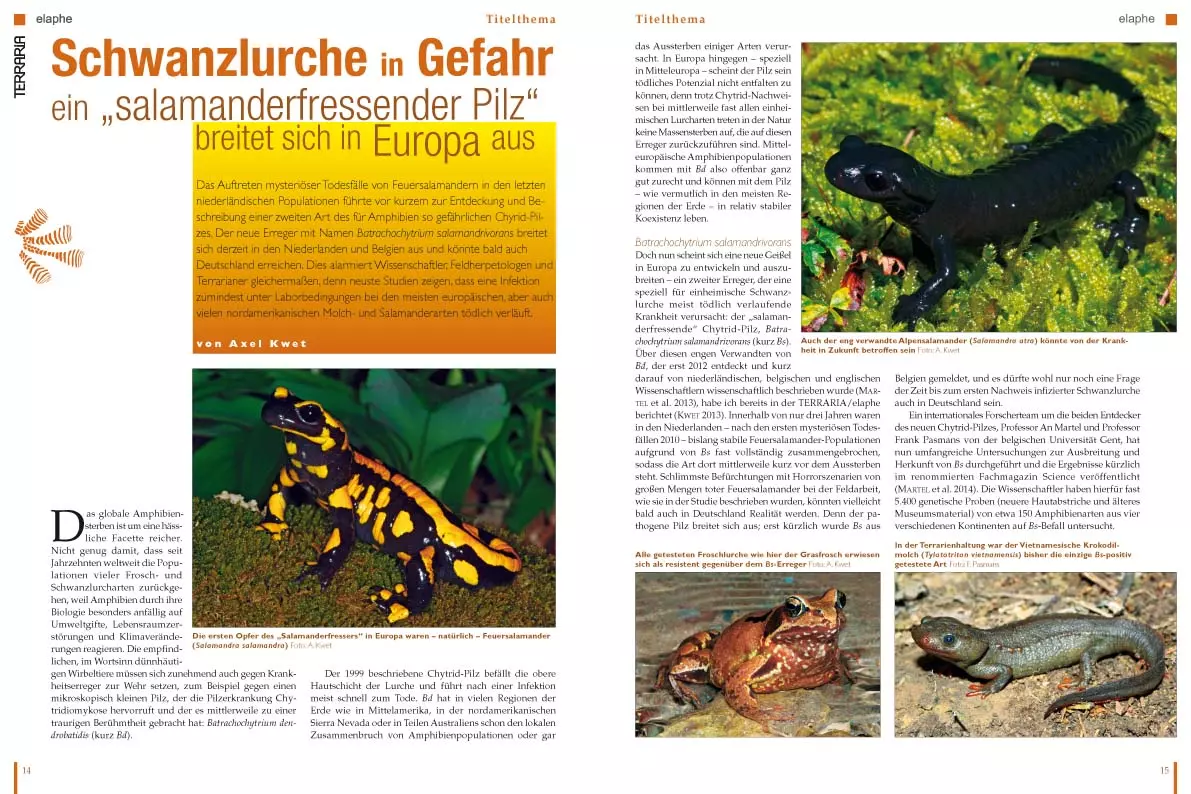
Tailed amphibians in danger a “salamander-eating fungus” spreads in Europe
Axel Kwet

Questions about the Salamander Eater
Interview with Prof. Frank Pasmans, with questions from Axel Kwet

Species conservation and captive breeding of amphibians a new approach to keeping cave-dwelling paddle-footed frogs using Rhacophorus orlovi
Mikhail F. Bagaturov, Anna A. Bagaturova & Rustam K. Berdiev

Panorama
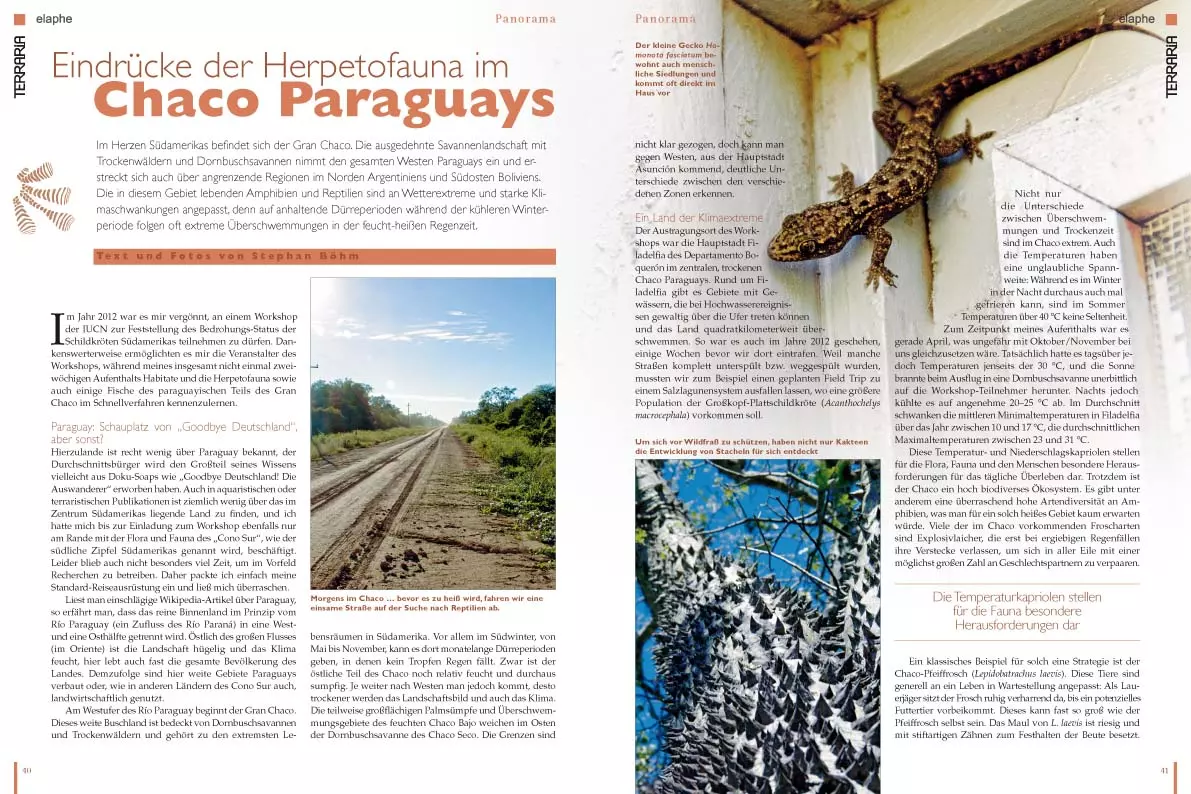
Impressions of the herpetofauna in the Chaco of Paraguay
Stephan Böhm

The ruin lizards (Podarcis siculus tyrrhenicus) of the island of Giannutri
Jürgen Gebhart

Research

New species
New keel-tailed iguanas of the genus Tropidurus
Axel Kwet

Newly described: three Japanese angle-toothed newts from Kyushu
Axel Kwet

Among researchers
Field study on the Cypriot Levantine viper (Macrovipera lebetina lebetina)
Daniel Jestrzemski

An observation on ophiophagy in the puff adder (Bitis arietans)
Tobias Machts

Salamandra

Terraristics
The day gecko of south-western Morocco Quedenfeldtia moerens (Chabanaud, 1916)
Uwe Schlüter

Also in your neighbourhood

Nature and species conservation

Field notes
Frost effect on the spawn of the grass frog
Rudolf Malkmus

Hail damage to amphibians?
Axel Kwet

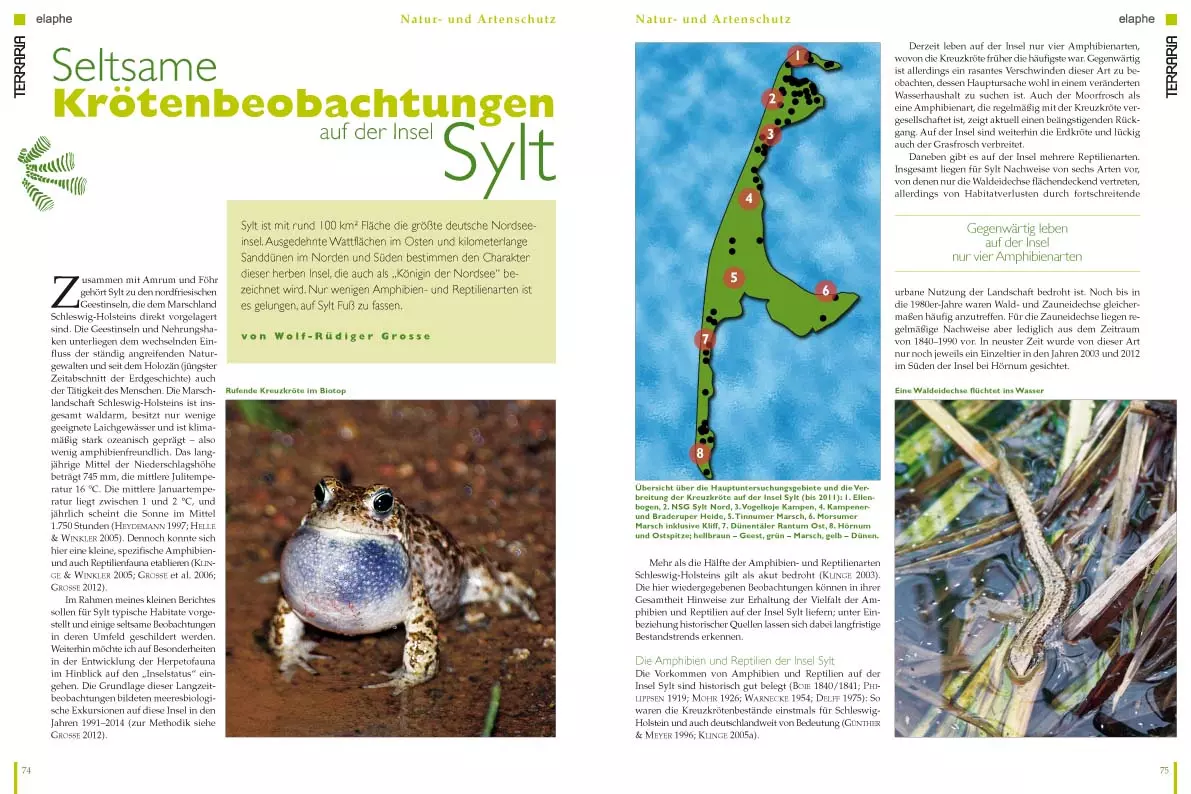
Strange toad observations on the island of Sylt
Wolf-Rüdiger Grosse

Subscription & Service

Gallery
The Thesaurus of Albertus Seba. Old treasures in the Berlin Museum of Natural History
Axel Kwet, Rainer Günther & Aaron Bauer

Preview

Incubator
Smoke detector
Rolf Leptien

Composition
Feeding recommendation
Technical details
Size information

0 of 0 reviews

Give us a rating!

Share your experience with the product with other customers.


Suggested products

Handbook of food plants for tortoises and other reptiles
Handbook of forage plants 2nd revised editionMarion Minch is not only a successful breeder of diverse tortoises for many years, but also an excellent connoisseur of native wild herbs. She founded and runs samenkiste.de, which is well known to many tortoise keepers and nature lovers. Her name is inextricably linked with reptile care and species-appropriate nutrition for tortoises. Her handbook of food plants summarises the most important native food plants for herbivorous and omnivorous reptiles. She not only considers tortoises, but also iguanas, spiny-tailed dragons and even chameleons. From the basics of plant biology to native wild herbs to suitable food plants for hardy tropical reptile species, this comprehensive work provides the basis for species-appropriate keeping. In the expanded and supplemented 2nd edition, the plant section is divided according to flower colour. This makes it even easier to identify wild herbs. The work has also been supplemented with a wealth of additional information and many pictures.

CHF 46.50

Geckos
Geckos in the terrarium by Astrid FalkThe book offers a comprehensive introduction to geckos and their species-appropriate keeping in terrariums. It explains what you need to think about before buying a gecko and what preparations should be made. The book describes in detail how the terrarium is technically equipped and set up. The care of the animals, their special features and behaviour, their diet, reproduction and rearing of young animals are described, as well as diseases and husbandry problems with tried and tested suggestions for prevention and treatment. Individual gecko species that are particularly suitable for keeping and breeding in terrariums are portrayed in detail in the second part of the book.

CHF 28.50

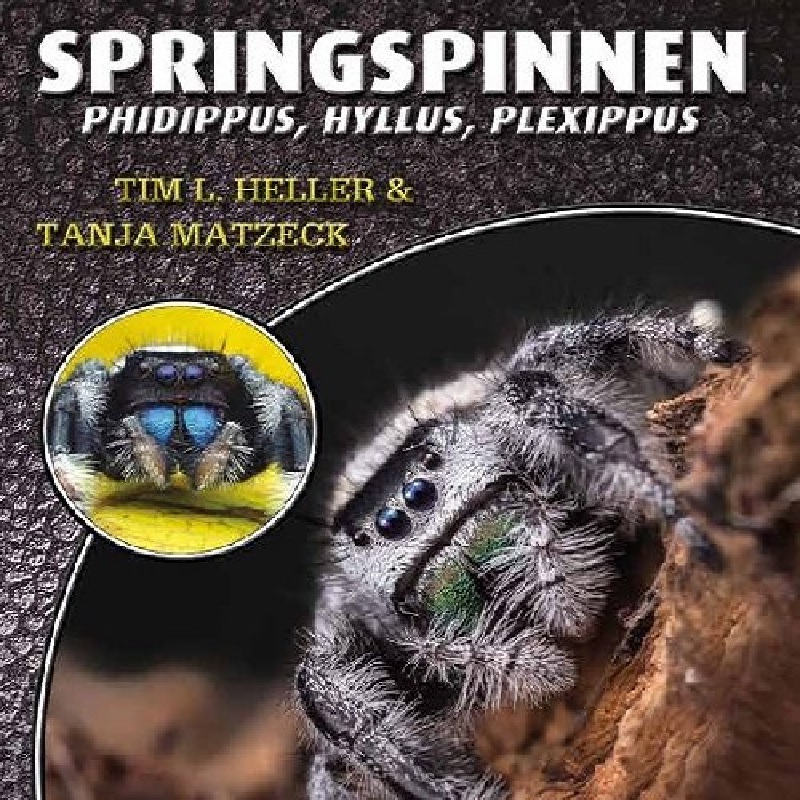
Jumping spiders Phidippus, Hyllus, Plexippus
Book Jumping Spiders - Phidippus, Hyllus & Plexippus A guide to keeping jumping spiders of the genera Phidippus, Hyllus & Plexippus. Who can resist the charm of jumping spiders? The childlike appearance of their expressive face simply leaves no one cold! In addition, their behavior is extremely exciting to observe, their colors are bright and their requirements for species-appropriate keeping are very easy to meet. No wonder these likeable jumpers are all the rage! This volume in the "Species by Species" series describes in detail what to look out for when buying and keeping them, introduces the most commonly kept species and color forms and provides plenty of tips on how to keep them successfully - so you can be sure they will breed well! Species by Species introduces you to the books in this series, which present the most popular terrarium animals. Each volume offers you detailed, practical care instructions and all the information you need to successfully breed your animals. All important questions from the required tank size to terrarium set-up, technical equipment, species-appropriate nutrition and disease prevention are answered with numerous tricks and tips. Experienced, long-standing breeders reveal how you can encourage the animals to reproduce and raise healthy young. All this in full color, generously illustrated and attractively designed - just about your terrarium animal - species by species

CHF 23.90

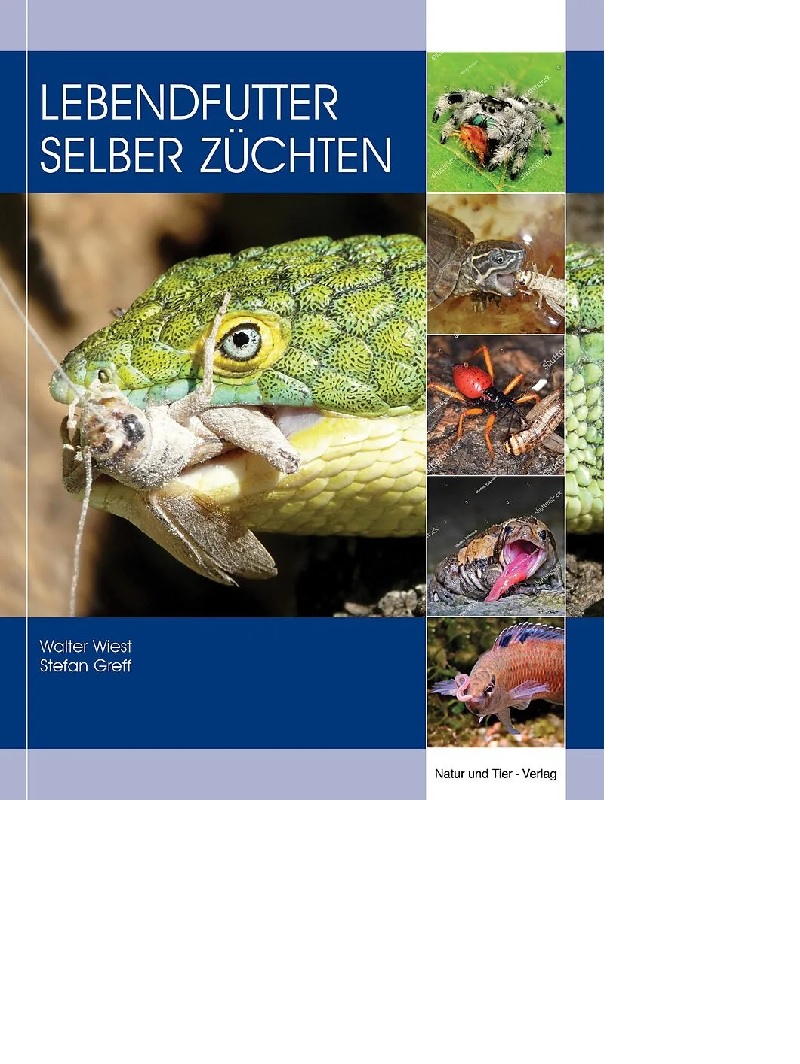
Book Breeding live food yourself
Book "Grow your own live food" - The perfect guide for pet owners Discover practical and detailed instructions on how you can easily breed food for your reptiles, birds, fish or other animals yourself in the book "Breeding live food yourself". With valuable tips on various food insects, their care and breeding, you can save money and ensure a species-appropriate diet for your pets. Contents of the book: Step-by-step instructions for breeding feeder insects Information on the best types of food for reptiles, birds and fish Care instructions and breeding conditions for various live food species Tips for sustainable and cost-effective food production Why breed your own live food? Get healthy, fresh food for your animals Save money and reduce dependence on pet shops Promote the health and well-being of your animals with species-appropriate food Whether you are a beginner or an experienced pet owner, this book provides you with everything you need to successfully breed live food yourself.

CHF 46.50

Marginata 69 - New Guinea tortoises
Marginata 69 - New Guinea tortoises – the genus ElseyaCover storyThe unrecognised beauties: New Guinea tortoises (Andreas S. Hennig)My experiences with Branderhorst's New Guinea tortoise, Elseya (Elseya) branderhorsti (Ouwens, 1914) (Andreas S. Hennig)Keeping and breeding of Rhodin's New Guinea tortoise, Elseya (Hanwarachelys) rhodini Thomson, Amepou, Anamiato & Georges, 2015 (Andreas S. Hennig)PortraitGeoemyda spengleri, Chinese serrated tortoise (Andreas S. Hennig)ReportageMacrochelys temminckii – Experiences and impressions with vulture tortoises part 2 (Reiner Praschag)KeepingAn alternative to year-round keeping of the Egyptian tortoise in the terrarium – my experiences with seasonal outdoor keeping of Testudo kleinmanni (Ricarda Schramm)EtymologySawbacks and living maps part 4: Graptemys gibbonsi, Pascagoula humpback tortoise (Holger Vetter)Classifieds & animal placement

CHF 16.50

Marginata 42 - Jewellery box turtles
Marginata 42 - Jewellery Box Turtles Unique steppe tortoisesCoal tortoises in VenezuelaSea turtles in Sri Lanka Contents: One of the most beautiful and commonly kept box turtles, the ornate box turtle (Terrapene ornata) is the main focus of Marginata. As an inhabitant of the North American prairie and forest regions, it inhabits the centre of the USA and here the region from western Indiana, to eastern Texas and as far as Louisiana. The subspecies T. ornata luteola inhabits the arid areas of West Texas, New Mexico, Arizona and is also found in adjacent areas of northern Mexico. The species is regularly kept and bred in captivity. In the forthcoming issue of Marginata, both field data from the USA, as well as husbandry and breeding under outdoor conditions and rearing in special mini-greenhouse terrariums are presented. ContentsEditorialMagazineDates REPORTAGENews about the Ornate Box Turtle (Terrapene ornata)Hans - Dieter Philippen KEEPING AND BREEDINGOptimising the husbandry of Terrapene ornataJosef Joven BREEDINGCourtship and mating behaviour of the ornate box turtle (Terrapene ornata)Hans - Dieter Philippen PORTRAITNew Guinea snapping turtle Elseya novaeguineae (Meyer, 1874)Hans - Dieter Philippen KEEPING AND BREEDINGSuccessful keeping of coal tortoises in VenezuelaRonny Bakowsky REPORTAGEOn the situation of marine turtles in Sri LankaSascha Pawlowski REPORTAGEFurther evidence of the morphological variability of the steppe tortoisePetr Velensky REPORTAGEOn the longevity of tortoises (Testudinidae)Hans-Volker Karl Book tipSubscription & ServiceRegional guide

CHF 16.50

Marginata 40 - Red-headed slider turtles
Marginata 40 - Red-headed slider turtlesFree-range keeping and breeding of European water turtlesKeeping and breeding big-headed tortoises part 2Looking turtles in the mouthContents:EditorialMagazineDates PHOTOSTORYThe red-headed slider turtleHans-Dieter Philippen REPORTAGEThe red-headed slider turtle in the wildHerbert Meier BREEDINGKeeping and breeding the red-headed slider (Podocnemis erythrocephala) Part 1David Drajeske PortraitSalvin’s Cross-breasted Turtle Staurotypus salvinii Grey, 1864Hans-Dieter Philippen BREEDINGBig-headed turtles in nature and human care part 2Reiner Praschag REPORTAGEOutdoor keeping of European pond turtles of the genera Mauremys and EmysSacha Pawlowski REPORTAGELooking turtles in the mouthEgon Heiss & Nikolay Natchev Book tipSubscription & ServiceRegional guide

CHF 16.50

Marginata 35 - Chinese three-legged turtle
Marginata 35 - Chinese three-legged turtleReintroduction of Testudo graeca in SpainBreeding the areolate flat tortoiseTurtle breeding at the Tennessee AquariumContents:EDITORIALMAGAZINEDATESPHOTOSTORYChinese three-keeled turtles (Mauremys [Chinemys] reevesii Gray, 1835)Hans - Dieter PhilippenREPORTAGEGlobal distribution of the Chinese three-keeled turtle (Mauremys [Chinemys] reevesii)Hans - Dieter PhilippenBREEDINGKeeping and breeding Chinese three-keeled turtles (Mauremys [Chinemys] reevesii Gray, 1831) on a slightly different scale – China’s turtle farmsTorsten Blanck, Ting Zhou, & Pi-Peng LiPORTRAITPinta Galápagos tortoise (Chelonoidis nigra abingdoni) – “Lonesome George”Hans - Dieter PhilippenBREEDINGRemarkable breeding successes in the Tennessee aquariumBill HughesREPORTAGEEvidence of viable populations of the Greek tortoise (Testudo graeca) establishing themselves outside their original range in the southof the iberian peninsulaJosé c. Báez, Jesús Duarte, M.A. Farfan & Raimundo RealBREEDINGExperiences with the husbandry and reproduction of the Areolate Flat-shelled Turtle (Homopus areolatus) under different conditions in Namibia and Switzerland. Part I: Husbandry and reproduction of the species in Namibia (Southern Africa)Alfred SchleicherREPORTAGEUnusual hatching of a Hermann’s tortoise (Testudo hermanni hermanni)Robert FröschBOOK TIPSMALL DISPLAYSSUBSCRIPTION & sERVIcEREGIONAL GUIDE

CHF 16.50

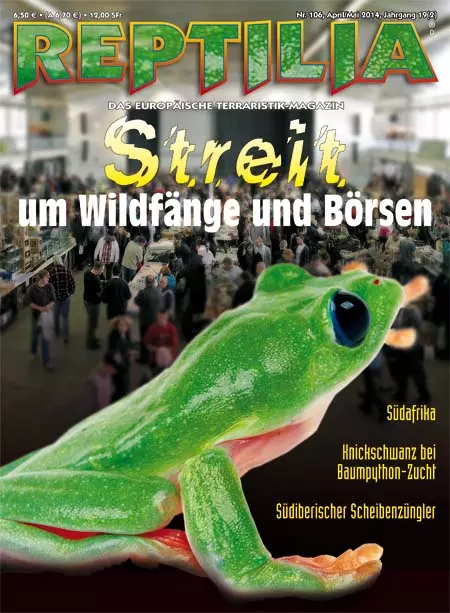
Terraria 52 - Expedition Borneo
Terraria 52 - Expedition Borneo Glass creepNewly described amphibians 2014 Contents: Borneo is the third largest island in the world and home to a unique variety of amphibians and reptiles. For herpetologists, it therefore has an almost mystical ring to it. We give you an overview of the biodiversity of this island and take you on current expeditions to explore the local herpetofauna.TerritorialHerpetoramaSuccessful snake model – oldest fossils discovered / Thorn devils: Larval-bearing fang frog / Reptile rescue centre in Munich: We urgently need help! / Cultural successor: Not at all poisonous adder / Leafhoppers: Sand lizards cost Lenin his head / Killer cats and animal welfare          Cover storyOn the way to the last wild paradises in the land of the headhunters on BorneoAxel Hilger In the north of Sarawak. An expedition reportJörg Hofmann The amphibians of the Gunung Mulu National Park on Borneo            Rudolf Malkmus PanoramaMaster for the masterless. A reptile rescue centre as a workplaceAndrea Frank Research New species            List of amphibians newly described in 2014            Axel Kwet Molecular differentiation of flagellates in reptiles. A research project in the Ingo-und-Waltraud-Pauler-Fonds of the DGHTDr Barbara Richter & Dr Nikola Pantchev Salamandra TerraristicsColourful underground fighters. Keeping and breeding the glass snake Dopasia gracilisAndreas Danier Also in your neighbourhood Nature and species conservation Field Notes            Instead of hibernation: Activity and prey acquisition of alpine and pond newts in southern Hesse            Alfred Buschinger Instead of going ashore in autumn: late larvae of common toads in the AllgäuAxel Kwet Observations on the predation behaviour of the large arrow snake (Dolichophis jugularis jugularis) in CyprusDaniel Jestrzemski Subscription & ServicePreview Incubator No more bees and flowers!            Heiko Werning

CHF 12.00

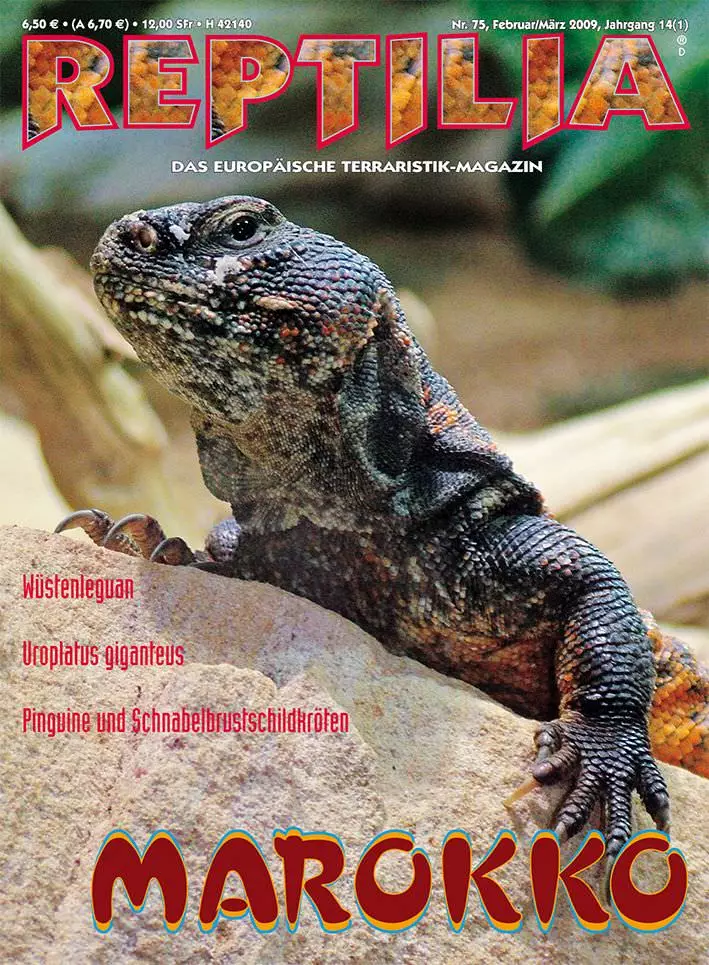
Terraria 08 - Yemen Chameleons
Terraria 08 - Yemen ChameleonsCrocodile newtsBreeding of mealwormsContents:2 EditorialHeiko WERNING TOPIC4 Chamaeleo calyptratus – a creature unknown!Nicolá LUTZMANN12 10 years of keeping and breeding Yemen chameleonsDavid HELLENDRUNG20 Hidden invadersBill LOVE24 Construction of a free room enclosure for keeping Yemen and panther chameleonsAndreas DICKHOFF & Tanja DICKHOFFSCIENCE35 Herpetorama External parasites in the king python / The closest relatives of snakes37 New species Naja ashei / Micrurus silviae & M. altirostris / Atractus40-43 Among researchers Of iguana islands and rainforests: Biodiversity research in HondurasAlexander GUTSCHE44 Keeping, Care and Breeding of the Mealworm Beetle (Tenebrio molitor) Peter Maria MÜLLER48 The Yellow Crocodile Newt, Tylototriton shanjing: Taxonomy, Care and BreedingWolf-Rüdiger GROSSE54 North American soft-shelled turtles of the genus ApalonePart 2: The Apalone speciesAndreas S. HENNIG62 Centruroides limbatus Daniel GAISER66 Experiences with keeping and breeding the forest tortoise Part 2 Read NIESSEN TRAVEL70 In the mountain rainforests of Mount Kinabalu/BorneoPart 3Rudolf MALKMUS TERRARIUM PRACTICE83 Test run Measurement and control technology from Lucky Reptile84 Prelude A good start: the Transpecos rat snake (Bogertophis subocularis)Michaela SCHULZ & Marco SCHULZ88 Eye-catcherThe snake cupboard - a visit to garter snake breeder Jörn FischbeckMike ZAWADZKI92 Also in your neighbourhood 95 TERRAnetGarter snake pages96 TERRAglobal With pleated skirt and high heels into the rainforestJoachim BULIANPerils of a herpetologist, part IIManuel ACEVEDO104 TERRAwinn

CHF 11.20

Hard armour - soft heart
The turtle expert Thorsten Geier would like to inspire you as a turtle enthusiast to keep these special animals as close to nature as possible. Based on his almost 20 years of in-depth experience with European tortoises, he provides a wealth of practical advice and tips for practical use: using nature as a model, he explains that the animals should be spared a life in a terrarium. His guide contains over 180 pages of detailed suggestions for keeping animals close to nature. Thorsten Geier explains the design of outdoor enclosures and presents suitable and less suitable food plants. Other topics include: optimal nutrition, caring for hatchlings and young animals, winter torpor, animal health, successful reproduction, species protection, but also mistakes in keeping tortoises and much more. Over 200 photos of the animals' habitat, enclosure photos, plant pictures etc. make this book a particularly valuable read. In a separate chapter, the author addresses our youngest turtle friends. Thorsten Geier would like to encourage them (and their parents) in particular to treat turtles in a species-appropriate manner.

CHF 21.90

Draco 40 - Dinosaurs, the return of the prehistoric giants
Draco 40 - Dinosaurs, the return of the prehistoric giants Contents: Editorial Dinosaurs - a success story of evolutionRainer Schoch, State Museum of Natural History Stuttgart Living fossils - digital dinosaurs in 3D qualityAxel Kwet Dinosaur show - in the realm of the giantsAxel Kwet Argentina - birthplace of the dinosaursBernd Herkner, Senckenberg Research Institute and Nature Museum Wild children's room - or: How a dinosaur book is madeMarkus Paßlick The tracks found in the Obernkirchen sandstone quarriesThorsten van der Lubbe, Lower Saxony State Museum Hanover In dinosaur countryHeiko Werning Magazine

CHF 18.40

Customers also saw

Nekton R Vitamin Supplement
gram: 35g
Nekton R Vitamin Supplement with Colour Intensification Vitamin supplement with colour intensification for the red areas of the plumage During rearing and moulting, Nekton R offers the best support for a healthy bird’s life thanks to a sophisticated blend of vitamins, amino acids, trace elements, minerals and colourants. The physiologically safe, food-grade colourant canthaxanthin, which occurs in the same composition in nature, ensures glossy feathers and bright red colours. A long-term, beneficial dietary supplement for all birds with red in their plumage. Prevents the fading of plumage colours Positive effects on the natural lustre (the brilliance of the plumage) Supports moulting/ rearing Provides all important nutrients Composition: Dextrose, silica, calcium carbonate Feeding guide:Daily for approx. 10 small birds, e.g. canaries: 1g Nekton R in 250ml water or 100g soft foodNekton R is administered via drinking water or soft food from the start of moulting/rearing until the end of moulting or complete colour change. No other multivitamin preparation should be administered during the use of Nekton R.

CHF 11.50