Reptilia 46 - Frogs in danger

Article no: reptilia46

CHF 11.20

Stock: 0

Ready for dispatch in 1-3 days, delivery time 7 working days

Delivery between Tuesday, 28 April and Wednesday, 29 April
Zahlungsarten
Product information "Reptilia 46 - Frogs in danger"

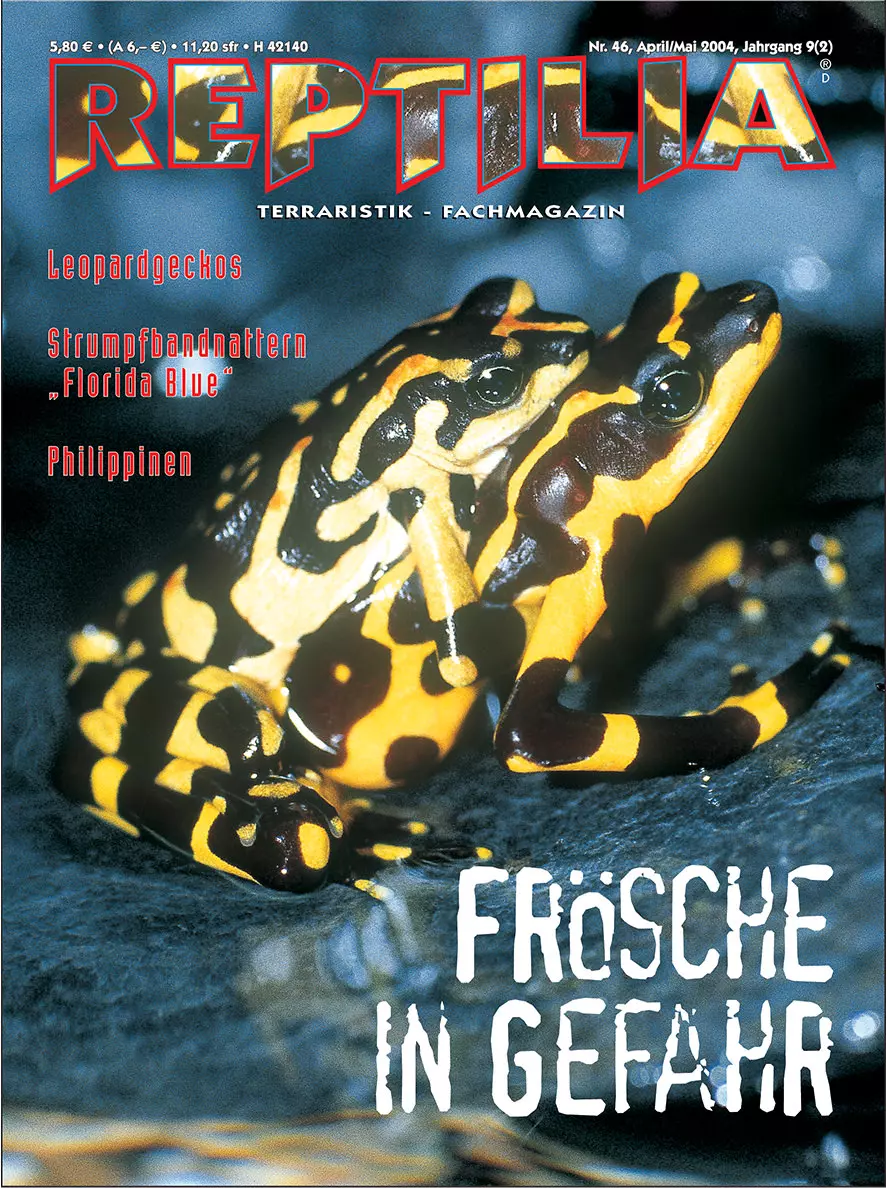
Reptilia 46 - Frogs in danger

Leopard geckos
Garter snakes "Florida blue"
Philippines

Contents:

    • 2 EDITORIAL
    • 4 MAGAZINE
    • 11 DATES
    • 14 WESTERN HERP PERSPECTIVES
      Small game in the sand
      by B. Love
    • 16 PHOTO REPORTAGE
      Amphibian extinction: insight into the history and current research
      by S. Lötters
    • 24 REPORTAGE
      Nose frogs in danger - Hope for the semi-aquatic nose frog (Rhinoderma rufum)? by K. Busse & H. Werning
    • 34 HERPETOFAUNA
      The decline of frog populations in the high Andes of Venezuela by E. La Marca
    • 39 REPORTAGE
      Amphibian extinction in African style by S. Schick
    • 45 TRAVEL
      Clicking, ringing, whistling and shooting - the frogs of Panay by M. Gaulke
    • 51 PORTRAIT AND POSTER
      Testudo hermanni boettgeri
      by B. Trapp
    • 56 KEEPING AND BREEDING
      The leopard gecko - not just a beginner's animal
      Keeping and breeding of Eublepharis macularius in the terrarium
      by T. Wilms
    • 63 HERPETOFAUNA
      Not every blue garter snake is a "similis" - On distinguishing the blue forms of the common garter snake Thamnophis sirtalis sirtalis "florida blue" and the Florida garter snake Thamnophis sirtalis similis
      by M. Hallmen
    • 70 KEEPING AND BREEDING
      Keeping and breeding the red-eyed slender-headed turtle Emydura subglubosa
      by A. S. Hennig
    • 74 HERPETOFAUNA
      North America's king of rattlesnakes – Crotalus atrox – Part 2
      by D. Schmidt
    • 80 REPORTAGE
      Planning and construction of a reptile zoo: "Reptilium - Terrarium and Desert Zoo" in Landau - Part 1: The planning phase
      by T. Wilms
    • 86 SMALL ADVERTS
    • 94 RAT & TAT
    • 96 LIBRARY
  • 104 GLOSSES
    The Costa Cordalis of Wedding
    by H. Werning
Composition
Feeding recommendation
Technical details
Size information

0 of 0 reviews

Give us a rating!

Share your experience with the product with other customers.


Suggested products

Handbook of food plants for tortoises and other reptiles
Handbook of forage plants 2nd revised editionMarion Minch is not only a successful breeder of diverse tortoises for many years, but also an excellent connoisseur of native wild herbs. She founded and runs samenkiste.de, which is well known to many tortoise keepers and nature lovers. Her name is inextricably linked with reptile care and species-appropriate nutrition for tortoises. Her handbook of food plants summarises the most important native food plants for herbivorous and omnivorous reptiles. She not only considers tortoises, but also iguanas, spiny-tailed dragons and even chameleons. From the basics of plant biology to native wild herbs to suitable food plants for hardy tropical reptile species, this comprehensive work provides the basis for species-appropriate keeping. In the expanded and supplemented 2nd edition, the plant section is divided according to flower colour. This makes it even easier to identify wild herbs. The work has also been supplemented with a wealth of additional information and many pictures.

CHF 46.50

Geckos
Geckos in the terrarium by Astrid FalkThe book offers a comprehensive introduction to geckos and their species-appropriate keeping in terrariums. It explains what you need to think about before buying a gecko and what preparations should be made. The book describes in detail how the terrarium is technically equipped and set up. The care of the animals, their special features and behaviour, their diet, reproduction and rearing of young animals are described, as well as diseases and husbandry problems with tried and tested suggestions for prevention and treatment. Individual gecko species that are particularly suitable for keeping and breeding in terrariums are portrayed in detail in the second part of the book.

CHF 28.50

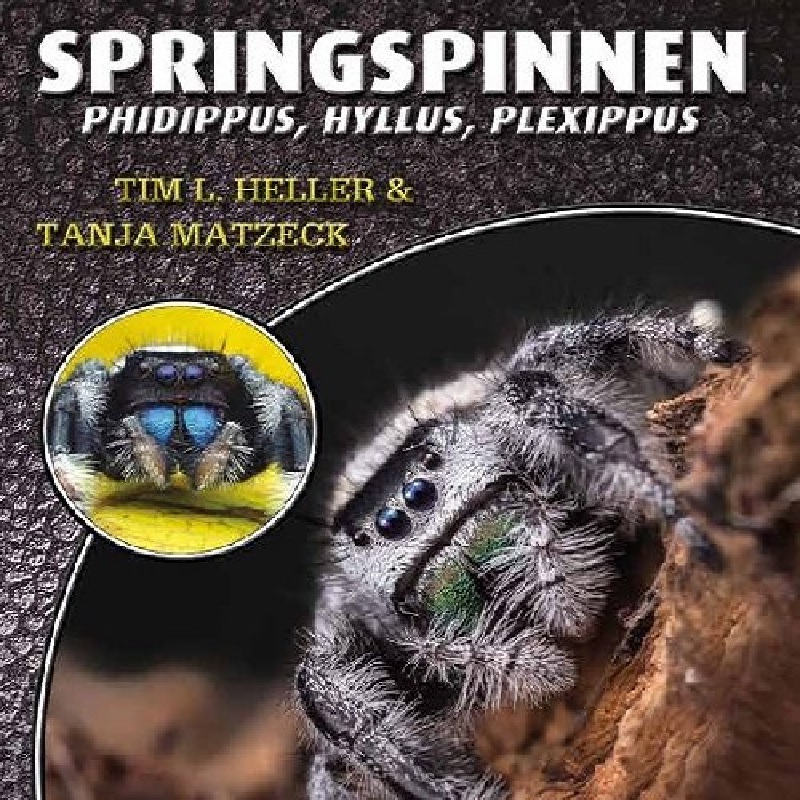
Jumping spiders Phidippus, Hyllus, Plexippus
Book Jumping Spiders - Phidippus, Hyllus & Plexippus A guide to keeping jumping spiders of the genera Phidippus, Hyllus & Plexippus. Who can resist the charm of jumping spiders? The childlike appearance of their expressive face simply leaves no one cold! In addition, their behavior is extremely exciting to observe, their colors are bright and their requirements for species-appropriate keeping are very easy to meet. No wonder these likeable jumpers are all the rage! This volume in the "Species by Species" series describes in detail what to look out for when buying and keeping them, introduces the most commonly kept species and color forms and provides plenty of tips on how to keep them successfully - so you can be sure they will breed well! Species by Species introduces you to the books in this series, which present the most popular terrarium animals. Each volume offers you detailed, practical care instructions and all the information you need to successfully breed your animals. All important questions from the required tank size to terrarium set-up, technical equipment, species-appropriate nutrition and disease prevention are answered with numerous tricks and tips. Experienced, long-standing breeders reveal how you can encourage the animals to reproduce and raise healthy young. All this in full color, generously illustrated and attractively designed - just about your terrarium animal - species by species

CHF 23.90

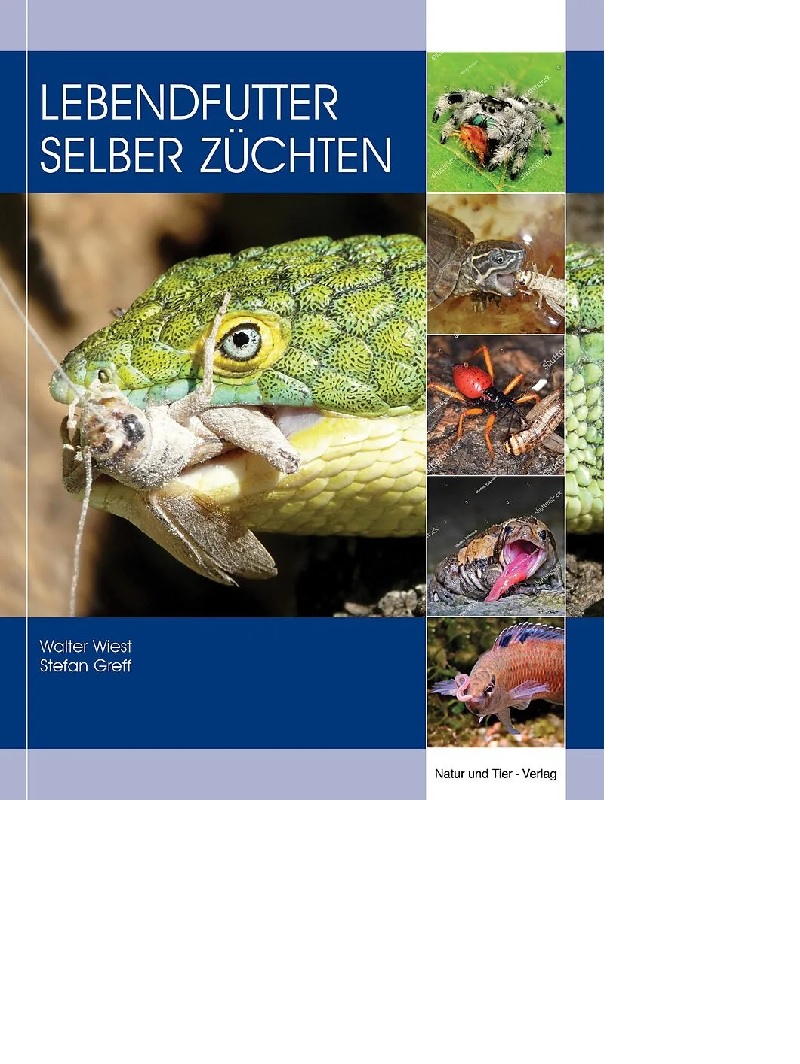
Book Breeding live food yourself
Book "Grow your own live food" - The perfect guide for pet owners Discover practical and detailed instructions on how you can easily breed food for your reptiles, birds, fish or other animals yourself in the book "Breeding live food yourself". With valuable tips on various food insects, their care and breeding, you can save money and ensure a species-appropriate diet for your pets. Contents of the book: Step-by-step instructions for breeding feeder insects Information on the best types of food for reptiles, birds and fish Care instructions and breeding conditions for various live food species Tips for sustainable and cost-effective food production Why breed your own live food? Get healthy, fresh food for your animals Save money and reduce dependence on pet shops Promote the health and well-being of your animals with species-appropriate food Whether you are a beginner or an experienced pet owner, this book provides you with everything you need to successfully breed live food yourself.

CHF 46.50

Marginata 69 - New Guinea tortoises
Marginata 69 - New Guinea tortoises – the genus ElseyaCover storyThe unrecognised beauties: New Guinea tortoises (Andreas S. Hennig)My experiences with Branderhorst's New Guinea tortoise, Elseya (Elseya) branderhorsti (Ouwens, 1914) (Andreas S. Hennig)Keeping and breeding of Rhodin's New Guinea tortoise, Elseya (Hanwarachelys) rhodini Thomson, Amepou, Anamiato & Georges, 2015 (Andreas S. Hennig)PortraitGeoemyda spengleri, Chinese serrated tortoise (Andreas S. Hennig)ReportageMacrochelys temminckii – Experiences and impressions with vulture tortoises part 2 (Reiner Praschag)KeepingAn alternative to year-round keeping of the Egyptian tortoise in the terrarium – my experiences with seasonal outdoor keeping of Testudo kleinmanni (Ricarda Schramm)EtymologySawbacks and living maps part 4: Graptemys gibbonsi, Pascagoula humpback tortoise (Holger Vetter)Classifieds & animal placement

CHF 16.50

Terraria 51 - Amphibian crisis
Terraria 51 - Amphibian crisis ChacoMoroccan day gecko Contents: Cover story: Amphibian crisis The global amphibian crisis is threatening frogs all over the world, and we may be facing a dramatic extinction of species. One glimmer of hope is the so-called amphibian ark, the targeted breeding of particularly endangered species in human care. In the cover story of the next issue of TERRARIA/elaphe, we look at various methods used by zoos, scientific institutions and private keepers to successfully breed frogs in the long term. Territorial Herpetorama Cover story Tailed amphibians in danger a “salamander-eating fungus” spreads in EuropeAxel Kwet Questions about the Salamander EaterInterview with Prof. Frank Pasmans, with questions from Axel Kwet Species conservation and captive breeding of amphibians a new approach to keeping cave-dwelling paddle-footed frogs using Rhacophorus orloviMikhail F. Bagaturov, Anna A. Bagaturova & Rustam K. Berdiev PanoramaImpressions of the herpetofauna in the Chaco of ParaguayStephan Böhm The ruin lizards (Podarcis siculus tyrrhenicus) of the island of GiannutriJürgen Gebhart Research New speciesNew keel-tailed iguanas of the genus TropidurusAxel Kwet Newly described: three Japanese angle-toothed newts from KyushuAxel Kwet Among researchersField study on the Cypriot Levantine viper (Macrovipera lebetina lebetina)Daniel Jestrzemski An observation on ophiophagy in the puff adder (Bitis arietans)Tobias Machts Salamandra TerraristicsThe day gecko of south-western Morocco Quedenfeldtia moerens (Chabanaud, 1916)Uwe Schlüter Also in your neighbourhood Nature and species conservation Field notesFrost effect on the spawn of the grass frogRudolf Malkmus Hail damage to amphibians?Axel Kwet Strange toad observations on the island of SyltWolf-Rüdiger Grosse Subscription & Service GalleryThe Thesaurus of Albertus Seba. Old treasures in the Berlin Museum of Natural HistoryAxel Kwet, Rainer Günther & Aaron Bauer Preview Incubator Smoke detectorRolf Leptien

CHF 12.00

Terraria 20 - Varied poison dart frogs
Terraria 20 - Diverse poison dart frogs Pacific boasComb spiders of the genus Phoneutria Contents: Poison dart frogs are the most popular amphibians in terraristics, and they have been successfully kept and bred for decades. So you should know everything there is to know about the "jewels of the rainforest" by now? Far from it! These magnificent frogs always have tangible surprises and novelties in store for us, even with seemingly well-known species. In a spectacularly illustrated report, Frank Steinmann looks at the countless local forms of the golden tree frog, Dendrobates auratus, and reveals why many of the names circulating in terraristics for the colour forms are misleading. Ivonne Meuche has been researching strawberry frogs in Costa Rica for years and reports on the most interesting results that have not yet been scientifically published. And we also show photos of a beautiful, newly discovered and as yet undescribed dendrobatid, the Golden Supatá poison dart frog, which André Schreiber observed in Colombia.EditorialMagazine Snake systematics special: New systematics of South American Pit vipers Species status again for the Dark Tiger Python, subspecies status for the Sulawesi Dwarf Tiger Python Make five out of one – The new systematics of the chain snake complex Autumn TERRARISTIKA in Hamm Legal: Again: Right of retention of the animal The aga toad – or how to benefit from an aggressively invasive species On the distribution of Hemidactylus mabouia in Paraguay Test run addendum TERRAglobalThe frilled lizard: A miniature dinosaurKarl-Heinz SWITAKBack in the fieldMaik DOBIEYTITLE THEME: Diverse poison dart frogs"Further notes" on Dendrobates auratus – the variability of the golden tree frog in PanamaFrank STEINMANNIn the area of Ranitomeya dorisswansonaeAndré SCHREIBEROophaga pumilio – The strawberry frog in the spotlight of researchIvonne MEUCHE"Rana dorada de Supatá" – the Golden Supatá poison dart frog from ColombiaAndré SCHREIBERPacific boas in the terrarium – Candoia carinata and Candoia paulsoniRenè MEIERKORDThe Northern Pine Snake (Pituophis melanoleucus melanoleucus) in the wild and terrarium. Part 2Bernd SKUBOWIUSThe genus Phoneutria – keeping and breedingReinhard HÜBERS and Dirk REIMANNTRAVEL"Exo Terra" Expedition Tanzania 2008 Part 2: A new chameleon speciesRoland ZOBELNEW SPECIESNew monitor species discovered in IndonesiaAndré KOCHTwo new day geckos from MadagascarAxel KWETBrazilian angel frogAxel KWETAMONG RESEARCHERSHerpetological research in Central AmericaAndreas HERTZ and Sebastian LOTZKATEYE-CATCHERIf you love your lizards, you carry them on your hands. Exceptional successes with toad lizardsKriton KUNZNear youSubscription & ServicePreviewIncubatorThe "Rock Helga" – A Morocco adventure in two parts (Part 2)Mike ZAWADZKI

CHF 12.00

Reptilia 70 - Mambas
Reptilia 70 - Mambas Outdoor terrariumFalse water cobraWarty newts Contents: 2 EDITORIAL 4 MAGAZINE 13 DATES 16 WESTERN HERP PERSPECTIVESDoctor Frankenstein's work continuesBy B. Love 18 PHOTO REPORTAGEMambasBy J. Valverde 26 HERPETOFAUNAObservations on the behaviour of the greencoloured mambas (Dendroaspis viridis,D. angusticeps and D. jamesoni kaimosae) in the terrariumBy R. Aeberhard 31 KEEPING AND BREEDINGDendroaspis jamesoni kaimosae –Keeping and first experiences with the breeding of Jameson's MambaBy R. Aeberhard 38 TRAVELNorth Carolina's southern coastal plain –A paradise for reptile enthusiastsBy H. Luef 51 PORTRAIT AND POSTERMauremys rivulataBy B. Trapp 55 KEEPING AND BREEDINGBreeding of the Vietnamese and theLaos warty newtBy P. Bachhausen & G. Espallargas 65 KEEPING AND BREEDINGHydrodynastes gigas – from rearing tobreeding the false water cobraBy R. Meierkord 70 HERPETOFAUNAFringed-finger lizards (Acanthodactylus) in the wild and in the terrariumPart 3: The Acanthodactylus cantoris groupBy U. Schlüter 76 REPORTAGEFrom one make two – Conversion of an outdoor terrarium for snakesPart 1: The technical side of the conversionBy M. Hallmen 85 FAQ – FREQUENTLY ASKED QUESTIONSDead leaf mantisesBy K. Kunz 91 LIBRARY 104 INCUBATOR Zoo director – Part 1By H. Werning

CHF 12.00

NTV - African white-bellied hedgehog
NTV - African white-bellied hedgehog - All about the small, prickly animals you will learn in this book. 64 pages Format: 14.8 x 21 cm numerous color photos Daniela Guist Content: Hedgehogs are simply sympathizers. Who could escape the curiosity of such a little sting-knight? It is no wonder that especially the pretty Weissbauchigel has mixed the kleinsäugerszene and now belongs in all its attractive color variants among the most popular exotics in the domestic animal husbandry. Its multifaceted behavior, the communication among each other and the family life together inspire the owner. Author Daniela Guist has been holding and breeding Weissbauchigel for a long time and is a proven expert in this field. In this book, she describes her experiences and describes in detail and practical ways how the prickly bladders are nurtured and cultivated. A must for all hedgehogs! The barbed dress distribution and habitat Transport and quarantine The enclosure Feed and water behavior health The handling of white belly offspring color forms

CHF 21.90

Small mammals in terrariums
The book explains everything about the care and keeping of small animals. 144 pages 163 photos 2 graphics Format: 16.8 x 21.8 cm 2nd revised edition Author Christian Ehrlich Publisher NTV Contents: Away from the stuffy cage and towards modern and species-appropriate animal husbandry: many small mammals are best kept in a suitably equipped terrarium. This book presents the most suitable types of terrarium and provides a detailed and practical description of how to breed and care for the animals successfully. Anatomy, lineage and systematics Distribution, biotopes, adaptations All information on species-appropriate keeping: from suitable terrariums to equipment and technology to feeding Successful breeding: Mating stimulation and rearing of young animals Taming small mammals Topic free-range: This is how it is species-appropriate. Solutions to problems: How to avoid the most common mistakes in care, and how to help sick animals: Keeping animals healthy Huge species section with detailed portraits of 80 species of marsupials, predatory marsupials, true marsupials, xenarthrans, insectivores, bats, rodents and sengis Brilliant photos Many animal lovers no longer want to be satisfied with just the classic hamster in the equally classic hamster cage. If you want to keep and observe such exciting animals as hedgehogs, opossums, predatory marsupials, sugar gliders, armadillos, tenrecs, ground squirrels, squirrels, bats & co., this book is a must, because all of them and many more are best kept in a suitably equipped terrarium. Christian Ehrlich, editor of the specialist magazine RODENTIA, has now dealt with this topical subject in detail. The author is able to draw on his many years of experience in keeping and breeding small mammals from various related groups and shares his insights here in an easy-to-read but extremely expert manner. Ehrlich describes the biology of the animals, presents their specific husbandry requirements and gives plenty of tips on their successful care and breeding. The book offers detailed portraits of no less than 80 species of marsupials, predatory marsupials, true marsupials, xenarthrans, insectivores, bats, rodents and sengis. For all friends of very special animals and for all those who strive for species-appropriate animal husbandry, this book is an absolute must.

CHF 35.90

Bird spiders in the terrarium
Alles über Vogelspinnen im Terrarium von Martin Meinhardt 136 Seiten 123 Farbfotos, mit Karte und 4 grafischen Darstellungen Format: 16,8 x 21,8 cm 3. Auflage Taschenbuch Autor Martin Meinhardt Verlag NTV Inhalt: Vogelspinnen sind traumhafte Terrarientiere! Ihr attraktives Äusseres und das spannende Verhalten lassen sie in der Gunst der Spinnenfreunde ganz oben stehen. Der langjährige und versierte Züchter Martin Meinhardt erläutert in dieser überarbeiteten und um viele Artporträts erweiterten Auflage seines Praxis-Ratgebers alles, was Sie für die artgerechte Pflege und die erfolgreiche Nachzucht der Tiere wissen müssen. Systematik – die Verwandtschaft der Vogelspinnen Körperbau – so funktioniert eine Vogelspinne Gift und Brennhaare – warum Vogelspinnen trotzdem nicht gefährlich sind Verhalten – Beuteerwerb, Balz und Fortpflanzung Artgerechte Pflege – Einrichten und Klimatisieren geeigneter Terrarien; Vogelspinnen richtig füttern Erfolgreich nachzüchten – Geschlechtsunterschiede, Verpaarung, Aufzucht der Jungtiere Detaillierte Artporträts – ausführliche Informationen zu besonders geeigneten Arten Faszinierende Farbfotos

CHF 33.50

Reptilia 99 - Saving energy in terraristics
Reptilia 99 - Saving energy in terraristics Red-backed spiderIncubation of monitor lizard eggsHind Indian hinged tortoise Contents: EDITORIALMAGAZINE AROUND THE WORLD IN 5 YEARSWaiting with turtlesA. Pachmann DATES WESTERN HERP PERSPECTIVESAgainst winter depressionB. Love PHOTOREPORTAGEEnergy revolution in the terrarium. Ideas and suggestions on how to reduce power consumption and energy costs when keeping terrarium animalsB. Akeret REPORTAGEAmphibians and reptiles in the energy-saving house. Opportunities and possibilities of the Renewable Energy Sources Act for terrarium husbandryT. Eisenberg REPORTAGELarge terrariums for giant snakes and saving energy – a contradiction?S. Müller KEEPING AND BREEDINGKeeping and breeding the red-backed spider (Latrodectus hasselti)M. Schmidt HERPETOFAUNAFringed-finger lizards (Acanthodactylus) in the wild and in the terrarium. Part 6: The Acanthodactylus-boskianus groupU. Schlüter REPRODUCTIONOn the incubation of clutches of Varanus kingorum, King's dwarf monitorR. Vitt REPORTAGELooking for snakes on a family holiday. A drama in three actsT. Schmidt REPORTAGEThe tortoises of Kalogria (Peloponnese)M. Rogner ANIMALS OF OUR HOMEThe grass frogR. Leptien Test runLibrarySUBSCRIPTION & SERVICEALSO NEAR YOU TRAVELVisiting Cuora galbinifrons on Hainan, ChinaT. Blanck PREVIEW BRUTKASTEN I would even let myself be locked up for REPTILIA – Part 1H. Werning

CHF 12.00