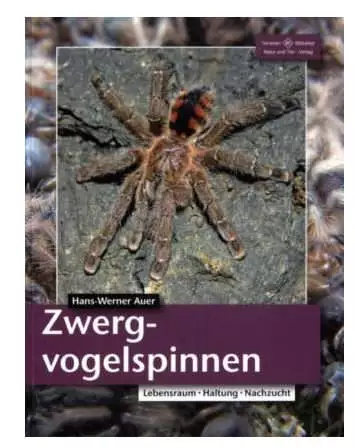
NTV - Dwarf tarantulas all about keeping and caring for these amazing tiny creatures.
160 pages
179 photos
Paperback
Publication date 24.06.2011
1st edition
Author Hans-Werner Auer
Anyone interested in dwarf tarantulas, i.e. very small species, has hit the jackpot: These tiny creatures include some of the most exciting, spectacular and colourful species of all! What's more, spider lovers can keep and observe a large number of different tree and ground dwellers in a very small space. And this hobby never gets boring anyway, as new, wonderful species are constantly being discovered and introduced to terraristics.
Composition
Feeding recommendation
Technical details
Size information
0 of 0 reviews
Give us a rating!
Share your experience with the product with other customers.
Login
No reviews found. Go ahead and share your findings with others.
Handbook of forage plants 2nd revised editionMarion Minch is not only a successful breeder of diverse tortoises for many years, but also an excellent connoisseur of native wild herbs. She founded and runs samenkiste.de, which is well known to many tortoise keepers and nature lovers. Her name is inextricably linked with reptile care and species-appropriate nutrition for tortoises. Her handbook of food plants summarises the most important native food plants for herbivorous and omnivorous reptiles. She not only considers tortoises, but also iguanas, spiny-tailed dragons and even chameleons. From the basics of plant biology to native wild herbs to suitable food plants for hardy tropical reptile species, this comprehensive work provides the basis for species-appropriate keeping. In the expanded and supplemented 2nd edition, the plant section is divided according to flower colour. This makes it even easier to identify wild herbs. The work has also been supplemented with a wealth of additional information and many pictures.
Geckos in the terrarium by Astrid FalkThe book offers a comprehensive introduction to geckos and their species-appropriate keeping in terrariums. It explains what you need to think about before buying a gecko and what preparations should be made. The book describes in detail how the terrarium is technically equipped and set up. The care of the animals, their special features and behaviour, their diet, reproduction and rearing of young animals are described, as well as diseases and husbandry problems with tried and tested suggestions for prevention and treatment. Individual gecko species that are particularly suitable for keeping and breeding in terrariums are portrayed in detail in the second part of the book.
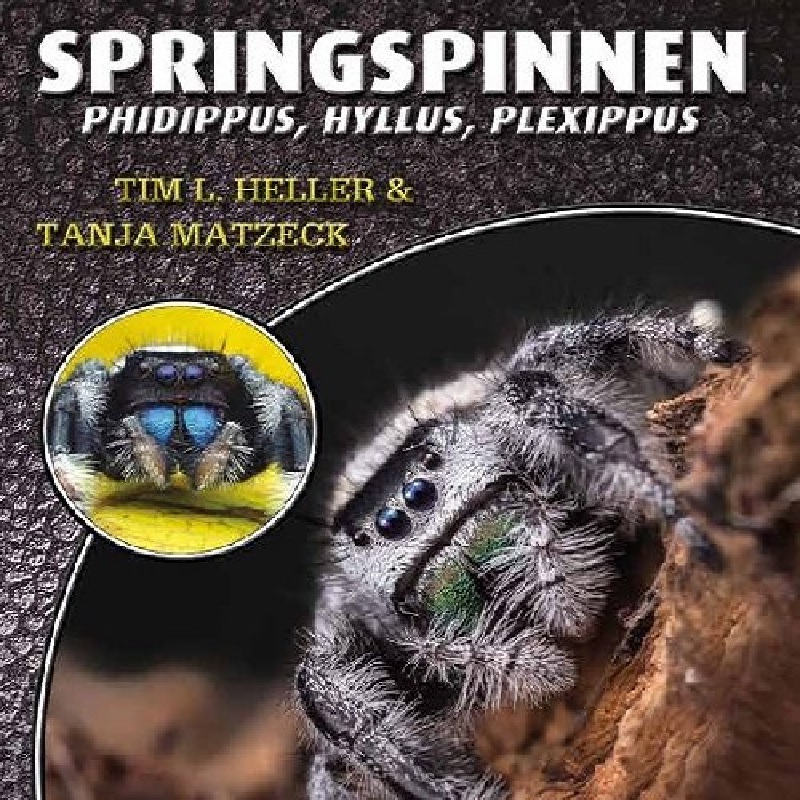
Book Jumping Spiders -
Phidippus, Hyllus & Plexippus
A guide to keeping jumping spiders of the genera Phidippus, Hyllus & Plexippus. Who can resist the charm of jumping spiders? The childlike appearance of their expressive face simply leaves no one cold! In addition, their behavior is extremely exciting to observe, their colors are bright and their requirements for species-appropriate keeping are very easy to meet. No wonder these likeable jumpers are all the rage!
This volume in the "Species by Species" series describes in detail what to look out for when buying and keeping them, introduces the most commonly kept species and color forms and provides plenty of tips on how to keep them successfully - so you can be sure they will breed well!
Species by Species introduces you to the books in this series, which present the most popular terrarium animals. Each volume offers you detailed, practical care instructions and all the information you need to successfully breed your animals.
All important questions from the required tank size to terrarium set-up, technical equipment, species-appropriate nutrition and disease prevention are answered with numerous tricks and tips.
Experienced, long-standing breeders reveal how you can encourage the animals to reproduce and raise healthy young.
All this in full color, generously illustrated and attractively designed - just about your terrarium animal - species by species
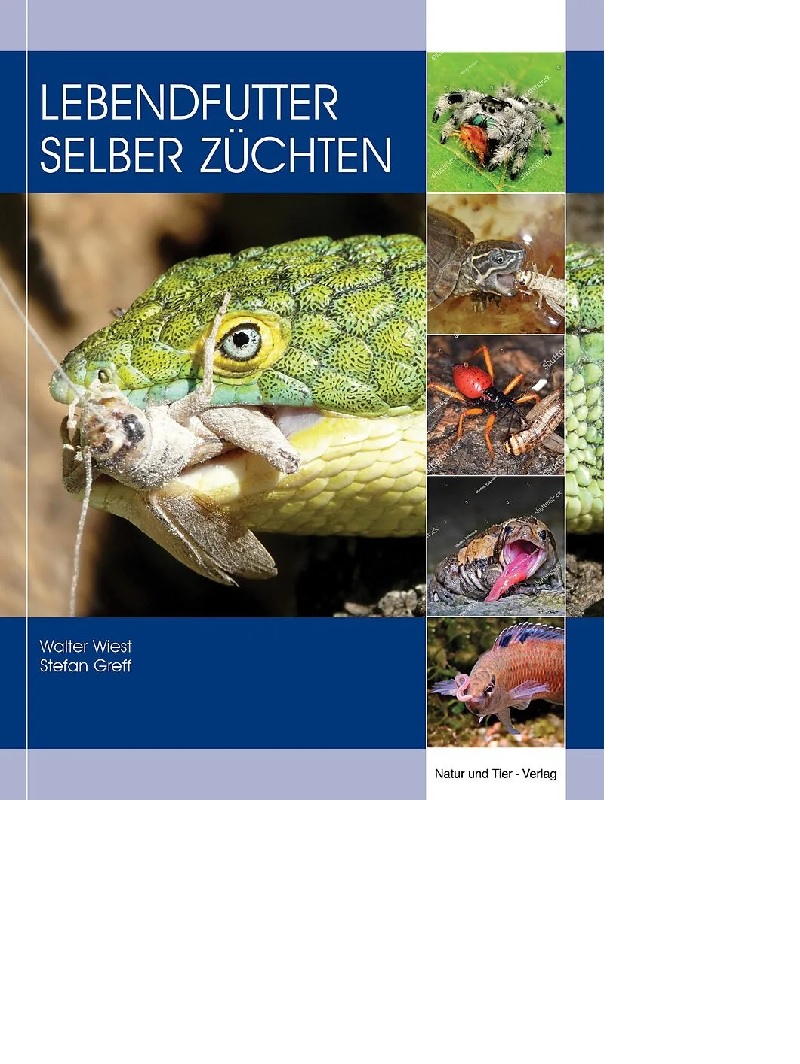
Book "Grow your own live food" - The perfect guide for pet owners
Discover practical and detailed instructions on how you can easily breed food for your reptiles, birds, fish or other animals yourself in the book "Breeding live food yourself". With valuable tips on various food insects, their care and breeding, you can save money and ensure a species-appropriate diet for your pets.
Contents of the book:
Step-by-step instructions for breeding feeder insects
Information on the best types of food for reptiles, birds and fish
Care instructions and breeding conditions for various live food species
Tips for sustainable and cost-effective food production
Why breed your own live food?
Get healthy, fresh food for your animals
Save money and reduce dependence on pet shops
Promote the health and well-being of your animals with species-appropriate food
Whether you are a beginner or an experienced pet owner, this book provides you with everything you need to successfully breed live food yourself.
Marginata 69 - New Guinea tortoises – the genus ElseyaCover storyThe unrecognised beauties: New Guinea tortoises (Andreas S. Hennig)My experiences with Branderhorst's New Guinea tortoise, Elseya (Elseya) branderhorsti (Ouwens, 1914) (Andreas S. Hennig)Keeping and breeding of Rhodin's New Guinea tortoise, Elseya (Hanwarachelys) rhodini Thomson, Amepou, Anamiato & Georges, 2015 (Andreas S. Hennig)PortraitGeoemyda spengleri, Chinese serrated tortoise (Andreas S. Hennig)ReportageMacrochelys temminckii – Experiences and impressions with vulture tortoises part 2 (Reiner Praschag)KeepingAn alternative to year-round keeping of the Egyptian tortoise in the terrarium – my experiences with seasonal outdoor keeping of Testudo kleinmanni (Ricarda Schramm)EtymologySawbacks and living maps part 4: Graptemys gibbonsi, Pascagoula humpback tortoise (Holger Vetter)Classifieds & animal placement
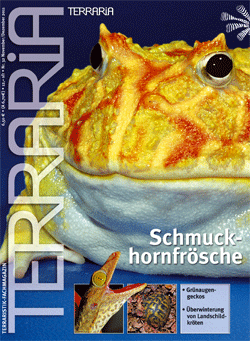
Terraria 32 - Ornamental horned frogsGreen-eyed geckosHibernation of tortoisesContents:They seem to be all about their mouths: horned frogs do not captivate with delicate forms, but rather, alongside their colourful splendour, simply through their presence. They are frogs with character. These perennial favourites in the terrarium world are now also being bred in diverse, very attractive forms. Whilst the number of species in the terrarium has remained very limited for decades, new and exciting species have finally made their way into the ‘Hobby’ in recent times. In our cover story, we introduce you to the attractive representatives of this genus, describe in detail their care and breeding, and discuss current developments. EditorialAxel KwetMagazineNational Breeders’ Expo in Daytona Beach, Florida/Cannibalism in the tree-dwelling toad-leaved frog, Trachycephalus resinifictrix/Giant catch in the Philippines: the world’s largest crocodile/Rescue from an uncomfortable prison/A tiger python that fasted for four and a half years/Legal notice/Recently, at the zooTERRAglobalBarely described - and already almost extinct? Mirco Solé Cover story Jewelled horn frogs - big mouth and what's behind it!Stefan Hochenegger & Kriton KunzKeeping and breeding the Brazilian horned frog, Ceratophrys aurita Fernando LicitraKeeping and breeding the Argentine horned frog, Ceratophrys ornata Erich HirtenlehnerThe world’s longest insect in a terrarium? Keeping and breeding Phobaeticus serratipes and other large stick insects Timm AdamThe turtle year. Outdoor biology and husbandry of European tortoises over the course of the year Part 5: November/December: Hibernation and hibernation Michael WirthExperiences with Smith’s Green-eyed Gecko, Gekko smithii Ingo KoberCare and breeding of the banded spitting cobra, Naja nigricincta nigricinctaMichael KreuzerJourneyUSA - In search of reptiles in the national parks of the West David PrötzelNew speciesTwo new reptiles from Madagascar: a colourful skink and a bizarre leaf-tailed gecko Axel KwetAmong explorers On the hunt for frogs and toads in the outback of the Australian Kimberley Ligia Pizzatto & Camila BothSubscription & ServiceEye-catcherDesert life in the Allgäu - the "Desert Life" by Susan and Werner Kalopp Heiko WerningNear youPreview IncubatorTouristic in the jungle part 2: Cool editor, cooler frog Heiko Werning
Draco 09 - Invertebrates in the terrarium
Content:
2 - Editorial
3 - Invertebrates, by Dieter Masberg
20 - The Landing Crab, by Harry Wölfel
27 - Phasmids (ghost insects, stick insects and walking leaves), by Sven Bradler and Christoph Seiler
33 - Phasmids as pets, by Christoph Seiler and Sven Bradler
38 - The Australian Pfeffermins stick insect Megacrania batesii - no simple fosterling, by Christoph Seiler and Sven Bradler
41 - essence of darkness - essence of light: The Mysterious Life of the Giant and Rose Beetles, by Arndt Löwenberg
55 - Exotic cord feet in the terrarium, by Timm Adam
67 - Safety in scorpion keeping: 10 golden rules, by Herbert Schiejok
70 - Own experiences with the keeping of Euscorpius carpaticus mauretanicus (THORELL, 1876), by Mario Schedel
74 - Pseudoscorpions in nature and in small terrariums, by Kriton Kunz
82 - Book case
94 - Magazine
The content at a glance:Invertebrates - the large army of the animal world, fascinatingly multi-layered, mostly hardly researched and weathered by the otherness to the vertebrates and to us humans since ancient mystery. Dieter Mahsberg's introduction to this unusual DRACO fans out the entire prism of the invertebrates: What characterizes all invertebrates, what groups are there, how do they live? After this overview you will also find a list of all taxa with species numbers that are relevant for keeping - a huge potential of highly interesting animals that will certainly not leave your thirst for research cold!Phasmids (ghost insects, stick insects and wandering leaves)Phasmids are certainly among the stars of the invertebrate boom: Sven Bradler and Christoph Seiler present the basics of the systematics and biology of these interesting animals, which include the longest insect still living today. Learn everything you need to know about the way of life of the well camouflaged invertebrates, marvel at sophisticated protection and defence mechanisms or unusual reproductive strategies. By the way, an extra section of the richly illustrated article is dedicated to the European species: so why not keep your eyes open during your next holiday!Phasmids as petsAnd on we go with the phasmids, because Christoph Seiler and Sven Bradler naturally also explain to you the keeping and breeding of the insects, which are often quite easy to care for, and which as pure herbivores make the time-consuming breeding of feed animals superfluous. The authors name the most important food plants, describe the types of terrariums with which you can meet the different requirements of the animals, and give insider tips on how to reproduce the beautiful insects - and of course they also point out possible sources of error that should be avoided! For beginners in phasmid breeding as well as for old hands an absolute must!The Australian peppermint stick insect Megacrania batesii - no simple fosterlingAnd to make sure that the absolute phasmid experts also get their money's worth, Seiler and Bradler go into detail about the keeping and breeding of this little kept and quite difficult to reproduce species in this article, in which especially the young animals captivate with their rich colors. The secret of the success in the reproduction of the Australian peppermint stick insect begins already with the suitable food, because the animals are very choosy. Seiler and Bradler will give you tips on how to get the plants you need to breed this very special stick insect without spending a lot of money. And, of course, the authors also give you insight into their successful breeding methods, so that after reading this article you have acquired all the prerequisites to try your hand at cultivating this Australian jewel yourself!The hermit crabThey often appear in pet shops and on dealer lists, these cute crustaceans, but hardly anyone knows how to keep them successful. Harry Wölfel presents amazing facts from the biology of these crustaceans, which are not very species-rich but all the more interesting - or did you know that the largest species in this group can reach a range of up to 1 m? Our DRACO author will not only tell you where the land hermit crabs occur and how they "function", but will also explain what to look out for when keeping them, how to set up the terrarium adequately, and he will even give you hints on how to breed them, which is not easy. One of the very few articles in the relevant literature, and in addition so expert and detailed - it's your own fault who as a crab fan escapes this treat!Beings of darkness - Beings of light. The mysterious life of the giant and rose beetlesThese magnificent beetles are certainly among the most beautiful insects of all, and even people who otherwise have nothing to do with "crawling animals" cannot escape the aesthetics of the animals. Did you know why nature has endowed many species of rose beetles with such lavish splendour? Arndt Löwenberg will not only tell you this, but will also give you a comprehensive introduction to the biology of these increasingly cultivated animals. And he gives a practical description of where these pearls and giants of the beetle world come from, how they are kept and bred and what the key to success is!Exotic cord feet in the terrariumUnfortunately, there is almost nothing to be found in the literature about keeping and breeding the quaint string feet. Timm Adam is a competent remedy. What is a string foot, how do these bizarre animals live? The author does not only go into detail about the stars of his contribution, but also about their relatives, for example the Skolopender. But the focus is clearly on the string feet and the role they play in science and terraristics. Are string feet poisonous? How can I set up a suitable terrarium, what do I have to consider with the climatic conditions, how can I feed the animals? And how do you breed these interesting invertebrates? Timm Adam has all the answers ready and does not leave out any hints of problems with their breeding. In short: The ultimate string foot hit!Own experiences with the keeping of Euscorpius carpaticus mauretanicus (Thorell, 1876)If you are fascinated by scorpions, but don't want to bring the most poisonous ones into your house, you are well advised to use specimens of this small species. Their keeping and breeding are not particularly difficult and can therefore be recommended to beginners in scorpion keeping. To make sure that you do everything right from the start, Mario Schedel will show you what to look out for. From the suitable terrarium over aspects like socialization up to the successful offspring all important aspects are covered!Safety in keeping scorpionsTopic number 1 in the keeping of these fascinating arachnids is, of course, always safety, which must be absolutely guaranteed. Scorpion expert Herbert Schiejok points out all the important parameters that have to be observed for a safe keeping, gives tips on which terrarium types are best suited, what has to be taken into account when setting up the tank and what has to be observed when handling the animals in the terrarium. How, for example, do you catch a scorpion safely, how do you move it, and what do I do if the animal has been stabbed in spite of all caution? A responsible terrarium keeper who cares about his own protection and that of his fellow human beings will certainly not miss this contribution!Pseudoscorpions in nature and in the smallest terrariumDo you find scorpions fascinating, but shy away from the risk of a poison sting? You would like to take care of really special animals? How about pseudoscorpions? These tiny creatures, which you can easily find in your garden, in the forest or perhaps even in your house, are very similar to their big relatives, but unlike them they do not have a "tail" with a poison sting. Kriton Kunz overhears with you the secret activities of the funny little guys, presents them fascinating details from the widely unknown biology of the unusual arachnids and gives you tips on where and how you can capture the dwarves. And anyone who has ever maintained or even recreated the bizarre "mini scorpions" in a neatly furnished mini-terrarium will certainly not be able to get rid of them in a hurry!
Reptilia 87 - Crocodiles - primeval animals in danger
Jewelled box turtleDesign of rainforest terrariumsLong-nosed snake, Rhynchophis boulengeriContents:Cover story: Crocodiles – primeval animals in dangerWhen the great dinosaurs ruled the world, crocodiles were already lurking for prey in the swamps of that era. These reptiles have not changed their design significantly for millions of years – a success story of evolution. It is only today that many species are on the brink of extinction because humans are killing them en masse and, above all, destroying their habitats. With the cover story of the next REPTILIA, a high-calibre team of experts opens a series of articles that shed light on the crucial role that zoos can play in saving these living fossils. Dieter Gramentz also presents the precarious situation of the swamp and saltwater crocodile in Sri Lanka, and Ralf Sommerlad reports on a hopeful project to preserve the extremely rare Siamese crocodile.Endangered crocodiles in Europe's zoological gardens? R. Sommerlad, F. Schmidt & T. Ziegler
Table of contents
Editorial MAGAZINE DATES WESTERN HERP PERSPECTIVES “Winter herping” in Florida B. Love
PHOTOSTORY Crocodiles – reptile giants in danger R. Sommerlad
REPORTAGE Endangered crocodiles in Europe's zoological gardens? R. Sommerlad, F. Schmidt & T. Ziegler
REPORTAGE A special conservation project, not only for crocodiles: Danau Mesangat R. Sommerlad
REPORTAGE Threats to and "conservation" of the swamp crocodile (Crocodylus palustris) and the saltwater crocodile (Crocodylus porosus) in Sri Lanka D. Gramentz
PORTRAIT AND POSTER Bufo bufo (Linnaeus, 1758). Common toadA. Kwet & J. Fieber
PRACTICE Near-natural design of rainforest terrariums D. Hluschi
KEEPING AND REPRODUCTION Information on the care, husbandry and breeding of the Vietnamese long-nosed snake, Rhynchophis boulengeri Mocquard, 1897 B. Schulz & K.-D. Schulz
KEEPING AND REPRODUCTION Care and breeding of the Eastern jewelled box turtle, Terrapene ornata ornata M. Wirth & H. P. Mattern
HERPETOFAUNA Black widows. Spiders of the genus Latrodectus C. Nagel & R. Hübers
SUBSCRIPTION & SERVICE ALSO NEAR YOU PREVIEW
INCUBATOR Borderlands. Part 2 H. Werning
Terraria 58 – ‘Amazonas’ setupsNewly described amphibians 2015Responsible venomous snake careContents:Cover story: Amazonian setups – AmazonasTerritorialHerpetoramaSalamander in amber - a spectacular findCultural successor: Crocodile in the AllgäuThorn devils: confusion of names for African toadsInvasive red-cheeked tortoise spreads its wingsBlattsteiger: A dead man helps the survivors - with a turtleLookupCover storyNatural habitats at Wilhelma: a living, man-made ‘Amazonas’ biotopeIsabel Koch & Björn SchäferThe Amazon House at Dortmund Zoo: Territory of the green iguanasSimone KarlowskiThe Guiana dragon tree (Dracaena guianensis) at Schönbrunn ZooDoris Preininger, Manuela Sirny, Eveline Dungl & Anton WeissenbacherPanoramaRio Douro - The Grand Canyon of PortugalRudolf MalkmusResearchNew speciesList of new amphibians described in 2015Axel KwetUnknown invaders: the African clawed frog in EuropeJohn Measey, Thierry Backeljau, Anthony Herrel, Rui Rebeio & Dennis RödderSalamandraTerraristicsA checklist of safety precautions when keeping venomous snakesGerald BenyrImportant and invasive infectious diseases in amphibians: chytrid mycosis and ranavirus infectionsRachel E. Marschang, Kim Oster Heckers & Janosch Dietz Nature and species conservationField notesLight at the end of the tunnelUte Nüsken & Christoph LeebAutumn mating of grass snakesBenny TrappThe dice snake (Natrix tesselata) at the reintroduction site in Knorre near Meissen: current situation and a look back at the floods of June 2013Peter Strasser & Torsten PetersTerrarino - the children's page The spring frogsAlexa SabarthSubscription & ServiceAlso in your neighbourhoodPreviewIncubator In praise of bondageHeiko Werning
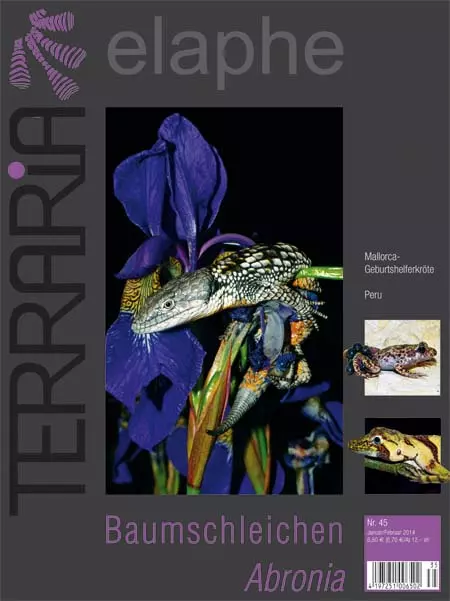
Terraria 45 - Tree creepers AbroniaMajorca Treehugger ToadPeruContents:The fascinating tree creepers are a little-known but particularly magnificent reptile. In their Central American homeland, they are sometimes highly endangered, but in the terrarium hobby more and more species are being successfully kept and bred. We offer a comprehensive overview.TerritorialHerpetoramaCover storyTree Snakes of the Genus AbroniaChristian LangnerKeeping and breeding the tree snake Abronia lythrochilaChristian LangnerPanoramaIn search of amphibians and reptiles at the AmazonasTobias EisenbergResearchAmong researchersBlack toads with red bellies: the genus Melanophryniscus in UruguayRaúl ManeyroNew speciesTwo species of treehollow toad frogsAxel KwetThe Italian slow worm is a separate speciesAxel KwetSun protection for snakes. Investigation into the UV light transmission of the eye scales and skin of some speciesJochen Geiger & Frank BuchterSalamandraTerraristicsKeeping and breeding the Ceylon lancehead, Trimeresurus trigonocephalusKarsten HoerCare and breeding of the Majorcan midwife toad, Alytes muletensisSergé Bogaerts & Uwe SeidelNature and species conservationField notesSnake wedding at the Lopper - Dice snakes at Lake Alpnach, SchweizerUrs & Heidi JöstLate discovery of young sand lizardsAxel Kwet Wall gecko with tickGuntram DeichselCaution poisonous!The amphibian of the year 2014 - a toad with warning colourAndreas Nöllert, Axel Kwet & Richard PodlouckySubscription & ServiceAlso in your neighbourhoodPreviewIncubator Lost Dutchman Part 2Heiko Werning
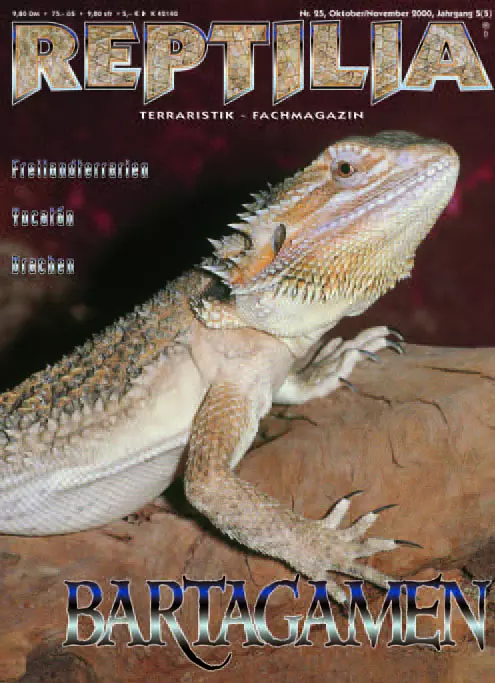
Reptilia 25 - Bearded dragons
Outdoor terrariumsYucatánDragons
Contents:
2 Editorial
4 Letters to the Editor
8 Magazine
16 Dates
20 Western Herp Perspectives: Road Cruising - in search of reptiles and amphibians by car
22 Photo report: The bearded dragons, by A. Hauschild
28 Keeping and breeding: An evergreen: Bearded dragons in the terrarium, by A. Hauschild
33 Herpetofauna: Behaviour and interaction of my bearded dragons (Pogona vitticeps) in the terrarium, by R. Kohlmeyer
39 Report: Bearded dragon fever, by B. Love
43 Journey: Travelling in the realm of the Maya, by L. Barkam and H. Werning
51 Portrait and poster: Trapelus pallidus, by L. Rifai and D. Modry
56 Herpetofauna: Notes on Boiga nigriceps(GÜNTHER, 1863)
62 Report: To Madagascar - for the turtles?, by W. Schmidt and K. Liebel
68 Keeping and breeding: Dendrobates azureus, a blue jewel in the terrarium, U. Dost
73 Terraristics: Building a snake enclosure, Part 1: Basic considerations, by M. Hallmen
78 Herpetology and culture: 'In caves lives the dragon's old brood', a look at the ideas of dragons in East and West, Part 1, by K. Kunz
87 Advice and action
91 Library
104 Gloss: Dead texts don't talk, by L. Hogeback
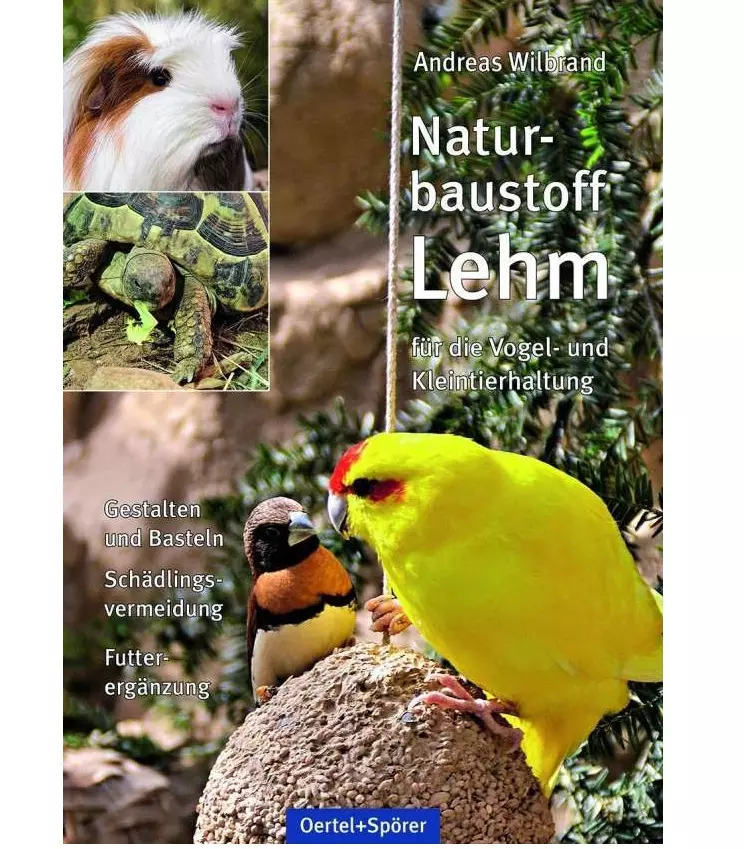
Natural building material clay for keeping birds and small animals
The first clay DIY book for animal lovers - a practical guide with simple instructions, new ideas and health tips!
Designing and crafting
Pest prevention
Feed supplement
Clay is the oldest and most universal building material in the world. The animal world has been demonstrating for millions of years how it can be used to build safe dwellings. And humans also utilised this building material a long time ago and even created huge and artistic buildings from it.
Clay can also be used perfectly for our pets. Building projects for animal housing of all kinds, landscaping in terrariums, soil construction for aquariums, pest control in aviaries, pigeon coops and stables - this book will show you how to do all this and what you need for it.Clay is not only a building material that can almost always be reused, but also contributes to the health of humans and animals. Clay binds toxins, displaces pests and is suitable as a fertiliser. For this reason, the health maintenance of our protégés through clay is also described in detail
CHF 27.90
❅
❆
❅
❆
❅
❆
❅
❆
❅
❆
❅
❆
This website uses cookies to ensure the best experience possible. More information...