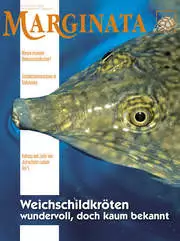
Marginata No. 33 - Softshell Turtles - Wonderful, but hardly known

Article no: marginata33

CHF 16.50

Stock: 0

Ready for dispatch in 1-3 days, delivery time 7 working days

Delivery between Monday, 31 August and Tuesday, 1 September
Zahlungsarten
Product information "Marginata No. 33 - Softshell Turtles - Wonderful, but hardly known"

Marginata No. 33 - Softshell Turtles - Wonderful, but hardly known

Warum stranden Meeresschildkröte?
Schildkrötenforschung in Andalusien
Haltung und Zucht von Astrochelys radiata Teil 5

Inhalt:


Editorial
Magazin
Termine

HALTUNG UND ZUCHT
Erfolgreiche Haltung und Aufzucht junger Weichschildkröten
Hans-Dieter Philippen

REPORTAGE
Thermoregulation bei Weichschildkröten
Dieter Gramentz

REPORTAGE
Bemerkungen zum Wanderverhalten von Weichschildkröten
Dieter Gramentz

Porträt
Kuba-Schmuckschildkröte (Trachemys decussata)
Hans-Dieter Philippen
Michael Wirth und Peter Fritz

REPORTAGE
Strandende Meeresschildkröten an der andalusischen Küste
Juan J. Bellido & José C. Baez

REPORTAGE
Maurische Landschildkröten (Testudo graeca) in Andalusien
Anneliese Pioch

Buchtipp
Kleinanzeigen
Abo & Service
Regionalführer
Composition
Feeding recommendation
Technical details
Size information

0 of 0 reviews

Give us a rating!

Share your experience with the product with other customers.


Suggested products

Handbook of food plants for tortoises and other reptiles
Handbook of forage plants 2nd revised editionMarion Minch is not only a successful breeder of diverse tortoises for many years, but also an excellent connoisseur of native wild herbs. She founded and runs samenkiste.de, which is well known to many tortoise keepers and nature lovers. Her name is inextricably linked with reptile care and species-appropriate nutrition for tortoises. Her handbook of food plants summarises the most important native food plants for herbivorous and omnivorous reptiles. She not only considers tortoises, but also iguanas, spiny-tailed dragons and even chameleons. From the basics of plant biology to native wild herbs to suitable food plants for hardy tropical reptile species, this comprehensive work provides the basis for species-appropriate keeping. In the expanded and supplemented 2nd edition, the plant section is divided according to flower colour. This makes it even easier to identify wild herbs. The work has also been supplemented with a wealth of additional information and many pictures.

CHF 46.50

Geckos
Geckos in the terrarium by Astrid FalkThe book offers a comprehensive introduction to geckos and their species-appropriate keeping in terrariums. It explains what you need to think about before buying a gecko and what preparations should be made. The book describes in detail how the terrarium is technically equipped and set up. The care of the animals, their special features and behaviour, their diet, reproduction and rearing of young animals are described, as well as diseases and husbandry problems with tried and tested suggestions for prevention and treatment. Individual gecko species that are particularly suitable for keeping and breeding in terrariums are portrayed in detail in the second part of the book.

CHF 28.50

Jumping spiders Phidippus, Hyllus, Plexippus
Book Jumping Spiders - Phidippus, Hyllus & Plexippus A guide to keeping jumping spiders of the genera Phidippus, Hyllus & Plexippus. Who can resist the charm of jumping spiders? The childlike appearance of their expressive face simply leaves no one cold! In addition, their behavior is extremely exciting to observe, their colors are bright and their requirements for species-appropriate keeping are very easy to meet. No wonder these likeable jumpers are all the rage! This volume in the "Species by Species" series describes in detail what to look out for when buying and keeping them, introduces the most commonly kept species and color forms and provides plenty of tips on how to keep them successfully - so you can be sure they will breed well! Species by Species introduces you to the books in this series, which present the most popular terrarium animals. Each volume offers you detailed, practical care instructions and all the information you need to successfully breed your animals. All important questions from the required tank size to terrarium set-up, technical equipment, species-appropriate nutrition and disease prevention are answered with numerous tricks and tips. Experienced, long-standing breeders reveal how you can encourage the animals to reproduce and raise healthy young. All this in full color, generously illustrated and attractively designed - just about your terrarium animal - species by species

CHF 23.90

Book Breeding live food yourself
Book "Grow your own live food" - The perfect guide for pet owners Discover practical and detailed instructions on how you can easily breed food for your reptiles, birds, fish or other animals yourself in the book "Breeding live food yourself". With valuable tips on various food insects, their care and breeding, you can save money and ensure a species-appropriate diet for your pets. Contents of the book: Step-by-step instructions for breeding feeder insects Information on the best types of food for reptiles, birds and fish Care instructions and breeding conditions for various live food species Tips for sustainable and cost-effective food production Why breed your own live food? Get healthy, fresh food for your animals Save money and reduce dependence on pet shops Promote the health and well-being of your animals with species-appropriate food Whether you are a beginner or an experienced pet owner, this book provides you with everything you need to successfully breed live food yourself.

CHF 46.50

Marginata 69 - New Guinea tortoises
Marginata 69 - New Guinea tortoises – the genus ElseyaCover storyThe unrecognised beauties: New Guinea tortoises (Andreas S. Hennig)My experiences with Branderhorst's New Guinea tortoise, Elseya (Elseya) branderhorsti (Ouwens, 1914) (Andreas S. Hennig)Keeping and breeding of Rhodin's New Guinea tortoise, Elseya (Hanwarachelys) rhodini Thomson, Amepou, Anamiato & Georges, 2015 (Andreas S. Hennig)PortraitGeoemyda spengleri, Chinese serrated tortoise (Andreas S. Hennig)ReportageMacrochelys temminckii – Experiences and impressions with vulture tortoises part 2 (Reiner Praschag)KeepingAn alternative to year-round keeping of the Egyptian tortoise in the terrarium – my experiences with seasonal outdoor keeping of Testudo kleinmanni (Ricarda Schramm)EtymologySawbacks and living maps part 4: Graptemys gibbonsi, Pascagoula humpback tortoise (Holger Vetter)Classifieds & animal placement

CHF 16.50

Draco 57 - Snakes: Colour and drawing breeding
Draco 57 - Snakes: Colour and markings breedingsContents:Editorial Variety is the trump cardHans - Dieter Philippen Colour forms in garter snakes. A look into the past, the present and the trends of tomorrowDaniel GrübnerHurricane Season Hans-Jörg WinnerSturdy beauties. Colour and pattern variations in PituophisBernd SkubowiusThe latest trends in breeding the green tree python Marcel HoffmannChoose the diamond! Colour and pattern types of diamond pythonsMarc Mense A look at colour breeding in Pantherophis guttatusStephan Drees Colour and pattern forms in the western hook-nosed snakeFilip LonghitanoReal rarities: Colour varieties of the grey-banded king snake Malte Hornig

CHF 32.00

Draco 06 - Local amphibians
Draco 06 - Native amphibians Contents: Page content 2 Editorial 4 The native amphibians - an overview, by Dr B. Thiesmeyer 22 A king without a kingdom, by E. Meier & T. Mutz 30 The moor frog Rana arvalis NILSSON, 1842, by H. Laufer & A. Pieh 38 The green toad Bufo viridis LAURENTI, 1768, by A. Pieh & N. Braitmayer 45 Midwife toads (genus Alytes, discoglossidae): Biology, care and breeding, by H.-J. Schekeler 53 Great crested newts: Little water dragons in our ponds and pools, by A. Kupfer 58 Long time in the forest: Long live the salamander!, by Dr B. Thiesmeyer 69 First photos of the birth of the Alpine salamander (Salamandra atra atra) 78 Book box 89 Magazine

CHF 16.80

Reptilia 77 - Moss frogs - the genus Theloderma
Reptilia 77 - Moss frogs - the genus Theloderma Travelling antsStar tortoiseAnolis roquet summus Contents: The fantastic masters of camouflage of the Asian frog genus Theloderma (moss or lichen frogs) are highly sought-after, extremely attractive terrarium inhabitants. Several species are endangered and urgently require conservation breeding projects – another reason to strive for their propagation. And the fact that their representatives also display many interesting behaviours, such as waving with the hind legs or “toe-twitching” in the context of catching prey, makes working with them even more exciting.REPTILIA editor Kriton KUNZ, who maintains one of the world’s most species-rich Theloderma collections, along with the Russian Theloderma experts Sergei RYABOV and Ivan ARININ, present these remarkable frogs in detail in the feature topic of this REPTILIA. Table of contents: EDITORIAL MAGAZINEBreakthrough in REPTILIA’s nose frog project: opening of a research and breeding station in Conceptión/Chile in collaboration with Leipzig Zoovby H. Werning DATES WESTERN HERP PERSPECTIVESThe hidden value of reptile excursions vby B. Love PHOTOSTORYMarvellous masters of camouflage. The moss frogs of the genus Thelodermaby K. Kunz KEEPING AND BREEDINGKeeping and breeding of Theloderma gordoni in the terrarium vby I. Arinin KEEPING AND BREEDING Experience with the first breeding of paddle frogs of the species Theloderma horridum in the Exotic Terrarium of the City of Tula vby A. A. Evsyunin TRAVEL EPiece of paradise. The Pouso Alegre in the Brazilian Pantanal from the perspective of a reptile friend. Part 2by M. Hallmen PORTRAIT and posterKinabalu bamboo viper. Parias malcolmiby J. M. Dehling KEEPING AND BREEDING The banded hook-nosed snake of the genus Lystrophis. Keeping and breeding a little beauty by A. Hutwalker REPORT First confiscated, then bred: Star tortoises (Geochelone elegans) at Allwetterzoo Münster vby J. Scholdei REPORTTravelling ants. Predatory nomads of the tropics vby D. J. C. Kronauer KEEPING AND BREEDINGBeauty has a name: Anolis roquet summus (Lazell, 1972) vby H. Herfurth LIBRARY ALSO IN YOUR AREA SUBSCRIPTION & SERVICE PREVIEW INCUBATOR In wild Wedding. An Eastern in two parts for three young men of “southern appearance”, a reptile researcher and a cockroach – Part 2 vby H. Werning

CHF 12.00

NTV, Discover the amphibians
NTV, Discover the amphibians and learn all about these animals. 56 pages colour photos throughout Large format: 20.7 x 28 cm Hardcover Author Kriton Kunz Contents: Every child knows a frog that swims around in its pond and croaks cheerfully, or the black and yellow fire salamander. But how do these friendly animals live? What do they eat, how do they survive the winter? How does a tadpole become a small frog? And what other amazing amphibians are there? "Entdecke die Amphibien" explains what amphibians are, their special features and their incredible abilities in an entertaining and child-friendly way. Fantastic records from the world of frogs, salamanders and the like are included, as well as an exciting quiz about these colourful survival artists. Including 20 great stickers 

CHF 17.90

Reptilia 07 - Climbing snakes
Reptilia 07 - Climbing snakesTurtle conservation in NepalStump crocodiles in the CongoRed-footed tarantulaContents:Page 2 - EditorialPage 4 - Letters to the editorPage 5 - MagazinePage 16 - Photo reportagePage 22 - Keeping and breeding: The Persian Climbing Snake Elaphe persica, by K.-D. SchulzePage 25 - Report: Endangerment and protection of the Aesculapian snake in Germany, by M. WaitzmannPage 29 - Keeping and breeding: Elaphe guttata, by J. BergadáPage 33 - Travel report: Stump crocodiles in the Congo, by A. Brieger, F. W. Huchzermeyer and J. RileyPage 39 - Portrait and poster: Corucia zebrata, by M. Aresté and J. L. FarriolsPage 43 - Report: A species conservation programme for tortoises in Nepal, by K. Ernst, K. B. Shah and H. SchleichPage 49 - Keeping and breeding: Dendrobates galactonotus, by R. and B. PieperPage 53 - Keeping and breeding: Avicularia avicularia, by J. M. Marínez NadalPage 57 - Herpetology and Culture: Traditional Chinese Medicine, Part 2: Turtles as fire extinguishers, by G. PetersPage 62 - Western Herp Perspectives, by B. LovePage 64 - Prize puzzlePage 69 - Reptilia on the road: Arizona Sonora Desert Museum Tucson, by H. WerningPage 74 - Advice and actionPage 77 - LibraryPage 80 - Incubator: Glossary by H. Werning

CHF 9.80

Reptilia 95 - Chameleon & Co. The genus Furcifer
  Krokodil-AnlageAsiatische FalltürspinnenHaltung von Schmuckschildkröten Inhalt: Das Pantherchamäleon, Furcifer pardalis, gehört zu den beliebtesten Echsen überhaupt. Diese extrem farbenprächtigen, imposanten Chamäleons aus Madagaskar werden inzwischen in verschiedenen Lokalformen erfolgreich und dauerhaft in unseren Terrarien nachgezüchtet. Die Gattung Furcifer hält aber noch viele weitere hochinteressante Arten bereit – freuen Sie sich auf ein in jeder Hinsicht buntes Titelthema mit viel Praxisbezug! EDITORIALMAGAZINTERMINEIN 5 JAHREN UM DIE WELTBrüllaffen, Klappschildkröten und VulkaneA. PachmannWESTERN HERP PERSPECTIVESAuf Reptiliensuche in AustralienB. LoveFOTOSTORYChamäleons der Gattung FurciferP. NecasHERPETOFAUNAAbenteuer Komorenchamäleon – auf der Suche nach Furcifer cephalolepisR. LeptienPORTÄTIm Porträt: das Teppichchamäleon, Furcifer lateralis P. NecasIm Porträt: das Pantherchamäleon, Furcifer pardalisP. NecasZUCHTDie Entstehung einer neuen Designermorphe der Kornnatter (Pantherophis guttatus)A. SchmidHALTUNG UND VERMEHRUNGPhilippinenkrokodile (Crocodylus mindorensis) im Aquarium des Kölner Zoos. Teil 2: Bau einer Schauanlage für eine der am stärksten bedrohten Krokodilarten der Welt T. Ziegler, R. Sommerlad, W. Brass, K. van der Straeten, D. Karbe & A. RauhausHERPETOFAUNAAuf dem Weg ins All. Die Welt der Buchstaben-Schmuck-schildkröte, Trachemys scripta. Teil 5: Haltung und Vermehrung von Buchstaben-SchmuckschildkrötenA. S. HennigWIRBELLOSEAußergewöhnliche Falltürspinnen aus Asien: die Gattung Cyclocosmia F. Schneider, B. F. Striffler & I. WendtABO & SERVICETerrarienschauanlagen international Der „Rimba Reptile Park“ auf Bali M. HallmenTiere unserer Heimat Die ErdkröteR. LeptienBibliothekTipps & TricksTestlaufAUCH IN IHRER NÄHEREISEZwischen Anolis und Cycluren: Unterwegs auf Puerto RicoH. WerningVORSCHAUBRUTKASTENIguana chilena, Teil 2 H. Werning  

CHF 12.00

Reptilia 59 - Rose chafer
Reptilia 59 - Rose chafer South American tortoisesBuilding a desert terrariumReptile of the year: Forest lizard Contents: 4 EDITORIAL 6 MAGAZINE 17 DATES 20 PHOTO REPORTAGERose chaferBy M. Tomás Rafáles 28 KEEPING AND REPRODUCTIONCare and breeding of the rose chaferAmaurodes passeriniiBy M. Tomás Rafáles 33 REPORTAGEEuropean rose beetles (family Cetoniidae)By M. Yliana 39 TRAVELThin air – An excursion into the highlands ofIran and TurkeyBy B. Trapp 51 PORTRAIT AND POSTERPsammodynastes pulverulentusBy M. Gaulke 55 HERPETOFAUNAOn the "Reptile of the Year 2006" – The Eurasianforest or mountain lizard (Zootoca vivipara),the world's most successful terrestrial reptileBy W. Böhme & D. Rödder 62 PRACTICEUse of a conservatory as a terrariumlocation for a desert terrariumPart 1: Planning and building the terrariumBy T. Ackermann 71 HERPETOFAUNA The North African-Arab cat snakeTelescopus dhara (Forsskål, 1775)By U. Schlüter 77 REPORTAGEObservations on the occurrence ofGeochelone (Chelonoides) in southern BoliviaBy J. Knaack 87 CLASSIFIED ADS 92 RAT & TAT 96 WESTERN HERP PERSPECTIVESThe new "Good Guys"By B. Love 104 INCUBATORMaggot dispenserBy H. Werning

CHF 11.20