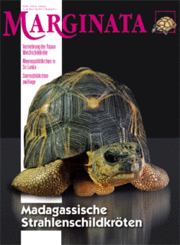
Marginata No. 29 - Madagascan ray turtle

Article no: marginata29

CHF 16.50

Stock: 0

This article is currently not available

Product information "Marginata No. 29 - Madagascan ray turtle"

Marginata No. 29 - Madagascan ray turtle

Schildkrötenforschung in den Tropen
Sternschildkrötenzwillinge
Gallaguar-Schildkrötenschutz in Indonesien

Inhalt:

Editorial
Magazin
Termine

REPORTAGE
Madagaskars Südwesten – Heimat einer gestreiften Exotin
Jutta Hammer

REPORTAGE
Village des Tortues. Auffangstation für gewilderte Schildkröten
Jutta Hammer

HALTUNG UND ZUCHT
Haltung und Nachzucht der Madagassischen Strahlenschildkröte. Teil 1
Michael Wirth & Peter Fritz

POSTER
Sulawesi-Sumpfschildkröte Leucocephalon yuwonoi
Hans-Dieter Philippen

REPORTAGE
Zur Situation von Meeresschildkröten in Sri Lanka
Sascha Pawlowski

REPORTAGE
Erfolgreiches Jahr 2010 im Internationalen Zentrum für Schildkrötenschutz (IZS) im Allwetterzoo Münster
Elmar Meier, Martina Raffel & Hans-Dieter Philippen

REPORTAGE
Die Papua-Weichschildkröte (Carettochelys insculpta) und ihre Nachzucht in „Down Under“
Egon Heiss

REPORTAGE
Conrad Gesner und die Schildkröten
Kriton Kunz

REPORTAGE
Ein nicht alltäglicher Doppelschlupf von Zwillingen bei der Sternschildkröte (Geo­chelone elegans) im Allwetterzoo Münster
Jochen Scholdei

Buchtipp
Kleinanzeigen
Abo & Service
Regionalführer

Composition
Feeding recommendation
Technical details
Size information

0 of 0 reviews

Give us a rating!

Share your experience with the product with other customers.


Suggested products

Handbook of food plants for tortoises and other reptiles
Handbook of forage plants 2nd revised editionMarion Minch is not only a successful breeder of diverse tortoises for many years, but also an excellent connoisseur of native wild herbs. She founded and runs samenkiste.de, which is well known to many tortoise keepers and nature lovers. Her name is inextricably linked with reptile care and species-appropriate nutrition for tortoises. Her handbook of food plants summarises the most important native food plants for herbivorous and omnivorous reptiles. She not only considers tortoises, but also iguanas, spiny-tailed dragons and even chameleons. From the basics of plant biology to native wild herbs to suitable food plants for hardy tropical reptile species, this comprehensive work provides the basis for species-appropriate keeping. In the expanded and supplemented 2nd edition, the plant section is divided according to flower colour. This makes it even easier to identify wild herbs. The work has also been supplemented with a wealth of additional information and many pictures.

CHF 46.50

Geckos
Geckos in the terrarium by Astrid FalkThe book offers a comprehensive introduction to geckos and their species-appropriate keeping in terrariums. It explains what you need to think about before buying a gecko and what preparations should be made. The book describes in detail how the terrarium is technically equipped and set up. The care of the animals, their special features and behaviour, their diet, reproduction and rearing of young animals are described, as well as diseases and husbandry problems with tried and tested suggestions for prevention and treatment. Individual gecko species that are particularly suitable for keeping and breeding in terrariums are portrayed in detail in the second part of the book.

CHF 28.50

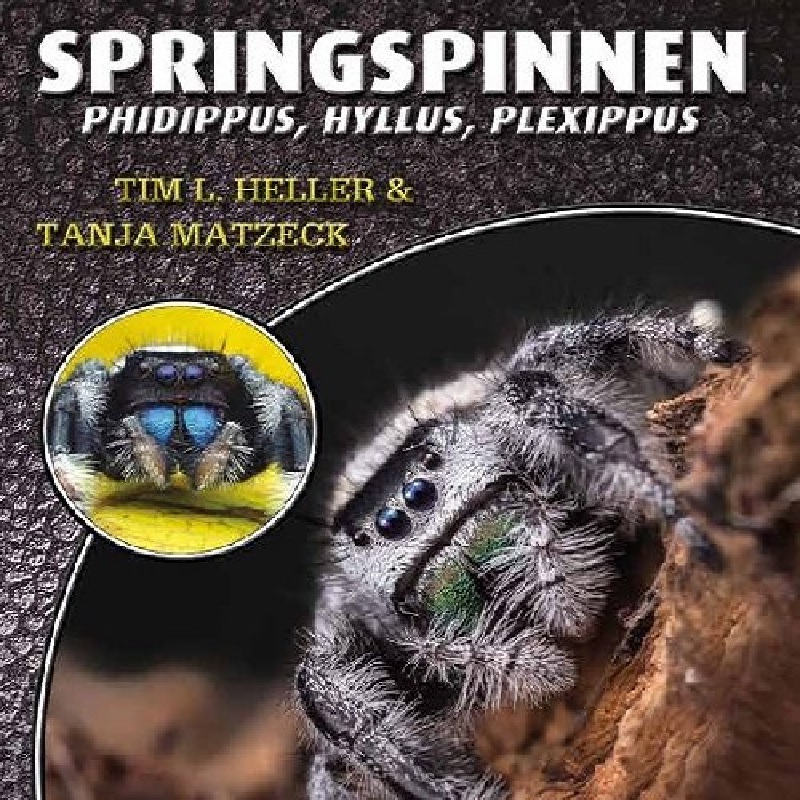
Jumping spiders Phidippus, Hyllus, Plexippus
Book Jumping Spiders - Phidippus, Hyllus & Plexippus A guide to keeping jumping spiders of the genera Phidippus, Hyllus & Plexippus. Who can resist the charm of jumping spiders? The childlike appearance of their expressive face simply leaves no one cold! In addition, their behavior is extremely exciting to observe, their colors are bright and their requirements for species-appropriate keeping are very easy to meet. No wonder these likeable jumpers are all the rage! This volume in the "Species by Species" series describes in detail what to look out for when buying and keeping them, introduces the most commonly kept species and color forms and provides plenty of tips on how to keep them successfully - so you can be sure they will breed well! Species by Species introduces you to the books in this series, which present the most popular terrarium animals. Each volume offers you detailed, practical care instructions and all the information you need to successfully breed your animals. All important questions from the required tank size to terrarium set-up, technical equipment, species-appropriate nutrition and disease prevention are answered with numerous tricks and tips. Experienced, long-standing breeders reveal how you can encourage the animals to reproduce and raise healthy young. All this in full color, generously illustrated and attractively designed - just about your terrarium animal - species by species

CHF 23.90

Book Breeding live food yourself
Book "Grow your own live food" - The perfect guide for pet owners Discover practical and detailed instructions on how you can easily breed food for your reptiles, birds, fish or other animals yourself in the book "Breeding live food yourself". With valuable tips on various food insects, their care and breeding, you can save money and ensure a species-appropriate diet for your pets. Contents of the book: Step-by-step instructions for breeding feeder insects Information on the best types of food for reptiles, birds and fish Care instructions and breeding conditions for various live food species Tips for sustainable and cost-effective food production Why breed your own live food? Get healthy, fresh food for your animals Save money and reduce dependence on pet shops Promote the health and well-being of your animals with species-appropriate food Whether you are a beginner or an experienced pet owner, this book provides you with everything you need to successfully breed live food yourself.

CHF 46.50

Marginata 69 - New Guinea tortoises
Marginata 69 - New Guinea tortoises – the genus ElseyaCover storyThe unrecognised beauties: New Guinea tortoises (Andreas S. Hennig)My experiences with Branderhorst's New Guinea tortoise, Elseya (Elseya) branderhorsti (Ouwens, 1914) (Andreas S. Hennig)Keeping and breeding of Rhodin's New Guinea tortoise, Elseya (Hanwarachelys) rhodini Thomson, Amepou, Anamiato & Georges, 2015 (Andreas S. Hennig)PortraitGeoemyda spengleri, Chinese serrated tortoise (Andreas S. Hennig)ReportageMacrochelys temminckii – Experiences and impressions with vulture tortoises part 2 (Reiner Praschag)KeepingAn alternative to year-round keeping of the Egyptian tortoise in the terrarium – my experiences with seasonal outdoor keeping of Testudo kleinmanni (Ricarda Schramm)EtymologySawbacks and living maps part 4: Graptemys gibbonsi, Pascagoula humpback tortoise (Holger Vetter)Classifieds & animal placement

CHF 16.50

Draco 54 - Nutrition of European tortoises
Draco 54 - Nutrition of European tortoises Contents: EditorialModelled on nature: The diet of European tortoises in their natural habitatMichael Wirth  Tortoise nutrition, but species-appropriate – a practical guideMichael Wirth   Herb collecting made easy – an introduction to identifying and collecting wild plants Michael Wirth   The 1x 1 of meadow herbs Michael Wirth    Hay in tortoise nutrition – valuable and vital Michael Wirth    Ten questions about tortoise nutrition Markus Baur    Bibliography    In your neighbourhood     Services

CHF 32.00

Reptilia 85 - Snake-necked tortoises
Reptilia 85 - Snake-necked tortoisesCrocodile-tailed crested lizardBreeding of the king pythonPristidactylus valeriaeContents:The snake-necked turtles include such popular species for the aquaterrarium as the Australian representatives of the genus Chelodina or the pointed-headed turtles of the genus Emydura, but also the bizarre Mata-Mata from the waters of Amazonia or the funny toad-headed turtles of the genus Phrynops. In our cover story, we introduce you to this exciting family of turtles with lots of brilliant photos and portray some particularly interesting species in detail.Table of contentsEDITORIALMAGAZINEEcotourism de luxe: End of the chameleon conservation project in the Peloponnese?H. WerningSancho, the illegal immigrant - what to do when exotic animals are found?S. SchletchSkin-eating blind worms bred for the first timeA. Kupfer & S. ReinhardWESTERN HERP PERSPECTIVESConfusing species protectionBill LovePHOTOSTORY Snake-necked tortoises J. ValverdeKEEPING AND REPRODUCTIONThe Argentine snake-necked tortoise(Hydromedusa tectifera) - observations in biotope and terrarium D. FabiusKEEPING AND REPRODUCTION Keeping and breeding of the broad-breasted snapping turtle, Myuchelys latisternum(Elseya latisternum) H. ProkopTRAVEL Cave dwellers in the PhilippinesM. GaulkePORTRAIT AND POSTER Telescopus fallax (Fleischmann 1831). European cat snakeK. Ehrlich & B. TrappHERPETOFAUNA A conservation project for the Valeria large-headed iguana, Pristidactylus valeriae - with the support of REPTILIA B. CamousseigtKEEPING AND REPRODUCTION Versatile favourites. Experiences with Royal PythonsM. BorerKEEPING AND REPRODUCTION News on sex determination of the crocodile-tailed humpback lizard, Shinisaurus crocodilurus M. ZollwegHERPETOFAUNA Basking sites on mangrove biotopes of Phelsuma robertmertensi Meier, 1980 on the Comorian island of Mayotte P. KrauseANIMALS OF OUR HOMEA snake that is not a snake: the slow wormR. LeptienLIBRARYSUBSCRIPTION & SERVICEALSO NEAR YOUPREVIEWBRUTKASTENBag magicM. ZawadzkiDATESHeiko WerningWESTERN HERP PERSPECTIVESConfusing species protectionB. Love

CHF 12.00

Reptilia 04 - Bird spiders
Reptilia 04 - Tarantulas SkinkThailandMysticism & superstition Contents: Page 2 - EditorialPage 3 - Letters to the editorPage 6 - MagazinePage 17 - Photo reportage: Tarantulas, by P. KlaasPage 23 - Keeping and reproduction: Keeping and breeding tarantulas, by P. KlaasPage 26 - Terraristics and law: Legal issues in keeping spiders and scorpions, by D. RösselPage 27 - Report: A feast of tarantulas, by R. WestPage 30 - Psychology: Arachnophobia, by L. HogebackPage 33 - Travelogue: Thailand - Mecca of herpetological tourism, by J. BergadáPage 37 - Travelogue: The snake farm of Bangkok, by J. ViaderPage 39 - Portrait and poster: Chondropython viridis, by M. Aresté and J. L. FarriolsPage 43 - Herpetofauna: Skinks, by P. Gassner and A. HauschildPage 50 - Reptilia on the road: Terrarium displays, by H. WerningPage 54 - Terraristics and law: Snake keeping in residential property and tenancy law, by D. RösselPage 57 - Herpetology and Culture: Magic and Superstition, Part 1: Turtles and Amphibians, by L. B. Carissimi-PriorPage 62 - Terraristics: Egg-laying problems with tortoises, by E. MeierPage 69 - Supplement: Venomous snakesPage 74 - Advice and actionPage 76 - LibraryPage 80 - Incubator: Glossary by H. Werning

CHF 9.80

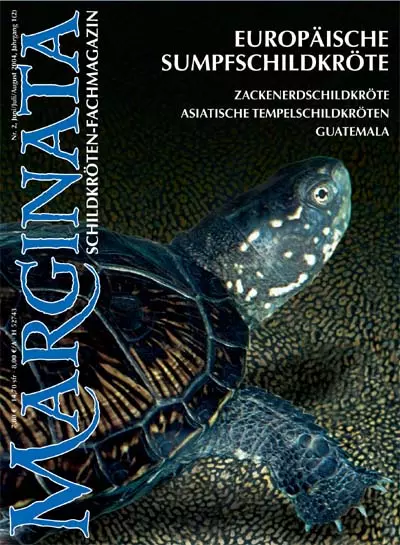
Marginata 02 - European Pond Turtle
Marginata 02 - European pond turtle Serrated terrapinsAsian Temple TurtlesGuatemala Contents: 2 EDITORIAL 3 THE TEAM INTRODUCES ITSELF 4 READER LETTERS 5 MAGAZINE 9 DATES 10 PHOTO REPORTAGEEuropean pond turtles (Emys orbicularis LINNAEUS, 1758)Hans - Dieter Philippen 14 REPORTAGEObservations and experiences regarding the keeping and breeding of the European pond turtle (Emys orbicularis LINNAEUS, 1758)Bernd Wolff 24 REPORTAGEThe relationship between origin, currently known phylogeny (evolutionary history) and habitat of the European pond turtle (Emys orbicularis) using three populations as examplesJens Poschadel 31 PORTRAITMadagascan flat-tailed turtlePyxis [Acinixys] planicauda (GRANDIDIER, 1867)Matthias Mähn 36 REPORTAGESpecies protection on the dream beach –The projects of the organisation ARCAS in GuatemalaKriton Kunz 46 REPORTAGEThe fascination of serrated terrapins (genus GeoemydaSome aspects of their keeping and biologyIngo Schaefer 52 REPORTAGEIntensively exploited without protection: Amyda cartilaginea (BODDART, 1770) and Dogania subplana (GEOFFROY ST.-HILAIRE, 1809) Mark Auliya 56 BOOK TIP 57 CLASSIFIEDS 58 REPORTAGESalmonellosis – Measures to prevent turtle-related transmissionTessa E. H. Römkens and Frank Stam 62 REGIONAL GUIDE 64 AGATHA MARGINATA

CHF 14.70

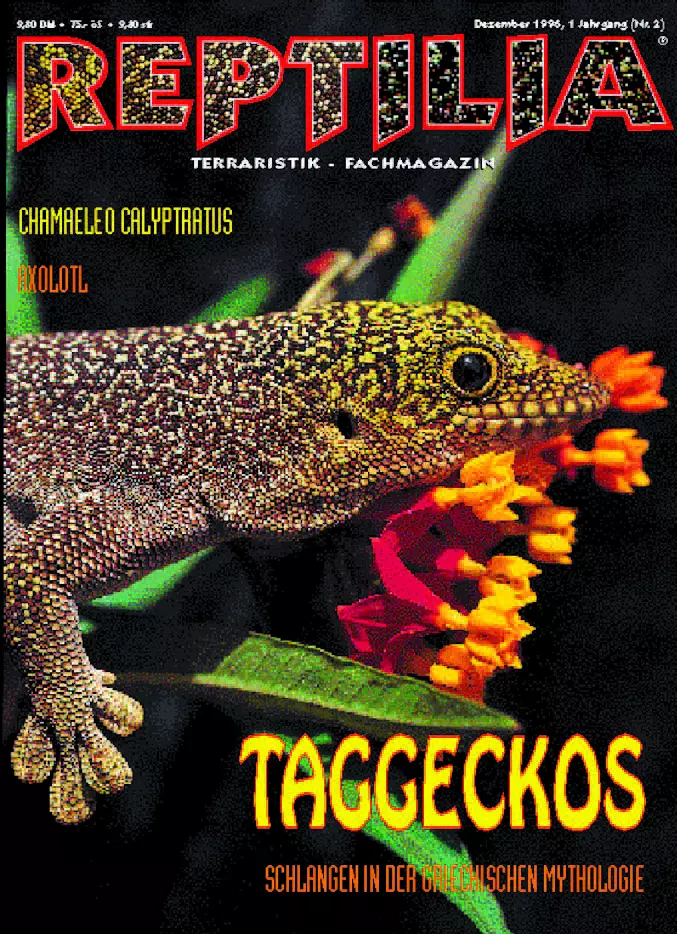
Reptilia 02 - Day geckos
Reptilia 02 - Day geckosChameleo caylptratusAxolotlSnakes in Greek mythologyContents:Page 2 - EditorialPage 3 - Letters to the editor and discussionPage 7 - MagazinePage 17 - Photo report: Phelsuma, by J. KrügerPage 23 - Keeping and reproduction: Phelsuma standingi, by G. HallmannPage 26 - Report: Phelsuma and species conservation: The Round Island project, by G. HallmannPage 29 - Herpetofauna: Diurnal geckos, by Dr M. MeyerPage 33 - Travelogue: Baja California Part 2: The island world in the Gulf of California, by H. WerningPage 39 - Portrait and poster: Anolis marmoratus marmoratus, by M. SchmidtPage 43 - Keeping and breeding: Axolotl, by J. WistubaPage 47 - Terraristics: Sex determination in reptiles, by Dr M. Bachs TabernerPage 47 - Terraristics: Sexual dimorphism in African spurred tortoises, by A. Romairone / I. Iglesias IzquierdoPage 53 - Herpetofauna: Horned frogs, by M. BatllePage 56 - Herpetology and culture: Mythology: The snakes of Olympus, by L. B. Carissimi-PrioriPage 61 - Keeping and reproduction: Chamaeleo calyptratus, by W. SchmidtPage 69 - Veterinary medicine: Internal parasites in reptiles and amphibians, by Dr C. López del CastilloPage 73 - LibraryPage 75 - Advice and actionPage 80 - Incubator: Glossary by H. Werning

CHF 9.80

Reptilia 63 - Small monitor lizards
Reptilia 63 - Small monitor lizards ThailandLizards in the greenhouseRespiratory diseases in tortoises Contents: 2 EDITORIAL 3 MAGAZINE 11 DATES 14 WESTERN HERP PERSPECTIVESThe luxury point of viewBy B. Love 16 PHOTO REPORTAGESmall monitor lizards in the terrariumBy B. Eidenmüller 24 KEEPING AND BREEDINGKeeping and breeding of the spiny-tailedmonitor lizard (Varanus acanthurus)By S. Arth 34 KEEPING AND BREEDINGVaranus boehmei, keeping and first-timebreeding in the terrariumBy M. Reisinger & D. Reisinger-Raweyai 39 KEEPING AND BREEDINGKeeping, care and breeding ofVaranus macraeiBy A. Dedlmar 42 TRAVELThailand - fascination herpetofaunaBy F. Longhitano 51 PORTRAIT AND POSTERLiophis jaegeriBy A. Kwet 56 REPORTAGEFrog societies in South AmericaBy D. Rödder, G. Zeidan, W. Pertel & R. L. Teixeira 64 PRACTICEKeeping lizards in the greenhouseBy D. Prötzel 71 KEEPING AND BREEDING Truly a jewel in the terrarium: Ampulex compressaBy T. Ramann 75 HERPETIC MEDICINERespiratory diseases in tortoises:recognise, treat, preventBy U. Eggenschwiler 80 TERRARIUM EXHIBITIONSThe reptile and amphibian exhibition of the Dusit Zoo in BangkokBy J. Bulian 87 FAQ - FREQUENTLY ASKED QUESTIONSAcquisition of royal pythons (Python regius)By T. Kölpin 91 HERPETOCULTUREThe lion for Bavaria, the bear for Berlin, the chameleon for...?By J. Wolf 94 LIBRARY 104 INCUBATOR specialAt night in the museumBy H. Werning & L. Hogeback

CHF 11.20

Draco 25 - Garter snakes
Draco 25 - Garter snakes Contents: 2 Editorial 6 Overview of the genus ThamnophisMartin Hallmen & Daniel Grübner 25 Old and new developments regarding the San Francisco garter snake (Thamnophis sirtalis tetrataenia)Martin Hallmen 32 The most common garter snakes in the terrariumDaniel Grübner 40 The garter snakesJan Sonnenberg 50 Aids for distinguishing some subspecies and colour forms of garter snakesPart 1: Thamnophis sirtalis sirtalis “flame” andThamnophis sirtalis sirtalis “speckled flame”Martin HallmenPart 2: The red subspecies of Thamnophis sirtalisJan SonnenbergPart 3: Thamnophis sirtalis similis andThamnophis sirtalis sirtalis “Florida blue”Martin HallmenPart 4: Distinguishing between Thamnophis proximus and Thamnophis sauritus and differentiation fromThamnophis radix and Thamnophis sirtalis sirtalisJan Sonnenberg 60 Garter snakes in scienceJan Gebauer 66 The less frequently recognised garter snakesDaniel Grübner 77 Colour forms of garter snakesDaniel Grübner & Jan Sonnenberg 86 Field observations of garter snakes in North AmericaHerbert Bruchmann 94 Common diseases in garter snakesBirgit Rüschoff, Bettina Christian & Daniel Grübner 102 Garter snakes in outdoor terrariumsMartin Hallmen 114 10 years European Garter Snake AssociationMartin Hallmen 116 Book box 124 Magazine

CHF 18.40