Product information "Marginata 23 - Soft-shelled turtles"
Marginata 23 - Soft-shelled turtles
Sea turtles of India Cold frames for tortoises Testudo hermanni in Catalonia
Contents:
2 Editorial 3 letters to the editor 4 Magazine 8 dates 10 REPORTAGE The African Beaked Tortoise (Chersina angulata). Part 1 Comments on the biology and ecology of the species, the comparison of three different biotopes and the integration of the species in these areas Michael Wirth 31 POSTER The pale-footed tortoise (Pangshura smithii pallidipes) Hans - Dieter Philippen 36 REPORTAGE Status and protection of the western tortoise turtle (Testudo hermanni hermanni) in Catalonia, Spain Silvia Brusciotti, Joaquim Soler and Albert Martinez 42 REPORT Threats to, protection and utilisation of marine turtles. Part 3: Mass egg laying of the bastard turtles turtle and current protection measures taken in India Gerald & Christa Benyr 50 REPORTAGE The Chelonium - a cold frame with a system Michael Wirth 58 Book tip 60 classifieds 61 Subscription & Service 63 regional guide
Composition
Feeding recommendation
Technical details
Size information
0 out of 0 reviews
Give us a rating!
Share your experience with the product with other customers.
Log in
No reviews found. Go ahead and share your findings with others.
Handbook of forage plants 2nd revised editionMarion Minch is not only a successful breeder of diverse tortoises for many years, but also an excellent connoisseur of native wild herbs. She founded and runs samenkiste.de, which is well known to many tortoise keepers and nature lovers. Her name is inextricably linked with reptile care and species-appropriate nutrition for tortoises. Her handbook of food plants summarises the most important native food plants for herbivorous and omnivorous reptiles. She not only considers tortoises, but also iguanas, spiny-tailed dragons and even chameleons. From the basics of plant biology to native wild herbs to suitable food plants for hardy tropical reptile species, this comprehensive work provides the basis for species-appropriate keeping. In the expanded and supplemented 2nd edition, the plant section is divided according to flower colour. This makes it even easier to identify wild herbs. The work has also been supplemented with a wealth of additional information and many pictures.
Geckos in the terrarium by Astrid FalkThe book offers a comprehensive introduction to geckos and their species-appropriate keeping in terrariums. It explains what you need to think about before buying a gecko and what preparations should be made. The book describes in detail how the terrarium is technically equipped and set up. The care of the animals, their special features and behaviour, their diet, reproduction and rearing of young animals are described, as well as diseases and husbandry problems with tried and tested suggestions for prevention and treatment. Individual gecko species that are particularly suitable for keeping and breeding in terrariums are portrayed in detail in the second part of the book.
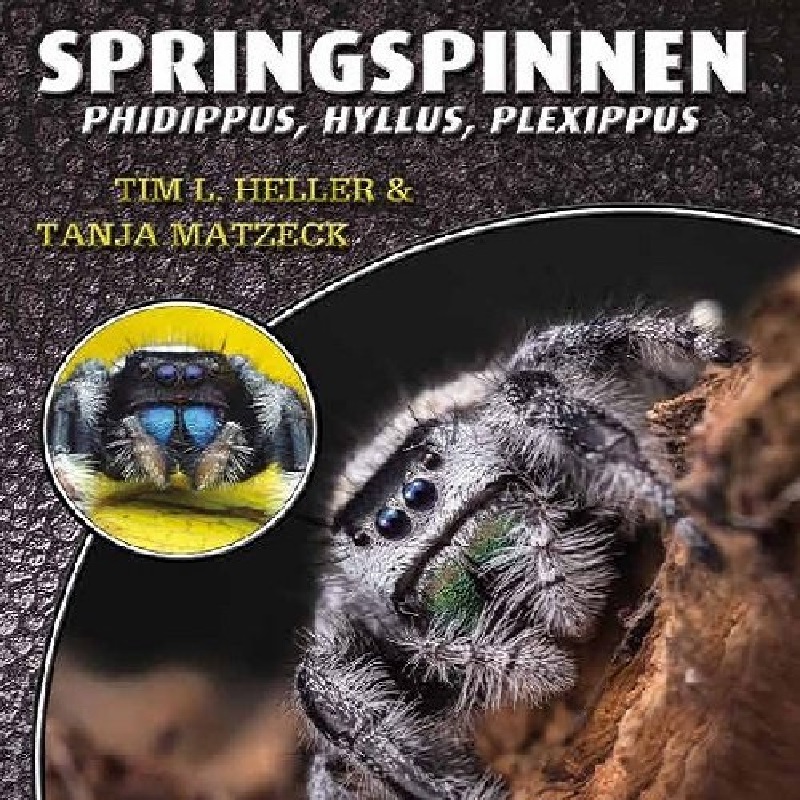
Book Jumping Spiders -
Phidippus, Hyllus & Plexippus
A guide to keeping jumping spiders of the genera Phidippus, Hyllus & Plexippus. Who can resist the charm of jumping spiders? The childlike appearance of their expressive face simply leaves no one cold! In addition, their behavior is extremely exciting to observe, their colors are bright and their requirements for species-appropriate keeping are very easy to meet. No wonder these likeable jumpers are all the rage!
This volume in the "Species by Species" series describes in detail what to look out for when buying and keeping them, introduces the most commonly kept species and color forms and provides plenty of tips on how to keep them successfully - so you can be sure they will breed well!
Species by Species introduces you to the books in this series, which present the most popular terrarium animals. Each volume offers you detailed, practical care instructions and all the information you need to successfully breed your animals.
All important questions from the required tank size to terrarium set-up, technical equipment, species-appropriate nutrition and disease prevention are answered with numerous tricks and tips.
Experienced, long-standing breeders reveal how you can encourage the animals to reproduce and raise healthy young.
All this in full color, generously illustrated and attractively designed - just about your terrarium animal - species by species
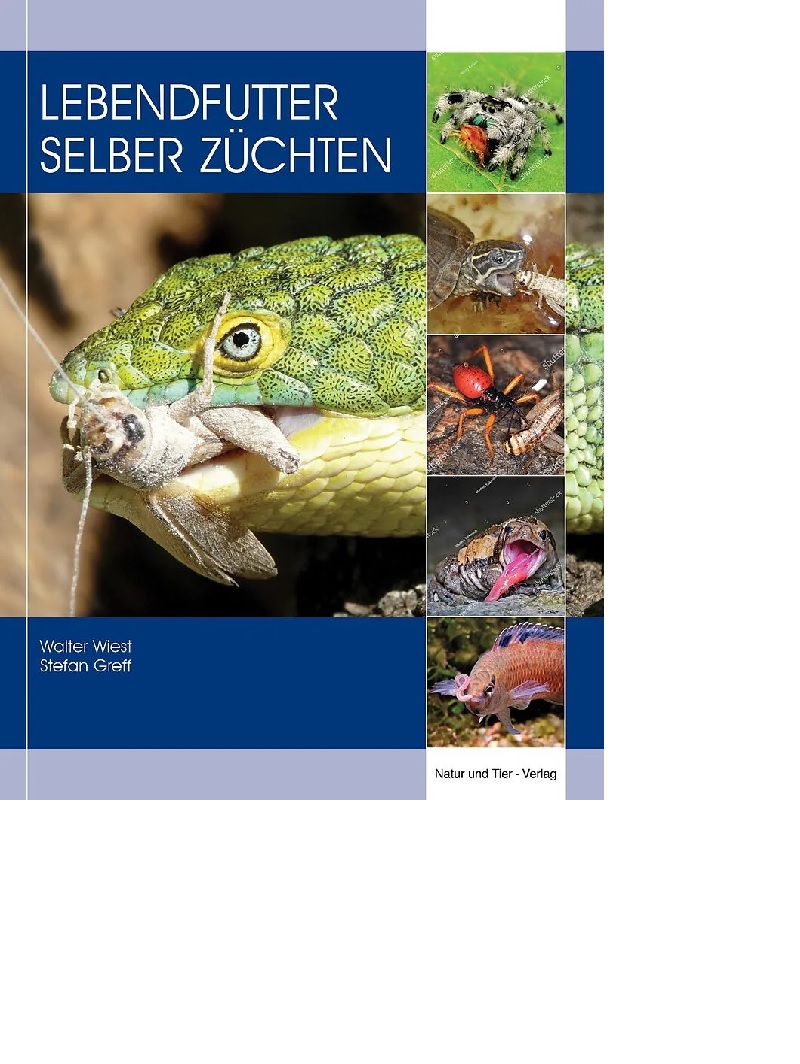
Book "Grow your own live food" - The perfect guide for pet owners
Discover practical and detailed instructions on how you can easily breed food for your reptiles, birds, fish or other animals yourself in the book "Breeding live food yourself". With valuable tips on various food insects, their care and breeding, you can save money and ensure a species-appropriate diet for your pets.
Contents of the book:
Step-by-step instructions for breeding feeder insects
Information on the best types of food for reptiles, birds and fish
Care instructions and breeding conditions for various live food species
Tips for sustainable and cost-effective food production
Why breed your own live food?
Get healthy, fresh food for your animals
Save money and reduce dependence on pet shops
Promote the health and well-being of your animals with species-appropriate food
Whether you are a beginner or an experienced pet owner, this book provides you with everything you need to successfully breed live food yourself.
Marginata 69 - New Guinea tortoises – the genus ElseyaCover storyThe unrecognised beauties: New Guinea tortoises (Andreas S. Hennig)My experiences with Branderhorst's New Guinea tortoise, Elseya (Elseya) branderhorsti (Ouwens, 1914) (Andreas S. Hennig)Keeping and breeding of Rhodin's New Guinea tortoise, Elseya (Hanwarachelys) rhodini Thomson, Amepou, Anamiato & Georges, 2015 (Andreas S. Hennig)PortraitGeoemyda spengleri, Chinese serrated tortoise (Andreas S. Hennig)ReportageMacrochelys temminckii – Experiences and impressions with vulture tortoises part 2 (Reiner Praschag)KeepingAn alternative to year-round keeping of the Egyptian tortoise in the terrarium – my experiences with seasonal outdoor keeping of Testudo kleinmanni (Ricarda Schramm)EtymologySawbacks and living maps part 4: Graptemys gibbonsi, Pascagoula humpback tortoise (Holger Vetter)Classifieds & animal placement
Draco 37 - Florida
Contents:
2 Editorial
4 Florida – a small herpetological travel guide Heiko Werning
24 Under and above water through the karst waters of Florida Beat Akeret
30 In search of gopher and box turtles Michael Wirth & Hans-Dieter Philippen
38 The National Breeders’ Expo – the catalyst for terraristics in the USA and worldwide Hans-Dieter Philippen
44 Exotic diary Rolf Leptien & Heiko Werning
56 Keeping and breeding of chain snakes, Lampropeltis getula, Florida Bernd Skubowius
64 The Florida pine snake, Pituophis melanoleucus mugitus Barbour, 1921 – so far still a rare terrarium inhabitant Bernd Skubowius
74 Turtle breeding in Central Florida Hans-Dieter Philippen
Reptilia 37 Jackson's chameleons
Kenyaschool vivariumTurtle trade in CambodiaContent:2 EDITORIAL4 READER'S LETTERS6 MAGAZINE12 DATES16 PHOTO REPORTAGEthree-horned chameleonsfrom P. Necas36 HUSBANDRY AND BREEDINGChamaeleo (Trioceros)bitaeniatus and its relatives - With comments on the keeping and reproduction of a representative of the Grupeeby N. Lutzmann44 HERPETOFAUNAChamaeleo (Trioceros)jacksonii and its subspeciesby N. Lutzmann51 PORTRAIT AND POSTEREryx jaculusby B. Trapp55 TRAVELOn Herpeto Safari in Kenyafrom I. Schürkes, V. Wasanga & S. Lötters62 REPORTStudies on the turtle trade in Cambodiaby E. Lehr & R. Holloway71 HUSBANDRY AND BREEDINGOne of Europe's most beautiful lizards in a terrarium: the pearl lizardfrom S. Bania76 WESTERN HERP PERSPECTIVESExotic poisonous snakes - the charm of something specialfrom B. Love79 REPORTThe school vivariumPart 2: Example Franziskaner-Gymnasium Kreuzbergby M. Hallmen90 CLASSIFIEDS95 LIBRARY104 GLOSSEBig autumn extra: you have mail!by H. WerningThe October/November issue of your terraristic magazine REPTILIA makes the hearts of all lizard fans and aesthetes beat faster with the title theme "Threehorned Chameleons": In this photo story, which is even more sumptuous than usual, chameleon expert Petr Necas not only gives a general overview of these fascinating animals from the subgenus Trioceros, but he also introduces you to no less than all species in detail!
Chamaeleo (Trioceros) bitaeniatus and his relatives are then described in detail by the expert par excellence in this field, namely Nicolá Lutzmann. He reports about the biology of the small dragons, brings clarity into the confused systematics and not least describes their keeping and breeding vividly - for all terrarists interested in these beautiful lizards an absolute "must".Just like the next article on the title theme of Nicolá Lutzmann, who deals with the popular Chamaeleo (Trioceros) jacksonii and its relatives. Here, too, the author knows how to write expertly about the field biology of the animals, clears up the subspecies confusion and gives detailed tips for the successful care and breeding of the primeval lizards.We stay in Africa and go on Herpeto Safari in Kenya with I. Schürkes, V. Wasanga and S. Lötters. This dreamlike nature destination has not only the "big five" to offer, but is also herpetologically the very first cream, of which you can convince yourself with brilliant photos and a highly interesting expedition report.Unfortunately, the fatal situation of the Asian turtle fauna is a long runner in the REPTILIA, and if we together with you, dear readers, could contribute significantly to the construction of the conservation breeding station in the all-weather zoo Münster, the situation on site is still dramatic. This is proven by the drastic pictures and shattering experiences that Edgar Lehr and Rohan Hollowy bring back from investigations into the turtle trade in Cambodia.Sandra Bania takes care of one of the most beautiful lizards in Europe in her terrarium: the pearl lizard. Therefore she knows how to describe enthusiastically that these magnificent and trustful animals are not only an optical delight, but also show a very varied and interesting behaviour, which makes the lizards together with their relatively unproblematic keeping to best suitable fosterlings, whose keeping and breeding after the reading of this detailed contribution certainly no problems, but however much joy prepares.In the second part of his report on Das Schulvivarium, Martin Hallmen presents a practical example, namely the vivarium at the Franziskaner-Gymnasium Kreuzberg, which he initiated and praised highly. Here you can learn concretely what you have to consider during the planning and expansion phase and how everyday life with the vivarium works, how it is integrated into lessons and what publicity effect can be achieved with it. Certainly a thing worth imitating!Also in this REPTILIA we offer you of course again the full spectrum of our service: In the magazine, for example, you will read curiosities about a reptilian flower pot and get to know an interesting and up-to-date approach to the labelling of tank lizards. Dates, classifieds and the poster (this time with the Western Sandboa Eryx jaculus) are not missing in the incubator, as is Heiko Werning's infamous gloss: "This time, some people will certainly be very happy about caring mail. Will you also be there?
Terraria No. 35 - Reptile search
Rhacophorus feaeTrugnattern
Inhalt:
Titelthema: Reptiliensuche in der NaturReptilien in freier Natur zu suchen und zu beobachten, macht nicht nur Spaß, sondern dabei lassen sich auch viele wichtige Erkenntnisse für die Haltung der betreffenden Arten sammeln. Allerdings ist es nicht einfach damit getan, rauszugehen und darauf zu hoffen, dass einem die Tiere nur so über den Weg laufen. Worauf es ankommt, um bei der Suche nach Reptilien auch wirklich Erfolg und damit schöne Erlebnisse zu haben, das erfahren Sie in den ausführlichen Beiträgen des Titelthemas der nächsten TERRARIA/elaphe-Ausgabe. TerritorialHerpetoramaTitelthema„Fieldherping“. Die erfolgreiche Suche nach Reptilien im FreilandMichael WirthVon Kratzern, gutem Müll und gebräunten Nacken. Praxistipps für die ReptiliensucheMichael WirthBitte nicht stören! Verantwortungsbewusstes Verhalten bei der Suche nach ReptilienBenny TrappPanoramaTerraglobal. Reptilien rund um Haus und GartenAlfred Schleicher Reptilienerinnerungen à la GuatemalaLester MeléndezForschungUnter Forschern. Vielfalt zwischen Tempeln und Landminen – Herpetologische Feldarbeit in KambodschaTimo HartmannNeue ArtenListe der im Jahr 2011 neu beschriebenen Reptilien Axel KwetSalamandraTerraristikKlassikerDer Grüne LeguanBasiliscus plumifrons, der Stirnlappenbasilisk: Erfahrungen aus 20 Jahren Haltung und Vermehrung im Terrarium. Teil 2: Pflege und NachzuchtIngo KoberGiftbisse von giftigen und „harmlosen“ Schlangen. Teil 2Dieter SchmidtErstnachzucht von Feas Riesenruderfrosch, Rhacophorus feae, im Leningrad Zoo Anna A. Bagaturova & Mikhail F. BagaturovNatur- und ArtenschutzFeldnotizen. Die Rote Liste der Amphibien und Reptilien Deutschlands. Teil 2: Verantwortlichkeit, Gefährdungsursachen, Schutz- und HilfsmaßnahmenKlaus-Detlef Kühnel, Arno Geiger & Richard PodlouckyVermisstHalbschwimmer-Nasenfrosch (Rhinoderma rufum)Alexander GutscheAuch in Ihrer NäheAbo & ServiceGalerie100 Jahre Herpetologia EuropaeaAxel Kwet
Draco 05 - Giant snakesContents:
Page content
2 Editorial
4 On the systematics and biology of giant snakes (Boidae), by Dr L. Dirksen & M. Auliya
20 Quo vadis, keeping boids in human hands, by Dr H. D. Lehmann
26 record specimens and man-eaters, by Dr L. Dirksen
32 Notes on the green tree python Morelia viridis(SCHLEGEL 1872) - population-related variants, care and breeding, by A. Kirschner & H. Abend
40 Quo vadis, Boa regia, by A. Kirschner
43 The King Python (SHAW 1802), by A. Kirschner
48 Destination: Down under - The giant snakes of Australia, by V. Franz
56 KLeine Riesenschlangen - Care and breeding of sand boas in the terrarium, by H. Seufer
68 Experiences with rarely kept Corallus species Corallus annulatus annulatus, Corallus hortulanus hortulanus and Corallus hortulanus ruschenbergeria, by S. Wirz
78 Book box
93 Magazine
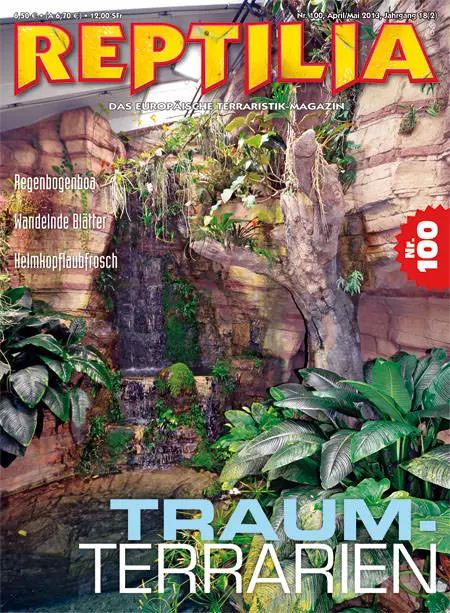
Reptilia 100 - Dream terrariums
Rainbow boaChanging leavesHelmeted tree frog
Contents:
What could be more fitting for the 100th issue of our magazine, than to showcase the very best the hobby has to offer: dream terrariums! We show you the most extraordinary tanks owned by private keepers, and they’ll leave you speechless. We’ve also included building guides with plenty of ideas so that you too can make your dream of the perfect terrarium a reality.
EDITORIALMAGAZINEDATES
AROUND THE WORLD IN 5 YEARSThe end is nearA. Pachmann
PHOTOREPORTAGEDream terrariums
REPORTAGEPack your swimming trunks – a visit to Georg Reitmaier’s superlative terrariumH. Werning
TERRARIUM PRACTICE“A Dream comes true”. Building a terrarium for keeping Morelia boeleniM. Uhlhaas, P. Pohlscheid & L. Schilling
TERRARIUM PRACTICEJewels in stainless steel. Building a terrarium for poison dart frogs. Part 1: Planning, construction and manufactureM. Schulte
REPORTAGEThe first world championship in terrascapingL. Barkam
Readers’ competition“Your dream terrarium”
KEEPING AND BREEDINGOn the knowledge, care and breeding of the Yucatán shovel-headed tree frog Triprion petasatusT. Eisenberg
KeepingKeeping and care of changing leaves, using Phyllium siccifolium from the Philippines as an exampleM. Friend
REPORTAGEFringed-finger lizards (Acanthodactylus) in the wild and in the terrarium. Part 7: The Acanthodactylus-erythrurus group and conclusionU. Schlüter
KEEPING AND BREEDINGOn the biology and care of the Guyana rainbow boa (Epicrates maurus guyanensis)M. Schwederski & L. Trutnau
Animals of our homelandThe European pond turtleR. Leptien
WESTERN HERP PERSPECTIVESThe safe world syndrome – protection from everything and everyoneB. Love
TIPS AND TRICKSSUBSCRIPTION & SERVICETest runALSO NEAR YOU
JourneyAdventure holiday in the PhilippinesM. Gaulke
PREVIEW
BRUTKASTENI would even let myself be locked up for the REPTILIA – part 2H. Werning
Alles über die Taggeckos der Gattung Phelsume von Hans-Peter Berghof
192Seiten
mit zahlreichen Farbfotos
3. Auflage
Über Lebensweise, Haltung und Nachzucht
Autor Hans-Peter Berghof
Verlag NTV
Inhalt:
Die Taggeckos der Gattung Phelsuma mit ihren bunten Farben und ihrem interessanten Verhalten zählen zu den absoluten Lieblingen der Terrarianer. Hans-Peter Berghof vermehrt diese Echsen seit langem erfolgreich und gibt hier sein gesammeltes Wissen über Haltung und Nachzucht dieser schönen Geckos weiter. Der spezielle Teil stellt detailliert sämtliche Arten mit ihren Pflegeansprüchen in Wort und Bild vor und gibt an, welche Tiere leichter und welche schwieriger zu halten sind. Die ideale Ergänzung zum Standardwerk von Hallmann et. al. von 1997, ergänzt um alle seither entdeckten Arten und neu erschienene Literatur.
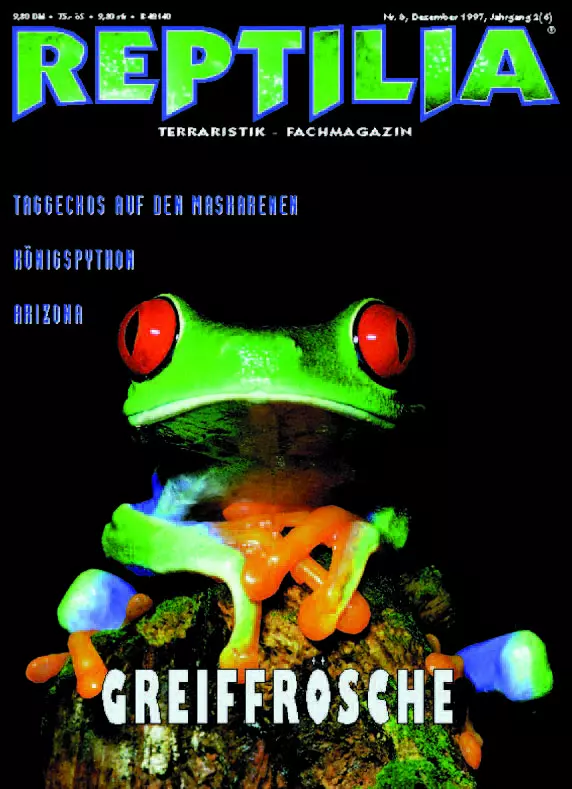
Reptilia 08 - Grasping frogsDay geckos on the MascarenesRoyal pythonArizonaContents:Page 2 - EditorialPage 3 - Letters to the editorPage 5 - MagazinePage 14 - Western Herp Perspectives: Albino turtles, by B. LovePage 16 - Photo report: Griffin frogs, by C. ProyPage 23 - Report: Sleepyheads - Maci frogs, by Dr H. HermannPage 28 - Keeping and breeding: Keeping and breeding the red-eyed frog, by H. Birkhahn and K. WassmannPage 33 - Travelogue: Arizona, by H. WerningPage 39 - Portrait and poster: Laudakia stellio, by D. Modry and P. NecasPage 43 - Report: The genus Neurergus - Fascinating mountain stream salamanders, by S. Steinfartz and G. SchultschickPage 49 - Keeping and breeding: Keeping and breeding the royal python, by W. WenglerPage 54 - Report: Day geckos on the Mascarene Islands, by G. TrautmannPage 60 - Herpetology and culture: The reptile cult in the realm of the pharaohs, by L. Batista Carissimi-PrioriPage 69 - Reptilia on the road: Zoo-Aquarium in Berlin, by H. WerningPage 74 - Advice and actionPage 77 - LibraryPage 80 - Incubator: Glossary by H. Evers