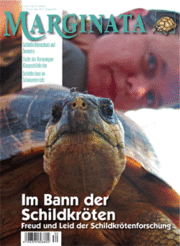
Marginata 20 - North American Box Turtles

Article no: marginata20

CHF 16.50

Stock: 0

Ready for dispatch in 1-3 days, delivery time 7 working days

Delivery between Tuesday, 7 July and Wednesday, 8 July
Zahlungsarten
Product information "Marginata 20 - North American Box Turtles"

Marginata 20 - North American Box Turtles

Turtles of Nova Scotia Part 2
Emys orbicularis twins
The world's largest broad-shelled turtle

Contents:

2 Editorial
3 letters to the editor
4 Magazine
8 dates
10 REPORTAGE
The box turtles of the genus Terrapene
Hans - Dieter Philippen
16 BREEDING IN HUMAN CARE
The Mexican representatives of the Carolina-
Group from the genus Terrapene
Markus Baur & Irmtraud Jasser-Häger
26 REPORTAGE
Notes on the ecology of
Terrapene ornata ornata in the area of
Great Plains
Michael Wirth & Hans-Peter Mattern
31 PORTRAIT
Aldabra giant tortoise,
Dipsochelys dussumieri (Gray, 1831)
Michael Wirth
35 REPORTAGE
Influence of calcium concentrations in the
Food on the digestibility of calcium,
Magnesium and phosphorus in Testudo hermanni
Annette Liesegang, Jean Michael Hatt &
Marcel Wanner
42 REPORT
Twin births in the European box turtle
European pond turtle (Emys orbicularis)
Hans - Dieter Philippen
44 REPORTAGE
"Ötzi", or: The turtle that emerged from the
Cold came ..
A remarkable incubation experience
Jutta Jähne & Hans - Dieter Philippen
46 REPORT
A journey to the turtles of
Nova Scotia (Nova Scotia), Canada
Part 2: Forests, streams, forest stream turtles
Herbert Becker, Andreas Gräf & Urs Landweer
57 REPORTAGE
"Il Gigante" - the largest living broad-shelled turtle
tortoise (Testudo marginata)
Hans - Dieter Philippen
60 Book tip
61 Classifieds
62 Regional guide

Composition
Feeding recommendation
Technical details
Size information

0 of 0 reviews

Give us a rating!

Share your experience with the product with other customers.


Suggested products

Handbook of food plants for tortoises and other reptiles
Handbook of forage plants 2nd revised editionMarion Minch is not only a successful breeder of diverse tortoises for many years, but also an excellent connoisseur of native wild herbs. She founded and runs samenkiste.de, which is well known to many tortoise keepers and nature lovers. Her name is inextricably linked with reptile care and species-appropriate nutrition for tortoises. Her handbook of food plants summarises the most important native food plants for herbivorous and omnivorous reptiles. She not only considers tortoises, but also iguanas, spiny-tailed dragons and even chameleons. From the basics of plant biology to native wild herbs to suitable food plants for hardy tropical reptile species, this comprehensive work provides the basis for species-appropriate keeping. In the expanded and supplemented 2nd edition, the plant section is divided according to flower colour. This makes it even easier to identify wild herbs. The work has also been supplemented with a wealth of additional information and many pictures.

CHF 46.50

Geckos
Geckos in the terrarium by Astrid FalkThe book offers a comprehensive introduction to geckos and their species-appropriate keeping in terrariums. It explains what you need to think about before buying a gecko and what preparations should be made. The book describes in detail how the terrarium is technically equipped and set up. The care of the animals, their special features and behaviour, their diet, reproduction and rearing of young animals are described, as well as diseases and husbandry problems with tried and tested suggestions for prevention and treatment. Individual gecko species that are particularly suitable for keeping and breeding in terrariums are portrayed in detail in the second part of the book.

CHF 28.50

Jumping spiders Phidippus, Hyllus, Plexippus
Book Jumping Spiders - Phidippus, Hyllus & Plexippus A guide to keeping jumping spiders of the genera Phidippus, Hyllus & Plexippus. Who can resist the charm of jumping spiders? The childlike appearance of their expressive face simply leaves no one cold! In addition, their behavior is extremely exciting to observe, their colors are bright and their requirements for species-appropriate keeping are very easy to meet. No wonder these likeable jumpers are all the rage! This volume in the "Species by Species" series describes in detail what to look out for when buying and keeping them, introduces the most commonly kept species and color forms and provides plenty of tips on how to keep them successfully - so you can be sure they will breed well! Species by Species introduces you to the books in this series, which present the most popular terrarium animals. Each volume offers you detailed, practical care instructions and all the information you need to successfully breed your animals. All important questions from the required tank size to terrarium set-up, technical equipment, species-appropriate nutrition and disease prevention are answered with numerous tricks and tips. Experienced, long-standing breeders reveal how you can encourage the animals to reproduce and raise healthy young. All this in full color, generously illustrated and attractively designed - just about your terrarium animal - species by species

CHF 23.90

Book Breeding live food yourself
Book "Grow your own live food" - The perfect guide for pet owners Discover practical and detailed instructions on how you can easily breed food for your reptiles, birds, fish or other animals yourself in the book "Breeding live food yourself". With valuable tips on various food insects, their care and breeding, you can save money and ensure a species-appropriate diet for your pets. Contents of the book: Step-by-step instructions for breeding feeder insects Information on the best types of food for reptiles, birds and fish Care instructions and breeding conditions for various live food species Tips for sustainable and cost-effective food production Why breed your own live food? Get healthy, fresh food for your animals Save money and reduce dependence on pet shops Promote the health and well-being of your animals with species-appropriate food Whether you are a beginner or an experienced pet owner, this book provides you with everything you need to successfully breed live food yourself.

CHF 46.50

Marginata 69 - New Guinea tortoises
Marginata 69 - New Guinea tortoises – the genus ElseyaCover storyThe unrecognised beauties: New Guinea tortoises (Andreas S. Hennig)My experiences with Branderhorst's New Guinea tortoise, Elseya (Elseya) branderhorsti (Ouwens, 1914) (Andreas S. Hennig)Keeping and breeding of Rhodin's New Guinea tortoise, Elseya (Hanwarachelys) rhodini Thomson, Amepou, Anamiato & Georges, 2015 (Andreas S. Hennig)PortraitGeoemyda spengleri, Chinese serrated tortoise (Andreas S. Hennig)ReportageMacrochelys temminckii – Experiences and impressions with vulture tortoises part 2 (Reiner Praschag)KeepingAn alternative to year-round keeping of the Egyptian tortoise in the terrarium – my experiences with seasonal outdoor keeping of Testudo kleinmanni (Ricarda Schramm)EtymologySawbacks and living maps part 4: Graptemys gibbonsi, Pascagoula humpback tortoise (Holger Vetter)Classifieds & animal placement

CHF 16.50

NTV - Dyeing frogs
The 130-page book about dyer frogs describes the popular amphibians and shows the different colour variations. 130 pages many colour photos Hardcover Bestseller Authors Peter Janzen and Wolfgang Schmidt Publisher Herpeton The dyer frogs, Dendrobates tinctorius in Latin, are among the most popular frogs in the terrarium hobby. The book describes their way of life, care, breeding and colour varieties. The book is supplemented with many photos.

CHF 31.90

Marginata 10 - Dalmatian long-necked turtle
Marginata 10 - Dalmatian long-necked turtle Food plants 5Pond turtles of the PhilippinesBreeding of spider tortoises 2 Contents: 2 EDITORIAL 3 READER LETTERS 7 MAGAZINE 8 DATES 10 PHOTO REPORTAGE  A land tortoise from Dalmatia:     Testudo hercegovinensis (Werner, 1899)   Hans - Dieter Philippen 16 REPORTAGE  The Dalmatian tortoise Testudo hermanni hercegovinensis (Werner, 1899)  Mario Schweiger 25 BREEDING IN HUMAN CARE  Keeping and breeding of    Testudo hermanni hercegovinensis   (Werner, 1899)  Hugo Müller & Mario Schweiger 31 PORTRAIT  Philippine box turtle, Siebenrockiella  (Panyaenemys) leytensis (Taylor, 1920)  Hans - Dieter Philippen 35 REPORTAGE  Food plants for tortoises part 5  Susanne Vogel 40 BREEDING IN HUMAN CARE  Keeping and successful breeding of the Madagascan spider tortoise   (Pyxis arachnoides arachnoides) Part 2  Peggy Ahr 48 REPORTAGE  The pond turtle fauna of the Philippines  Maren Gaulke and Alexander Volker Altenbach 54 SHORT REPORTAGE   Common toad vs. pond slider: natural threat of alien invaders?   Michael Wirth, Björn Franke and Gunnar Schier 56 BOOK TIP 1 59 BOOK TIP 2 61 CLASSIFIEDS 62 REGIONAL GUIDE 64 AGATHA MARGINATA

CHF 14.70

Reptilia 75 - Morocco
Reptilia 75 - Morocco FAQ Terrarium lightingTransport of terrarium animalsPenguins and beaked-breasted tortoises Contents: Morocco - so close to Europe, and yet a completely different world. Culturallyof course, but also in its animal world the country withits vast deserts and the mighty Atlas Mountains is of particular interest. Arabia expert and spinytail researcher ThomasWilms introduces you to Morocco, its spectacular landscapes and the very special herpetofauna. Stephanie de Pury, Sascha Esser and Michel Aymerich report on their exciting search for the lizard snake there, Rolf Leptien has travelled to the south of the country, and finally Hemmo Nickel portrays the remarkable scorpions of Morocco. 2 EDITORIAL3 MAGAZINE11 DATES14 WESTERN HERP PERSPECTIVES            The "crisis" of the Florida soft-shelled turtle            by B. Love16 PHOTOSTORY            Morocco            Treasure trove in north-west Africa            by T. Wilms24 TRAVEL            Morocco: In search of             the lizard snake            by S. de Pury, S. Esser & M. Aymerich32 TRAVEL            On an excursion to the south of Morocco            by R. Leptien38 REPORTAGE            The scorpions of Morocco            Part 1            by H. Nickel, J. Hornung & M. Koch47 PORTRAIT and POSTER            Uroplatus giganteus            by P. Schönecker51 HERPETOFAUNA            The Big Bend National Park and its             reptiles. Part 2: Snakes            by P. M. Kornacker & U. Dederichs59 TERRARIUM PRACTICE             Animal-friendly transport of reptiles            by S. Knauf66 HERPETOFAUNA            African beauty among penguins            Ecological relationships of the             beaked-breasted tortoise in             the Cape of South Africa            by M. Wirth79 FAQ – Frequently Asked Questions            Terrarium lighting – Part 1            by I. Kober & U. Geissel86  ALSO NEAR YOU91  SUBSCRIPTION & SERVICE94  PREVIEW96  BRUTKASTEN            Travel snippets from the Caribbean – Part 2            by H. Werning

CHF 12.00

Reptilia 10 - Green iguanas
Reptilia 10 - Green Iguanas Indian Star TortoiseSpringtail Breeding Contents: Page 2 - EditorialPage 3 - Letters to the EditorPage 6 - MagazinePage 12 - DatesPage 15 - Western Herp Perspectives: Spiders Steal the Show, by B. LovePage 17 - Photo Report: Green Iguanas, by M. SchardtPage 22 - Keeping and Breeding: Iguana iguana, by M. SchardtPage 28 - Herpetofauna: The Caribbean Green Iguana Iguana delicatissima, by M. SchardtPage 33 - Report: The Herpetofauna of Jordan, Part 2, by D. Modry and P. NečasPage 39 - Portrait and Poster: Dendrobates quinquevittatus, by Dr. H.-J. HermannPage 43 - Keeping and Breeding: Bull Snakes of the Genus Pituophis, by J. BergadáPage 48 - Keeping and Breeding: The Indian Star Tortoise Geochelone elegans, by A. DickPage 52 - Keeping and Breeding: The West African Clawed Gecko Hemitheconyx caudicinctus, by V. KnietschPage 56 - Terraristics: Feeder Breeding: Springtails from the Drawer, by T. SchäfferPage 61 - Herpetology and Culture: Tarantella – The Spider Dance, by L. Batista Carrissmi-PrioriPage 69 - Reptilia on the Move: Bochum Zoo, by M. SchmidtPage 74 - LibraryPage 76 - Help and AdvicePage 80 - Incubator: As an Exchange Student in the USA, by H. Werning

CHF 9.80

Reptilia 117 - Amphibian Rarities
Reptilia 117 - Amphibian raritiesFlooridaNight lizardIberian adderContents: Cover story: Amphibian raritiesIn all amphibian groups there are species which, for various reasons, are not kept as frequently in terrariums as fire salamanders, dyer frogs etc.: some species are only imported rarely and in small numbers, some have no lobby, others are highly sought after but not easy to breed.In the cover story of this issue of REPTILIA, we present such rarities in detail - with captivating photos and detailed reports on extremely pleasing breeding successes. We also visit a project in South America in which species sought after by terrarists are selectively propagated - and which simultaneously promotes science, nature conservation and environmental education.EditorialMAGAZINEDATES WESTERN HERP PERSPECTIVESThe fate of books, part 1B. LovePhoto storyAmphibian raritiesK. KunzKeeping and breedingCharming little fellows: Keeping and breeding Riobamba pouched frogs (Gastrotheca riobambae)D. SchmidtKeeping and breedingBreeding a Ryabov’s Phantom Moss Frog (Theloderma ryabovi) in a terrariumE. RyboltovskyReportageSustainable marketing of frogs for terraristics in EcuadorS. CondeKeeping and breedingKeeping and breeding the Iberian viper (Vipera seoanei)A. SchmidServicesKeeping and breedingCare and breeding of the night lizard Lepidophyma smithiG. KöhlerReportageTuataras. The living fossils of New ZealandO. DrewesAlso in your neighbourhoodJourneyThe great trek. Part 1: Melting Pot South FloridaH. WerningPreviewIncubatorNobody warns you about this before you have childrenH. Werning

CHF 12.00

The corn snake
All about corn snakes from Kriton Kunz 64 Seiten 14,8 x 21 cm zahlreiche Farbfotos Autor Kriton Kunz Inhalt: Vielleicht der Klassiker der Terraristik schlechthin ist die Kornnatter. Sie vereint in sich alle Eigenschaften, die eine Schlange zu einem geeigneten und auch dem Einsteiger empfehlenswerten Pflegling machen: Wunderschöne Färbung, attraktive Farbvarianten, ruhiges, umgängliches Wesen und leichte Haltbarkeit. Damit Sie Ihre Kornnattern vom ersten Tag an richtig und artgerecht pflegen können, vermittelt Ihnen Kriton Kunz, REPTILIA-Redakteur und erfahrener Schlangenhalter, in diesem Band der Reihe „Art für Art“ ausführlich und leicht verständlich alles, was Sie für die erfolgreiche Haltung dieser faszinierenden Art wissen müssen. Selbstverständlich erfahren Sie auch, wie Sie Ihre Tiere zur Vermehrung bringen, die Eier ausbrüten und die Jungtiere aufziehen können. Systematik und Körperbau Die faszinierende Biologie: Aus dem Leben der Kornnatter Alle Informationen zur artgerechten Haltung: Vom geeigneten Terrarium über Einrichtung und Technik bis hin zur Fütterung Erfolgreich nachzüchten: Paarungsstimulation, Inkubation der Eier und Aufzucht der Jungtiere Problemlösungen: Wie man die häufigsten Fehler bei der Pflege vermeidet, und wie man kranken Tieren helfen kann Brillante Fotos

CHF 21.90

Marginata 9 - Ornate tortoises
Marginata 9 - Ornate tortoises Food plants 4Breeding of spider tortoisesFlorida gopher tortoise Contents: 2 EDITORIAL3 MAGAZINE7 READERS' LETTERS8 DATES10 PHOTO REPORTAGE Lettered ornate tortoises, Trachemys scripta (Schoepff, 1792) Hans - Dieter Philippen16 BREEDING IN HUMAN CARE Keeping and breeding of the red-cheeked tortoise, Trachemys srcipta elegans (Wied, 1839) Hubert Felsner22 BREEDING IN HUMAN CARE The yellow-cheeked tortoise, Trachemys scripta scripta (Schoepff, 1792) – a fascinating keeper Iris Mörs31 PORTRAIT Siebenrock's snake-necked tortoise, Macrochelodina siebenrocki (Werner, 1902) Hans - Dieter Philippen35 REPORTAGE Food plants for tortoises part 4 Susanne Vogel42 BREEDING IN HUMAN CARE Keeping and successful reproduction of the Madagascan spider tortoise (Pyxis arachnoides arachnoides) Part 1 Peggy Ahr51 REPORTAGE In search of Florida gopher tortoises, Gopherus polyphemus (Daudin, 1802) Hans - Dieter Philippen58 SHORT REPORTAGE The ingestion of an unusually large "stomach stone" by a female of the broad-margined tortoise (Testudo marginata) Heinz Frühauf60 BOOK TIP61 CLASSIFIEDS62 REGIONAL GUIDE64 AGATHA MARGINATA

CHF 14.70