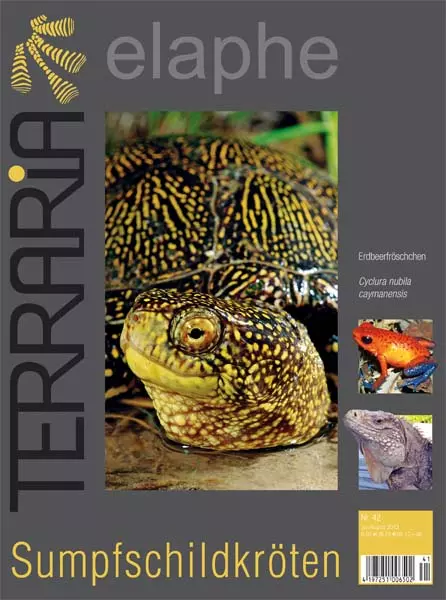
Terraria 42 - Pond turtles

Article no: terraria42

CHF 12.00

Stock: 0

Ready for dispatch in 1-3 days, delivery time 7 working days

Delivery between Friday, 28 August and Monday, 31 August
Zahlungsarten
Product information "Terraria 42 - Pond turtles"

Terraria 42 - Terrapins

Strawberry Frogs
Cyclura nubila caymanensis


Contents:

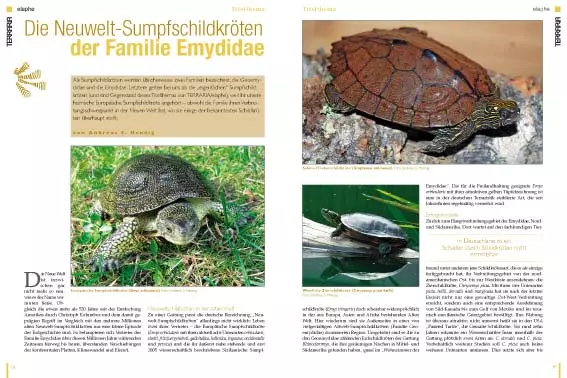
The Emydidae family includes some of the best-known and most popular turtles. In addition to our native European pond turtle, these include the North American ornamental and decorative turtles of the genera Pseudemys and Trachemys as well as the Terrapene box turtles. In the cover story, we provide an up-to-date overview of this interesting group and present a detailed article about the magnificent tortoise, Graptemys oculifera. We also shed light on the role that European pond turtles can play in biology lessons.

Territorial
Herpetorama

Cover story
The New World terrapins of the family Emydidae
Andreas S. Hennig

Graptemys oculifera: Biology, Care and Breeding of the Splendid Box Turtle Part 1: Biology, Endangerment and Initial Care Experiences
Ewald Roddewig

The European pond turtle (Emys orbicularis) in biology lessons
Michael Freund

Panorama

Terraglobal
On safari in Zambia, or: Why do the pelomeduses flee?
Alfred Schleicher

Pearl lizards (Timon lepidus) in the Sierra de Grazalema, Andalusia
Werner & Yvonne Lantermann

Research

New species
A Comorian gecko and the problem of the new online taxonomy
Oliver Hawlitschek

Trachylepis cristinae, a new skink from Sokrota
Axel Kwet

In search of strawberry frogs in Nicaragua
Diana Galindo Uribe, Javier Sunyer, Adolfo Amézquita, Gunther Köhler, Heiko Pröhl & Miguel Vences

Salamandra

Terraristics
Classics
The North African spiny-tailed dragon

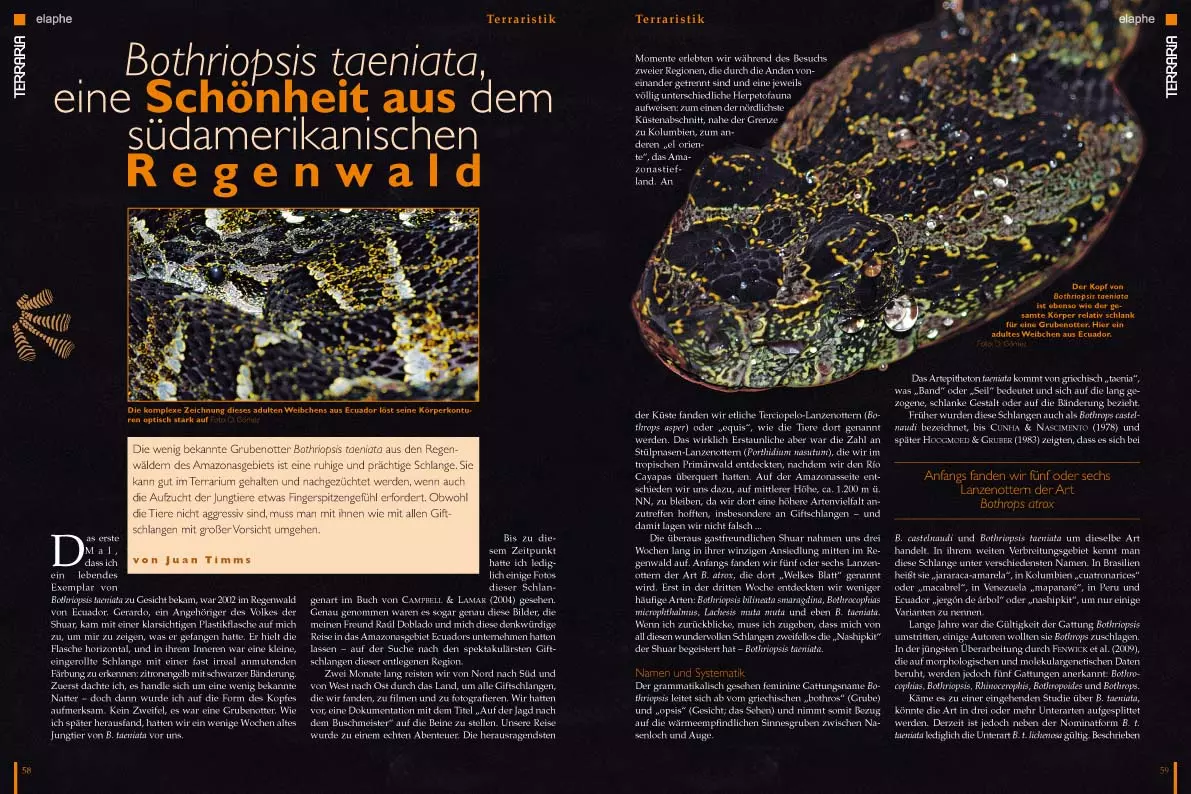
Bothriopsis taeniata, a beauty from the South American rainforest
Juan Timms

Homerange
In the realm of the little lizards. A visit to the terrarium facility of Katrin and Dietmar Mistler
Patrick Schönecker

Nature and species conservation

Field notes
Submerging under water as an escape strategy for the common lizard
Rudolf Malkmus

Grass snakes and slow worms - hunters and hunted
Andreas Ochsenbein

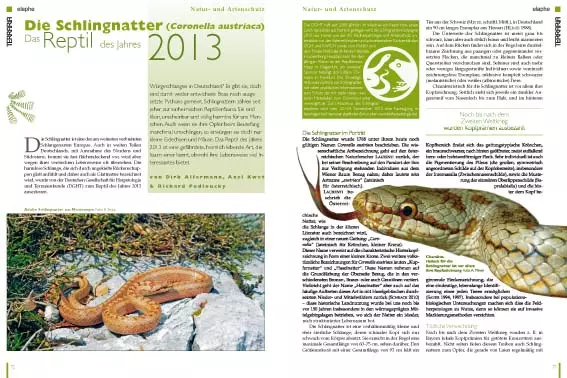
The smooth snake (Coronella austriaca). Reptile of the Year 2013
Dirk Alfermann, Axel Kwet & Richard Podloucky

Threatened in paradise
Kathrin Sawannia, Matthias Goetz & Katharina Foerster

Missing
Vogl’s Stump-footed Frog (Atelopus vogli)

Also in your neighbourhood
Subscription & Service

Gallery
Have a nice holiday! The journey is the reward
Benny Trapp

Preview

Incubator
Expired part 2
Heiko Werning

Composition
Feeding recommendation
Technical details
Size information

0 of 0 reviews

Give us a rating!

Share your experience with the product with other customers.


Suggested products

Handbook of food plants for tortoises and other reptiles
Handbook of forage plants 2nd revised editionMarion Minch is not only a successful breeder of diverse tortoises for many years, but also an excellent connoisseur of native wild herbs. She founded and runs samenkiste.de, which is well known to many tortoise keepers and nature lovers. Her name is inextricably linked with reptile care and species-appropriate nutrition for tortoises. Her handbook of food plants summarises the most important native food plants for herbivorous and omnivorous reptiles. She not only considers tortoises, but also iguanas, spiny-tailed dragons and even chameleons. From the basics of plant biology to native wild herbs to suitable food plants for hardy tropical reptile species, this comprehensive work provides the basis for species-appropriate keeping. In the expanded and supplemented 2nd edition, the plant section is divided according to flower colour. This makes it even easier to identify wild herbs. The work has also been supplemented with a wealth of additional information and many pictures.

CHF 46.50

Geckos
Geckos in the terrarium by Astrid FalkThe book offers a comprehensive introduction to geckos and their species-appropriate keeping in terrariums. It explains what you need to think about before buying a gecko and what preparations should be made. The book describes in detail how the terrarium is technically equipped and set up. The care of the animals, their special features and behaviour, their diet, reproduction and rearing of young animals are described, as well as diseases and husbandry problems with tried and tested suggestions for prevention and treatment. Individual gecko species that are particularly suitable for keeping and breeding in terrariums are portrayed in detail in the second part of the book.

CHF 28.50

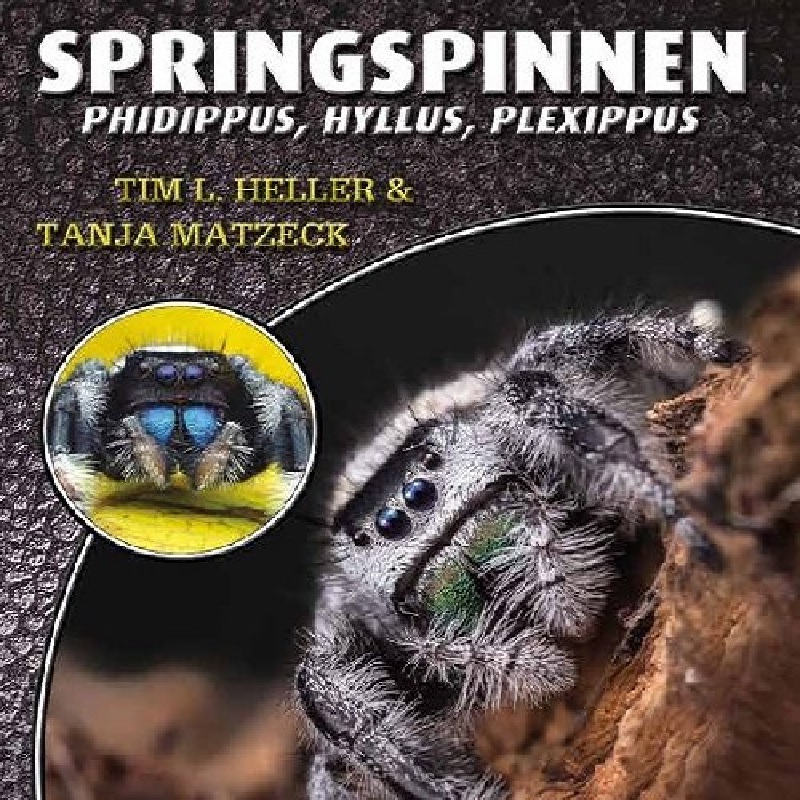
Jumping spiders Phidippus, Hyllus, Plexippus
Book Jumping Spiders - Phidippus, Hyllus & Plexippus A guide to keeping jumping spiders of the genera Phidippus, Hyllus & Plexippus. Who can resist the charm of jumping spiders? The childlike appearance of their expressive face simply leaves no one cold! In addition, their behavior is extremely exciting to observe, their colors are bright and their requirements for species-appropriate keeping are very easy to meet. No wonder these likeable jumpers are all the rage! This volume in the "Species by Species" series describes in detail what to look out for when buying and keeping them, introduces the most commonly kept species and color forms and provides plenty of tips on how to keep them successfully - so you can be sure they will breed well! Species by Species introduces you to the books in this series, which present the most popular terrarium animals. Each volume offers you detailed, practical care instructions and all the information you need to successfully breed your animals. All important questions from the required tank size to terrarium set-up, technical equipment, species-appropriate nutrition and disease prevention are answered with numerous tricks and tips. Experienced, long-standing breeders reveal how you can encourage the animals to reproduce and raise healthy young. All this in full color, generously illustrated and attractively designed - just about your terrarium animal - species by species

CHF 23.90

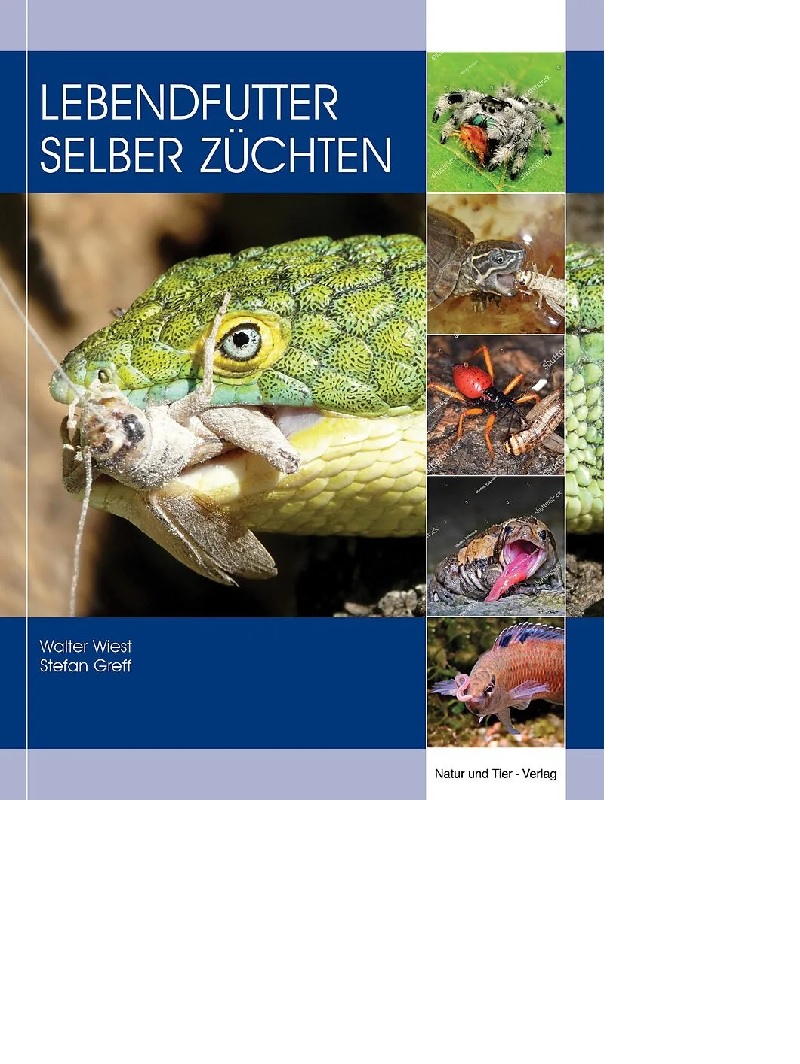
Book Breeding live food yourself
Book "Grow your own live food" - The perfect guide for pet owners Discover practical and detailed instructions on how you can easily breed food for your reptiles, birds, fish or other animals yourself in the book "Breeding live food yourself". With valuable tips on various food insects, their care and breeding, you can save money and ensure a species-appropriate diet for your pets. Contents of the book: Step-by-step instructions for breeding feeder insects Information on the best types of food for reptiles, birds and fish Care instructions and breeding conditions for various live food species Tips for sustainable and cost-effective food production Why breed your own live food? Get healthy, fresh food for your animals Save money and reduce dependence on pet shops Promote the health and well-being of your animals with species-appropriate food Whether you are a beginner or an experienced pet owner, this book provides you with everything you need to successfully breed live food yourself.

CHF 46.50

Marginata 69 - New Guinea tortoises
Marginata 69 - New Guinea tortoises – the genus ElseyaCover storyThe unrecognised beauties: New Guinea tortoises (Andreas S. Hennig)My experiences with Branderhorst's New Guinea tortoise, Elseya (Elseya) branderhorsti (Ouwens, 1914) (Andreas S. Hennig)Keeping and breeding of Rhodin's New Guinea tortoise, Elseya (Hanwarachelys) rhodini Thomson, Amepou, Anamiato & Georges, 2015 (Andreas S. Hennig)PortraitGeoemyda spengleri, Chinese serrated tortoise (Andreas S. Hennig)ReportageMacrochelys temminckii – Experiences and impressions with vulture tortoises part 2 (Reiner Praschag)KeepingAn alternative to year-round keeping of the Egyptian tortoise in the terrarium – my experiences with seasonal outdoor keeping of Testudo kleinmanni (Ricarda Schramm)EtymologySawbacks and living maps part 4: Graptemys gibbonsi, Pascagoula humpback tortoise (Holger Vetter)Classifieds & animal placement

CHF 16.50

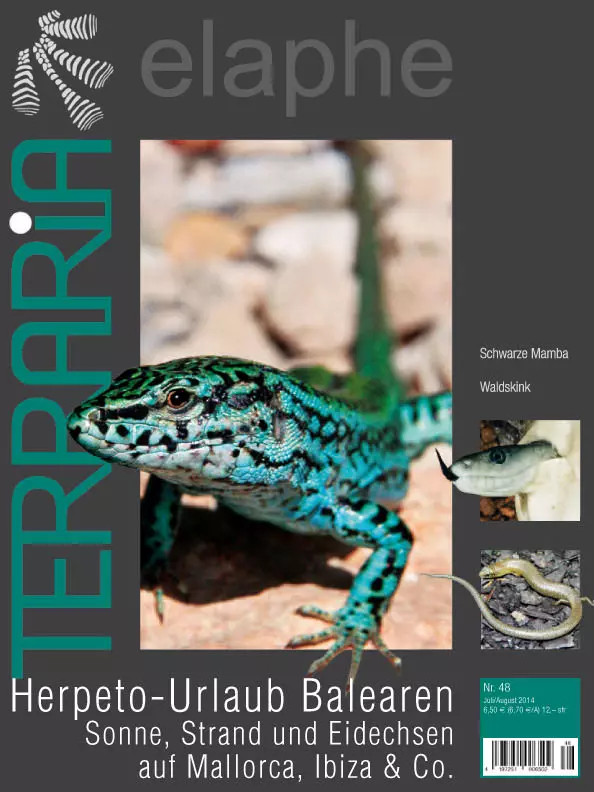
Terraria 48 - Herpeto Holiday Balearic Islands
Terraria 48 - Herpeto holiday Balearic IslandsBlack MambaForest skinkContents:TerritorialHerpetoramaCover storyHerpeto holiday Balearic Islands. Sun, beach and lizards on Mallorca, Ibiza & Co.Mike ZawadzkiIbiza - Sun, beach and lizardsMike ZawadzkiFormentera - Beyond timeMike ZawadzkiMenorca - Blown by the windMike ZawadzkiCabrera - Spain's little GalápagosMike ZawadzkiMallorca - The unrecognised islandMike ZawadzkiPanoramaIn search of mountain vipers (Monitvipera xanthina) in north-eastern Greece – Part 2Michael Wirth"Just Remember that Death is not the End". Taxidermy of reptilesJörg PetzoldWilly Wolterstorff. The "father of the newt" was born 150 years agoWolfgang BischoffResearchAmong researchers"Harmless" snake on the road or the discovery of a new pit viper in the HimalayasGernot VogelNew speciesThe relict-like leaf toad or the discovery of a new frog speciesMirko SoléSalamandraTerraristicsKeeping and breeding the Madagascar forest skink Amphiglossus macorcercusJochen MeyerSubscription & ServiceObservations of the black mamba, Dendroaspis polylepis, in the terrariumLudwig Trutnau & Alfred WallnerNature and species conservationField notesGreek vipersHans PichlerGrass frogs in VilsalpseeAxel KwetEasy help for the amphibian of the year, the yellow-bellied toadAndreas OchsenbeinAlso in your neighbourhoodPreviewIncubator The boys in the swampRolf Leptien

CHF 12.00

Draco 11 - Day geckos
Draco 11 - Day geckos Contents: 2 Editorial 4 day geckos of the genus PhelsumaJens Krüger 20 A terrarium for PhelumenHartmut Lipp 27 On the diet of day geckos of the genus Phelsuma Gerhard Hallmann 30 Group keeping and socialisation of PhelsumaHartmut Lipp 38 Phelsuma berghofi Krüger, 1996Biology, care and reproductionHand Peter Berghof 43 Experiences in the care and breeding of Phelsuma hielscheri Rösler, Obst & Seipp, 2001 from Isalo National Park Hans Peter Berhof & Roland Gebhard 47 On the keeping and breeding of Phelsuma inexpectata Mertens, 1966Oliver Pürkel 51 Taxonomy, care and breeding of the subspecies of Phelsuma lineata Hartmut Lipp 58 Selective colour breeding in Phelsuma madagascariensis grandis Rudolf Gerhardt 61 It doesn’t always have to be green – the less colourful representatives of the genus Phelsuma Hand Peter Berghof 68 Phelsums on Mauritius – A situation study Holger Schneider 77 To Madagascar – For the sake of day geckos Klaus Liebel & Wolfgang Schmidt 85 Book box 91 Magazine

CHF 16.80

Bede at Ulmer, Handbook of Turtle Diseases
Bede at Ulmer - Handbook of Turtle Diseases From the contents: Body structure and function of the organs Nervous system and sensory functions Selected behaviours Growth and age Direct husbandry and feeding damage Diseases of the head, eyes, ears, respiratory organs, digestive organs Poisoning Incubation defects and hatchling diseases

CHF 27.90

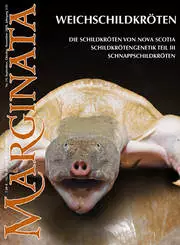
Marginata 19 - Soft-shelled turtles
Marginata 19 - Soft-shelled Turtles The turtles of Nova ScotiaTurtle genetics Part IIISnapping turtles Contents: 2Editorial3 Letters to the Editor4Magazine8 Dates10Reportage The family of soft-shelled turtles – a more than fascinating group of turtles by Hans-Dieter Philippen16ReportageThe Red-backed Flap- Soft-shelled Turtle (Cycloderma aubryi) – a special beauty from the Congo by Gunther Köhler & Herbert Nigl22Breeding in Human CareKeeping and breeding of the Indian Flap-backed Soft-shelled Turtle (Lissemys punctata punctata)by Christina Schäfer31ProfileOrnate Box Turtle, Terrapene ornata ornataby Hans - Dieter Philippen35 ReportageFeeder Animals Part 2Hans - Dieter Philippen40ReportageFrom the pea experiment to decoding of the human genome – Genetics yesterday and today Part 3 by Jens R. Poschadel & Martin Platz46ReportageA journey to the turtles of Nova Scotia in Canada by Herbert Becker, Andreas Gräf & Urs Landweer55ReportageThe snapping turtle problem, a problem to be taken seriously by Markus Baur, Tobias Friz & Rudolf Hoffmann60Book Tip61Classifieds62Regional Guide

CHF 14.70

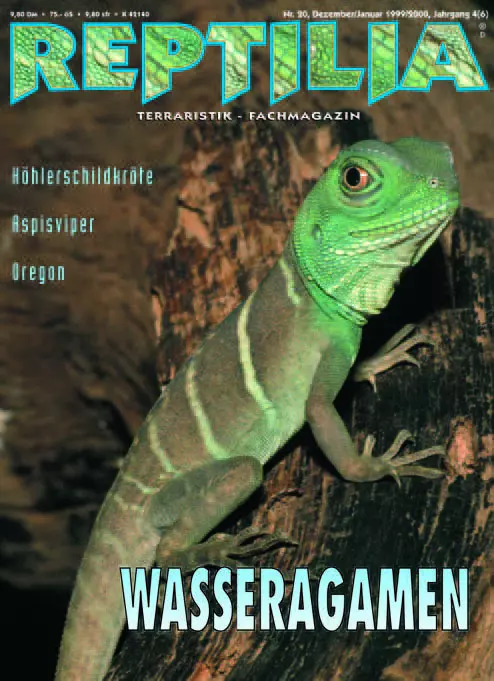
Reptilia 20 - Water dragons
Reptilia 20 - Water dragons Charcoal tortoiseAspis viperOregon Contents: Page 2 - EditorialPage 3 - Letters to the editorPage 6 - MagazinePage 13 - DatesPage 14 - Western Herp Perspectives: a childhood with box turtles, by B. LovePage 15 - Photo report: Water dragons, by. H. WerningPage 22 - Report: Observations of Physignathus concincinus in Thailand and Laos, by S. and U. MantheyPage 24 - Keeping and breeding: 15 years with water dragons, by H. WerningPage 32 - Report: The Australian water dragon Physignathus lesueurii lesueurii, by B. LangerwerfPage 40 - Journey: On tailed amphibian excursions in northern Oregon. Part 1: From the Columbia River Gorge to the north coast, by H. WallaysPage 47 - Portrait and poster: Tribolonotus gracilis, by U. DostPage 51 - Report: the alpine viper Vipera aspis atra, by W. StrassmannPage 56 - Report: Biology, distribution and conservation of the charcoal tortoise Geochelone carbonaria, by M. Merchàn, A. M. Fidalgo and C. PérezPage 64 - Keeping and breeding: Keeping and breeding of some Andean keel-tailed iguanas (Stenocercus) from the Peruvian highlands. Part 2, by U. SchlüterPage 68 - Report: Insects in the terrarium. Part 2, by H. FischerPage 80 - Reptilia on the road: Vivarium Darmstadt, by A. HauschildPage 83 - Advice and actionPage 89 - LibraryPage 96 - Gloss: The crisis in statutory health insurance for reptiles and amphibians, Part 1, by M. Vanselow

CHF 9.80

NTV, Genetics for Terrarians
NTV - Genetics for Terrarium Keepers 88 pages numerous illustrations Format: 16.8 x 21.8 cm Author Jens R. Poschadel & Martin Plath Publisher NTV Contents: Genetics plays an outstanding role in modern herpetology and terrarium keeping. Not only are new species described and pedigrees compiled on the basis of genetic analyses, but above all, anyone who breeds amphibians or reptiles must at least be familiar with the basics of heredity. Jens R. Poschadel and Martin Plath explain classical as well as molecular genetics in this book in an easily comprehensible manner and describe their significance for research and breeding of terrarium animals.

CHF 32.50

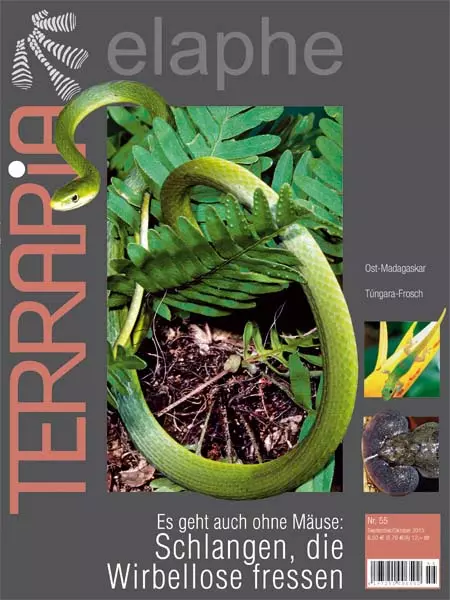
Terraria 55 - Snakes eating invertebrates
Terraria 55 - Snakes that eat invertebrates Túngara frogEast Madagascar Contents: Cover story: It works without mice: Snakes that eat invertebrates Most snakes in terraria have to be fed on rodents. However, there are a whole range of often lesser known but highly interesting species that exclusively eat invertebrates such as insects, snails and others. We present a selection of the most interesting representatives and discuss in detail the dwarf snakes of the genus Eirenis and the brown snakes of the genus Storeria. We also reveal how to breed slugs for feeding snail-eating snakes. Territorial HerpetoramaWorld's first reproduction of an endangered clawed frog species: Xenopus longipes Species diversity on the display Thorny devil: Kermit frog in Costa Rica Cultural followers: The reign of the terror lizards Pappochelys – a 240 million year old “turtle grandpa” Poison dart frog: Death of a turtle breeder Cover storySnakes that eat invertebratesKriton Kunz Terraristic remarks on the snakes of the genus StoreriaFrank Täufer Habitat and terrarium observations on dwarf snakes of the genus Eirenis from south-west SyriaHans Esterbauer Collect and breed slugsHerbert Stern PanoramaDiary of a trip to eastern Madagascar. Visiting the Marojejy National Park and the Betampona Nature ReservePeter Baert Research New speciesNew moccasin snakes in North AmericaAxel Kwet Among researchersHerpetology in theory and practice A journey to the Caribbean north of ColombiaClaudia Koch Salamandra TerraristicsFoam maker and top model. Exciting things surrounding the Túngara frog.Part 1: Behaviour and bioacousticsKriton Kunz Bibliography Ophiophagy in snakes in terrariaDieter Schmidt Nature and species protection Field notesGrass snakes hunting newtsRudolf Malkmus Common toad clings to common carpJörn Krütgen Children's page on the reptile of the year: The European pond turtle The snake plagueAxel Hilger & Axel Kwet Amphibian action plan for northwest BrazilMirco Solé Also in your areaSubscription & ServicePreview Incubator No gecko at allRolf Leptien

CHF 12.00