Handbook of forage plants 2nd revised editionMarion Minch is not only a successful breeder of diverse tortoises for many years, but also an excellent connoisseur of native wild herbs. She founded and runs samenkiste.de, which is well known to many tortoise keepers and nature lovers. Her name is inextricably linked with reptile care and species-appropriate nutrition for tortoises. Her handbook of food plants summarises the most important native food plants for herbivorous and omnivorous reptiles. She not only considers tortoises, but also iguanas, spiny-tailed dragons and even chameleons. From the basics of plant biology to native wild herbs to suitable food plants for hardy tropical reptile species, this comprehensive work provides the basis for species-appropriate keeping. In the expanded and supplemented 2nd edition, the plant section is divided according to flower colour. This makes it even easier to identify wild herbs. The work has also been supplemented with a wealth of additional information and many pictures.
Geckos in the terrarium by Astrid FalkThe book offers a comprehensive introduction to geckos and their species-appropriate keeping in terrariums. It explains what you need to think about before buying a gecko and what preparations should be made. The book describes in detail how the terrarium is technically equipped and set up. The care of the animals, their special features and behaviour, their diet, reproduction and rearing of young animals are described, as well as diseases and husbandry problems with tried and tested suggestions for prevention and treatment. Individual gecko species that are particularly suitable for keeping and breeding in terrariums are portrayed in detail in the second part of the book.
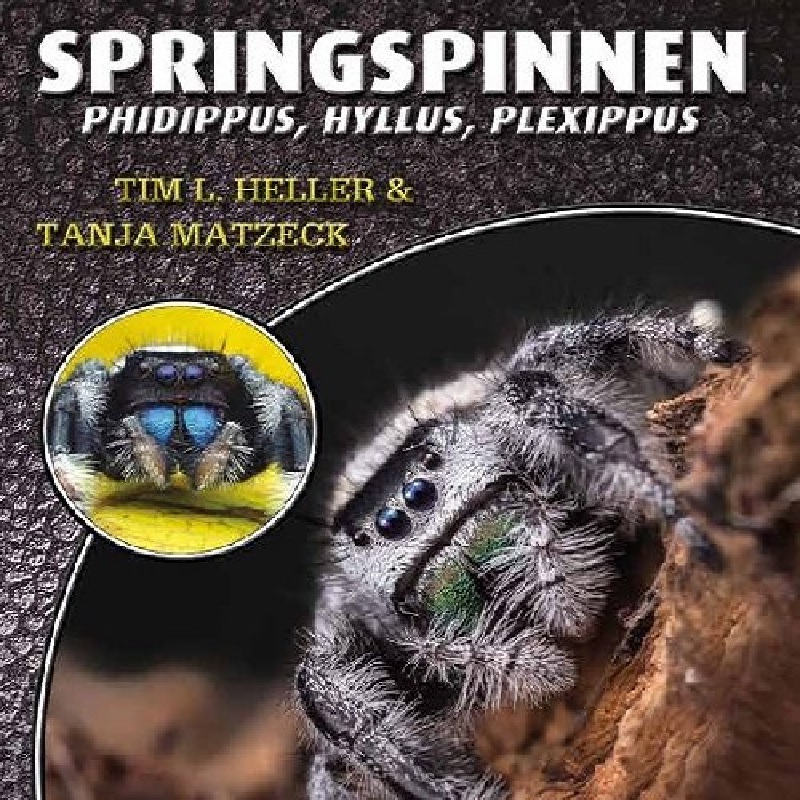
Book Jumping Spiders -
Phidippus, Hyllus & Plexippus
A guide to keeping jumping spiders of the genera Phidippus, Hyllus & Plexippus. Who can resist the charm of jumping spiders? The childlike appearance of their expressive face simply leaves no one cold! In addition, their behavior is extremely exciting to observe, their colors are bright and their requirements for species-appropriate keeping are very easy to meet. No wonder these likeable jumpers are all the rage!
This volume in the "Species by Species" series describes in detail what to look out for when buying and keeping them, introduces the most commonly kept species and color forms and provides plenty of tips on how to keep them successfully - so you can be sure they will breed well!
Species by Species introduces you to the books in this series, which present the most popular terrarium animals. Each volume offers you detailed, practical care instructions and all the information you need to successfully breed your animals.
All important questions from the required tank size to terrarium set-up, technical equipment, species-appropriate nutrition and disease prevention are answered with numerous tricks and tips.
Experienced, long-standing breeders reveal how you can encourage the animals to reproduce and raise healthy young.
All this in full color, generously illustrated and attractively designed - just about your terrarium animal - species by species
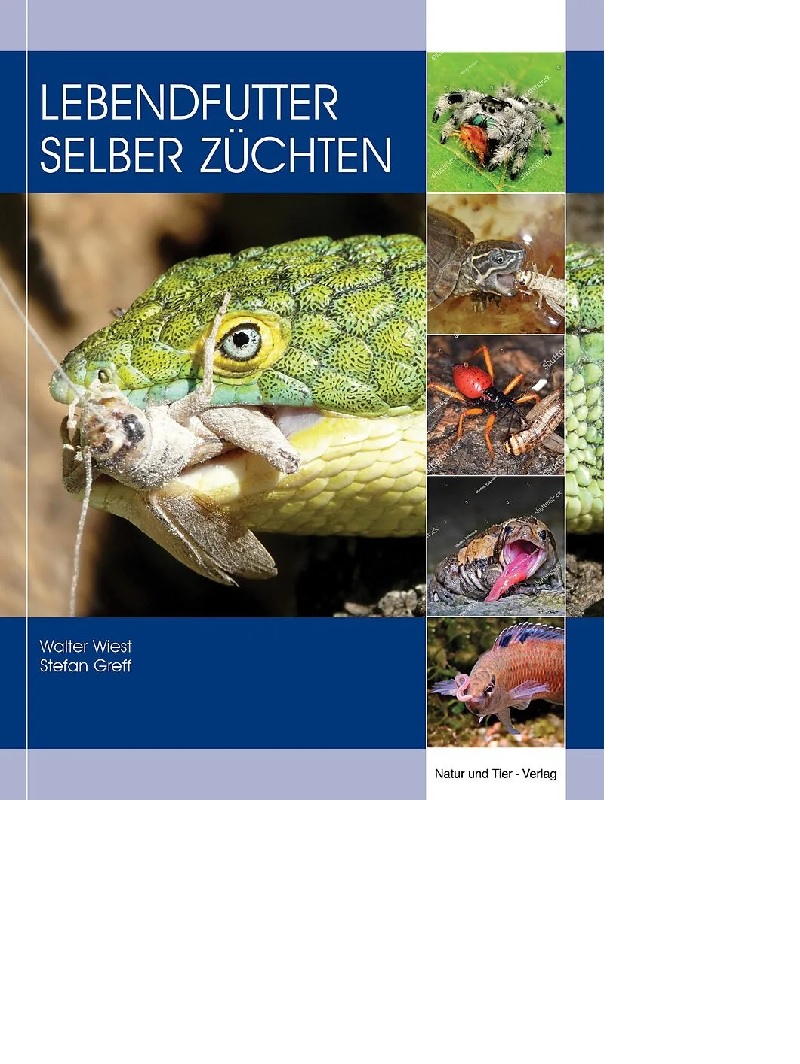
Book "Grow your own live food" - The perfect guide for pet owners
Discover practical and detailed instructions on how you can easily breed food for your reptiles, birds, fish or other animals yourself in the book "Breeding live food yourself". With valuable tips on various food insects, their care and breeding, you can save money and ensure a species-appropriate diet for your pets.
Contents of the book:
Step-by-step instructions for breeding feeder insects
Information on the best types of food for reptiles, birds and fish
Care instructions and breeding conditions for various live food species
Tips for sustainable and cost-effective food production
Why breed your own live food?
Get healthy, fresh food for your animals
Save money and reduce dependence on pet shops
Promote the health and well-being of your animals with species-appropriate food
Whether you are a beginner or an experienced pet owner, this book provides you with everything you need to successfully breed live food yourself.
Marginata 69 - New Guinea tortoises – the genus ElseyaCover storyThe unrecognised beauties: New Guinea tortoises (Andreas S. Hennig)My experiences with Branderhorst's New Guinea tortoise, Elseya (Elseya) branderhorsti (Ouwens, 1914) (Andreas S. Hennig)Keeping and breeding of Rhodin's New Guinea tortoise, Elseya (Hanwarachelys) rhodini Thomson, Amepou, Anamiato & Georges, 2015 (Andreas S. Hennig)PortraitGeoemyda spengleri, Chinese serrated tortoise (Andreas S. Hennig)ReportageMacrochelys temminckii – Experiences and impressions with vulture tortoises part 2 (Reiner Praschag)KeepingAn alternative to year-round keeping of the Egyptian tortoise in the terrarium – my experiences with seasonal outdoor keeping of Testudo kleinmanni (Ricarda Schramm)EtymologySawbacks and living maps part 4: Graptemys gibbonsi, Pascagoula humpback tortoise (Holger Vetter)Classifieds & animal placement
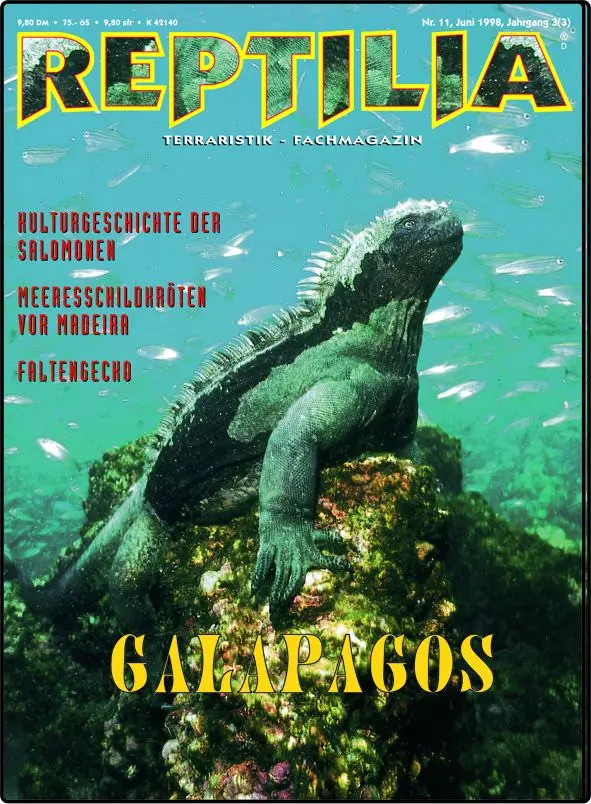
Reptilia 11 - Galapagos
Cultural history of the Solomon IslandsSea turtles off MadeiraWrinkled gecko
Contents:
EditorialLetters to the editorMagazinesDatesWestern Herp Perspectives: The Terrarium TrapB. Love
Photo reportageGalápagosH. Werning
HerpetofaunaThe Galápagos giant tortoiseB. Schramm
ReportageSpecies conservation hunt on GalápagosH. Stoldt
ReportageEl niño and the Galápagos reptilesH. Stoldt
Keeping and breedingThe Egg Snake Dasypeltis atraD. Modry and P. Neças
Portrait and posterBrachypelma emiliaP. Klaas
HerpetofaunaSea turtles off MadeiraProf. T. Dellinger and Prof. P. Wirtz
Keeping and breedingThe poison dart frog Minyobates minutusM. Schulte
TerraristicsProphylaxis and quarantineProf. P. Kölle and Prof. R. Hoffmann
Herpetology and cultureAmphibian and reptile myths of the MelanesiansDr. H.-J. Hermann
Reptilia on the roadLeipzig ZooS. Hennig
LibraryAdvice and actionIncubator
Draco 28 - Live food
Contents:
2 Editorial 4 Live food for amphibians and reptiles– History and basicsUrsula Friedrich 22 The professional handling of food animals – Basic requirement for a species- and animal-appropriate diet for reptiles and amphibiansThomas Wilms 32 Some aspects of breeding your own food animalsStefan Ziesmann 39 The pea aphid – an unusual food animalLars Österdahl 42 Breeding the common fruit fly (Drosophila melanogaster)– Many paths lead to successMarco Wagemann 50 Tropical cockroaches – lively insect lovers, valuable food animals or even both?Andreas Bauer 58 Oven fish breeding – a way to provide a little variety in the diet of our vivarium animals with little effort!Marco Wagemann 64 The breeding of aquatic snails Cornelia Gabler 67 Agate snails – not only an extraordinary food animalUwe Geissel 71 Tubifex breedingCornelia Gabler 74 Small mammals as food animals – using the house mouse (Mus musculus) as an exampleThomas Wilms & Beate Löhr 86 Book box
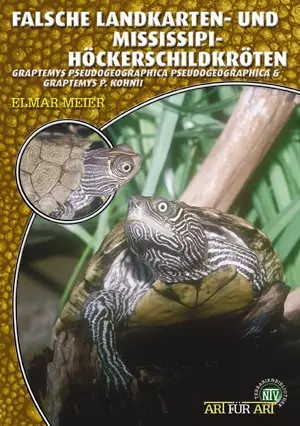
NTV - False map and Mississippi humpback turtles
64 pages
Format: 14.8 x 21 cm
Paperback
numerous colour photos
Author Elmar Meier
Content:
Systematics and body structure
The fascinating biology: From the life of the false map and Mississippi humpback turtle
All information on species-appropriate keeping: From suitable terrarium to equipment and technology to feeding
Successful breeding: Mating stimulation, incubation of the eggs and rearing of hatchlings
Solutions to problems: How to avoid the most common mistakes in care, and how to help sick animals
Brilliant photos
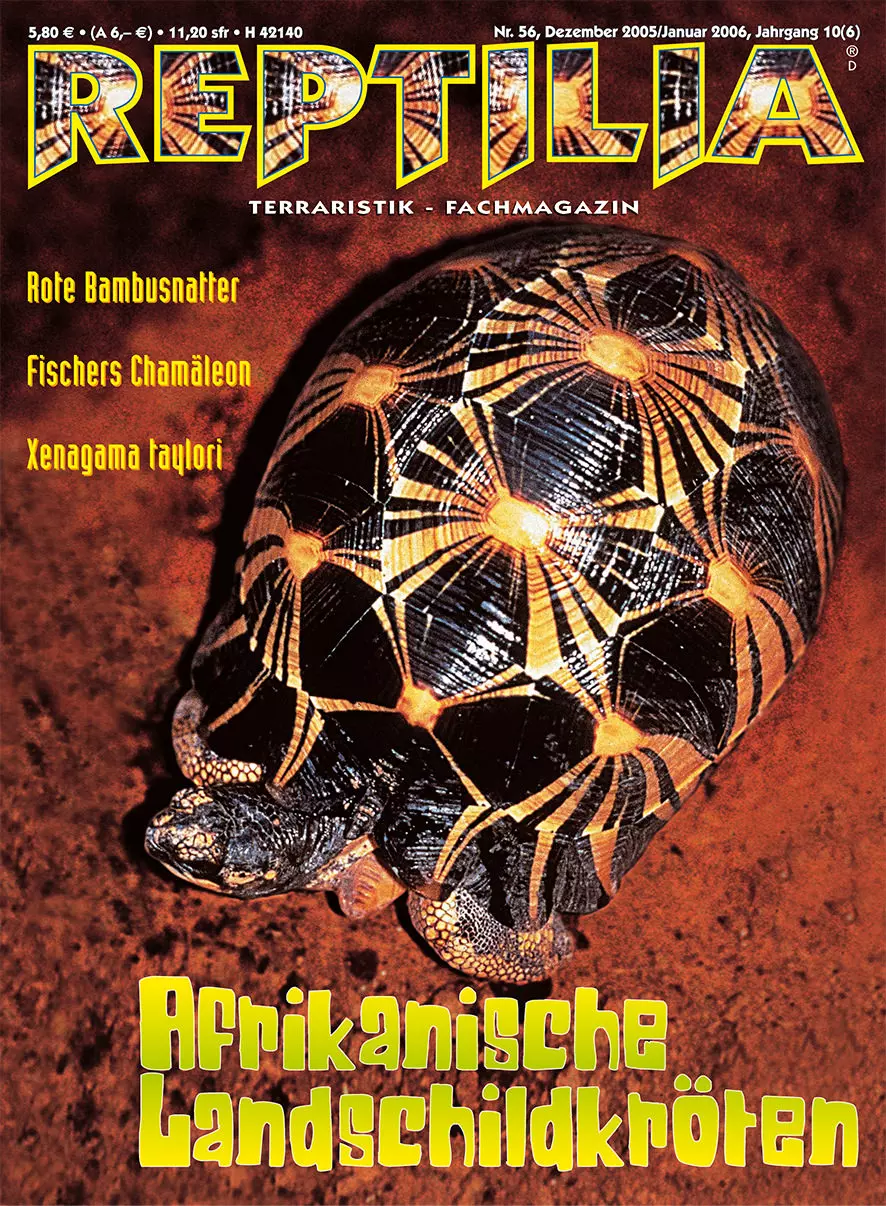
Reptilia 56 - African tortoises
Red bamboo snakeFisher's ChameleonXenagama taylori
Contents:
2 EDITORIAL
6 MAGAZINE & READERS' LETTERS
14 DATES
16 WESTERN HERP PERSPECTIVES The blue Mexican From B. Love
18 PHOTO REPORTAGE African tortoises By J. Valverde
26 REPORTAGE The tortoises of Africa – diversity through Adaptation to extreme habitats By T. & S. Vinke
31 HERPETOFAUNA Taxonomy, ecology and protection of the Panther tortoise (Stigmochelys pardalis) By J. S. Massana & A. M. Silvestre
36 KEEPING AND BREEDING The areola tortoise Hompus areola- tus (THUNBERG, 1787) – Observations and experiences: Lifestyle, husbandry, Breeding and rearing By A. Schleicher
42 TRAVEL Excursion in western Cuba By L. Geißler
51 PORTRAIT AND POSTER Bradypodion occidentale By M. Dobiey
56 KEEPING AND BREEDING Keeping, care and breeding of Taylors Beavertail dragon, Xenagama taylori (PARKER, 1935) By P. M. Müller
62 KEEPING AND BREEDING Terrarium keeping of the Thai Red bamboo snake (Oreophis porphyraceus coxi) and a rare birth of twins By V. Knietsch
67 HERPETOFAUNA On the breeding of the red broad-banded bamboo snake, Oreophis porphyraceus laticinctus SCHULZ & HELFENBERGER 1998 By J. Bulian, B Siebert & M. Ansermet
72 HERPETOFAUNA Chameleons in the western Usambara- Mountains in northern Tanzania By W. & Y. Lantermann
78 REPORTAGE A cyclone in Sri Lanka By P. Janzen
86 CLASSIFIED ADS
91 RAT & TAT
94 LIBRARY
104 BRUTKASTEN My flat-sharing community Part 1: I wouldn't have any time at all, Set cars on fire! By H. Werning
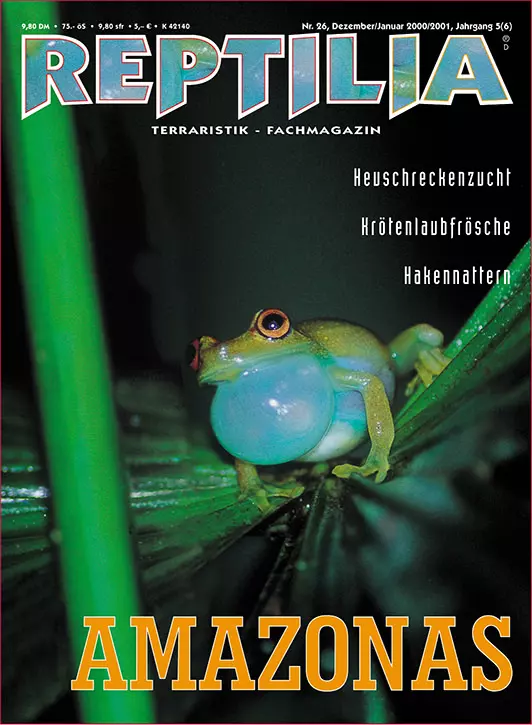
Reptilia 26 - Amazonas
Grasshopper breedingToad tree frogsHook-nosed snakes
Contents:
2 Editorial
3 Letters to the editor
6 Magazine
12 Dates
14 Western Herp Perspectives: The Evolution of Hunting, by B. Love
16 Photo report: Amazonas, by H. Werning
24 Vibrant Forests – The Flooded Forests of the Amazonas, by H. Werning and H. Kreibich
30 Report: In search of the largest anaconda, by L. Dirksen and P. Strimple
35 Report: Seeing the wood for the trees – What to do on the Amazonas, by H. Werning
42 Terrarium keeping: Breeding feeder insects: The Egyptian Migratory Locust Locusta migratoria, by T. Eisenberg
47 Care and breeding: The Mexican Hook-nosed Snake Heterodon nsicus kennerlyi, by D. Hasselberg
51 Portrait and poster: Geochelone sulcata, by M. Aresté
55 Care and breeding: The "flying lizard" – Care and breeding of Holaspis guentheri laevis, by Dr. M. Meyer
58 Care and breeding: Care and breeding of the tree cavity-dwelling toad tree frog (Phrynohyas resinifictrix GOELDI 1907) in the terrarium
65 Terrarium keeping: Construction of a snake-free enclosure, Part 2: Execution of the work
70 Herpetology and culture: "The dragon's old brood lives in caves", A look at ideas about dragons in East and West, part 2, by K. Kunz
75 Reptilia on tour: The Snake Park in Nairobi, Kenya, by A. S. Henning
82 Advice and action
97 Library
104 Gloss: Anaconda! (Part 1), by H. Werning
Reptilia 89 - Cobras
BaumvogelspinnenPyxis arachnoidesYucatán
Inhalt:
Kaum ein anderes Reptil erfüllt den Menschen seit alters so sehr mit gleichermaßen Faszination und Furcht wie die Kobras. Während in Mühlheim das entfleuchte Jungtier einer solchen Giftnatter gleich dafür sorgt, dass ein ganzes Haus entkernt wird, leben die Menschen kompletter Erdteile dauernd in direkter Nachbarschaft zu diesen Schlangen. Wir nähern uns diesen besonderen Reptilien mit zoologischem Interesse und werfen einen Blick auf ihre Lebensweise. Und berichten natürlich auch über ihre verantwortungsvolle Terrarienhaltung. EditorialMAGAZINTERMINEWESTERN HERP PERSPECTIVES„Okeetee“B. LoveFOTOSTORYKobrasS. WinchellHERPETOFAUNADie Gebänderte Wasserkobra, Boulengerina annulataM. DaintyKULTURKobras in der hinduistischen KulturR. AvadhaniHALTUNG UND NACHZUCHTDie Schwarzweiße Kobra, Naja melanoleuca. Teil 1Von L. YeomasReiseReise in den Nordosten Yucatáns. Parks und Sehenswürdigkeiten der Reviera MajaS. Esser & W. DahmPORTRÄT und PosterRanitomeya uakariiM. DobieyHALTUNG UND NACHZUCHTErfahrungen mit Haltung und Nachzucht des Vietnam-GoldgeckosP. PogodaherpetofaunaAfrikanische Baumvogelspinnen im PorträtK. MannsReportageUnterwegs auf dem Ahr-RotweinwanderwegH. KreyerhoffherpetofaunaDie Spinnenschildkröte Pyxis arachnoidesJ. Soler & A. Martínez SilvestreTiere unserer heimatDie ÄskulapnatterR. LeptienBibliothekABO & SERVICEAUCH IN IHRER NÄHEVORSCHAUBRUTKASTEN In den Sand gesetztH. Werning
Draco 02 - Mediterranean tortoises
Contents:
2 Editorial
4 Species and subspecies of Mediterranean tortoises, by A. Pieh
18 Insights into the natural lifestyle of Testudo hermanni hermanni, by K. Matthes
25 Impressions from various habitats of the Moorish tortoise (Testudo graeca) in Morocco – a travel report, by A. Pieh
32 On the reproductive biology of European tortoises using the marginated tortoise (Testudo marginata, SCHÖPF 1792) as an example, by M. Mähn and N. Graf
42 Planning and construction of an outdoor enclosure for European tortoises, by K. Simon
48 Tips for the hibernation of Mediterranean tortoises, by T. Wilms
52 Use of hay cobs as supplementary food for tortoises, by C. Dennert
56 On the keeping and breeding of the Horsfield’s tortoise (Testudo horsfieldii, GRAY 1844), by T. Wilms and B. Löhr
60 The Mediterranean tortoise in veterinary practice, by J. Wiechert
72 The teeth of tortoises, by D. Losansky
79 Book box
87 Magazine