Terraria 39 - Animal welfare and terraristics

Article no: terraria39

CHF 12.00

Stock: 0

Ready for dispatch in 1-3 days, delivery time 7 working days

Delivery between Tuesday, 20 October and Wednesday, 21 October
Zahlungsarten
Product information "Terraria 39 - Animal welfare and terraristics"

Terraria 39 - Animal welfare and terraristics

Emerald skink
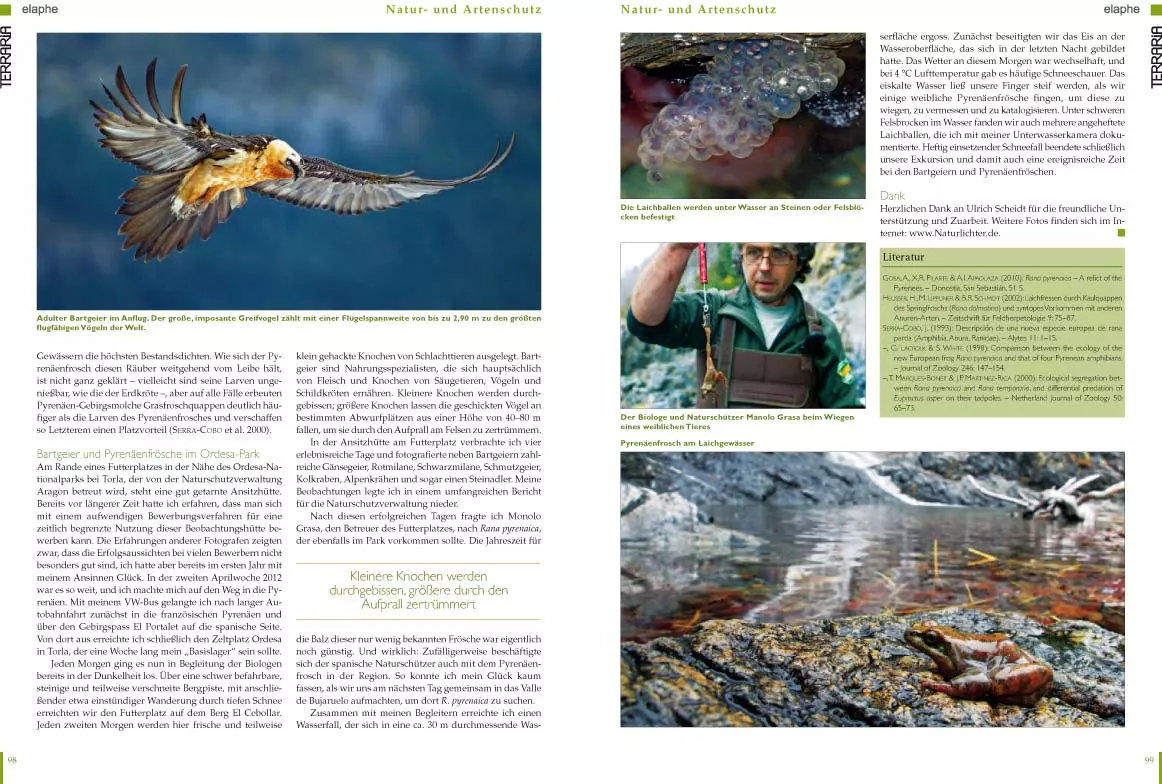
Pyrenean frogs and bearded vultures

Contents:

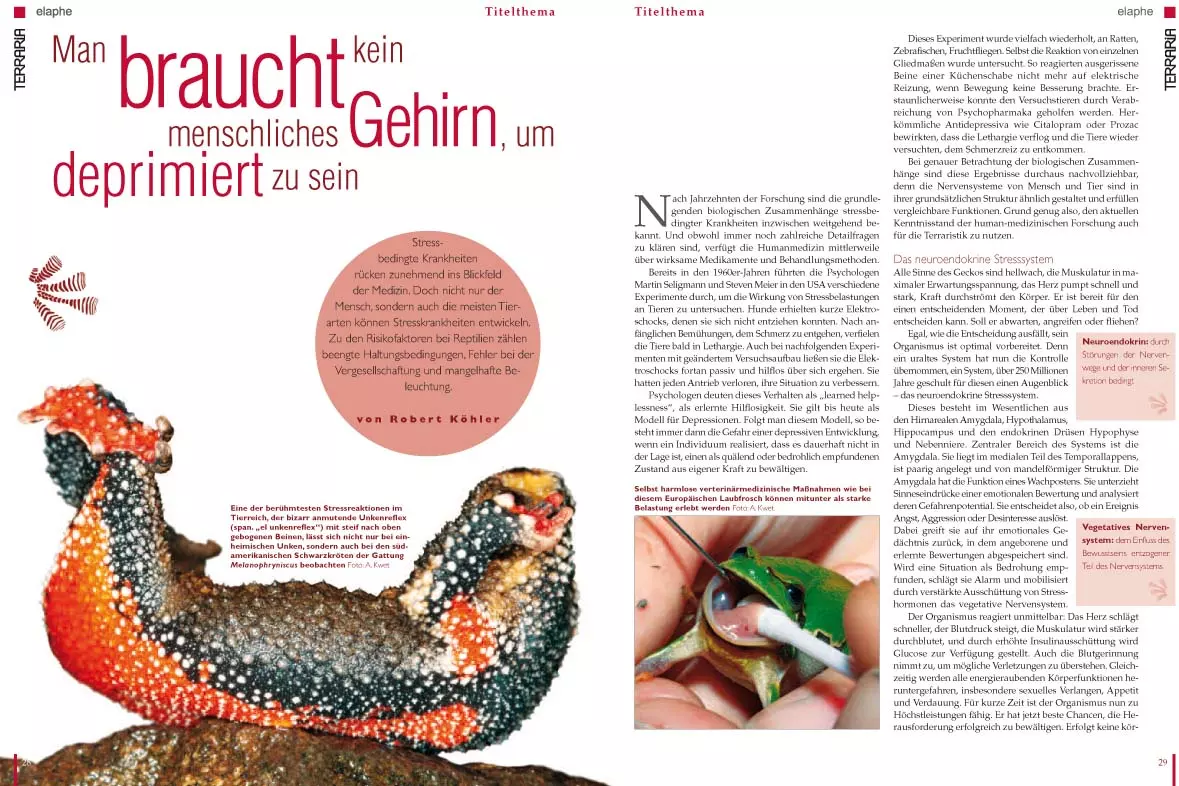
Cover story:Animal welfare and terraristics
What should actually belong together as a matter of course is sometimes irreconcilably opposed. Most terrarium enthusiasts see themselves as animal rights activists, while many animal rights activists completely reject terraristics. And within the terrarium hobby, there are always new insights and the need to improve animal welfare for the pets.
In the cover story of the next TERRARIA/elaphe, we take a look at the most important aspects of animal welfare in the terrarium hobby, investigate what drives our worst opponents, the animal rights activists, and devote ourselves to the important topic of stress-related illnesses in terrarium animals.

Territorial
Herpetorama

Cover story
"It takes more than a good heart to protect animals"
Interview with Markus Baur

You don't need a human brain to be depressed
Robert Köhler

In the realm of the wild animal rights activists
An essay by Heiko Werning

Panorama

Terraglobal
How important are ponds for frogs?
Mirco Solé

About the problems of writing an article
Joachim Bulian

The Barbados Wildlife Reserve – a worthwhile destination
Jens Jungnickel

Research
New species
New snail snake sets an example against overexploitation
Sebastian Lotzkat

New tree frogs with a bend in the toe – twoScinax species from southern Brazil
Axel Kwet

Among researchers
The reintroduction of the Siamese crocodile (Crocodylus siamensis) in Vietnam – a pioneering project?
Kristian Robert Pahl

Apothecary skinks and bionics
Uwe Schlüter

Salamandra

Terraristics

Classics
The King Python

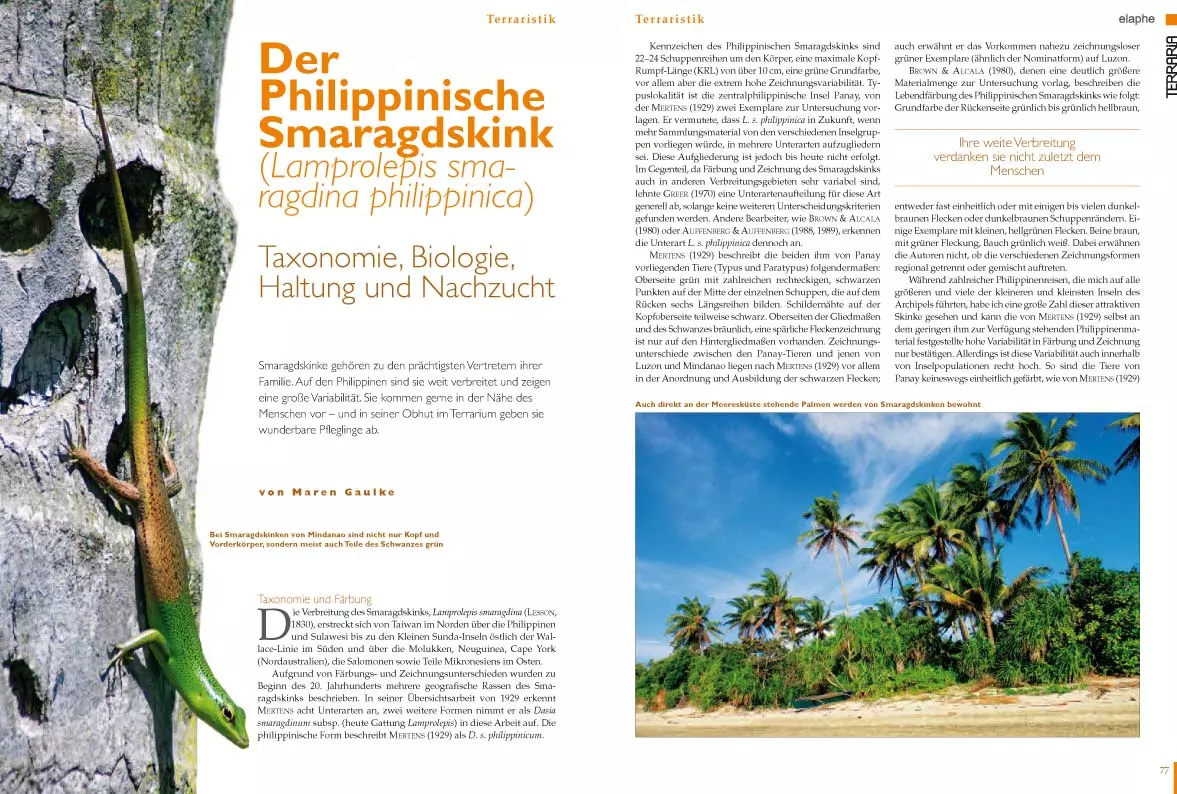
The Philippine Emerald Skink (Lamprolepis smaragdina philippinica) – Taxonomy, Biology, Care and Breeding
Maren Gaulke

Nature and species conservation

Field notes
Unusual year for midwife toads in Leinebergland (Lower Saxony)
Stefan Meyer

Double-headed smooth snake
Mario Schweiger

Forensic herpetology – A pond thriller
Guntram Deichsel

Between bearded vulture and Pyrenean frog
Christoph F. Robiller

Missing
Pointed-snouted stream frog (Taudactylus acutirostris)

Subscription & Service

Also in your neighbourhood

Gallery

2013 – The year of the snake

Preview

Incubator
Breaking Bad Wedding. Part 2
Heiko Werning

Composition
Feeding recommendation
Technical details
Size information

0 of 0 reviews

Give us a rating!

Share your experience with the product with other customers.


Suggested products

Handbook of food plants for tortoises and other reptiles
Handbook of forage plants 2nd revised editionMarion Minch is not only a successful breeder of diverse tortoises for many years, but also an excellent connoisseur of native wild herbs. She founded and runs samenkiste.de, which is well known to many tortoise keepers and nature lovers. Her name is inextricably linked with reptile care and species-appropriate nutrition for tortoises. Her handbook of food plants summarises the most important native food plants for herbivorous and omnivorous reptiles. She not only considers tortoises, but also iguanas, spiny-tailed dragons and even chameleons. From the basics of plant biology to native wild herbs to suitable food plants for hardy tropical reptile species, this comprehensive work provides the basis for species-appropriate keeping. In the expanded and supplemented 2nd edition, the plant section is divided according to flower colour. This makes it even easier to identify wild herbs. The work has also been supplemented with a wealth of additional information and many pictures.

CHF 46.50

Geckos
Geckos in the terrarium by Astrid FalkThe book offers a comprehensive introduction to geckos and their species-appropriate keeping in terrariums. It explains what you need to think about before buying a gecko and what preparations should be made. The book describes in detail how the terrarium is technically equipped and set up. The care of the animals, their special features and behaviour, their diet, reproduction and rearing of young animals are described, as well as diseases and husbandry problems with tried and tested suggestions for prevention and treatment. Individual gecko species that are particularly suitable for keeping and breeding in terrariums are portrayed in detail in the second part of the book.

CHF 28.50

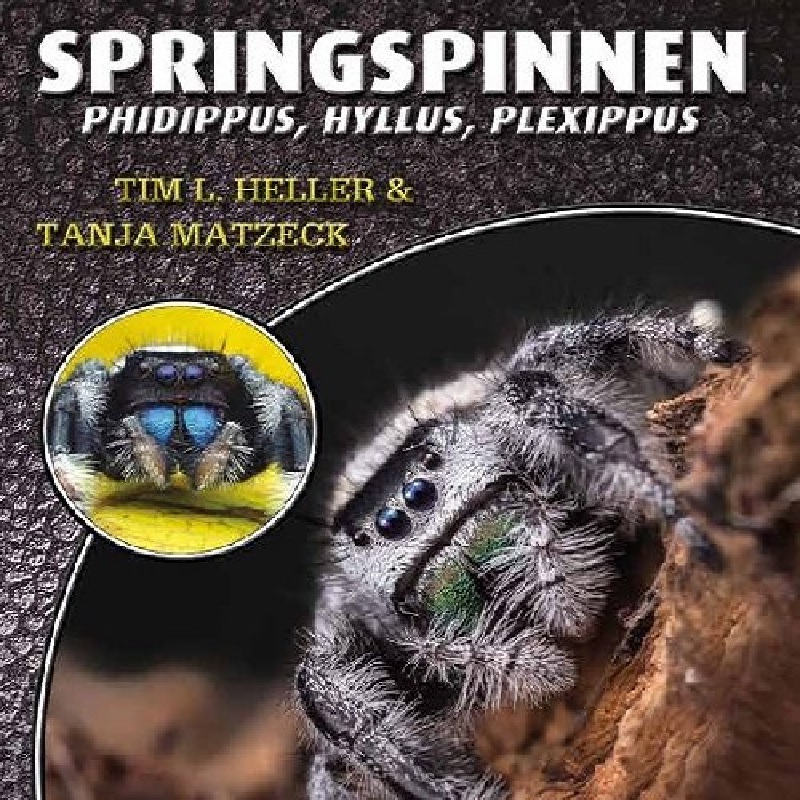
Jumping spiders Phidippus, Hyllus, Plexippus
Book Jumping Spiders - Phidippus, Hyllus & Plexippus A guide to keeping jumping spiders of the genera Phidippus, Hyllus & Plexippus. Who can resist the charm of jumping spiders? The childlike appearance of their expressive face simply leaves no one cold! In addition, their behavior is extremely exciting to observe, their colors are bright and their requirements for species-appropriate keeping are very easy to meet. No wonder these likeable jumpers are all the rage! This volume in the "Species by Species" series describes in detail what to look out for when buying and keeping them, introduces the most commonly kept species and color forms and provides plenty of tips on how to keep them successfully - so you can be sure they will breed well! Species by Species introduces you to the books in this series, which present the most popular terrarium animals. Each volume offers you detailed, practical care instructions and all the information you need to successfully breed your animals. All important questions from the required tank size to terrarium set-up, technical equipment, species-appropriate nutrition and disease prevention are answered with numerous tricks and tips. Experienced, long-standing breeders reveal how you can encourage the animals to reproduce and raise healthy young. All this in full color, generously illustrated and attractively designed - just about your terrarium animal - species by species

CHF 23.90

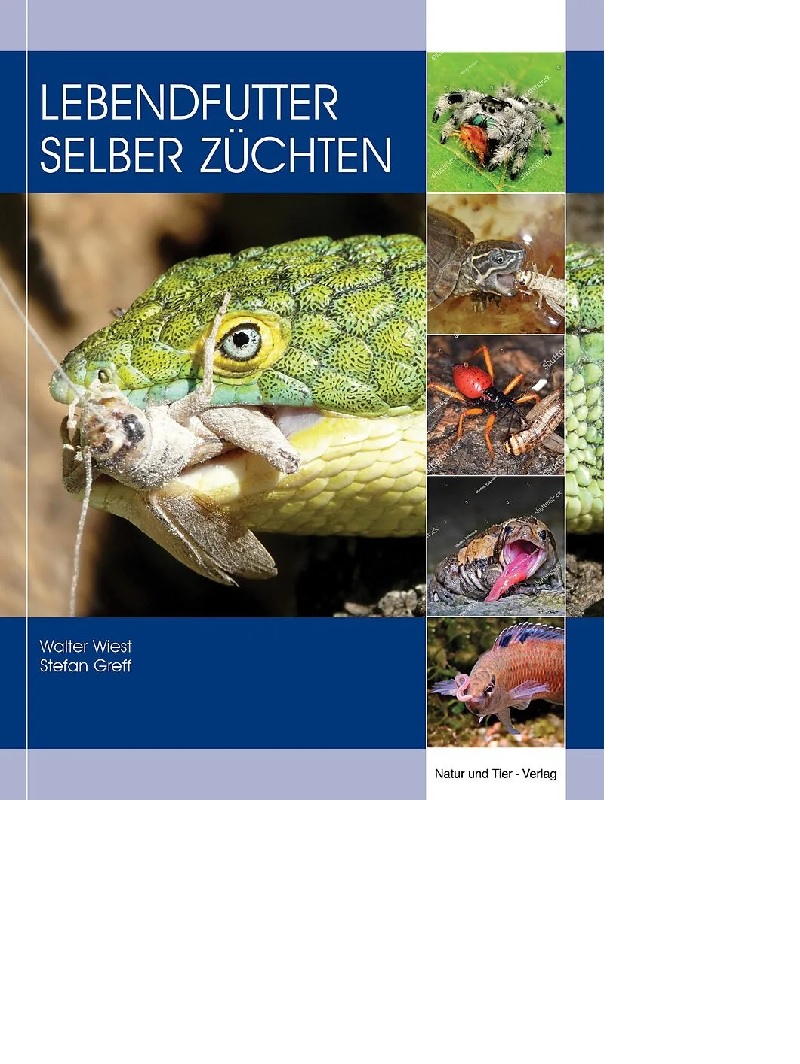
Book Breeding live food yourself
Book "Grow your own live food" - The perfect guide for pet owners Discover practical and detailed instructions on how you can easily breed food for your reptiles, birds, fish or other animals yourself in the book "Breeding live food yourself". With valuable tips on various food insects, their care and breeding, you can save money and ensure a species-appropriate diet for your pets. Contents of the book: Step-by-step instructions for breeding feeder insects Information on the best types of food for reptiles, birds and fish Care instructions and breeding conditions for various live food species Tips for sustainable and cost-effective food production Why breed your own live food? Get healthy, fresh food for your animals Save money and reduce dependence on pet shops Promote the health and well-being of your animals with species-appropriate food Whether you are a beginner or an experienced pet owner, this book provides you with everything you need to successfully breed live food yourself.

CHF 46.50

Marginata 69 - New Guinea tortoises
Marginata 69 - New Guinea tortoises – the genus ElseyaCover storyThe unrecognised beauties: New Guinea tortoises (Andreas S. Hennig)My experiences with Branderhorst's New Guinea tortoise, Elseya (Elseya) branderhorsti (Ouwens, 1914) (Andreas S. Hennig)Keeping and breeding of Rhodin's New Guinea tortoise, Elseya (Hanwarachelys) rhodini Thomson, Amepou, Anamiato & Georges, 2015 (Andreas S. Hennig)PortraitGeoemyda spengleri, Chinese serrated tortoise (Andreas S. Hennig)ReportageMacrochelys temminckii – Experiences and impressions with vulture tortoises part 2 (Reiner Praschag)KeepingAn alternative to year-round keeping of the Egyptian tortoise in the terrarium – my experiences with seasonal outdoor keeping of Testudo kleinmanni (Ricarda Schramm)EtymologySawbacks and living maps part 4: Graptemys gibbonsi, Pascagoula humpback tortoise (Holger Vetter)Classifieds & animal placement

CHF 16.50

NTV - The dyeing dart frog
The Dyer Frog by Dirk Wagner 64 pages Format: 14.8 x 21 cm 67 colour photos Contents: Foreword Relationship Description Distribution, habitat and way of life Colour forms Care Socialisation Poison Species protection Acquisition Transport and quarantine The terrarium Terrarium technology Light Warmth Water and humidity Furnishing and planting Food Care work Health Breeding Further information Literature

CHF 18.50

Draco 32 - Mediterranean tortoises
Draco 32 - Mediterranean tortoises Contents: 2 Editorial 4 Mediterranean tortoises Alexander Pieh & Hans - Dieter Philippen 35 The natural outdoor enclosure for species-appropriate keeping Mediterranean tortoises Peter Buchert 42 Construction and operation of a small greenhouse for keeping Mediterranean tortoises Thomas Wilms & Beate Löhr 47 A rare ectoparasite infestation: snake mites (Ophionyssus natricis) among Greek tortoises of the subspecies Testudo hermanni boettgeri Jutta Wiechert 50 The tortoises of IranPersian populations of the Moorish tortoise Markus Auer & Mario Herz 56 The tortoises of IranSteppe tortoises in Persia Mario Herz & Markus Auer 61 Species-appropriate husbandry and reproduction of the Greek tortoise Peter Kern 74 The Egyptian Tortoise (Testudo kleinmanni)Very popular and critically endangered Henk Zwartepoorte 79 Behind the scenes at a Slovenian tortoise farm Hans - Dieter Philippen 88 Book box 96 Magazine

CHF 18.40

Feed animal breeding
Forage animal breeding - live food for vivarium animals 187 pages 63 black and white photos Drawings black and white hardback 4th edition up-to-date and comprehensive with many instructions Authors Ursula Friederich and Werner Volland Ulmer Always fresh: prey for lizards, birds and co. Most vivarium animals, birds and some small mammals cannot survive without live food, at least in certain phases of their lives. This book is a basic guide for anyone who wants to breed a wide variety of food animals on a small or large scale. It describes the various food animals in detail, including species that have rarely been used to date, offers tried and tested instructions and answers all questions relating to setting up your own food animal farm.

CHF 35.90

Draco 19 - Madagascar
Draco 19 - Madagascar Contents: 2 Editorial 4 The herpetofauna of Madagascar:Diversity, way of life and endangermentFrank Glaw 22 Journey to the east of MadagascarSebastian Wolf 30 Masoala – The eye of the forestNicolá Lutzmann 37 Mysterious Madagascar boas: Sanzinia & Acrantophis Frank Glaw & Kathrin Glaw 44 On the road in the “Reserve Speziale” of AnkaranaHans-Peter Berghof 50 In search of chameleons along the Route National 2 from Antananarivo to the east coast near Ambila-LemaitsoNicolá Lutzmann, Guy Kremer, Nico van Steendam & Achim Flamme 56The gecko genera of MadagascarPatrick Schönecker & Andreas Böhle 68 Biology, care and breeding of the short-headed day gecko (Phelsuma breviceps) BOETTGER, 1894 Patrick Schönecker 7 The “Madagascan poison dart frogs”– Keeping and breeding of Mantella Hartmut Lipp 82 A journey through the Madagascan highlandsAndreas Böhle 90 Magazine

CHF 16.80

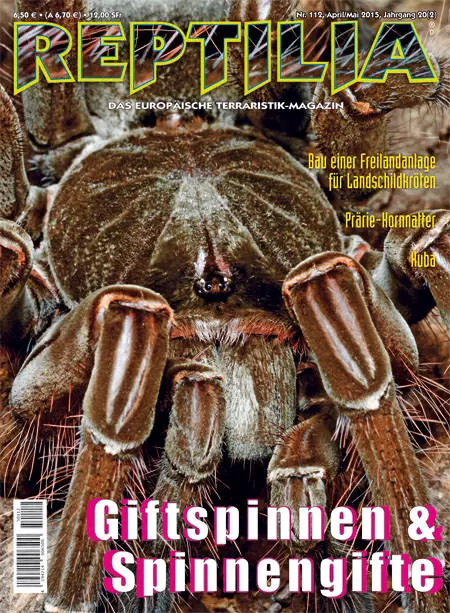
Reptilia 112 - Poison spiders & spider poisons
Reptilia 112 - Venomous Spiders & Spider Venoms Building an outdoor enclosure for tortoisesPrairie horned snakeCubaContents: Cover story: Venomous spiders & spider venomsAll spiders are venomous, including tarantulas, which are particularly popular in terrariums. Nevertheless, they are largely harmless to humans, but are often considered dangerous. This becomes a problem when legislators believe they need to protect the public from these “dangerous animals”. But how dangerous are venomous spiders really? We provide an overview, take a tour of the spider fauna in Australia, the kingdom of all venomous animals, and cover the keeping of venomous spiders in terrariums, from tarantulas to black widows. EditorialMAGAZINEDATES WESTERN HERP PERSPECTIVESFrog paradise EuropeB. Love Photo story“Venomous spiders” in terraristicsK. Kunz ReportageQueensland’s spiders and their venoms Part 1: The mygalomorph spidersT. J. Hauke Bibliography Keeping and breedingVenomous yet harmless – the genera Loxosceles and Sicarius in the terrariumG. Ackermann & A. Leetz ReportageStung by a tarantula? The South Russian tarantula (Lycosa singoriensis) in BurgenlandH.-J. Luef TERRARIUM PRACTICEOutdoor enclosure for tortoises 2.0M. Hallmen KEEPING AND BREEDINGRediscovering an old acquaintance: the Prairie Corn Snake (Pantherophis emoryi emoryi)K. Kessler Animals of our homelandThe smooth newtR. Leptien ServiceLibraryALSO NEAR YOU JourneyCuba all inclusive. Beaches, cocktails, anoles and roll-tailed iguanasI. Kober PREVIEW BRUTKASTEN Chuckwalla anecdotes Part 1H. Werning

CHF 12.00

Marginata 20 - North American Box Turtles
Marginata 20 - North American Box TurtlesTurtles of Nova Scotia Part 2Emys orbicularis twinsThe world's largest broad-shelled turtleContents:2 Editorial3 letters to the editor4 Magazine8 dates10 REPORTAGE The box turtles of the genus Terrapene Hans - Dieter Philippen16 BREEDING IN HUMAN CARE The Mexican representatives of the Carolina- Group from the genus Terrapene Markus Baur & Irmtraud Jasser-Häger26 REPORTAGE Notes on the ecology of Terrapene ornata ornata in the area of Great Plains Michael Wirth & Hans-Peter Mattern31 PORTRAIT Aldabra giant tortoise, Dipsochelys dussumieri (Gray, 1831) Michael Wirth35 REPORTAGE Influence of calcium concentrations in the Food on the digestibility of calcium, Magnesium and phosphorus in Testudo hermanni Annette Liesegang, Jean Michael Hatt & Marcel Wanner42 REPORT Twin births in the European box turtle European pond turtle (Emys orbicularis) Hans - Dieter Philippen44 REPORTAGE "Ötzi", or: The turtle that emerged from the Cold came .. A remarkable incubation experience Jutta Jähne & Hans - Dieter Philippen46 REPORT A journey to the turtles of Nova Scotia (Nova Scotia), Canada Part 2: Forests, streams, forest stream turtles Herbert Becker, Andreas Gräf & Urs Landweer57 REPORTAGE "Il Gigante" - the largest living broad-shelled turtle tortoise (Testudo marginata) Hans - Dieter Philippen60 Book tip 61 Classifieds62 Regional guide

CHF 16.50

NTV, amphibians at the garden pond
NTV, amphibians at the garden pond André de Saint-Paul, Ingo Brand & Wolfgang Schmidt 104 pages 96 photos Format: 16,8 x 21,8 With references to"Chemistry in the garden pond""Safety at the garden pond""Design" Content: You will not only get a beautifuland interesting small biotope to theown property, but can also be usedmake an important contribution to nature conservation! Everything you need to know in order for amphibians to settle in your pond The amphibian-friendly garden pond Large species part with splendid pictures With "amphibian calendar" for the garden pond Press commentaries: Following a taste of the time more and more garden pond friends lay themselves ponds, many of them become so-called natural ponds. Surely, only the fewest investors consider thereby, what they can cause. For these a book appeared, which can answer each question, which they could ask, exhaustively, if it refers to the topic: Amphibien at the garden pond . Who knows them all, toads, toads, frogs and newts? All animal species that before man had settled in the places of today's ponds had long been resident and indigenous and had been suppressed for the time being. What to do when they return suddenly and inconspicuously? Many gardeners are aware of the fact that this can happen in well-designed gardens and have been described in some articles (...). So what should we do to get to know these new citizens of the garden better and, if possible, to help them even more? Very simple: Buy and read the book discussed here!Rarely has a book summarized so much worth knowing about this topic so succinctly and comprehensibly.Some garden friends, who are not quite firm with the determination, will use the many clear photos beside the text, in order to determine its pond inhabitants correctly. The text leaves also no wish open, there are chapters about the animal species themselves and such, which have apparently secondary meaning, but for a longer existence of pond and animal are extremely important: "Nature as a model", "Legal regulations", "Settlement of amphibians", "Water supply", "Pond technology" and "Safety at the garden pond" are just a few examples. Everything is presented very clearly and comprehensibly for zoological laymen and is also exciting to read.Conclusion: A 5-star book!Walther Rohdich in The Aquarium 08/2002Recommended(...)Altogether (...) a recommendable book for garden owners who are interested in amphibians, as well as for all amphibian friends and those who want to become one.Petra Kölle in DATZ 9/2002(...)(This book) is intended to serve those who want to create a garden pond in their garden that is as close to nature as possible.The book first of all examines the question of whether the garden pond can be a Noah's ark for amphibians and what position amphibians occupy in the biotope garden pond. The next chapter gives a brief overview of amphibians: evolution, systematics, way of life, catching prey, breathing, voice, reproduction, from egg to lurch, migrations and enemies and diseases. This gives everyone the basic knowledge they need to better understand amphibians. (...)In the following kind descriptions all amphibian-types native with us are introduced except for two (...) in text and picture. Thereby, distribution, way of life and reproduction are discussed in detail. The garden ponds for amphibians are taken into account afterwards, whereby also the remaining garden is included in the discussion. The question "Fish and amphibians in a body of water - is that possible?", which is important for many people, is answered as well as questions about legal regulations, settlement in one's own garden and the construction and maintenance of a garden pond. (...)The last part of the book is about safety at the garden pond, care tips and an "amphibian calendar", which gives an overview of important events in the course of the year of the native species. At the end there is a glossary, a bibliography and an index.The book can be considered as quite successful and gives also the interested layman the possibility of making itself fast familiar with the topic. (...) Altogether a recommendable reading for "newcomers" or advanced readers who are interested in this topic.Peter Janzen, DGHT-AG Anuren, in elaphe 3/2002A feel-good garden for frogsA beautiful garden pond is not just a piece of quality of life. It can also make a contribution to nature and species conservation, according to André de Saint-Paul, Ingo Brand and Wolfgang Schmidt in the book "Amphibien am Gartenteich", published by Natur und Tier - Verlag. Location, pond type, water supply, planting and technology - nothing is left out. In addition the Artenteil equipped like the entire book with excellent color photos presents all domestic tail and frog through species with detailed information and refers also to their special needs.Review in Dresdner newest News of 30.05.2002(...)The book shows the right way. More and more garden owners want to create a piece of nature with frogs, toads and newts.One is also reasonably informed about the work involved in setting up and maintaining such a watercourse. The care of the small water is also important, and here the author gives many care tips.Also the amphibian calendar is valuable, which clearly tells each owner of a garden pond what is happening at which time of the year in his water and when he can find which kind of amphibian there.Get a beautiful and interesting small biotope on your own property. Well informed you can make an important contribution to nature conservation!

CHF 32.50