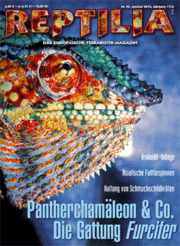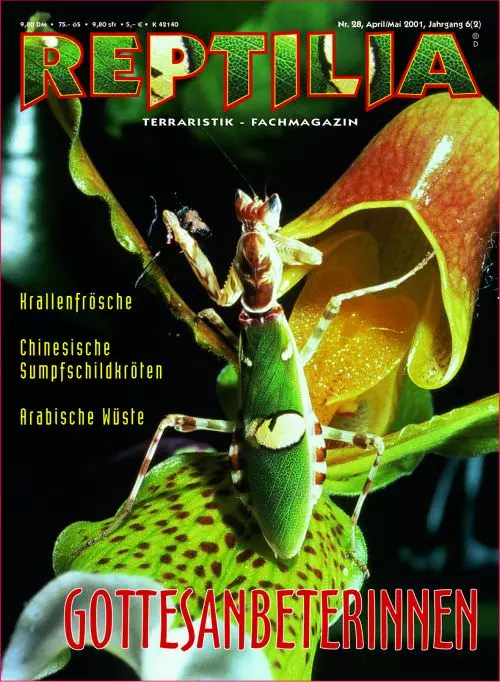
Reptilia 28 - Praying mantises

Article no: reptilia28

CHF 9.80

Stock: 0

This article is currently not available

Product information "Reptilia 28 - Praying mantises"

Reptilia 28 - Praying Mantises

Clawed frogs
Chinese pond turtles
Arabian Desert

Contents:

  • 2 Editorial
  • 3 letters to the editor
  • 6 Magazine
  • 14 dates
  • 18 Western Herp Perspectives: The future of terraristics, by B. Love
  • 20 Photo report: Praying mantises - A brief introduction to their lifestyle and biology, by F. Tomasinelli
  • 26 Photo report: Praying Mantises (Mantodea), An Overview, Part 1: Phylogeny, Systematics, Physique, Reproduction, by R. Ehrmann
  • 33 Keeping and breeding: Angels of Death - The orchid mantis, mimicry, behaviour and care of Hymenopis coronatus, by F. Tomasinelli
  • 38 Keeping and breeding: Burrows for clutches - The praying mantis Humbertiella ceylonica Saussure 1869 (insecta: Matodea), by H. Müller
  • 42 Journey: Rhub al Khali - The Empty Quarter, A journey to the United Arab Emirates, by R. Leptien
  • 51 Portrait and poster: Chamaeleo chamaeleon, by M. Aresté
  • 56 Keeping and breeding: Keeping and breeding the Chinese pond turtle Mauremys mutica (Cantor 1842), by A. S. Henning
  • 60 Keeping and breeding: Giant geckos from Madagascar: Homopholis boivini (Duméril, 1856) in a terrarium, by U. Schlüter
  • 64 Herpetofauna: Remarks on the biology and care of Rhinobotryum bovalli (Andersson, 1916), by A. Hohmeister
  • 68 Keeping and breeding: Keeping and breeding clawed frogs (Silurana spec.) - Part : Systematics, description and keeping, by K. Kunz
  • 74 Herpetoculture: Adam, Eve and the snake, by Dr C. Thiede
  • 77 Terraristics: Building a snake enclosure Part 4: Snakes and concrete. A gloss, by M. Hallmen
  • 80 Reptilia on the road: Outdoor terrarium and aquarium stone, by H. Wölfel
  • 91 Advice and action
  • 95 Library
  • 104 Gloss: DGHT conference: Preliminary statement, by H. Werning
Composition
Feeding recommendation
Technical details
Size information

0 of 0 reviews

Give us a rating!

Share your experience with the product with other customers.


Suggested products

Handbook of food plants for tortoises and other reptiles
Handbook of forage plants 2nd revised editionMarion Minch is not only a successful breeder of diverse tortoises for many years, but also an excellent connoisseur of native wild herbs. She founded and runs samenkiste.de, which is well known to many tortoise keepers and nature lovers. Her name is inextricably linked with reptile care and species-appropriate nutrition for tortoises. Her handbook of food plants summarises the most important native food plants for herbivorous and omnivorous reptiles. She not only considers tortoises, but also iguanas, spiny-tailed dragons and even chameleons. From the basics of plant biology to native wild herbs to suitable food plants for hardy tropical reptile species, this comprehensive work provides the basis for species-appropriate keeping. In the expanded and supplemented 2nd edition, the plant section is divided according to flower colour. This makes it even easier to identify wild herbs. The work has also been supplemented with a wealth of additional information and many pictures.

CHF 46.50

Geckos
Geckos in the terrarium by Astrid FalkThe book offers a comprehensive introduction to geckos and their species-appropriate keeping in terrariums. It explains what you need to think about before buying a gecko and what preparations should be made. The book describes in detail how the terrarium is technically equipped and set up. The care of the animals, their special features and behaviour, their diet, reproduction and rearing of young animals are described, as well as diseases and husbandry problems with tried and tested suggestions for prevention and treatment. Individual gecko species that are particularly suitable for keeping and breeding in terrariums are portrayed in detail in the second part of the book.

CHF 28.50

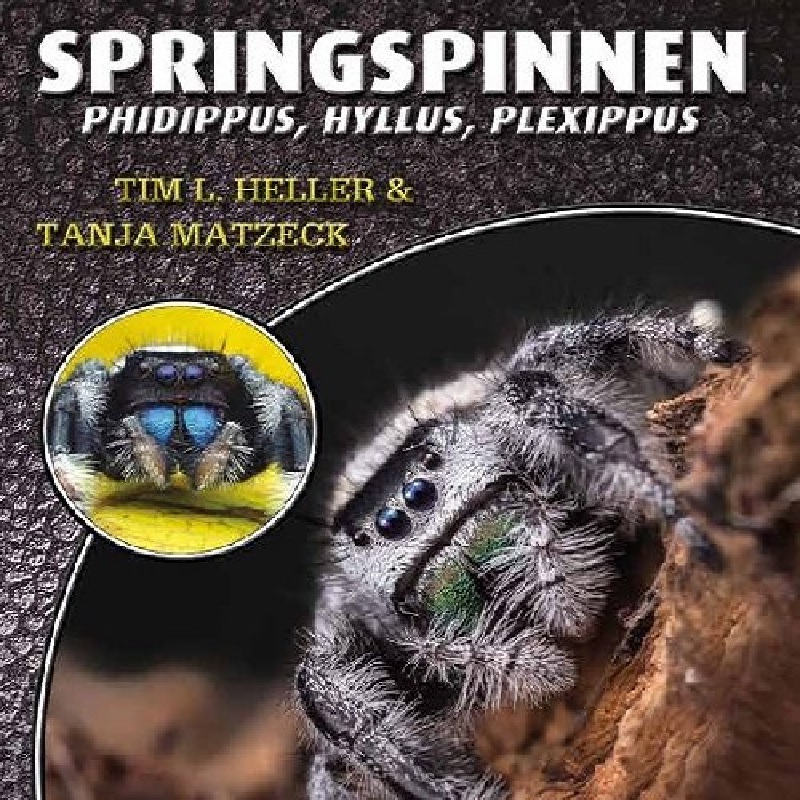
Jumping spiders Phidippus, Hyllus, Plexippus
Book Jumping Spiders - Phidippus, Hyllus & Plexippus A guide to keeping jumping spiders of the genera Phidippus, Hyllus & Plexippus. Who can resist the charm of jumping spiders? The childlike appearance of their expressive face simply leaves no one cold! In addition, their behavior is extremely exciting to observe, their colors are bright and their requirements for species-appropriate keeping are very easy to meet. No wonder these likeable jumpers are all the rage! This volume in the "Species by Species" series describes in detail what to look out for when buying and keeping them, introduces the most commonly kept species and color forms and provides plenty of tips on how to keep them successfully - so you can be sure they will breed well! Species by Species introduces you to the books in this series, which present the most popular terrarium animals. Each volume offers you detailed, practical care instructions and all the information you need to successfully breed your animals. All important questions from the required tank size to terrarium set-up, technical equipment, species-appropriate nutrition and disease prevention are answered with numerous tricks and tips. Experienced, long-standing breeders reveal how you can encourage the animals to reproduce and raise healthy young. All this in full color, generously illustrated and attractively designed - just about your terrarium animal - species by species

CHF 23.90

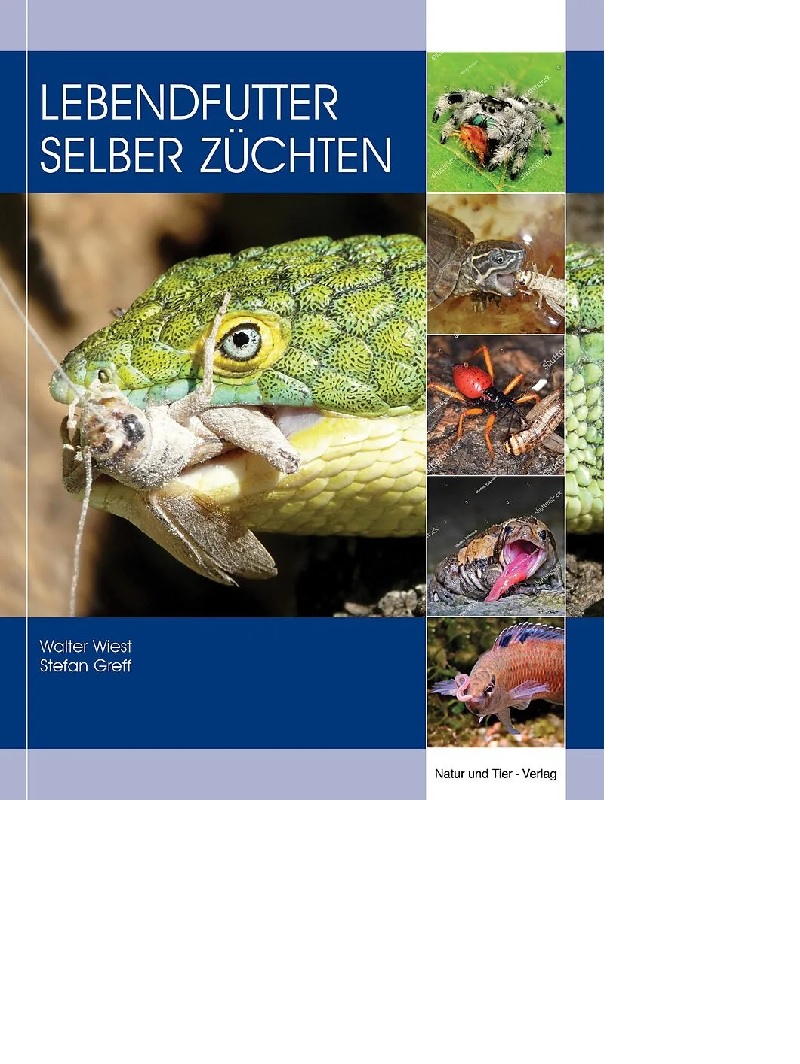
Book Breeding live food yourself
Book "Grow your own live food" - The perfect guide for pet owners Discover practical and detailed instructions on how you can easily breed food for your reptiles, birds, fish or other animals yourself in the book "Breeding live food yourself". With valuable tips on various food insects, their care and breeding, you can save money and ensure a species-appropriate diet for your pets. Contents of the book: Step-by-step instructions for breeding feeder insects Information on the best types of food for reptiles, birds and fish Care instructions and breeding conditions for various live food species Tips for sustainable and cost-effective food production Why breed your own live food? Get healthy, fresh food for your animals Save money and reduce dependence on pet shops Promote the health and well-being of your animals with species-appropriate food Whether you are a beginner or an experienced pet owner, this book provides you with everything you need to successfully breed live food yourself.

CHF 46.50

Marginata 69 - New Guinea tortoises
Marginata 69 - New Guinea tortoises – the genus ElseyaCover storyThe unrecognised beauties: New Guinea tortoises (Andreas S. Hennig)My experiences with Branderhorst's New Guinea tortoise, Elseya (Elseya) branderhorsti (Ouwens, 1914) (Andreas S. Hennig)Keeping and breeding of Rhodin's New Guinea tortoise, Elseya (Hanwarachelys) rhodini Thomson, Amepou, Anamiato & Georges, 2015 (Andreas S. Hennig)PortraitGeoemyda spengleri, Chinese serrated tortoise (Andreas S. Hennig)ReportageMacrochelys temminckii – Experiences and impressions with vulture tortoises part 2 (Reiner Praschag)KeepingAn alternative to year-round keeping of the Egyptian tortoise in the terrarium – my experiences with seasonal outdoor keeping of Testudo kleinmanni (Ricarda Schramm)EtymologySawbacks and living maps part 4: Graptemys gibbonsi, Pascagoula humpback tortoise (Holger Vetter)Classifieds & animal placement

CHF 16.50

Terraria 04 - Strawberry Poison Frog
Terraria 04 - Strawberry Frogs Green water dragonPatagonia Contents: 2 EditorialMatthias SchmidtTOPIC 3 • Diverse like no other: the strawberry frogKarl-Heinz Jungfer 12 • In search of strawberry frogs in Costa Rica and PanamaPeter Janzen 17 • Strawberry frogs and their poison Dietrich Mebs 22 • Keeping and breeding the strawberry frog (Oophaga pumilio)Peter Janzen & Manfred SalewskiSCIENCE 28 New speciesList of new amphibian and reptile species described in 2006Axel Kwet 40 Ornate tortoises – the genus Pseudemys Gray, 1844Part 3: Keeping, reproduction, literatureAndreas S. Hennig 47 Pointed snakes (genus Oxybelis Wagler, 1830) in the terrariumAndreas Hohmeister 54 Keeping and breeding the green water dragon(Physignathus cocincinus)Kerstin Franke 63 Lycosa erythrognatha – Keeping and breeding the red pine tarantulaThomas Bamann68 TRAVELThrough the vastness of PatagoniaHeiko WerningTERRARIUM PRACTICE 81 Test runAlternative terrarium types from the pet tradeKriton Kunz 86 Prelude Keeping and breeding the colourful masked iguana(Leiocephalus personatus)Julius Kramer 89 Eye-catcherKellerkinder – of geckos, turtles and a touch of South AfricaMike Zawadzki 93 Also in your neighbourhood 96 TERRAnetAdders and vipers / African tarantulas 97 TERRAglobalSpectacular frog migration in Kakadu National ParkKarl H. SwitakFatal – the call of the TokehMark Auliya & Chris Shepherd 104 TERRAwinn

CHF 11.20

Reptilia 11 - Galapagos
Reptilia 11 - Galapagos Cultural history of the Solomon IslandsSea turtles off MadeiraWrinkled gecko Contents: EditorialLetters to the editorMagazinesDatesWestern Herp Perspectives: The Terrarium TrapB. Love Photo reportageGalápagosH. Werning HerpetofaunaThe Galápagos giant tortoiseB. Schramm ReportageSpecies conservation hunt on GalápagosH. Stoldt ReportageEl niño and the Galápagos reptilesH. Stoldt Keeping and breedingThe Egg Snake Dasypeltis atraD. Modry and P. Neças Portrait and posterBrachypelma emiliaP. Klaas HerpetofaunaSea turtles off MadeiraProf. T. Dellinger and Prof. P. Wirtz Keeping and breedingThe poison dart frog Minyobates minutusM. Schulte TerraristicsProphylaxis and quarantineProf. P. Kölle and Prof. R. Hoffmann Herpetology and cultureAmphibian and reptile myths of the MelanesiansDr. H.-J. Hermann Reptilia on the roadLeipzig ZooS. Hennig LibraryAdvice and actionIncubator

CHF 9.80

Terraria 59 - The Fire Salamander
Terraria 59 - The Fire Salamander Newly described reptiles 2015Tyrol Contents: Cover story: The Fire Salamander - Amphibian of the Year 2016The colourful fire salamander, which was named Amphibian of the Year 2016, has achieved great popularity worldwide. Not only in terraristics, where the animals have been successfully kept and bred for decades, but also as a symbolic and flagship species in national and international species conservation. We present the different aspects of this species in detail and address the current threat posed by a microscopic fungus that is currently threatening wild populations, but also discuss measures that terrarium keepers can take to prevent or control its rapid spread. TerritorialHerpetoramaA headbutt with consequences – tree frogs with deadly venomDornteufel: Grass snakes without ringletsCultural follower: Frog with castleBlattsteiger: Lizards against Stuttgart 21A frog as acrobatSecond helping Cover storyLong live the salamander: Amphibian of the Year 2016Axel Kwet, Philine Werner & Ulrich Schulte Fire salamander – keeping and breeding a famous amphibian. Part 1: Terrarium, set-up and careYvonne & Thomas Klesius Batrachochytrium salamandrivorans. The new threat to tailed amphibiansPaul Bachhausen The fire salamander as a favourite and flagship species in the Thuringian Slate Mountains. Experiences from a volunteer projectManfred Klöppel PanoramaExcursion between the Grossglockner and Lienz DolomitesRolf Leptien In search of the Lebanese mountain viper (Montivipera bornmuelleri)Alexander Eppler Research New speciesList of reptiles newly described in 2015Axel Kwet Salamandra TerraristicsElaphe dione – an attractive snake in the terrariumHelmut Kantz Nature and species conservation Field notesMorphology follows genetics: A characteristic to distinguish two crested newt species from TurkeyUwe Gerlach & Michael Fahrbach Juvenile adder consumes adult common lizardChristoph Klaus, Andreas Nöllert & Siegfried Klaus The American Crocodile Education Sanctuary (ACES) in BelizePeter Janzen Terrarino – the children's page Comb on, newt!Ute Nüsken Subscription & Service Also in your areaPreview Incubator Herpetologists' Hostel WeddingHeiko Werning

CHF 12.00

Draco 28 - Live food
Draco 28 - Live food Contents: 2 Editorial 4 Live food for amphibians and reptiles– History and basicsUrsula Friedrich 22 The professional handling of food animals – Basic requirement for a species- and animal-appropriate diet for reptiles and amphibiansThomas Wilms 32 Some aspects of breeding your own food animalsStefan Ziesmann 39 The pea aphid – an unusual food animalLars Österdahl 42 Breeding the common fruit fly (Drosophila melanogaster)– Many paths lead to successMarco Wagemann 50 Tropical cockroaches – lively insect lovers, valuable food animals or even both?Andreas Bauer 58 Oven fish breeding – a way to provide a little variety in the diet of our vivarium animals with little effort!Marco Wagemann 64 The breeding of aquatic snails Cornelia Gabler 67 Agate snails – not only an extraordinary food animalUwe Geissel 71 Tubifex breedingCornelia Gabler 74 Small mammals as food animals – using the house mouse (Mus musculus) as an exampleThomas Wilms & Beate Löhr 86 Book box

CHF 18.40

The musk turtle
The musk turtle is the ideal turtle for beginners 64 pages Format: 14.8 x 21 cm 49 colour photos Author Maik Schilde Contents: The musk turtle is the ideal turtle for beginners!It is very small, so does not need a large tank, comes from a temperate climate zone, and you can do without complex equipment. Their diet as well as their care and even breeding are easily manageable.Tortoise expert Maik Schilde provides the reader in this volume with all the important basics for successfully keeping and, if necessary, breeding this fascinating tortoise species. Systematics and body structure The fascinating biology: From the life of the musk turtle All information on species-appropriate keeping: from suitable terrariums to equipment and technology to feeding Successful breeding: Mating stimulation, incubation of the eggs and raising the young Problem solutions: How to avoid the most common mistakes in care, and how to help sick animals Brilliant photos

CHF 17.50

Reptilia 56 - African land tortoises
Reptilia 56 - African tortoises Red bamboo snakeFisher's ChameleonXenagama taylori Contents: 2 EDITORIAL 6 MAGAZINE & READERS' LETTERS 14 DATES 16 WESTERN HERP PERSPECTIVES  The blue Mexican  From B. Love 18  PHOTO REPORTAGE  African tortoises  By J. Valverde 26 REPORTAGE  The tortoises of Africa – diversity through  Adaptation to extreme habitats  By T. & S. Vinke 31 HERPETOFAUNA  Taxonomy, ecology and protection of the   Panther tortoise (Stigmochelys pardalis)  By J. S. Massana & A. M. Silvestre 36 KEEPING AND BREEDING  The areola tortoise Hompus areola-  tus (THUNBERG, 1787) – Observations   and experiences: Lifestyle, husbandry,   Breeding and rearing  By A. Schleicher 42 TRAVEL  Excursion in western Cuba   By L. Geißler 51 PORTRAIT AND POSTER  Bradypodion occidentale  By M. Dobiey 56 KEEPING AND BREEDING  Keeping, care and breeding of Taylors   Beavertail dragon, Xenagama taylori   (PARKER, 1935)  By P. M. Müller 62 KEEPING AND BREEDING  Terrarium keeping of the Thai Red bamboo snake (Oreophis porphyraceus coxi)  and a rare birth of twins   By V. Knietsch 67 HERPETOFAUNA On the breeding of the red broad-banded bamboo snake, Oreophis porphyraceus laticinctus SCHULZ & HELFENBERGER 1998   By J. Bulian, B Siebert & M. Ansermet 72 HERPETOFAUNA   Chameleons in the western Usambara-  Mountains in northern Tanzania   By W. & Y. Lantermann 78 REPORTAGE  A cyclone in Sri Lanka   By P. Janzen 86 CLASSIFIED ADS 91 RAT & TAT 94 LIBRARY 104 BRUTKASTEN  My flat-sharing community  Part 1: I wouldn't have any time at all,  Set cars on fire!  By H. Werning

CHF 11.20

NTV - The golden tree climber
Dendrobates auratus - All about the golden treecreeper 64 pages many colour photos all about the golden treecreeper Author Ilze Dunce Publisher NTV The book explains everything about keeping and caring for these interesting amphibians. The set-up of the terrarium and feeding are explained in detail. Table of contents: Foreword Classification Natural habitat Skin venoms Behaviour Description of the colour variants or morphs Endangerment Terrarium Substrate Water Furnishings Planting Lighting Temperatures and heating Food and feeding Vitamins and minerals Propagation Incubation of the eggs Rearing the young frogs Diseases and their treatment Further information Literature used and further reading

CHF 18.50

Customers also saw

LifeTarrium for small interbrates
Acrylic LifeTarrium by Lucky ReptileThe LifeTarrium is a high-quality acrylic terrarium for scorpions, tarantulas and small invertebrate species like millipedes or mantids. The LifeTarriums can also be used to temporarily hold food animals.Made of high-quality acrylicthe Tarrium can be easily assembled and disassembled again.The trap door closes magneticallywith two different lids (depending on lighting)available in four different sizesThe assembly is very simple. First, the protective films must be removed from all acrylic parts. Then the individual parts are plugged together and fixed with the transparent rubber ring outside.When inserting the trap door must be observed, depending on the size, that the magnets meet so that the door also closes.The delivery is without decoration.

From CHF 44.90