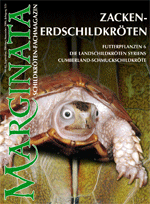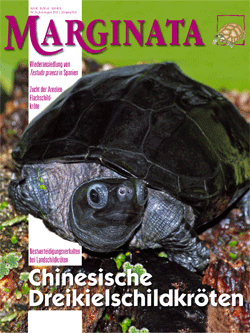
Marginata 35 - Chinese three-legged turtle

Article no: marginata35

CHF 16.50

Stock: 0

Ready for dispatch in 1-3 days, delivery time 7 working days

Delivery between Tuesday, 7 July and Wednesday, 8 July
Zahlungsarten
Product information "Marginata 35 - Chinese three-legged turtle"

Marginata 35 - Chinese three-legged turtle

Reintroduction of Testudo graeca in Spain
Breeding the areolate flat tortoise
Turtle breeding at the Tennessee Aquarium

Contents:

EDITORIAL
MAGAZINE
DATES

PHOTOSTORY
Chinese three-keeled turtles (Mauremys [Chinemys] reevesii Gray, 1835)
Hans - Dieter Philippen

REPORTAGE
Global distribution of the Chinese three-keeled turtle (Mauremys [Chinemys] reevesii)
Hans - Dieter Philippen

BREEDING
Keeping and breeding Chinese three-keeled turtles (Mauremys [Chinemys] reevesii Gray, 1831) on a slightly different scale – China’s turtle farms
Torsten Blanck, Ting Zhou, & Pi-Peng Li

PORTRAIT
Pinta Galápagos tortoise (Chelonoidis nigra abingdoni) – “Lonesome George”
Hans - Dieter Philippen

BREEDING
Remarkable breeding successes in the Tennessee aquarium
Bill Hughes

REPORTAGE
Evidence of viable populations of the Greek tortoise (Testudo graeca) establishing themselves outside their original range in the south
of the iberian peninsula
José c. Báez, Jesús Duarte, M.A. Farfan & Raimundo Real

BREEDING
Experiences with the husbandry and reproduction of the Areolate Flat-shelled Turtle (Homopus areolatus) under different conditions in Namibia and Switzerland. Part I: Husbandry and reproduction of the species in Namibia (Southern Africa)
Alfred Schleicher

REPORTAGE
Unusual hatching of a Hermann’s tortoise (Testudo hermanni hermanni)
Robert Frösch

BOOK TIP
SMALL DISPLAYS
SUBSCRIPTION & sERVIcE
REGIONAL GUIDE

Composition
Feeding recommendation
Technical details
Size information

0 of 0 reviews

Give us a rating!

Share your experience with the product with other customers.


Suggested products

Handbook of food plants for tortoises and other reptiles
Handbook of forage plants 2nd revised editionMarion Minch is not only a successful breeder of diverse tortoises for many years, but also an excellent connoisseur of native wild herbs. She founded and runs samenkiste.de, which is well known to many tortoise keepers and nature lovers. Her name is inextricably linked with reptile care and species-appropriate nutrition for tortoises. Her handbook of food plants summarises the most important native food plants for herbivorous and omnivorous reptiles. She not only considers tortoises, but also iguanas, spiny-tailed dragons and even chameleons. From the basics of plant biology to native wild herbs to suitable food plants for hardy tropical reptile species, this comprehensive work provides the basis for species-appropriate keeping. In the expanded and supplemented 2nd edition, the plant section is divided according to flower colour. This makes it even easier to identify wild herbs. The work has also been supplemented with a wealth of additional information and many pictures.

CHF 46.50

Geckos
Geckos in the terrarium by Astrid FalkThe book offers a comprehensive introduction to geckos and their species-appropriate keeping in terrariums. It explains what you need to think about before buying a gecko and what preparations should be made. The book describes in detail how the terrarium is technically equipped and set up. The care of the animals, their special features and behaviour, their diet, reproduction and rearing of young animals are described, as well as diseases and husbandry problems with tried and tested suggestions for prevention and treatment. Individual gecko species that are particularly suitable for keeping and breeding in terrariums are portrayed in detail in the second part of the book.

CHF 28.50

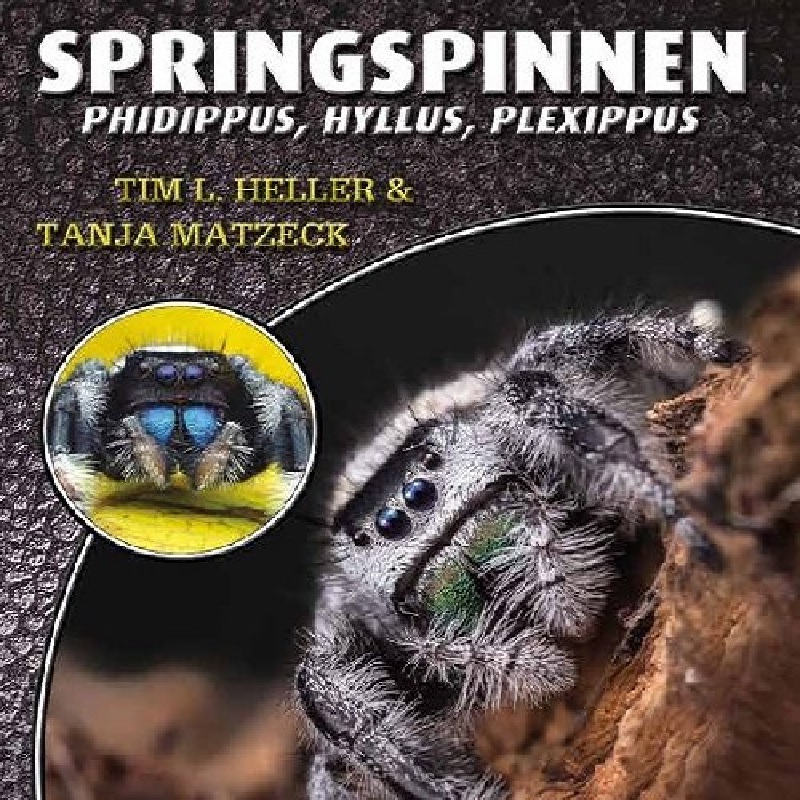
Jumping spiders Phidippus, Hyllus, Plexippus
Book Jumping Spiders - Phidippus, Hyllus & Plexippus A guide to keeping jumping spiders of the genera Phidippus, Hyllus & Plexippus. Who can resist the charm of jumping spiders? The childlike appearance of their expressive face simply leaves no one cold! In addition, their behavior is extremely exciting to observe, their colors are bright and their requirements for species-appropriate keeping are very easy to meet. No wonder these likeable jumpers are all the rage! This volume in the "Species by Species" series describes in detail what to look out for when buying and keeping them, introduces the most commonly kept species and color forms and provides plenty of tips on how to keep them successfully - so you can be sure they will breed well! Species by Species introduces you to the books in this series, which present the most popular terrarium animals. Each volume offers you detailed, practical care instructions and all the information you need to successfully breed your animals. All important questions from the required tank size to terrarium set-up, technical equipment, species-appropriate nutrition and disease prevention are answered with numerous tricks and tips. Experienced, long-standing breeders reveal how you can encourage the animals to reproduce and raise healthy young. All this in full color, generously illustrated and attractively designed - just about your terrarium animal - species by species

CHF 23.90

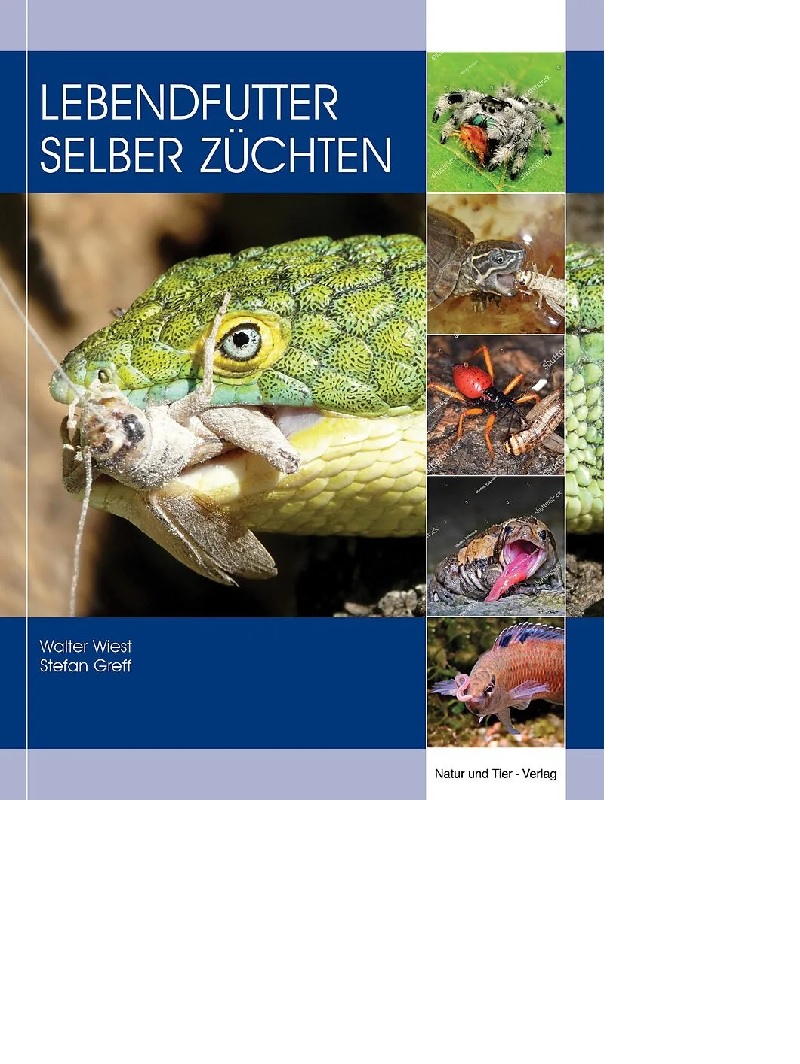
Book Breeding live food yourself
Book "Grow your own live food" - The perfect guide for pet owners Discover practical and detailed instructions on how you can easily breed food for your reptiles, birds, fish or other animals yourself in the book "Breeding live food yourself". With valuable tips on various food insects, their care and breeding, you can save money and ensure a species-appropriate diet for your pets. Contents of the book: Step-by-step instructions for breeding feeder insects Information on the best types of food for reptiles, birds and fish Care instructions and breeding conditions for various live food species Tips for sustainable and cost-effective food production Why breed your own live food? Get healthy, fresh food for your animals Save money and reduce dependence on pet shops Promote the health and well-being of your animals with species-appropriate food Whether you are a beginner or an experienced pet owner, this book provides you with everything you need to successfully breed live food yourself.

CHF 46.50

Marginata 69 - New Guinea tortoises
Marginata 69 - New Guinea tortoises – the genus ElseyaCover storyThe unrecognised beauties: New Guinea tortoises (Andreas S. Hennig)My experiences with Branderhorst's New Guinea tortoise, Elseya (Elseya) branderhorsti (Ouwens, 1914) (Andreas S. Hennig)Keeping and breeding of Rhodin's New Guinea tortoise, Elseya (Hanwarachelys) rhodini Thomson, Amepou, Anamiato & Georges, 2015 (Andreas S. Hennig)PortraitGeoemyda spengleri, Chinese serrated tortoise (Andreas S. Hennig)ReportageMacrochelys temminckii – Experiences and impressions with vulture tortoises part 2 (Reiner Praschag)KeepingAn alternative to year-round keeping of the Egyptian tortoise in the terrarium – my experiences with seasonal outdoor keeping of Testudo kleinmanni (Ricarda Schramm)EtymologySawbacks and living maps part 4: Graptemys gibbonsi, Pascagoula humpback tortoise (Holger Vetter)Classifieds & animal placement

CHF 16.50

The flower snake
All about the flower snake 64 pages Format: 14.8 x 21 cm numerous colour photos Author Andreas Gumprecht Contents: A large proportion of the animal imports that reach us every year from China consist of various climbing snakes. The majority of these are the flower snakes presented in this book in the "Species by Species" series.Despite this, reports of the successful keeping and breeding of this attractive snake have largely failed to materialise, although from a purely statistical point of view, the flower snake should by now be firmly established in the terrarium hobby.In this guidebook, long-time terrarium keeper and snake expert Andreas Gumprecht shares his positive experiences with the care and reproduction of the flower snake with the reader. Systematics and body structure The fascinating biology: From the life of the flower snake All information on species-appropriate keeping: from suitable terrariums to equipment and technology to feeding Successful breeding: Mating stimulation, incubation of the eggs and rearing the young Solutions to problems: How to avoid the most common mistakes in care and how to help sick animals Brilliant photos

CHF 18.50

Reptilia 102 - Poison dart frogs, newcomers and evergreens
Reptilia 102 - Poison dart frogs, newcomers and evergreens ChuckwallasGiant millipedesAngle-headed agamas Contents: Poison dart frogs are among the most popular terrarium animals of all. These colourful frogs fascinate with their behaviour and are ideal for keeping in lushly planted rainforest terrariums, which are an ornament for any living room. Some species have been successfully bred in terrariums for decades, while others have only recently found their way into the terrarium hobby and have yet to establish themselves. We present both groups: Newcomers and evergreens. EDITORIALMAGAZINEDATES WESTERN HERP PERSPECTIVES    Rattlesnake roundupsB. Love PHOTOREPORTAGEPoison dart frogs. Evergreens and newcomersM. Schmidt KEEPING AND REPRODUCTIONExperiences with keeping and breeding the Striped Leaf-climbing Frog (Phyllobates vittatus) in the terrariumT. Hofmann KEEPINGArmour-breaker – Ranitomeya benedicta, a rare guest in our terrariumsG. Elser TERRARIUM PRACTICEJewels in stainless steel. Building a terrarium for poison dart frogsPart 3: Keeping experiences with Phyllobates terribilisM. Schulte KEEPING AND BREEDINGKeeping tropical millipedesP. Ginal KEEPING A disastrous affairM. Rogner TERRARIUM PRACTICEThe dream of a jungle in the living room. Angle-headed agamas (Gonocephalus) in the terrariumM. Evers HERPETOFAUNAThe Chuckwalla – Sun worshipper in the rocky desertU. & J. Schimmelpfennig INTERVIEWThe corpse of StraubingREPTILIA in conversation with M. Baur TEST RUN TERRARIUM PRACTICEThe “Venom Defender” gloves. Development of an aid for handling dangerous animalsC. Kouijzer SERVICEALSO IN YOUR AREA TRAVELTo Sardinia in midsummerA. Schmid PREVIEW BRUTKASTEN Island of the iguanas. Part 1H. Werning

CHF 12.00

The redknee tarantula
All about the redknee tarantula (Brachypelma smithi) from Boris F. Striffler 64 Seiten 14,8 x 21 cm zahlreiche Farbfotos Taschenbuch Autor Boris F. Striffler Verlag NTV Inhalt: Die Rotknie-Vogelspinne ist sicherlich nicht nur die bekannteste Vogelspinne, sondern auch eine der schönsten. Aber nicht nur ihre attraktive Färbung und das eindrucksvolle Äussere, sondern auch ihr ruhiges Wesen und die leichte Haltbarkeit machten diese Art zu einem der begehrtesten Terrarienpfleglinge überhaupt. Boris F. Striffler beschäftigt sich seit langem wissenschaftlich und als Terrarianer mit Vogelspinnen. In diesem Band der Reihe „Art für Art“ geht er im Detail und leicht verständlich auf sämtliche wissenswerten Aspekte der Haltung und Pflege von Rotknie-Vogelspinnen ein. Und selbstverständlich vermittelt er Ihnen auch, wie Sie Ihre Lieblinge zur Vermehrung bringen und die Jungspinnen aufziehen können. Systematik und Körperbau Die faszinierende Biologie: Aus dem Leben der Rotknie-Vogelspinne Alle Informationen zur artgerechten Haltung: Vom geeigneten Terrarium über Einrichtung und Technik bis hin zur Fütterung Erfolgreich nachzüchten: Paarungsstimulation, verschiedene Methoden zur Eizeitigung und Aufzucht der Jungtiere Problemlösungen: Wie man die häufigsten Fehler bei der Pflege vermeidet, und wie man kranken Tieren helfen kann Brillante Fotos

CHF 21.90

NTV, Plants in the terrarium
NTV - Plants in the Terrarium 408 pages over 1205 illustrations Format: 17.5 x 23.2 cm Hardcover Author Beat Akeret Contents: If you want to fulfil your desire to bring a piece of nature into your home with a terrarium, you cannot do without plants to create a natural habitat for your pets. Plants not only increase the visual value of a terrarium, they also improve the climate and provide the animals with cover and hiding places. Some amphibians and reptiles are also very closely tied to certain plants. Planting in the terrarium therefore fulfils a whole range of functions and is an important part of the furnishings.This book offers everything you need to know about caring for terrarium plants, designing near-natural terrariums and selecting suitable plant species! With 400 pages and over 1000 illustrations, this is probably the most comprehensive German standard work on the subject of terrarium planting!

CHF 52.00

The yellow-bellied slider
The yellow-cheeked tortoise is one of the most popular tortoises among young and old. 64 pages 14.8 x 21 cm numerous colour photos Author Andreas S. Hennig Contents: Hardly any other turtle species is as popular with young and old as the yellow-cheeked tortoise. And rightly so, as it is a beautifully coloured species with interesting behaviour that can also be recommended to beginners. Experienced tortoise keeper Andreas S. Hennig will give you lots of tips and tricks on how to keep and feed this attractive species correctly from the outset. Of course, you will also learn how to breed your turtles, hatch the eggs and raise the adorable young. Systematics and body structure The fascinating biology: From the life of the yellow-cheeked tortoise All information on species-appropriate keeping: from suitable terrariums to equipment and technology to feeding Successful breeding: Mating stimulation, incubation of the eggs and rearing the young Solutions to problems: How to avoid the most common mistakes in care and how to help sick animals Brilliant photos

CHF 11.90

The gold dust day gecko
All about the gold-dusted day gecko by Peter Krause 64 pages Format: 14.8 x 21 cm numerous colour photos 3rd edition Author Peter Krause Publisher NTV Contents: The gold-dusted day gecko is one of the most commonly kept day gecko species. As it is also one of the most colourful species of the genus, even long-time phelsum keepers enjoy these animals time and time again. What also makes the gold-dust day gecko so popular and extremely suitable as a terrarium pet is its agile, lively nature and easy keeping. Systematics and body structure The fascinating biology: From the life of the gold dust day gecko All information on species-appropriate keeping: from suitable terrariums to equipment and technology to feeding Successful breeding: Mating stimulation, incubation of the eggs and rearing the young Solutions to problems: How to avoid the most common mistakes in care and how to help sick animals Brilliant photos

CHF 21.90

Draco 01 - Chameleons
Draco 01 - Chameleons Contents: 2 Editorial 4 Chameleons, the ancestry and systematics of the terrestrial lions, by P. Necas/D. Modry 20 On the trail of chameleons in southern Africa, by D. Jörgens 25 The play of colours of chameleons, by T. Stegemann 29 The tongue of the chameleons, by T. Stegemann 32 Chameleons in human care - review and current status, by G. Masurat 52 The Yemen Chameleon Chamaeleo calyptrates, by U. Dost 57 Coccidial infections in Chamaeleo calyptratus – a ‘trivial’ problem in the terrarium? by D. Modry, P. Necas, B. Koudela 61 On the keeping and breeding of Chamaeleo pfefferi, by A. Böhle and F. Steffen 63 About the terrestrial, leaf or stump-tailed chameleons of the genera Brookesia and Rhampholeon, by W. Schmidt 68 The chameleon in African mythology, by D. and M. Schuster 77 Magazine 86 Book box 89 Family Chamaeleoniade - List of recent species and subspecies

CHF 14.90