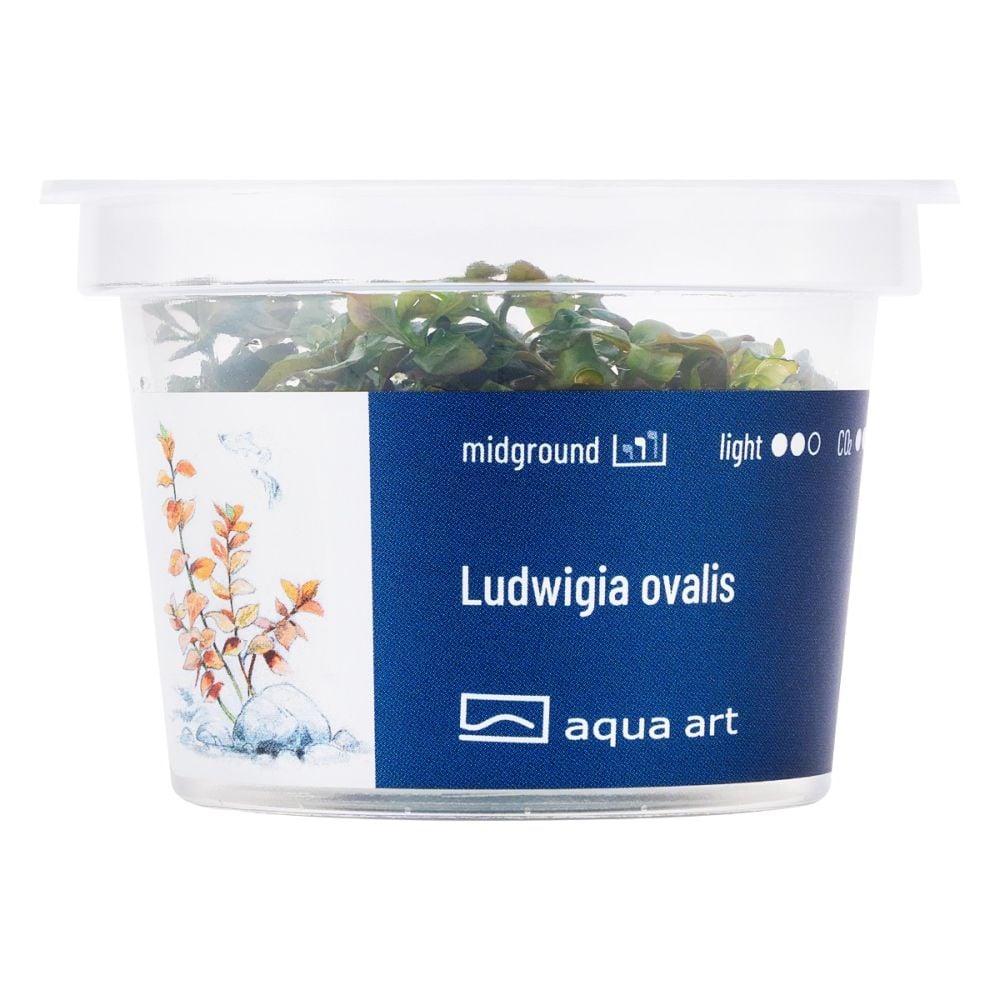
Product information "Ludwigia ovalis Invitro Aquarienpflanze"
Ludwigia ovalis invitro cup
This plant, with a characteristic oval leaf
oval leaf shape in orange-pink color, is easy to grow and an interesting addition to the aquarium.
interesting addition to the aquarium. The leaves are slightly smaller
than those of the popular Repens variety. Due to their rapid growth
the clumps must be trimmed and thinned out regularly to prevent excessive growth.
prevent excessive growth. The original shape of the leaf blade
makes it an attractive addition to the plant composition in the aquarium.
aquarium.
To use this plant, remove it from the cup and rinse the gel.
cup and rinse the gel thoroughly under running water.
Then divide it into small clumps of 1-2 cm and plant them at short intervals.
them at short intervals. As it grows, it will form a
form a uniform group of adult plants.
This plant
comes from in vitro cultivation and is free from snails, parasites and algae.
and algae. High-quality gel was used as a medium, so it will establish itself
quickly establish itself in the aquarium.
Light requirement: medium to intensive
Optimum temperature: 10 to 28 Β°C
Water values: soft to hard
pH value: 4 to 7
CO2 and nutrients: recommended
Propagation: cuttings
Composition
Feeding recommendation
Technical details
Size information
0 of 0 reviews
Leave a review!
Share your experiences with other customers.
Login
No reviews found. Share your insights with others.
Lobelia cardinalis / Kardinalslobelie
max. WuchshΓΆhe
- 20 cm
Herkunftsland
Nordamerika
Eignung
Gesellschaftsaquarium
Typ
StΓ€ngelpflanze
Familie
Lobeliaceae
Gattung
cardinalis
Vermehrung
Kopfstecklinge
Wuchsgeschwindigkeit
mittel
pH
6 - 8
WasserhΓ€rte
10 - 20 Β°dh
Hinweise
Nicht sehr anspruchsvoll.
Die Kardinalslobelie ist eine StΓ€ngelpflanze aus Nordamerika. In der emersen Form sind die BlΓ€tter dunkelolivgrΓΌn mit scharlachroter Blattunterseite. Die submerse Pflanze dagegen ist hellgrΓΌn mit kleineren BlΓ€ttern. Ihre fleischigen StΓ€ngel wachsen nur sehr langsam und erreichen unter Wasser auch nur eine HΓΆhe von 10 - 20 cm. Lobelia cardinalis wird sehr oft fΓΌr den Bepflanzungsstil βHolland-Aquariumβ verwendet. Hier werden Pflanzen in grΓΆΓeren Gruppen nach strenger Anordnung dicht eingepflanzt und kultiviert, so dass der Eindruck eines botanischen Gartens entsteht. Langsamwachsende Art mit geringen AnsprΓΌchen an die Wasserwerte, sowie Boden und Temperatur.
πΏ Proserpinaca palustris - Decorative aquarium plant with serrated foliage
Structure and color for the middle to background layout
Proserpinaca palustris from Aqua Art is an unusual aquarium plant with finely toothed, fern-like leaves that can take on a fascinating copper-orange coloration in good light. It grows upright and gives the aquascape a special depth effect and structure thanks to its unique texture.
In well-lit tanks with a COβ supply, it develops vibrant colors and healthy growth. Its eye-catching appearance makes it ideal as an accent plant in the middle or background.
β Advantages at a glance
Unique leaf shape with serrated foliage
Color gradient from green to copper-orange in strong light
Ideal for structured middle and background design
Demanding, but very decorative under optimal conditions
Grown in vitro - free from snails and pesticides
Particularly striking in layouts with contrasting plants
π Product details
Name: Proserpinaca palustris
Origin: North and South America
Type: Stem plant
Growth height: approx. 20-40 cm
Light requirement: medium to high
COβ supply: recommended to necessary
Growth: medium
Propagation: Cuttings after pruning
Delivery form: In vitro cup (sterile)
Manufacturer: Aqua Art
π‘ Zoo Roco tip
Proserpinaca palustris looks particularly impressive when planted in groups and combined with fine-leaved plants such as Myriophyllum or Rotala. Strong light and regular micronutrient fertilization are crucial for intensive colouring.
With Proserpinaca palustris from Aqua Art, you can add variety, color and structure to your aquascape - ideal for sophisticated layouts with character.Customers also searched for: Proserpinaca palustris, Aqua Art, structure-rich aquarium plant, stem plant aquarium, serrated leaves, InVitro plant aquarium, aquascaping plant, buy Proserpinaca, reddish aquarium plant, background plant aquarium
Salvinia auriculataSalvinia Auriculata (Brazilian salvinia) is a floating plant native to South America. It grows moderately quickly so that its population can be controlled. Easy to grow. Absorbs nitrogen to combat algae. Propagates by spreading.Difficulty of cultivation: easy to mediumLight requirement: medium to highCOβ requirement: lowHeight of the adult plant: 0.5 cmGrowth: moderate to fastTemperature: 22 - 24Β°CPlacement in the aquarium: SurfaceOrigin: South and Central AmericaCup diameter 6 cmSalvinia Auriculata (Brazilian Salvinia) is a floating ornamental plant. It is native to the calm, still waters of South and Central America. It can be found from Paraguay to Cuba. It owes its popularity above all to its original appearance. Its small oval leaves with a diameter of 10 mm cm are arranged opposite each other on an elongated leaf stalk. These leaves are covered with fine hairs that trap air bubbles, allowing them to float. Depending on the light intensity, they are wavy or flat. Salvinia forms a third type of underwater leaves on which the spores are deposited.Like all floating plants, Salvinia is recommended for shady waters . Its great appetite for nitrogen and phosphorus compounds makes this plant a good ally in the fight against algae.
Salvinia has low light and nutrient requirements. It grows well in both moderate and strong light. As a floating plant, it does not require a substrate but draws all the necessary nutrients directly from the water. During the vegetation period, it reproduces by spreading, whereby the growth rate is moderate. This makes it easy to control its growth and remove excess plants. It grows to a length of 3-6 cm and likes warm, humid air, so it is advisable to use a glass or cover when growing it.It should be placed in such a way that no condensation falls on the plants. It adapts very quickly to the new parameters. However, it should be borne in mind that it will die if there is too little light. It thrives best in soft to medium-hard water at 22-24Β°C.
The in vitro culture of plants is carried out in tissue culture laboratories. Thanks to the sterile production conditions, the cuttings are free from snails, algae or pathogens.Planting:The plant must be removed from the cup and thoroughly rinsed of the gel under running water. This is best done by placing the plant in a container of lukewarm water. Most of the gel will then fall off by itself. Place the plant on the surface of the water.
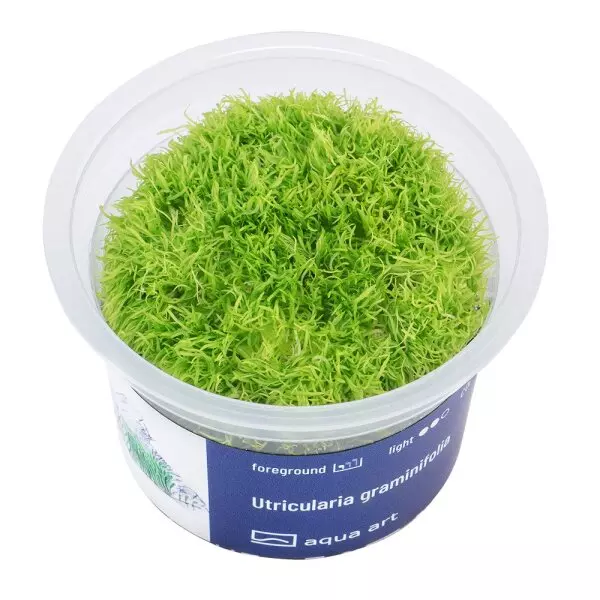
Invitro Utricularia graminifolia
Utricularia graminifolia is an attractive in-vitro aquarium plant that is particularly appreciated for its grass-like appearance and its ability to form dense carpets in the aquarium. This plant comes from the water hose family (Lentibulariaceae) and is known for its fine, grass-like leaves that create a natural and aesthetically pleasing underwater landscape.
Difficulty of cultivation:
: difficultLight requirement: mediumCOβ requirement: mediumHeight of the adult plant: up to 3-10 cmGrowth: medium to fast, depending on lightTemperature: 24 - 26Β°CPlacement in the aquarium: ForegroundOrigin: Asia6 cm cup diameter
Utricularia graminifolia is ideal for foreground planting in aquaria. It forms dense, green carpets that create a natural look and can serve as hiding places for small fish and shrimps. This plant is suitable for both beginners and experienced aquarists and contributes to the biological diversity and aesthetic beauty of an aquarium.
Planting:
The plant must be removed from the cup and thoroughly rinsed off the gel under
rinse off the gel thoroughly under running water. This is best done
by placing the plant in a container of lukewarm water. The
Most of the gel will then fall off by itself. Divide the contents
the contents of the cup into 1-2 cm clumps and then place these in the substrate
into the substrate at a small distance.
π± Eleocharis parvula - Fine ground cover for the natural aquarium
Natural lawn effect in the foreground
The dwarf needle sedge / Eleocharis parvula from Aqua Art is a popular foreground plant for natural aquariums and aquascapes. The fine, grass-like stems grow dense and low and form a dense, light green carpet of grass under optimal conditions. The plant is ideal for detailed layouts and looks particularly harmonious in open tanks with clear lines.
Thanks to its undemanding nature, it is also suitable for beginners. With a supply of COβ and good lighting, it grows quickly and ensures a neat appearance in the tank.
β Advantages at a glance
Forms a dense carpet of grass in the foreground
Fine stems for a natural look
Grows compact and low
Ideal for nano aquariums & aquascapes
Very easy to care for with COβ and light
Shrimp-safe & pesticide-free (in vitro)
π Product details
Name: Eleocharis parvula
Type: Ground cover / foreground plant
Origin: Europe/North America
Growth height: approx. 3-10 cm
Light requirement: medium to high
COβ supply: recommended
Growth: medium
Propagation: via runners
Delivery form: In vitro cup (sterile cultivation)
Manufacturer: Aqua Art
π‘ Zoo Roco tip
Eleocharis parvula can be perfectly combined with stones or root wood to create natural-looking bank zones. Cut the plant into smaller clumps when planting so that the carpet can close evenly.
Eleocharis parvula from Aqua Art is a finely structured, low-maintenance ground cover plant that transforms the aquarium into a near-natural underwater landscape.
π± Eleocharis parvula 'Mini' - Fine grass carpet for the foreground
Ultra-compact ground cover for detailed aquascapes
Eleocharis parvula 'Mini' from Aqua Art is a particularly low-growing variant of the well-known turf grass plant. It is ideal for nano aquariums and natural aquariums where a fine, even grass lawn is desired in the foreground. Due to its low height, the view of other design elements such as stones or wood is retained - ideal for modern Iwagumi layouts.
As an in vitro plant, it is free from algae, pesticides and snails, making it ideal for sensitive aquarium inhabitants such as shrimps.
β Advantages at a glance
Particularly compact & low growth
Ideal for nano aquariums and foreground layouts
Forms a dense, light green carpet of grass
InVitro - sterile & shrimp-safe
Easy to care for with COβ and light supply
Perfect for Iwagumi and natural aquariums
π Product details
Name: Eleocharis parvula 'Mini'
Type: Ground cover / foreground plant
Growth height: approx. 2-5 cm
Light requirement: medium to high
COβ supply: recommended
Growth: medium
Propagation: via runners
Delivery form: In vitro cup (sterile)
Manufacturer: Aqua Art
π‘ Zoo Roco tip
Divide the in-vitro cup into small portions and place them in nutrient-rich soil at regular intervals - this way Eleocharis 'Mini' grows together to form a dense, natural-looking carpet. Ideal in combination with light-colored substrates or high-contrast hardscapes.
With Eleocharis parvula 'Mini' from Aqua Art, you can design the foreground of your aquarium precisely, naturally and richly detailed - perfect for creative aquascaping concepts.Customers also searched for: ground cover aquarium, foreground plant, InVitro plant, Aqua Art, grass carpet aquarium, aquascaping foreground, nano aquarium plants, COβ plants aquarium, fine aquarium plant
πΏ Proserpinaca palustris - Decorative aquarium plant with serrated foliage
Structure and color for the middle to background layout
Proserpinaca palustris from Aqua Art is an unusual aquarium plant with finely toothed, fern-like leaves that can take on a fascinating copper-orange coloration in good light. It grows upright and gives the aquascape a special depth effect and structure thanks to its unique texture.
In well-lit tanks with a COβ supply, it develops vibrant colors and healthy growth. Its eye-catching appearance makes it ideal as an accent plant in the middle or background.
β Advantages at a glance
Unique leaf shape with serrated foliage
Color gradient from green to copper-orange in strong light
Ideal for structured middle and background design
Demanding, but very decorative under optimal conditions
Grown in vitro - free from snails and pesticides
Particularly striking in layouts with contrasting plants
π Product details
Name: Proserpinaca palustris
Origin: North and South America
Type: Stem plant
Growth height: approx. 20-40 cm
Light requirement: medium to high
COβ supply: recommended to necessary
Growth: medium
Propagation: Cuttings after pruning
Delivery form: In vitro cup (sterile)
Manufacturer: Aqua Art
π‘ Zoo Roco tip
Proserpinaca palustris looks particularly impressive when planted in groups and combined with fine-leaved plants such as Myriophyllum or Rotala. Strong light and regular micronutrient fertilization are crucial for intensive colouring.
With Proserpinaca palustris from Aqua Art, you can add variety, color and structure to your aquascape - ideal for sophisticated layouts with character.Customers also searched for: Proserpinaca palustris, Aqua Art, structure-rich aquarium plant, stem plant aquarium, serrated leaves, InVitro plant aquarium, aquascaping plant, buy Proserpinaca, reddish aquarium plant, background plant aquarium
πΏ Hygrophila sp. 'Araguaia' InVitro Reddish-brown accent plant with unique growth habit
Hygrophila sp. 'Araguaia' from Aqua Art is a particularly attractive, compact stem plant with a reddish-bronze color and finely branched growth. It is ideal for the foreground to midground and provides structured contrasts and warm color accents in aquascapes.
This plant is one of the slow-growing Hygrophila species and can be easily shaped and thickened by regular pruning. Supplied as an in-vitro plant, it is free from algae, snails and pesticides - ideal for shrimp tanks and sensitive aquariums.β Advantages at a glance:
Compact Hygrophila with reddish-bronze leaves
InVitro - sterile, snail-free & pesticide-free
Ideal for the foreground or middle ground
Slow-growing - easy to shape and grow bushy
Good effect with strong lighting & COβ supply
Very decorative in natural aquariums and layouts with contrasting colorsπ Product details:
Name: Hygrophila sp. 'Araguaia'
Type: Stem plant
Placement: Foreground to midground
Growth height: approx. 5-15 cm
Light requirement: medium to high
COβ supply: recommended
Growth: slow
Delivery form: In vitro cup (sterile cultivated)
Manufacturer: Aqua Artπ‘ Zoo Roco tip:
Combine Hygrophila 'Araguaia' with light green plants such as Micranthemum or Hydrocotyle sp. 'Japan'
- to show off the darker coloring particularly well. For a
dense carpet, regular pruning is recommended.Hygrophila 'Araguaia' provides subtle color accents and fine structure in the lower section of the aquarium - ideal for sophisticated layouts and harmonious plant design.
Ludwigia sphaerocarpa 'Pilosa' InVitro Red accent plant for aquascaping
Ludwigia sphaerocarpa 'Pilosa' is a decorative and rare stem plant with a particularly intense red coloration and fine leaf structure - a real eye-catcher for any natural aquarium. This variety is ideal for the mid to background area and adds color depth and contrast to groups of green plants.
As an Aqua Art in vitro plant, it is free from snails, algae and pesticides, making it perfect for shrimp tanks and sensitive aquariums. With good lighting and COβ supply, it develops its full color intensity and grows vigorously but controllably.β Advantages at a glance:
Intensely red-colored stem plant with a fine texture
Grown in vitro - sterile, free from harmful substances
Ideal for color contrasts in the middle or background
Safe for shrimps and sensitive aquariums
Grows compact & controllable with good careπ Product details:
Name: Ludwigia sphaerocarpa 'Pilosa'
Type: Stem plant
Placement: Middle to background
Growth height: approx. 20-40 cm
Light requirement: medium to high
COβ supply: recommended
Color effect: red to reddish-green
Growth: medium
Delivery form: In vitro cup (sterile cultivation)
Manufacturer: Aqua Artπ‘ Zoo Roco tip:
For strong red coloration, the plant should be kept under intensive lighting and regularly supplied with iron and micronutrients. A good supply of COβ also has a positive effect on growth and color.Ludwigia sphaerocarpa 'Pilosa' from Aqua Art brings structure, contrast and an intense play of colors to the aquarium - perfect for modern aquascaping layouts.
Invitro aquarium plant Rotala rotundifoliaColorful stem plant for the background
Rotala rotundifolia is one of the most popular stem plants in the aquarium hobby - versatile, easy to care for and particularly attractive thanks to its delicate, round leaves. Depending on the light intensity and nutrient supply, it develops a vibrant green to bright red, adding lively color accents to any aquarium layout.
The in vitro version is grown under sterile conditions and is therefore free from algae, snails and pesticides - ideal for sensitive aquariums, especially shrimp tanks. Fast-growing and adaptable, Rotala rotundifolia is ideal for the mid to background and harmonizes wonderfully with other fine stem plants in the natural aquarium.
Advantages at a glance:
β Changes color depending on the light - from green to red
β Fast-growing & ideal for dense groups of plants
β InVitro - guaranteed free from harmful substances & snails
β Safe for shrimps & sensitive tanks
β Perfect for aquascaping & classic plant aquariumsProduct details:
Name: Rotala rotundifolia
Type: Stem plant
Position in aquarium: Middle to background
Growth height: approx. 30-50 cm
Light requirement: Medium to high
COβ supply: Recommended for more intense colorationTemperature: 22 - 28Β°C
Delivery form: In vitro cup (grown sterile)
Color effect: Green to reddish, depending on light & nutrients
Invitro aquarium plant Bacopa myriophylloidesDelicate aquarium plant for the background
Bacopa myriophylloides is an elegant stem plant with delicate, finely pinnate leaves - a real eye-catcher for the background of your aquarium. Its special structure brings lightness and movement to the layout and is ideal for aquascaping and natural aquariums.
As a high-quality in vitro plant, it is free from algae, snails and pesticides, making it particularly safe for shrimps and sensitive tanks. With good lighting and COβ supply, Bacopa myriophylloides grows compactly and healthily - with a beautiful, delicate appearance.
Advantages at a glance:
β Delicate stem plant with feathery leaves
β Ideal for the background & textured layouts
β InVitro - sterile, pesticide-free & shrimp-safe
β Healthy growth with light & COβ addition
β Perfect for aquascaping & natural aquariumsProduct details:
Name: Bacopa myriophylloides
Type: Stem plant
Location in the aquarium: Background
Growth height: approx. 30-50 cm
Light requirement: Medium to high
COβ supply: Recommended
Delivery form: In vitro cup (grown sterile)
Special feature: Very fine, decorative leaf structure
InVitro Ammania senegalensis from Aqua ArtThe Ammania senegalensis InVitro from Aqua Art is an impressive aquarium plant with intense red coloration that is a real eye-catcher, especially in the middle and background of your aquarium. Thanks to InVitro cultivation, you get a 100 % sterile, pesticide-free plant that is also ideal for sensitive shrimps and aquascaping projects.
With sufficient light, nutrients and COβ, Ammania senegalensis develops strong, red stems and oval leaves - perfect for colorful contrasts in plant aquariums.
Advantages at a glance:
β Bright red stem plant for the middle & background
β InVitro - free from algae, snails & pesticides
β Safe for shrimps & sensitive aquarium inhabitants
β Ideal for aquascaping & natural aquariums
β Fast-growing with good lighting & COβ supplementationProduct details:
Name: Ammania senegalensis
Origin: Africa
Type: Stem plant
Position in the aquarium: Middle to background
Growth height: approx. 20-40 cm
Light requirement: Medium to high
COβ supply: Recommended
Delivery form: In vitro cup (lab-grown, sterile)Planting: The plant must be removed from the cup and thoroughly
rinsed thoroughly from the gel under running water. This is best done
best done by placing the plant in a container with lukewarm water.
lukewarm water. Most of the gel will then fall off by itself. Divide
the contents of the cup into 1-2 cm clumps and place these a short distance apart in the
then place them a short distance apart in the substrate or on the selected
objects.
Micranthemum umbrosum
Micranthemum Umbrosum is a light green stem plant with small round leaves. Depending on how it is pruned, it is suitable for both the foreground and background of the aquarium. Difficulty of cultivation: easy Light requirement: medium, to high COβ requirement: medium Height of the adult plant: 20 cm Growth: fast Temperature: 22-26 Β°C Placement in the aquarium: Second level Origin: North and Central America Cup diameter: 6 cm Micranthemum Umbrosum (Round-leaved meadowfoam) is a naturally occurring plant in North and Central America. It grows both in water and in marshy areas. It is prized by aquarists for its unique appearance.
The plant forms long stems with paired, alternate, small, round, light green leaves. It has a fairly well developed root system. It needs regular pruning and is easy to shape into a desired form. It is propagated vegetatively by cutting off the shoot tips and planting them in the ground.
It likes water with a hardness of 2-12Β°N, a pH of 5.5-7.7 and a temperature of 24-26Β°C. It is sensitive to trypaflavin and can be damaged by snails. It has fairly high light requirements. With insufficient light, it pulls upward, and distinct gaps can be seen between the leaves. With sufficient light, it forms dense clumps that are pleasing to the aquarist's eye.Micranthemum umbrosum is usually placed in the background of the aquarium, but it also looks good in the foreground when cut short. It does not require absolute COβ fertilization, but grows much faster in its presence. When growing this plant, pay special attention to the proper concentration of iron in the aquarium water..
Planting:The plant must be removed from the cup and thoroughly rinsed from the gel under running water. This is best done by placing the plant in a container of lukewarm water. Most of the gel will then fall off by itself. Divide the contents of the cup into 1-2 cm lumps and then set them at intervals of 1 to 2 cm.
Ludwigia sp. 'Super Mini Red'Ludwigia sp. Super Mini Red' is a fast growing red plant for the second or third level in the aquarium. It is easy to propagate and does not require strong lighting. This plant grows in the soil and on decoration.Difficulty of cultivation: mediumLight requirement: mediumCOβ requirement: mediumHeight of adult plant: 10-25 cmGrowth rate: mediumTemperature: 20-28Β°C Placement in aquarium: second or third level.
Origin: Cultivar (cultivated variety) Cup diameter: 6 cm Ludwigia sp. 'Super Mini Red' is the smallest of the red-leaved Ludwigia varieties. It has fine and delicate dark red leaves. A particularly decorative aquarium plant. Depending on tank size, it is suitable for the middle or third level of the aquarium. It is popular for arrangements in Dutch and natural style aquariums. The leaf blade is about 2 cm long and 1.5 cm wide. The plant does not have excessive requirements. It grows even in moderate light, although the red color then becomes less intense.
The plant can be planted in the ground or on decorations. When attached to the roots, it forms fanciful compositions, reminiscent of treetops. In this form of cultivation should not forget about the additional application of liquid fertilizer. The best growth results are obtained when planted in a fertile substrate. Under good conditions it spreads quickly.Ludwigia sp. Super Mini Red' has many lovers thanks to its extremely intense red color. It discolors easily and quickly under strong light conditions. In this way, it becomes an incredibly eye-catching design element in their aquarium. Due to its rapid growth, it must be regularly cut back and trimmed.
It does well in the strong spots of an arrangement, in the second or third row. The Super Mini Red variety does not require COβ and grows in the water column even with low light intensity and low fertilizer levels. Therefore, it is a suitable plant for beginners in plant aquaristics. However, it is important to remember that the best growing results can be achieved with appropriate lighting and additional carbon dioxide addition. It grows in both hard and soft water with pH between 5.5 and 7.5.
It does not require complicated care. Frequent pruning and good growing conditions will ensure beautiful, dense plants. It can grow up to 25 cm tall. As with most stems, the cut tips of the plants can be replanted in the ground. The plant will form side shoots at the cut.Planting:The plant must be removed from the cup and thoroughly rinsed from the gel under running water. This is best done by placing the plant in a container of lukewarm water. Most of the gel will then fall off by itself. Divide the contents of the cup into 1-2 cm lumps and then set them at intervals of 1 to 2 cm.
Rotala Rotundifolia 'Green'
Rotala Rotundifolia 'Green' (Round-leaved Rotala) is a mid-ground plant. It is characterized by fast growth and moderate light requirements. The color is usually light green.Difficulty of growing: easy Light requirements: medium COβ requirements: not necessary Height of mature plant: 50-60 cm Growth: fast Temperature: 20-28Β°C Placement in aquarium: third level Origin: South Asia, Southeast Asia Cup diameter 6 cm The natural range of the round-leaved Rotalas (Rotala rotundifolia) is South, Southeast and East Asia. It has been spread by humans to Australia, the United States and Brazil, among other places. She is thus already almost a globetrotter.Rotala rotundifolia 'Green' is very similar to Rotala rotundifolia, but its leaves remain bright green even in bright light.
This plant is characterized by its fast growth and its tendency to spread profusely, especially when regularly pruned. It tolerates medium light levels, but the higher the light, the more intense the plant's growth and colors. If left to grow freely, it reaches a length of 30-60 cm, cutting off access to light to the lower parts, where it begins to lose its leaves. Under favorable conditions, if left uncontrolled, it can dominate an entire tank, especially if it is a tank with a small capacity. Once it reaches the surface of the water, it begins to float on it. It does not need additional carbon dioxide fertilization unless you want to accelerate its growth even more.
It is tolerant of pH and water hardness, although like most plants, it cannot tolerate extremes.
It tolerates temperatures between 20 and 28 Β°C, but thrives better in the upper end of this range. It can grow in both an active and a poor substrate, but in this case it is advisable to fertilize under the roots. In well-lit, CO2-fertilized aquariums, it may require additional fertilization with macronutrients due to its rapid growth. Otherwise, it will lose its color and the leaves will become smaller. Rotala rotundifolia is propagated in the aquarium by cutting off stem pieces and placing them in a selected spot in the substrate. When transplanted to a new tank, it will need some time to acclimate and grow faster.Planting: The plant must be removed from the cup and thoroughly rinsed from the gel under running water. This is best done by placing the plant in a container of lukewarm water. Most of the gel will then fall off by itself. Divide the contents of the cup into 1-2 cm lumps and then place them at a small distance into the substrate.
Lobelia cardinalis 'Mini'Lobelia cardinalis 'Mini' is a green plant, recommended for the second level of the aquarium and for the paludarium. A very decorative species that is not particularly demanding.Difficulty of growing: easy Light requirements: medium COβ requirements: low Outgrown plant height: up to 20 cm Growth: medium Temperature: 15-28Β°C Placement in aquarium: second level Origin: North America Shell diameter: 6 cm Lobelia Cardinalis mini is a plant native to North America. In nature, it is found in wetlands and riverbanks. It is distributed from the Gulf of Mexico through the eastern states of the United States to southern Canada.
It grows in the ground and has a well-developed root system. The feathery stems can develop auxiliary roots in leafless areas. Its small leaves are bright green, oval with a conspicuous pale central vein.Lobelias can be cultivated in aquariums and paludariums. It thrives in muddy soil as well as underwater. It tolerates temperatures from 15 to 28 Β°C and can also be kept in a pond. It thrives best at 20-23Β°C and requires soft to medium-hard water with a pH between 6.5 and 7.2.Without sufficient light, the leaves turn yellow, but in bright light the undersides of the leaves turn purple. It is not particularly demanding, but regular water changes, fertilizer and COβ support its growth.In the aquarium, lobelia should be planted in a group in the middle ground, but it is also well suited as a foreground plant. Pruning is necessary for the plant to grow well; use scissors to remove older leaves. You can also cut back the entire plant and use the cut tips as cuttings.
Planting: The plant must be removed from the cup and thoroughly rinsed from the gel under running water. This is best done by placing the plant in a container of lukewarm water. Most of the gel will then fall off by itself. Divide the contents of the cup into 1-2 cm lumps and then set them at intervals of 1 to 2 cm.
Limnophila aromaticaLimnophila Aromatica (fragrant limnophilia) is a beautiful plant for the second or third level. It turns purple under intense light.Difficulty of cultivation: moderate Light requirement: medium COβ requirement: medium Adult plant height: up to 50 cm Growth: moderate Temperature: 22-28Β°C Placement in aquarium: second or third level Origin: Asia Cup diameter: 6 cm Limnophila Aromatica (fragrant Limnophila, rice paddy weed) is a plant that has earned a place in aquariums around the world due to its unique appearance and leaf color. It is native to Asia, where it usually grows in rice paddies or swamps near water. It does well after the end of the rainy season in a dry place in a still moist, sandy soil. At high temperatures, the plant flowers, forms fruit, and then dies. Traditionally used as a spice, especially in Vietnamese cuisine. Its flavor is reminiscent of cumin and lemon. Currently, the plant can also be found in America and Australia.Limnophilia Aromatica is a stalk plant that produces lance-shaped leaves with serrated edges. Their color depends on the intensity of light. If the plant has little access to light, its leaves are green. If the light is strong, the entire top of the plant is intense red and the leaves are purple on the underside.
In aquariums, plant it in the second or third level, leaving a distance of 1.5 cm between cuttings. It grows quite fast, its optimal pH is 6-7. It tolerates temperatures between 15 and 30 Β°C, but it is better to avoid extreme temperatures and keep it between 22 and 28 Β°C. In aquariums it is propagated by cutting and planting young plants that form on the stems or from the tips. The plant does not require absolute COβ fertilization, but grows much faster with COβ addition.
To achieve the desired intense red-purple color of the leaves, the plant must be strongly illuminated. In addition, attention must be paid to the correct water parameters in the aquarium, especially the optimal iron, nitrate and phosphate content, so that the plant can absorb the nutrients from the water column. Due to its strongly developed root system, the plant grows best in active media.Planting: The plant must be removed from the cup and thoroughly rinsed from the gel under running water. This is best done by placing the plant in a container of lukewarm water. Most of the gel will then fall off by itself. Divide the contents of the cup into 1-2 cm lumps and then set them at intervals of 1 to 2 cm.
Nesea sp. GoldNesea sp. "Gold" is a stem plant, with intense yellow to orange colors that is rare in aquarium plants.
Growing difficulty:
: medium, demandingLight requirement: mediumCOβ requirement: mediumAdult plant height: 40-50 cmGrowth: mediumTemperature: 22-28Β°CPlacement in aquarium: third levelOrigin: AfricaCup diameter 6 cmNesea Crassicaulis Gold (Nesea sp. Gold) from Africa, a quite rare and very decorative plant with medium requirements and moderate growth rate.With sufficient light, it takes on colors ranging from bright yellow to intense orange.
Nesea sp. Gold is not very demanding in terms of growing conditions. The yellow coloration of the leaves can be achieved even with moderately intense light. The stronger the lighting, the more the color shifts towards an orange tone. The plant can reach a height of up to 50 cm and is thus intended for the third level. However, it has a fairly moderate growth, so it does not require frequent pruning and with good care can be used as a foreground plant.
Nesea sp. Gold needs COβ in gaseous form, but the carbon dioxide requirement is not too high and medium due to the growth rate is not too fast. It requires nutrient-rich water for optimal appearance. However, attention should be paid to potassium levels, as excess can cause deformation of the growth cones.It grows best at temperatures between 22 and 28 degrees Celsius. Since it prefers high temperatures, it is suitable for tanks with a population of extremely heat-loving fish.
The undoubted advantage of this plant is the combination of a very unusual leaf color and low requirements. Nesea sp. Gold provides a good contrast with both green and red foliage plants, and the effect is relatively easy to achieve. It does not require a large amount of CO2. It likes soft and slightly acidic water, but can grow in other parameters as well. It needs good light, a nutrient-rich substrate, CO2 and adequate fertilization to achieve intense coloration. If you want to keep Nesea sp. Gold as a background plant, you should prune it regularly. This will not only keep it at the right height, but will also make it thicker and give it a striking appearance. After pruning, the plant will rejuvenate and the cut tops can be planted in the ground.Planting: Before planting, simply rinse the plants from the gel. Unlike plants kept in rockwool, partial drainage is not required..
πΏ Proserpinaca palustris - Decorative aquarium plant with serrated foliage
Structure and color for the middle to background layout
Proserpinaca palustris from Aqua Art is an unusual aquarium plant with finely toothed, fern-like leaves that can take on a fascinating copper-orange coloration in good light. It grows upright and gives the aquascape a special depth effect and structure thanks to its unique texture.
In well-lit tanks with a COβ supply, it develops vibrant colors and healthy growth. Its eye-catching appearance makes it ideal as an accent plant in the middle or background.
β Advantages at a glance
Unique leaf shape with serrated foliage
Color gradient from green to copper-orange in strong light
Ideal for structured middle and background design
Demanding, but very decorative under optimal conditions
Grown in vitro - free from snails and pesticides
Particularly striking in layouts with contrasting plants
π Product details
Name: Proserpinaca palustris
Origin: North and South America
Type: Stem plant
Growth height: approx. 20-40 cm
Light requirement: medium to high
COβ supply: recommended to necessary
Growth: medium
Propagation: Cuttings after pruning
Delivery form: In vitro cup (sterile)
Manufacturer: Aqua Art
π‘ Zoo Roco tip
Proserpinaca palustris looks particularly impressive when planted in groups and combined with fine-leaved plants such as Myriophyllum or Rotala. Strong light and regular micronutrient fertilization are crucial for intensive colouring.
With Proserpinaca palustris from Aqua Art, you can add variety, color and structure to your aquascape - ideal for sophisticated layouts with character.Customers also searched for: Proserpinaca palustris, Aqua Art, structure-rich aquarium plant, stem plant aquarium, serrated leaves, InVitro plant aquarium, aquascaping plant, buy Proserpinaca, reddish aquarium plant, background plant aquarium
πΏ Hygrophila sp. 'Araguaia' InVitro Reddish-brown accent plant with unique growth habit
Hygrophila sp. 'Araguaia' from Aqua Art is a particularly attractive, compact stem plant with a reddish-bronze color and finely branched growth. It is ideal for the foreground to midground and provides structured contrasts and warm color accents in aquascapes.
This plant is one of the slow-growing Hygrophila species and can be easily shaped and thickened by regular pruning. Supplied as an in-vitro plant, it is free from algae, snails and pesticides - ideal for shrimp tanks and sensitive aquariums.β Advantages at a glance:
Compact Hygrophila with reddish-bronze leaves
InVitro - sterile, snail-free & pesticide-free
Ideal for the foreground or middle ground
Slow-growing - easy to shape and grow bushy
Good effect with strong lighting & COβ supply
Very decorative in natural aquariums and layouts with contrasting colorsπ Product details:
Name: Hygrophila sp. 'Araguaia'
Type: Stem plant
Placement: Foreground to midground
Growth height: approx. 5-15 cm
Light requirement: medium to high
COβ supply: recommended
Growth: slow
Delivery form: In vitro cup (sterile cultivated)
Manufacturer: Aqua Artπ‘ Zoo Roco tip:
Combine Hygrophila 'Araguaia' with light green plants such as Micranthemum or Hydrocotyle sp. 'Japan'
- to show off the darker coloring particularly well. For a
dense carpet, regular pruning is recommended.Hygrophila 'Araguaia' provides subtle color accents and fine structure in the lower section of the aquarium - ideal for sophisticated layouts and harmonious plant design.
πΏ Hydrocotyle verticillata InVitro Whorled pennywort for the foreground
Hydrocotyle verticillata from Aqua Art is a unique foreground plant with umbrella-shaped leaves that are reminiscent of small water lilies or parasols. This special leaf shape makes it a real eye-catcher in natural aquariums and aquascapes - especially in shallow tanks or detailed layouts.
The plant remains compact, grows creeping across the bottom and is ideal for creative foreground or midground designs. Supplied as an in vitro plant, it is free from pesticides, algae and snails, making it ideal for shrimp tanks and sensitive aquarium inhabitants.β Advantages at a glance:
Eye-catching umbrella-shaped leaves - natural look with design character
InVitro - shrimp-safe, pesticide-free & algae-free
Compact growth - perfect for the foreground
Grows creeping & forms small groups
Ideal for shallow tanks & creative aquascapes
Undemanding & easy to care forπ Product details:
Name: Hydrocotyle verticillata
Type: Ground cover / foreground plant
Growth height: approx. 2-7 cm
Light requirement: low to medium
COβ supply: not essential, but beneficialpH value: 5 to 7
Growth: slow to medium
Propagation: by runners, cuttings, division
Delivery form: In vitro cup (sterile cultivation)
Manufacturer: Aqua Artπ‘ Zoo Roco tip:
Hydrocotyle verticillata looks particularly harmonious in combination with fine mosses or light-colored substrates. It is also very suitable for aquascaping and shallow-planted nano aquariums andcan also be kept emersed in Wabi-Kusa.
Bacopa CarolinianaBacopa Caroliniana is a green stem plant for the second and third floors of the aquarium. It is a slow growing plant with few requirements. Ideal for aquariums with little technology.Difficulty of growing: easy Light requirements: medium COβ requirements: medium Outgrown plant height: up to 40 cm Growth: slow Temperature: 24-25Β°C Placement in aquarium: Second and third tiersOrigin: North AmericaCup diameter: 6 cmBacopa Caroliniana is an extremely decorative green plant with a thick stem overgrown by ovate leaves, which face each other in two whorls. It grows up to 40 cm tall, making it ideal for the third level of an aquarium. In nature it grows in the swamps of North America.
Bacopa Caroliniana is perfect for aquariums with low technology. It does not require excessively strong lighting, about 0.6 W/l is sufficient. In addition to its low light requirements, it also does not need intensive COβ fertilization. With fertilization accelerates the growth that, unlike other plants, is rather slow.If it is regularly pruned, it is suitable not only for the third, but also for the second level of the aquarium. Cut stems can be planted in the substrate to compact the pile.
Additional fertilization with preparations containing iron has an excellent effect. Low maintenance and slow growth rate means that the plant does not require special attention from the aquarist.
Due to its delicate root system, it thrives best in a fine substrate with the addition of peat balls or substrate.The optimum temperature is 24-25 oC. A short-term drop in temperature does not affect the condition of the plant. If the temperature is too high, the growth of the plant is often stunted and the stem may die.Planting: The plant must be removed from the cup and thoroughly rinsed from the gel under running water. This is best done by placing the plant in a container of lukewarm water. Most of the gel will then fall off by itself. Divide the contents of the cup into 1-2 cm lumps and then place them at a small distance on the selected items.
Ludwigia sphaerocarpa 'Pilosa' InVitro Red accent plant for aquascaping
Ludwigia sphaerocarpa 'Pilosa' is a decorative and rare stem plant with a particularly intense red coloration and fine leaf structure - a real eye-catcher for any natural aquarium. This variety is ideal for the mid to background area and adds color depth and contrast to groups of green plants.
As an Aqua Art in vitro plant, it is free from snails, algae and pesticides, making it perfect for shrimp tanks and sensitive aquariums. With good lighting and COβ supply, it develops its full color intensity and grows vigorously but controllably.β Advantages at a glance:
Intensely red-colored stem plant with a fine texture
Grown in vitro - sterile, free from harmful substances
Ideal for color contrasts in the middle or background
Safe for shrimps and sensitive aquariums
Grows compact & controllable with good careπ Product details:
Name: Ludwigia sphaerocarpa 'Pilosa'
Type: Stem plant
Placement: Middle to background
Growth height: approx. 20-40 cm
Light requirement: medium to high
COβ supply: recommended
Color effect: red to reddish-green
Growth: medium
Delivery form: In vitro cup (sterile cultivation)
Manufacturer: Aqua Artπ‘ Zoo Roco tip:
For strong red coloration, the plant should be kept under intensive lighting and regularly supplied with iron and micronutrients. A good supply of COβ also has a positive effect on growth and color.Ludwigia sphaerocarpa 'Pilosa' from Aqua Art brings structure, contrast and an intense play of colors to the aquarium - perfect for modern aquascaping layouts.
Eleocharis pusilla InVitroDelicate ground cover for nano and natural aquariums
Eleocharis pusilla from Aqua Art is a delicate, grass-like ground cover that looks particularly elegant in nano aquariums and delicate aquascapes. It grows significantly lower and finer than Eleocharis acicularis and forms dense, short grassy areas with a natural appearance.
Thanks to in vitro cultivation, Eleocharis pusilla is free from pesticides, algae and snails, making it ideal for shrimp tanks and sensitive aquariums. The plant grows compactly, requires little care and spreads evenly through runners.β Advantages at a glance:
Very fine ground cover with short, dense growth
InVitro - sterile, shrimp-safe & pesticide-free
Ideal for nano aquariums & detailed layouts
Spreads through runners to form a carpet of grass
Easy to care for - requires only medium light conditions
Perfect for the foreground in aquascapingπ Product details:
Name: Eleocharis pusilla
Type: Ground cover / foreground plant
Growth height: approx. 3-5 cm
Growth habit: grass-like, creeping
Light requirement: medium to high
COβ supply: recommended, but not essential
Growth: slow to medium
Propagation: by stolons
Delivery form: In vitro cup (sterile cultivation)
Manufacturer: Aqua Artπ‘ Zoo Roco tip:
Divide the InVitro cup into small portions and place them in nutrient-rich soil with some space between them. This will create a dense, natural carpet of grass in just a few weeks. Ideal in combination with stones or root wood!Eleocharis pusilla is the perfect choice for detail-loving aquarium designers who value naturalness, delicacy and structure - even in small tanks.
π± Eleocharis parvula 'Mini' - Fine grass carpet for the foreground
Ultra-compact ground cover for detailed aquascapes
Eleocharis parvula 'Mini' from Aqua Art is a particularly low-growing variant of the well-known turf grass plant. It is ideal for nano aquariums and natural aquariums where a fine, even grass lawn is desired in the foreground. Due to its low height, the view of other design elements such as stones or wood is retained - ideal for modern Iwagumi layouts.
As an in vitro plant, it is free from algae, pesticides and snails, making it ideal for sensitive aquarium inhabitants such as shrimps.
β Advantages at a glance
Particularly compact & low growth
Ideal for nano aquariums and foreground layouts
Forms a dense, light green carpet of grass
InVitro - sterile & shrimp-safe
Easy to care for with COβ and light supply
Perfect for Iwagumi and natural aquariums
π Product details
Name: Eleocharis parvula 'Mini'
Type: Ground cover / foreground plant
Growth height: approx. 2-5 cm
Light requirement: medium to high
COβ supply: recommended
Growth: medium
Propagation: via runners
Delivery form: In vitro cup (sterile)
Manufacturer: Aqua Art
π‘ Zoo Roco tip
Divide the in-vitro cup into small portions and place them in nutrient-rich soil at regular intervals - this way Eleocharis 'Mini' grows together to form a dense, natural-looking carpet. Ideal in combination with light-colored substrates or high-contrast hardscapes.
With Eleocharis parvula 'Mini' from Aqua Art, you can design the foreground of your aquarium precisely, naturally and richly detailed - perfect for creative aquascaping concepts.Customers also searched for: ground cover aquarium, foreground plant, InVitro plant, Aqua Art, grass carpet aquarium, aquascaping foreground, nano aquarium plants, COβ plants aquarium, fine aquarium plant
CHFΒ 6.50
β
β
β
β
β
β
β
β
β
β
β
β
This website uses cookies to ensure the best experience possible. More information...