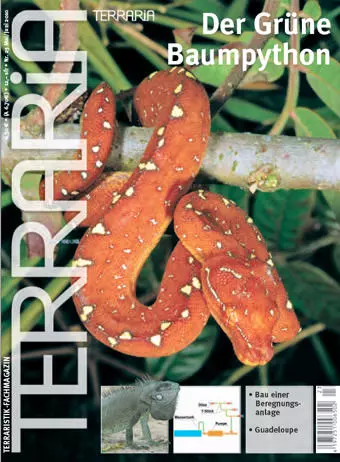
Terraria 23 - The green tree phyton

Article no: terraria23

CHF 12.00

Stock: 0

Ready for dispatch in 1-3 days, delivery time 7 working days

Delivery between Tuesday, 28 April and Wednesday, 29 April
Zahlungsarten
Product information "Terraria 23 - The green tree phyton"

Terraria 23 - The Green Tree Python

Construction of an irrigation system
Guadeloupe

Contents:

Hardly any other snake enjoys as much reverent enthusiasm as Morelia viridis, the Green Tree Python. Even die-hard snake haters can hardly escape the aesthetic fascination radiated by the beautifully green-coloured, elegantly “coiled” pythons on a branch. And then there are the brightly red, yellow or green coloured juveniles! This snake is correspondingly popular in terraristics, and although it is still not an easy species to keep, it has made an impressive triumphant advance in our terrariums in recent years. A good two decades ago, breeding itself was considered a sensation, but today a wide variety of targeted colour breeds are already circulating. The cover story of the upcoming TERRARIA reports on the latest developments in this giant snake – you can look forward to previously unpublished information as well as magnificent photos!

Editorial
Magazine
El Niño to blame for snake bites?/Male toad on wrong routes/Legal matters/Snake conference/Marketplace

TERRAglobal
Camping in the Páramo
Maik Dobiey

Cover Story
The Green Tree Python – Terrarium Set-up and Technology
by Michèl Kroneis

Outdoor enclosures for Morelia viridis
by Joachim Bulian

“And the further rearing went smoothly …”. Some notes on the rearing of the Green Tree Python (Morelia viridis)
by Joachim Bulian

A simple irrigation system for “small” money
by Peter Maria Müller

Between rubbish and mines: the Dalmatian tortoise Testudo hermanni hercegovinensis. Part 2
by Michael Wirth

Butterflies in the house
by Hans-Günther Kaiser

Travel
Herpetological impressions searching for iguanas in the French Antilles: Guadeloupe
by Stefanie Schönecker & Patrick Schönecker

New species
New from New Guinea: two species and genera of narrow-mouthed frogs
by Axel Kwet

Two new species of agamas in the genera Pseudocalotes and Bronchocela
by Jakob Hallermann

Among researchers
Biodiversity and species decline in Bolivia
by Steffen Reichle

Eye-catcher
In the desert paradise – tortoises and iguanas among columnar cacti. A visit to Robert Blome in Arizona
 by Heiko Werning

Near you
Subscription & Service
Preview

Incubator
80 mosquitoes for one frog. Part 1
by Heiko Werning

Composition
Feeding recommendation
Technical details
Size information

0 of 0 reviews

Give us a rating!

Share your experience with the product with other customers.


Suggested products

Geckos
Geckos in the terrarium by Astrid FalkThe book offers a comprehensive introduction to geckos and their species-appropriate keeping in terrariums. It explains what you need to think about before buying a gecko and what preparations should be made. The book describes in detail how the terrarium is technically equipped and set up. The care of the animals, their special features and behaviour, their diet, reproduction and rearing of young animals are described, as well as diseases and husbandry problems with tried and tested suggestions for prevention and treatment. Individual gecko species that are particularly suitable for keeping and breeding in terrariums are portrayed in detail in the second part of the book.

CHF 28.50

Handbook of food plants for tortoises and other reptiles
Handbook of forage plants 2nd revised editionMarion Minch is not only a successful breeder of diverse tortoises for many years, but also an excellent connoisseur of native wild herbs. She founded and runs samenkiste.de, which is well known to many tortoise keepers and nature lovers. Her name is inextricably linked with reptile care and species-appropriate nutrition for tortoises. Her handbook of food plants summarises the most important native food plants for herbivorous and omnivorous reptiles. She not only considers tortoises, but also iguanas, spiny-tailed dragons and even chameleons. From the basics of plant biology to native wild herbs to suitable food plants for hardy tropical reptile species, this comprehensive work provides the basis for species-appropriate keeping. In the expanded and supplemented 2nd edition, the plant section is divided according to flower colour. This makes it even easier to identify wild herbs. The work has also been supplemented with a wealth of additional information and many pictures.

CHF 46.50

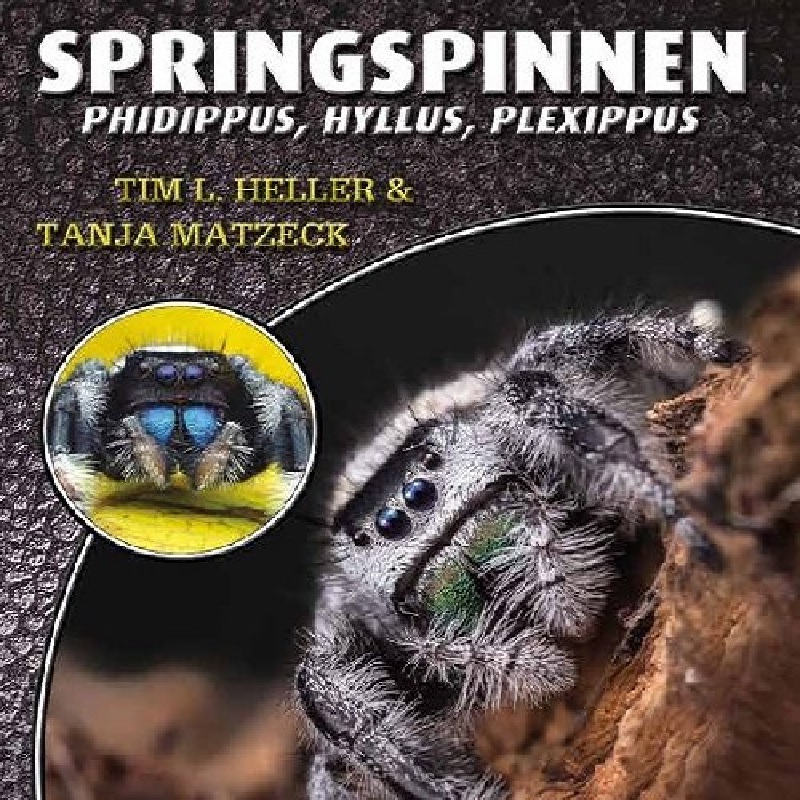
Jumping spiders Phidippus, Hyllus, Plexippus
Book Jumping Spiders - Phidippus, Hyllus & Plexippus A guide to keeping jumping spiders of the genera Phidippus, Hyllus & Plexippus. Who can resist the charm of jumping spiders? The childlike appearance of their expressive face simply leaves no one cold! In addition, their behavior is extremely exciting to observe, their colors are bright and their requirements for species-appropriate keeping are very easy to meet. No wonder these likeable jumpers are all the rage! This volume in the "Species by Species" series describes in detail what to look out for when buying and keeping them, introduces the most commonly kept species and color forms and provides plenty of tips on how to keep them successfully - so you can be sure they will breed well! Species by Species introduces you to the books in this series, which present the most popular terrarium animals. Each volume offers you detailed, practical care instructions and all the information you need to successfully breed your animals. All important questions from the required tank size to terrarium set-up, technical equipment, species-appropriate nutrition and disease prevention are answered with numerous tricks and tips. Experienced, long-standing breeders reveal how you can encourage the animals to reproduce and raise healthy young. All this in full color, generously illustrated and attractively designed - just about your terrarium animal - species by species

CHF 23.90

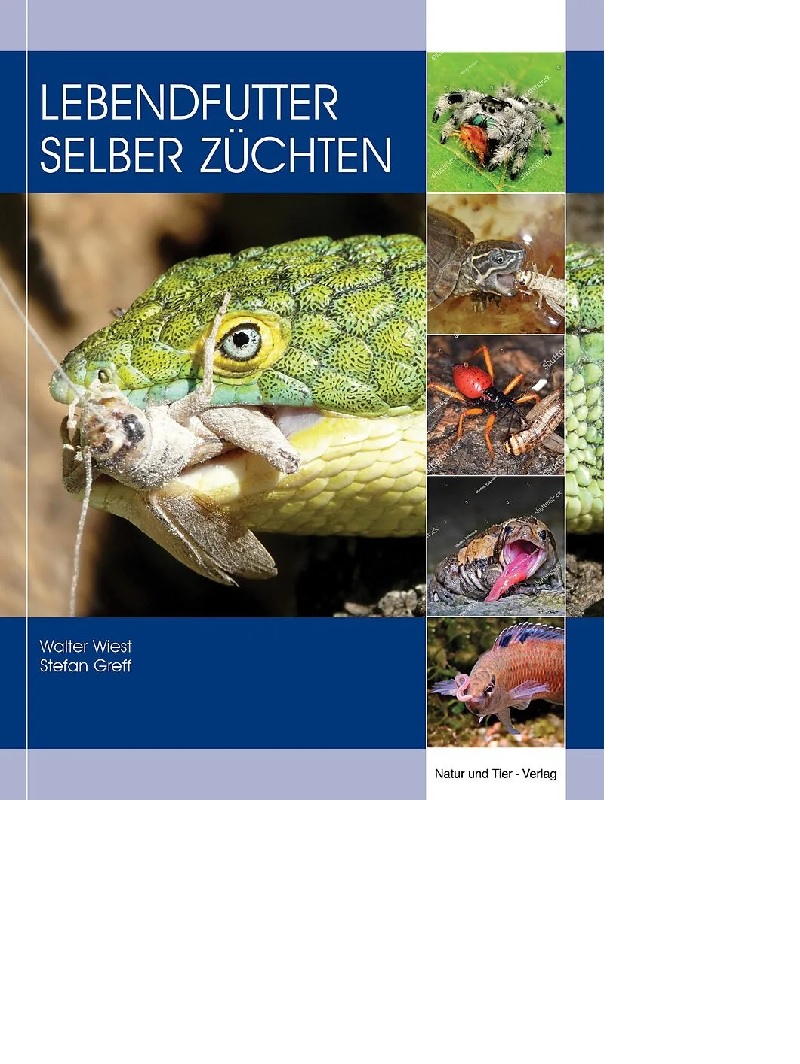
Book Breeding live food yourself
Book "Grow your own live food" - The perfect guide for pet owners Discover practical and detailed instructions on how you can easily breed food for your reptiles, birds, fish or other animals yourself in the book "Breeding live food yourself". With valuable tips on various food insects, their care and breeding, you can save money and ensure a species-appropriate diet for your pets. Contents of the book: Step-by-step instructions for breeding feeder insects Information on the best types of food for reptiles, birds and fish Care instructions and breeding conditions for various live food species Tips for sustainable and cost-effective food production Why breed your own live food? Get healthy, fresh food for your animals Save money and reduce dependence on pet shops Promote the health and well-being of your animals with species-appropriate food Whether you are a beginner or an experienced pet owner, this book provides you with everything you need to successfully breed live food yourself.

CHF 46.50

Marginata 69 - New Guinea tortoises
Marginata 69 - New Guinea tortoises – the genus ElseyaCover storyThe unrecognised beauties: New Guinea tortoises (Andreas S. Hennig)My experiences with Branderhorst's New Guinea tortoise, Elseya (Elseya) branderhorsti (Ouwens, 1914) (Andreas S. Hennig)Keeping and breeding of Rhodin's New Guinea tortoise, Elseya (Hanwarachelys) rhodini Thomson, Amepou, Anamiato & Georges, 2015 (Andreas S. Hennig)PortraitGeoemyda spengleri, Chinese serrated tortoise (Andreas S. Hennig)ReportageMacrochelys temminckii – Experiences and impressions with vulture tortoises part 2 (Reiner Praschag)KeepingAn alternative to year-round keeping of the Egyptian tortoise in the terrarium – my experiences with seasonal outdoor keeping of Testudo kleinmanni (Ricarda Schramm)EtymologySawbacks and living maps part 4: Graptemys gibbonsi, Pascagoula humpback tortoise (Holger Vetter)Classifieds & animal placement

CHF 16.50

Banded Velvet Gecko & Wahlberg's Gecko
All about the banded velvet gecko and the Wahlberg's gecko by Mirko Barts 64 pages Format: 14.8 x 21 cm numerous colour photos Paperback Author Mirko Barts Contents: This book offers a detailed description of the species Banded Velvet Gecko and Wahlberg's Gecko as well as "instructions" for successful keeping and breeding in the artificial terrarium habitat.Mirko Barts knows more about keeping and breeding these animals than almost anyone else. He provides the reader with the expertise needed to care for these lizards in an expert and easy-to-understand manner. Of course, he also tells you how to breed these adorable animals, hatch the eggs and raise the young. Systematics and body structure The fascinating biology: From the life of the Banded Velvet Gecko and the Wahlberg's Gecko All information on species-appropriate keeping: from suitable terrariums to equipment and technology to feeding Successful breeding: Mating stimulation, incubation of the eggs and rearing the young Solutions to problems: How to avoid the most common mistakes in care and how to help sick animals Brilliant photos

CHF 19.90

Draco 04 - Iguanas
Draco 04 - Iguanas Contents: Page content 2 Editorial 4 Iguanas, by H. Werning 18 Sex differences in iguanas, by U. Schlüter 29 Islands - Hot spots of biodiversity as habitat of a unique iguana fauna, by M. Monzel 38 About the iguanas of Madagascar, by W. Schmidt and K. Liebel 44 Desert keel-tailed iguanas from Peru, by U. Schlüter 50 Keeping, breeding and care of Anolis cybotes, by M. Rogner 54 The desert iguana Dipsosaurus dorsalis: lifestyle, keeping and breeding, by H. Wölfel 62 Care of green iguanas, by G. Köhler 70 Psychogenic egg-laying difficulties in a green iguana (Iguana iguana rhinolopha), by J. Rauh 73 Iguana farming, by G. Köhler 79 Book box 93 Magazine

CHF 14.90

Draco 57 - Snakes: Colour and drawing breeding
Draco 57 - Snakes: Colour and markings breedingsContents:Editorial Variety is the trump cardHans - Dieter Philippen Colour forms in garter snakes. A look into the past, the present and the trends of tomorrowDaniel GrübnerHurricane Season Hans-Jörg WinnerSturdy beauties. Colour and pattern variations in PituophisBernd SkubowiusThe latest trends in breeding the green tree python Marcel HoffmannChoose the diamond! Colour and pattern types of diamond pythonsMarc Mense A look at colour breeding in Pantherophis guttatusStephan Drees Colour and pattern forms in the western hook-nosed snakeFilip LonghitanoReal rarities: Colour varieties of the grey-banded king snake Malte Hornig

CHF 32.00

Reptilia 15 - Mantella
Reptilia 15 - MantellaBlack-headed dwarf snakeLong-tailed lizardSri LankaContents:Page 2 - EditorialPage 3 - MagazinePage 5 - Report: Can the turtles of Asia still be saved? by E. MeierPage 16 - DatesPage 18 - Western Herp Pespectives: First contact with Baja, by B. LovePage 20 - Photo report: MantellaPage 26 - Herpetofauna: Mantella - Interesting poison frogs from Madagascar, by K. SchmidtPage 35 - Report: Protection of Madagascan colour poison frogs and their habitats, by H. ZimmermannPage 40 - Travel report: In the dry zone of Sri Lanka, by Dr M. GaulkePage 47 - Portrait and poster: Tylototriton verrucosus, by M. Aresté and J. L. FarriolsPage 51 - Keeping and breeding: The South China long-tailed lizard, by U. SchlüterPage 55 - Keeping and breeding: Rhoptropus barnardi - a day gecko from Namibia, by Dr M. MeyerPage 60 - Report: Cockroaches (Blattoptera) - Rulers of the world? by A. HauschildPage 64 - Keeping and breeding: Observations on the black-headed dwarf snake Rhynchocalamus m. melanocephalus (Jan, 1862), by H. EsterbauerPage 69 - Report: King cobra bite with consequences, by T. Ziegler, H. X. Quang and N. Ba TrinhPage 74 - Herpetology and culture: The snake in Celtic mythology, part 2, by L. Batista Carissimi-PrioriPage 81 - Reptilia on the road: The vivarium at Chemnitz Zoo, by A. S. HennigPage 88 - Advice and actionPage 91 - LibraryPage 96 - Incubator: 5,995 characters Resentment

CHF 9.80

Reptilia 88 - The Cryptopusics
Reptilia 88 - The Scheltopusik RhodesMeaning of UV irradiationColour forms of the western hook-nosed snakeContents:Europe's largest and at the same time strangest lizard captivates all reptile enthusiasts: the Scheltopusik. This equally awe-inspiring and elegant species, with its snake-like shape and lizard head, is one of the best-known reptiles and a classic in terrarium keeping. Nevertheless, reports of successful breeding remain rare. In the upcoming REPTILIA, Benny Trapp and Michael Wirth present Scheltopusiks from all parts of the range, both in text and fantastic photos, while Sascha Esser and his team from the Alexander Koenig Zoological Research Museum also report on breeding in indoor terrariums. This extraordinary cover story is rounded off by Peter Fritz, who describes in a very comprehensible way the construction of an outdoor enclosure for this species – something sure to interest every other outdoor terrarium keeper as well. Table of contents EditorialMAGAZINEDATES WESTERN HERP PERSPECTIVES Insufficiently recognised reptilesB. Love PHOTOSTORY Europe's largest lizard – the Scheltopusik, Pseudopus apodus M. Wirth PRACTICE An outdoor enclosure for the Scheltopusik, Pseudopus apodus P. Fritz REPORTAGE Keeping and breeding of the Scheltopusik, Pseudopus apodus, at the Alexander Koenig Zoological Research Museum S. Esser REPORTAGE The Scheltopusik in Croatia M. Wirth PORTRAIT AND POSTERGopherus polyphemusH. Werning ReportageColour forms of the western hook-nosed snake (Heterodon nasicus) F. Longhitano PRACTICE How important are UV light, vitamin and mineral supplements? New findings on bone metabolic diseases and their prevention using the example of the Yemen chameleon A. Kwet & S. Hoby TRAVEL The herpetofauna of Rhodes U. Schlüter Animals of our homeland. The dice snake R. Leptien TERRARIUM DISPLAYS The paradise of the unloved – the Scheidegg reptile zoo M. Wirth SUBSCRIPTION & SERVICE ALSO NEAR YOU PREVIEW  INCUBATOR  Ilha de Marchanteria   

CHF 12.00

Terraria 40 - Night-active Geckos
Terraria 40 - Nocturnal Geckos Majorca midwife toadEnclosure of tortoise outdoor enclosures Contents: Cover story: Nocturnal Geckos Nocturnal geckos are among the most popular terrarium animals of all. In the cover story of this issue of TERRARIA/elaphe, we take an in-depth look at the biology, care and breeding of three representatives of this vast group: the house geckos of the genus Hemidactylus, often scorned as “feed geckos”; the impressive green-eyed gecko Gekko siamensis; and finally the eye-spotted arched-toed gecko (Cyrtodactylus peguensis). TerritorialHerpetorama Cover storyHalf-finger geckos: Hemidactylus. The misunderstood genusBernd-Michael Zwanzig & Wolfgang Grossmann Keeping and breeding of Cyrtodactylus peguensisSiriporn Maier Experiences with the Thai green-eyed gecko, Gekko siamensisIngo Kober Panorama TerraglobalReptile search with obstacles - Part 1Joachim Bulian Pond frogs, pond newts, alpine newts. “Quantitative” side notes from our own gardenWerner & Yvonne Lantermann The herpetofauna of the Portuguese Star MountainsRudolf Malkmus Research New speciesList of amphibians newly described in 2012Axel Kwet Salamandra TerraristicsClassic. The smooth clawed frog Setting boundaries with understanding. The enclosure of an outdoor enclosure for European tortoisesPeter Buchert HomerangeIn snake country – A visit to Yvonne and Thomas KlesiusHeiko Werning Nature and species conservationField notes. Eyes bigger than the mouth – unsuccessful prey-catching attempt of a fire-bellied toadStefan Meyer Smooth newt or hybrid newt?Wolf-Rüdiger Grosse & Holger Wawrzyniak The Majorca midwife toad (Alytes muletensis). A fossil from the Ice AgeAxel Hilger MissingTurkestan angular-toothed newt (Hynobius turkestanicus)Alexander Gutsche Subscription & ServiceAlso in your neighbourhood GalleryWilly Wolterstorff – “Father of the newts” Preview IncubatorThe beagle of terraristicsJörg Hofmann

CHF 12.00

NTV, Discover the amphibians
NTV, Discover the amphibians and learn all about these animals. 56 pages colour photos throughout Large format: 20.7 x 28 cm Hardcover Author Kriton Kunz Contents: Every child knows a frog that swims around in its pond and croaks cheerfully, or the black and yellow fire salamander. But how do these friendly animals live? What do they eat, how do they survive the winter? How does a tadpole become a small frog? And what other amazing amphibians are there? "Entdecke die Amphibien" explains what amphibians are, their special features and their incredible abilities in an entertaining and child-friendly way. Fantastic records from the world of frogs, salamanders and the like are included, as well as an exciting quiz about these colourful survival artists. Including 20 great stickers 

CHF 17.90