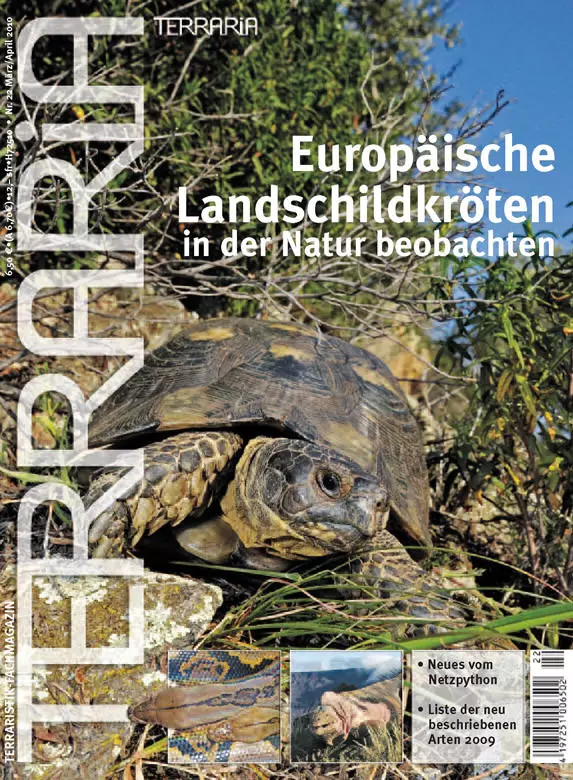
Terraria 22 - European tortoises in the nature observe

Article no: terraria22

CHF 12.00

Stock: 0

Ready for dispatch in 1-3 days, delivery time 7 working days

Delivery between Monday, 31 August and Tuesday, 1 September
Zahlungsarten
Product information "Terraria 22 - European tortoises in the nature observe"

Terraria 22 - Observe European tortoises in the wild

News from the reticulated python
List of newly described species 2009

Contents:

Editorial

Magazine
Traditional use of the Great Honeycomb Toad (Pipa pipa) by the indigenous population of French Guiana / A success for species conservation: reintroduction of young hawksbill turtles from Frankfurt Zoo to the Seychelles / Snake booklet for the further training of biology teachers / Marketplace

TERRAglobal
The "water snake"
Fabio Cupul

Visiting the Red-throated Leaf-tailed Gecko, Saltuarius salebrosus
Gunther Schmida

Cover story
Observing European tortoises in the wild
Michael Wirth

The tortoise project of Murcia
Benny Trapp

The Marginated Tortoise, Testudo marginata – black giants from the Greek Phrygana
Michael Wirth

Between rubbish and mines: the Dalmatian tortoise Testudo hermanni hercegovinensis Part 1
Michael Wirth

Some remarks on systematics, care and reproduction of the reticulated python
Henry Bellosa & Ralf Mößle

A grateful fosterling: The Oman lizard, Omanosaura jayakari, its keeping and breeding
Sascha Esser

New species
List of amphibian and reptile species newly described in 2009
Axel Kwet

Test run
Rearing racks
Kriton Kunz

Near you
Subscription & Service
Preview

Incubator
Axolotl Roadway
Heiko Werning
Composition
Feeding recommendation
Technical details
Size information

0 of 0 reviews

Give us a rating!

Share your experience with the product with other customers.


Suggested products

Handbook of food plants for tortoises and other reptiles
Handbook of forage plants 2nd revised editionMarion Minch is not only a successful breeder of diverse tortoises for many years, but also an excellent connoisseur of native wild herbs. She founded and runs samenkiste.de, which is well known to many tortoise keepers and nature lovers. Her name is inextricably linked with reptile care and species-appropriate nutrition for tortoises. Her handbook of food plants summarises the most important native food plants for herbivorous and omnivorous reptiles. She not only considers tortoises, but also iguanas, spiny-tailed dragons and even chameleons. From the basics of plant biology to native wild herbs to suitable food plants for hardy tropical reptile species, this comprehensive work provides the basis for species-appropriate keeping. In the expanded and supplemented 2nd edition, the plant section is divided according to flower colour. This makes it even easier to identify wild herbs. The work has also been supplemented with a wealth of additional information and many pictures.

CHF 46.50

Geckos
Geckos in the terrarium by Astrid FalkThe book offers a comprehensive introduction to geckos and their species-appropriate keeping in terrariums. It explains what you need to think about before buying a gecko and what preparations should be made. The book describes in detail how the terrarium is technically equipped and set up. The care of the animals, their special features and behaviour, their diet, reproduction and rearing of young animals are described, as well as diseases and husbandry problems with tried and tested suggestions for prevention and treatment. Individual gecko species that are particularly suitable for keeping and breeding in terrariums are portrayed in detail in the second part of the book.

CHF 28.50

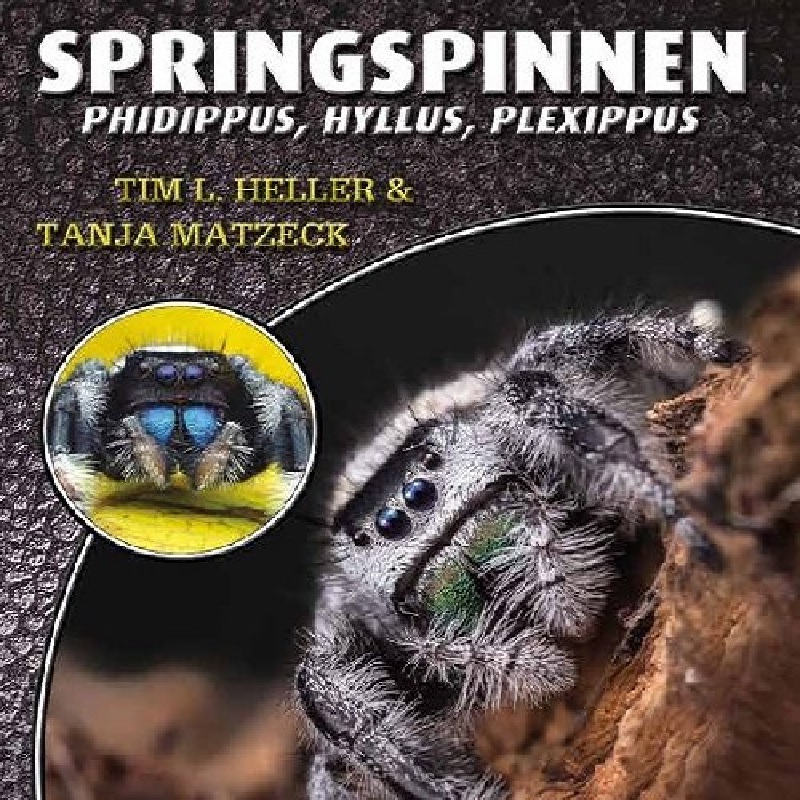
Jumping spiders Phidippus, Hyllus, Plexippus
Book Jumping Spiders - Phidippus, Hyllus & Plexippus A guide to keeping jumping spiders of the genera Phidippus, Hyllus & Plexippus. Who can resist the charm of jumping spiders? The childlike appearance of their expressive face simply leaves no one cold! In addition, their behavior is extremely exciting to observe, their colors are bright and their requirements for species-appropriate keeping are very easy to meet. No wonder these likeable jumpers are all the rage! This volume in the "Species by Species" series describes in detail what to look out for when buying and keeping them, introduces the most commonly kept species and color forms and provides plenty of tips on how to keep them successfully - so you can be sure they will breed well! Species by Species introduces you to the books in this series, which present the most popular terrarium animals. Each volume offers you detailed, practical care instructions and all the information you need to successfully breed your animals. All important questions from the required tank size to terrarium set-up, technical equipment, species-appropriate nutrition and disease prevention are answered with numerous tricks and tips. Experienced, long-standing breeders reveal how you can encourage the animals to reproduce and raise healthy young. All this in full color, generously illustrated and attractively designed - just about your terrarium animal - species by species

CHF 23.90

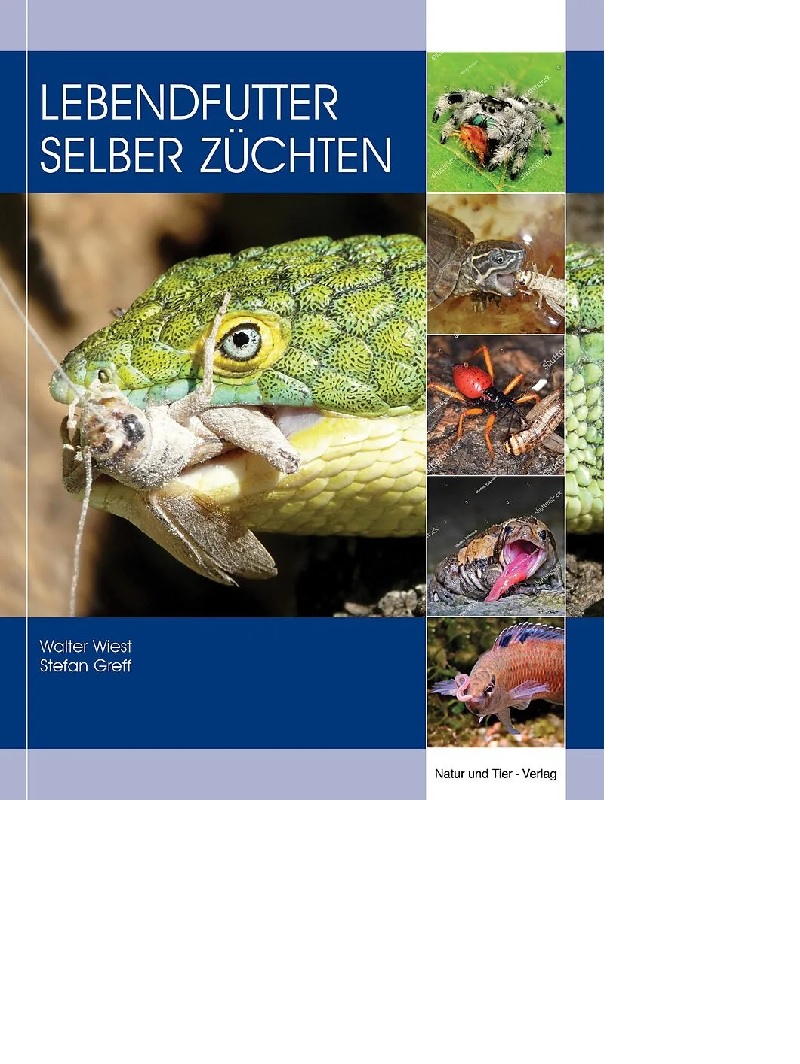
Book Breeding live food yourself
Book "Grow your own live food" - The perfect guide for pet owners Discover practical and detailed instructions on how you can easily breed food for your reptiles, birds, fish or other animals yourself in the book "Breeding live food yourself". With valuable tips on various food insects, their care and breeding, you can save money and ensure a species-appropriate diet for your pets. Contents of the book: Step-by-step instructions for breeding feeder insects Information on the best types of food for reptiles, birds and fish Care instructions and breeding conditions for various live food species Tips for sustainable and cost-effective food production Why breed your own live food? Get healthy, fresh food for your animals Save money and reduce dependence on pet shops Promote the health and well-being of your animals with species-appropriate food Whether you are a beginner or an experienced pet owner, this book provides you with everything you need to successfully breed live food yourself.

CHF 46.50

Marginata 69 - New Guinea tortoises
Marginata 69 - New Guinea tortoises – the genus ElseyaCover storyThe unrecognised beauties: New Guinea tortoises (Andreas S. Hennig)My experiences with Branderhorst's New Guinea tortoise, Elseya (Elseya) branderhorsti (Ouwens, 1914) (Andreas S. Hennig)Keeping and breeding of Rhodin's New Guinea tortoise, Elseya (Hanwarachelys) rhodini Thomson, Amepou, Anamiato & Georges, 2015 (Andreas S. Hennig)PortraitGeoemyda spengleri, Chinese serrated tortoise (Andreas S. Hennig)ReportageMacrochelys temminckii – Experiences and impressions with vulture tortoises part 2 (Reiner Praschag)KeepingAn alternative to year-round keeping of the Egyptian tortoise in the terrarium – my experiences with seasonal outdoor keeping of Testudo kleinmanni (Ricarda Schramm)EtymologySawbacks and living maps part 4: Graptemys gibbonsi, Pascagoula humpback tortoise (Holger Vetter)Classifieds & animal placement

CHF 16.50

Reptilia 85 - Snake-necked tortoises
Reptilia 85 - Snake-necked tortoisesCrocodile-tailed crested lizardBreeding of the king pythonPristidactylus valeriaeContents:The snake-necked turtles include such popular species for the aquaterrarium as the Australian representatives of the genus Chelodina or the pointed-headed turtles of the genus Emydura, but also the bizarre Mata-Mata from the waters of Amazonia or the funny toad-headed turtles of the genus Phrynops. In our cover story, we introduce you to this exciting family of turtles with lots of brilliant photos and portray some particularly interesting species in detail.Table of contentsEDITORIALMAGAZINEEcotourism de luxe: End of the chameleon conservation project in the Peloponnese?H. WerningSancho, the illegal immigrant - what to do when exotic animals are found?S. SchletchSkin-eating blind worms bred for the first timeA. Kupfer & S. ReinhardWESTERN HERP PERSPECTIVESConfusing species protectionBill LovePHOTOSTORY Snake-necked tortoises J. ValverdeKEEPING AND REPRODUCTIONThe Argentine snake-necked tortoise(Hydromedusa tectifera) - observations in biotope and terrarium D. FabiusKEEPING AND REPRODUCTION Keeping and breeding of the broad-breasted snapping turtle, Myuchelys latisternum(Elseya latisternum) H. ProkopTRAVEL Cave dwellers in the PhilippinesM. GaulkePORTRAIT AND POSTER Telescopus fallax (Fleischmann 1831). European cat snakeK. Ehrlich & B. TrappHERPETOFAUNA A conservation project for the Valeria large-headed iguana, Pristidactylus valeriae - with the support of REPTILIA B. CamousseigtKEEPING AND REPRODUCTION Versatile favourites. Experiences with Royal PythonsM. BorerKEEPING AND REPRODUCTION News on sex determination of the crocodile-tailed humpback lizard, Shinisaurus crocodilurus M. ZollwegHERPETOFAUNA Basking sites on mangrove biotopes of Phelsuma robertmertensi Meier, 1980 on the Comorian island of Mayotte P. KrauseANIMALS OF OUR HOMEA snake that is not a snake: the slow wormR. LeptienLIBRARYSUBSCRIPTION & SERVICEALSO NEAR YOUPREVIEWBRUTKASTENBag magicM. ZawadzkiDATESHeiko WerningWESTERN HERP PERSPECTIVESConfusing species protectionB. Love

CHF 12.00

Reptilia 04 - Bird spiders
Reptilia 04 - Tarantulas SkinkThailandMysticism & superstition Contents: Page 2 - EditorialPage 3 - Letters to the editorPage 6 - MagazinePage 17 - Photo reportage: Tarantulas, by P. KlaasPage 23 - Keeping and reproduction: Keeping and breeding tarantulas, by P. KlaasPage 26 - Terraristics and law: Legal issues in keeping spiders and scorpions, by D. RösselPage 27 - Report: A feast of tarantulas, by R. WestPage 30 - Psychology: Arachnophobia, by L. HogebackPage 33 - Travelogue: Thailand - Mecca of herpetological tourism, by J. BergadáPage 37 - Travelogue: The snake farm of Bangkok, by J. ViaderPage 39 - Portrait and poster: Chondropython viridis, by M. Aresté and J. L. FarriolsPage 43 - Herpetofauna: Skinks, by P. Gassner and A. HauschildPage 50 - Reptilia on the road: Terrarium displays, by H. WerningPage 54 - Terraristics and law: Snake keeping in residential property and tenancy law, by D. RösselPage 57 - Herpetology and Culture: Magic and Superstition, Part 1: Turtles and Amphibians, by L. B. Carissimi-PriorPage 62 - Terraristics: Egg-laying problems with tortoises, by E. MeierPage 69 - Supplement: Venomous snakesPage 74 - Advice and actionPage 76 - LibraryPage 80 - Incubator: Glossary by H. Werning

CHF 9.80

Terraria 39 - Animal welfare and terraristics
Terraria 39 - Animal welfare and terraristics Emerald skinkPyrenean frogs and bearded vultures Contents: Cover story:Animal welfare and terraristicsWhat should actually belong together as a matter of course is sometimes irreconcilably opposed. Most terrarium enthusiasts see themselves as animal rights activists, while many animal rights activists completely reject terraristics. And within the terrarium hobby, there are always new insights and the need to improve animal welfare for the pets.In the cover story of the next TERRARIA/elaphe, we take a look at the most important aspects of animal welfare in the terrarium hobby, investigate what drives our worst opponents, the animal rights activists, and devote ourselves to the important topic of stress-related illnesses in terrarium animals. TerritorialHerpetorama Cover story"It takes more than a good heart to protect animals"Interview with Markus Baur You don't need a human brain to be depressedRobert Köhler In the realm of the wild animal rights activistsAn essay by Heiko Werning Panorama TerraglobalHow important are ponds for frogs?Mirco Solé About the problems of writing an articleJoachim Bulian The Barbados Wildlife Reserve – a worthwhile destinationJens Jungnickel ResearchNew speciesNew snail snake sets an example against overexploitationSebastian Lotzkat New tree frogs with a bend in the toe – twoScinax species from southern BrazilAxel Kwet Among researchersThe reintroduction of the Siamese crocodile (Crocodylus siamensis) in Vietnam – a pioneering project?Kristian Robert Pahl Apothecary skinks and bionicsUwe Schlüter Salamandra Terraristics ClassicsThe King Python The Philippine Emerald Skink (Lamprolepis smaragdina philippinica) – Taxonomy, Biology, Care and BreedingMaren Gaulke Nature and species conservation Field notesUnusual year for midwife toads in Leinebergland (Lower Saxony)Stefan Meyer Double-headed smooth snakeMario Schweiger Forensic herpetology – A pond thrillerGuntram Deichsel Between bearded vulture and Pyrenean frogChristoph F. Robiller MissingPointed-snouted stream frog (Taudactylus acutirostris) Subscription & Service Also in your neighbourhood Gallery 2013 – The year of the snake Preview IncubatorBreaking Bad Wedding. Part 2Heiko Werning

CHF 12.00

Terraria 50 - Monitor lizards in the terrarium
Terraria 50 - Monitor lizards in a terrariumDrinking behaviour of snakesAndaman lizardsContents:Cover story: Monitor lizards and terrariumsMany monitor lizards are among the most sought-after species in the terrarium hobby. Hobby keepers have made a decisive contribution to our knowledge of these charismatic lizards, discovering species and describing their behaviour. Some island monitor lizards are considered endangered and their trade represents a risk factor. At the same time, breeding successes are now also regularly achieved with rare species. In the cover story of the upcoming TERRARIA/elaphe, we will be focussing on the many facets of the mutual relationship between monitor lizards and terraristics.TerritorialHerpetoramaCover storyHistory of keeping monitor lizards in Germany and SchweizerBeat AkeretThe blue monitor lizard. The incredible story of the discovery of Varanus macraeiManfred Reisinger7 years of keeping and breeding the Blue-spotted Tree Monitor (Varanus macraei) at Cologne Zoo: A look back and a look aheadAnna Rauhaus, Lorraine Gutjahr, Johannes Oberreuter & Thomas ZieglerFirst evidence of parthenogenesis in Varanus rainerguentheri, a Pacific monitor lizard from the indicus groupJulian GrabbePanoramaThe Andaman Islands - A little known animal paradiseGernot VogelResearchNew speciesConfusion about new vulture turtlesAxel KwetNew wolf tooth snake from CambodiaAxel KwetAmong researchersA road in the primary rainforest - a small cause with a big effectRudolf MalkmusHerat: We meet again. As a lecturer in a war zonePhilipp WagnersSalamandraTerraristicsLook smart, snake keeper Observations on the drinking behaviour of snakesRalf HöroldAlso in your neighbourhoodNature and species conservationField notesCrow catches grass snakeRalf GramlichGrass frog cannibals in the spawning watersAxel KwetSubscription & ServiceThe introduced wall lizards of KamenzDieter GramentzPreviewIncubator ElvisHeiko Werning

CHF 12.00

Reptilia 63 - Small monitor lizards
Reptilia 63 - Small monitor lizards ThailandLizards in the greenhouseRespiratory diseases in tortoises Contents: 2 EDITORIAL 3 MAGAZINE 11 DATES 14 WESTERN HERP PERSPECTIVESThe luxury point of viewBy B. Love 16 PHOTO REPORTAGESmall monitor lizards in the terrariumBy B. Eidenmüller 24 KEEPING AND BREEDINGKeeping and breeding of the spiny-tailedmonitor lizard (Varanus acanthurus)By S. Arth 34 KEEPING AND BREEDINGVaranus boehmei, keeping and first-timebreeding in the terrariumBy M. Reisinger & D. Reisinger-Raweyai 39 KEEPING AND BREEDINGKeeping, care and breeding ofVaranus macraeiBy A. Dedlmar 42 TRAVELThailand - fascination herpetofaunaBy F. Longhitano 51 PORTRAIT AND POSTERLiophis jaegeriBy A. Kwet 56 REPORTAGEFrog societies in South AmericaBy D. Rödder, G. Zeidan, W. Pertel & R. L. Teixeira 64 PRACTICEKeeping lizards in the greenhouseBy D. Prötzel 71 KEEPING AND BREEDING Truly a jewel in the terrarium: Ampulex compressaBy T. Ramann 75 HERPETIC MEDICINERespiratory diseases in tortoises:recognise, treat, preventBy U. Eggenschwiler 80 TERRARIUM EXHIBITIONSThe reptile and amphibian exhibition of the Dusit Zoo in BangkokBy J. Bulian 87 FAQ - FREQUENTLY ASKED QUESTIONSAcquisition of royal pythons (Python regius)By T. Kölpin 91 HERPETOCULTUREThe lion for Bavaria, the bear for Berlin, the chameleon for...?By J. Wolf 94 LIBRARY 104 INCUBATOR specialAt night in the museumBy H. Werning & L. Hogeback

CHF 11.20

Reptilia 06 - Mimicry - The perfect deception
Reptilia 06 - Mimicry - The perfect illusion MaltaBuilding polystyrene terrariumsNutrition of tortoises Contents: Page 2 - EditorialPage 3 - Letters to the editorPage 5 - MagazinePage 11 - DatesPage 14 - Western Herp Perspectives: The Queen of Snakes, by B. LovePage 16 - Photo reportage: Mimicry, by L. AissefairePage 24 - Report: Mimicry - Saving energy through camouflage, by Dr M. GaulkePage 32 - Keeping and breeding: Like a leaf in the wind. The walking leaf Phyllum celebicum in the terrarium, by H. FischerPage 38 - Travelogue: Temples, disc-tongued frogs and reptiles – impressions of a trip to Malta, by U. SchlüterPage 43 - Photographic profile: Reptiles and amphibians in the Du Tsingy de Bamaraha nature reserve (West Madagascar), by G. Hallmann, E. Hoffmann, J. Krüger, P. Schlagböhmer and G. TrautmannPage 47 - Portrait and poster: Gastrotheca riobambae, by H. WerningPage 51 - Report: Nutrition of European tortoises, Part 2, by Dr C. DennertPage 59 - Keeping and breeding: A mini-crocodile for the paludarium – The keeled skink Tropidophorus grayi, by U. DostPage 64 - Terrarium practice: Styrofoam terrariums, by D. HasselbergPage 69 - Herpetofauna: The Bismarck Dwarf Python Liasis boa – keeping and breeding a colourful giant snake, by V. FranzPage 72 - Herpetology and culture: Snakes go to school – Part 2, by M. HallmenPage 81 - Reptilia on the road: Zoo Berlin-Friedrichsfelde, by H. WerningPage 84 - Advice and HelpPage 90 - LibraryPage 96 - Satire: Something different, by A. Scheffler

CHF 9.80

The plumed basilisk
Alles über den Stirnlappenbasilisk von Ingo Kober 64 Seiten 14,8 x 21 cm zahlreiche Farbfotos 2. Auflage Autor Ingo Kober Verlag NTV Inhalt: Eindrucksvolle grosse Echsen sind sie, die Stirnlappenbasilisken. Den Betrachter erinnern sie unwillkürlich an drachenartige Fabelwesen. Dabei handelt es sich bei diesen attraktiven Echsen um völlig harmlose und äusserst interessante Tiere, die sich zur Pflege im Terrarium vorzüglich eignen. Ingo Kober beschäftigt sich seit vielen Jahren mit Stirnlappenbasilisken. In diesem Buch geht er auf alle Aspekte rund um die Haltung und artgerechte Pflege dieser spannenden Echsen ein und zeigt Ihnen, wie Sie Ihre Tiere zur Vermehrung bringen, die Eier ausbrüten und die Kleinen aufziehen können. Systematik und Körperbau Die faszinierende Biologie: Aus dem Leben der Stirnlappenbasilisken Alle Informationen zur artgerechten Haltung: Vom geeigneten Terrarium über Einrichtung und Technik bis hin zur Fütterung Erfolgreich nachzüchten: Paarungsstimulation, Inkubation der Eier und Aufzucht der Jungtiere Problemlösungen: Wie man die häufigsten Fehler bei der Pflege vermeidet, und wie man kranken Tieren helfen kann Brillante Fotos

CHF 21.90