
Small spitz
FCI standard number: 97
Country of origin: Germany
Classification: FCI Group 5, Section 4, European Spitz, without working test
Height at withers bitch: 27 cm ± 3 cm
Height at withers male: 27 cm ± 3 cm
Weight female: approx. according to size, usually around 4–6 kg
Weight male: approx. according to size, usually around 4–6 kg
Coat colour: black, brown, white, orange, grey or other colours
Coat texture: Double coat with long, straight, protruding top coat and short, dense, fluffy undercoat
Neck circumference: approx. 24–32 cm - please always measure directly on the dog
The small spitz
History of the Scottish Terrier
The Kleinspitz belongs to the German Spitz breed and is one of the oldest dog breeds in Central Europe. The Spitz is considered to be a descendant of the Stone Age turf dog and later pile dwelling Spitz. For many generations, they were kept as watchful farmyard and companion dogs. The Kleinspitz developed as a smaller variety of the German Spitz.
Appearance
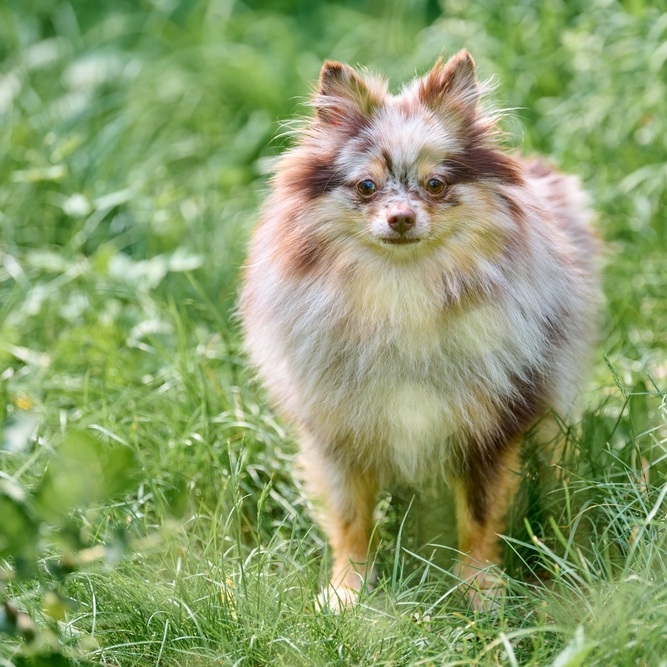
Body shape: The Miniature Spitz is small, compact and almost square in build. Typical features include the fox-like head, the small, erect ears, the dark, alert eyes and the bushy tail curled over the back. Despite its small size, it appears alert, proud and lively.
Coat: The coat is very lush and striking. The neck and shoulders are framed by a thick mane, the legs are well feathered and the tail is bushy. The coat is neither wavy nor curly, but stands out in a typical spitz-like manner due to the dense undercoat.
Nature/character
The Kleinspitz is considered to be lively, attentive, affectionate and very alert. It is usually closely attached to its humans and reliably reports what is happening around it. It is often rather reserved towards strangers without being fundamentally fearful. His eagerness to learn, his presence and his often astonishingly self-confident demeanour for such a small dog are typical.
Grooming
The coat needs regular grooming to prevent matting and to remove loose hair. Thorough brushing several times a week is advisable, often even more frequently when the coat is changing. Ears, claws, teeth and eyes should also be checked. Despite their luxuriant coat, grooming is usually manageable if it becomes a routine right from the start.
Health
The Kleinspitz is generally regarded as a robust and long-lived variety. Nevertheless, as with any breed, care should be taken to ensure responsible breeding. Depending on the line, patellar luxation, dental problems, eye problems or other hereditary diseases can play a role. Regular veterinary checks, good weight management and a reputable breeding base are important.
Education
The Kleinspitz is generally easy to train if it is handled in a friendly, clear and consistent manner. Because of its alertness, particular attention should be paid to directing barking behaviour at an early stage. He is smart and attentive, but can also be stubborn if he is not taken seriously because of his size. With early socialisation and loving leadership, he usually develops into a pleasant companion.
What are the special features of this breed?
What is special about this breed is the combination of small size and large demeanour. The Kleinspitz is not a quiet lap dog, but an attentive, self-confident and often very alert companion. Other typical characteristics are the lush coat, the tail carried over the back and the close bond with its humans. He has a lot of personality and wants to be taken seriously in everyday life.
Suitable for first-time dog owners?
Yes, the Kleinspitz is often well suited to first-time dog owners. They are usually eager to learn, adaptable and closely attached to their humans. However, it is important that his alertness and barking behaviour are well managed from the outset and that he is not belittled simply because of his small size. This assessment is a professional categorisation based on the breed characteristics described.
Family dog or not?
Yes, the Kleinspitz can be a good family dog. They are affectionate, lively and like to be close to their humans. It fits particularly well into families or households that enjoy a watchful, small and present dog. He usually feels very comfortable with respectful behaviour and clear rules.
Login
Suggested products