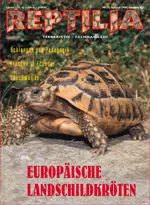
Reptilia 17 - European tortoises

Article no: reptilia17

CHF 9.80

Stock: 0

Ready for dispatch in 1-3 days, delivery time 7 working days

Delivery between Thursday, 3 December and Friday, 4 December
Zahlungsarten
Product information "Reptilia 17 - European tortoises"

Reptilia 17 - European tortoises

Snakes and education
Frogs in Ecuador
Chuckwallas

Contents:

Page 2 - Editorial
Page 3 - Letters to the editor
Page 5 - Magazine
Page 12 - Travelogue: Herpetological observations on the Peloponnese - Addendum, by L. Siegmund and B. Trapp
Page 14 - Dates
Page 16 - Western Herp Perspectives: Road Cruising, by B. Love
Page 18 - Photo report: European tortoises, by J. Soler Massana and M. Silvestre
Page 24 - Keeping and breeding: European tortoises in an outdoor terrarium, by H. and T. Holfert
Page 32 - Report: Feeding European tortoises - Part 1, by Dr C. Dennert
Page 40 - Travelogue: Mayotte - A herpetological treasure trove, by P. Krause, U.-J. Bartling and P. Baldamus
Page 47 - Portrait and poster: Pogona vitticeps, by H. D. Müller
Page 51 - Keeping and breeding: Chuckwallas, by H. Wölfel
Page 60 - Keeping and breeding: On keeping the tree snuffle Ahaetulla nasuta, by O. Witte
Page 64 - Keeping and breeding: Poecilothera, by R. Baldwin
Page 69 - Report: A small cross-section of the frog fauna of Ecuador, by S. Lötters and A. Widmer
Page 73 - Herpetology and culture: Snakes go to school - Part 1, by M. Hallmen
Page 82 - Reptilia on the road: Rainforest house in the Botanical Garden of the University of Osnabrück, by M. Schmidt
Page 85 - Advice and action
Page 91 - Library
Page 96 - Glossary: Iguana à la carte - Part 2, by H. Werning

Composition
Feeding recommendation
Technical details
Size information

0 out of 0 reviews

Give us a rating!

Share your experience with the product with other customers.


Suggested products

Handbook of food plants for tortoises and other reptiles
Handbook of forage plants 2nd revised editionMarion Minch is not only a successful breeder of diverse tortoises for many years, but also an excellent connoisseur of native wild herbs. She founded and runs samenkiste.de, which is well known to many tortoise keepers and nature lovers. Her name is inextricably linked with reptile care and species-appropriate nutrition for tortoises. Her handbook of food plants summarises the most important native food plants for herbivorous and omnivorous reptiles. She not only considers tortoises, but also iguanas, spiny-tailed dragons and even chameleons. From the basics of plant biology to native wild herbs to suitable food plants for hardy tropical reptile species, this comprehensive work provides the basis for species-appropriate keeping. In the expanded and supplemented 2nd edition, the plant section is divided according to flower colour. This makes it even easier to identify wild herbs. The work has also been supplemented with a wealth of additional information and many pictures.

CHF 46.50

Geckos
Geckos in the terrarium by Astrid FalkThe book offers a comprehensive introduction to geckos and their species-appropriate keeping in terrariums. It explains what you need to think about before buying a gecko and what preparations should be made. The book describes in detail how the terrarium is technically equipped and set up. The care of the animals, their special features and behaviour, their diet, reproduction and rearing of young animals are described, as well as diseases and husbandry problems with tried and tested suggestions for prevention and treatment. Individual gecko species that are particularly suitable for keeping and breeding in terrariums are portrayed in detail in the second part of the book.

CHF 28.50

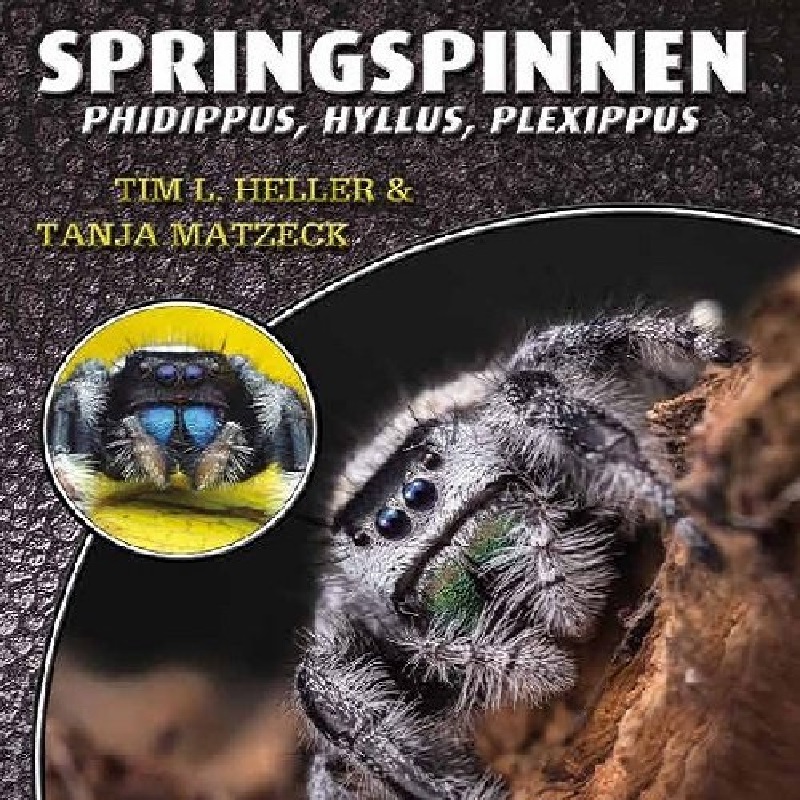
Jumping spiders Phidippus, Hyllus, Plexippus
Book Jumping Spiders - Phidippus, Hyllus & Plexippus A guide to keeping jumping spiders of the genera Phidippus, Hyllus & Plexippus. Who can resist the charm of jumping spiders? The childlike appearance of their expressive face simply leaves no one cold! In addition, their behavior is extremely exciting to observe, their colors are bright and their requirements for species-appropriate keeping are very easy to meet. No wonder these likeable jumpers are all the rage! This volume in the "Species by Species" series describes in detail what to look out for when buying and keeping them, introduces the most commonly kept species and color forms and provides plenty of tips on how to keep them successfully - so you can be sure they will breed well! Species by Species introduces you to the books in this series, which present the most popular terrarium animals. Each volume offers you detailed, practical care instructions and all the information you need to successfully breed your animals. All important questions from the required tank size to terrarium set-up, technical equipment, species-appropriate nutrition and disease prevention are answered with numerous tricks and tips. Experienced, long-standing breeders reveal how you can encourage the animals to reproduce and raise healthy young. All this in full color, generously illustrated and attractively designed - just about your terrarium animal - species by species

CHF 23.90

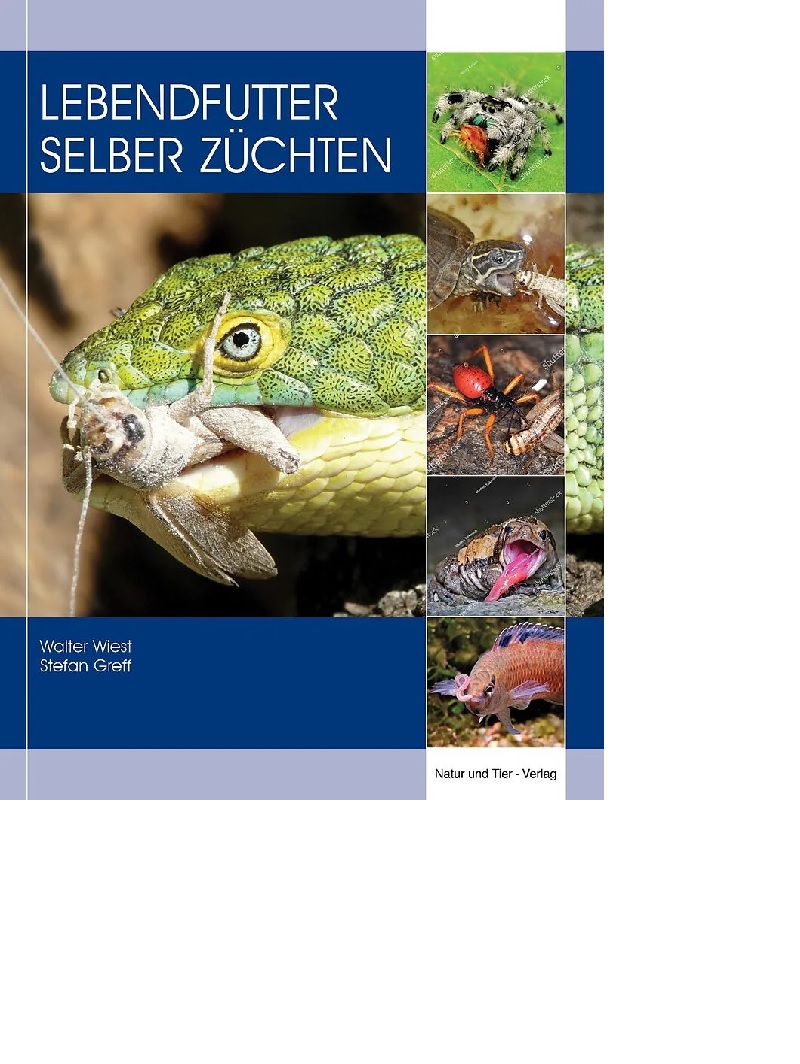
Book Breeding live food yourself
Book "Grow your own live food" - The perfect guide for pet owners Discover practical and detailed instructions on how you can easily breed food for your reptiles, birds, fish or other animals yourself in the book "Breeding live food yourself". With valuable tips on various food insects, their care and breeding, you can save money and ensure a species-appropriate diet for your pets. Contents of the book: Step-by-step instructions for breeding feeder insects Information on the best types of food for reptiles, birds and fish Care instructions and breeding conditions for various live food species Tips for sustainable and cost-effective food production Why breed your own live food? Get healthy, fresh food for your animals Save money and reduce dependence on pet shops Promote the health and well-being of your animals with species-appropriate food Whether you are a beginner or an experienced pet owner, this book provides you with everything you need to successfully breed live food yourself.

CHF 46.50

Marginata 69 - New Guinea tortoises
Marginata 69 - New Guinea tortoises – the genus ElseyaCover storyThe unrecognised beauties: New Guinea tortoises (Andreas S. Hennig)My experiences with Branderhorst's New Guinea tortoise, Elseya (Elseya) branderhorsti (Ouwens, 1914) (Andreas S. Hennig)Keeping and breeding of Rhodin's New Guinea tortoise, Elseya (Hanwarachelys) rhodini Thomson, Amepou, Anamiato & Georges, 2015 (Andreas S. Hennig)PortraitGeoemyda spengleri, Chinese serrated tortoise (Andreas S. Hennig)ReportageMacrochelys temminckii – Experiences and impressions with vulture tortoises part 2 (Reiner Praschag)KeepingAn alternative to year-round keeping of the Egyptian tortoise in the terrarium – my experiences with seasonal outdoor keeping of Testudo kleinmanni (Ricarda Schramm)EtymologySawbacks and living maps part 4: Graptemys gibbonsi, Pascagoula humpback tortoise (Holger Vetter)Classifieds & animal placement

CHF 16.50

Marginata 7 - Magnificent tortoises
Marginata 7 - Magnificent Tortoises Food plants 2Herpesvirus in tortoisesTurkish tortoises Contents: 2 EDITORIAL 3 READER LETTERS 4 MAGAZINE 8 DATES 10 PHOTO REPORTAGE Magnificent Tortoises (Rhinoclemmys pulcherrima GRAY, 1856) Hans - Dieter Philippen 16 BREEDING IN HUMAN CARE Keeping, care and breeding of the Magnificent Tortoise Rhinoclemmys pulcherrima incisa (Bocourt, 1868) Andreas Mende & Thomas Berndt 21 BREEDING IN HUMAN CARE The Costa Rican Magnificent Tortoise (Rhinoclemmys pulcherrima manni) Fons Bänziger 26 FIELD RESEARCH The tropical dry forest in north-western Costa Rica Jan Michels 31 PORTRAIT Egyptian tortoise Testudo [Pseudotestudo] kleinmanni (Lortet, 1883) Hans - Dieter Philippen 35 VETERINARY MEDICINE An update on herpesvirus in tortoises Thomas Filip & Anna Kübber-Heiss 45 REPORTAGE Food plants for tortoises Part 2 Susanne Vogel 51 SHORT REPORT A foray through the area of Dalyan and Kaunos, Turkey Franz Hummel 54 SHORT REPORT Oh you big egg ... Heinz Frühauf 55 REPORTAGE ShellShock conservation campaign Hans - Dieter Philippen 59 RAT & TAT 60 BOOK TIP 61 CLASSIFIEDS 62 REGIONAL GUIDE 64 AGATHA MARGINATA

CHF 14.70

Reptilia 115 - Adders for the terrarium
Reptilia 115 - Adders for the Terrarium Flamingo flowersBlue rock iguanaNew Zealand mantis Contents:Cover story: Adders for the TerrariumAdders are among the classic and most popular terrarium animals. This extremely species-rich group of snakes has produced some of the most popular reptile pets. We provide an overview of the terrarium-relevant species and focus in particular on those adders suitable for beginners, among which there are many truly perfect pets. But we also have a real beauty for advanced keepers and report on the keeping and breeding of red bamboo adders. EditorialMAGAZINEDATES WESTERN HERP PERSPECTIVESThe dark sideB. Love FotostoryEvergreens in the terrarium: AddersK. Kunz PracticeAdders. Species and tips for beginnersD. Schmidt Husbandry and breedingThai bamboo adders (Oreocryptophis porphyraceus coxi) in the terrariumM. Hornig Husbandry and breedingThe New Zealand mantis, Orthodera novaezealandiae. A praying mantis from the other side of the worldB. Fuhrmann & C. Sehorz Husbandry and breedingThe keeping and breeding of the Blue rock iguana (Petrosaurus thalassinus) in the terrariumJ. Schulz PlantsArum family in the terrarium. Part 3: The genus AnthuriumB. Akeret Husbandry and breedingFirst ever natural rearing of the critically endangered Philippine crocodiles (Crocodylus mindorensis) in Europe successfulT. Ziegler, A. Rauhaus & C. Niggemann, AG Zoological Garden Cologne Animals of our homelandThe fire salamanderR. Leptien ALSO IN YOUR AREA Service TravelOn an excursion through the Colombian Amazon rainforestJ. Cañas-Orozco PREVIEW INCUBATOR Attention – more cat contentH. Werning

CHF 12.00

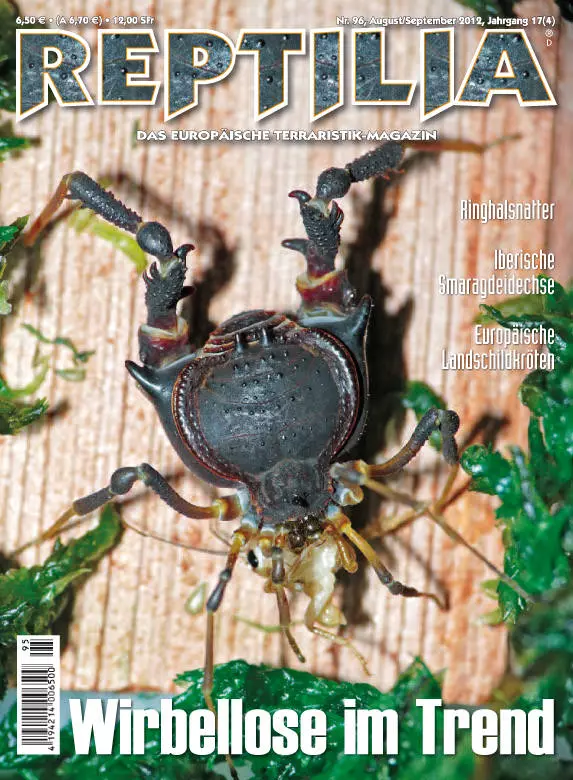
Reptilia 96 - Invertebrates in trend
Reptilia 96 - Invertebrates in Trend Ring-necked snakeIberian emerald lizardTortoises of Mallorca Contents: A wide variety of different invertebrates can be kept in a species-appropriate, space- and energy-saving manner in a small space. However, it would be far too short-sighted to attribute the growing enthusiasm for the mostly many-legged co-inhabitants solely to such practical aspects: More and more terrarium keepers are simply being carried away by the often bizarre beauty of the animals, by extremely exciting behaviours and lifestyles that could not be more different from our world. In our photo story, we offer you an up-to-date overview of the keeping of a wide variety of species. With chameleon crabs, Madagascan giant crickets and praying mantises, our authors also present some “trendy” invertebrates in detail. EDITORIALMAGAZINEDATESAround the world in 5 yearsBuzzers in the webA. PachmannWESTERN HERP PERSPECTIVESSecret PlacesB. LovePHOTOSTORY Invertebrates. The new rulers in the terrarium hobbyK. KunzKEEPING AND BREEDINGBeetles in the terrarium. Evolutionary wonders of natureI. Fritzsche & F. RossowKEEPING AND BREEDINGExperiences with the Red Chameleon Crab (Metasesarma aubryi) U. DostKEEPING AND BREEDINGPredatory bugs of the genus Platymeris in the terrariumI. FritzscheREPORTAGE/KEEPING AND BREEDINGJourney into the microcosm. In search of mantids in MalaysiaJ. KühneKEEPING AND BREEDINGKeeping and breeding of Parymenopus davisoni T. RönischHERPETOFAUNADiscovery of a new colour variant of the Iberian emerald lizard (Lacerta schreiberi) C. JeschullHERPETOFAUNAThe tortoises of Son Real on Mallorca M. RognerKEEPING AND BREEDINGRing-necked snakes (Diadophis punctatus) in the terrariumU. SchlüterSHOW FACILITIESThe Bonn Museum Alexander KoenigS. EsserANIMALS OF OUR HOMEThe alpine newtR. LeptienSUBSCRIPTION & SERVICELibraryTips & TricksTest runALSO IN YOUR AREATRAVELChameleon holiday – a Madagascar trip K. PawlikPREVIEWINCUBATORDangerous encountersM. Zawadzki

CHF 12.00

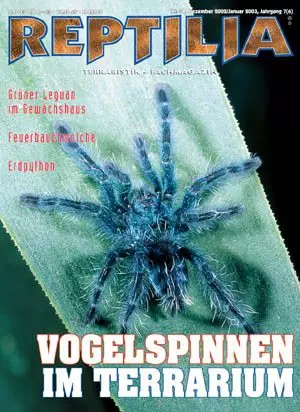
Reptilia 38 - Tarantulas in terrariums
Reptilia 38 - Tarantulas in the terrariumGreen iguana in a greenhouseFire-bellied newtsEarth pythonContents: 2 EDITORIAL 3 READER LETTERS 7 MAGAZINE 15 DATES 16 WESTERN HERP PERSPECTIVES The hymn of natural terrariumsfrom B. Love 18 PHOTO REPORTAGE Large, hairy spiders - An introduction to the Theraphosidae familyby F. Tomasinelli 26 KEEPING AND BREEDINGBreeding of tarantulas with special consideration of their way of life in the wildby B. F. Striffler 32 KEEPING AND BREEDINGThe ‘Malaysian Earth Tiger’ – Keeping and Breeding the Asian Tarantula Cyriopagopus thorelliby F. de Vita & F. Tomasinelli 36 KEEPING AND BREEDINGPoecilotheria subfusca POCOCK, 1895: Group housing and breedingby B. F. Striffler 42 TRAVELAdventure Oman Mountainsby R. Leptien 51 PORTRAIT AND POSTERAzemiops feaeby A. Gumprecht 56 REPORTAGEA life like in paradise - experiences with keeping a green iguana in a tropical hallby C. Ströhlein, idea-Schmetterlings-Paradies Neuenmarkt 61 HERPTOFAUNAThe fire-bellied newts of the genus CynopsPart 1: Keeping and speciesby P. Bachhausen 68 KEEPING AND BREEDINGObservations on the ecology and terrarium husbandry of the Eastern lizard snake, Malpolon monspessulanus insignitus Geoffroy, 1827by H. Esterbauer 74 HERPTOFAUNAThe Burrowing Python (Calabaria reinhardtii)by S. Seidel 78 REPORTAGEThe school vivariumPart 3: Behavioural practical course for a biology classby M. Hallmen 85 RAT & TAT 87 CLASSIFIED ADS 92 LIBRARY 104 GLOSSESFeed animal breeding magazineby N. Nadolny This issue of your specialist terrarium magazine REPTILIA is dedicated to tarantulas. Alongside a photo feature richly illustrated with impressive photographs, which provides an overview of the family of these popular animals, there are expert and detailed reports on keeping and breeding them. The focus is on the magnificent Poecilotheria species, which – unusually for tarantulas – can almost without exception be kept in groups, as well as the “Malaysian Earth Tiger” Cyriopagopus thorelli. The article by B. Striffler on the breeding of tarantulas, with particular attention to their natural behaviour, also deserves special mention. Here you will discover interesting facts that you will search for in vain in standard books on tarantulas, and which will enable you to draw valuable conclusions regarding husbandry and breeding conditions.Spectacular finds and a life-threatening attack - the result of the exciting travelogue Adventure Oman, which you should not miss. After the brilliant photos of the extremely rarely shown venomous snake Azemiops feae comes a report on an unusual way of keeping the green iguana that could not be more exemplary.Extremely colourful animals that can reach a great age when kept properly are the fire-bellied newts of the genus Cynops, which newt expert P. Bachhausen presents to you in detail through text and images.Observing animals in the wild not only provides fascinating insights into their way of life, but also makes it easy to draw conclusions about the successful care and breeding of these species. The proof of this simple yet effective strategy: the article by H. Esterbauer on the ecology and terrarium husbandry of the Eastern lizard snake, Malpolon monspessulanus insignitus.In this issue of REPTILIA, we are also able to present one of the first reports on the breeding of the unusual ground python Calabaria reinhardtii. S. Seidel, who achieved this success, describes in detail here, amongst other things, the husbandry conditions that stimulated his animals to mate.In the last part of his article on the school vivarium, M Hallmen finally reports on the concrete possibilities that arise from keeping animals in the classroom.As always, REPTILIA once again offers you the full range of comprehensive services: events, classifieds, the magazine featuring interesting facts about Hobby, advice and practical tips, and the library are all included, as is the column, this time offering a satirical take on RODENTIA, the specialist magazine on small mammals published by Natur und Tier Verlag.

CHF 11.20

Terraria 01 - Terrarium lighting
Terraria 01 - Terrarium lighting PantanalBlack toad Contents: 2 Editorial Heiko Werning 3 The TERRARIA team Editorial and advisory board TITLE TOPIC 6 • Basic knowledge of terrarium lighting – a key to successful keeping Ingo Kober & Uwe Geissel 17 • Which type suits me? The different lamps used in terrariums Ingo Kober & Uwe Geissel 22 • Lighting of terrariums – 10 case studies from practice Ingo Kober & Uwe Geissel SCIENCE 26 Herpetorama Snake evolution/Fast aga toads/Shrill frogs 28 New species New lizards from New Caledonia / Two new Telmatobius species from Bolivia/Two new Liolaemus species from Argentina 31 Among researchers Biodiversity research in the Amazon Andreas Schlüter 36 A rarity in the terrarium: Mitchell’s bearded dragon – Pogona mitchelli (Badham, 1976) Thomas Hörenberg 44 Melanophryniscus – not just black toads Part 1: General information on the genus Melanophryniscus Axel Kwet 54 The Tunisian tortoise, Testudo nabeulensis (Highfield, 1990) Manfred Rogner 59 Diversity instead of boredom – Care and breeding of the striped house snake (Lamprophis lineatus) Kriton Kunz 65 Biology, husbandry and breeding of the Arizona bark scorpion, Centruroides vittatus (Say, 1821) Alexander Tietz 72 TRAVEL In the land of the Jacarés – the Pantanal Heiko Werning TERRARIUM PRACTICE 84 Test run terraform hide trays 85 Prelude Quarantine and sampling for parasitological examination of terrarium animals Sascha Hanig & Michael Kluge A good start: the large Madagascar day gecko Phelsuma madagascariensis grandis Ingo Kober 90 Eye-catcher A facility for breeding pine-cone lizards Axel Kwet 94 Also in your vicinity 96 TERRAnet AmphibiaWeb/Homepage Axel Kwet 98 TERRAglobal Environmental education in Guatemalan Lester S. Meléndez García The coffin as an incubator Joachim Bulian 103 Preview 104 TERRAwinn

CHF 11.20

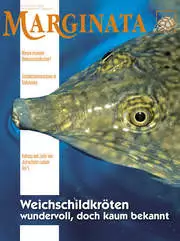
Marginata No. 33 - Softshell Turtles - Wonderful, but hardly known
Marginata No. 33 - Softshell Turtles - Wonderful, but hardly known Warum stranden Meeresschildkröte?Schildkrötenforschung in AndalusienHaltung und Zucht von Astrochelys radiata Teil 5 Inhalt: Editorial Magazin Termine HALTUNG UND ZUCHT Erfolgreiche Haltung und Aufzucht junger Weichschildkröten Hans-Dieter Philippen REPORTAGE Thermoregulation bei Weichschildkröten Dieter Gramentz REPORTAGE Bemerkungen zum Wanderverhalten von Weichschildkröten Dieter Gramentz Porträt Kuba-Schmuckschildkröte (Trachemys decussata) Hans-Dieter Philippen HALTUNG UND NACHZUCHTHaltung und Nachzucht der Madagassischen Strahlenschildkröte Teil 5 Michael Wirth und Peter Fritz REPORTAGEStrandende Meeresschildkröten an der andalusischen KüsteJuan J. Bellido & José C. Baez REPORTAGEMaurische Landschildkröten (Testudo graeca) in Andalusien Anneliese Pioch Buchtipp Kleinanzeigen Abo & Service Regionalführer

CHF 16.50

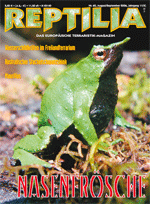
Reptilia 60 - Darwin's frogs
Reptilia 60 - Nose frogs Aquatic turtles in the outdoor terrariumAustralian spiny-tailed skinkMauritius Contents: 4 EDITORIAL 5 MAGAZINE 12 DATES 15 PHOTO REPORTAGEFrom Darwin's treasure trove: Nose frogs By H. Werning 22 KEEPING AND BREEDINGThe breeding of the nose frogRhinderma darwinii for more than twodecadesBy K. Busse 30 REPORTAGEThe REPTILIA project "Nose Frogs":Field studies on Rhinodermadarwinii, the Darwin's frogBy P. Ulmer 39 REPORTAGEHalf-swimmers in sight? The search for Rhinoderma rufum continues.By M. Solé 43 TRAVELMauritius for beginnersBy M. Rogner 51 PORTRAIT AND POSTERMontivipera xanthinaBy N. Stümpel & B. Trapp 55 KEEPING AND BREEDINGOn keeping and breeding the Australianspiny-tailed skink Egernia stokesii stokesii (Gray, 1845), with notes on feeding-management. Part 1By S. Knauf 62 PRACTICEUse of a conservatory as a terrarium-location for a desert terrariumPart 2: The inhabitants: Tympanocryptis tetra-porophora (Lucas & Frost, 1895)By T. Ackermann 68 PRACTICE North American aquatic turtles in the outdoor terrarium Part 1: General remarksBy A. S. Hennig 72 HERPETOFAUNASand lovers - The psammophilous snakesof North AfricaBy U. Schlüter 86 FAQ - FREQUENTLY ASKED QUESTIONSAcquisition of tarantulasBy K. Kunz 90 LIBRARY 100 WESTERN HERP PERSPECTIVESAlterna feverBy B. Love 104 INCUBATOR"How do you even get something like this"?By H. Werning

CHF 11.20