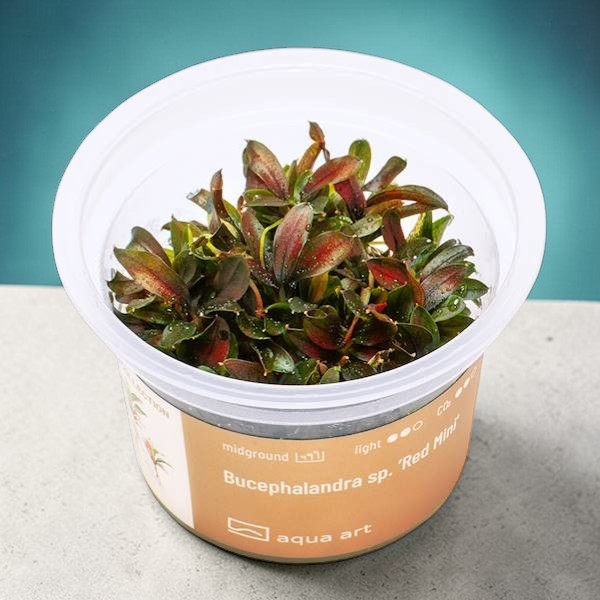
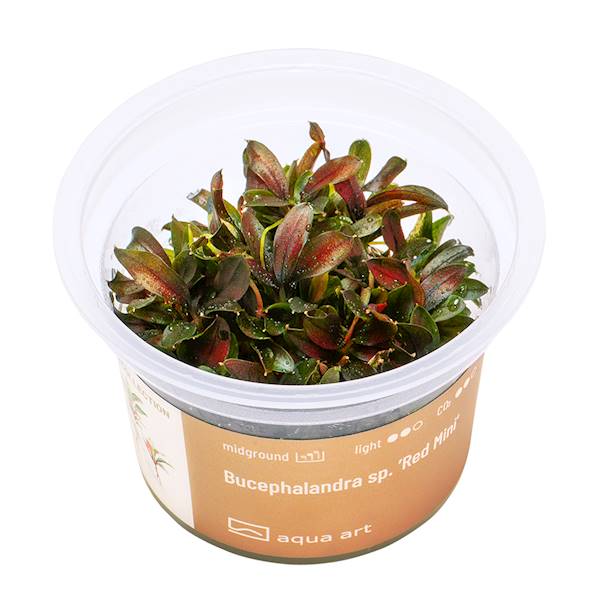
Product information "Ludwigia ovalis Invitro aquarium plant"
Ludwigia ovalis invitro cup
This plant, with a characteristic oval leaf
oval leaf shape in orange-pink color, is easy to grow and an interesting addition to the aquarium.
interesting addition to the aquarium. The leaves are slightly smaller
than those of the popular Repens variety. Due to their rapid growth
the clumps must be trimmed and thinned out regularly to prevent excessive growth.
prevent excessive growth. The original shape of the leaf blade
makes it an attractive addition to the plant composition in the aquarium.
aquarium.
To use this plant, remove it from the cup and rinse the gel.
cup and rinse the gel thoroughly under running water.
Then divide it into small clumps of 1-2 cm and plant them at short intervals.
them at short intervals. As it grows, it will form a
form a uniform group of adult plants.
This plant
comes from in vitro cultivation and is free from snails, parasites and algae.
and algae. High-quality gel was used as a medium, so it will establish itself
quickly establish itself in the aquarium.
Light requirement: medium to intensive
Optimum temperature: 10 to 28 °C
Water values: soft to hard
pH value: 4 to 7
CO2 and nutrients: recommended
Propagation: cuttings
Composition
Feeding recommendation
Technical details
Size information
0 of 0 reviews
Give us a rating!
Share your experience with the product with other customers.
Login
No reviews found. Go ahead and share your findings with others.
Vallisneria spiralis Torta
Large screw - swamp screw
max. growth height
30 - 50 cm
Country of origin
Africa, Asia
Suitability
Perch aquarium, community aquarium
Type
Rosette
Family
Hydrocharitaceae
Genus
Vallisneria
Propagation
Stolons
Growth rate
medium
pH
6 - 9
Water hardness
10 - 30 °dh
Notes
A very decorative variety of Vallisneria spiralis with a twisted growth habit. It is also known commercially as ‘screw vallisneria’. With a height of 30-50 cm, the leaves remain significantly shorter than those of the stem form. It is also undemanding in cultivation, only the light intensity should be slightly higher than for the normal V. spiralis. The ‘Torta’ variety is suitable for the middle ground of small aquaria or the background of larger aquaria.
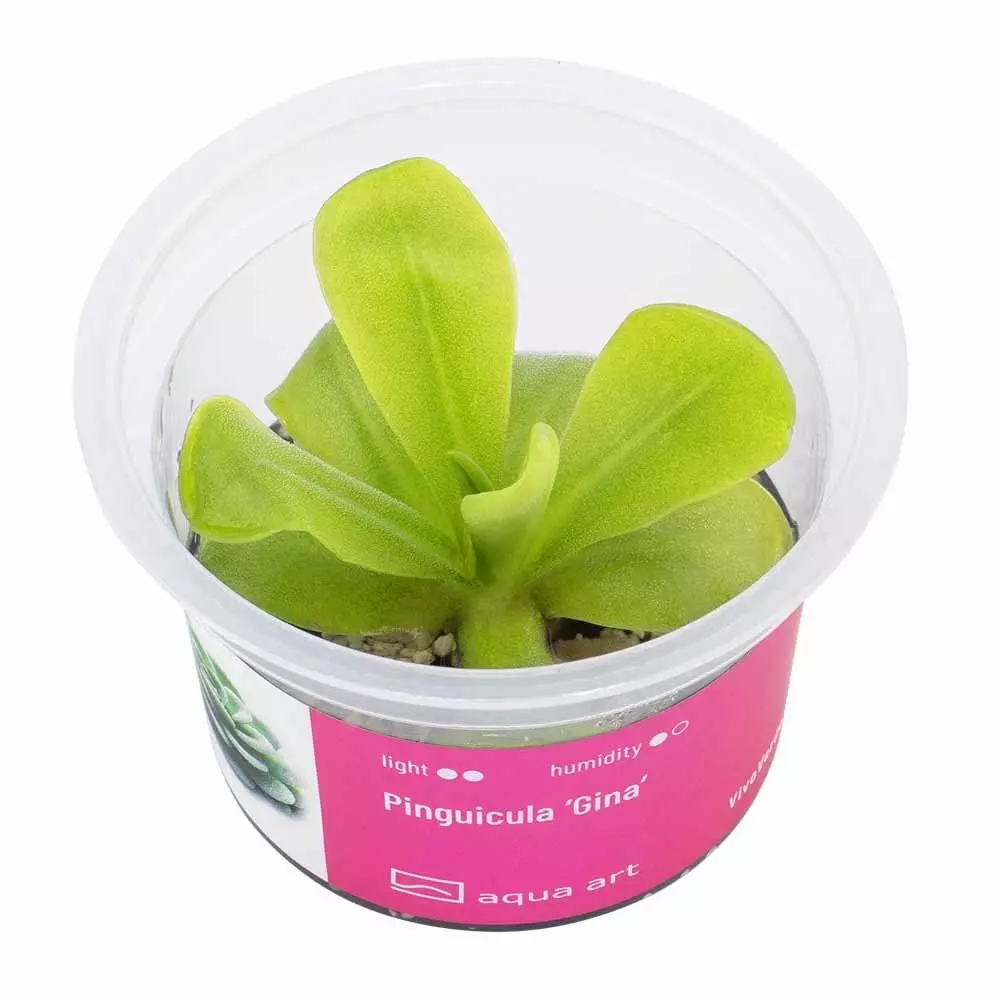
Carnivorous plant - Pinguicula Ginasupplied in an in vitro cupDiameter up to 12cmSunlightHumidity: 50-70%Temperature: 15-25 °C
Flower purple, one flower per stemPinguicula 'Gina' is a Mexican hybrid of the common Pinguicula zecheri and Pinguicula agnata. It was registered as a cultivar in 1998. Pinguicula 'Gina' is known for its eye-catching flowers and blooms all year round. It is easy to cultivate and therefore a good plant for beginners. The color of the leaves can vary from bright green to yellow to pink depending on the light intensity.Size:
The diameter of the rosette can reach up to 12cm.
Flowers:
Flowering time: Mainly in spring and summer. Delicate flowers with lilac-colored petals.
The stem is slender and elongated with a single flower per stem.Light:
Partial to full sun or equivalent growing light.Substrate:
A well-drained mix often consisting of peat, perlite and sand.Feeding/fertilizing:
Avoid fertilizing the substrate! The plant gets all the nutrients it needs from the prey it catches or eats.Humidity:
The humidity should be between 50-70%.
Temperature:
The ideal temperature for this plant is 15-25 °CPropagation:
Propagation is by leaf cuttingsThe combination of carnivorous plants with reptiles
reptiles in a terrarium can create an aesthetically pleasing and ecologically
interesting environment. Carnivorous plants such as Drosera,
Nepenthes, Pinguicula and Sarracenia are not only exotic and beautiful, they also
they also contribute to a balanced ecosystem by controlling the population of small insects.
small insects.
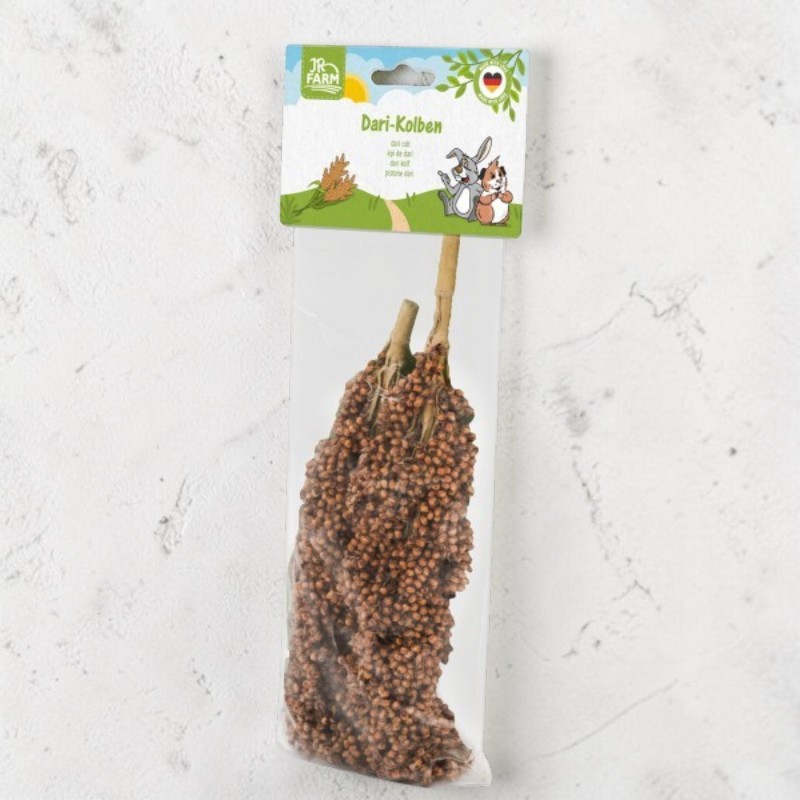
JR FARM dari cob rodents (100 g)
Individual food for dwarf rabbits, guinea pigs, rats, hamsters, mice, chinchillas and degus
The JR FARM dari cob is natural entertainment for your pet. Your pet has to work for gathering the sun ripened seeds.
Feeding recommendation:
according to the size of the animal, up to 2 dari cobs per week.
100 g
Aqua Art Drosera capensis 'Albino' - bright cape sundew as an in vitro plantDrosera capensis 'Albino' has a particularly bright appearance: instead of red tentacles, it has predominantly green catch leaves with clear, sticky drops and forms white flowers. As an in vitro plant, you can start it cleanly in a cup - ideal for very bright, moist biotopes in terrariums or plant shelves. Characteristics and requirements:Albino form: hardly/no red pigments, light-colored tentacles and sticky traps with glittering catching drops (sundew principle)Origin: South Africa, Cape region (Cape of Good Hope area)Size: depending on conditions, usually approx. 5-20 cm in heightLight: full sun or strong plant light 10-14 hrs/dayHumidity:optimal approx. 65-75 %Temperature: ideal approx. 22-32 °CStriking color contrast to red carnivoresSupports the natural reduction of small flying insects (e.g. fungus gnats/small mosquito species) with trapping leavesEasy to care for: focus on light + constant humidity, no fertilization necessaryNo dormant period necessaryDrosera capensis 'Albino' is the Cape sundew for anyone who loves carnivores but is looking for a particularly bright, elegant look. In contrast to many classic Cape sundew forms, 'Albino' shows hardly any red pigments: The plant appears predominantly green, the catching droplets shine clearly and the flowers appear white. This provides a nice contrast in terrariums, paludariums or on bright windowsills - especially next to reddish species or colored hardscape elements. The catching technique is typical of sundews: sticky drops sit on the tentacles to which small insects adhere. This is not only exciting to watch, but also fits perfectly into nutrient-poor biotopes because Drosera supplements its low nutrient requirements with prey. Fertilizing is not necessary - on the contrary, too many nutrients are usually the quickest route to problems for carnivores.Three points are crucial for successful cultivation: plenty of light, constant humidity and suitable substrate/water. Aqua Art recommends full sun or an equally strong plant light with around 10 to 14 hours of illumination per day. This keeps the plant vital and reliably forms catching droplets. The following applies to the climate: A humidity of approx. 65-75 % is ideal and the plant prefers to grow at 22-32 °C. This makes it particularly suitable for well-lit, humid terrariums or warm indoor rooms with stable conditions.Quality counts when watering: use water that is as low in salt and minerals as possible (e.g. rain or distilled water) and keep the substrate permanently moist. As an in vitro plant, you get a clean start in a practical cup - this is ideal if you value controlled conditions and want to keep your terrarium as free of "roommates" as possible.Zoo Roco tip:If your Drosera hardly shows any "dew", it is usually due to insufficient light or air that is too dry. First increase the light intensity (not just the hours) and ensure that the substrate is constantly moist. After opening the in-vitro cup: carefully rinse the gel, place in carnivorous substrate and gradually acclimatize to full sun or strong light for 1-2 weeks.
JR Nibble-Posy 25g
Supplementary feed for all rodents
The JR FARM Nibble-Posy consists of many individual, natural fruits and offers every rodent a healthy and natural occupation. Simply to dose and always welcome in between meals.
Feeding recommendation:
according to the size of the animal, lie 3 (e.g. mouse) to 14 (rabbit) individual plants in the cage (rodent) per week.
Ingredients:
Green wheat spike 50%, oat panicles
Cryptocoryne Spiralis 'Red'
Cryptocoryne Spiralis 'Red' is an extremely decorative plant for the second level of an aquarium. It is characterized by narrow, strongly curled leaves with a dark brown-red coloration. This variety originates from India and is a true rarity.Difficulty of growing: mediumLight requirement: mediumCO₂ requirement: lowAdult plant height: up to 40 cmGrowth: moderateTemperature: 23-27°CPlacement in aquarium: second levelOrigin: Asia6 cm cup diameterCryptocoryne Spiralis 'Red' is a very special and beautiful plant native to Asia. It can be found from Bangladesh to India to the island of Sri Lanka. In its natural habitat, this Cryptocoryne grows along streams and rivers in forests and higher elevations with humid climates. It is still little known in Europe and is considered a rarity in aquaristics, especially since it is rarely available in stores. Cryptocoryne Spiralis 'Red' is characterized by its dark brown-red, narrow leaves, which are strongly wavy and resemble a stripe with a wrinkled edge. The leaves are grouped in a rosette. In appearance, this plant resembles another Zwittera variety, namely Cryptocoryne Cispatula var.
Red Cryptocoryne Spiralis contrasts well with green plants and is ideal for the background of the aquarium. It is original and unusual, making it an eye-catcher.It is not very demanding in cultivation, does not require special care and does not need regular pruning. You just need to provide her with the right growing conditions.
It needs moderate light. It has no special requirements for pH, which is 6.0-7.0. It prefers moderately hard water up to 10°. The plant does not need any special fertilization as long as a nutrient-rich substrate is available. It is good if it contains an addition of clay and peat. It is also important that it is at least 5-7 cm thick, as this variety develops a rather strong root system. It has long, creeping stems and easily reproduces by spreading. To obtain a seedling, simply divide it.Planting: The plant must be removed from the cup and thoroughly rinsed from the gel under running water. This is best done by placing the plant in a container of lukewarm water. Most of the gel will then fall off by itself. Divide the contents of the cup into 1-2 cm lumps and then place them at a small distance on the selected items.
Ludwigia ovalis invitro cup
This plant, with a characteristic oval leaf
oval leaf shape in orange-pink color, is easy to grow and an interesting addition to the aquarium.
interesting addition to the aquarium. The leaves are slightly smaller
than those of the popular Repens variety. Due to their rapid growth
the clumps must be trimmed and thinned out regularly to prevent excessive growth.
prevent excessive growth. The original shape of the leaf blade
makes it an attractive addition to the plant composition in the aquarium.
aquarium.To use this plant, remove it from the cup and rinse the gel.
cup and rinse the gel thoroughly under running water.
Then divide it into small clumps of 1-2 cm and plant them at short intervals.
them at short intervals. As it grows, it will form a
form a uniform group of adult plants.This plant
comes from in vitro cultivation and is free from snails, parasites and algae.
and algae. High-quality gel was used as a medium, so it will establish itself
quickly establish itself in the aquarium.
Light requirement: medium to intensive
Optimum temperature: 10 to 28 °C
Water values: soft to hard
pH value: 4 to 7
CO2 and nutrients: recommended
Propagation: cuttings
Ludwigia ovalis invitro cup
This plant, with a characteristic oval leaf
oval leaf shape in orange-pink color, is easy to grow and an interesting addition to the aquarium.
interesting addition to the aquarium. The leaves are slightly smaller
than those of the popular Repens variety. Due to their rapid growth
the clumps must be trimmed and thinned out regularly to prevent excessive growth.
prevent excessive growth. The original shape of the leaf blade
makes it an attractive addition to the plant composition in the aquarium.
aquarium.To use this plant, remove it from the cup and rinse the gel.
cup and rinse the gel thoroughly under running water.
Then divide it into small clumps of 1-2 cm and plant them at short intervals.
them at short intervals. As it grows, it will form a
form a uniform group of adult plants.This plant
comes from in vitro cultivation and is free from snails, parasites and algae.
and algae. High-quality gel was used as a medium, so it will establish itself
quickly establish itself in the aquarium.
Light requirement: medium to intensive
Optimum temperature: 10 to 28 °C
Water values: soft to hard
pH value: 4 to 7
CO2 and nutrients: recommended
Propagation: cuttings
🌿 Proserpinaca palustris - Decorative aquarium plant with serrated foliage
Structure and color for the middle to background layout
Proserpinaca palustris from Aqua Art is an unusual aquarium plant with finely toothed, fern-like leaves that can take on a fascinating copper-orange coloration in good light. It grows upright and gives the aquascape a special depth effect and structure thanks to its unique texture.
In well-lit tanks with a CO₂ supply, it develops vibrant colors and healthy growth. Its eye-catching appearance makes it ideal as an accent plant in the middle or background.
✅ Advantages at a glance
Unique leaf shape with serrated foliage
Color gradient from green to copper-orange in strong light
Ideal for structured middle and background design
Demanding, but very decorative under optimal conditions
Grown in vitro - free from snails and pesticides
Particularly striking in layouts with contrasting plants
📋 Product details
Name: Proserpinaca palustris
Origin: North and South America
Type: Stem plant
Growth height: approx. 20-40 cm
Light requirement: medium to high
CO₂ supply: recommended to necessary
Growth: medium
Propagation: Cuttings after pruning
Delivery form: In vitro cup (sterile)
Manufacturer: Aqua Art
💡 Zoo Roco tip
Proserpinaca palustris looks particularly impressive when planted in groups and combined with fine-leaved plants such as Myriophyllum or Rotala. Strong light and regular micronutrient fertilization are crucial for intensive colouring.
With Proserpinaca palustris from Aqua Art, you can add variety, color and structure to your aquascape - ideal for sophisticated layouts with character.Customers also searched for: Proserpinaca palustris, Aqua Art, structure-rich aquarium plant, stem plant aquarium, serrated leaves, InVitro plant aquarium, aquascaping plant, buy Proserpinaca, reddish aquarium plant, background plant aquarium
🌿 Hygrophila sp. 'Araguaia' InVitro Reddish-brown accent plant with unique growth habit
Hygrophila sp. 'Araguaia' from Aqua Art is a particularly attractive, compact stem plant with a reddish-bronze color and finely branched growth. It is ideal for the foreground to midground and provides structured contrasts and warm color accents in aquascapes.
This plant is one of the slow-growing Hygrophila species and can be easily shaped and thickened by regular pruning. Supplied as an in-vitro plant, it is free from algae, snails and pesticides - ideal for shrimp tanks and sensitive aquariums.✅ Advantages at a glance:
Compact Hygrophila with reddish-bronze leaves
InVitro - sterile, snail-free & pesticide-free
Ideal for the foreground or middle ground
Slow-growing - easy to shape and grow bushy
Good effect with strong lighting & CO₂ supply
Very decorative in natural aquariums and layouts with contrasting colors📋 Product details:
Name: Hygrophila sp. 'Araguaia'
Type: Stem plant
Placement: Foreground to midground
Growth height: approx. 5-15 cm
Light requirement: medium to high
CO₂ supply: recommended
Growth: slow
Delivery form: In vitro cup (sterile cultivated)
Manufacturer: Aqua Art💡 Zoo Roco tip:
Combine Hygrophila 'Araguaia' with light green plants such as Micranthemum or Hydrocotyle sp. 'Japan'
- to show off the darker coloring particularly well. For a
dense carpet, regular pruning is recommended.Hygrophila 'Araguaia' provides subtle color accents and fine structure in the lower section of the aquarium - ideal for sophisticated layouts and harmonious plant design.
Ludwigia sphaerocarpa 'Pilosa' InVitro Red accent plant for aquascaping
Ludwigia sphaerocarpa 'Pilosa' is a decorative and rare stem plant with a particularly intense red coloration and fine leaf structure - a real eye-catcher for any natural aquarium. This variety is ideal for the mid to background area and adds color depth and contrast to groups of green plants.
As an Aqua Art in vitro plant, it is free from snails, algae and pesticides, making it perfect for shrimp tanks and sensitive aquariums. With good lighting and CO₂ supply, it develops its full color intensity and grows vigorously but controllably.✅ Advantages at a glance:
Intensely red-colored stem plant with a fine texture
Grown in vitro - sterile, free from harmful substances
Ideal for color contrasts in the middle or background
Safe for shrimps and sensitive aquariums
Grows compact & controllable with good care📋 Product details:
Name: Ludwigia sphaerocarpa 'Pilosa'
Type: Stem plant
Placement: Middle to background
Growth height: approx. 20-40 cm
Light requirement: medium to high
CO₂ supply: recommended
Color effect: red to reddish-green
Growth: medium
Delivery form: In vitro cup (sterile cultivation)
Manufacturer: Aqua Art💡 Zoo Roco tip:
For strong red coloration, the plant should be kept under intensive lighting and regularly supplied with iron and micronutrients. A good supply of CO₂ also has a positive effect on growth and color.Ludwigia sphaerocarpa 'Pilosa' from Aqua Art brings structure, contrast and an intense play of colors to the aquarium - perfect for modern aquascaping layouts.
Invitro aquarium plant Rotala rotundifoliaColorful stem plant for the background
Rotala rotundifolia is one of the most popular stem plants in the aquarium hobby - versatile, easy to care for and particularly attractive thanks to its delicate, round leaves. Depending on the light intensity and nutrient supply, it develops a vibrant green to bright red, adding lively color accents to any aquarium layout.
The in vitro version is grown under sterile conditions and is therefore free from algae, snails and pesticides - ideal for sensitive aquariums, especially shrimp tanks. Fast-growing and adaptable, Rotala rotundifolia is ideal for the mid to background and harmonizes wonderfully with other fine stem plants in the natural aquarium.
Advantages at a glance:
✅ Changes color depending on the light - from green to red
✅ Fast-growing & ideal for dense groups of plants
✅ InVitro - guaranteed free from harmful substances & snails
✅ Safe for shrimps & sensitive tanks
✅ Perfect for aquascaping & classic plant aquariumsProduct details:
Name: Rotala rotundifolia
Type: Stem plant
Position in aquarium: Middle to background
Growth height: approx. 30-50 cm
Light requirement: Medium to high
CO₂ supply: Recommended for more intense colorationTemperature: 22 - 28°C
Delivery form: In vitro cup (grown sterile)
Color effect: Green to reddish, depending on light & nutrients
Invitro aquarium plant Bacopa myriophylloidesDelicate aquarium plant for the background
Bacopa myriophylloides is an elegant stem plant with delicate, finely pinnate leaves - a real eye-catcher for the background of your aquarium. Its special structure brings lightness and movement to the layout and is ideal for aquascaping and natural aquariums.
As a high-quality in vitro plant, it is free from algae, snails and pesticides, making it particularly safe for shrimps and sensitive tanks. With good lighting and CO₂ supply, Bacopa myriophylloides grows compactly and healthily - with a beautiful, delicate appearance.
Advantages at a glance:
✅ Delicate stem plant with feathery leaves
✅ Ideal for the background & textured layouts
✅ InVitro - sterile, pesticide-free & shrimp-safe
✅ Healthy growth with light & CO₂ addition
✅ Perfect for aquascaping & natural aquariumsProduct details:
Name: Bacopa myriophylloides
Type: Stem plant
Location in the aquarium: Background
Growth height: approx. 30-50 cm
Light requirement: Medium to high
CO₂ supply: Recommended
Delivery form: In vitro cup (grown sterile)
Special feature: Very fine, decorative leaf structure
InVitro Ammania senegalensis from Aqua ArtThe Ammania senegalensis InVitro from Aqua Art is an impressive aquarium plant with intense red coloration that is a real eye-catcher, especially in the middle and background of your aquarium. Thanks to InVitro cultivation, you get a 100 % sterile, pesticide-free plant that is also ideal for sensitive shrimps and aquascaping projects.
With sufficient light, nutrients and CO₂, Ammania senegalensis develops strong, red stems and oval leaves - perfect for colorful contrasts in plant aquariums.
Advantages at a glance:
✅ Bright red stem plant for the middle & background
✅ InVitro - free from algae, snails & pesticides
✅ Safe for shrimps & sensitive aquarium inhabitants
✅ Ideal for aquascaping & natural aquariums
✅ Fast-growing with good lighting & CO₂ supplementationProduct details:
Name: Ammania senegalensis
Origin: Africa
Type: Stem plant
Position in the aquarium: Middle to background
Growth height: approx. 20-40 cm
Light requirement: Medium to high
CO₂ supply: Recommended
Delivery form: In vitro cup (lab-grown, sterile)Planting: The plant must be removed from the cup and thoroughly
rinsed thoroughly from the gel under running water. This is best done
best done by placing the plant in a container with lukewarm water.
lukewarm water. Most of the gel will then fall off by itself. Divide
the contents of the cup into 1-2 cm clumps and place these a short distance apart in the
then place them a short distance apart in the substrate or on the selected
objects.
Micranthemum umbrosum
Micranthemum Umbrosum is a light green stem plant with small round leaves. Depending on how it is pruned, it is suitable for both the foreground and background of the aquarium. Difficulty of cultivation: easy Light requirement: medium, to high CO₂ requirement: medium Height of the adult plant: 20 cm Growth: fast Temperature: 22-26 °C Placement in the aquarium: Second level Origin: North and Central America Cup diameter: 6 cm Micranthemum Umbrosum (Round-leaved meadowfoam) is a naturally occurring plant in North and Central America. It grows both in water and in marshy areas. It is prized by aquarists for its unique appearance.
The plant forms long stems with paired, alternate, small, round, light green leaves. It has a fairly well developed root system. It needs regular pruning and is easy to shape into a desired form. It is propagated vegetatively by cutting off the shoot tips and planting them in the ground.
It likes water with a hardness of 2-12°N, a pH of 5.5-7.7 and a temperature of 24-26°C. It is sensitive to trypaflavin and can be damaged by snails. It has fairly high light requirements. With insufficient light, it pulls upward, and distinct gaps can be seen between the leaves. With sufficient light, it forms dense clumps that are pleasing to the aquarist's eye.Micranthemum umbrosum is usually placed in the background of the aquarium, but it also looks good in the foreground when cut short. It does not require absolute CO₂ fertilization, but grows much faster in its presence. When growing this plant, pay special attention to the proper concentration of iron in the aquarium water..
Planting:The plant must be removed from the cup and thoroughly rinsed from the gel under running water. This is best done by placing the plant in a container of lukewarm water. Most of the gel will then fall off by itself. Divide the contents of the cup into 1-2 cm lumps and then set them at intervals of 1 to 2 cm.
Rotala Rotundifolia 'Green'
Rotala Rotundifolia 'Green' (Round-leaved Rotala) is a mid-ground plant. It is characterized by fast growth and moderate light requirements. The color is usually light green.Difficulty of growing: easy Light requirements: medium CO₂ requirements: not necessary Height of mature plant: 50-60 cm Growth: fast Temperature: 20-28°C Placement in aquarium: third level Origin: South Asia, Southeast Asia Cup diameter 6 cm The natural range of the round-leaved Rotalas (Rotala rotundifolia) is South, Southeast and East Asia. It has been spread by humans to Australia, the United States and Brazil, among other places. She is thus already almost a globetrotter.Rotala rotundifolia 'Green' is very similar to Rotala rotundifolia, but its leaves remain bright green even in bright light.
This plant is characterized by its fast growth and its tendency to spread profusely, especially when regularly pruned. It tolerates medium light levels, but the higher the light, the more intense the plant's growth and colors. If left to grow freely, it reaches a length of 30-60 cm, cutting off access to light to the lower parts, where it begins to lose its leaves. Under favorable conditions, if left uncontrolled, it can dominate an entire tank, especially if it is a tank with a small capacity. Once it reaches the surface of the water, it begins to float on it. It does not need additional carbon dioxide fertilization unless you want to accelerate its growth even more.
It is tolerant of pH and water hardness, although like most plants, it cannot tolerate extremes.
It tolerates temperatures between 20 and 28 °C, but thrives better in the upper end of this range. It can grow in both an active and a poor substrate, but in this case it is advisable to fertilize under the roots. In well-lit, CO2-fertilized aquariums, it may require additional fertilization with macronutrients due to its rapid growth. Otherwise, it will lose its color and the leaves will become smaller. Rotala rotundifolia is propagated in the aquarium by cutting off stem pieces and placing them in a selected spot in the substrate. When transplanted to a new tank, it will need some time to acclimate and grow faster.Planting: The plant must be removed from the cup and thoroughly rinsed from the gel under running water. This is best done by placing the plant in a container of lukewarm water. Most of the gel will then fall off by itself. Divide the contents of the cup into 1-2 cm lumps and then place them at a small distance into the substrate.
Lobelia cardinalis 'Mini'Lobelia cardinalis 'Mini' is a green plant, recommended for the second level of the aquarium and for the paludarium. A very decorative species that is not particularly demanding.Difficulty of growing: easy Light requirements: medium CO₂ requirements: low Outgrown plant height: up to 20 cm Growth: medium Temperature: 15-28°C Placement in aquarium: second level Origin: North America Shell diameter: 6 cm Lobelia Cardinalis mini is a plant native to North America. In nature, it is found in wetlands and riverbanks. It is distributed from the Gulf of Mexico through the eastern states of the United States to southern Canada.
It grows in the ground and has a well-developed root system. The feathery stems can develop auxiliary roots in leafless areas. Its small leaves are bright green, oval with a conspicuous pale central vein.Lobelias can be cultivated in aquariums and paludariums. It thrives in muddy soil as well as underwater. It tolerates temperatures from 15 to 28 °C and can also be kept in a pond. It thrives best at 20-23°C and requires soft to medium-hard water with a pH between 6.5 and 7.2.Without sufficient light, the leaves turn yellow, but in bright light the undersides of the leaves turn purple. It is not particularly demanding, but regular water changes, fertilizer and CO₂ support its growth.In the aquarium, lobelia should be planted in a group in the middle ground, but it is also well suited as a foreground plant. Pruning is necessary for the plant to grow well; use scissors to remove older leaves. You can also cut back the entire plant and use the cut tips as cuttings.
Planting: The plant must be removed from the cup and thoroughly rinsed from the gel under running water. This is best done by placing the plant in a container of lukewarm water. Most of the gel will then fall off by itself. Divide the contents of the cup into 1-2 cm lumps and then set them at intervals of 1 to 2 cm.
Limnophila aromaticaLimnophila Aromatica (fragrant limnophilia) is a beautiful plant for the second or third level. It turns purple under intense light.Difficulty of cultivation: moderate Light requirement: medium CO₂ requirement: medium Adult plant height: up to 50 cm Growth: moderate Temperature: 22-28°C Placement in aquarium: second or third level Origin: Asia Cup diameter: 6 cm Limnophila Aromatica (fragrant Limnophila, rice paddy weed) is a plant that has earned a place in aquariums around the world due to its unique appearance and leaf color. It is native to Asia, where it usually grows in rice paddies or swamps near water. It does well after the end of the rainy season in a dry place in a still moist, sandy soil. At high temperatures, the plant flowers, forms fruit, and then dies. Traditionally used as a spice, especially in Vietnamese cuisine. Its flavor is reminiscent of cumin and lemon. Currently, the plant can also be found in America and Australia.Limnophilia Aromatica is a stalk plant that produces lance-shaped leaves with serrated edges. Their color depends on the intensity of light. If the plant has little access to light, its leaves are green. If the light is strong, the entire top of the plant is intense red and the leaves are purple on the underside.
In aquariums, plant it in the second or third level, leaving a distance of 1.5 cm between cuttings. It grows quite fast, its optimal pH is 6-7. It tolerates temperatures between 15 and 30 °C, but it is better to avoid extreme temperatures and keep it between 22 and 28 °C. In aquariums it is propagated by cutting and planting young plants that form on the stems or from the tips. The plant does not require absolute CO₂ fertilization, but grows much faster with CO₂ addition.
To achieve the desired intense red-purple color of the leaves, the plant must be strongly illuminated. In addition, attention must be paid to the correct water parameters in the aquarium, especially the optimal iron, nitrate and phosphate content, so that the plant can absorb the nutrients from the water column. Due to its strongly developed root system, the plant grows best in active media.Planting: The plant must be removed from the cup and thoroughly rinsed from the gel under running water. This is best done by placing the plant in a container of lukewarm water. Most of the gel will then fall off by itself. Divide the contents of the cup into 1-2 cm lumps and then set them at intervals of 1 to 2 cm.
Ludwigia ovalis invitro cup
This plant, with a characteristic oval leaf
oval leaf shape in orange-pink color, is easy to grow and an interesting addition to the aquarium.
interesting addition to the aquarium. The leaves are slightly smaller
than those of the popular Repens variety. Due to their rapid growth
the clumps must be trimmed and thinned out regularly to prevent excessive growth.
prevent excessive growth. The original shape of the leaf blade
makes it an attractive addition to the plant composition in the aquarium.
aquarium.To use this plant, remove it from the cup and rinse the gel.
cup and rinse the gel thoroughly under running water.
Then divide it into small clumps of 1-2 cm and plant them at short intervals.
them at short intervals. As it grows, it will form a
form a uniform group of adult plants.This plant
comes from in vitro cultivation and is free from snails, parasites and algae.
and algae. High-quality gel was used as a medium, so it will establish itself
quickly establish itself in the aquarium.
Light requirement: medium to intensive
Optimum temperature: 10 to 28 °C
Water values: soft to hard
pH value: 4 to 7
CO2 and nutrients: recommended
Propagation: cuttings
Vallisneria spiralis Torta
Large screw - swamp screw
max. growth height
30 - 50 cm
Country of origin
Africa, Asia
Suitability
Perch aquarium, community aquarium
Type
Rosette
Family
Hydrocharitaceae
Genus
Vallisneria
Propagation
Stolons
Growth rate
medium
pH
6 - 9
Water hardness
10 - 30 °dh
Notes
A very decorative variety of Vallisneria spiralis with a twisted growth habit. It is also known commercially as ‘screw vallisneria’. With a height of 30-50 cm, the leaves remain significantly shorter than those of the stem form. It is also undemanding in cultivation, only the light intensity should be slightly higher than for the normal V. spiralis. The ‘Torta’ variety is suitable for the middle ground of small aquaria or the background of larger aquaria.
Anubias barteri var. glabraAnubias barteri var. glabra' or Anubias minima. This is a recommended species for aquaria with little light. Ideal for medium-sized tanks. The plant is easy to grow, does not require intensive fertilization and reproduces by dividing the rhizome. In vitro plant.Difficulty of cultivation: easyLight requirement: lowCO₂ requirement: lowHeight of the adult plant: 15-25 cmGrowth: slowTemperature: 20 - 22°CPlacement in the aquarium: Middle groundOrigin: AfricaCup diameter 6 cmAnubias Barteri Var. Glabra is a green plant from the Asteraceae family that is native to the swamps of Africa. It can grow both under water and in water. It can be found in the trade under the name Anubias minima. Unlike other Anubias, it is easy to plant in the substrate and has characteristic lanceolate leaves that grow up to 15 cm long. It can reach a height of 25 cm, but grows slowly so that it can also be cultivated in small aquariums.
The plant has a rhizome from which roots grow that wrap tightly around the spot where it is planted , making it ideal for planting on roots or lava rock. It is suitable for a second or third planting
Anubias thrives at different temperatures. It is suitable for cooler tanks as well as warm, tropical aquariums, e.g. with discus fish.It tolerates hard, soft, acidic and alkaline water. It prefers weak, diffuse lighting. It can become overgrown with algae under prolonged and intensive lighting. It is therefore advisable to plant it in darker or even shady areas of the aquarium.This plant does not like neglected aquaria and prefers the water to be changed regularly and no dirt to accumulate on its leavesIt grows slowly but forms a very attractive shape, especially in a group that forms a green, decorative clump. It feels very comfortable in tanks with a low water level and looks great in 'dachshund' type aquariums, where it creates the effect of an aesthetically pleasing tank. Thanks to it, we can create very interesting compositions. It is also well suited for aquariums with cichlids and other herbivorous fish
It does not require special care, it is enough to remove older leaves, which stimulates the rhizome to form cuttings. If you want to obtain new cuttings, you can regularly divide the rhizome into 2-3 cm long sections.
To attach the Anubias to roots or stones, a very thin string, thread or a special adhesive for attaching aquarium plants is sufficient.
The in vitro culture of plants is carried out in tissue culture laboratoriesThanks to the sterile production conditions, the cuttings are free from snails, algae or pathogens.Planting:The plant must be removed from the cup and thoroughly rinsed of the gel under running waterThis is best done by placing the plant in a container of lukewarm water. Most of the gel will then fall off by itself.
The Plant Growth System Nano is a small, elegant solution for small aquariums
A Plant Growth System Nano is a desirable solution for precise CO2 dosage for small aquariums. CO2 addition benefits the growth of all plants and improves colour development.
A simple and inexpensive way to supply extra CO2 to the plants in your aquarium
Easy to install, use and maintain
Suitable for starter-sets, where even small amounts of extra CO2 will make a positive difference for the plants
User guide:
Ensure that the regulator is fully off before you mount the regulator on the CO2 cartridge.
Fill the diffuser-chamber with water.
Place the cartridge in the rack, slide the suction cups on the hose and mount the hose to the regulator and the diffuser.
Mount the diffuser with the suction cups at the inner side of the tank near the bottom and place the hose in the back corner.
Leave the diffuser for 24h in the tank to ensure the ceramic disc is fully moistened.
Open the regulator carefully and count the number of bubbles per minute in the diffuser-chamber.
Wait 5 minutes, adjust and repeat until the number of bubbles per minute is similar to the recommendation in the table.
The table shows recommended dosage (bubbles per minute) in different tank sizes. A 95 g CO2 cartridge contains 50,000 ml CO2.
The most important nutrient for plants is CO2.
The natural CO2 level in an aquarium is 0-0.5 mg/L of water.Even the slightest addition of CO2 can make a big difference improving the growth and vigour of the plants.
If the aquarium contains only slow-growing Easy-plants, the addition of CO2 gas into the water should reach a level of approx. 3 mg/L to ensure good growth conditions.
For Medium category plants the CO2 requirement is approximately 10 mg/L and for Advanced plants approx. 25 mg/L.
*) If you have a larger aquarium containing Medium or Advanced plants, the lifetime of a nano-cartridge will be too short.In this case we recommend a larger cylinder e.g. 2 kg refillable.
Juwel Aquarium Rio 125 combination as a special offer set
Rio Aquarium 125 from Juwel Combination incl. HeliaLux Spectrum and HeliaLux SmartControl
The Juwel 125 combination has a timeless design with sophisticated technology and meticulous workmanshipThe Rio Aquarium line from Juwel is discreet and perfectly accentuates the underwater landscape you have created.
The Rio 125 aquarium unites the everlasting rectangular shape and state-of-the-art equipment. With its compact footprint of 81 × 36 cm and classic, rectangular design, the Juwel Aquarium Rio 125 adapts to any living style and fits perfectly into your home.
The safety base frame ensures a particularly secure stand and allows for easy setup of the Rio 180 Juwel Aquarium without special supports. The careful workmanship from high-quality materials and perfectly harmonised technology guarantees maximum quality and safety.
Timeless design
Sophisticated technology,
Meticulous workmanship
With HeliaLux Spectrum and HeliaLux SmartControl
Bioflow 3.0 filter system
Heater
Available in two colours: black or white
The Juwel Rio 125 freshwater aquarium is suitable for community tanks, Asian tanks and South American tanks.
Bioflow 3.0 filter system and heater
For optimal filtration, the RIO 125 is equipped with a powerful Bioflow 3.0. This internal filter combines effectiveness with safety and forms the centrepiece of a JUWEL aquarium. It follows the principle "The water stays in the aquarium!" and is therefore the safest way to filter an aquarium. The Bioflow 3.0 is equipped with five powerful filter media and a quiet, powerful Eccoflow 500 circulation pump.The JUWEL 100 Watt adjustable heater ensures the correct temperature in the RIO 125 and is optimally integrated into the water circuit of the Bioflow 3.0 filter system.Thanks to the use of high-quality silver contacts and impact-resistant borosilicate glass, the JUWEL adjustable heater meets the highest demands in terms of function and safety and is, of course, TÜV/GS certified.
Aquarium dimensions:Dimensions 81 × 36 × 50 cmWeight 24 kgCapacity approx. 125 litres
Furniture dimensions:Dimensions: 81 × 36 cm, H=73 cm
Our combination offer also includes the following items:
HeliaLux Spectrum
The HeliaLux Spectrum is a high-performance LED insert light with a full spectrum. The most modern, specially designed SMD LEDs ensure maximum light output for optimal plant growth while saving around 50% energy. White LEDs provide brilliant illumination of your aquarium, red, blue and green LEDs meanwhile ensure intense colours and maximum contrast in your underwater world. The perfectly coordinated diversity of colours promotes the vitality of your fish and ensures optimal plant growth.
CombiLightThe combination of white 9000 K & 6500 K LEDs ensures ideal plant growth in your JUWEL aquarium.ColourLightFor intense colours and maximum contrast, special red, green and blue LEDs have been installed in the HeliaLux Spectrum.HeatControlSpecially developed aluminium honeycombs ensure optimal heat dissipation and a long service life for the SMD LEDs.AntiScratchThe longevity of your HeliaLux Spectrum insert light is ensured by a scratch-resistant safety glass.
HeliaLux SmartControl
With the HeliaLux SmartControl, you can programme and control your HeliaLux insert lamps conveniently via WLAN – whether with a mobile phone, tablet or PC.You can conveniently control your individual daily routine via the interface of your Internet browser. The control of the HeliaLux insert lamps is carried out via WLAN.
The HeliaLux SmartController gives you the opportunity to adapt the lighting conditions in your aquarium to your needs. In addition to sunrise and sunset, up to 16 lighting phases per day can be conveniently programmed individually. You can quickly and easily change the light moods in your aquarium depending on the day.The freely adjustable colour channels also allow targeted setting of individual moonlight lighting.
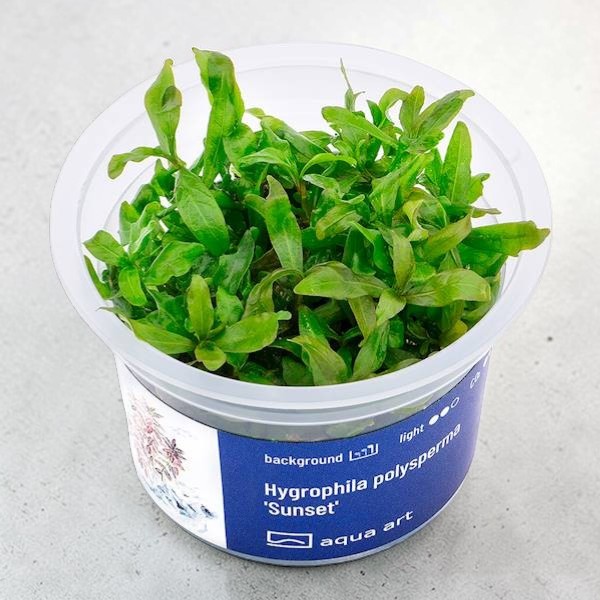
Hygrophila polysperma (Indian water lily)
max. growth height
- 50 cm
Country of origin
India, Sri Lanka and Thailand
Suitability
Discus aquariumCommunity aquarium
Type
Stem plant
Family
Acanthaceae
Genus
Hygrophila
Propagation
Cuttings
Growth rate
fast
pH
5 - 9
Water hardness
10 - 30 °dh
Notes
Cut back regularly.
Hygrophila polysperma is one of the "easiest" plants in the aquarium hobby. Even under the worst conditions, it can continue to grow to some extent. If the growing conditions are improved, the plant naturally thrives much better. With good lighting, the tips of its shoots turn a reddish brown colour. It grows very quickly, so it needs to be cut back more often than other stem plants. Highly recommended for initial planting and as an algae preventative.
Nymphaea red - Red tiger lotus as a forcing tuber
max. growth height
- 50 cm
Country of origin
Africa
Suitability
Discus aquarium, community aquarium
Type
family
Nymphaeaceae
genus
Nymphaea
Propagation
Seeds, daughter plants from the tuber
Growth rate
fast
pH
5 - 8
Water hardness
0 - 20 °dh
Notes
The Tiger Lotus is widespread in tropical Africa and colonizes a wide variety of waters there - temporary ponds and lakes on the one hand, but also flowing waters on the other. It has a tuber as a storage organ with strong floating leaves. The most beautiful thing about this plant, however, are the submerged juvenile leaves, which do not reach the surface of the water. Of the two color forms, the red tiger lotus is the most popular among aquarists; however, its green color form is rarely found in the trade. Tiger lotus are quite undemanding, older and larger leaves are always removed at the base of the tuber.
CHF 8.90
❅
❆
❅
❆
❅
❆
❅
❆
❅
❆
❅
❆
This website uses cookies to ensure the best experience possible. More information...