Product information "Echinodorus grisebachii Bleherae - Large Amazon sword"
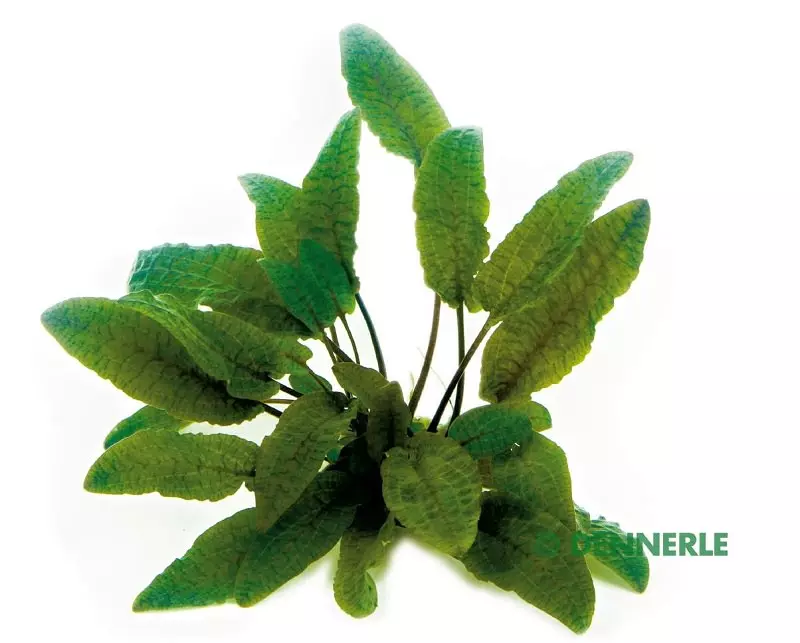
Echinodorus grisebachii Bleherae
Amazonas - Sword Plant
max. growth height
60 - 80 cm
Country of origin
Brazil
Suitability
Perch aquarium, discus aquarium Community aquarium
Type
Rosette plant
family
Alismataceae
Genus
Echinodorus
Propagation
Adventive plants on the flower stalk
Growth rate
fast
pH
5 - 9
Water hardness
10 - 20 °dh
Notes
The large Amazonas sword plant is perhaps the most popular plant in the aquarium hobby. Its leaves are 3–6 cm wider than those of the ‘amazonicus’ variety, and the height of up to 60 cm makes this species appear even more dominant. Mature clumps, some with more than 50 leaves, are a striking feature. However, the substrate must be at least 10 cm deep for the root system to develop properly. Combined with Helanthium species (dwarf Echinodorus), beautiful South American underwater landscapes can be created.
Composition
Feeding recommendation
Technical details
Size information
6 of 6 reviews
5 out of 5 stars
Give us a rating!
Share your experience with the product with other customers.
Login
10 October 2025 16:27
Très bien. Conforme à la description
21 August 2025 14:03
Peace all round.
I am totally satisfied with the fast delivery, nice advice, help with questions "and" a super good price.
Cryptocoryne wendtii Braun
Cryptocoryne wendtii Brown
(formerly Cryptocoryne wendtii Tropica)
max. growth height
- cm
Country of origin
Sri Lanka
Suitability
Community aquarium, NanoCubes and aquascaping
Type
Rosette plant
family
Araceae
Genus
Cryprocoryne
Propagation
Stolons
Growth rate
medium
pH
5-8
Water hardness
very soft to very hard
Notes
The brown colour variant of Cryptocoryne wendtii is also very popular and can be used in many planted landscapes. Its leaf edges are slightly wavy; in some cases, the leaves are also bullous in shape. The leaf colour is green to brown, sometimes with brown streaking. With good lighting, its leaves become deep dark brown. In combination with other green cryptocorynes, this creates a very striking contrast. Like almost all Cryptocorynes from Sri Lanka, it grows well in harder water and is therefore ideally suited for cichlid aquaria.
Echinodorus grisebachii Amazonicus
Narrow-leaved Amazonian sword plant
max. growth height
- 50 cm
Country of origin
Brazil
Suitability
Perch aquariumCommunity aquarium
Type
Rosette plant
Family
Alismataceae
Genus
Echinodorus
Propagation
Adventive plants on the flower stalk
Growth rate
fast
pH
5 - 8
Water hardness
0 - 20 °dh
Notes
This sword plant is native to the Amazon region in Brazil. It is also known as the "narrow-leaved Amazonas sword plant", is very vigorous and can be kept in aquaria from 200 litres. The submerged leaves are 2-3 cm wide and bottle green. This species is particularly suitable for South American plantings with angelfish or discus fish in combination with other Echinodorus species. An open, bright location promotes vigorous growth and the formation of inflorescences with adventitious plants.
Echinodorus Jungle Star No. 2 / Sword Plant Little Bear
max. growth height
- 25 cm
Country of origin
Cultivated form
Suitability
Perch aquarium, community aquarium
Type
Rosette plant
Family
Alismataceae
Genus
Echinodorus
Propagation
Adventive plants on the flower stalk
Growth rate
medium
pH
5 - 8
Water hardness
0 - 20 °dh
Notes
The 'Little Bear' variety has been on the market since 1995 and is still one of the most popular red-leaved varieties. In the aquarium, the plant forms a compact rosette with a rust-red to deep dark red colour. Older plants reach a height of up to 25 cm. As with many Echinodorus varieties, emersed and submerged leaves differ enormously. The 'Little Bear' is bright green in the greenhouse and produces its first red submerged leaves after just a few days in the aquarium. Always a fascinating spectacle!
Vallisneria spiralis (smooth-leaved marsh screw)
max. growth height
- 100 cm
Country of origin
Tropical cosmopolitan
Suitability
Perch aquarium, discus aquarium, community aquarium
Type
Rosette plant
family
Hydrocharitaceae
Genus
Vallisneria
Propagation
Stolons
Growth rate
fast
pH
6 - 9
Water hardness
10 - 30 °dh
Notes
Vallisneria spiralis is also one of the classics in aquaristics. This undemanding aquatic plant forms ribbon-shaped leaves between 0.8 and 1.5 cm wide. Sometimes leaf lengths of up to 1 metre are achieved. It is easy to care for and cultivate and is ideal for creating a green, living back wall. Runner shoots that grow into the front area should be removed in good time. The species name "spiralis" does not refer to the leaves, but to the spirally twisted flower stems. It is also an ideal plant for perch aquaria.
Vesicularia montagnei - In-Vitro
max. growth height
- 5 cm
Country of origin
Southeast Asia
Suitability
NanoCube, aquascaping, community aquarium
Type
Epiphyte
Family
Hypnaceae
Genus
Vesicularia
Propagation
Division
Growth rate
slow
pH
5 - 8
Water hardness
10 - 20 °dh
Notes
This beautiful moss comes from the Sunda Islands in Indonesia. It is also known commercially as "Christmas moss". This name is derived from the downward hanging shoots and is reminiscent of the branches of a Christmas tree. Very easy to grow and care for, it can be trimmed into shape at any time. Like all mosses, V. montagnei likes to grow on roots and stones. This also has the advantage of being able to reshape a landscape with just a few simple steps.
Hygrophila corymbosa Kompakt / Short-stemmed Water Friend
max. growth height
- 15 cm
Country of origin
Cultivated form
Suitability
NanoCube, aquascaping and community aquarium
Type
Stem plant
family
Acanthaceae
Genus
Hygrophila
Propagation
Cuttings, side shoots
Growth rate
slow
pH
5 - 8
Water hardness
0 - 30 °dh
Notes
This growth form is probably the result of a mutation and is rather atypical for the Hygrophila genus due to its height. The stems are strongly compressed and the leaves sit close together in a compact form. Plants cultivated above water have deep dark green leaves, in the aquarium they are bright light green. It grows slowly, which is why it requires significantly less care than other Hygrophila species. It is well suited to the foreground. Its leaf shape makes it a nice change from other foreground plants.
Ludwigia ovalis invitro cup
This plant, with a characteristic oval leaf
oval leaf shape in orange-pink color, is easy to grow and an interesting addition to the aquarium.
interesting addition to the aquarium. The leaves are slightly smaller
than those of the popular Repens variety. Due to their rapid growth
the clumps must be trimmed and thinned out regularly to prevent excessive growth.
prevent excessive growth. The original shape of the leaf blade
makes it an attractive addition to the plant composition in the aquarium.
aquarium.To use this plant, remove it from the cup and rinse the gel.
cup and rinse the gel thoroughly under running water.
Then divide it into small clumps of 1-2 cm and plant them at short intervals.
them at short intervals. As it grows, it will form a
form a uniform group of adult plants.This plant
comes from in vitro cultivation and is free from snails, parasites and algae.
and algae. High-quality gel was used as a medium, so it will establish itself
quickly establish itself in the aquarium.
Light requirement: medium to intensive
Optimum temperature: 10 to 28 °C
Water values: soft to hard
pH value: 4 to 7
CO2 and nutrients: recommended
Propagation: cuttings
Anubias barteri var. glabraAnubias barteri var. glabra' or Anubias minima. This is a recommended species for aquaria with little light. Ideal for medium-sized tanks. The plant is easy to grow, does not require intensive fertilization and reproduces by dividing the rhizome. In vitro plant.Difficulty of cultivation: easyLight requirement: lowCO₂ requirement: lowHeight of the adult plant: 15-25 cmGrowth: slowTemperature: 20 - 22°CPlacement in the aquarium: Middle groundOrigin: AfricaCup diameter 6 cmAnubias Barteri Var. Glabra is a green plant from the Asteraceae family that is native to the swamps of Africa. It can grow both under water and in water. It can be found in the trade under the name Anubias minima. Unlike other Anubias, it is easy to plant in the substrate and has characteristic lanceolate leaves that grow up to 15 cm long. It can reach a height of 25 cm, but grows slowly so that it can also be cultivated in small aquariums.
The plant has a rhizome from which roots grow that wrap tightly around the spot where it is planted , making it ideal for planting on roots or lava rock. It is suitable for a second or third planting
Anubias thrives at different temperatures. It is suitable for cooler tanks as well as warm, tropical aquariums, e.g. with discus fish.It tolerates hard, soft, acidic and alkaline water. It prefers weak, diffuse lighting. It can become overgrown with algae under prolonged and intensive lighting. It is therefore advisable to plant it in darker or even shady areas of the aquarium.This plant does not like neglected aquaria and prefers the water to be changed regularly and no dirt to accumulate on its leavesIt grows slowly but forms a very attractive shape, especially in a group that forms a green, decorative clump. It feels very comfortable in tanks with a low water level and looks great in 'dachshund' type aquariums, where it creates the effect of an aesthetically pleasing tank. Thanks to it, we can create very interesting compositions. It is also well suited for aquariums with cichlids and other herbivorous fish
It does not require special care, it is enough to remove older leaves, which stimulates the rhizome to form cuttings. If you want to obtain new cuttings, you can regularly divide the rhizome into 2-3 cm long sections.
To attach the Anubias to roots or stones, a very thin string, thread or a special adhesive for attaching aquarium plants is sufficient.
The in vitro culture of plants is carried out in tissue culture laboratoriesThanks to the sterile production conditions, the cuttings are free from snails, algae or pathogens.Planting:The plant must be removed from the cup and thoroughly rinsed of the gel under running waterThis is best done by placing the plant in a container of lukewarm water. Most of the gel will then fall off by itself.
Anubias Barteri Nana 'Petite'
Anubias Barteri Nana 'Petite' is a very small, uniformly filigree Anubias variety. Selection has resulted in a miniature form that is ideal for nano aquariums.Difficulty of cultivation: easy Light requirement: low CO₂ requirement: low Height of the adult plant: up to 5 cm Growth slow Temperature: 20-30 °C Placement in aquarium: In the foreground Origin: cultivation 6 cm cup diameter Anubias barteri is a succulent green plant of the rhizome family, naturally native to the swamps of Cameroon and Nigeria, growing in fast-flowing waters. It can grow both under and above water. "Petite" is a selected cultivar of Anubias barteri. This species does not occur in nature in such a miniature form. Consistent selection by Singapore botanists has resulted in a delicate, compact version of Anubias barteri for nano-aquariums. The variety is rarely seen in the trade and represents a kind of rarity. The plant has a rhizome that forms roots that strongly entwine the area in which it is planted. It is therefore ideal for planting on roots or rocks, such as volcanic lava.The very decorative, tiny, heart-shaped leaves are stiff and fleshy, shiny on the surface and have a velvety texture on the underside. At the same time, they are very hard and stiff, so herbivorous fish are not interested in them. The height of this miniature plant is less than 5 cm. Therefore, it is well suited for the foreground. However, it can also be used for eye-catching trees in the background. Under good conditions, it can produce a delicate white flower. Anubias Barteri Nana 'Petite' can handle a variety of temperatures. It can thrive in cooler tanks as well as in warm, tropical aquariums with discus fish, for example. It likes water with a pH of 5.5-8.0, up to 15 ° dH. it prefers weak, diffuse lighting, reaching more like 0.3 W/l. In case of prolonged and intense lighting, it may become overgrown with algae. Therefore, it is advisable to plant it in darker or even shaded areas of the tank. The plant does not like neglected aquariums, it prefers water that is changed regularly and does not leave dirt on its leaves. It grows slowly, but forms a very attractive shape, especially when it grows in a group to form a green, decorative clump. It is very comfortable in tanks with low water levels and looks great in nano aquariums. Therefore, it is a popular plant for many aquascapers. With it can create very interesting miniature compositions. It also does well in aquariums with cichlids and other herbivorous fish. It is often used in shrimp tanks and nano aquariums for fighting fish. It does not require special care, it is enough to remove older leaves, which stimulates the rhizome to form offshoots. If you want to get new cuttings, you can divide the rhizome into 2-3 cm long sections from time to time. To attach the Anubias to roots or stones, it is enough to use very thin string, thread or special glue for fixing aquarium plants.
Planting: The plant must be removed from the cup and thoroughly rinsed from the gel under running water. This is best done by placing the plant in a container of lukewarm water. Most of the gel will then fall off by itself.
Vallisneria spiralis (smooth-leaved marsh screw)
max. growth height
- 100 cm
Country of origin
Tropical cosmopolitan
Suitability
Perch aquarium, discus aquarium, community aquarium
Type
Rosette plant
family
Hydrocharitaceae
Genus
Vallisneria
Propagation
Stolons
Growth rate
fast
pH
6 - 9
Water hardness
10 - 30 °dh
Notes
Vallisneria spiralis is also one of the classics in aquaristics. This undemanding aquatic plant forms ribbon-shaped leaves between 0.8 and 1.5 cm wide. Sometimes leaf lengths of up to 1 metre are achieved. It is easy to care for and cultivate and is ideal for creating a green, living back wall. Runner shoots that grow into the front area should be removed in good time. The species name "spiralis" does not refer to the leaves, but to the spirally twisted flower stems. It is also an ideal plant for perch aquaria.
Vallisneria nana / Grassy marsh screw
max. growth height
- 70 cm
Country of origin
Australia
Suitability
Perch aquarium, community aquarium, NanoCube, aquascaping
Type
Rosette plant
Family
Hydrocharitaceae
Genus
Vallisneria
Propagation
Stolons
Growth rate
medium
pH
6 - 9
Water hardness
10 - 30 °dh
Notes
Vallisneria nana is a new vallisneria in the aquarium hobby. The species name “nana” means: dwarf. However, the plant only exhibits this growth behaviour in its natural habitat in Australia. In our aquaria, the plants can reach lengths of 30-70 cm. This very narrow-leaved species is therefore more suitable for the background. Cultivation and care are very simple, but here too it is important to control the growth of the runners. CO2-applications additionally promote the growth of all Vallisnerias.
Anubias nana on root (dwarf spear leaf on root)
The dwarf spear leaf is one of the most popular aquarium plants. This is an excellent foreground plant with very low requirements. The rhizome, a thickened shoot, must not be covered with substrate. It is best to tie the Anubias barteri nana to a stone or a root. This is the best way for the plant to grow. It is not only suitable for community aquaria or nano cubes, but is also ideal for cichlids from Lake Malawi or Lake Tanganyika. The small Anubias barteri nana look beautiful and very decorative between these stone structures.
max. growth height
5-10 cm
Country of origin
West Africa
Suitability
Community aquarium, NanoCube and cichlid aquarium (cichlids)
Type
Epiphyte
Family
Araceae
Genus
Anubias
Propagation
Division of the rhizome
Growth rate
slow
pH
5-9
Water hardness
very soft to very hard
Notes
Tie onto a stone or a root.
Anubias barteri var. nana 'Bonsai' - Smallest dwarf spear leafDennerle A21.3
max. growth height
- 5 cm
Country of origin
Cultivated form
Suitability
Aquascaping, perch aquarium, community aquarium, NanoCube
Type
Epiphytic plant
Family
Araceae
Genus
Anubias
Propagation
Lateral shoots on the rhizome
Growth rate
slow
pH
5 - 9
Water hardness
0 - 30 °dh
Notes
Tie onto a stone or a root.
It really couldn't get any smaller! It is probably the smallest Anubias in the world and a real enrichment for any underwater landscape. In cultivation and care it is just as robust as the parent form, but needs a little more light to form beautiful, compact cushions. The dwarf form can already be used in a 10 L Nano Cube. The plants look very natural when tied onto delicate roots. The red bogwood is best suited for this. But the Bonsai Anubias also cuts a fine figure on decorative stones.
Anubias barteri nana
Dwarf spear leaf, multi-stemmed - XXL - Mother plant
Dennerle A21
max. growth height
5 - 10 cm
Country of origin
West Africa
Suitability
Aquascaping, perch aquarium, community aquarium, NanoCubes
Type
Perennial plant
family
Araceae
Genus
Anubias
Propagation
Division of the rhizome
Growth rate
slow
pH
5 - 9
Water hardness
0 - 30 °dh
Hints
Tie to a stone or root. Easy to care for and undemanding.
The dwarf spear leaf, as it is known by its German trade name, is one of the most popular aquarium plants of all. It is an excellent foreground plant that requires very little care. When planting, attention must be paid to the rhizome. This thickened shoot must not be covered with substrate. The small Anubias grows best when tied up on stones and roots (see Mbuna trees on page 78). The dwarf spear leaves are very often used for cichlids from Lake Malawi and Lake Tanganyika. Here they look particularly decorative between the stone structures.
Echinodorus Jungle Star No. 2 / Sword Plant Little Bear
max. growth height
- 25 cm
Country of origin
Cultivated form
Suitability
Perch aquarium, community aquarium
Type
Rosette plant
Family
Alismataceae
Genus
Echinodorus
Propagation
Adventive plants on the flower stalk
Growth rate
medium
pH
5 - 8
Water hardness
0 - 20 °dh
Notes
The 'Little Bear' variety has been on the market since 1995 and is still one of the most popular red-leaved varieties. In the aquarium, the plant forms a compact rosette with a rust-red to deep dark red colour. Older plants reach a height of up to 25 cm. As with many Echinodorus varieties, emersed and submerged leaves differ enormously. The 'Little Bear' is bright green in the greenhouse and produces its first red submerged leaves after just a few days in the aquarium. Always a fascinating spectacle!
Echinodorus Ozelot - aquarium plant
max. growth height
- 30 cm
Country of origin
cultivated form
Suitability
Perch aquarium, community aquarium
Type
Rosette plant
family
Alismataceae
Genus
Echinodorus
Propagation
Adventitious plants on the flower stalk
Growth rate
medium
pH
5 - 8
Water hardness
5 - 20 °dh
Notes
The popular variety Echinodorus 'Ozelot' has been on the market for some time. Its striking pattern of spots is striking, reminiscent of the fur of the ocelot cat. The plant is very vigorous with narrow elliptical leaves. New leaves show an intense brown-red to dark red color. Over time, they turn dark olive green with the typical spotted pattern. The growth height of this attractive variety is only 20-30 cm. It is therefore also suitable for use in medium-sized aquaria.
Echinodorus Dschungelstar No. 9 / Frog Spoon Spotted Harbich
max. growth height
- 25 cm
Country of origin
Cultivated form
Suitability
Perch aquarium, community aquarium
Type
Rosette plant
family
Alismataceae
Genus
Echinodorus
Propagation
Adventive plants on the flower stalk
Growth rate
medium
pH
5 - 8
Water hardness
0 - 20 °dh
Notes
The leaf shape of No. 9 is reminiscent of the pure green variety 'Harbich'. In addition, however, there is a very beautiful red spot pattern. The almost circular emersed leaves can only be observed above water; in the aquarium they have shorter stalks and the leaf shape is much more elongated. The olive-green leaves with reddish-brown markings are often wavy at the leaf edge. With a growth height of up to 25 cm, this variety is also suitable for smaller aquariums. Like all Jungle Star varieties, it is very easy to care for.
Cryptocoryne usteriana - in vitro
max. growth height
- 70 cm
Country of origin
Philippines
Suitability
Perch aquarium, community aquarium
Type
Rosette plant
family
Araceae
Genus
Cryptocoryne
Propagation
Stolons
Growth rate
slow
pH
6 - 8
Water hardness
7 - 21 °dh
Notes
An impressive species of water trumpet is Cryptocoryne usteriana from the Philippines. Unlike many other water trumpet species, it grows permanently under water and is therefore not suitable for emersed cultivation in the greenhouse. Because of this fact, it is very rarely found in the trade. The bullous leaves grow up to 70 cm long, the leaf colour is bright medium green with a reddish underside. Under medium lighting, Cryptocoryne usteriana grows ideally in hard, alkaline water and is therefore ideal for cichlids from Lake Malawi and Lake Tanganyika. The plant still grows quite well even with low CO2 supply and is very undemanding to care for. It looks confusingly similar to the better-known Cryptocoryne aponogetifolia.
Aquatic plants in vitro
In vitro plants are cultivated in the laboratory under sterile conditions. They are delivered in a 7 cm, closed container. The small plants are completely free of algae and snails and can be planted directly. This product group is ideal for smaller aquariums and nano cubes as well as for modern aquascaping. How demanding each plant is can be easily identified at the top right corner of the packaging. Before planting, simply rinse off the nutrient medium and portion the plant.
Aponogeton longiplumulosus
Wavy Madagascar water spikelet
max. growth height
- 60 cm
Country of origin
Madagascar
Suitability
Community aquarium
Type
Tuberous plant
Family
Aponogetonaceae
Genus
Aponogeton
Propagation
Seeds
Growth rate
medium
pH
5 - 8
Water hardness
10 - 20 °dh
Notes
This tuberous plant from north-west Madagascar is highly recommended for aquaria. It is quite easy to grow, you only need to provide sufficient space. The wavy leaf edges are very decorative and show to best effect in calm plantings, e.g. in combination with Mayaca moss. A. longiplumulosus can be kept in the aquarium for years. In the dormant phase it stops growing; after a few months, new leaves will emerge again. Removal of the tuber is not required.
Aponogeton madagascariensis - Large Madagascar - Lattice plant
max. growth height
- 60 cm
Country of origin
Madagascar
Suitability
Community aquarium
Type
Tuberous plant
Family
Aponogetonaceae
Genus
Aponogeton
Propagation
Seeds
Growth rate
medium
pH
5 - 7.5
Water hardness
10 - 20 °dh
Notes
Observe rest periods.
Like A. boivinianus, this aquatic plant also originates from Madagascar. The unusual lattice structure of the leaves is striking. This species is very demanding in care, even for the plant expert. Stronger water movement and cooler water are an advantage. Regular rest periods with low temperatures and low lighting must be observed in order to enjoy this plant in the long term.
Anubias barteri var. nana 'Gold'Dennerle A21.6
max. growth height
5 - 10 cm
Country of origin
Cultivated form
Suitability
Aquascaping, perch aquarium, community aquarium, NanoCube
Type
Perennial plant
Family
Araceae
Genus
Anubias
Propagation
Lateral shoots on the rhizome
Growth rate
slow
pH
5 - 9
Water hardness
0 - 30 °dh
Notes
Tie onto a stone or root
Another and also new variety of the dwarf spear leaf is the 'Gold' variety. It was discovered in the normal cultivation stock in a nursery in Taiwan. After isolation, it took a few years until a stable stock was available. Its light green to golden yellow leaf colour clearly distinguishes it from other dark green Anubias species. The lighting should not be too weak here, otherwise the plants will become darker in leaf colour again.
Salvinia auriculataSalvinia Auriculata (Brazilian salvinia) is a floating plant native to South America. It grows moderately quickly so that its population can be controlled. Easy to grow. Absorbs nitrogen to combat algae. Propagates by spreading.Difficulty of cultivation: easy to mediumLight requirement: medium to highCO₂ requirement: lowHeight of the adult plant: 0.5 cmGrowth: moderate to fastTemperature: 22 - 24°CPlacement in the aquarium: SurfaceOrigin: South and Central AmericaCup diameter 6 cmSalvinia Auriculata (Brazilian Salvinia) is a floating ornamental plant. It is native to the calm, still waters of South and Central America. It can be found from Paraguay to Cuba. It owes its popularity above all to its original appearance. Its small oval leaves with a diameter of 10 mm cm are arranged opposite each other on an elongated leaf stalk. These leaves are covered with fine hairs that trap air bubbles, allowing them to float. Depending on the light intensity, they are wavy or flat. Salvinia forms a third type of underwater leaves on which the spores are deposited.Like all floating plants, Salvinia is recommended for shady waters . Its great appetite for nitrogen and phosphorus compounds makes this plant a good ally in the fight against algae.
Salvinia has low light and nutrient requirements. It grows well in both moderate and strong light. As a floating plant, it does not require a substrate but draws all the necessary nutrients directly from the water. During the vegetation period, it reproduces by spreading, whereby the growth rate is moderate. This makes it easy to control its growth and remove excess plants. It grows to a length of 3-6 cm and likes warm, humid air, so it is advisable to use a glass or cover when growing it.It should be placed in such a way that no condensation falls on the plants. It adapts very quickly to the new parameters. However, it should be borne in mind that it will die if there is too little light. It thrives best in soft to medium-hard water at 22-24°C.
The in vitro culture of plants is carried out in tissue culture laboratories. Thanks to the sterile production conditions, the cuttings are free from snails, algae or pathogens.Planting:The plant must be removed from the cup and thoroughly rinsed of the gel under running water. This is best done by placing the plant in a container of lukewarm water. Most of the gel will then fall off by itself. Place the plant on the surface of the water.
Limnophila sessiliflora / small Ambulia
max. growth height
- 50 cm
Country of origin
Southeast Asia
Suitability
Community aquarium
Type
Stem plant
family
Scrophulariaceae
Genus
sessifloria
Propagation
Head cuttings, side shoots
Growth rate
fast
pH
5 - 8
Water hardness
10 - 20 °dh
Notes
A widespread stem plant in Asia. In the emersed stage it is small with densely leafed shoots. In the aquarium, the leaflets are much more pronounced and the colour is now light green. Limnophila sessiliflora is a good alternative to the more light-demanding Cabomba plant. As with many delicate stem plants, it should also be planted in a larger number of stems as a group. With good lighting, the tips of its shoots turn rusty brown.
/
max. growth height
- 40 cm
Country of origin
Cultivated form
Suitability
Perch aquarium, community aquarium
Type
Rosette plant
family
Alismataceae
Genus
Echinodorus
Propagation
Adventive plants on the flower stalk
Growth rate
medium
pH
5 - 8
Water hardness
0 - 20 °dh
Notes
The name of this variety refers to the narrow, long leaves underwater. Added to this is a vivid pattern of markings, similar to that of a python snake. Under very good lighting, the youngest leaves take on an intense reddish hue. Nutrient-rich substrate and a good supply of CO2e allow the plants to thrive. Like most Echinodorus, the plant looks most impressive when kept as a solitary specimen. Maintenance involves simply removing older leaves and thinning out the plant.
CHF 11.90
❅
❆
❅
❆
❅
❆
❅
❆
❅
❆
❅
❆
This website uses cookies to ensure the best experience possible. More information...