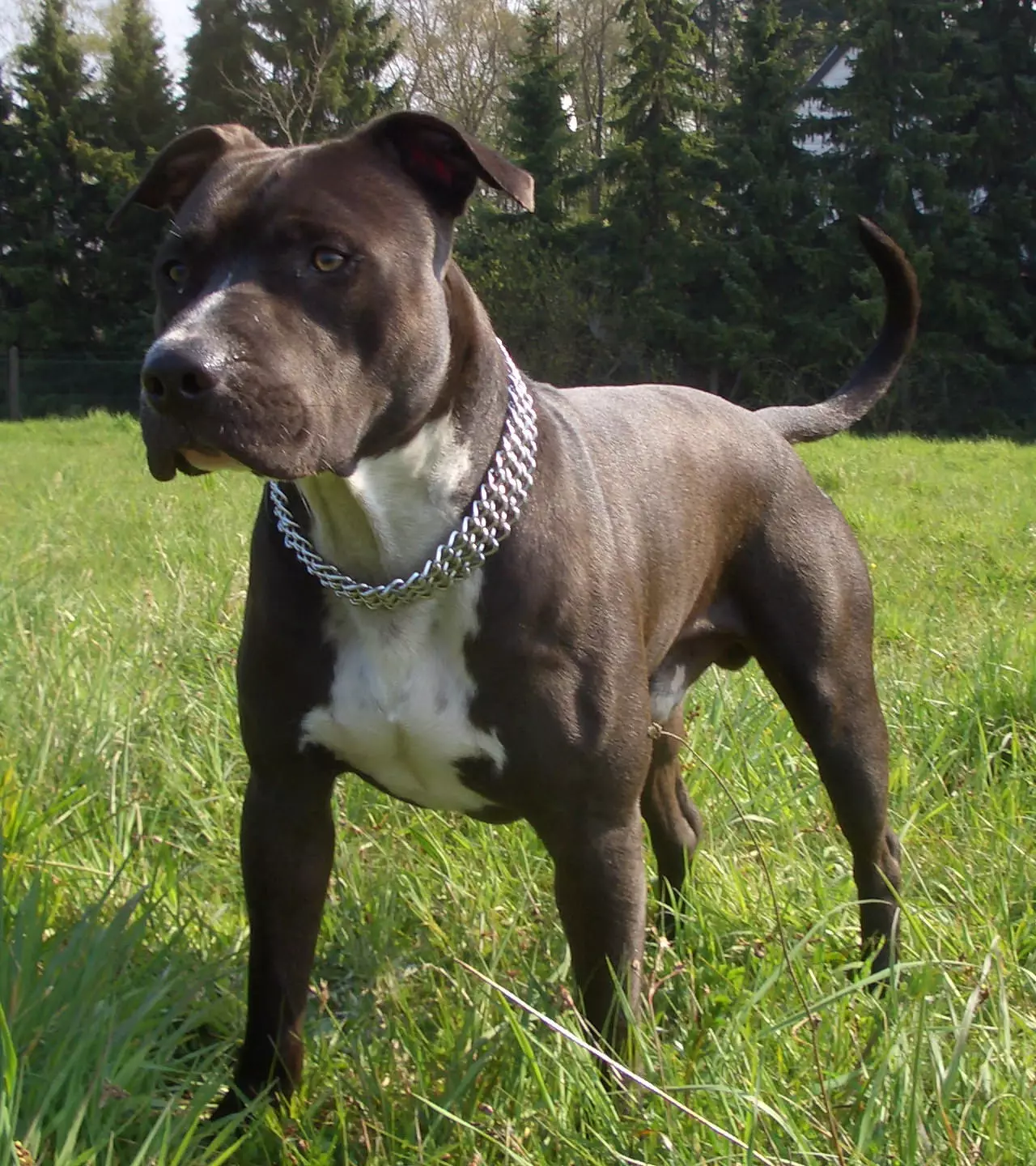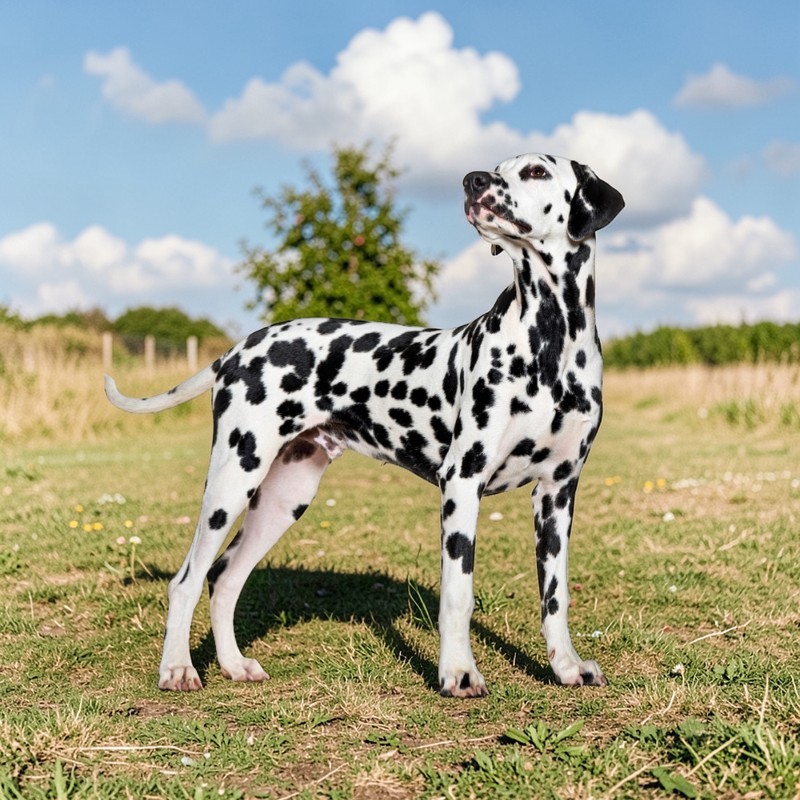
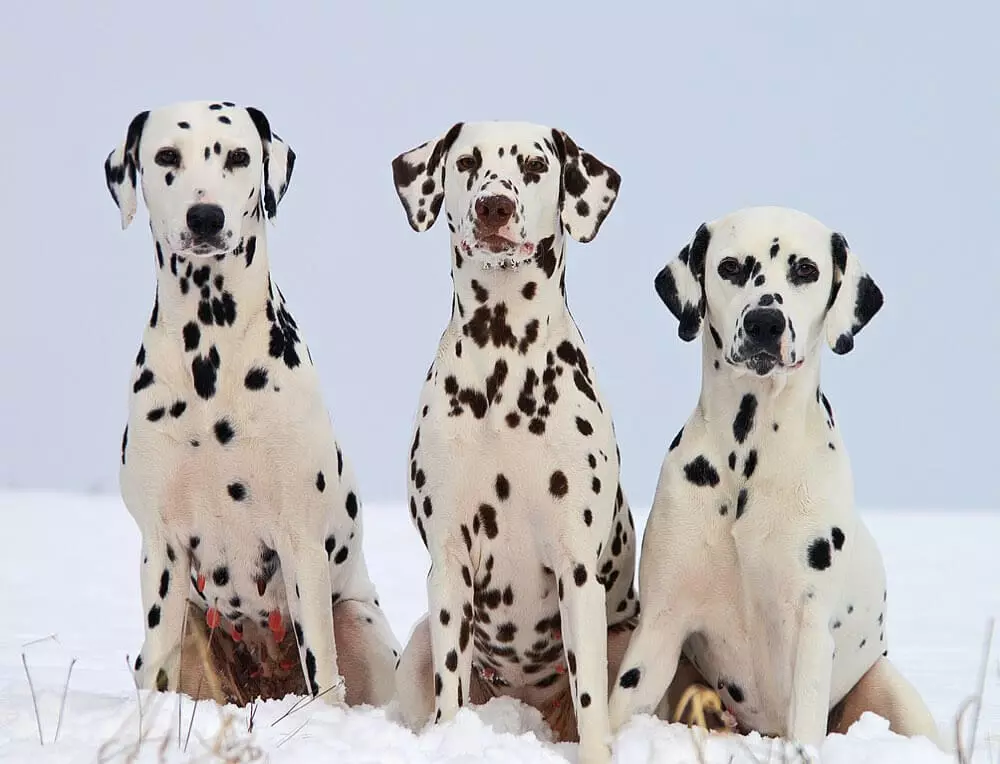
Dalmatian

FCI standard number: 153
Country of origin: Croatia
Classification: FCI Group 6 (running dogs, sweating dogs and related breeds)
Height at withers bitch: 54-60 cm
Height at withers male: 56-62 cm
Weight bitch: often around 16-24 kg (typical, varies according to line/body type)
Weight male: often around 18-32 kg (typical, varies according to line/body type)
Coat colour: Basic colour pure white with black or liver-brown (brown) spots
Coat texture: Short, shiny, hard and dense
Neck circumference: highly individual; in adult Dalmatians often roughly around 35-50 cm (measure on the dog before buying a collar/harness).
Product information "Dalmatian"

The Dalmatian


History of the Scottish Terrier

The origin of the Dalmatian is described in paintings and ecclesiastical chronicles from the 16th to 18th centuries; the standard refers in particular to the area of the eastern Mediterranean and the historical province of Dalmatia (now Croatia). Later, the Dalmatian became known and standardised in England as the "Coach Dog".


Appearance

Body shape: The Dalmatian appears harmoniously proportioned, rectangular in build, strong and well-muscled, but not heavy. Its elegant, flowing movement is characteristic.

Coat: The coat is short and dense; the clearly defined spots should be evenly distributed.


Nature and character

In the FCI standard, it is described as friendly, lively, loyal, independent and "easy to train", with a pronounced running dog instinct and a love of exercise and nature.


Grooming

Dalmatians are low-maintenance in the sense of "no cutting/trimming": regular brushing helps to remove loose hair (they often shed noticeably). Also check the basics such as ears, claws and teeth. Sufficient daily exercise and activity is particularly important, otherwise they will quickly become underchallenged.


Health

Congenital deafness is comparatively common in Dalmatians; breeders often have puppies tested using the BAER test. In addition, there is a breed-typical tendency to hyperuricosuria (increased uric acid excretion), which can favour urate urinary stones; a genetic cause (including SLC2A9) has also been described.


Education

Dalmatians are smart and willing to work, but need clear rules, routine and meaningful tasks. Short, varied units with positive motivation work best. Hunting and running dog instincts are important: Build up recall and lead behaviour early and cleanly.


What are the special features of this breed?

Very active and persistent - more of a "sports partner" than a sofa dog. Breed-typical deafness problem → BAER test is a major issue. Breed-typical metabolic peculiarity (uric acid/urate stones) → management and attention useful. Distinctive, short coat - easy to groom, but hair can still be everywhere.


Suitable for first-time dog owners?

Conditionally yes. If you like to be active, train in a consistent and friendly manner and take care of health issues (BAER, urate issues), it can be a good fit. It is often too demanding for people who are looking for a dog that "just runs on the side".


Family dog or not?

Yes, often - when everyday life is right. Dalmatians can be very people-orientated, but need exercise, activity and clear rules. They usually work well in calm, structured families; in very hectic households without time for exercise, it tends to be difficult.

Composition
Feeding recommendation
Technical details
Size information

0 of 0 reviews

Give us a rating!

Share your experience with the product with other customers.


Suggested products

Australian Cattle Dog
Profile Australian Cattle DogHistory of the Australian Cattle DogThe Australian Cattle Dog was developed in Australia specifically for hard work with cattle: What was needed was an enduring, strong dog that could also control and drive difficult cattle. The standard describes the development from crosses of working collies with the Dingo, later with other influences.AppearanceBody shape: It is a strong, compact, symmetrically built working dog. He appears very muscular, agile and enduring without being clumsy.Coat: The coat is short to medium length, dense and weatherproof, with a distinct undercoat.Temperament and characterThe standard describes him as very intelligent, alert, courageous and reliable. At the same time, he is naturally suspicious of strangers and has a strong protective instinct.GroomingThe coat is generally easy to care for, but should be brushed more frequently when changing coat to remove undercoat. Overall, it needs much more attention than "hair care".HealthTypical issues mentioned are hip dysplasia and eye problems such as progressive retinal atrophy (PRA) and a genetic tendency to deafness.EducationHe is very capable of learning, but he needs clear rules, early socialization and meaningful tasks. Without guidance, he may try to "do" moving things (this includes nipping at heels), which must be properly trained early on, especially with children.What special features does this breed haveHe is a real working dog in family format: extremely persistent, clever, often very closely bonded to his caregiver and happiest when he is challenged physically and mentally on a daily basis.Suitable for first-time dog owners?Only to a limited extent. If you are really sporty, take training seriously and offer consistent activity, it can work. It is usually too demanding for "relaxed beginners" who are looking for an uncomplicated companion.Family dog or not?It can be a good family dog, but often more for active families with clear rules. Many descriptions emphasize that he can "herd" children and other animals if not trained early, and that he can be reserved towards strangers.
 
Greater Swiss Mountain Dog
The Gordon Setter History of the Scottish Terrier The Gordon Setter originates from Scotland and was bred there as an enduring hunting dog for bird hunting. The breed became particularly famous through the Duke of Gordon, who promoted it in the 18th and 19th centuries. The aim was to produce a powerful, elegant and robust setter with excellent tracking ability and close contact with humans. Today, the Gordon Setter is used both for hunting and as a sporting companion and family dog. Appearance Body shape: Strong, elegant and harmoniously built. The Gordon Setter is the heaviest of the setter breeds, but does not appear clumsy. He has a deep chest, a straight back and an overall athletic appearance. Coat: The coat is typically jet black with clearly defined chestnut-red markings. It is shorter on the head and the front of the legs, medium length on the body and clearly feathered on the ears, chest, belly, legs and tail. Nature/character The Gordon Setter is considered intelligent, loyal, sensitive and very people orientated. He is lively, attentive and eager to work, but often somewhat more serious and calm than other setters. He is very affectionate towards his family. Towards strangers he is usually more reserved than impetuous. He needs a close bond and feels most comfortable with clear, fair leadership. Grooming The coat needs regular grooming to prevent matting. Brushing several times a week is advisable, especially on the feathered areas. Ears, paws and teeth should also be checked. After walks in the woods and fields, it is important to check the coat and hangings for dirt, burrs or ticks. Health The Gordon Setter is generally considered a robust breed, but like many medium-sized to large dogs, it can be prone to hip dysplasia. Eye problems can also occur. Attention should also be paid to ear care, as the long hanging ears can favour inflammation. Responsible breeding, sufficient exercise and a balanced diet are important. Education Training should be loving, consistent and patient. The Gordon Setter is smart, but also sensitive and not suited to harsh methods. Its hunting disposition requires early training, especially in recall and impulse control. With good socialisation, clear rules and sensible exercise, he will develop into a reliable companion. What are the special features of this breed? The Gordon Setter has a great hunting instinct, stamina and a love of work. He is not a pure sofa dog, but needs both physical and mental activity. It is characterised by its close bond with its humans and its often somewhat more delicate, sensitive nature. Compared to other setters, he often appears somewhat more powerful, serious and calm, but still needs plenty of exercise and tasks. Suitable for first-time dog owners? Conditional. The Gordon Setter can be well suited to committed first-time dog owners with time, patience and a love of exercise. However, its hunting instinct, sensitivity and need for activity should not be underestimated. Without suitable exercise and consistent training, he can become difficult. Family dog or not? Yes, the Gordon Setter is basically a good family dog. He is affectionate, loyal and seeks to be close to his carers. In an active family with sufficient time, exercise and activity, he usually feels very comfortable. He can be friendly and patient with children, provided he is well socialised and treated with respect.
 
Giant Schnauzer
The Giant SchnauzerHistory of the Giant SchnauzerThe Giant Schnauzer originates from Germany. Originally, it was mainly used as a herding and farm dog in southern Germany. Around 1900, breeders recognized its suitability as a powerful working dog. It has been listed in the stud book since 1913 and was officially recognized as a service dog in 1925. AppearanceBody shape: The Giant Schnauzer is large, strong and compact rather than slender. It appears muscular, robust and alert, with an almost square format. Despite its strength, it should not appear clumsy, but harmonious and capable of working. Coat: The coat is typically schnauzer-like, wiry and hard. In addition, the distinctive bushy brows and the strong beard strongly characterize the expression of the breed. Pepper-salt, pure black with black undercoat and black-silver are permitted. Nature/characterThe Giant Schnauzer is considered to be self-confident, strong in character, alert and resilient. At the same time, it is described as benign, loyal and closely attached to its family. Its intelligence, trainability and high willingness to work are typical. It is precisely this mixture that makes him so interesting as a service and working dog.GroomingGrooming is more complex than it seems at first glance. The hard coat should be brushed regularly and dead hair must usually be removed by trimming to maintain the structure and function of the coat. In addition, ears, claws, teeth and paws should be checked regularly. HealthThe Giant Schnauzer is generally regarded as a hardy and efficient breed. Nevertheless, attention should be paid to responsible breeding. As with other large, athletic dogs, hip problems and other hereditary diseases can play a role, depending on the lineage. Controlled growth, good weight management and sensible physical exercise are also important. TrainingTraining should be clear, calm and consistent. The Giant Schnauzer is intelligent and capable of learning, but also self-confident and not simply eager to please. It needs early socialization, reliable rules and a meaningful task. Underchallenging or unclear leadership can quickly become problematic with this strong and alert breed. What are the special features of this breed?What makes this breed special is the combination of its striking Schnauzer appearance, strong personality and high working ability. The Giant Schnauzer is not only an impressive family dog, but also a versatile sporting, working and service dog. Its alertness, resilience and self-confidence make it special, but also require experienced and committed owners.Suitable for first-time dog owners?Only to a limited extent. A very committed and well-informed first-time dog owner can cope with a Giant Schnauzer, but the breed is not easy. Its size, strength, alertness and the need for clear guidance and activity make it more demanding than many typical beginner dogs.Family dog or not?Yes, in principle the Giant Schnauzer can be a good family dog. They are often loyal, affectionate and closely bonded to their humans. However, it is best suited to active, structured households that have time for training, activity and consistent leadership. It is not intended to be an uncomplicated dog for everyday life.
 
Hovawart
The Hovawart dog History of the Scottish TerrierThe Hovawart is an old German working dog breed. Its name is derived from the Middle High German words for court and guard and already describes its original task as a guard and protection dog for house and yard. Modern pure breeding began in 1922 with dogs of a similar type from farms, later crossed with German Shepherds, Newfoundlanders and Leonbergers, among others. The FCI lists Germany as the country of origin of the breed. AppearanceBody shape: The Hovawart is a sturdy, medium-sized to large, slightly elongated dog with a harmonious and robust build. It appears alert, agile and self-assured, without looking clumsy. Coat: The coat is long, dense and lies close to the body for the most part. It is longer on the chest, belly, backs of the forelegs, thighs and tail, forming distinct feathering in these areas. The three recognised colour varieties are blond, black and black and tan. Nature/characterThe Hovawart is considered to be alert, self-confident, intelligent and closely attached to its family. It is not a nervous permanent barker, but has a pronounced protective and territorial behaviour. In everyday life, he is often loyal, sensitive and eager to learn, but needs people who give him security and clear guidance. Its close bond with its carers is also typical. GroomingThe coat is generally considered to be quite low-maintenance, although it is long. Regular brushing is important, especially when the coat changes and in areas that tend to become matted, such as the armpits or trousers. Ears, claws and teeth should also be checked. HealthThe Hovawart is generally considered a robust breed, but care should be taken to ensure responsible breeding with health checks. It is particularly important to check for hip dysplasia, and eye examinations also play a role in breeding. As with large, active dogs, a suitable weight, controlled growth and joint-friendly exercise at a young age are also important. EducationThe training of a Hovawart should start early and be consistent, calm and fair. He is smart and eager to work, but also tests boundaries and likes to act independently. Varied training, mental exercise and clear, reliable leadership are crucial. Harsh methods are unsuitable because many Hovawarts react sensitively and need a real partnership. What are the special features of this breed?The Hovawart has a mixture of alertness, independence, sensitivity and a high willingness to work. It is often late to mature and develops mentally more slowly than some other breeds, which requires patience in training. Added to this is his clear territorial behaviour. He wants to have tasks, be close to his humans and not just run along. It is precisely this combination of protective instinct, independence and close family ties that makes this breed so special. Suitable for first-time dog owners?Rather only conditionally. A committed, well-informed first-time dog owner can get on well with a Hovawart with plenty of support, dog training and consistency. Overall, however, the breed is rather demanding because it is powerful, independent, alert and often demanding at a young age. Without experience or clear leadership, a Hovawart can quickly take on too much responsibility itself. Family dog or not?Yes, in principle the Hovawart can be a very good family dog. He is loyal, people-orientated and usually feels most at home when he is closely involved in family life. At the same time, it is not an uncomplicated side dog. It is particularly suited to active families with space, time and the willingness to devote a lot of time to training and exercise.
 
Lhasa Apso
The Lhasa ApsoHistory of the Scottish TerrierThe Lhasa Apso originates from Tibet and was kept there for many centuries as a watchful companion and temple dog. Especially in monasteries and wealthy households, it was regarded as a valued small guard dog. The FCI lists Tibet as the country of origin and Great Britain as the breed's patron country.AppearanceBody shape: The Lhasa Apso is a small, well-balanced and robust dog. Despite its small size, it does not appear dainty, but rather compact, confident and resilient. Its expression is alert and self-assured.Coat: The coat is one of the breed’s most striking features. It is long, heavy and falls straight down. It should be neither silky nor woolly. The thick fur on the head, beard and around the eyes is part of the Lhasa Apso’s typical appearance.Nature/characterThe Lhasa Apso is considered cheerful, self-confident, attentive and quite independent. It is often reserved or somewhat aloof towards strangers, but is usually close to the people it loves. Its mixture of small size and surprisingly alert, serious character is typical.GroomingGrooming is time-consuming and requires regularity. The long coat should be brushed and combed thoroughly to prevent matting. Eyes, ears, paws, claws and teeth should also be checked regularly. Consistent grooming is very important in everyday life, especially for such a long-haired little dog. HealthThe Lhasa Apso is generally regarded as a fairly robust and long-lived small breed. Nevertheless, care should be taken to ensure responsible breeding. Depending on the line, eye problems, skin issues, dental problems or patella problems can play a role. Regular veterinary checks, good weight management and a reputable breeding base are important. EducationTraining should be friendly, clear and consistent. The Lhasa Apso is intelligent, but often also wilful and not simply eager to please. It therefore needs early socialisation, reliable rules and calm leadership. Harsh methods do not suit this self-confident, often sensitive breed. What are the special features of this breed?What is special about this breed is the combination of its small body, large presence and ancient monastery dog history. The Lhasa Apso is not a typical submissive small dog, but often a self-confident, alert and quite independent companion. In addition, its distinctive, long coat makes it unmistakable.Suitable for first-time dog owners?Conditional. A calm, consistent and well-informed first-time dog owner can get on well with a Lhasa Apso. However, the breed is not completely uncomplicated because it can be independent, vigilant and sometimes stubborn. Anyone who underestimates small dogs simply because of their size will not always get on easily with a Lhasa Apso.Family dog or not?Yes, in principle the Lhasa Apso can be a good family dog. It is particularly suited to quiet, respectful households where its independence is taken seriously. It often gets on well with older, understanding children. It is less at home in very noisy or hectic families. This classification is a technical deduction from the breed's character, size and typical behaviour.
 
Miniature Schnauzer
The Miniature SchnauzerHistory of the Scottish TerrierThe Miniature Schnauzer originated around the turn of the century in the Frankfurt am Main area and was initially known as the rough-haired Miniature Pinscher. The aim was to create a small dog with the character and appearance of the Schnauzer, without dwarf-like exaggerations.AppearanceThe Miniature Schnauzer is a small, strong, stocky rather than slender, rough-coated dog. It is said to be the miniature version of the Schnauzer and appears alert, robust and compact. Body shape: Squarely built, with the height at the withers roughly corresponding to the body length; strong, compact and well proportioned.Coat: Wiry, dense and weatherproof, with a distinctive beard and bushy brows. Nature/characterThe Miniature Schnauzer is considered to be smart, lively, alert and fearless. The FCI describes it analogously with the characteristics of the Schnauzer in a small form: benign, playful, spirited and alert.GroomingThe coat needs regular brushing and, in this breed, usually also professional trimming to maintain the typical wiry structure. The beard, eyebrows and legs require additional grooming because dirt easily accumulates there. HealthThe FCI standard requires functionally and clinically healthy breeding animals. The Miniature Schnauzer is generally considered to be a fairly robust small dog, but responsible breeding is important as always. The standard itself does not give a detailed list of typical breed diseases.EducationThe Miniature Schnauzer is eager to learn and attentive, but needs clear, friendly consistency. Because of its alertness and self-confident terrier temperament, you should work on socialisation, leash training and controlled alert behaviour at an early age.What are the special features of this breed?His distinctive Schnauzer head with beard and brows, wiry coat and mixture of small size and great self-confidence are what make him special. He is not a fragile lap dog, but an alert, robust and rather present companion dog.Suitable for first-time dog owners?Yes, often well suited. The Miniature Schnauzer can be very suitable for motivated beginners because it is manageable, intelligent and suitable for everyday use. However, you should be prepared to deal with its alertness, temperament and grooming requirements.Family dog or not?Yes, in many cases a good family dog. He is affectionate, lively and robust enough for an active everyday life, as long as he is treated with respect and kept busy in a meaningful way. They usually do well in families with clear rules and regular grooming.
 
Doberman
The DobermanHistory of the Scottish TerrierThe Dobermann is the only German dog breed to be named after its first known breeder: Friedrich Louis Dobermann. In the 19th century, the breed was developed as a vigilant, sharp and resilient guard and working dog and was later also used as a police and service dog.AppearanceBuild: medium to large, strong, muscular and at the same time very elegant. Typical are the proud posture, the clear lines and the athletic, almost square build. He appears powerful, determined and very present.Coat: The coat is very easy to care for because it is short and smooth. It provides less protection against the cold than densely coated breeds with an undercoat, which is why many Dobermans are more sensitive in winter or when wet.Nature/characterAccording to the FCI, the Doberman should have a friendly and peaceful disposition, be very affectionate in the family, with a medium temperament, medium keenness, good manageability, willingness to work, self-confidence and fearlessness. The VDH also describes him as intelligent, attentive, robust and loyal; he is often initially reserved towards strangers.GroomingGrooming is uncomplicated; regular brushing and the usual claw, ear and dental care are usually sufficient. Exercise, activity and close social contact are more important for the Doberman than grooming. They are athletic and want to be challenged both physically and mentally.HealthHeart health and responsible breeding are particularly important for this breed. Frequently mentioned issues are dilated cardiomyopathy (DCM), von Willebrand's disease (vWD) and hip dysplasia (HD); VDH breeder websites mention heart examinations, genetic tests and HD examinations, among other things. Thyroid problems are also mentioned as a typical breed issue.EducationThe Doberman is very capable of learning and eager to work, but needs expert, calm and consistent leadership. His strength, alertness and sensitivity need to be channelled in the right direction. With fair training, early socialisation and clear rules, he is usually a very reliable partner.What are the special features of this breed?The Dobermann combines elegance, speed, alertness and a high willingness to work like hardly any other breed. He usually bonds very closely to his humans, is alert and quick to react, but also sensitive and not made for a side-by-side attitude. He needs closeness, structure and meaningful tasks.Suitable for first-time dog owners?Rather no. The VDH expressly describes it as not a four-legged friend for beginners because it is demanding and needs expert training. Dedicated beginners with very good guidance could keep him, but overall he is better suited to experienced dog owners.Family dog or not?Yes, in principle - but only if kept appropriately. The FCI standard expressly states that it should also be particularly suitable as a family dog. The VDH describes it as a loyal family dog with a close bond, high adaptability and good tolerance towards children. However, this requires good socialisation, sufficient exercise and competent training.
 
Australian Cattle Dog
Profile Australian Cattle DogHistory of the Australian Cattle DogThe Australian Cattle Dog was developed in Australia specifically for hard work with cattle: What was needed was an enduring, strong dog that could also control and drive difficult cattle. The standard describes the development from crosses of working collies with the Dingo, later with other influences.AppearanceBody shape: It is a strong, compact, symmetrically built working dog. He appears very muscular, agile and enduring without being clumsy.Coat: The coat is short to medium length, dense and weatherproof, with a distinct undercoat.Temperament and characterThe standard describes him as very intelligent, alert, courageous and reliable. At the same time, he is naturally suspicious of strangers and has a strong protective instinct.GroomingThe coat is generally easy to care for, but should be brushed more frequently when changing coat to remove undercoat. Overall, it needs much more attention than "hair care".HealthTypical issues mentioned are hip dysplasia and eye problems such as progressive retinal atrophy (PRA) and a genetic tendency to deafness.EducationHe is very capable of learning, but he needs clear rules, early socialization and meaningful tasks. Without guidance, he may try to "do" moving things (this includes nipping at heels), which must be properly trained early on, especially with children.What special features does this breed haveHe is a real working dog in family format: extremely persistent, clever, often very closely bonded to his caregiver and happiest when he is challenged physically and mentally on a daily basis.Suitable for first-time dog owners?Only to a limited extent. If you are really sporty, take training seriously and offer consistent activity, it can work. It is usually too demanding for "relaxed beginners" who are looking for an uncomplicated companion.Family dog or not?It can be a good family dog, but often more for active families with clear rules. Many descriptions emphasize that he can "herd" children and other animals if not trained early, and that he can be reserved towards strangers.
 
Greater Swiss Mountain Dog
The Greater Swiss Mountain Dog Its history The Greater Swiss Mountain Dog originates from Switzerland and is one of the old farm and working dogs of the Alpine region. It was formerly used as a guard dog, draught dog and herding dog. For a long time, the breed was considered to have almost disappeared until it was specifically promoted again at the beginning of the 20th century. Today, it is mainly kept as a family, guard and companion dog. Appearance Body shape: Strong, large, muscular and harmoniously built. The body is slightly longer than high, with a broad chest, strong back and powerful limbs. Despite its mass, it does not appear clumsy, but expressive and resilient. Coat: The coat is dense, weatherproof and easy to care for. Typical is the tricolored pattern with black base color, rust-red markings on the cheeks, above the eyes, on the chest and legs as well as white markings on the head, chest, paws and tip of the tail. Temperament/character The Greater Swiss Mountain Dog is considered to be self-confident, calm, attentive and people-oriented. He is very loyal to his family and usually shows a balanced, friendly nature. He is often alert and reserved towards strangers, without unnecessary aggression. He has a mind of his own, but is reliable and loyal when well bonded. Grooming Grooming is generally uncomplicated. Regular brushing is usually sufficient, but more frequent brushing is recommended during the shedding season. Ears, claws and teeth should be checked and groomed. Because of its size, care should also be taken to ensure that it has a suitable weight and is exercised in a way that is easy on the joints. Health Like many large dog breeds, the Greater Swiss Mountain Dog can also be prone to joint problems such as hip dysplasia and elbow dysplasia. Gastric torsion is also an important issue, which is why feeding and exercise should be well coordinated. Reputable breeding, controlled growth at a young age and a healthy body weight are particularly important. Training Training should be calm, clear and consistent. Harsh methods are unsuitable, as the breed can react sensitively to unfair treatment. The Greater Swiss Mountain Dog learns well, but needs a close bond, patience and confident leadership. Early socialization is important so that it reacts calmly and confidently to environmental stimuli. What are the special features of this breed? This breed has a lot of strength, size and alertness. A Greater Swiss Mountain Dog is not a dog to be kept on the side. It needs plenty of space, a close family bond and people who can lead it reliably. Its mixture of calmness and protective instinct is also typical. Many representatives of the breed mature rather late and appear youthful for a long time. Due to their size, they can be very physically present in everyday life, which should not be underestimated. Suitable for first-time dog owners? Conditionally. For motivated and well-informed first-time dog owners, the breed may be possible, but it is not the easiest choice. Their size, strength, independence and protectiveness require good, consistent training and a great sense of responsibility. If you have little dog experience, you should prepare yourself intensively and ideally work with a dog school or trainer. Family dog or not? Yes, the Greater Swiss Mountain Dog is generally a good family dog. He is affectionate, loyal and usually very close to his caregivers. They can be friendly and patient with children. Because of its size and strength, however, it should always be handled under supervision. It is particularly suitable for families who have enough space, time and understanding for a large, hard-working and alert dog.
 
Pekingese
The PekingeseHistory of the PekingeseThe Pekingese originates from China and is one of the ancient Asian social dogs. Long before our era, there were depictions of small dogs that resembled today's Pekingese. In China, the breed was closely associated with the imperial court and later became known in Europe. Great Britain had a strong influence on its further development and is listed as a patron country by the FCIAppearanceBody shape: The Pekingese is small, compact and surprisingly heavy for its size. Typical features are the broad, rather flat head, the short muzzle, the large dark eyes and the overall lion-like expression. Despite its small size, it should appear dignified, robust and not dainty. Coat: The coat is moderately long, straight and very abundant without completely covering the body. The mane around the neck and shoulders and the feathering on the ears, legs, tail and toes are particularly striking. The variety of permissible colors makes the breed visually quite versatile. Nature/characterThe Pekingese is considered courageous, self-confident, dignified and often quite independent. It is usually closely attached to its caregivers, but is often more reserved than impetuous towards strangers. Its large presence in a small space is typical. He often appears more serious and independent than many other small companion dogs. This character assessment is a professional derivation from the breed type, standard and breed description.GroomingGrooming is time-consuming and requires regularity. The long coat should be brushed and combed thoroughly to prevent matting. Eyes, skin folds, ears, claws and teeth should also be checked regularly. Careful grooming is particularly important in the facial area. This practical grooming assessment is a professional deduction from the coat type and build. HealthHealth is particularly important for the Pekingese. The short head shape can be associated with breathing problems, sensitivity to heat and other stresses relevant to everyday life. The eyes, skin folds and spine also deserve attention. This is why very responsible breeding with a view to functionality and resilience is particularly important. TrainingThe Pekingese needs friendly, clear and consistent leadership. He is intelligent, but often also headstrong and not simply pleasing. Therefore, despite its small size, it should be taken seriously and given reliable rules. With early socialization and calm consistency, it usually develops into a pleasant companion dog. What are the special features of this breed?What is special about this breed is the combination of its lion-like appearance, old imperial court history and very self-confident demeanor. The Pekinese is not a typical submissive small dog, but often a dignified, courageous and independent companion. It is this mixture of small size and big personality that makes them special. Suitable for first-time dog owners?Conditionally. A calm and well-informed first-time dog owner can get on well with a Pekingese. However, the breed is not completely uncomplicated because it is independent, requires a lot of care and can be more demanding in terms of health than many other small dogs.Family dog or not?Conditionally yes. The Pekingese can be a good family dog if you respect its independence and treat it with consideration. They are often particularly well suited to quiet households. It usually feels less at home in very turbulent families or with boisterous behavior.
 
Golden Retriever
The Golden RetrieverHistory of the Scottish TerrierThe Golden Retriever was bred in Great Britain as a reliable retriever (especially for hunting with a shotgun, also from the water) - hence its love of water, its "soft mouth" and its close co-operation with humans.AppearanceBody shape: medium to large, strong and harmoniously built; symmetrical, ‘robust’ with a friendly expression. Coat: medium length, with feathering (especially on legs, tail and chest) and a dense undercoat – making it weather-resistant, but also requiring more grooming.Nature/characterTypical characteristics are: friendly, trusting, intelligent, docile and with a natural willingness to work ("will to please"). Many Golden Retrievers need a lot of activity (head + body) - otherwise they look for "jobs" for themselves (e.g. stealing, carrying, digging).GroomingCoat care: regular brushing (much more frequently when changing coat), as undercoat and feathering tend to become matted. Ears & paws: Check ears (drooping ears + bathing = risk of inflammation), check paws/"feathers" after walks in the forest.HealthWith Golden Retrievers, particular attention should be paid to serious breeding (health examinations, transparency, suitable matings). Frequently discussed issues in the breed include hips/elbows, eyes, ears and a certain tendency to be overweight (especially with too many snacks + too little exercise). (General note; specific risks depend heavily on line/breeding/keeping).EducationUsually easy to train because they are co-operative and people-oriented. Important: early impulse control, "don't eat anything from the floor", calm behaviour when left alone, leash training. Positive, clear rules + meaningful tasks are ideal: Retrieving, dummy work, mantrailing, obedience, rescue dog work - suits the breed very well.What are the special features of this breed?Retriever gene: Many like to carry things around, love search and retrieve tasks. People-orientated: Closeness and co-operation are often more important than "being alone in the garden". Water-loving + fur: Many like to bathe - drying their fur/checking their ears is part of this. "Friendly to everything": Can be great, but is rather unsuitable depending on the goal (guard dog).Suitable for first-time dog owners?Often yes - but only if you have the time and desire for training and exercise. Although a Golden is usually co-operative, it is not a sure-fire winner: young dogs can be wild, boisterous and very "food-motivated". If you consistently train them in a friendly manner and keep them busy every day, you will usually get a very pleasant companion.Family dog or not?Very often an excellent family dog because it is generally friendly, patient and social. Important for families: Children & dog must be supervised (resting areas, rules, no constant behaviour of the dog). A Golden that is kept busy is usually relaxed - one that is underchallenged can become annoying.
 
Chow Chow
Profile Chow-Chow / Chow ChowHistory of the Chow ChowAccording to the FCI standard, the Chow Chow originates from China, where it was used as a guard dog and also for hunting. It has been known there for over 2000 years and only arrived relatively late (around 1800) in other countries, including England.AppearanceBody shape: You get a compact, short coupled, well-balanced dog with a lion-like appearance and a proud and dignified stance. The tail carried high over the back and the typical gait are also characteristic. Coat: The coat is very dense and weatherproof, either as a rough-haired or smooth-haired variety. Around the neck, it is often particularly luxuriant in the rough-haired type and looks like a mane.Temperament and characterThe Chow Chow is described in the standard as a calm, very alert dog, headstrong, loyal and at the same time rather reserved. This means that he often bonds strongly, but is not necessarily the "jump on everyone and be happy" type.GroomingYou should brush the dense coat regularly so that undercoat and knots do not become a problem, especially when changing coats. In summer, good heat management is important because a lot of fur can be a burden in the heat.HealthFrequently mentioned issues are eye problems such as entropion (curled eyelid), hip dysplasia and hypothyroidism. When choosing a breeder, make sure that the examinations are transparent and discuss preventive care (eyes, hips, thyroid) with your vet at an early stage.TrainingThe best way to train your dog is with calm consistency, clear rules and respectful treatment. Because the Chow Chow is independent, it needs reliable everyday rituals early on, good socialization and training that builds cooperation rather than pressure.What special features does this breed haveThe lion-like appearance, the very dense undercoat and the bluish-black tongue are typical breed characteristics. In everyday life, he is often calm, but attentive and not "submissive", which makes leadership through clarity and trust particularly important.Suitable for first-time dog owners?Rather limited: If you familiarize yourself well, remain consistent and build up socialization and rules suitable for everyday life properly from the start, it can work. If you expect a dog that wants to please everyone by itself and always follows immediately, the breed is often less suitable.Family dog or not?This can be a good fit if the family is calmly structured and everyone respects the reserved character. In very turbulent households, management is important so that the dog has privacy, calm and clear boundaries.
 

Customers also saw

Deerhound
The DeerhoundHistory of the DeerhoundThe Deerhound is known as the "Scottish Deerhound" and has been used to hunt red deer for many centuries. The standard describes a long tradition in Scotland and emphasizes that the type has remained very similar over the centuries.AppearanceBody shape: Reminiscent of a very large, rough-coated Greyhound: high-stepping, deep-chested, powerfully built but elegant. His body is built for speed, strength and endurance.Coat: The coat is functional: wiry and weatherproof on the body, with softer areas on the head/chest/belly; "woolly" coats are undesirable.Temperament and characterTypical characteristics are gentle dignity, friendliness and a rather calm demeanor in the house. The standard describes him as gentle, friendly, good-natured, obedient and easy to train - at the same time he remains a sighthound with a sight-hunting instinct.GroomingBrush/comb out regularly (especially after forest/hedges) so that dirt and small patches of felt do not remain. Check ears, claws and teeth as usual. Above all, it is important to find the right balance between exercise (e.g. free, safe sprints) and rest - Deerhounds are often athletic outdoors and surprisingly relaxed indoors.HealthIn large, deep-chested breeds, gastric torsion (GDV/bloat) is an important issue. In addition, dilated cardiomyopathy (DCM) and bone cancer (osteosarcoma) are described as relevant problems in Deerhounds.TrainingFriendly, clear and calm leadership. Typical for sighthounds is the instinct to hunt by sight: recall is often never "100% game-proof". Therefore, train alternatives early on (impulse control, orientation towards humans) and work with a lead/secured free run in areas with lots of game. Short, positive sessions usually work better than drill-like training.What are the special features of this breed?Very large, fast and strong - needs safe opportunities for free runs. Sight hunting instinct: deer/hares can "flip the switch" (management more important than perfection). Often quiet indoors, athletic outdoors - many are real "sofa sprinters". Keep an eye on health issues of large, deep-chested dogs (e.g. GDV).Suitable for first-time dog owners?Conditionally. If you are experienced in handling large dogs or are prepared to familiarize yourself consistently (safety management, greyhound recall reality, health care), it can work. As an "uncomplicated side dog" it is usually too demanding.Family dog or not?Yes, often - if the family is right. In quiet households with respectful children, clear rules and enough space/exercise, he can be a very pleasant family dog. For very hectic families or when there are hardly any safe running opportunities, he is rather difficult.
 
Small poodle
Small Poodle History of the Scottish Terrier The poodle is one of the old European dog breeds and was originally used as a water dog. It was strongly characterised and further developed in France in particular, which is why France is now considered the country of origin. Over time, the larger working dog developed into different size variants, including the small poodle. Later, the poodle became known primarily as an intelligent companion, show and family dog. Appearance Body shape: The Toy Poodle is harmoniously, elegantly and well-proportioned. It appears neither clumsy nor fragile, but lively, proud and agile. Typical features include a rather square overall appearance, a fine but not weak bone structure, and a springy, light gait. Coat: The coat is one of the breed’s most striking features. It is dense, fine and tightly curled or formed into cords. The Toy Poodle usually sheds very little, but requires regular and careful grooming. Nature/character The small poodle is considered to be very intelligent, attentive, playful and people-orientated. It learns quickly, enjoys working with its people and is often extremely adaptable. Many small poodles are friendly, alert and sensitive without being overly nervous. Thanks to their intelligence and keen powers of observation, they often react very clearly to the mood and everyday life of their owners. Grooming Grooming is more time-consuming than many initially think. The coat must be regularly brushed, combed and cut or clipped at sensible intervals so that it does not become matted. Ears, claws, teeth and eyes should also be checked regularly. Because the coat sheds so little, loose wool often gets caught in the coat and needs to be actively removed. Health The small poodle is generally regarded as a fairly robust and long-lived variety. Nevertheless, attention should be paid to responsible breeding. Depending on the line, patella problems, eye diseases, dental problems or hereditary diseases can play a role. Regular veterinary checks, good weight management and a reputable breeding base are important. Education The small poodle is generally very easy to train. It learns quickly, is attentive and often wants to work closely with its human. It responds best to friendly, clear and consistent training. Harsh methods are unsuitable because many Poodles react sensitively. With early socialisation, variety and meaningful mental activity, the small poodle usually develops into a very pleasant companion. What are the special features of this breed? What is special about this breed is the combination of intelligence, elegance and a great love of learning. The small poodle is usually much more than just a pretty companion dog. They are often very attentive, athletic and versatile, for example in everyday life, dog sports or mental tasks. They also have a special coat that sheds very little but requires a lot of grooming. Suitable for first-time dog owners? Yes, the small poodle is often very suitable for first-time dog owners. They are usually smart, co-operative and easy to train. The important thing is not to underestimate them. Even a small to medium-sized poodle needs training, activity and regular grooming. If you are prepared to do this, you will often find him to be a very pleasant beginner's dog. Family dog or not? Yes, the small poodle is generally a very good family dog. It is usually friendly, playful and closely bonded to its humans. They generally feel very comfortable in a family with loving consistency, sufficient activity and respectful behaviour. Due to its adaptability, it often suits both active families and quieter households.