Handbook of forage plants 2nd revised editionMarion Minch is not only a successful breeder of diverse tortoises for many years, but also an excellent connoisseur of native wild herbs. She founded and runs samenkiste.de, which is well known to many tortoise keepers and nature lovers. Her name is inextricably linked with reptile care and species-appropriate nutrition for tortoises. Her handbook of food plants summarises the most important native food plants for herbivorous and omnivorous reptiles. She not only considers tortoises, but also iguanas, spiny-tailed dragons and even chameleons. From the basics of plant biology to native wild herbs to suitable food plants for hardy tropical reptile species, this comprehensive work provides the basis for species-appropriate keeping. In the expanded and supplemented 2nd edition, the plant section is divided according to flower colour. This makes it even easier to identify wild herbs. The work has also been supplemented with a wealth of additional information and many pictures.
Geckos in the terrarium by Astrid FalkThe book offers a comprehensive introduction to geckos and their species-appropriate keeping in terrariums. It explains what you need to think about before buying a gecko and what preparations should be made. The book describes in detail how the terrarium is technically equipped and set up. The care of the animals, their special features and behaviour, their diet, reproduction and rearing of young animals are described, as well as diseases and husbandry problems with tried and tested suggestions for prevention and treatment. Individual gecko species that are particularly suitable for keeping and breeding in terrariums are portrayed in detail in the second part of the book.
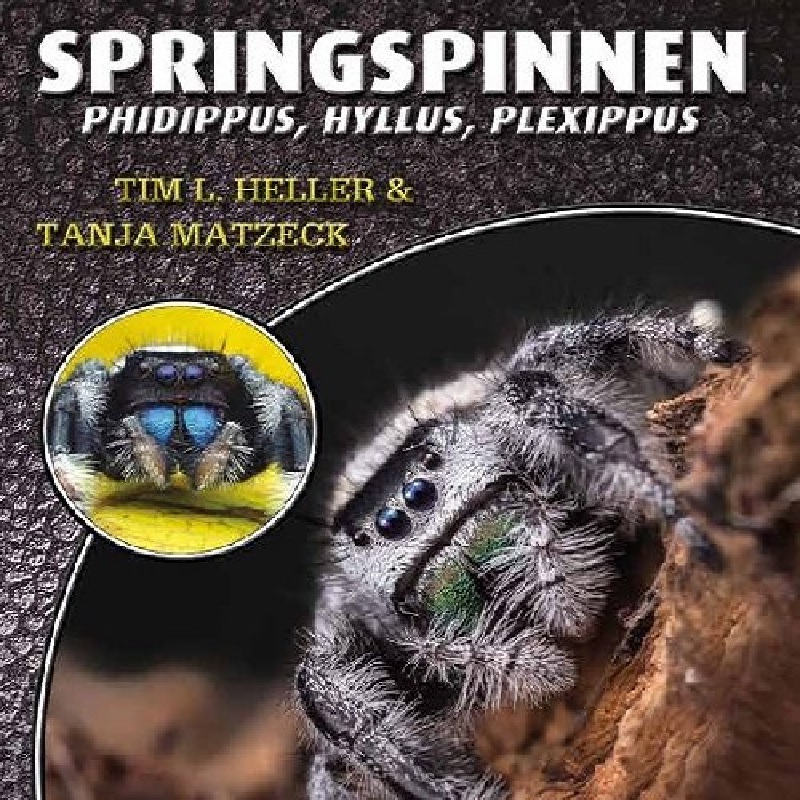
Book Jumping Spiders -
Phidippus, Hyllus & Plexippus
A guide to keeping jumping spiders of the genera Phidippus, Hyllus & Plexippus. Who can resist the charm of jumping spiders? The childlike appearance of their expressive face simply leaves no one cold! In addition, their behavior is extremely exciting to observe, their colors are bright and their requirements for species-appropriate keeping are very easy to meet. No wonder these likeable jumpers are all the rage!
This volume in the "Species by Species" series describes in detail what to look out for when buying and keeping them, introduces the most commonly kept species and color forms and provides plenty of tips on how to keep them successfully - so you can be sure they will breed well!
Species by Species introduces you to the books in this series, which present the most popular terrarium animals. Each volume offers you detailed, practical care instructions and all the information you need to successfully breed your animals.
All important questions from the required tank size to terrarium set-up, technical equipment, species-appropriate nutrition and disease prevention are answered with numerous tricks and tips.
Experienced, long-standing breeders reveal how you can encourage the animals to reproduce and raise healthy young.
All this in full color, generously illustrated and attractively designed - just about your terrarium animal - species by species
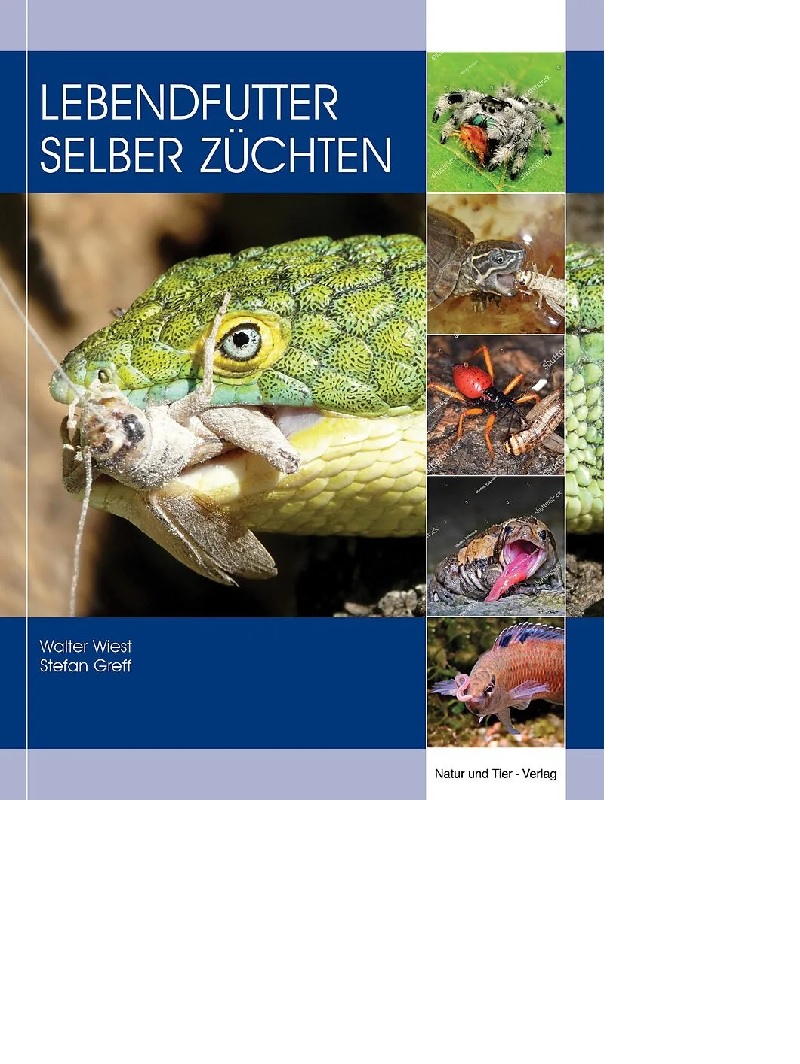
Book "Grow your own live food" - The perfect guide for pet owners
Discover practical and detailed instructions on how you can easily breed food for your reptiles, birds, fish or other animals yourself in the book "Breeding live food yourself". With valuable tips on various food insects, their care and breeding, you can save money and ensure a species-appropriate diet for your pets.
Contents of the book:
Step-by-step instructions for breeding feeder insects
Information on the best types of food for reptiles, birds and fish
Care instructions and breeding conditions for various live food species
Tips for sustainable and cost-effective food production
Why breed your own live food?
Get healthy, fresh food for your animals
Save money and reduce dependence on pet shops
Promote the health and well-being of your animals with species-appropriate food
Whether you are a beginner or an experienced pet owner, this book provides you with everything you need to successfully breed live food yourself.
Marginata 69 - New Guinea tortoises – the genus ElseyaCover storyThe unrecognised beauties: New Guinea tortoises (Andreas S. Hennig)My experiences with Branderhorst's New Guinea tortoise, Elseya (Elseya) branderhorsti (Ouwens, 1914) (Andreas S. Hennig)Keeping and breeding of Rhodin's New Guinea tortoise, Elseya (Hanwarachelys) rhodini Thomson, Amepou, Anamiato & Georges, 2015 (Andreas S. Hennig)PortraitGeoemyda spengleri, Chinese serrated tortoise (Andreas S. Hennig)ReportageMacrochelys temminckii – Experiences and impressions with vulture tortoises part 2 (Reiner Praschag)KeepingAn alternative to year-round keeping of the Egyptian tortoise in the terrarium – my experiences with seasonal outdoor keeping of Testudo kleinmanni (Ricarda Schramm)EtymologySawbacks and living maps part 4: Graptemys gibbonsi, Pascagoula humpback tortoise (Holger Vetter)Classifieds & animal placement
Herpeton - Fire-bellied newts
With this book, the authors draw on their over 20 years of experience with various fire-bellied newt species to provide beginners and advanced keepers with instructions on how to keep and breed their animals professionally
Contents:
Systematics, habitats, way of life, appearance, behaviour, acquisition of animals, stocking density, acclimatisation, socialisation, capture and temporary housing, aquaria (size, cover, aquarium technology, location, equipment, rearing tanks, aqua-terraria and paludaria, terraria, plants for fire-bellied newt tanks, care and water changes, overview of food animals, life expectancy, hibernation, egg laying and egg development, housing of eggs, larval development, housing of larvae, rearing of metamorphosed juveniles, problems with breeding, diseases, species descriptions, (Cynops ensicauda, Cynops pyrrhogaster, Cynops orientalis), and much more.
Marginata 40 - Red-headed slider turtlesFree-range keeping and breeding of European water turtlesKeeping and breeding big-headed tortoises part 2Looking turtles in the mouthContents:EditorialMagazineDates PHOTOSTORYThe red-headed slider turtleHans-Dieter Philippen REPORTAGEThe red-headed slider turtle in the wildHerbert Meier BREEDINGKeeping and breeding the red-headed slider (Podocnemis erythrocephala) Part 1David Drajeske PortraitSalvin’s Cross-breasted Turtle Staurotypus salvinii Grey, 1864Hans-Dieter Philippen BREEDINGBig-headed turtles in nature and human care part 2Reiner Praschag REPORTAGEOutdoor keeping of European pond turtles of the genera Mauremys and EmysSacha Pawlowski REPORTAGELooking turtles in the mouthEgon Heiss & Nikolay Natchev Book tipSubscription & ServiceRegional guide
Marginata 23 - Soft-shelled turtlesSea turtles of IndiaCold frames for tortoisesTestudo hermanni in CataloniaContents:2 Editorial3 letters to the editor4 Magazine8 dates10 REPORTAGE The African Beaked Tortoise (Chersina angulata). Part 1 Comments on the biology and ecology of the species, the comparison of three different biotopes and the integration of the species in these areas Michael Wirth31 POSTER The pale-footed tortoise (Pangshura smithii pallidipes) Hans - Dieter Philippen36 REPORTAGE Status and protection of the western tortoise turtle (Testudo hermanni hermanni) in Catalonia, Spain Silvia Brusciotti, Joaquim Soler and Albert Martinez42 REPORT Threats to, protection and utilisation of marine turtles. Part 3: Mass egg laying of the bastard turtles turtle and current protection measures taken in India Gerald & Christa Benyr50 REPORTAGE The Chelonium - a cold frame with a system Michael Wirth58 Book tip60 classifieds61 Subscription & Service63 regional guide
All about the leopard gecko by Melanie Hartwig
64 pages
Format: 14.8 x 21 cm
70 colour photos
1 map
Paperback
Author Melanie Hartwig
Contents:
Foreword
Description
Distribution and natural habitat
Lifestyle
Legal regulations and acquisition
Transport and quarantine
Terrarium and technology
The terrarium setup
Care and diet
Hibernation
Propagation
Rearing the young
Colour and pattern forms
Basics of the theory of heredity
Diseases
Socialisation
Further information
Thanks
Literature used and further reading
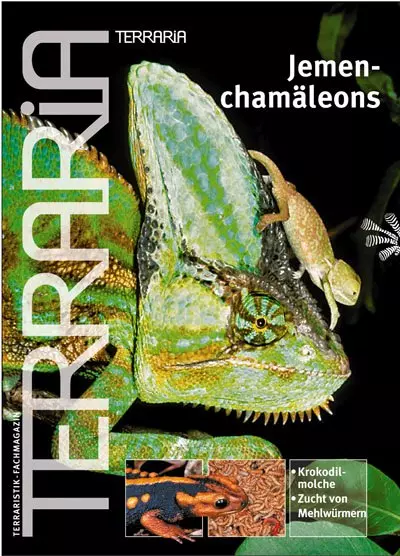
Terraria 08 - Yemen ChameleonsCrocodile newtsBreeding of mealwormsContents:2 EditorialHeiko WERNING TOPIC4 Chamaeleo calyptratus – a creature unknown!Nicolá LUTZMANN12 10 years of keeping and breeding Yemen chameleonsDavid HELLENDRUNG20 Hidden invadersBill LOVE24 Construction of a free room enclosure for keeping Yemen and panther chameleonsAndreas DICKHOFF & Tanja DICKHOFFSCIENCE35 Herpetorama External parasites in the king python / The closest relatives of snakes37 New species Naja ashei / Micrurus silviae & M. altirostris / Atractus40-43 Among researchers Of iguana islands and rainforests: Biodiversity research in HondurasAlexander GUTSCHE44 Keeping, Care and Breeding of the Mealworm Beetle (Tenebrio molitor) Peter Maria MÜLLER48 The Yellow Crocodile Newt, Tylototriton shanjing: Taxonomy, Care and BreedingWolf-Rüdiger GROSSE54 North American soft-shelled turtles of the genus ApalonePart 2: The Apalone speciesAndreas S. HENNIG62 Centruroides limbatus Daniel GAISER66 Experiences with keeping and breeding the forest tortoise Part 2 Read NIESSEN TRAVEL70 In the mountain rainforests of Mount Kinabalu/BorneoPart 3Rudolf MALKMUS TERRARIUM PRACTICE83 Test run Measurement and control technology from Lucky Reptile84 Prelude A good start: the Transpecos rat snake (Bogertophis subocularis)Michaela SCHULZ & Marco SCHULZ88 Eye-catcherThe snake cupboard - a visit to garter snake breeder Jörn FischbeckMike ZAWADZKI92 Also in your neighbourhood 95 TERRAnetGarter snake pages96 TERRAglobal With pleated skirt and high heels into the rainforestJoachim BULIANPerils of a herpetologist, part IIManuel ACEVEDO104 TERRAwinn
Reptilia 36 - Expedition West Africa
Mangrove night tree snakeOrnate tortoisesTokeh
Contents:
2 EDITORIAL
4 READER LETTERS
6 MAGAZINE
12 DATES
16 PHOTO REPORTAGE Expedition West Africa by H. Nickel
24 TRAVEL Through the desert – The West Africa expedition of the Museum Alexander Koenig
by H. Nickel
32 HERPETOFAUNA Spur-thighed tortoises in Mauritania by H. Nickel and D. ould Selah
38 REPORTAGE Crocodiles of the desert by H. Nickel and T. Shine
43 KEEPING AND BREEDING Tokehs in the terrarium: Better than their reputation by I. Kober
51 PORTRAIT AND POSTER Pristidactylus torquatus by H. Werning
56 KEEPING AND BREEDING Breeding and rearing the mangrove night tree snake Boiga dendrophila melanota by J. Bulian
63 REPORTAGE The school vivarium Part 1: General basics by M. Hallmen
69 REPORTAGE New anaconda species discovered! by H. Werning
73 REPORTAGE On some misidentifications of dwarf clawed frogs of the genus Hymenochirus in the literature by K. Kunz
82 ADVICE & ACTION SPECIAL Frequently asked questions about keeping ornamental and ornate tortoises by A. S. Hennig
86 CLASSIFIED ADS
90 LIBRARY
94 WESTERN HERP PERSPECTIVES Watch out! Poisonous snakes by B. Love
104 GLOSSES Exposed! (Part 2) by H. Werning
Reptilia 01 - CrocodilesBearded dragonsFire SalamandersBaja californiaGAUDÍ and herpetologyContents:2 - Editorial6 - Magazine14 - Keeping and breeding: Bearded crocodiles, by J. Bergadá and J. Pether23 - Travelogue: Crocodiles in Ghana, by S. Zwernemann26 - Report: Hamburger made from crocodile meat, by M. Schmidt29 - Terraristics: Keeping guidelines for crocodiles30 - Pros and cons: keeping crocodiles33 - Travelogue: Baja California, by H. Werning39 - Portrait and poster: Hyla meridionalis, by M. Aresté and J. L. Farriols43 - Terraristics: Sexing of snakes, by Dr M. Bachs46 - Keeping and reproduction: Acrantophis dummeriliby W. Wengler49 - Herpetofauna, Fire Salamanders, by X. Rivera and A. de Saint Paul58 - Herpetology and culture: Gaudí and herpetology, by E. Filella64 - Veterinary medicine - Shell necrosis in turtles, by C. Lopez del Castillo71 - Report: Species conservation in the jungle of French Guiana, by S. Alviani73 - Library77 - Advice and action80 - Incubator: Glossary by H. Werning