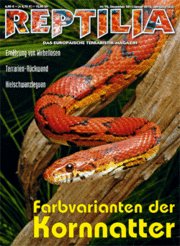
Reptilia 92 - Color variations of the corn snake

Article no: reptilia92

CHF 12.00

Stock: 0

Ready for dispatch in 1-3 days, delivery time 7 working days

Delivery between Tuesday, 28 April and Wednesday, 29 April
Zahlungsarten
Product information "Reptilia 92 - Color variations of the corn snake"

Reptilia 92 - Color variations of the corn snake

Ernährung von Wirbellosen
Terrarien - Rückwand
Kielschwanzleguan

Inhalt:

Inhalt
Immer neue, immer spektakulärere Farb- und
Zeichnungsformen der Kornnatter drängen ins Hobby. Wie bei kaum einer anderen Art haben die Züchter bei dieser Schlange ihre Kunst auf die Spitze getrieben aus dem Klassiker der Terraristik wurde so auch ein topmodernes Terrarientier. REPTILIA-Kolumnist Bill Love und seine Frau Kathy, selbst langjährig erfahrene Züchter, bieten Ihnen in mehreren prächtig bebilderten Artikeln einen Überblick über die Entwicklung der Farbzuchten und die aktuell erhältlichen Varianten, über das für die gezielte Zucht notwendige Know-how, und last but not least berichten sie aus ihrer persönlichen Erfahrung über eine ganz spezielle Morphe, die sie als Erste überhaupt erzielten.


EDITORIAL

MAGAZIN
TERMINE
WESTERN HERP PERSPECTIVES
Regelungs-Rage Von B. Love

FOTOSTORY
Den Guppys auf der Spur 50 Jahre Zucht der Kornnatter, Pantherophis guttatus
Von K. & B. Love

Haltung und Nachzucht Kornnattern vermehren Ein Rezept für Jedermann

Von K. & B. Love

HALTUNG UND NACHZUCHT
Okeetee Rising Mein Vierteljahrhundert in der Welt der Kornnattern
Von K. Love

Reise
Überleben im Sand
Eine Exkursion in die peruanische Wüste
Von G. Chavez & A. P. Mendoza

PORTRÄT und Poster
Triturus carnifex

Von B. Trapp

Herpetofauna
Auf dem Weg ins All Die Welt der Buchstaben-Schmuckschildkröte, Trachemys scriptaTeil 2
Von A. S. Hennig

Haltung und Vermehrung
Haltung und Vermehrung des Halsband-Kielschwanzleguans, Tropidurus torquatus

Von J. Luttermann

TERRARIENPRAXIS
Selbstbau der perkeften Terrarienrückwand – ein missglückter Versuch

Von L. Pfetzing & J. Egerer

ERNÄHRUNG
Hochwertige Ernährung wirbelloser Futtertiere und Terrarienbewohner – Teil 2

Von R. Lautensack & R. Hübers

Tiere unserer Heimat
Ein schützenswertes Reptil – die Kreuzotter

Von R. Leptien

Bibliothek
BRUTKASTEN
Mit den Fleisch der Feinde

Gastgeschichte von U. Hannemann


Composition
Feeding recommendation
Technical details
Size information

0 of 0 reviews

Give us a rating!

Share your experience with the product with other customers.


Suggested products

Handbook of food plants for tortoises and other reptiles
Handbook of forage plants 2nd revised editionMarion Minch is not only a successful breeder of diverse tortoises for many years, but also an excellent connoisseur of native wild herbs. She founded and runs samenkiste.de, which is well known to many tortoise keepers and nature lovers. Her name is inextricably linked with reptile care and species-appropriate nutrition for tortoises. Her handbook of food plants summarises the most important native food plants for herbivorous and omnivorous reptiles. She not only considers tortoises, but also iguanas, spiny-tailed dragons and even chameleons. From the basics of plant biology to native wild herbs to suitable food plants for hardy tropical reptile species, this comprehensive work provides the basis for species-appropriate keeping. In the expanded and supplemented 2nd edition, the plant section is divided according to flower colour. This makes it even easier to identify wild herbs. The work has also been supplemented with a wealth of additional information and many pictures.

CHF 46.50

Geckos
Geckos in the terrarium by Astrid FalkThe book offers a comprehensive introduction to geckos and their species-appropriate keeping in terrariums. It explains what you need to think about before buying a gecko and what preparations should be made. The book describes in detail how the terrarium is technically equipped and set up. The care of the animals, their special features and behaviour, their diet, reproduction and rearing of young animals are described, as well as diseases and husbandry problems with tried and tested suggestions for prevention and treatment. Individual gecko species that are particularly suitable for keeping and breeding in terrariums are portrayed in detail in the second part of the book.

CHF 28.50

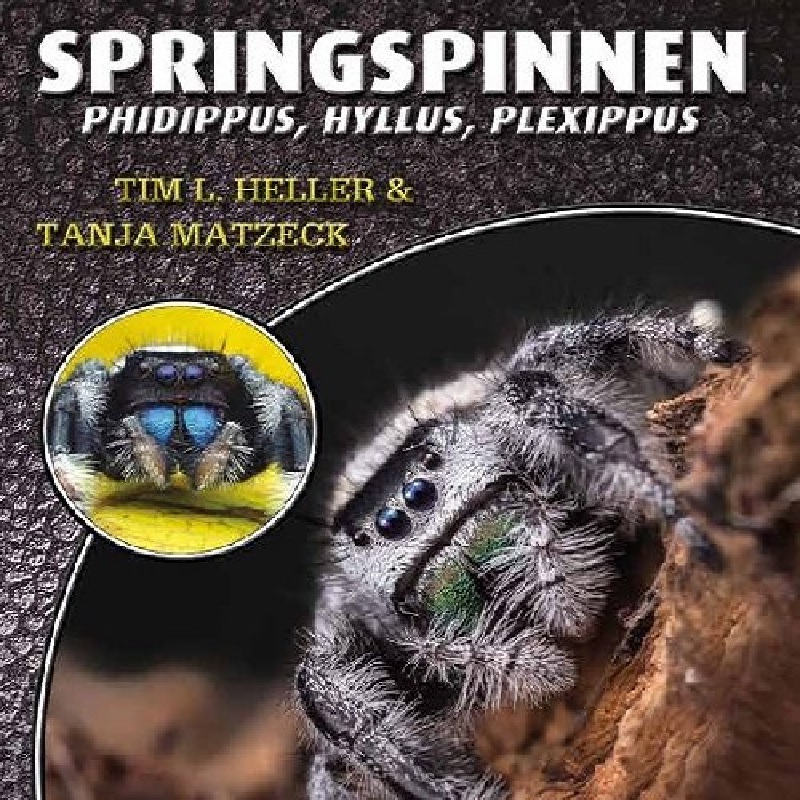
Jumping spiders Phidippus, Hyllus, Plexippus
Book Jumping Spiders - Phidippus, Hyllus & Plexippus A guide to keeping jumping spiders of the genera Phidippus, Hyllus & Plexippus. Who can resist the charm of jumping spiders? The childlike appearance of their expressive face simply leaves no one cold! In addition, their behavior is extremely exciting to observe, their colors are bright and their requirements for species-appropriate keeping are very easy to meet. No wonder these likeable jumpers are all the rage! This volume in the "Species by Species" series describes in detail what to look out for when buying and keeping them, introduces the most commonly kept species and color forms and provides plenty of tips on how to keep them successfully - so you can be sure they will breed well! Species by Species introduces you to the books in this series, which present the most popular terrarium animals. Each volume offers you detailed, practical care instructions and all the information you need to successfully breed your animals. All important questions from the required tank size to terrarium set-up, technical equipment, species-appropriate nutrition and disease prevention are answered with numerous tricks and tips. Experienced, long-standing breeders reveal how you can encourage the animals to reproduce and raise healthy young. All this in full color, generously illustrated and attractively designed - just about your terrarium animal - species by species

CHF 23.90

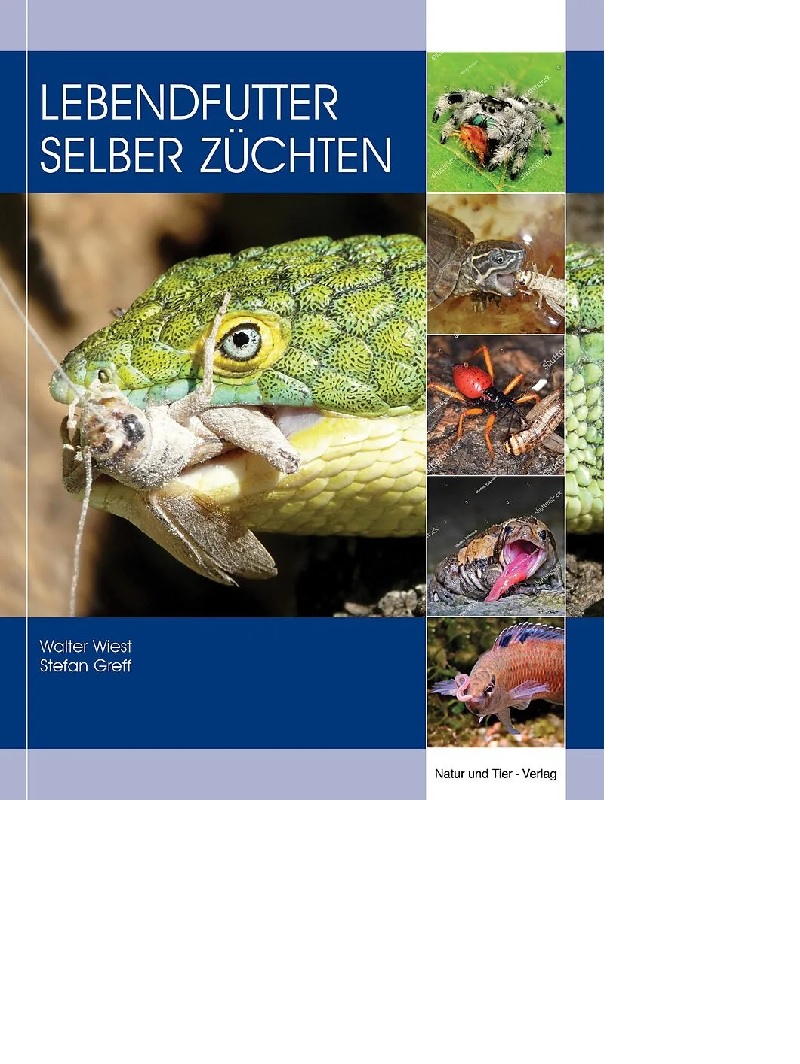
Book Breeding live food yourself
Book "Grow your own live food" - The perfect guide for pet owners Discover practical and detailed instructions on how you can easily breed food for your reptiles, birds, fish or other animals yourself in the book "Breeding live food yourself". With valuable tips on various food insects, their care and breeding, you can save money and ensure a species-appropriate diet for your pets. Contents of the book: Step-by-step instructions for breeding feeder insects Information on the best types of food for reptiles, birds and fish Care instructions and breeding conditions for various live food species Tips for sustainable and cost-effective food production Why breed your own live food? Get healthy, fresh food for your animals Save money and reduce dependence on pet shops Promote the health and well-being of your animals with species-appropriate food Whether you are a beginner or an experienced pet owner, this book provides you with everything you need to successfully breed live food yourself.

CHF 46.50

Marginata 69 - New Guinea tortoises
Marginata 69 - New Guinea tortoises – the genus ElseyaCover storyThe unrecognised beauties: New Guinea tortoises (Andreas S. Hennig)My experiences with Branderhorst's New Guinea tortoise, Elseya (Elseya) branderhorsti (Ouwens, 1914) (Andreas S. Hennig)Keeping and breeding of Rhodin's New Guinea tortoise, Elseya (Hanwarachelys) rhodini Thomson, Amepou, Anamiato & Georges, 2015 (Andreas S. Hennig)PortraitGeoemyda spengleri, Chinese serrated tortoise (Andreas S. Hennig)ReportageMacrochelys temminckii – Experiences and impressions with vulture tortoises part 2 (Reiner Praschag)KeepingAn alternative to year-round keeping of the Egyptian tortoise in the terrarium – my experiences with seasonal outdoor keeping of Testudo kleinmanni (Ricarda Schramm)EtymologySawbacks and living maps part 4: Graptemys gibbonsi, Pascagoula humpback tortoise (Holger Vetter)Classifieds & animal placement

CHF 16.50

Draco 58 - Chameleons
Draco 58 - Chameleons EditorialChameleons in the terrariumManfred RognerThe physiological colour change in chameleonsTobias MachtsChameleons in Burundi and first data on biology from terrarium keepingNicolá Lutzmann, Benoit Nzigidahera, Max Dehling,Eberhard Fischer, Onesphore Masabo, David Hellendrung,Uli Wagner, Walter Herwig, Armin Hummel,Ralph Lademann, Dominik & Natascha RochnaIn search of the Togo chameleonRolf Leptien Where the European chameleon lives up to its nameHans-Jürgen Luef In search of Malta's chameleonsRolf Leptien Now a terrarium classic: the Yemen chameleon, Chamaeleo calyptratusManfred Rogner

CHF 32.00

Reptilia 49 - Food animal breeding
Reptilia 49 - Food animal breedingScorpion crust lizardSpotted pythonChinese mountain dragonContents: 2 EDITORIAL 4 READER LETTERS 5 MAGAZINE 14 DATES 18 WESTERN HERP PERSPECTIVESHurricane Sale in Floridaby B. Love 20 PHOTO REPORTAGE Breeding food animals yourself - a problem?by F. Bruse & H. Werning 27 REPORTAGEEfficient and productive cricket breeding by F. Bruse 33 REPORTAGEBreeding the chocolate cockroach (Shellfordella tartara) by F. Bruse 36 REPORTAGEA simple Drosophila breeding project by F. Bruse 40 HERPETOFAUNANotes on the Motagua lizard (Cnemidophorus motaguae) by U. Schlüter 43 TRAVELHerpetological observations and more from Gambia by U. Thieme 51 PORTRAIT AND POSTERGeoclemys hamiltoniby H. - D. Philippen 56 KEEPING AND BREEDINGKeeping and Breeding the Chinese Mountain Agame (Japalura splendida) by H. Schradin 68 HERPETOFAUNADendrobates pumilioThe strawberry frog on the Bocas Islands by B. Schwarz 72 KEEPING AND BREEDING The black Mexican chain snake (Lampropeltis getula nigrita in the terrariumby M. Thums 79 REPORTAGEAntaresia maculosa (PETERS, 1873)Spotted pythonby D. Hasselberg 85 CLASSIFIED ADS 90 RAT & TAT 93 LIBRARY 104 GLOSSESIn search of Uracentron azureumPart 1by H. Werning

CHF 11.20

Reptilia 43 - Australian monitor lizards
Reptilia 43 - Australian monitor lizards Dendrobates claudiaeBrown snakesKruger Park Contents: 2 EDITORIAL 4 READER LETTERS 6 MAGAZINE 12 DATES 16 WESTERN HERP PERSPECTIVESImprove your reptile photos – it's easyby B. Love 18 PHOTO REPORTAGE Australian monitor lizardsby D. F. Bennet 26 HERPETOFAUNAThe Varanus-gouldii-complex by D. F. Bennet 29 HERPETOFAUNAThe monitor lizards of the Australian desert by E. R. Pianka 36 KEEPING AND BREEDINGKeeping and continuous breeding of King’s rock monitor, Varanus kingorum STORR, 1980), including the first breeding of an albino juvenile. by B. Eidenmüllser 41 KEEPING AND BREEDINGVaranus glauerti – the “Scaly Jewel” by F. Izaber 41 KEEPING AND BREEDINGStoreria dekayi – the Northern brown snake by M. Held 47 TRAVELIn Kruger National Park – not because of the big onesby W. Rohdich 51 PORTRAIT AND POSTERBungarus f. flavicepsby A. Gumprecht 56 REPORTAGETurtle Island Part 1: Personal experiences with the sea turtles of Barbadosby M. Hallmen 62 REPORTAGEExperiences and difficulties in caring for and “breeding” the common agama (Agama agamaby J. Rauh and T. Gaubies 68 REPORTAGEMale or female? ROPS e. V. – First results of the research work of the years 1999–2003by B. Röll and F. W. Henkel 29 HERPETOFAUNADendrobates claudiae & Phyllobates lugubris – two poison dart frogs from Panama in the same outfit by T. Ostrowski 76 HERPETOLOGY AND CULTUREDead animals in Tunisia – On the souvenir trade in North Africaby K. Kunz 85 CLASSIFIED ADS 90 RAT & TAT 93 LIBRARY 104 GLOSSBiblical plague on the ICEby H. Werning

CHF 11.20

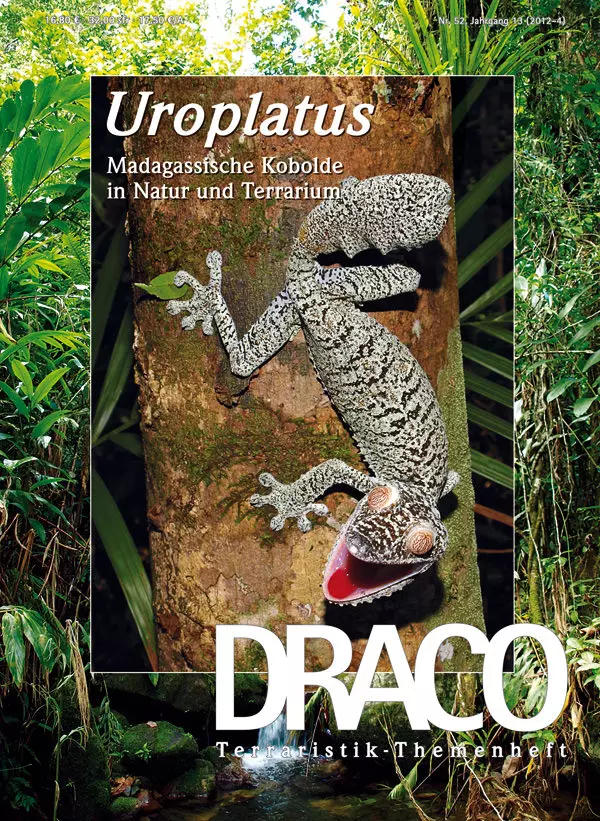
Draco 52 - Uroplatus Madagascan goblins in nature and terrarium
Draco 52 Magazine Uroplatus Madagascan Goblins in Nature & Terrarium Contents: EditorialSoul-stealers with adhesive lamellae – Madagascan flat-tailed geckos of the genus UroplatusPhilip-Sebastian GehringIn search of flat-tailed geckos in MadagascarPhilip-Sebastian Gehring & Patrick SchöneckerBiology, husbandry and long-term breeding of Uroplatus guentheri Mocquard, 1980 up to the fourth filial generationPatrick Schönecker A ghost in the terrarium – the successful keeping and breeding of Uroplatus phantasticus (Boulenger, 1888)Kai-Uwe Volta & Philipp Höhne Experiences in the keeping and breeding of the lichen flat-tailed gecko (Uroplatus sikorae Boettger, 1913)Philip-Sebastian Gehring Natural treasures of Madagascar: Flat-tailed geckos and their protectionFanomezana Ratsoavina and Philip-Sebastian Gehring Experiences with keeping flat-tailed geckos (Uroplatus fimbriatus) in the Masoala rainforest at Zurich Zoo, SwitzerlandSamuel Furrer

CHF 32.00

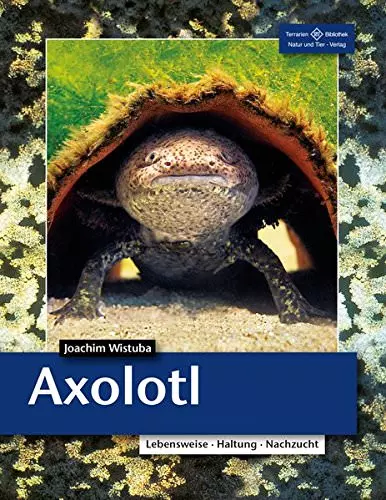
NTV, Axolotl
A book about the salamanders that always remain in the larval stage - the axolotl NTV publishing house Jochaim Wistuba 100 pages Axolotls are widely known as the salamanders that can reproduce in the larval stage. However, it is not only this biological peculiarity and their bizarre appearance that make them popular pets, they are also excellent to keep and breed in the indoor aquarium. The author goes into detail about the origin, keeping, reproduction and diseases of the axolotl and also explains the biology of these fascinating "water monsters". Naturally, all colour varieties and hybrid forms are presented.

CHF 34.90

NTV - The oriental firebelly toad
The oriental firebelly toad by Manfred Rogner 64 Seiten 14,8 x 21 cm zahlreiche Farbfotos Inhalt: Wenn man einem Einsteiger eine attraktive, interessante und dazu auch noch leicht haltbare Amphibienart empfehlen wollte, stünde die Chinesische Rotbauchunke mit Sicherheit ganz oben auf der Liste. Darum ist diese bunte, muntere Art seit langem zu Recht äußerst beliebt. Der erfahrene Terrarianer Manfred Rogner hält und züchtet seit Jahren Chinesische Rotbauchunken und kennt sich mit diesen Tieren bestens aus. Darum kann er Ihnen in diesem Buch fachkundig, aber leicht nachvollziehbar alle wichtigen Aspekte der Pflege dieser ganz besonderen Amphibien vermitteln und Ihnen auch Insider-Tipps an die Hand geben, wie Sie Ihre Unken zur Vermehrung bringen und die Kaulquappen sowie die Jungunken aufziehen können. Systematik und Körperbau Die faszinierende Biologie: Aus dem Leben der Chinesischen Rotbauchunke Alle Informationen zur artgerechten Haltung: Vom geeigneten Terrarium über Einrichtung und Technik bis hin zur Fütterung Erfolgreich nachzüchten: Paarungsstimulation, Aufzucht der Kaulquappen und der jungen Unken Problemlösungen: Wie man die häufigsten Fehler bei der Pflege vermeidet, und wie man kranken Tieren helfen kann Brillante Fotos

CHF 14.90

Draco 03 - Poison Arrow Frogs
Draco 03 - Poison dart frogs Contents: 2 Editorial 4 Poison dart frogs - An introduction to biology, systematics and distribution, by S. Lötters 16 Brood care in poison dart frogs, by A. Quiguango-Ubillus 24 Reproductive behaviour in poison dart frogs, by K.-H. Jungfer 29 The poison dart frogs of Bolivia and their distribution, by S. Lötters and S. Reichle 32 Poison dart frogs in the terrarium, by M. Schmidt 50 Building an artificial waterfall from polystyrene, by D. Löhmann 58 The Web-climbing Tree Frog - A small jewel from the rainforest, by H. Divossen 62 Keeping and breeding Dendrobates histrionicus, by E. Schoop 70 Colourful encounters in the Choco, by J. Stelder 73 Infectious diseases - a constant threat to dendrobatid keeping? by M. Mutschmann 83 Book box 89 Magazine

CHF 14.90

Customers also saw

%
Aviary Santiago black
Santiago black aviary Aviary is black without accessories. Dimensions: 100x76x182cm0.70m2 / 1.10m3Ideal for birds such as canaries, budgerigars or cockatiels.  This aviary is suitable for: 2-10 finches 2-6 canaries 2-6 budgerigars 2-4 lovebirds 2 large parakeets up to cockatiel size Swiss animal welfare legislation contains legal provisions governing the appropriate keeping of and handling of birds. The following regulations apply to all bird species: Social species must be kept socially (no individual housing) The enclosures must comply with the minimum dimensions = minimum requirements All birds must be offered a bathing opportunity The enclosures must be structured with various, springy perching options of different thicknesses and orientations, with one third of the volume remaining free of structures All birds must be provided with suitable sand for consumption The private keeping of certain bird species is subject to authorisation (wild animal keeping authorisation) The keeping of parrots on stands and the keeping of song canaries in Harz breeders is prohibited The use of sand sleeves as a covering for perches is prohibited for finches: minimum enclosure area for 4 birds: 0.24 m2 (e.g. 60 cm x 40 cm) minimum height 50 cm for parrots: minimum enclosure area for 4 small parakeets and lovebirds 0.24 m2 (e.g. 60 cm x 40 cm), minimum height 50 cm minimum enclosure area for 6 medium-sized parakeets up to cockatiel size 0.5 m2 (e.g. 100 cm x 50 cm), minimum height 60 cm

CHF 475.00 CHF 495.00 (4.04% saved)