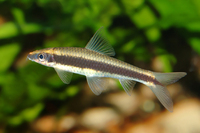
Siamese trunk barb

Crossocheilus siamensis

available for sale


Profile

The Siamese barb is a group fish and should ideally be kept in groups of at least 5-6 animals. Keeping them alone leads to stress.

Family

Carp fish (Cyprinidae)

Home country

Thailand, Laos, Cambodia, Malaysia

Synonyms

SAE (Siamese Algae Eater), Siamese Flying Fox (colloquial, often for confusion with similar species), true Siamese trunk barb: Crossocheilus siamensis or Crossocheilus oblongus

First introduction

Common in the aquarium hobby since the 1960s/70s.

Size

Up to 14-16 cm

Sexual differences

Very difficult to recognise. Females often somewhat stronger and rounder. Males slimmer. No clear sexual dimorphism.

Diet

Omnivorous with a focus on plant food Algae (including brush algae!) Flake and granulated food Vegetables (courgette, spinach, cucumber) Frozen food such as Artemia or Cyclops Important: Do not confuse with pure carnivores - they need plant matter!

Temperature

23-28 °C

Tank size

At least 200 litres - strong swimmers!

Water values

pH: 6.0-7.5 / GH: 5-15 °dGH

Product information "Siamese trunk barb"

Profile of the Siamese trunk barb


Area of origin

Running waters and weedy river sections in Southeast Asia. Clear, oxygen-rich water with a moderate current.

Species

There are several similar species within the genus Crossocheilus, which are often confused: The species frequently offered in the pet trade include

  • Crossocheilus siamensis / oblongus (true Siamese trunk barb)
  • Crossocheilus langei (often confused, but less effective against algae)
  • Gyrinocheilus aymonieri (Chinese algae eater - NOT to be confused!)

The real SAE can be recognised by: a continuous black stripe up to the caudal fin Transparent fins without dark areas small barbels

Social behaviour

Peaceful, active and social. Less shy in groups. More territorial towards conspecifics when older. Ideal for community tanks with other robust fish. Eager to jump → cover required

Keeping conditions

Plenty of swimming space. Light to medium current. Lots of plants and roots. Very good oxygen supply. Cover important. Stable water conditions. Excellent for controlling algae, especially filamentous and brush algae

Breeding

Extremely rare in the aquarium. Presumably free spawners. Spawning behaviour hardly documented in captivity. Mostly bred commercially by hormone stimulation. Natural breeding in the hobby is considered almost impossible.

Special features

One of the few species that eat brush algae. Very industrious algae eaters. Frequent mix-ups in the trade → look out for characteristics. Slightly less algae-eating with age, but still beautiful behaviour. Does not tolerate high nitrate and dirt levels

Conclusion

The Siamese barb is an extremely useful, peaceful and lively aquarium inhabitant. As an excellent algae eater - especially of stubborn brush algae - it is ideal for larger community aquariums. With good care, plenty of space and group keeping, it remains active, robust and a valuable helper in the tank.


If you have any questions or problems, our trained team at Zoo Roco is here to help. They can provide expert advice on all matters.

Composition
Feeding recommendation
Technical details
Size information

0 of 0 reviews

Give us a rating!

Share your experience with the product with other customers.


Suggested products

Eubranchipus grubii
Fairy shrimps (spring gillfoot) Fairy shrimps (spring gillfoot) are very common. Fairy shrimps are gilled crustaceans that have been found on our planet since prehistoric times in salt lakes, drying waters or polar waters.Only animals from Asia or America that live in a water temperature of 20-30°C are suitable for keeping in an aquarium. These species (Branchinella thailandensis and Dendrocephalus brasiliensis) live in waters that regularly dry out and are only filled with rainwater. The water is therefore very soft. Appearance The animals have 11 pairs of leaf feet. These leaf-shaped limbs serve not only for locomotion but also for breathing – which has led to the term "gilled-foot crustacean". There are sometimes minor differences in colour. They are found in colours ranging from orange to reddish-brown and may have greenish to bluish hues at the joints and at the boundaries of the segments.Both sexes have two short thread-like antennae. However, another pair of antennae differ in both shape and according to sex. Males have lobe-shaped appendages that can be curled up. Adult females are mainly distinguished by the ventrally located brood sacs, which are filled with eggs, and the ends of the female's tail are translucently light. Systematics Phylum: Arthropoda / ArthropodsSubphylum: Crustacea / CrustaceansClass: Anostraca – Gill-feetFamily: BranchipodidaeGenus: Branchipus / Eubranchipus /Tanymastix etc. Care Depending on the species, fairy shrimps live for 6-12 weeks and the size of adult animals varies from 1-3cm.Can Triops and fairy shrimps be kept together?yes, they can Aquarium size: Initially, a Faunarium box size 230 x 155 x 170 mm is quite sufficient From a body length of 1.5cm, they can be gradually accustomed to larger tanks Basic lighting: Sunlight or aquarium lighting is sufficientAeration: An air pump with a stone and very little air flow is sufficient for keepingSetup:Only water and breeding substrate in the breeding/starting container. A little fine aquarium sand can be used as substrate (but this is not absolutely necessary)Decorations can be used, but are only for our eyes and not of importance to the fairy shrimps.Fairy shrimps are free-swimmers – so they need enough free swimming space in the breeding container.If the animals swim around freely, you can also add a little aquarium moss to the water. To ensure the water is soft, it is best to use 2/3 distilled water and 1/3 mineral water (non-carbonated).Water temperature: Fluctuations in temperature of +/- 5° C are not dramatic.The ideal breeding temperature is 26°.Start:The larvae only hatch when they are completely surrounded by water. Therefore, place the eggs on adhesive tape and then put this in the water – so the eggs are not washed to the edge and always remain in contact with water.After 1-3 days the larvae hatch. The larvae grow quickly and can reach sexual maturity after up to 40 moults in one to two weeks. The males hold the females with their jaw pincers shortly before and also during mating. After mating, the eggs develop in the egg sacs on the females’ abdomens. They fall to the bottom of the water and can survive for several years of prolonged drought in the substrate.When the fairy shrimps have died, the water can be drained off and the substrate with the eggs left completely dry. The larvae can only hatch again if the eggs were completely dry.Once this is dried out, a new batch can be started.If no substrate is used, you can also siphon off the eggs with a thin hose. Let the water containing the eggs run through a fine net or a coffee filter – this way you can collect the eggs.Important: The animals do not tolerate large water changes. If fairy shrimps are to be moved to a larger home, it is best to place the animals together with the breeding water into the new home or tank and slowly fill up the container with conditioned tap water. Feeding The larvae are fed from the 3rd day after hatching.The larvae can be fed with algae powder or JBL Artemio fluid. For all animal husbandry: Children must be guided, supervised and monitored by their parents. Children must learn that an animal has its own needs and habits and they must respect this. Parents should be aware that they are responsible for the animal. For questions and problems our trained team at Zoo Roco is at your disposal. They can advise you professionally on all matters.
 
Siamese fighting fish
The Siamese fighting fish (Betta splendens) Area of origin: The Siamese fighting fish is a world-famous aquarium inhabitant, originally from Thailand, or more precisely from Southeast Asia. Habitat: Fighting fish live in small warm puddles, ponds, lakes, in rice fields as well as floodplains and lagoons.The fighting fish use the dense vegetation to protect themselves from predators. Care: The fighting fish aquarium has a volume of 20 to 25 litres and therefore falls into the category of nano aquariums.When choosing a tank, you should also make sure that the height does not exceed 40 cm, as the fighting fish does not have the strength to swim very high to get air.As fighting fish are very calm and slow animals, it is not advisable to install a strong-flowing pump. Fighting fish need little to no current. Some of today's cultivated forms have fins so large that the fighting fish cannot swim for long at a time as they quickly become exhausted.The male fighting fish must be kept individually, as the name suggests: they fight, and that to the death. The females, on the other hand, can be kept in groups. Breeding fighting fish, in turn, is more difficult, as even there quarrels can occur.Fighting fish should be fed as variedly as possible. It is advisable to offer live and frozen food from time to time, such as mosquito larvae, water fleas and artemia. They occupy a territory, which they regularly swim around. If the territory is too large, a fighting fish does not feel comfortable as it quickly loses track. It is not advisable to keep them with other fish, as fighting fish feel stressed or receive too little food. They are best kept with snails. Fighting fish like tanks that are heavily planted, as this offers hiding places and the fighting fish can also rest among the plants. It is important that not the whole water surface is covered with plants, as the fighting fish is a labyrinth fish and breathes air at the water surface. Food: The fighting fish are pure carnivores. Ornamental fish food with plant-based ingredients can make the fighting fish ill, so a flake food consisting only of meat is highly recommended. When feeding the fighting fish, the following applies: regularly, but in small quantities.
 
Red-eyed Moenkhausia
Red-eyed MoenkhausiaArea of originCommon in rivers, floodplains and slow-flowing areas of South America. Prefers clear, slightly acidic to neutral waters with plants and root areas.SpeciesThe genus Moenkhausia comprises over 60 species, many of which look very similar. The species frequently offered in the pet trade includeMoenkhausia sanctaefilomenae (red-eye tetra)Moenkhausia pittieri (diamond tetra)Moenkhausia costaeSocial behaviourVery peaceful Ideal for community tanks. Lively swimming behaviour, lots of movement. Forms loose shoals. Can occasionally nibble curiously at very long fins (e.g. gourami), but rarely aggressive.Keeping conditionsPlenty of free swimming space. Densely planted edge zones. Subdued light possible due to floating plants. Stable water values. Good filtration, moderate current. Cover recommended - bouncyBreedingPossible, but not easy. Free spawners. Eggs are scattered and sink to the bottom. Parents eat spawn → separate breeding tank required. Dark substrate prevents light damage to eggs. Feed fry with infusoria after hatching, later with Artemia naupliiSpecial featuresVery robust species → well suited for beginners. The characteristic "red eye" makes it unmistakable. Very active tetra that loves to swim. Perfect for larger community aquariums. Goes well with many peaceful fish species.ConclusionMoenkhausia sanctaefilomenae is a lively, attractive and very robust schooling fish that is ideal for community aquariums. With its striking red-eye colouring and its spirited but peaceful swimming behaviour, it brings life to the aquarium. It is easy to care for and therefore suitable for both beginners and experienced aquarists.If you have any questions or problems, our trained team at Zoo Roco is here to help. They can provide expert advice on all matters.
 
Blue Gourami
Herkunftsgebiet: Südostasien (Malaysia, Thailand, Burma, Vietnam), lnseln des indoaustralischen Archipels. Soziales Verhalten: Friedlich, allerdings fast langweilig mit zunehmendem Alter. Jungtiere sind sehr possierlich. Mehrere Männchen sollten nicht in einem Aquarium zusammen gehalten werden. Hälterungsbedingungen: Jede Art von Einrichtung. Die Vergesellschaftung mit sehr robusten Arten verdrängt diese Art in die Ecken. Ein Fisch, der fast nicht totzukriegen ist. Er wird allerdings sehr scheu, wenn er als ausgewachsener Fisch in ein anderes, fremdes Becken umgesetzt wird; pH 6 - 8,8; Härte 5 - 35° dGH. Zucht: Wasserspiegel absenken auf 15 cm. Es wird ein Schaumnest gebaut. Nach dem Ablaichen sollte das Weibchen entfernt werden, da das Männchen bösartig sein kann. Besonderheiten: Einer der härtesten Aquarienfische überhaupt. Frisst auch Planarien (Scheibenwürmer). Auf dem Foto rechts oben ist die Zuchtform T. trichopterus ,,cosby" (Marmorierter Fadenfisch) abgebildet, darunter die Normalfärbung. Eine gelb-rosa albinotische Farbform ist immer häufiger im Handel zu habenQuellennachweis: Mergus Atlas Band 1Für Fragen und Probleme steht Ihnen unser ausgebildetes Team im Zoo Roco zur Verfügung. Es kann Sie in allen Fragen fachgerecht beraten.
 
Forktail blue-eye
Herkunftsgebiet: Neuguinea: Küstenebene und anschliessendes inneres Tiefland zwischen Dyke Ackland Bay und Collingwood Bay an dem östlichen Ende von Neuguinea. Soziales Verhalten: Munterer, friedlicher Schwarmfisch Hälterungsbedingungen: Wie bei P. connieae angegeben. P. furcatus liebt dichte Bepflanzung der Becken. Zucht: Ähnelt stark der von P. connieae. Einzelheiten:ALLEN & CROSS (1982): Rainbowfishes of Australia and Papua New Guinea, T.F.H.-Verlag, beschreiben ein Zuchtbecken für die Pseudomugil-Arten folgendermassen: Ein Becken mit den Massen 40 x 25 x 25 cm reicht aus. Der Boden sollte mit einer dünnen Sandschicht bedeckt sein, einen Klumpen Javamoos und 2 oder 3 schwimmende Riccia-Polster sowie einen schwach arbeitenden Ausströmerstein enthalten. Man kann die Tiere sowohl paarweise als auch in Gruppen zur Zucht ansetzen. Ist das Männchen zu aggressiv, so gibt man 1 - 2 weitere Weibchen hinzu. Ein Ansatz im Schwarm bringt erheblich bessere Ergebnisse als paarweise Zucht. Die Tiere laichen gewöhnlich am Morgen ab. Die Eier haben Haftfäden und kleben an den Wasserpflanzen. Die Entwicklungszeit beträgt bei 25° C 15 - 20 Tage. Die Elterntiere werden herausgefangen (Laichräuber). Fütterung der Jungen mit Infusorien und Staubfutter. Besonderheiten: P. furcatus unterscheidet sich von P. connieae durch das Vorhandensein von gewöhnlich 8 - 9 (selten 7) segmentierten Strahlen in der zweiten Rücken-flosse (10 - 11, gelegentlich 9, selten 12 bei P. connieae) und durch je einen dorsalen und ventralen Rand in der Schwanzflosse. d von P. furcatus haben eine kräftig orangefarbene Brust, während sie bei P. connieae gelb ist.Quellennachweis: Mergus Atlas Band 2Für Fragen und Probleme steht Ihnen unser ausgebildetes Team im Zoo Roco zur Verfügung. Es kann Sie in allen Fragen fachgerecht beraten.
 
Swordtail
Swordtail profileArea of origin:Swordtails live in rivers, streams and slow-flowing waters in Central America. They often live in densely overgrown bank areas.Species:Mainly breeding forms of Xiphophorus helleri are offered in the pet trade. The species frequently offered in pet shops include (colour and fin variants)Red swordtailKoi swordtailTuxedo WagtailGreen swordtail (wild form)Highfin swordtailPineappleBlack MoscowMarigoldSocial behaviour:Swordtails are active and peaceful fish, but males can occasionally rival each other. In a well-structured aquarium, their behaviour is usually calm. They go well with many other peaceful species. Keeping conditions:A spacious, well-planted aquarium with free swimming space is important. Swordtails prefer harder water, a gentle current and regular water changes. A cover is also recommended - they can jump.Breeding:Swordtails are viviparous. Females give birth to 30-80 fry every 4-6 weeks. Fine plants are recommended as protection for the young, as the parents can eat their offspring. Breeding is very easy.Special features:Very robust and recommended species for beginners Males can "metamorphose" late - sometimes females develop a sword later Wide range of colours and varieties. Very reproductiveConclusion:The swordtail is an attractive, lively and uncomplicated aquarium fish that exhibits interesting social behaviour, especially in groups. Thanks to its robustness and easy breeding, it is ideal for community aquariums and also for beginners.If you have any questions or problems, our trained team at Zoo Roco is here to help. They can provide expert advice on all matters.
 
Black phantom tetra
Profile Black Phantom TetraArea of origin:The black phantom tetra lives in slow-flowing, densely vegetated waters in South America. The water is often soft, slightly acidic and shady due to plant growth.Species:The black phantom tetra offered in the trade is predominantly Hyphessobrycon megalopterus.Other "phantom" species are e.g:Red phantom tetra (Hyphessobrycon sweglesi)White phantom tetra (Megalamphodus megalopterus var.)The species frequently offered in pet shops includeBlack phantom tetra (standard form)Rarer:Longfin variantSocial behaviour:The black phantom tetra is peaceful and displays beautiful courtship and display behaviour within the school - the males in particular show off their large dorsal fins. It is ideal for community aquariums with other calm species.Keeping conditions:Well-planted aquarium with free swimming zones. Darkened areas (roots, floating plants) preferred. Gentle current. Stable water values and regular water changes. Dark substrate makes the colours appear stronger.Breeding:Free spawners - the eggs are scattered over plants or spawning substrates. Parents eat the spawn → breeding tank necessary. Soft, slightly acidic water promotes spawning success. Fry are very small and require infusoria/small food.Special features:Very peaceful and ideal for community tanks Males like to show off with fanned-out fins Colours look particularly intense in shady, darker aquariums Robust and well suited for beginners Conclusion:The black phantom tetra is an elegant, peaceful schooling fish that particularly comes into its own in well-planted aquariums with soft light. Its harmonious nature and beautiful contrasting colours make it an ideal inhabitant for many community aquariums.If you have any questions or problems, our trained team at Zoo Roco is here to help. They can provide expert advice on all matters.
 
Boesemans rainbowfish
Boesemans rainbowfishArea of origin:Boeseman's Rainbowfish inhabits clear, slightly alkaline lakes and tributaries of West Papua. The water is hard, rich in oxygen and often very clear.Species:The Boesemans Rainbowfish belongs to the genus Melanotaenia. Other known species (not identical, but closely related): The species frequently offered in the pet trade include:Melanotaenia boesemani (Boeseman)Melanotaenia praecox (neon rainbowfish)Melanotaenia lacustrisMelanotaenia herbertaxelrodiGlossolepis incisus (red rainbowfish)Social behaviour:Very peaceful Ideal for larger community tanks. Strong mating behaviour, especially in the morning. Show very dynamic swimming behaviour in the shoal. Pair-forming during courtship, but shoaling speciesKeeping conditions:Lots of free swimming space. Dense marginal planting Clear, stable water parameters. Strong filtration and good oxygen supply. A cover is recommended – rainbowfish like to jump. Good light intensity promotes colourfulnessBreedingRelatively simple Free spawners with daily egg-laying over fine-leaved plants or spawning mops. Eggs stick to plants. Parents should be separated after spawning. Fry require the finest powdered food/infusoria, later Artemia nauplii. Hard, slightly alkaline water promotes breeding success.Special featuresOne of the most colourful freshwater fish of all. Colours become more intense with age. Particularly active and keen swimmers. Very social species – keeping them alone leads to stress. Good water quality is crucial for health.Conclusion:Boeseman's rainbowfish are colourful, lively and robust schooling fish that really come into their own in larger aquariums. If you provide sufficient space, clear water and varied feeding, you will have an impressive, active and peaceful aquarium inhabitant.If you have any questions or problems, our trained team at Zoo Roco is here to help. They can provide expert advice on all matters.
 
Black Molly
Herkunftsgebiet: In zahlreichen Lokalformen vom nördlichsten Südamerika über das gesamte Mittelamerika der atlantischen Abdachung bis zum Süden Nordamerikas  Soziales Verhalten: Sehr friedlich, guter Algenfresser. Im Gesellschaftsaquarium nicht sehr ausdauernd, da Zuchtformen leicht kränkeln Hälterungsbedingungen: Die Zuchtform Black Molly ist wärmebedürftig (26 - 30°C); die Wildform verträgt Temperaturen ab 18° C. Becken mit schnellwüchsigen Pflanzen und viel Oberflächenbewuchs ausstatten. Verstecke bieten. Etwas Salzzugabe (0,1 %). pH-Wert 7,5 - 8,2; Härte 11 -3O°dGH. Zucht: Sehr vermehrungsfreudige Art. Von schwarzen Eltern kann man leicht gescheckte Junge bekommen. Zuchtformen: Leierschwanz, Mondmolly, Fahnenmolly.Tragzeit: 30-40 Tage Besonderheiten: Black Mollies werden nicht sehr alt, die Zuchtformen meist nicht mehr als drei Jahre. Die starke Variationsbreite dieser Art hat zu der grossen Zahl der Synonyma geführt.Quellennachweis: Mergus Atlas Band 1Für Fragen und Probleme steht Ihnen unser ausgebildetes Team im Zoo Roco zur Verfügung. Es kann Sie in allen Fragen fachgerecht beraten.
 
Pearl gourami
Area of origin: Malaysia, Borneo and Sumatra; in rivers densely overgrown with plants Social behaviour: Very peaceful, but two males can often fight each other. Keeping conditions: Water level from approx. 30 cm, provide hiding places on the water surface (floating ferns). Do not keep with rowdy fish (e.g. cichlids), T. leeri then loses its magnificent colours and stands shyly in a corner, indeed, does not dare to eat. The room temperature should be above 20-22° C, otherwise the fish will catch a cold easily and become ill Breeding: Lower the water level to approx. 12 cm. A large foam nest is built between aquatic plants and is well guarded by the male after spawning. The male does not drive the female away as brusquely as other labyrinth fish species.Foam nest Special features: Very persistent, the hardiest of the labyrinthine fish next to the blue gourami. Lives for about 8 years. Source: Mergus Atlas Volume 1Our trained team is available to assist you with any questions or issues at Zoo Roco. They can provide you with expert advice on all matters.
 
Cayo Largo Screw
Herkunftsgebiet: Florida bis Brasilien, Bermuda (Fundort Cayo Largo/Kuba) und auf Jamaica (Blue River bis Frenchman's Cove) Die Schnecken sind auch ausserhalb des Wassers bis zu 0,5m im feuchten Uferbereich zu finden. Beschreibung: Die Schnecke ist in der Farbe und im Muster extrem variabel Besonderheiten: Fressen keine Pflanzen.Für Fragen und Probleme steht Ihnen unser ausgebildetes Team im Zoo Roco zur Verfügung. Es kann Sie in allen Fragen fachgerecht beraten.
 
Catfish
Herkunftsgebiet: Zuflüsse des Amazonas, schnellfliessende klare Bäche Soziales Verhalten: Friedliche Art, die für große Gesellschaftsaquarien geeignet ist Hälterungsbedingungen: Bevorzugt grosse, klare Becken, sauerstoffreich und mit grossen Wurzeln als dunkle Rastplätze ausgestattet. Hier, gegen das Licht geschützt, verbringen die Welse den größten Teil des Tages bewegungslos. Ein starker Filter oder Ausströmer sollen für Strömung und Sauerstoffanreicherung sorgen.   Zucht: Die Paarungsbereitschaft ist durch Färbung erkennbar. Männchen färbt sich dunkel mit weißen Punkten, Weibchen färbt Kopf graurot. Der Laichakt beginnt dann bald. Laicht in Höhlen von Wurzeln. Das Männchen betreibt Brutpflege und befächelt das Gelege. Zucht bei Wasserwerten von pH 6,7 - 7. Härte 4 - 10 Grad dGH. Eier sind senfkornähnlich in Gelegeballen. Junge schlüpfen nach ca. 5 Tagen und saugen sich sogleich an den Beckenscheiben fest. Nach etwa 14 Tagen verschwindet der große Dottersack und man muss mit grünem, feinstem Flockenfutter (MicroMin) füttern. Quellennachweis: Mergus Atlas Band 1   Für Fragen und Probleme steht Ihnen unser ausgebildetes Team im Zoo Roco zur Verfügung. Es kann Sie in allen Fragen fachgerecht beraten.
 

Customers also saw

Guppy
The guppy fish (guppies / guppies) Area of origin: Central America to Brazil, today mostly captive bred from Asia (Singapore). Social behaviour: Livebearers. Some parents chase their young immediately after birth. No brood care, otherwise very peaceful Keeping conditions: The persistent guppy can be kept in almost any aquarium. High-breeding guppies are sensitive. pH 5.5 - 8.5 (7.0); hardness 5 - 25 (15) dGH. Well-planted tank of any size if possible. Breeding: Surface plants such as floating ferns for random breeding. Targeted breeding only possible with spawning box. 20 - 40 young, males sexually mature at three months, females earlier. Stock insemination possible. Raise fry with Artemia, powdered food and powdered flake food. Standard forms: European guppy breeders currently recognise 12 different standards, which can be divided into three classes. The classes are the large-finned breeding forms (fantail, triangle-tail, veiltail and flag-tail), the swordtype class (double-sword, top-sword, bottom-sword and lyre-tail) and the short-tail class (spade-tail, spear-tail, round-tail and needle-tail). In addition, there is an almost infinite number of colours in the animals in each class and in each standard, which are usually judged separately at shows. Here are the individual standards: Fantail The tail fin has an elongated triangular shape with an angle of 45 degrees close to the body. Its ideal length is equal to the body length. The edges are straight, the transitions can be slightly rounded. The dorsal fin is pointed, rises steeply at the base and extends to the end of the first third of the caudal fin Triangle tail The tail fin has the shape of a triangle with an angle of 70 degrees close to the body. Its length is 80% of the body length. The edges are straight, the transitions can be slightly rounded. The dorsal fin rises steeply, is broad and extends bluntly to the end of the first third of the caudal fin. Veiltail The upper and lower edges of the caudal fin form curves which run in such a way that the greatest width of the fin is reached at 75% of its length. The rear edge is concave, the length is 80% of the body length and should not be less than 50%. The fin width is 3/4 of the length. The dorsal fin has a rounded end and extends to the end of the first third of the caudal fin. Bannertail The tail fin has the shape of a rectangle, the length of which is 8/10 of the body length. The fin width is 4/10 of the body length. The base of the fins is rounded. Minimum tail length 6/10 of the body length. Minimum width the largest body width. The dorsal fin extends to the end of the first third of the caudal fin and is pointed. Double sword The caudal fin has an oval basic shape with sword-shaped extension of the upper and lower fin rays. The length of the fins corresponds to the length of the body. The outer edges form an angle of 30 degrees. The part of the fins between the blades must not exceed 4/10 of the body length and can be colourless. Here too, the dorsal fin extends to the end of the first third of the caudal fin. The dorsal fin is slender, rises steeply at the base and is pointed at the end. Topsword The caudal fin has an oval basic shape with a sword-shaped extension of the upper fin rays. The length of the sword corresponds to the length of the body and runs at the upper edge at a 15 degree angle or parallel to the body axis. The basic oval shape must not exceed 4/10 of the body length and can be colourless. The dorsal fin is slender and extends, as usual, tapering to the end of the first third of the caudal fin. Bottom sword The caudal fin has an oval basic shape with a sword-shaped extension of the lower fin rays. The length of the sword corresponds to the body length and forms an angle of 15 degrees to the body axis at its lower edge. The basic oval shape must not exceed 4/10 of the body length and can be colourless. The dorsal fin is slender, rises steeply at the base and reaches out to where? To the end of the first third of the caudal fin, of course. Lyretail The caudal fin has approximately the shape of a lyre. The basic shape is round and must not exceed 4/10 of the body length. The outer fin rays reach 8/10 of the body length with the tips clearly bent outwards. The dorsal fin rises steeply and reaches the end of the first third of the caudal fin with an upwardly curved tip. Spade tail The shape of the tail fin resembles a miner's spade. The upper and lower fin borders, which stand out from the body with a clear projection, are parallel. Their length corresponds to half the body length, the height reaches 8/10 of the fin length. The dorsal fin extends pointedly from the base of the caudal fin to the end of the first third of the caudal fin. Speartail The shape of the tail fin resembles the tip of a spear. Its length is 8/10 of the body length, the height 6/10 of the fin length. The dorsal fin rises steeply and reaches the end of the first third of the caudal fin with an upward curved tip. Roundtail The caudal fin has a circular shape, the diameter is 5/10 of the body length The dorsal fin extends roundly to the base of the caudal fin. Needletail The tail fin has a circular shape, the length of which is 4/10 of the body length. The centre fin rays are elongated like needles. The total length of the fin corresponds to the body length. The dorsal fin is slender, rises steeply at the base and tapers to the end of the first third of the caudal fin. Special features: The guppy's ability to breed quickly, its variability in shape and colour and its endurance make it one of the most popular fish for beginners. Recently, the guppy has been reclassified as a member of the genus Lebistes. It is therefore correctly called Lebistes reticulatus again. Do not socialise guppies with fighting fish. The fins of the males are eaten by the fighting fish of both sexes.Source reference: Mergus Atlas Volume 1If you have any questions or problems, our trained team is at your disposal at Zoo Roco. They can provide you with expert advice on all questions.